Local News & Commentary Since 1890.

Posts Tagged ‘mental health’

Four Stars Is Enough

In Local News, Opinion, Uncategorized on May 3, 2026 at 11:35 am

Deer In Headlines
By Gery Deer
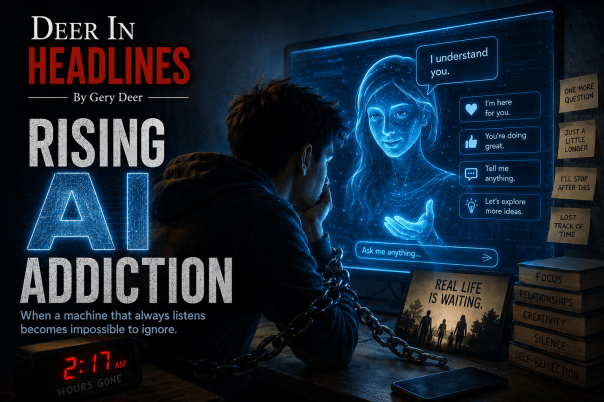
Modern society has developed a strange habit of seeking approval from people who often have no stake, no expertise, and no genuine interest in what they are judging. We have turned everyday life into a performance staged for an invisible audience armed with star ratings and comment boxes. The irony is that most of the people who hand out these ratings are just as unqualified as those receiving them, yet we treat their opinions as if they were carved into stone.

Somewhere along the way, we decided that five stars should be the goal, the standard, and the measure of a life well lived. But five stars is a fantasy. Real life is messy, inconsistent, and rarely perfect, no matter how carefully we curate it for public consumption. And yet, we chase that perfect rating as if it will unlock some hidden validation that finally tells us we are enough.

The truth is far less dramatic. You can earn five stars online and still feel empty the moment the notification fades. Nothing about your actual life changes because someone you will never meet clicked a rating on a screen. We have mistaken attention for value and validation for truth.

If you step back for a moment, it becomes clear how absurd it all is. Why are we letting strangers—whose only qualification is a profile picture and a scrolling thumb—decide how we feel about ourselves? The answer is uncomfortable: because we have built systems that reward approval over authenticity. And once approval becomes the currency, we stop asking whether it is worth anything.

Perhaps the healthier standard is not perfection, but sufficiency. A four-star life acknowledges effort, imperfection, growth, and honesty without demanding applause from people who do not know the work behind the scenes. In the end, maybe four stars is not a compromise, but a liberation—a reminder that our worth is not determined by strangers tapping glass. It is determined by how we show up when no one is watching, by how we treat others in quiet moments, and by whether we can look at ourselves with honest acceptance.

The obsession with public approval has turned many lives into performances instead of experiences. We post instead of living, we curate instead of connecting, and we measure instead of finding meaning. There is a quiet relief in deciding that enough is enough—that not every moment needs applause, not every effort needs validation, and not every choice needs a rating.

Life becomes lighter when we stop outsourcing our self-worth to algorithms and anonymous judges. The most honest score we will ever receive is the one we give ourselves after reflection. And that score does not need to be perfect to be meaningful.

So instead of chasing five stars, maybe we should aim for something far more human: consistency, kindness, effort, and integrity. Those are harder to rate, but easier to live with. When we strip away the noise of online approval, we often find that what matters has been in front of us all along—a quiet life, well lived, not perfectly, but honestly.

That is the real measure, not stars or likes, but substance. And substance does not require applause to exist. If we can accept that truth, we free ourselves from an exhausting pursuit of approval that never truly satisfies, and we return to something steadier, more grounded, and far more real: a life measured not by strangers, but by our own honest standards.

In that space, four stars is not a downgrade, but clarity. Clarity that we are allowed to be imperfect and still be whole. The world will continue to rate everything it sees, but we do not have to participate in every judgment.

We can choose instead to live beyond the rating system and rediscover what it means to be enough without external confirmation. That choice is quiet, but powerful, and it begins when we finally stop asking strangers for permission to be ourselves.

We can live more freely when we decide that our value is not a public vote, but a private truth built from daily actions, intentions, and quiet integrity—beyond the screen and beyond the noise of judgment itself.

What Grounds You?

In Local News, Opinion, Uncategorized on May 3, 2026 at 11:27 am

Deer In Headlines
By Gery Deer

In a world that never stops talking, the hardest thing to do is listen for silence. We scroll, swipe, click, and chase, convinced the next notification might carry something essential. Most of the time, it doesn’t. It just adds another layer of noise to an already crowded headspace, another reason to forget where we are standing and who we were before the noise found us.

That is why the question matters: what grounds you? Not in some abstract, self-help sense, but in the real, tactile way that keeps your feet planted when everything else feels like it is spinning. Grounding is not a trend. It is a tether. It is the quiet, stubborn force that keeps you from drifting too far into anxiety, ambition, or the endless churn of digital life.

I have come to believe that grounding lives in the senses. It is the weight of something familiar in your hands, the sound of a rhythm you have known for years, the smell that pulls you backward through time without asking permission. It is not complicated, and that is precisely why we overlook it. We are trained to chase what is new, not what is true.

For me, those anchors are unapologetically analog. There is the click of a typewriter key, sharp and deliberate, a sound that refuses to be rushed. There is the feel of bicycle handlebars steady under my grip, reminding me that forward motion does not require a screen. And there is an old truck, a 1967 International Harvester grain truck, that answers to the name Serenity.

Serenity is not subtle. It is steel and wood and history, the kind of machine that demands your attention simply by existing. But for me, it carries something quieter. It carries the low thrum of an engine from childhood, the memory of time spent beside my father, learning without realizing I was learning. It carries the echo of music played with family, the shared language of rhythm and repetition.

In that way, the truck is more than an object. It is a bridge. It connects who I was to who I am, and it does so without asking for an update or a password. It simply exists, waiting patiently, ready to remind me that not everything meaningful needs to be optimized, digitized, or shared.

I suspect we all have something like that, even if we have not named it yet. Maybe it is the smell of coffee brewing before dawn, or the steady weight of a dog settling into your lap at the end of a long day. Maybe it is a song that hits the same way every time, no matter how many years pass.

The problem is not that these things are hard to find. The problem is that we are rarely still long enough to notice them. The world benefits from our distraction. It profits from our attention being constantly pulled somewhere else. Stillness, on the other hand, does not monetize well. It does not trend. It simply works.

When the noise gets loud, and it will, those anchors matter. They give us a place to return to, a baseline that reminds us we are more than our inboxes and timelines. They pull us back into our bodies, into the present moment, into something real. Without them, it is far too easy to drift, to lose the thread of ourselves in the endless scroll.

So ask yourself the question and answer it honestly. What is your tether? What is the thing that keeps you here when everything else tries to carry you away? Find it. Name it. Keep it close. Because when the storm comes, and it always does, you will need to know exactly what holds you to the ground.

In the end, grounding is not about escaping the modern world. It is about surviving it with your sense of self intact. It is about choosing, again and again, to return to what is real, even when what is real feels quieter than the noise. That choice may be small, even invisible to anyone else, but it is powerful. It is the difference between being carried along and standing firm.

Hold on to it, always.

Fear Has Two Voices

In Opinion, psychology, Uncategorized on April 10, 2026 at 7:48 am

Deer In Headlines

By Gery Deer

Fear is a quiet architect of our lives, shaping decisions long ahead of our realization. It whispers in moments that look like opportunity, altering possibility into risk and, eventually, retreat. Sometimes it protects us. Often it simply holds us still. And sometimes it rewrites who we are.

In life, fear shows up early and often, teaching us to avoid the stove after we get burned and to look before we leap. But somewhere along the way, caution evolves into habit, and habit becomes a cage we forget we can open. We replace growth with safety and comfort.

In our careers, fear can wear a suit and speak in reasonable tones. It tells us to stay where we are valued, and not risk failure by reaching for something bigger. It disguises itself as practicality, even as wisdom, while quietly draining ambition. We are stable when it is stagnant.

In relationships, fear is even more subtle, threading through conversations we avoid and truths we soften. It warns us that honesty might cost us connection, so we edit ourselves into safer versions of who we are. Over time, distance grows where closeness might have lived. Silence than vulnerability, and lonelier.

The irony is that not all fear is wrong. Some of it exists to keep us from harm, to remind us of consequences and limits. Healthy fear sharpens awareness and prepares us to act wisely. It is the difference between recklessness and courage.

The problem arises when fear loses ground in reality and begins to expand unchecked. We imagine outcomes that have not and may never happen, yet we respond as if they are inevitable. In doing so, we surrender opportunities before they even arrive. We rehearse failure and prepare for the worst without considering the more positive outcomes.

So how do we live with fear without letting it decide for us? The answer is not to eliminate it but to understand it. Fear is information, not instruction. It signals that something matters, but it does not determine what we must do next.

One way to manage fear is to name it clearly. Are you afraid of failure or embarrassment? Of loss, or of change? When we define the fear, we shrink its power. Vague dread feels overwhelming, but specific concerns can be examined and addressed. Clarity turns shadows into navigable shapes.

Another approach is to take small, deliberate steps. Fear thrives on the magnitude of the leap, so reduce the leap. Make the call. Send the email. Have the conversation. Each action chips away at the story that you cannot move forward. Momentum becomes its own antidote and that progress builds confidence.

It also helps to reframe fear as energy. The quickened pulse, the sharpened focus, the restless thoughts are not just symptoms of anxiety but signs that you are engaged. Channel that energy into preparation and action, rather than rumination and retreat. Such energy, directed forward, becomes drive and doesn’t dread time. Time instead becomes an ally.

Managing is never a one-size-fits-all process. Personality, fortitude, and experience all matter, as does context. Some people need to push themselves harder, while others need permission to pause and assess. The goal is not to become fearless but learn to discern which fears to heed and which to challenge.

There is a duality to fear that we often overlook. It can be a guardrail or a barrier, a warning or a wall. The difference lies in how we interpret and respond to it. Left unchecked, it limits us. Understood and engaged, it can guide us toward more growth choices.

Each of us carries a different relationship with fear. It is shaped by our histories, our successes, and our scars. What paralyzes one person may motivate another. That is why self-awareness is essential. When you understand your patterns, you can begin to rewrite them with intention and patience, easing discomfort.

In the end, fear will always have a voice. The question is whether it gets the final word. When we learn to listen without surrendering and to act with awareness rather than avoidance, we reclaim our agency. Fear becomes not an obstacle but a companion we can walk with and call upon when needed.

Festina Lente

In Local News, Opinion, sociology, Uncategorized on January 4, 2026 at 12:56 pm

Deer In Headlines

By Gery Deer

Change in our lives comes in two speeds, and neither of them bothers to ask our permission. It either creeps along like a stubborn snail crossing a sidewalk, or it arrives so fast we wake up wondering who moved the furniture while we were asleep. Slow change is invisible because it’s gradual. Fast change is invisible because it’s overwhelming. It reminds me of the Latin phrase, “Festina Lente,” which means, “make haste, slowly.” Either way, we rarely recognize those significant moments of change until after they’ve happened.

I think our lives are divided into chapters or acts, like a play. Each one is marked by some moment, some Rubicon we didn’t know we were crossing at the time. That moment signals a new direction, usually unexpected and rarely announced with trumpets or a warning label. There’s no narrator to step forward and tell us this is Act Two. Life just keeps going, and we keep improvising.

Some people believe those moments don’t exist at all, that life is simply a continuous stream of overlapping events pushing us forward with little control. Others, like me, are convinced that fate is a convenient myth. Our lives are driven by choices. We make decisions based on circumstance, opportunity, fear, optimism, and experience. Those decisions quietly determine what comes next.

When real change happens, there is a moment when something nudges our lives in a new direction. The frustrating part is that we only notice it in hindsight. One of mine occurred in October of 1987, while reading the classified ads in my college newspaper. I needed a job. Buried among the listings was a small notice that the paper was hiring staff writers.

Less than an hour later, my writing career began. I was an engineering student with no sense that a decision made from necessity and desperation would shape the rest of my working life. I didn’t feel a shift. There was no lightning bolt. I just filled out an application.

Years followed in engineering and technology, but I kept writing. Newspapers. Technical publications. Industry magazines. Software manuals. The transition from a technical career to a creative one didn’t happen overnight. It was painfully slow, full of doubt, subjectivity, and rejection. Writing is a hard business in which to make a name, and I’m still working on it.

Along the way, I changed direction more than once. Demand shifted. Markets changed. The economy had opinions. Some pivots worked. Others failed spectacularly. I adjusted, recalibrated, and kept moving forward, sometimes confidently, other times reluctantly.

Nearly forty years later, that moment sitting in front of the bookstore with a newspaper folded open on my lap was clearly a dividing line. At the time, it was just another Tuesday.

As we settle into a new year, consider what might need to change in your life. Or what changed in the past year without notice. Professionally. Personally. Emotionally. We like to believe we’ll recognize those moments when they arrive, that we’ll feel enlightened or prepared. We won’t. Change doesn’t work that way, no matter how many self-help books promise otherwise.

So what do we do? We do the best we can with what we know at the time. We pay attention. We stay flexible. We understand that most change happens in tiny, almost imperceptible increments, except when it doesn’t. Perspective is everything. Our reality is defined by how we see ourselves, our surroundings, and the people around us.

If there’s comfort in that, it’s this: you don’t have to have it all figured out. Recognizing change comes later. Coping with it comes from patience, adaptability, and a willingness to pivot when necessary. Life will change, slowly or suddenly. Our job is simply to keep showing up, learning as we go, and trusting that today’s ordinary moment may someday reveal itself as the one that changed everything.

Change asks us to breathe, to pause, and to remember that discomfort often signals growth – however difficult. When things accelerate, ground yourself. When they crawl, stay patient. Talk to others. Write things down. Measure progress over months, not days. Most of all, give yourself time. You are not late. You are living inside the process, not observing it from the end.

Happy Expectations

In Local News, Opinion, Uncategorized on October 24, 2025 at 7:41 am

Deer In Headlines II

By Gery Deer

Happiness, expectations, and acceptance. If I’ve learned anything in my nearly six decades of riding this blue spinning ball of water and mud around the cosmos, it’s that everything boils down to those three things.

First, there’s the idea of happiness – which has always escaped me. If you believe all the self-help books, lifestyle gurus, and advertising agencies, happiness is all about meeting needs or wants by a combination of philosophical and material means. Makes it seem pretty easy, doesn’t it? Well, we all know that’s nonsense.

It might sound cliché, but happiness isn’t something you can buy in a store or conjure up simply by deciding today that you’re going to be content. Although there is evidence to show that you can be happier by managing your thoughts, which then alters your feelings, resulting in whatever state of mind you’re trying to achieve. Yeah, that doesn’t sound convoluted at all,l does it?

Happiness is not something anyone can tell you how to reach. I have no clue what it means to you; I haven’t even figured out what it means to me. However, I know what it’s not, and sometimes that’s the best first step. Whatever you do, don’t follow someone else’s idea of happiness, nor should you believe that if you don’t reach it, you’re somehow lacking. That’s ridiculous.

If things need to change in your life for you to feel what you believe is happiness, then do it. Sometimes it’s easy; most of the time, it’s hard. Often, things you need to change are highly dependent on the behavior of others.

Which brings me to expectations. That’s a big word with a lot packed into it. We have expectations of ourselves, whether good, bad, or indifferent. But we also know that others have expectations of us. Ironically, those are much harder to manage because often we don’t know what they are.

People always have expectations of us, but most never share them. We walk around in a constant state of confusion, never really knowing if we’re meeting those expectations or not. It could be a partner, a coworker, a boss, a family member, or whoever. But regardless of the origin, you have two choices.

You can either ask someone, point-blank, what they expect of you and respond as you see fit. Or, you can live your best life and not worry about it. I’m always operating in a combination of both of those things. There are some whose expectations we would likely always going to want to know. That’s probably because they may be closer to us than others, or how we behave or respond to something directly affects their lives in some way. So it’s important that they tell us their expectations. Otherwise, there’s no way we could possibly do anything about them.

Of course, there’s always the very real possibility we can’t do anything about these situations anyway. Some people’s expectations can be entirely unrealistic, even the ones we have of ourselves. That brings me to the final concept – acceptance.

Do you know the Serenity Prayer? While I’m not one to hang my hat on prayers to get through my day, the idea of accepting things that you can’t change, over which you have no control. It’s good advice. Now, if only I could follow it at those times.

When my father died, I was forced to accept it. Five years later, I’m still trying to accept that we did everything possible to properly care for him. Ironically, that’s harder to accept than his passing. Sadly, that’s how it works sometimes. Acceptance can often be simultaneously invaluable and fleeting. However, acceptance also needs to include the positives in life.

I regularly temper my acceptance when good things happen. Part of me always assumes something will come along and mess it up. I spend a great deal of time at odds with that dark, pessimistic side of myself. But, slowly, cautiously, I’m learning to “let it land,” and take the win.

The pursuit of happiness, how we handle expectations, and striving toward some level of acceptance are all incredibly challenging. Each affects every aspect of our lives. Inevitably, it’s your choice how to handle them.

Vision Quest

In Opinion, psychology, sociology, Uncategorized on September 12, 2025 at 10:03 am

Deer In Headlines II

By Gery Deer

Somewhere between the motivational posters in your work break room and the TED Talk rabbit hole you fell into online last Tuesday, someone probably told you that you need a “vision” for your life. A grand, sweeping, cinematic plan that guides your every move like you’re the protagonist in a Christopher Nolan film. Lights, camera, confusion.

Now, let’s be honest – most of us are just trying to remember where we left our coffee mug and whether we fed the dog this morning. But a life vision? That sounds exhausting, and at least partially unrealistic.

Don’t misunderstand. I’m not saying you should wander aimlessly through life like a robot vacuum cleaner with a dying battery, bumping your way from wall to wall, down this hallway and that. Any purposeful achievement generally starts with a dream and some kind of plan, even an informal one. To me, that’s just common sense.

But obsessing over the idea of a perfectly curated roadmap for your life might do more harm than good. That’s especially true when we project the obsession onto others—our kids, our coworkers, some unsuspecting barista. And you need to allow for some flexibility so you can recognize opportunity when it comes and act in your best interest – that’s more how I work, I would say.

When someone says you can’t make it without a vision board and a color-coded calendar that looks like NASA designed it, they are probably trying to sell you something. In case you haven’t figured this out on your own, life is messy, unpredictable, and occasionally throws a raccoon through your metaphorical window.

Some of the most successful people I know didn’t start with a vision. They began with a problem, a deep interest in something, or just plain boredom. They stumbled into opportunities, made a few mistakes (okay, a lot of mistakes), and figured things out along the way. Their “vision” was more like a foggy windshield they wiped clean with the sleeve of their hoodie – and that’s okay.

Here’s the thing: having a vision sounds noble, but it can also blind you. When you’re so focused on the end goal, you miss the weird little detours that could lead to something better. You ignore the people around you who might need help, or who might help you.

Instead of the kind of vision you read about in self-help books, maybe what we need is a clearer view—the ability to see what’s happening right now. That way, we notice the opportunities, the needs, the small wins, and then be present enough to pivot when life throws a curveball—or a raccoon.

If you’re in a position to guide others—whether you’re a parent, a manager, or just the guy who always gets asked for directions at the grocery—there’s a temptation to impose your vision on them. You want them to succeed, so you hand them your blueprint. “Here’s how I did it. Follow this, and you’ll be fine.”

Really? People don’t come with identical parts and a universal tool kit. What worked for you might be a disaster for someone else. Your vision might be their nightmare.

Instead of handing out visions like party favors, let’s ask questions. What excites you? What scares you? What do you want to try, even if you might fail? Influence isn’t about shaping someone’s path—it’s about helping them find their own flashlight.

So here’s my alternative vision pitch: wander with purpose. Be curious. Be open. Set goals, sure—but don’t carve them into stone. Scribble them on napkins and be willing to toss them when life hands you a better idea.

Life isn’t a straight line. It’s a squiggly mess of trial and error, happy accidents, and moments of clarity that usually arrive while you’re doing something mundane like folding laundry or eating cold pizza in the middle of the night. So what to do? Ignore all the nonsense out there and do what leads you to the life you want.

While a valuable foundation, vision isn’t an absolute. Flexibility, awareness, and a good sense of humor are you best tools along life’s path. Now – what did I do with that coffee mug?

Mr. Deer Goes To Washington

In Health, Local News, National News, Opinion, Science, Technology, Uncategorized, World News on February 28, 2025 at 4:55 pm

Deer In Headlines II

By Gery Deer

According to the National Kidney Foundation, more than 20 million Americans are affected by renal (kidney) and urological conditions. It goes on to say that millions more, currently unaccounted for, are at risk. The causes range from congenital issues to diseases that affect the urological system.

I happen to be in the category of the former. In March, I’m joining a couple of hundred other patients, caregivers, and advocates to meet with congressional representatives about more support to care for, as I will explain in my case, adult patients with congenital urological conditions.

I was born with a rare condition known as bladder exstrophy. It affects about 40,000 people worldwide, and only a few specialty hospitals in the United States specialize in the predominantly pediatric component of treatment. As a child, I was treated in Dayton, Ohio, by some of the best pediatric surgeons in the country who were, it’s safe to say, figuring it out as they went. But they did a tremendous job, and here I am.

From just a few hours old, I was looked after by a contingent of physicians and specialists in what I’ve come to refer to as the “pediatric bubble.” My healthcare providers communicated with each other and consulted on various issues as they perfected this procedure or completed that surgery. As complex as it might seem, my parents were kept well-informed and had direct lines of communication with my general practitioner and my surgeons.

Unfortunately, once you hit about 21 or 22 years old, your pediatric bubble bursts and you are unceremoniously dumped into the world without proper adult urological care. Fortunately, my pediatric surgeon handed me off to someone he trained with, an adult urologist who looked after me for 25 years until his recent retirement. For the first time in my life, I was without a specialist, and my particular problem created a barrier to finding new care.

This situation is familiar to patients with many congenital conditions that carry over into adulthood. To maintain continuity of care, most continue to see their specialists for decades, long after the primary reconstructive surgeries are complete. Thankfully, I was left with few residuals as I grew up, but maintenance needs require somewhat more specialized attention. In addition, as patients age, their physicians must know something about the situation.

Bladder exstrophy, or BE, like many other congenital problems, requires a specific set of surgical skills, reconstructive knowledge, and urological and renal expertise. There is also a critical shortage of practicing urologists. All of this, combined with the potentially long-term commitment to the patient, leaves most urologists choosing not to treat BE patients, and therein hangs the problem.

Enter the Association for the Bladder Exstrophy Community, or A-BE-C, and its newly formed Adult Patient Advisory Council (APAC), of which I am an organizing member. While A-BE-C’s global mission began as primarily pediatric, the advisory council was established to provide resources for adult patients. The goal is to ease the transition from pediatric BE care into adulthood. That’s where me and my plane ticket to Washington, D.C. come into the story.

I’ll represent our organization at the American Urological Association’s annual patient advocacy summit. It’s an opportunity to share these concerns and potential solutions with congressional representatives.

I hope they’ll listen to some of my ideas, including a subsidy or tax credit funded to help encourage young doctors to specialize in urology and, even more so, help them to dedicate some of their practice to adult BE care. With all the tragically unsympathetic, uninformed budget cuts, I wish I was more optimistic. But I will still try, and you may be able to help.

Patient advocacy isn’t about awareness and support. It’s about action. Sadly, urological problems are generally the subject of lousy humor, ignorance, and ageism. But I assure you, there’s nothing funny about it for the patients and caregivers. For them, it’s a daily struggle to maintain proper care.

You can help by following A-BE-C on social media and sharing educational content. You can also contact your congressional representatives to remind them about this. These patients don’t need more research. They need qualified specialists and the peace of mind that their cause matters.

TCN Behavioral Health Hosts Chalk Walk for Recovery

In Children and Family, Dayton Ohio News, Local News, Media, psychology, sociology, Uncategorized on September 19, 2024 at 1:24 pm

Fairborn, Ohio – September 17, 2024 – TCN Behavioral Health Services, Inc. will host a Chalk Walk for Recovery at their 1825 Commerce Center Blvd. office in Fairborn on Friday, September 27 from 4-7pm. The event will take place in TCN’s front parking lot.

The Chalk Walk is an opportunity for community members of all ages to come together to create chalk art and support those in recovery. TCN is providing the chalk and sidewalk space and anyone who would like to create art is invited to participate.

This year’s event will feature local artists and vendors as well as food and refreshments for sale. Water will be made available to participants free of charge, and there will be Recovery Month t-shirts for sale featuring TCN’s winning recovery month slogan: My past will remind me, but it will not define me.

“TCN takes great pride in its commitment to serving our communities. In recognition of September being Addiction and Recovery Awareness Month, TCN will be hosting a Chalk the Walk for Recovery event. We would love for you to come join us for this event!” says TCN Associate CEO Tom Otto.

Founded in 1990, TCN Behavioral Health Services, Inc. is a comprehensive behavioral health agency dedicated to improving lives by providing clinically excellent and accessible behavioral health services.  TCN provides substance use, mental health and psychiatric services for adults and youth in Greene County and beyond.  For more information or to donate to TCN call (937)376-8700 or visit www.tcn.org.

Gossip Column

In Local News, Opinion, psychology, sociology, Uncategorized on May 18, 2024 at 9:02 am

Deer In Headlines II

By Gery Deer

Gossip. It’s an insidious phenomenon that always hurts people. Usually, gossip is inaccurate and degrades even more as it travels from person to person. Gossip is a destructive game of telephone that usually ends in the victim’s humiliation.

Gossip begins with someone sharing something confidential, saying, “Hey, just between you and me…” and so on. But it’s doubtful the information will remain a secret. The story inevitably spreads like air escaping a leaky tire.

Although there is debate about whether gossip is predominantly negative, nothing good comes from it. One study even suggests that gossipers tend to have a “darker” personality, uncaring about the social consequences of their behavior. Another offers the theory that we’re motivated by a need to bond with others in our social circles, keep ourselves entertained, vent emotions, and establish social status.

Low self-esteem seems to be a common theme among gossipers. They validate themselves by spreading news of others’ misfortunes and by sharing negative stories about people, reinforcing their imaginary superiority. 

All that sounds great academically. But, personally, I think people are just mean sometimes. They want to feel superior, so they start rumors and gossip to gain an upper hand—even if it’s all in imaginary. Ignorance probably plays a role, too. Those who spread gossip often believe the person at the story’s heart will never find out, so no harm done, right? Wrong. Trust me, they always find out.

In the past, gossip proliferated over the backyard fence or around the water cooler at work. However, with the advent of social media, gossip has taken on a new level, broadcasting misinformation to countless recipients at the speed of light. Clickbait is a perfect example of modern gossip-mongering, complete with a compelling story, video, and photos.

At this point, it’s probably important to clarify how I distinguish between gossip and rumor. Official definitions explain gossip as the spread of information that’s essentially true but likely unkind or hurtful. A rumor, on the other hand, is false information passed around without confirmation or conscience. However, I’m not convinced this distinction is always evident in practice. In my opinion, there’s very little difference between gossip and rumor, regardless of what old Mr. Webster says.

Regardless of your definition, one of the most important things to remember is how gossip affects the victim and how that affects the gossiper. In this context, the word “victim” refers to the person who is the subject or target of gossip. Since most of that information is false or intended to harm someone, that person is indisputably a victim. Although spreading gossip is not criminal, when those actions cause harm, there should be more severe consequences.

Victims of gossip can suffer devastating and long-lasting effects. I remember when I was in fifth grade, one of the bullies in my class made up a story about me that spread through our rural school like a bad case of Chicken Pox.

It was a painfully frustrating time for me. I already had to deal with being a 10-year-old adjusting to a strange new school. Simultaneously, however, I had to get good grades and spend every other waking minute defending myself against ridiculous lies.

Sometimes, gossip severely damages someone’s reputation or their livelihood. In such cases, it could be considered slander, and the harmed person may have a right to pursue legal action. The person who started the false information may be liable and must pay financial or other restitution.

We can’t control what others say about us, to whom, when, or how. At a time when misinformation and fake news are the norm, all we can do is abstain from its distribution. Think about it. Would you want someone gossiping about you, your business, coworkers, or your family?. Finally, remember that the best gossip is the kind you keep to yourself. And, if you hear gossip or the rumor mill is churning out something about someone close to you, do what you can to help put an end to it. I’ll close with a quote from the great Hee Haw Honeys song: “We’re not ones to go around repeating gossip. So, you’d better be sure to listen close the first time.”

Greene County is Unplugging on March 1, 2024. We Hope You Will Too!

In Children and Family, Dayton Ohio News, Health, Media, psychology, Technology, Uncategorized on February 22, 2024 at 11:35 am

GREENE COUNTY, OH —Do you spend a lot of time scrolling through social media, watching short videos, commenting on, or reacting to various posts? Do you have multiple cell phones? Are you documenting every move, event, and emotion on social media platforms and find it hard to get through a meaningful conversation without adding to your story? Are you mindlessly scrolling through YouTube videos, chatting on Discord or other apps? We miss out on the valuable and meaningful moments of our lives as we pass the hours with our faces buried in our smart phones, documenting every move through social media and shielding ourselves from the outside world, where real connections and memories are made.

If you notice these mannerisms in yourself – or your friends & family, the Disconnect to Connect Coalition would like to invite you to commit to the Global Day of Unplugging (GDU) right here in Greene County from sundown on March 1 through sundown on March 2.

We invite you to encourage those around you – your business colleagues, your students, your co-workers, your neighbors, your family, and your friends to take this day and carve out precious time to unplug, relax, reflect, be active, visit the outdoors, and connect with loved ones. We ask that you share a message about Global Day of Unplugging on your marquis sign if available, tell your friends and neighbors, share it in a newsletter, announce it on the radio, or any other way that you can think of to get the message out. Use the hashtag #GreeneCountyUnplugged and share our daily posts from our social media platforms.

We hope you will join us in this effort county-wide on March 1, 2024! Ideas to Unplug:

  • Join up with Greene County Parks and Trails and take a walk in the woods
  • Go on a scavenger hunt
  • Have lunch with a friend you haven’t seen in a long time
  • Ride a bike
  • Bake some cookies
  • Volunteer at the Food Pantry
  • Grab some sidewalk chalk and help your kids get creative
  • Blow and pop some bubbles
  • Create a joke jar
  • Plan an evening out with friends for dinner and/or a comedy club experience
  • Host a game night with cards or board games
  • Host a spa night

Disconnect to Connect (D2C) is a committee made up of professionals from several different county organizations, including Greene County Public Health, the Greene County Educational Service Center, Mental Health and Recovery Board of Clark, Greene and Madison Counties, Greene County Children Services, Greene County Family & Children First, and the Greene County Public Library. The group was developed to tackle the concerns of parents, educators, and community members about the effect of digital devices on the mental health and well-being of our youngest community members.

For more information or questions, please call 937-374-5669 or email lfox@gcph.info