Local News & Commentary Since 1890.

Archive for April, 2026|Monthly archive page

Dayton Professionals Invited to Turn Personal Stories into Strategic Brand Assets

In Business, Dayton Ohio News, Education, Uncategorized on April 19, 2026 at 9:42 am

Event Update: POSTPONED

We want to let you know that the Story to Strategy: Professional Narrative Master Class, originally scheduled for Wednesday, May 6, 2026, at The Hub at the Dayton Arcade, has been postponed.
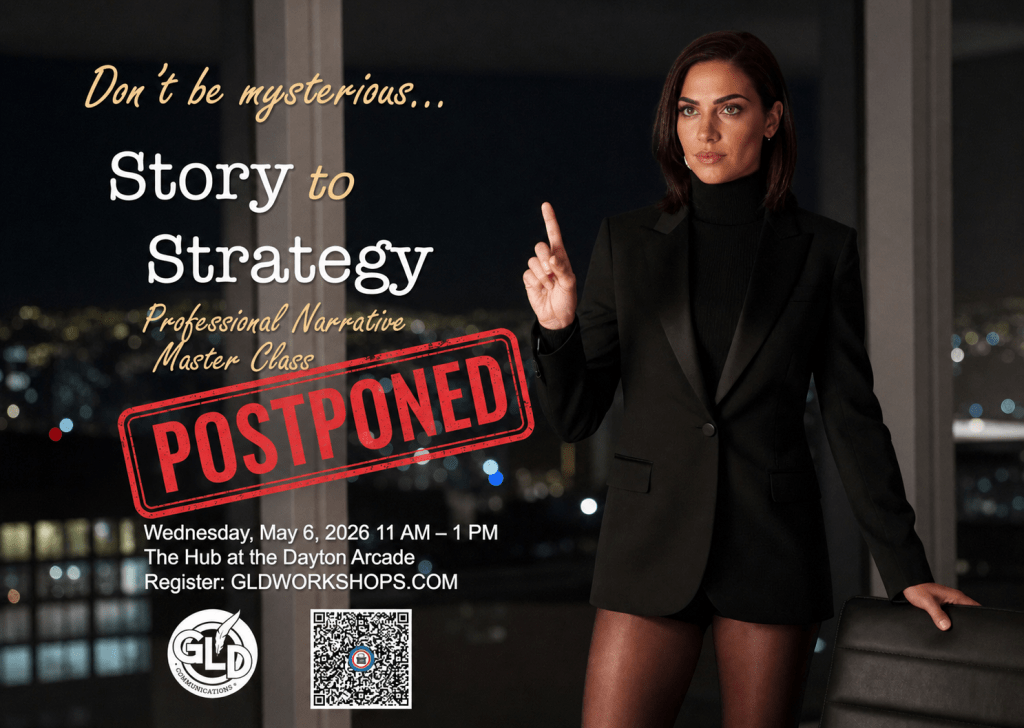
We appreciate your interest and support, and we’re working to secure a new date that will allow us to deliver the best possible experience for attendees.

This event may be rescheduled at a later date, please follow our Eventbrite or LinkedIn page for further updates.
GLD Communications
“Let us tell your story.”

:::ORIGINAL ANNOUNCEMENT:::

DAYTON — In an era when professional credibility can be drowned out by constant digital noise, a new master class in downtown Dayton aims to help individuals cut through the clutter by refining one powerful tool: their own story.

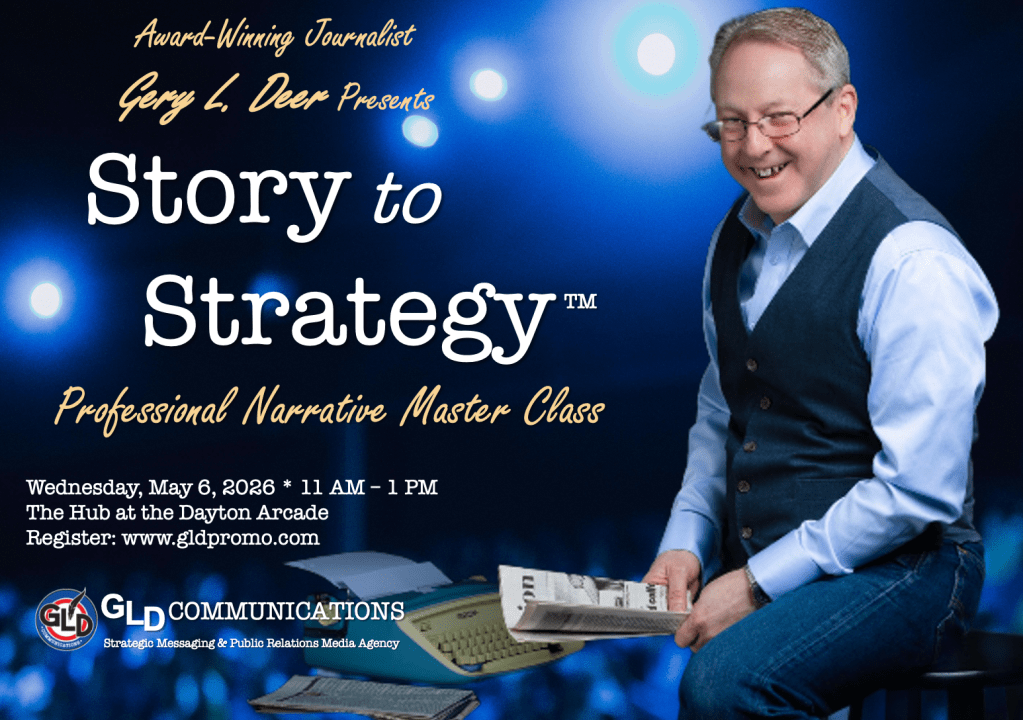
“Story to Strategy™: Professional Narrative Master Class,” scheduled for Wednesday, May 6, 2026, will bring together executives, creatives and professionals for a two-hour, hands-on session focused on shaping authentic, strategic personal narratives. The class will be held from 11 a.m. to 1 p.m. at the Dayton Arcade, hosted by the Entrepreneurs Center.

Led by award-winning journalist and communications strategist Gery Deer, the workshop emphasizes clarity over self-promotion, guiding participants to better understand how their experiences translate into a credible and effective professional identity.

“In a world saturated with noise, credibility comes from clarity,” Deer said. “This isn’t about teaching people how to promote themselves louder—it’s about helping them define how they show up and why that matters to the people they serve.”

The session is designed as an interactive, immersive experience that draws on journalistic practices such as reporting and editing, as well as modern marketing strategies. Participants will work to identify the “through-line” in their professional journey, refine that narrative into a clear personal brand, and apply those insights to real-world decisions.
Organizers say the course is intentionally accessible, requiring no technical or artificial intelligence skills—just a willingness to engage and reflect. Attendees are encouraged to bring whatever tools they prefer for note-taking, from traditional pen and paper to laptops or tablets.

The $99 registration fee includes lunch, with a buy-one-get-one offer available to encourage collaboration and shared learning.

The February event marks the second installment in the 2026 Master Class Series presented by GLD Communications, a quarterly program aimed at equipping professionals with practical communication and branding tools. Additional sessions are planned for later in the year, including a “21st Century Public Relations Master Class” in August and a “Personal Brand Master Class” in October.

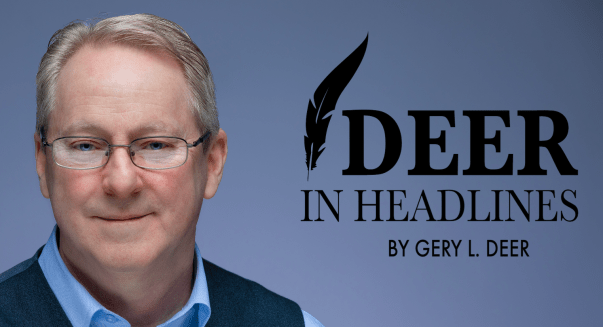
Deer, founder of GLD Communications, brings decades of experience in journalism, marketing and business development. Known for his “Deer in Headlines” newspaper column series, he has led workshops for chambers of commerce, professional associations and community organizations throughout the Midwest.

For attendees, the takeaway is intended to be immediate and actionable—not theoretical.

“A strong narrative can turn a brand into something more human, more relatable,” Deer said. “When people understand your story, they’re more likely to trust you—and that’s where real opportunity begins.”

Registration details and future class announcements are available through GLD Communications’ event listings.

We Need to Stop Warrantless Spying on Americans. Here’s How.

In history, National News, News Media, Opinion, Politics, Uncategorized on April 17, 2026 at 9:38 am

COURTESY: The New York Times – April 17, 2026

A photo of a blurry surveillance camera, in the foreground, against a sharper-focused seascape in the background.
Credit…Grade Solomon

By Mike Lee and Dick Durbin

Mr. Lee and Mr. Durbin are senators.

Add The New York Times on Google 

This article was updated to reflect news developments.

We disagree on many issues. One of us is a longtime Democrat, the other a conservative Republican. But both of us are deeply concerned about warrantless government surveillance of the American people.

In 2008, Congress enacted Section 702 of the Foreign Intelligence Surveillance Act to allow the government to gather vital intelligence about foreign governments, terrorists and spies. The problem is that it has also allowed agencies like the F.B.I. and the National Security Agency to regularly gather and search through the private communications of American citizens without a warrant. That is a clear violation of rights protected by the Constitution.

It’s true that Section 702 doesn’t allow the direct targeting of Americans, but their communications are still often gathered during the warrantless surveillance of foreigners abroad. Once the government has this data, agencies then have the ability to search through it. And they do: Transparency reports reveal that thousands of such searches are performed every year. A federal court previously found that some the F.B.I. had conducted had violated the Fourth Amendment.

Predictably, without a requirement for court approval of these searches, abuses have been rampant. As a recent report from the Brennan Center for Justice highlighted, F.B.I. agents in recent years have searched for the communications of “protesters across the political spectrummembers of Congress; a congressional chief of staff; a state court judgemultiple U.S. government officials, journalists and political commentators; and 19,000 donors to a political campaign.” In a time of extreme partisanship, these abuses have provoked bipartisan outrage.

Congress should have a serious and informed debate on these issues rather than ramming through a reauthorization of Section 702 with minimal reforms yet again, sidelining Americans’ constitutional rights in the process.

That’s why the two of us have proposed the Security and Freedom Enhancement (SAFE) Act, a compromise that would reauthorize the valuable core of this tool while enacting reasonable safeguards to protect the Fourth Amendment rights of all Americans.

The government would still be able to check its databases to uncover connections between targeted foreigners and Americans. But it would have to get court approval in the small number of cases in which these searches have generated results and the government has a proper basis for gaining access to the contents of the communications. Importantly, our warrant requirement also contains robust exceptions for legitimate emergencies, so that we can balance civil liberties with legitimate security needs.

Our bill would also cut off another form of warrantless surveillance: the widespread practice of circumventing the Fourth Amendment by purchasing Americans’ sensitive information from data brokers.

The Department of Justice (including the Drug Enforcement Administration and the F.B.I.), the Department of Homeland Security (including ICE, Customs and Border Patrol and the Secret Service) and the Defense Intelligence Agency have purchased cellphone location information for millions of Americans. Such information is highly sensitive and can reveal intimate details of that person’s life. Even more troubling, artificial intelligence could supercharge such surveillance, allowing the government to harvest and analyze mass quantities of highly personal and sensitive information about Americans without court approval. Our legislation would close these loopholes — again with pragmatic exceptions to accommodate legitimate safety and security needs.

Congress should not take an all-or-nothing approach to reauthorizing Section 702. We have the time and the responsibility to get this right. Members may disagree about what reforms are required — that’s why we have debates and amendments. But simply extending the law without any changes to protect Americans’ privacy should be off the table.

We owe it to the American people to meet this moment and do our jobs to protect both national security and civil liberties. Our bill offers a bipartisan solution to do just that.

Mike Lee, Republican of Utah, and Dick Durbin, Democrat of Illinois, are senators.

The Times is committed to publishing a diversity of letters to the editor. We’d like to hear what you think about this or any of our articles. Here are some tips. And here’s our email: letters@nytimes.com.

Follow the New York Times Opinion section on FacebookInstagramTikTokBlueskyWhatsApp and Threads.

Fear Has Two Voices

In Opinion, psychology, Uncategorized on April 10, 2026 at 7:48 am

Deer In Headlines

By Gery Deer

Fear is a quiet architect of our lives, shaping decisions long ahead of our realization. It whispers in moments that look like opportunity, altering possibility into risk and, eventually, retreat. Sometimes it protects us. Often it simply holds us still. And sometimes it rewrites who we are.

In life, fear shows up early and often, teaching us to avoid the stove after we get burned and to look before we leap. But somewhere along the way, caution evolves into habit, and habit becomes a cage we forget we can open. We replace growth with safety and comfort.

In our careers, fear can wear a suit and speak in reasonable tones. It tells us to stay where we are valued, and not risk failure by reaching for something bigger. It disguises itself as practicality, even as wisdom, while quietly draining ambition. We are stable when it is stagnant.

In relationships, fear is even more subtle, threading through conversations we avoid and truths we soften. It warns us that honesty might cost us connection, so we edit ourselves into safer versions of who we are. Over time, distance grows where closeness might have lived. Silence than vulnerability, and lonelier.

The irony is that not all fear is wrong. Some of it exists to keep us from harm, to remind us of consequences and limits. Healthy fear sharpens awareness and prepares us to act wisely. It is the difference between recklessness and courage.

The problem arises when fear loses ground in reality and begins to expand unchecked. We imagine outcomes that have not and may never happen, yet we respond as if they are inevitable. In doing so, we surrender opportunities before they even arrive. We rehearse failure and prepare for the worst without considering the more positive outcomes.

So how do we live with fear without letting it decide for us? The answer is not to eliminate it but to understand it. Fear is information, not instruction. It signals that something matters, but it does not determine what we must do next.

One way to manage fear is to name it clearly. Are you afraid of failure or embarrassment? Of loss, or of change? When we define the fear, we shrink its power. Vague dread feels overwhelming, but specific concerns can be examined and addressed. Clarity turns shadows into navigable shapes.

Another approach is to take small, deliberate steps. Fear thrives on the magnitude of the leap, so reduce the leap. Make the call. Send the email. Have the conversation. Each action chips away at the story that you cannot move forward. Momentum becomes its own antidote and that progress builds confidence.

It also helps to reframe fear as energy. The quickened pulse, the sharpened focus, the restless thoughts are not just symptoms of anxiety but signs that you are engaged. Channel that energy into preparation and action, rather than rumination and retreat. Such energy, directed forward, becomes drive and doesn’t dread time. Time instead becomes an ally.

Managing is never a one-size-fits-all process. Personality, fortitude, and experience all matter, as does context. Some people need to push themselves harder, while others need permission to pause and assess. The goal is not to become fearless but learn to discern which fears to heed and which to challenge.

There is a duality to fear that we often overlook. It can be a guardrail or a barrier, a warning or a wall. The difference lies in how we interpret and respond to it. Left unchecked, it limits us. Understood and engaged, it can guide us toward more growth choices.

Each of us carries a different relationship with fear. It is shaped by our histories, our successes, and our scars. What paralyzes one person may motivate another. That is why self-awareness is essential. When you understand your patterns, you can begin to rewrite them with intention and patience, easing discomfort.

In the end, fear will always have a voice. The question is whether it gets the final word. When we learn to listen without surrendering and to act with awareness rather than avoidance, we reclaim our agency. Fear becomes not an obstacle but a companion we can walk with and call upon when needed.