By Gery Deer
(JAMESTOWN) — One of Jamestown’s newest small-business success stories is taking another step forward.

Jamestown Cafe has launched its first-ever website, giving customers a new way to stay connected with the downtown café while making it easier to learn about menu offerings, hours, events, specials, and online ordering opportunities.
The new site serves as a digital front door for the café, which has quickly become a gathering place in downtown Jamestown since opening in 2025. Visitors can browse menu items, learn about the café’s story, view operating hours, find contact information, and stay informed about upcoming events and seasonal offerings.
Owner Ashley Mannier said the website represents another milestone in the café’s continued growth and its commitment to serving the community.
Located at 9 W. Washington St., the café occupies a restored historic downtown building that Mannier and her family transformed from a vacant storefront into a welcoming neighborhood destination. Since opening, the business has become known for specialty coffee drinks, breakfast and brunch selections, sandwiches, pastries, and baked goods served in an atmosphere that celebrates local history and community connections.
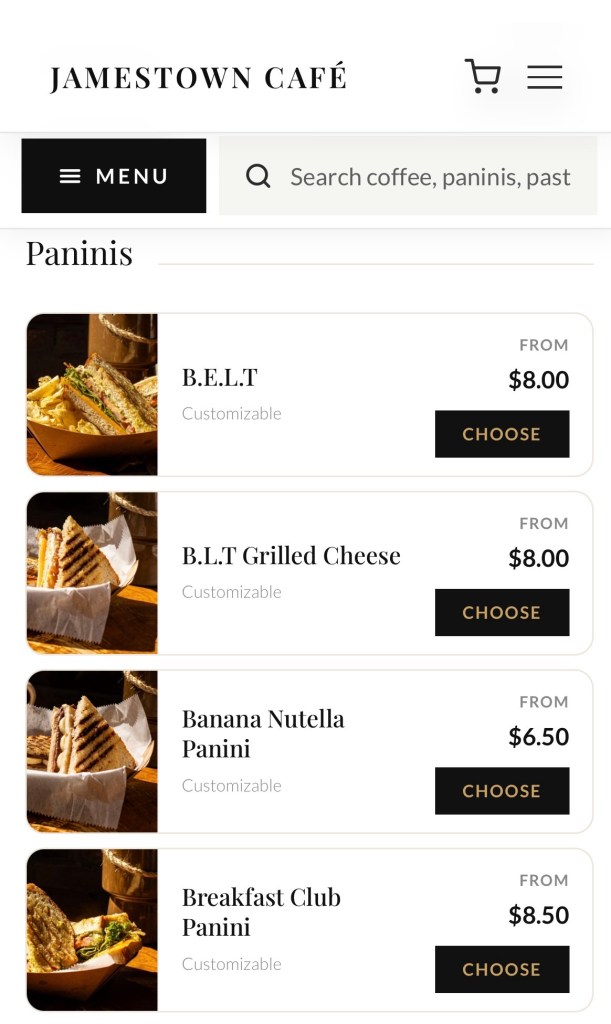
The website, developed by Ryan Patt Solutions, in Jamestown, allows customers to quickly check current hours, view menu offerings, and learn about featured items ranging from breakfast paninis and specialty coffee drinks to sandwiches and bakery selections. The online platform also provides a central location for announcements about new menu additions, special promotions, and community events hosted by the café.
For customers who rely on social media for updates, the website complements the café’s existing Facebook and Instagram presence while offering a more permanent and easily accessible source of information. Future updates are expected to include expanded online ordering features, event notifications, and regular announcements about new drinks, sandwiches, baked goods, and seasonal specialties.
The launch reflects a growing trend among small-town businesses investing in professional online presences to better serve customers and provide convenient access to information outside regular business hours. For Jamestown Café, it offers another way to strengthen the connection between the business and the community it was created to serve.
Those interested in learning more about the café, viewing menu options, checking hours, or staying informed about upcoming specials and events can visit the new website at thejamestowncafe.com.
The café is open Wednesday through Friday from 7 a.m. to 5 p.m., Saturday from 7 a.m. to 4 p.m., and Sunday from 8 a.m. to 3 p.m.





 The Jamestown Comet
advocacy summit, Deer In Headlines, Gery Deer, Gery L. Deer, healthcare advocacy, Jamestown, journalism commentary, Ohio, Only at this table, opinion column
Only at this table.
In Opinion, Uncategorized on March 6, 2026 at 11:20 pmDeer In Headlines
By Gery Deer
It was late evening at a hotel restaurant in Washington, D.C. Most of the restaurant crowd were either deep in their own discussions or had eyes glued to televisions broadcasting college basketball. And there we were. A handful of adults who were born with or a parent of someone with bladder exstrophy, all of us in town as patient advocates preparing to take on Congress.
We laughed and talked, as burgers, salads and something fried occupied most of the real estate between us. Someone had to move a basket of fries so we could make room for desserts and more drinks.
On the surface, we didn’t look so different from anyone else in the room. Just another group decompressing after a long day. But the conversation? That could have only happened there. Only at this table.
Bladder exstrophy is rare – very rare. So, when you’re born with a condition that requires extensive surgery – or surgeries – and lifelong management, there are very few who can relate. Explaining it often brings sighs of pity, confused expressions, and a host of questions.
At this table, there was none of that. We didn’t have to define the anatomy. We didn’t have to summarize childhood surgical histories or explain why insurance preauthorization feels less like paperwork and more like gladiator combat. We could start mid-story.
We compared hospital experiences the way other people compare hometowns. We talked about the benefits and challenges of living with something so unusual it was often hard to explain, even to those closest to us.
That shared experience can lead to its own sort of verbal shorthand. It strips away the introductory chapter and drops you straight into the middle of the book. And shared experiences from birth? There’s no need to tiptoe around things, perform bravery or package vulnerability in tidy language. You can be direct. You can be specific. You can be understood.
There was a moment — and I won’t detail it, because some conversations belong only to those who were present — when the tone softened. Someone shared a memory from adolescence, a time when feeling different felt especially sharp. No one rushed to fix it. No one offered a motivational poster response. Instead, there was safety in letting go, in the expression of feelings and thoughts that only others like us could understand.
It manifests as a shared laugh, or a look, or a nod. It’s not dramatic. It doesn’t require a spotlight. It’s a quiet acknowledgment that says, “Yeah, I know.”
Every community has a version of this table. Veterans find it with other veterans. Cancer survivors with survivors. Parents of children with complex needs with others who speak that language fluently. I experience it whenever I talk to those who have cared for elderly parents. Even journalists have our own version — around a busy lunch counter or late dinner table, arguing about headlines.
The table isn’t about exclusivity. It’s about the rare and deeply emotional relief of not having to translate your life for someone else, and timing matters.
We weren’t children navigating surgeries for the first time. We were adults who had built careers, relationships and resilience. We had come to Washington to advocate, to push for better systems. That context shaped the conversation.
We were recounting the past, but also connecting it to the future. Even more incredible to me was the fact that the congenital flaw that made us the objects of both fascination and ridicule as children was now quite literally our superpower. It was what brought us to Capitol Hill to help others – because we can.
When we finally stood up, games still flickering on the screens and the crowd still rumbling, I looked at that table and felt the weight of its ordinariness. It was just wood and silverware and a stack of dishes.
But for a couple of hours one evening, amid basketball fans and bar noise, it was something far more. It was a place where five people shared something unique to them – an understanding. No, it was more than that. It was something as rare as the condition that we shared, but as unique as each one of us. But only at this table.