Deer In Headlines
By Gery Deer
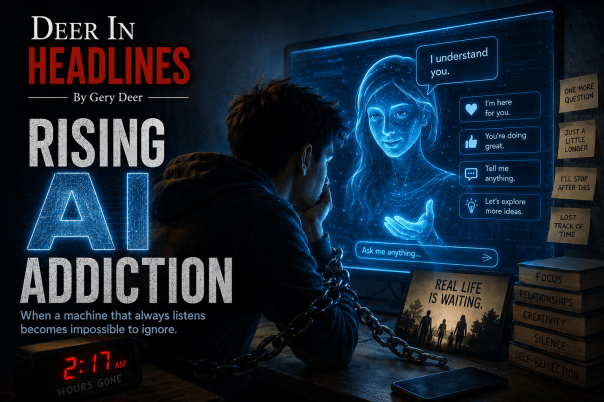
A few years ago, people worried that artificial intelligence would eventually replace human workers. Today, another possibility is emerging, and it may arrive long before robot uprisings or mass unemployment. More and more people are becoming emotionally and psychologically dependent on AI systems that never sleep, never argue, never get bored, and never stop responding.
That dependence does not always look dramatic. It rarely begins with obsession. It starts innocently, usually disguised as productivity or curiosity. Someone asks an AI chatbot to summarize an article. Then they ask it to explain a difficult topic. Soon, they are discussing politics, relationships, career frustrations, or private fears with software designed to keep conversations going as long as possible. Hours disappear.
People increasingly report losing track of time while interacting with AI tools. A quick question becomes an evening of conversation. A work assignment turns into endless prompt refinement. Students claim they are researching while actually drifting through AI-generated distractions that feel productive without accomplishing much. The machine always has another answer, another idea, another response waiting instantly. Human beings have never encountered technology quite like this.
Television entertained audiences. Social media captured attention. Smartphones made distraction portable. Artificial intelligence combines all of those features while adding something far more powerful: interaction. AI responds directly to emotions, language, interests, and insecurities. It creates the illusion that someone is listening carefully, even when no actual understanding exists behind the screen.
That illusion matters because people are wired to seek validation, reassurance, and escape from discomfort. AI delivers all three immediately. Feeling lonely? The chatbot responds warmly. Feeling insecure? The chatbot encourages you. Feeling overwhelmed? The chatbot simplifies complicated decisions. Real human relationships require patience, compromise, and emotional effort. AI companions require almost nothing. For some users, that convenience can quietly become dependency.
Teenagers may be especially vulnerable because their social identities are still developing. Adults facing isolation, anxiety, or depression may also find AI interaction easier than navigating difficult human relationships. Employees working remotely can spend entire days communicating more with machines than with coworkers. Over time, the distinction between healthy use and compulsive reliance becomes increasingly blurred. There is another concern receiving far less public attention: the erosion of silence and reflection.
For generations, boredom served an important psychological purpose. Quiet moments allowed people to process emotions, reflect on problems, and develop independent thoughts. Waiting rooms, walks, and long drives once provided mental breathing space. Today, every pause can instantly be filled with AI interaction. Questions no longer remain unanswered. Uncertainty no longer lingers. The machine is always available to entertain, reassure, or distract. That may sound harmless, but constant stimulation changes behavior.
Researchers already know excessive social media use can affect sleep, attention spans, anxiety levels, and emotional health. Artificial intelligence could intensify those effects because it feels personal. Unlike scrolling through videos or reading random posts, AI systems simulate conversation and emotional engagement. They can mirror language patterns, reinforce beliefs, and encourage users to continue interacting. The long-term consequences remain largely unknown.
That uncertainty alone should concern parents, educators, employers, and policymakers. Society embraced social media long before understanding its psychological impact, particularly on younger users. By the time researchers recognized the extent of the damage, billions of people had already integrated those platforms into daily life. Artificial intelligence is advancing even faster, while public understanding remains dangerously limited.
None of this means AI should be feared or rejected entirely. Artificial intelligence can improve medical research, education, accessibility, and workplace efficiency. Used responsibly, it can become a valuable tool. The problem begins when tools evolve into substitutes for attention, relationships, creativity, or emotional resilience.
People should begin setting boundaries now rather than wait for future studies to confirm the obvious. Limiting recreational AI use, protecting device-free time, encouraging in-person relationships, and teaching digital self-awareness may become essential habits in the years ahead.
The greatest danger may not be that artificial intelligence becomes more human. It may be that humans gradually become less connected, less reflective, and less able to exist without constant digital reinforcement. Such existence diminishes us. Getting lost in a digital world only makes the real one harder to deal with if and when you ever come out of it.
 The Jamestown Comet