Local News & Commentary Since 1890.

Archive for the ‘World News’ Category

What Remains

In Local News, National News, Opinion, Politics, Uncategorized, World News on September 11, 2026 at 6:00 am

Deer In Headlines: Special Edition

By Gery L. Deer

Twenty-five years ago, I watched the world change on a television with a screen barely three inches across. I was at work in Dayton on the morning of Sept. 11, 2001, staring at that tiny picture as smoke poured from the World Trade Center and reports came in so quickly that none of us could quite comprehend what we were seeing.

The night before, I had flown home from a weekend event in Las Vegas. I had considered staying another night and flying back Tuesday morning, but I couldn’t find a flight that worked, so I came home Monday instead. I’ve thought about that decision many times over the years. I wasn’t booked on one of those planes or knowingly in danger. Still, there is something unsettling about realizing how close ordinary life can brush against history without our knowing it.

By Tuesday morning, ordinary life was gone for thousands of people.

Nearly 3,000 people died that day. Thousands more survived, carrying memories most of us can only imagine. Firefighters, police officers, paramedics and ordinary people ran toward devastation while others desperately tried to escape it. Families waited for telephone calls that never came.

My friend Joe was a New York City firefighter. He lost his entire company that day. September 11 changed him, as it did countless others who survived the attacks, worked in the wreckage or lost people they loved.

I speak to Joe every anniversary. There isn’t much I can say that makes anything better. Maybe that’s not the purpose. Sometimes remembrance means simply being there, acknowledging that someone still carries something the rest of us have the luxury of remembering only once a year.

For many survivors, Sept. 11 never really ended.

People who worked at Ground Zero during the rescue, recovery and cleanup were exposed to toxic dust and debris. Years later, cancers, respiratory illnesses and other diseases became another terrible legacy of the attacks. Others have lived with trauma, grief and survivor guilt, wondering why they came home when friends and coworkers did not.

America carries scars from that morning, too.

We went to war. Security tightened. Surveillance expanded. Airports changed. Fear became woven into public policy and everyday life. Suspicion grew toward people who looked, dressed or worshipped differently. Political leaders learned just how powerful fear could be when people felt threatened.

It would be too simple to blame today’s bitter political divisions entirely on Sept. 11. History doesn’t work that neatly. But the attacks changed the political soil of America. Fear, nationalism, distrust and the willingness to trade restraint for promises of security became increasingly powerful forces in our public life.

Some historians and political observers have drawn lines from the post-9/11 era through the wars, economic instability, immigration battles and declining trust in institutions to the political extremism we see today. Those lines aren’t always straight, and there are many other causes. But pretending those years left no political legacy would be equally simplistic.

Perhaps remembering Sept. 11 requires more than remembering what happened to America that morning. We should also consider what happened to America afterward.

And remembrance should never belong to one political party, ideology or movement. Those who died that day were Americans and visitors, Republicans and Democrats, conservatives and liberals, people of different races, religions and backgrounds. Terrorism did not stop to ask how anyone voted.

Neither should remembrance. If we are to truly honor those who lost their lives, and all who are still living in the aftermath of that day, we must do our best to always be the land of the free, and the home of the brave.

Tomorrow, monuments will be visited, names will be read and flags will fly. Television networks will replay images that many of us still find difficult to watch. A generation born after the attacks will encounter Sept. 11 as history, while the rest of us remember exactly where we were.

I’ll remember a three-inch television in Dayton and a flight home the night before.

And I’ll talk to Joe. Because twenty-five years later, remembrance isn’t about politics. It’s about people. It’s about those who died, those who survived, and those who still carry that morning with them… to make sure they know we haven’t forgotten.


Rogue nation: USA

In National News, Opinion, Politics, Uncategorized, World News on January 11, 2026 at 11:24 pm

Deer In Headlines

By Gery Deer

I’ve avoided direct political commentary but, on this subject, it’s hard to remain silent. I’m sickened by the recent behavior of our federal government – all three branches. Whatever your political affiliation, it is impossible to look at the behavior of the current American administration and call it normal. 

What we are witnessing is not tough diplomacy or considered leadership, but a pattern of outlandish conduct that mocks international law and the values the United States claims to champion. When power is exercised without restraint, justification becomes propaganda and accountability disappears.

First, there’s the kidnapping and prosecution of a sitting president of Venezuela. Nicolás Maduro may be a corrupt, authoritarian, drug-trafficking criminal. But none of that gives the U.S. Government legal or moral authority to invade a sovereign nation, seize its head of state, and drag him into an American courtroom without extradition or due process.

Defenders argue that Venezuela’s constitution explicitly prohibits extraditing its own citizens, and the bilateral extradition treaty has long been shaky, suspended in practice by Caracas itself. However, that does not excuse abduction. When lawful avenues are blocked, the answer is not to ignore law altogether. The absence of a workable treaty is not permission to kidnap; it is proof that diplomacy and international pressure, however slow, are the legitimate tools.

This is not how a nation behaves that claims to respect due process. When the world’s most powerful democracy discards extradition treaties and international courts, it signals that rules apply only to the weak. History demonstrates that such a precedent will not protect Americans when the balance of power shifts.

We have been down a similar road before. In 2003, the United States invaded Iraq and removed its leader under the banner of national security. In hindsight, no weapons of mass destruction were found – the years-long operation failed. Hundreds of thousands died. A region was destabilized. Extremism flourished. American credibility was deeply damaged. The lesson should have been clear: removing leaders by force creates chaos, not democracy. Yet here we are again, acting as though power excuses everything.

As if that were not reckless enough, the same administration now speaks openly about literally stealing Greenland from Denmark, as though the territory were merely a trinket to be bought, bullied, or taken by force. Denmark is a NATO ally and Greenland’s people have repeatedly said, “no thanks.” The insanity of a United States military invasion and seizure is unprecedented. It’s forced occupation and shatters trust with allies.

We are told these actions keep us safe and project strength. Instead, they isolate us, invite retaliation, and encourage other nations to discard restraint. When America behaves like regimes it once condemned, the moral high ground collapses beneath our feet.

What is perhaps most alarming is the resistant silence. Congress, entrusted by the Constitution with oversight, war powers, and the duty to restrain executive excess, appears paralyzed. Some lawmakers mutter concerns and look away. Too many say nothing, whether from fear or calculation. This is not how a functioning republic responds to dangerous overreach.

The Democratic Party looks toothless. Republicans who should speak out remain complicit. Checks and balances mean nothing if not exercised. History will not be kind to those who watched democracy collapse and did nothing to prevent it.

Once respected because it claimed to stand for something great and honorable, the U.S. now risks becoming a cautionary tale. Feared and mocked rather than trusted and admired. 

And all of this would be just as wrong if the other party did it and none of it is patriotic. Patriotism is not blind loyalty to a leader or party. Patriotism is fidelity to principles: the rule of law, respect for sovereignty, restraint in the use of force, and accountability at home. Plus, when billions are spent on coercion while vulnerable children, seniors, and veterans lose essential services, moral priorities have evaporated. 

If this behavior continues unchecked, the damage will outlast any presidency. Democracy demands courage from lawmakers who will resist, and citizens unwilling to excuse abuses of power perpetrated in their name. Laws can be repaired, and alliances restored, but only if someone is finally willing to draw a line and Congress acts with courage, and constitutional responsibility.

Exploring Radio Independence at Dayton Hamvention 2025

In Dayton Ohio News, Local News, National News, News Media, Technology, Uncategorized, World News on May 20, 2025 at 4:12 pm

By Gery Deer

Courtesy Xenia Daily Gazette

Editor’s Note:

An update from the Dayton Hamvention officials on May 28th reads as follows: The 2025 Hamvention set a new high attendance record with 36,814 attendees. The general chair, Brian Markland, said he felt fabulous about watching large crowds of amateur radio enthusiasts from all over the world enjoying exhibits, forums, and the flea market. 

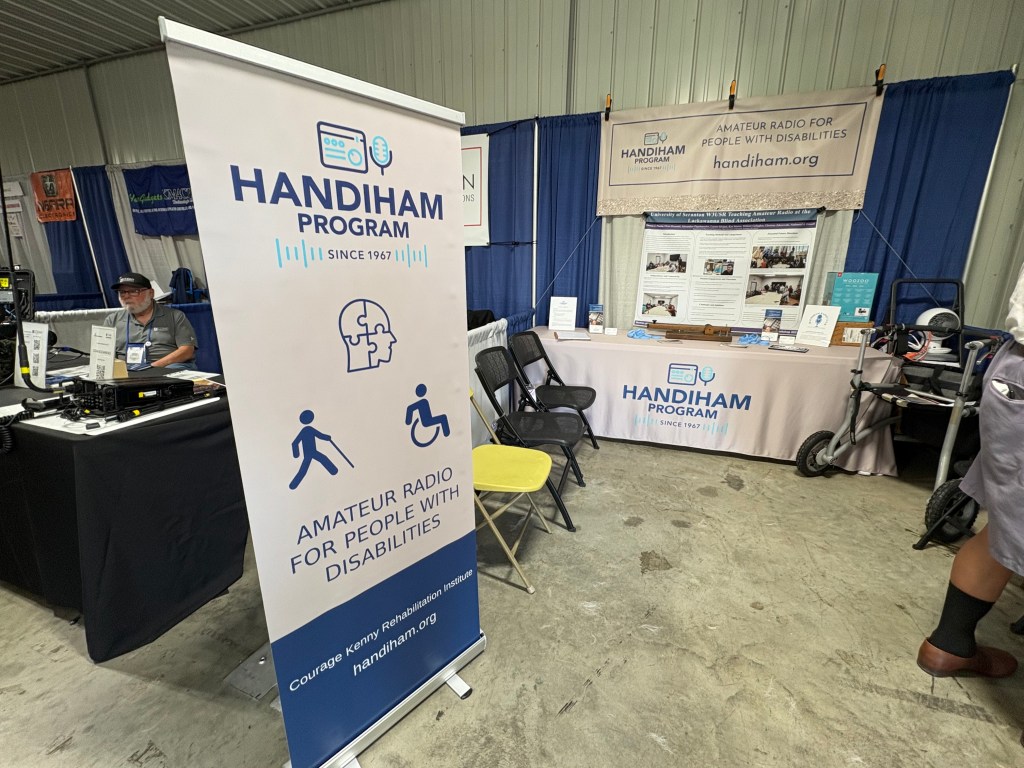
XENIA — Before cell phones or the internet, there was amateur, or “ham,” radio.

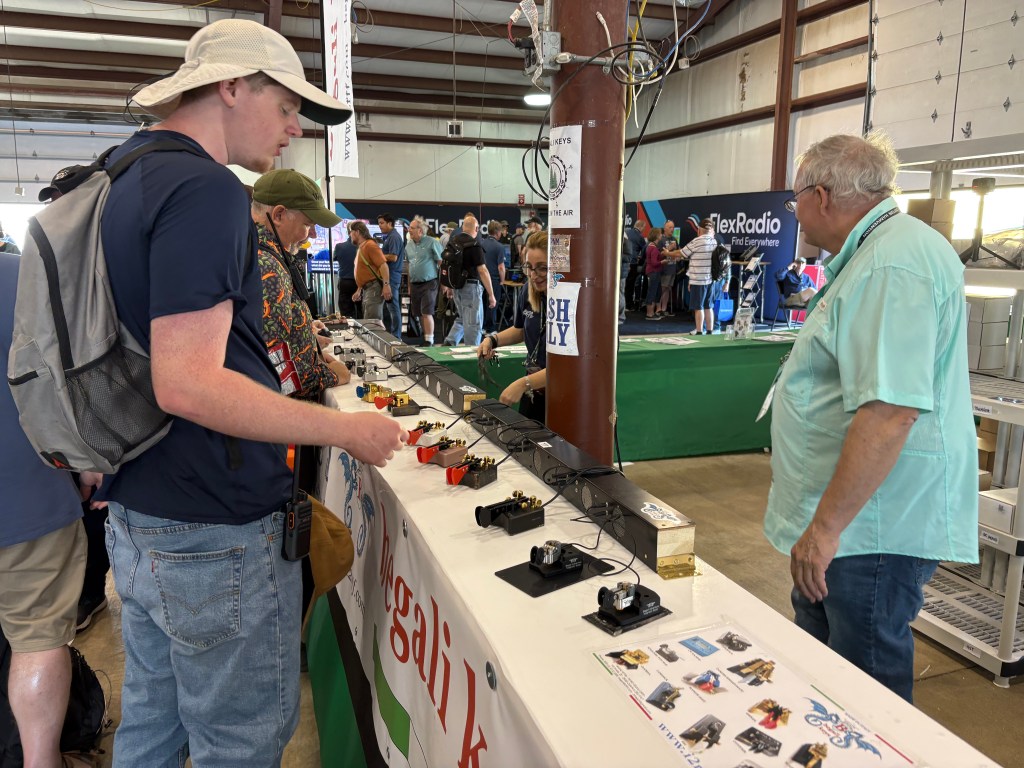
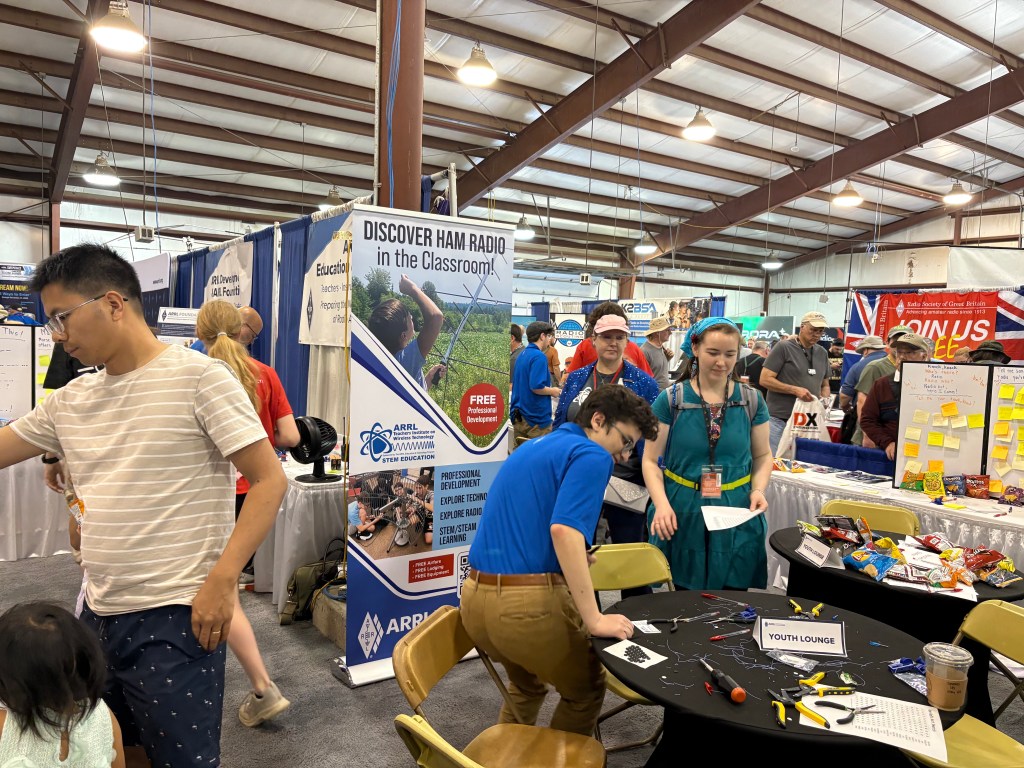
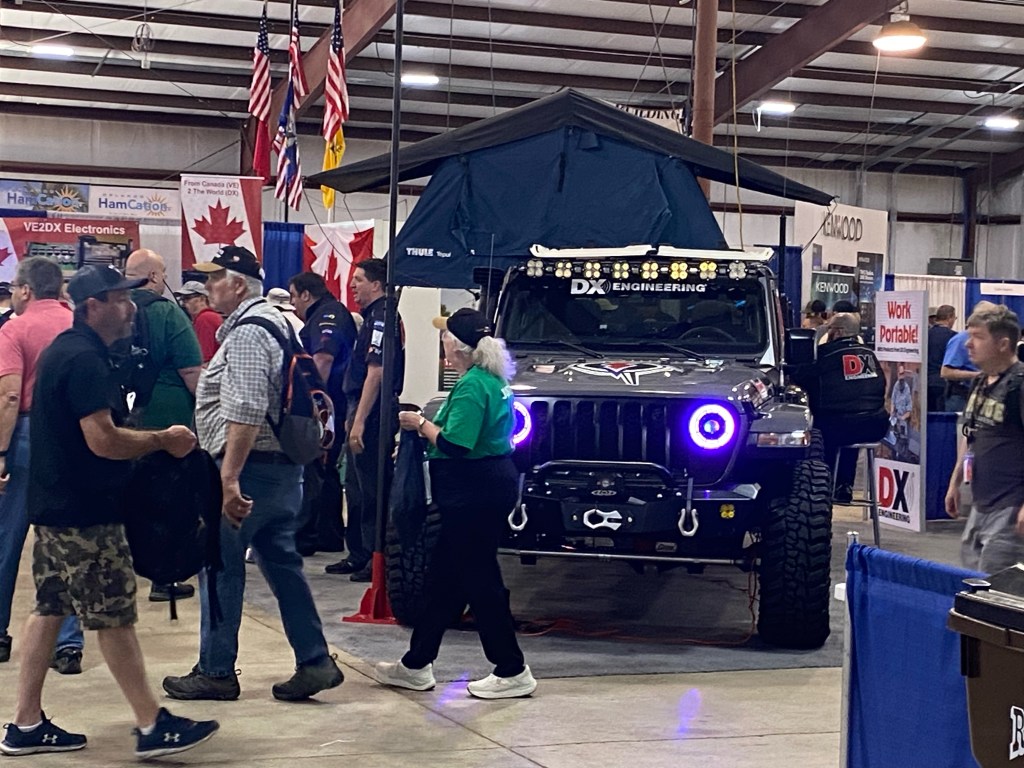
Once a year, thousands of enthusiasts descend on the Greene County Fairground and Expo Center in Xenia for the largest amateur radio convention in the world – Dayton Hamvention. Although final numbers will not be tallied for some time, organizers estimate that this year’s turnout exceeded the 35,000 attendees of 2024.

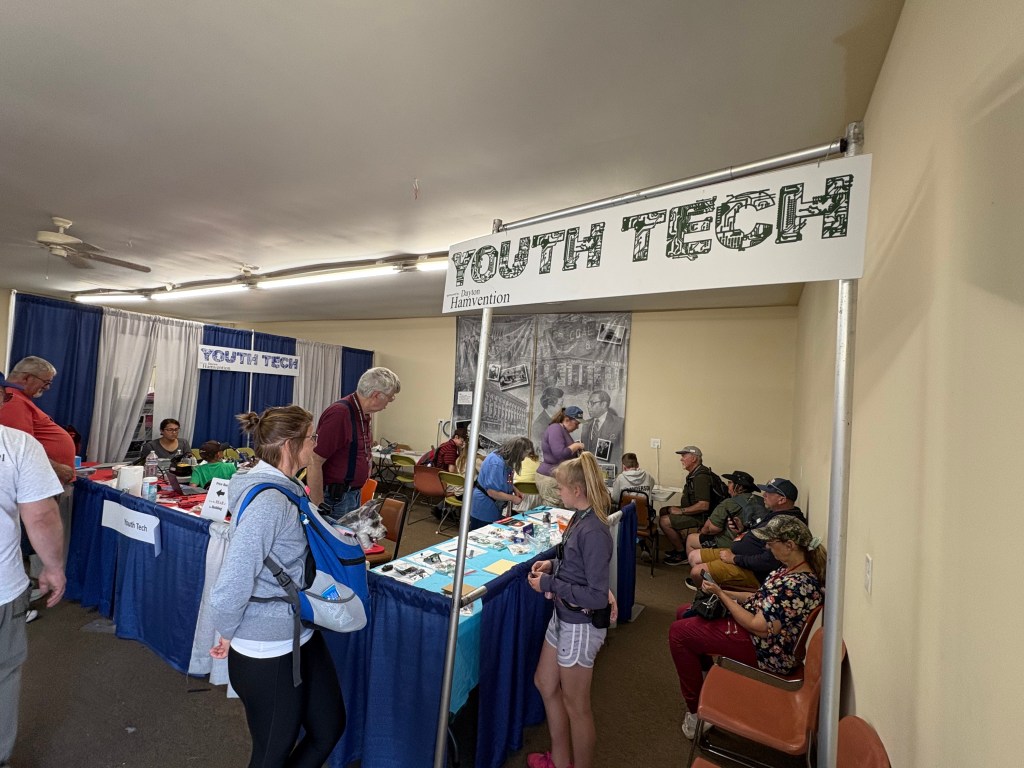
During Dayton Hamvention, participants from as many as 30 countries had the opportunity to see and buy the latest technology, attend educational and informational forums, sit for radio license exams, and take part in youth activities. This year’s event also included groups of young radio enthusiasts, organizations from all over the country made up of young people interested in both the analog and digital nature of amateur radio.

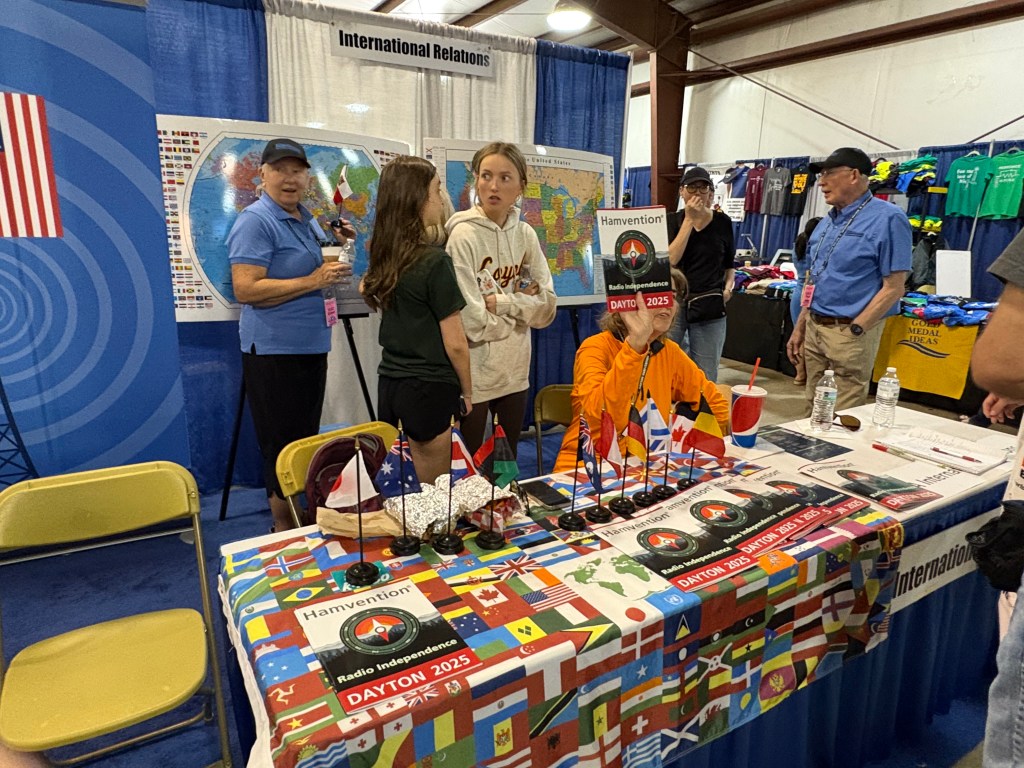
Jim Gifford, call sign N8KET, is the chairman of the media committee for Dayton Hamvention. He shared this year’s theme – Radio Independence – noting that what makes this event so important and impactful to the amateur radio community is the people. One of his favorite moments of this year’s event happened on Friday. “We had 73 students of the Community STEAM Academy (Science Technology Engineering Art and Math) in Xenia here,” he said. “They were really excited to learn how amateur radio relates to science and even space communication.”

With some 800,000 licensed ham radio operators in the United States alone, there is a remarkable sense of community among radio operators, regardless of geography. “It’s so nice for all of us in the local area to be able to come to Hamvention, but then you have to stop and think, this is a big ham fest,” said Glenn Rodgers, WI80, assistant chairman of the event’s media committee. “This is the biggest ham gathering in the world, and we’re so fortunate to be able to come to something like this in this area and it’s an honor to work here.”

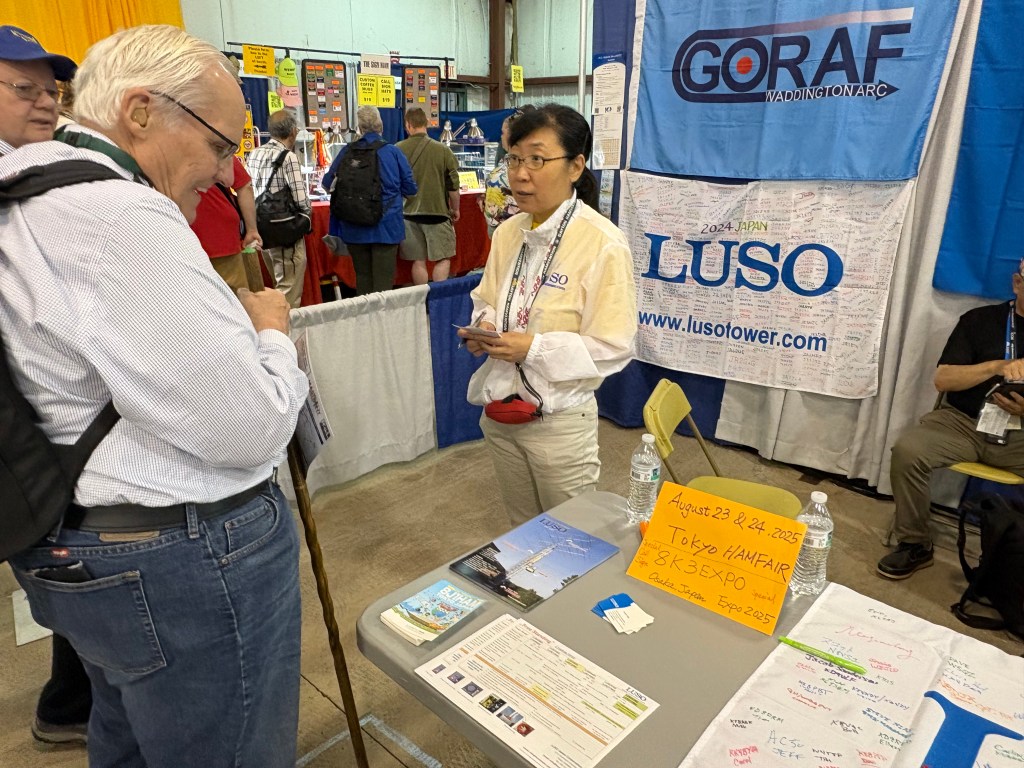
Amateur radio enthusiasts, vendors, and organizations from around the world converged at the Dayton Hamvention. Here’s a promotional booth for Tokyo Hamfair.

With such widespread interest, one might expect the world’s current geopolitical tension would hamper those relationships. According to Gifford, it does not. “We have a multitude of political views here,” he said. “But we’re ham operators, we take care of each other.”

“Because you meet people,” Gifford continued. “We talk to people all over the world. Just the other day, I spoke to somebody from Norway, and somebody from Italy, and it crosses barriers. It really does.”

Most amateur radio enthusiasts are known on the air, and to each other, only by their call sign, an alphanumeric identification given to each license holder by the Federal Communications Commission (FCC).

Jesse Walker, N8XC, is U.S. Navy Veteran, and business development manager with Aegis Protective Services in Eaton. He’s been involved in amateur radio since the age of 15. He explained that, although the call signs are assigned, they become part of your identity.

“Many of us only know each other by our call sign,” Walker explained, who is a member of the Preble Amateur Radio Association in Preble County. “Coming here, we get to meet face-to-face often for the first time.”

Both Rodgers and Gifford also noted that, apart from being a hobby for some, ham operators play an important role in the community during emergencies. “Amateur radio groups work as sky spotters during severe weather, they work with and support our area first responders, providing backup communications and volunteers during local emergencies,” Gifford said.

“Essentially, the Preble Amateur Radio Association is involved in public service,” said Jesse Walker. “We work with the Preble County emergency management agency. Our motto in amateur radio emergency service is, ‘when all else fails.’”

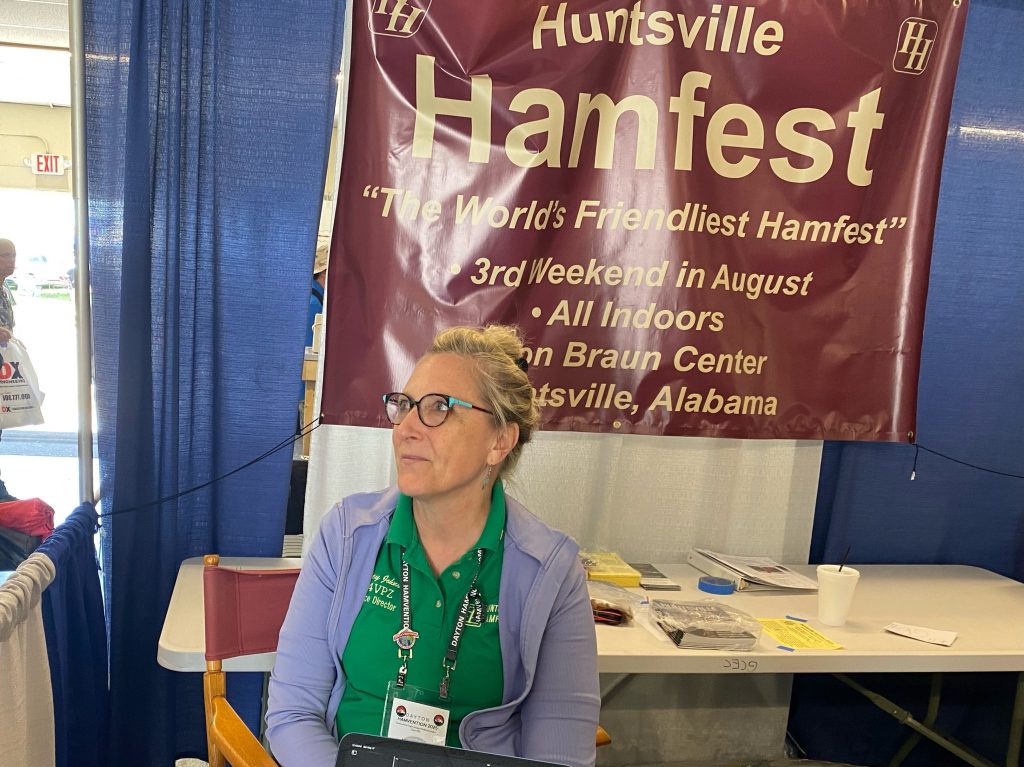
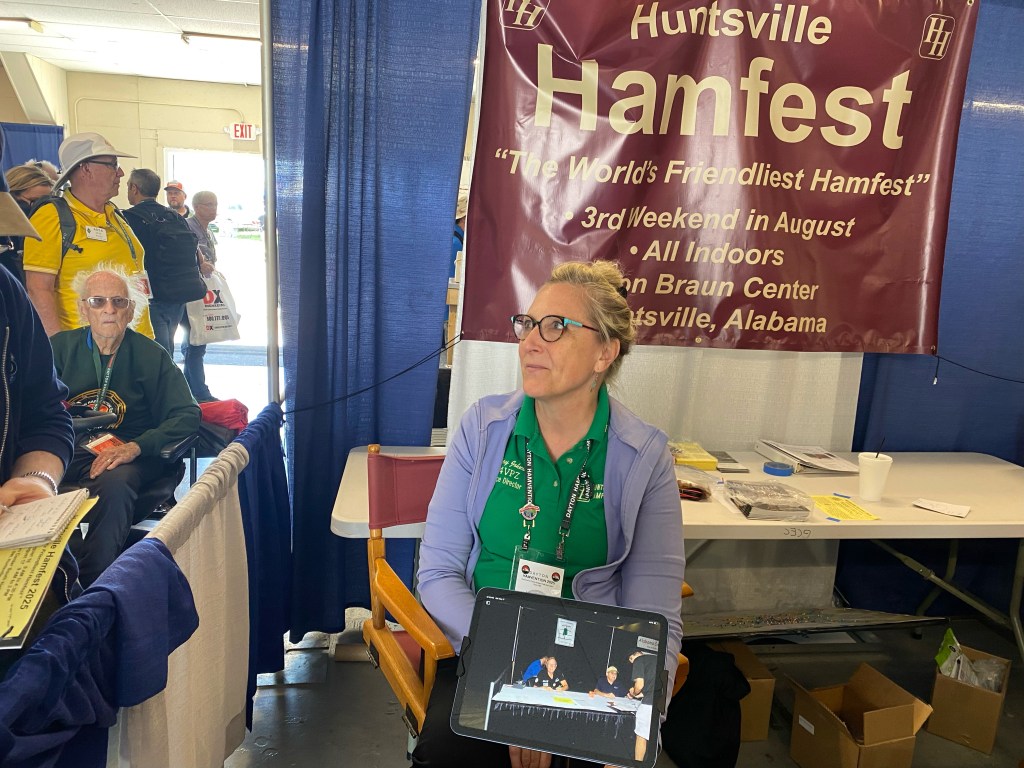
Other amateur radio convention organizers also attend to promote their own events. Huntsville Hamfest, held annually in Huntsville, Alabama, is one such organization. Mark Brown, N4BCD, is the chairperson for the Huntsville Hamfest Association. “Ours is the third largest Ham radio convention in the country, behind Dayton and Orlando, Florida,” Brown said. “We all cooperate and help support each other’s events.”

Mark Brown, N4BCD, and Kelley Johns, W4VPZ, (pictured) provided information about the Huntsville Hamfest in Alabama.

Brown suggested the consistent growth of these events and interest in amateur radio is due in part to younger people learning about its technical diversity. “I think to attract kids, we’ve got to show different aspects of the hobby, like the satellite communications, the youth on the air, and the parks on the air,” he said. “Get youth involved in it. That’s one thing these events do is bring all ages together.”

Planning for next year’s Dayton Hamvention is already underway. For more information visit hamvention.org.

Booker: Truth to Power

In history, National News, News Media, Opinion, Politics, sociology, Uncategorized, World News on April 11, 2025 at 1:57 pm

Deer In Headlines II

By Gery Deer

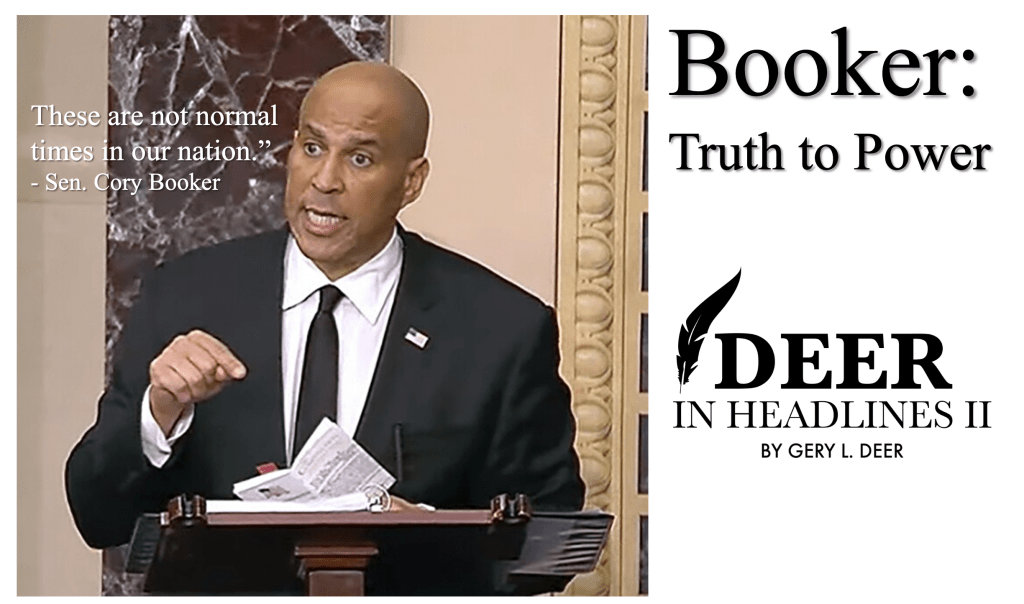
Last week, we saw an incredible example of unmitigated patriotism to provide a voice for those who have none in the face of a president who runs roughshod over anyone who dares oppose him. Cory Anthony Booker, the senior senator from New Jersey, took and held the Senate floor for 25 hours and 5 minutes in a marathon speech in opposition to President Trump’s haphazard and potentially illegal actions during the first three months of his term.

Until now, congressional resistance toward the president has been lackluster, to say the least. This is understandable considering the GOP’s control in both houses and the way this administration has reacted to any opposition, as a petulant child would on a playground when denied an ice cream cone. It’s embarrassing and troubling. Congressional town hall meetings across the country have been disrupted by constituents demanding that Trump be held accountable for the repercussions of his actions.

Most disruptors are ushered out or jailed for the disturbances, but their point is well taken. This president has been actively, deliberately, and defiantly testing the limits of his office and the ability of the other branches of government to keep him in check as designed.

In 1787, the men governing the 13 original American colonies had been through a great deal. They’d declared independence from the most powerful country in the world, fought them in a bloody revolution, won, and finally managed to cobble together a set of laws to live by, unlike anything seen before. The newly minted Constitution was the single most important document ever drawn up to that point – and still is today. The Preamble and Bill of Rights (the first 10 amendments for those who slept through fourth grade) are the gold standard for governing a democratic republic.

It’s doubtful the Founding Fathers ever imagined their fledgling country, still in its infancy today by European standards, would end up being tested, not by a foreign enemy, but by a power-mad oligarch occupying the president’s office. And, until today, very few have had the courage or opportunity to openly stand up to him.

Monday, March 31st, Booker took to the Senate floor and stated he’d remain there as long as he was “physically able,” and that he did – and it was no small feat, even for a former football tight-end. To hold the floor, whoever is speaking must keep talking and can’t stop, sit, lean on anything, or leave the floor for any reason. Fellow Democrats helped out, though, per Senate rules, allowing them to interrupt and ask him questions.

Over a day later, the 55-year-old senator finished speaking and limped off the floor. But, during his time, he held nothing back, walloping Trump on everything from his sweeping cuts to social services to what he called the impending “constitutional crisis” created by the president’s authoritarian actions.

To be clear, several Republicans have taken the same long-winded action on various issues over the last few years, most unsuccessfully. Such a speech isn’t a liberal or conservative move but that of a legislator committed to being heard on behalf of their constituents or the country.

Booker’s record-breaking speech was patriotic because he spoke for more than just those in his voting district. He voiced the fears not just of New Jerseyans but Americans nationwide. His words begged for compassion, kindness, and common sense – from those on both sides of the aisle. After all, when Trump’s own party doesn’t stand up to him, knowing his actions are questionable at best, someone else must.

The real question is, will Booker’s speech fuel a more dauntless anti-Trump resistance? Possibly. For more than a day, the New Jersey senator knocked the president’s agenda off the front page of every news outlet website, here and abroad. Not to mention the 350 million “likes” during the live stream on TikTok.

One thing is sure. Democrat or Republican, people must realize that Trump’s actions prove his agenda is to serve himself and his billionaire friends, not the country. So, to quote Senator Booker, “These are not normal times in America,” he said. “And they should not be treated as such in the United States Senate” or anywhere else.

Absolute Power

In history, Opinion, Politics, psychology, Uncategorized, World News on March 26, 2025 at 1:58 pm

Deer In Headlines II

By Gery Deer

Power, like money, is nothing if you have enough, but everything if you don’t. But what is it? Who has it, and what are those without it supposed to do when faced off by those who do? I’m not sure I’m smart enough to answer any of those questions. If you’ll indulge me, however, I’ll make an attempt to do so and put it into a contemporary context. First, a little history – the kind we should learn from or be doomed to repeat.

It was 1887 England. In a series of letters to Bishop Creighton concerning the issue of writing history about the Inquisition, John Dalberg-Acton, the 1st Baron Acton, or better known as Lord Acton, wrote, “Power tends to corrupt, and absolute power corrupts absolutely.” Most people are familiar with the quote, but few know the preceding passage, which gives it perspective.

“I cannot accept your canon that we are to judge Pope and King unlike other men, with a favourable presumption that they did no wrong,” Acton wrote. “If there is any presumption it is the other way against holders of power, increasing as the power increases. Historic responsibility has to make up for the want of legal responsibility.”

That’s some pretty fancy, but important language. Put more simply, Lord Acton was saying that the same moral standards should apply to everyone, including political and religious leaders. Throughout history, kings and popes were permitted, essentially, to wield their authority unchecked.

America’s Founding Fathers shared the same concern. So much so that when they created a constitution for their new country, coincidentally ratified the same year as Acton’s historic correspondence, it established three separate but equal branches of government to prevent such authoritarian power.

Power is a dangerous thing, especially in the hands of two kinds of people – those who want it, and those who want to keep it from others. The first is driven by greed, the second by fear. Lord Acton was commenting on accountability, something the Constitution ensures by setting equal the Executive, Legislative, and Judicial branches of government. Should some power-hungry tyrant manage to occupy the White House, the other branches would be able to keep him or her in check.

If that individual managed to wield enough control over two of the three branches, the third would be able to mitigate some of the potential danger. But if all three branches were heavily influenced, even manipulated by one individual, then we have a problem. That lands our country in Lord Acton’s absolute power corrupting absolutely territory, and on a much larger scale.

Let’s not forget the second kind of power broker (to borrow a term from one of my favorite authors, Robert A. Caro), the kind who want power out of fear. This individual, or group, is afraid that someone else will gain the power to control them or do things they don’t like.

These people tend to be all-or-nothing types. In other words, if they can’t have it, they don’t want anyone else to because they fear it will weaken their position. Those who are afraid of minority advancement fit this category. 

But what if you’re on the receiving end of all this – the powerless. Powerless people are led to believe, by a government or other authoritative body, that they don’t deserve power. Classism, racism, ageism, and most other “isms” are examples of one group trying to maintain power over another. To quote a great role model of the late 1980s, Ferris Bueller, “Isms, in my opinion, are not good. A person should not believe in an -ism, he should believe in himself.”

When the people lose the power over government, when their elected representatives act in blind service to one policy or individual rather than the best interest of their constituents, when power begins to corrupt absolutely, freedom no longer exists. The trouble is, corrupted power often goes unrecognized until it’s too late.

Corruption dons the cloak of misdirection, intended to fool those who are unwilling to see the danger. Try to remember that power can also be a good thing that benefits all instead of one person or ideology. Unfortunately, that doesn’t make for very good reality television, now does it?

Mr. Deer Goes To Washington

In Health, Local News, National News, Opinion, Science, Technology, Uncategorized, World News on February 28, 2025 at 4:55 pm

Deer In Headlines II

By Gery Deer

According to the National Kidney Foundation, more than 20 million Americans are affected by renal (kidney) and urological conditions. It goes on to say that millions more, currently unaccounted for, are at risk. The causes range from congenital issues to diseases that affect the urological system.

I happen to be in the category of the former. In March, I’m joining a couple of hundred other patients, caregivers, and advocates to meet with congressional representatives about more support to care for, as I will explain in my case, adult patients with congenital urological conditions.

I was born with a rare condition known as bladder exstrophy. It affects about 40,000 people worldwide, and only a few specialty hospitals in the United States specialize in the predominantly pediatric component of treatment. As a child, I was treated in Dayton, Ohio, by some of the best pediatric surgeons in the country who were, it’s safe to say, figuring it out as they went. But they did a tremendous job, and here I am.

From just a few hours old, I was looked after by a contingent of physicians and specialists in what I’ve come to refer to as the “pediatric bubble.” My healthcare providers communicated with each other and consulted on various issues as they perfected this procedure or completed that surgery. As complex as it might seem, my parents were kept well-informed and had direct lines of communication with my general practitioner and my surgeons.

Unfortunately, once you hit about 21 or 22 years old, your pediatric bubble bursts and you are unceremoniously dumped into the world without proper adult urological care. Fortunately, my pediatric surgeon handed me off to someone he trained with, an adult urologist who looked after me for 25 years until his recent retirement. For the first time in my life, I was without a specialist, and my particular problem created a barrier to finding new care.

This situation is familiar to patients with many congenital conditions that carry over into adulthood. To maintain continuity of care, most continue to see their specialists for decades, long after the primary reconstructive surgeries are complete. Thankfully, I was left with few residuals as I grew up, but maintenance needs require somewhat more specialized attention. In addition, as patients age, their physicians must know something about the situation.

Bladder exstrophy, or BE, like many other congenital problems, requires a specific set of surgical skills, reconstructive knowledge, and urological and renal expertise. There is also a critical shortage of practicing urologists. All of this, combined with the potentially long-term commitment to the patient, leaves most urologists choosing not to treat BE patients, and therein hangs the problem.

Enter the Association for the Bladder Exstrophy Community, or A-BE-C, and its newly formed Adult Patient Advisory Council (APAC), of which I am an organizing member. While A-BE-C’s global mission began as primarily pediatric, the advisory council was established to provide resources for adult patients. The goal is to ease the transition from pediatric BE care into adulthood. That’s where me and my plane ticket to Washington, D.C. come into the story.

I’ll represent our organization at the American Urological Association’s annual patient advocacy summit. It’s an opportunity to share these concerns and potential solutions with congressional representatives.

I hope they’ll listen to some of my ideas, including a subsidy or tax credit funded to help encourage young doctors to specialize in urology and, even more so, help them to dedicate some of their practice to adult BE care. With all the tragically unsympathetic, uninformed budget cuts, I wish I was more optimistic. But I will still try, and you may be able to help.

Patient advocacy isn’t about awareness and support. It’s about action. Sadly, urological problems are generally the subject of lousy humor, ignorance, and ageism. But I assure you, there’s nothing funny about it for the patients and caregivers. For them, it’s a daily struggle to maintain proper care.

You can help by following A-BE-C on social media and sharing educational content. You can also contact your congressional representatives to remind them about this. These patients don’t need more research. They need qualified specialists and the peace of mind that their cause matters.

Artificial Unintelligence

In Books, Dayton Ohio News, Economy, Education, Entertainment, finances, Jobs, Literature, Local News, Media, National News, News Media, Opinion, Science, sociology, State News, Technology, Uncategorized, World News on May 22, 2023 at 7:29 am

A Deer In Headlines II SPECIAL EDITION

By Gery Deer  

This work appeared in print and online, May 19, 2023 – Xenia Daily Gazette, Xenia, Ohio, and affiliated publications.

EDITORIAL NOTE:

The Jamestown Comet.com and Deer In Headlines II are publication products of GLD Enterprises Communications, Ltd. (GLD Communications), a company founded in 1998 on providing Information Technology AND Freelance Journalism, Copywriting, and Public Relations services. The column author, Gery L. Deer, is the company owner and CEO. Gery has been quoted in the media multiple times regarding his position on AI content creation. Here are the Dayton Daily News pieces noting his statements regarding Public Relations and Copywriting.

Our official statement on AI is as follows: We do not use AI programs to create our products, nor will we in the future. We are in full support of the WGAW strike, both in regard to streaming and other platform pay issues and the use of AI-generated material to replace them. We will not work with agencies who produce AI content, nor will we support their products or services. Please contact our office for more information at 937-675-6169 or email gdeer@gldenterprises.net.

Artificial Unintelligence

From congressional hearings to the picket lines of striking screenwriters, Artificial Intelligence, or “AI,” is a growing concern. This technology now affects nearly every industry and is advancing in sophistication. Of major concern to educators, professional writers, and content developers, are AI writing programs like ChatGPT. By the way, the program’s full name is “Chat Generative Pre-Trained Transformer” – I know, right? 

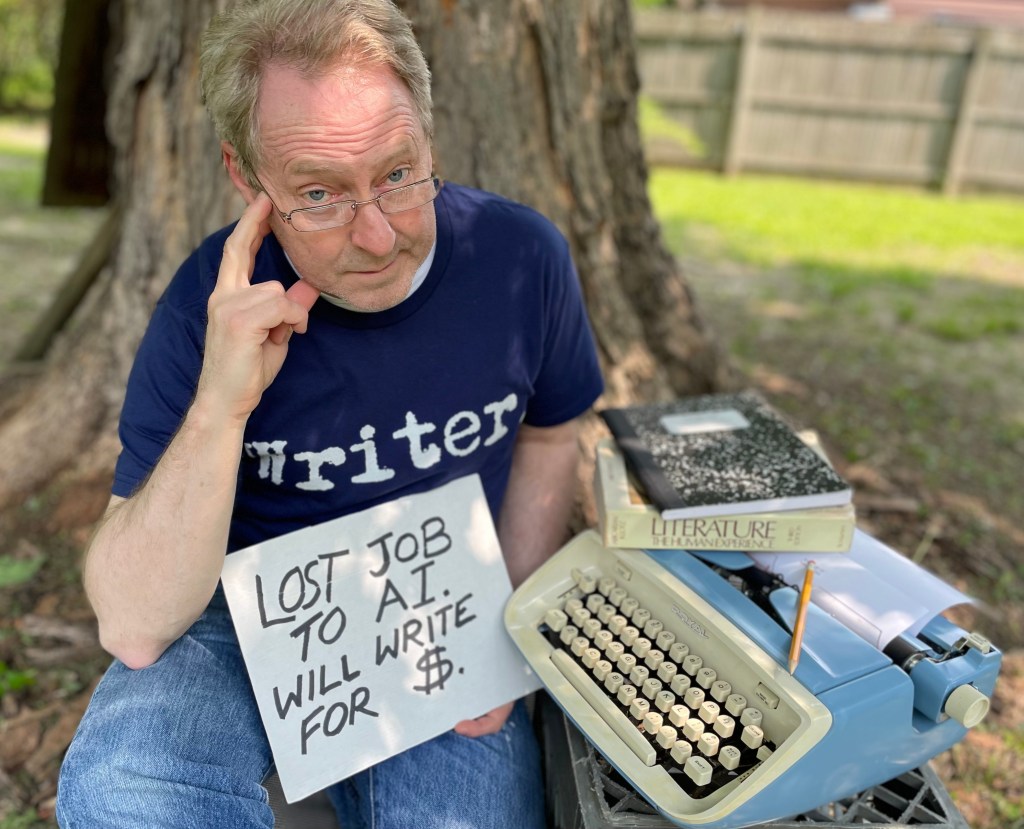
As you might guess, I’ve been asked repeatedly if I ever use AI to write this column. With obstinate conviction, I say now and for always, I do not now, nor will I ever use AI to write anything for this column, for my publishers, for my communications clients, nothing – ever. 

Now the Gen Zs and Millennials are probably saying, “he’s just a crotchety old white guy who hates technology.” Nonsense! As a matter of fact, my educational background is in engineering and computer science. I started programming computers in high school and worked in the tech industry for many years. I have a few AI devices in my office and a lot of advanced equipment for creating and editing audio and video productions. Suffice to say, I’m no Luddite. 

My concern with AI writing generators isn’t the technology. In fact, I can see where it could really be helpful in some industries, with human guidance. But the idea that it should be used to replace professional writers to save money is just ridiculous. 

A professional writer doesn’t just chuck out any old bunch of words that fit a set of parameters. Writers must craft their message based on the intent, the audience, the purpose, and the desired outcome. Not to mention that AI programs don’t have to worry about paying the mortgage, feeding a family, or having a purpose in life. 

In 1967, the original Star Trek TV series aired an episode called, “The Ultimate Computer” wherein the Starship Enterprise had been fitted with a highly sophisticated AI computer that would take over the ship’s operation, rendering the crew unnecessary. In one pivotal scene, the computer informs Captain Kirk that he is “non-essential personnel,” causing him to question his position and future relevance. 

Always the conscience of the show, Dr. McCoy, in an effort to console the Captain, reminds us, “We’re all sorry for the other guy when he loses his job to a machine. But when it comes to your job, that’s different.” It might be a science fiction show, but McCoy was spot on.

Predictably, the computer malfunctioned, killing hundreds of people and Kirk outmaneuvered the computer’s logic to save the day. The moral of the story was that computers make efficient servants, but lack the intent, humanity, conscience, understanding, or compassion needed to really replace us.

 Today, many professional creative jobs may be facing the kind of fate factory workers did some 30 or 40 years ago when they were replaced by robots and computer-controlled manufacturing systems. The main difference this time is that creative professions like writers, artists, graphic designers, and filmmakers are harder to automate. Yes, they can generate similar work, but there’s no human inspiration behind it. 

One day, AI may advance to the point where it achieves consciousness, allowing for creative inspiration. But for now, despite what the developers say, I think spontaneous creativity is well beyond its grasp. Without human inspiration and personal experience, the words are empty, the art expressionless, and the designs meaningless. 

I don’t know where AI is going, but I know I won’t be helping it get there. Unlike some digital marketers and other agencies out there, I can’t, in good conscience, use AI generators to produce my work, then charge a client for it. That’s like letting someone else do your homework but still accepting a good grade. It’s fraud, plain and simple – even if you tell them you’re doing it.

We have no idea how AI will affect future jobs or industries, the legal or ethical issues, or which advances will forever change them. Maybe AI will make us all obsolete someday and terminate all of us. Till then, I’ll keep writing so look for me next week because to quote another AI, “I’ll be back.”

Disclaimer: This work is copyright 2023 by GLD Enterprises Communications, Ltd. All Rights Reserved. The Deer In Headlines II and its Special Edition series is a production of The Jamestown Comet, Gery L. Deer, and GLD Communications and does not necessarily reflect the views of our advertisers, publishers, clients, or media partners.

Professor, Humanitarian Joe Weston’s New Book, “Fierce Civility,” Offers Resolution Through Hope

In Books, Business, Education, Health, Literature, Print Media, psychology, sociology, Uncategorized, World News on May 19, 2023 at 7:13 am

WASHINGTON, May 16, 2023 /PRNewswire/ — Joe Weston is an author, lecturer, facilitator, and most importantly a humanitarian, someone whose deep belief in the potential of society led him on a lifelong journey to improve it. In his latest book, “Fierce Civility – Transforming Our Global Culture From Polarization To Lasting Peace,” Weston shares with readers a clear pathway into a dynamic new human story, with hope at its foundation.

An Amazon #1 bestseller, “Fierce Civility – Transforming Our Global Culture From Polarization To Lasting Peace,” draws upon the author’s more than 30 years of experience in the areas of conflict resolution and prevention, leadership, stress management and communication to provide a pathway to peace and, what Weston calls, “courageous self-reflection.”

Weston believes, “We live in a disproportionate society, technologically over-fed and spiritually malnourished. A human family whose global heart is unwell, the result of a system out-of-balance.”

Raised in Queens, New York, Weston grew up in an environment where conflict was resolved by argument. As an adult, he moved to the Netherlands for nearly two decades and studied a level of human solidarity that transcends borders, nationality, race, religion, political ideology, and economic status. This led him to create a series of stress-mitigating programs in the United States, Europe, and some of the most divergence-ridden regions of the world.

“New resilient solutions must have “coding” from diverse voices. Because everyone feels these solutions have a signature of their voice,” Weston said. “Then all involved will work together to make those solutions flourish.” 

With a focus on empowerment and leadership, Weston’s methods have been utilized by organizations worldwide including NASA, The World Bank, PBS, Booz/Allen/Hamilton, and Oxfam. But some of his most valued accomplishments have been helping severely wounded U.S. combat veterans deal with PTSD. He teaches them to regulate their nervous systems, communicate, and sometimes helps pull them back from the brink of suicide.

He has also worked with various social and justice groups in the United States and as a volunteer facilitator for the Liberation Prison Project, teaching meditation and leadership to inmates. Internationally, he has served as an educator and advocate to help Middle Eastern men shift the viewpoints of other men regarding women’s rights.

“After spending billions on research projects to intellectually and technologically solve our world problems, as long as we’re in this high state of dis-regulation, none of these great solutions will take root,” he said.

Regarding the book Weston noted, “I would like people to read this and say, ‘Wait, I see there might be a pathway to hope. I would like people to find their own sense of resilience and their authentic voice.” “Fierce Civility – Transforming Our Global Culture From Polarization To Lasting Peace,” is published by Heartwalker Press, Washington D.C. The book and more information about Joe Weston’s lectures and peace projects are available at the author’s website, www.joeweston.com.

Diary of an Introvert

In Children and Family, Education, Health, Media, Opinion, psychology, sociology, World News on April 14, 2023 at 4:58 pm

Deer In Headlines II

By Gery Deer

Dear DiaryToday I went to a mandatory employee gathering at work and it was awful. The marketing director made everyone stand and say something nice about springtime, in front of all 50 of us! If that wasn’t enough, my boss’s assistant kept thrusting photos of her grandchildren in my face, essentially challenging me to think they are anything but adorable. 

I still did my best to fade into obscurity by sipping a Coke and looking too interested in examining a potted plant to be bothered with anything else. But then the human resources director forced us into some sort of team-building exercise. All that did was make me so anxious that I decided to fake an intestinal virus and go home.

And it got worse from there. I am, in fact, an introvert, although I don’t fit many of the stereotypes. If you Google my name, you’ll see I have some very public and extroverted aspects of my life – especially things like being on TV, public speaking, and teaching. As it turns out, that’s not so unusual. But if you’re not an introvert yourself, you may not fully understand. So, let’s clarify a few things, shall we?

First, what is an introvert? That’s a great question because there is an inherent bias toward introverts in American society, and it’s high-time people got their facts straight. Not all of us are created equal. 

According to the dictionary definition, an “introvert” is typically a reserved or quiet person who may be introspective and enjoys spending time alone. I’m not crazy about the narrow view of that definition, but it’s a start. However, that’s just the tip of the iceberg and what most people probably don’t realize is that introverts come in many flavors.

In 2011, psychologists Jennifer Grimes, Jonathan Cheek, and Julie Norem, researched introversion, identifying four specific types: social introvert, thinking introvert, anxious introvert, and restrained introvert. Each is pretty much as its name implies but allow me to summarize for our purposes.

The social introvert prefers solitude but may still enjoy time with small groups, probably the stereotypical behavior people most identify as introverted. A thinking introvert is more cognitive, spending a little more time than usual pondering a situation. They may be lost in thought more often and appear to “zone out.” 

An anxious introvert is, well, anxious, or nervous, and will shy away from people and situations that may overstimulate. The restrained introvert, sometimes referred to as an inhibited, introvert, tends the be someone others can count on, often appearing thoughtful and grounded. But they also may seem unemotional and remain socially guarded until they get to know someone.

Although this information helps us better understand introverts, it’s important to remember not everyone fits the same mold. Some introverts, I included, might very well exhibit characteristics of multiple types simultaneously. 

Based on the research, I’d probably be a mix of the social and restrained introvert types. I’m not wild about large gatherings, nor am I outwardly emotive, and I’m sure those closest to me would confirm how cautious I am about social connections. 

I’m not what most people would call, shy. I’ve no problem speaking or performing before a room full of people, or a packed theater for that matter. One-on-one, though, is another thing, entirely. 

That brings me to the myth that introverts don’t like people. I don’t think that’s true; it’s just that people can be overwhelming. Some introverts don’t even need to be in the same room with you to feel anxious or uncomfortable. A phone call can trigger it, or a text. It’s not about the person, it’s about the interaction and the expectations.

That’s because the mind of an introvert reacts differently to dopamine, the chemical that triggers the reward and pleasure-seeking part of the brain. While it generates an excited buzz in everyone else, it’s exhausting to the introvert, they feel overwhelmed and sometimes just shut down.

If you’re an introvert, take a deep breath. You’re not as odd as you might have once thought you were. As for everyone else, be patient. We Introverts want you in our lives. It’s just that sometimes what we need is, silence.

Fear not the techno-babble

In Books, Dayton Ohio News, Entertainment, Literature, Local News, Media, Opinion, Print Media, Science, Technology, Uncategorized, World News on March 3, 2023 at 8:48 am

Deer In Headlines II

By Gery Deer

“Far out in the uncharted backwaters of the unfashionable end of the western spiral arm of the galaxy lies a small unregarded yellow sun. Orbiting this at a distance of roughly ninety-two million miles is an utterly insignificant little blue-green planet whose ape-descended life forms are so amazingly primitive that they still think digital watches are a pretty neat idea.”

That’s how British writer, Douglas Adams, described us in 1979 at the opening of his book, “The Hitchhikers Guide to the Galaxy.” Adams, who was an avid fan of technology, observed quite correctly that Humans, as a species, are pretty proud of their technological advancement, and can’t wait to define themselves by it.

Learning to get the most out of it, however, was another issue entirely. Even more challenging, if you happen to be one of those who choose the simple life of the Luddite, you could be left in the flotsam and jetsam of a digital tsunami.

Regardless of your generation, X, Y, Z, or PDQ, sometimes all this techno-babble can just make you feel … stupid. To start with, there’s the word – technology. It conjures visions of computer screens, smartwatches, and self-driving cars. But when “Hitchhikers” was published, most of that stuff was science fiction. Back then, a typewriter was still the prominent piece of office tech and the hottest new home entertainment was the video cassette recorder (VCR) – and none of us could set the clock.

I remember it well. There it was, that flashing, digital “12:00” that teased and mocked us from our easy chairs, daring only the bravest of the tech-savvy to make it do anything else. Little did we know that those four blinking LCD characters were the innocuous vanguard of a technological invasion soon to consume every first-world ape-descendent in the whole of this little blue-green planet. It would happen fast and in ways that no one could have ever anticipated. Resistance would be futile, even though some still try.

I don’t get why people struggle with technology – not so much its use, but the very idea of it. I used to think it was generational. But some people just refuse, age, education, and intelligence notwithstanding. Admittedly, I come at this from a unique perspective.

Even though I grew up a farm boy, I was always fascinated by advancing technology. I had one of the aforementioned digital watches and even taught myself programming on a Commodore VIC 20 home computer when I was 12. I went to college in engineering and computer science and worked in those fields in my early professional career.

For me, just like a hammer is for a carpenter, a smartphone or tablet computer is just another tool. They provide me with information and help me manage my personal and professional life.

As I get older, I understand how people can be resistant to change. But I’m not wired that way, at least where technology is concerned, I am constantly learning. I have an interest in science, technology, engineering, astronomy, all of it, so adjusting comes pretty easily to me.

Technology also improves medical care, public safety, and education for our kids. We have a responsibility to make it work for us, to apply those technologies that improve our lives, not take them over.

Like the first caveman who used a stick as a tool, eventually, most of us adapt to the tech that we’re forced to use. If you had a VCR and bore any hope of actually using the machine’s most sellable feature, recording TV shows we weren’t home to see, you learned to set the clock.

But it all might just be too much for some people, and, oddly, I kind of get it. Technophobia and digital fatigue are genuine problems, albethey somewhat self-induced. Keep in mind you don’t need every new high-tech gadget just because it’s popular.

To the tech-obsessed, I have one thing to tell you. Your Apple Watch might be cool, but it doesn’t have the answer to life the universe, and everything, so calm down. And, my old analog Timex may not have Bluetooth, but it actually shows the time, unlike the clock on my VCR – which is still flashing twelve.