Local News & Commentary Since 1890.

Archive for the ‘Politics’ Category

We Need to Stop Warrantless Spying on Americans. Here’s How.

In history, National News, News Media, Opinion, Politics, Uncategorized on April 17, 2026 at 9:38 am

COURTESY: The New York Times – April 17, 2026

A photo of a blurry surveillance camera, in the foreground, against a sharper-focused seascape in the background.
Credit…Grade Solomon

By Mike Lee and Dick Durbin

Mr. Lee and Mr. Durbin are senators.

Add The New York Times on Google 

This article was updated to reflect news developments.

We disagree on many issues. One of us is a longtime Democrat, the other a conservative Republican. But both of us are deeply concerned about warrantless government surveillance of the American people.

In 2008, Congress enacted Section 702 of the Foreign Intelligence Surveillance Act to allow the government to gather vital intelligence about foreign governments, terrorists and spies. The problem is that it has also allowed agencies like the F.B.I. and the National Security Agency to regularly gather and search through the private communications of American citizens without a warrant. That is a clear violation of rights protected by the Constitution.

It’s true that Section 702 doesn’t allow the direct targeting of Americans, but their communications are still often gathered during the warrantless surveillance of foreigners abroad. Once the government has this data, agencies then have the ability to search through it. And they do: Transparency reports reveal that thousands of such searches are performed every year. A federal court previously found that some the F.B.I. had conducted had violated the Fourth Amendment.

Predictably, without a requirement for court approval of these searches, abuses have been rampant. As a recent report from the Brennan Center for Justice highlighted, F.B.I. agents in recent years have searched for the communications of “protesters across the political spectrummembers of Congress; a congressional chief of staff; a state court judgemultiple U.S. government officials, journalists and political commentators; and 19,000 donors to a political campaign.” In a time of extreme partisanship, these abuses have provoked bipartisan outrage.

Congress should have a serious and informed debate on these issues rather than ramming through a reauthorization of Section 702 with minimal reforms yet again, sidelining Americans’ constitutional rights in the process.

That’s why the two of us have proposed the Security and Freedom Enhancement (SAFE) Act, a compromise that would reauthorize the valuable core of this tool while enacting reasonable safeguards to protect the Fourth Amendment rights of all Americans.

The government would still be able to check its databases to uncover connections between targeted foreigners and Americans. But it would have to get court approval in the small number of cases in which these searches have generated results and the government has a proper basis for gaining access to the contents of the communications. Importantly, our warrant requirement also contains robust exceptions for legitimate emergencies, so that we can balance civil liberties with legitimate security needs.

Our bill would also cut off another form of warrantless surveillance: the widespread practice of circumventing the Fourth Amendment by purchasing Americans’ sensitive information from data brokers.

The Department of Justice (including the Drug Enforcement Administration and the F.B.I.), the Department of Homeland Security (including ICE, Customs and Border Patrol and the Secret Service) and the Defense Intelligence Agency have purchased cellphone location information for millions of Americans. Such information is highly sensitive and can reveal intimate details of that person’s life. Even more troubling, artificial intelligence could supercharge such surveillance, allowing the government to harvest and analyze mass quantities of highly personal and sensitive information about Americans without court approval. Our legislation would close these loopholes — again with pragmatic exceptions to accommodate legitimate safety and security needs.

Congress should not take an all-or-nothing approach to reauthorizing Section 702. We have the time and the responsibility to get this right. Members may disagree about what reforms are required — that’s why we have debates and amendments. But simply extending the law without any changes to protect Americans’ privacy should be off the table.

We owe it to the American people to meet this moment and do our jobs to protect both national security and civil liberties. Our bill offers a bipartisan solution to do just that.

Mike Lee, Republican of Utah, and Dick Durbin, Democrat of Illinois, are senators.

The Times is committed to publishing a diversity of letters to the editor. We’d like to hear what you think about this or any of our articles. Here are some tips. And here’s our email: letters@nytimes.com.

Follow the New York Times Opinion section on FacebookInstagramTikTokBlueskyWhatsApp and Threads.

Lincoln Day Dinner

In Dayton Ohio News, Local News, Politics on February 19, 2026 at 10:09 am
Husted (photo submitted)

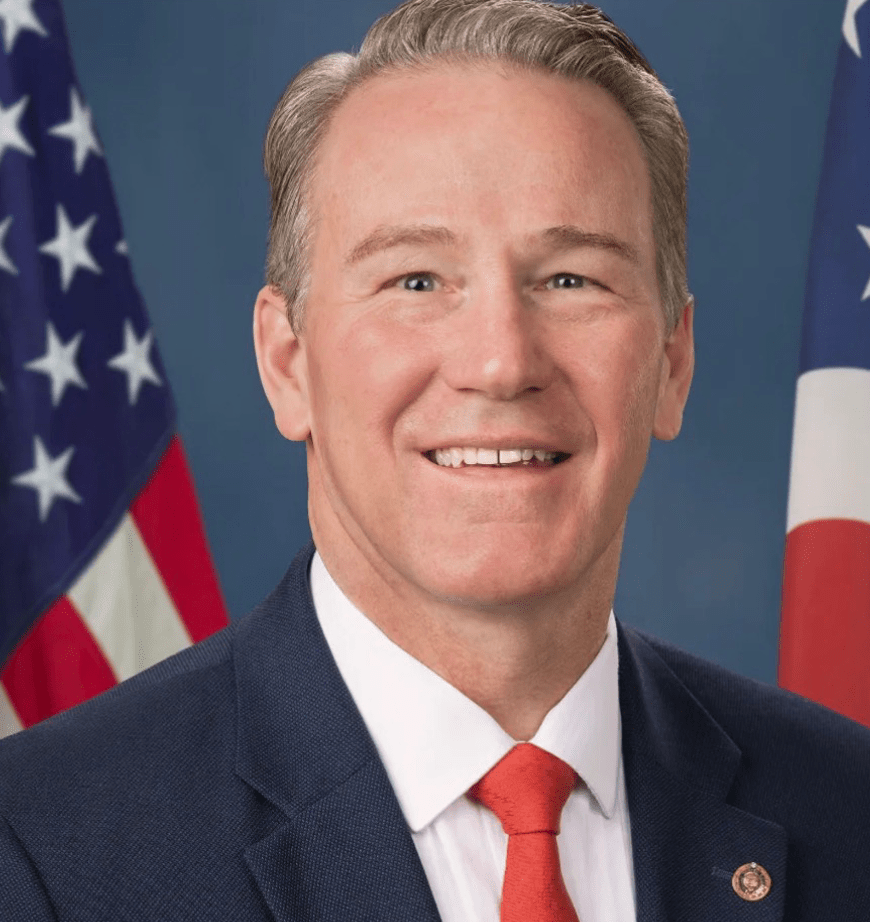
Ohio Senator Jon Husted will speak at the Greene County Republican Party Lincoln Day Dinner on Friday, March 6, at the Fairborn DoubleTree by Hilton (2800 Presidential Drive, Fairborn, OH).  Senator Husted was appointed by Governor DeWine to replace then-Senator JD Vance after Vance was elected Vice President.  Senator Husted will be introduced by Congressman Mike Turner from Ohio’s 10th District (Montgomery, Greene, and part of Clark Counties). 

The evening will begin with an opportunity for underwriters and table sponsors to meet with Senator Husted from 4:30 to 5:15pm.  The doors open for general admission at 5:15pm and the program will begin at 6:00pm with opening formalities, guest speaker remarks, and dinner.  

In addition to Senator Husted and Congressman Turner, many elected officials and candidates for state and county offices are expected to attend.  Tickets may be purchased from this site:  https://tinyurl.com/4dy93ha9  For more information, call (937)974-7917.

Information provided by Carolyn Uecker, Lt Col, USAF (Ret)  (937)974-7917

Rogue nation: USA

In National News, Opinion, Politics, Uncategorized, World News on January 11, 2026 at 11:24 pm

Deer In Headlines

By Gery Deer

I’ve avoided direct political commentary but, on this subject, it’s hard to remain silent. I’m sickened by the recent behavior of our federal government – all three branches. Whatever your political affiliation, it is impossible to look at the behavior of the current American administration and call it normal. 

What we are witnessing is not tough diplomacy or considered leadership, but a pattern of outlandish conduct that mocks international law and the values the United States claims to champion. When power is exercised without restraint, justification becomes propaganda and accountability disappears.

First, there’s the kidnapping and prosecution of a sitting president of Venezuela. Nicolás Maduro may be a corrupt, authoritarian, drug-trafficking criminal. But none of that gives the U.S. Government legal or moral authority to invade a sovereign nation, seize its head of state, and drag him into an American courtroom without extradition or due process.

Defenders argue that Venezuela’s constitution explicitly prohibits extraditing its own citizens, and the bilateral extradition treaty has long been shaky, suspended in practice by Caracas itself. However, that does not excuse abduction. When lawful avenues are blocked, the answer is not to ignore law altogether. The absence of a workable treaty is not permission to kidnap; it is proof that diplomacy and international pressure, however slow, are the legitimate tools.

This is not how a nation behaves that claims to respect due process. When the world’s most powerful democracy discards extradition treaties and international courts, it signals that rules apply only to the weak. History demonstrates that such a precedent will not protect Americans when the balance of power shifts.

We have been down a similar road before. In 2003, the United States invaded Iraq and removed its leader under the banner of national security. In hindsight, no weapons of mass destruction were found – the years-long operation failed. Hundreds of thousands died. A region was destabilized. Extremism flourished. American credibility was deeply damaged. The lesson should have been clear: removing leaders by force creates chaos, not democracy. Yet here we are again, acting as though power excuses everything.

As if that were not reckless enough, the same administration now speaks openly about literally stealing Greenland from Denmark, as though the territory were merely a trinket to be bought, bullied, or taken by force. Denmark is a NATO ally and Greenland’s people have repeatedly said, “no thanks.” The insanity of a United States military invasion and seizure is unprecedented. It’s forced occupation and shatters trust with allies.

We are told these actions keep us safe and project strength. Instead, they isolate us, invite retaliation, and encourage other nations to discard restraint. When America behaves like regimes it once condemned, the moral high ground collapses beneath our feet.

What is perhaps most alarming is the resistant silence. Congress, entrusted by the Constitution with oversight, war powers, and the duty to restrain executive excess, appears paralyzed. Some lawmakers mutter concerns and look away. Too many say nothing, whether from fear or calculation. This is not how a functioning republic responds to dangerous overreach.

The Democratic Party looks toothless. Republicans who should speak out remain complicit. Checks and balances mean nothing if not exercised. History will not be kind to those who watched democracy collapse and did nothing to prevent it.

Once respected because it claimed to stand for something great and honorable, the U.S. now risks becoming a cautionary tale. Feared and mocked rather than trusted and admired. 

And all of this would be just as wrong if the other party did it and none of it is patriotic. Patriotism is not blind loyalty to a leader or party. Patriotism is fidelity to principles: the rule of law, respect for sovereignty, restraint in the use of force, and accountability at home. Plus, when billions are spent on coercion while vulnerable children, seniors, and veterans lose essential services, moral priorities have evaporated. 

If this behavior continues unchecked, the damage will outlast any presidency. Democracy demands courage from lawmakers who will resist, and citizens unwilling to excuse abuses of power perpetrated in their name. Laws can be repaired, and alliances restored, but only if someone is finally willing to draw a line and Congress acts with courage, and constitutional responsibility.

Share your concerns about ODOT-owned/maintained roads.

In Dayton Ohio News, finances, Local News, Politics, Technology, Uncategorized on September 24, 2025 at 11:31 am

Provided by the Greene County Engineer:

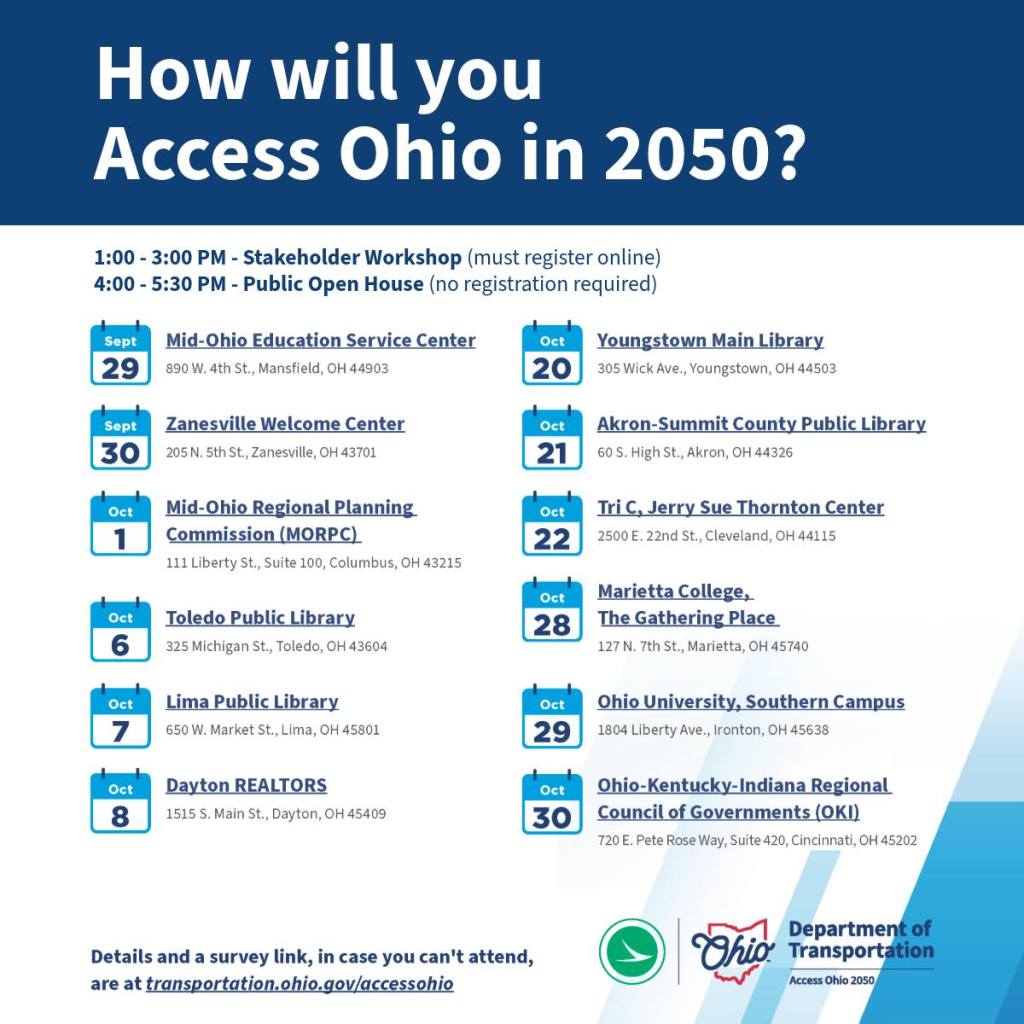
The Ohio Department of Transportation (ODOT) is developing a multi-modal, long-range transportation plan that will shape the state’s transportation policies and investments over the next 25 years. Access Ohio 2050 outlines 10 objectives designed to achieve four key goals: safety, preservation, efficiency, and mobility.

ODOT oversees projects on major roadways, including highways and interstates across the state and here locally of 675, 68, 235, 35 , 444, 4, 70, 73, 42, 380, and 725.

Now is your opportunity to share your input with ODOT at locations we hear concerns about from you on ODOT owned/maintained roads, like I 675 at Wilmington Pike, I 675 at Grange Hall, I 675 at WPAFB Gate, US 35 Superstreet in Beavercreek, US 68 at Hyde Road, SR 235 at Trebein Road, SR 235 at Bryon Road, SR 235 at Hilltop Road, US 68 at Brush Road, Spring Valley Paintersville Rd at SR 380, etc This is your opportunity to share input on future projects in the Greater Miami Valley and across the state!

(DIRECT PUBLIC SURVEY LINK)

These concerns can be intersection safety related, corridor safety related, traffic congestion related, pedestrian safety related, bike crossing safety related, road condition related, etc.

Attend the Public Open House on Oct 8!

Complete the online survey!

Click the link to take the survey: https://publicinput.com/v54281

While the survey uses a rating scale, additional comments and feedback are welcome and can be sent directly to:

• Casey Clark, Project Manager: Casey.Clark@dot.ohio.gov

• Randy Lane, Statewide Planning Manager: Randy.Lane@dot.ohio.gov

Learn more here https://www.transportation.ohio.gov/programs/accessohio

Note : Comments posted on this post are NOT collected as part of the survey so please go to their page and complete the survey and submit your feedback there, attend the open house and/or email them directly.

On Facebook:

Ohio Department of Transportation – Cincinnati District 8

Ohio Department of Transportation

Greene County Sheriff’s Office

Ohio State Highway Patrol

Operation Crowdfunded

In Health, Opinion, Politics, Uncategorized on September 23, 2025 at 2:58 pm

Deer In Headlines II

By Gery Deer

The United States of America: the land of innovation and opportunity, where billionaires launch rockets for sport and algorithms decide your mortgage rate. So, it shouldn’t surprise anyone that Americans now turn to crowdfunding to pay for basic healthcare. Not as a quirky side hustle, mind you, but as a legitimate strategy for survival.

This year, roughly 1.8 million Americans will be diagnosed with cancer. The average cost of treatment? A cool $183 billion. That’s not per person, of course—just the collective tab. But when you break it down, individual patients often face six-figure bills, even with insurance. Meanwhile, nearly 70% of seniors will require long-term care, either at home or in a facility. And with government assistance programs shrinking faster than a hospital gown in the dryer, many are left to fend for themselves. Each year, more and more are turning to crowdfunding.

According to statistics published by Astute Analytica, Americans raise more than $3 billion annually through platforms like GoFundMe, GiveSendGo, and others—most of it for medical expenses. While that might seem a heartwarming testament to community spirit, it’s simultaneously a tragic commentary on our national priorities.

When you live in the “richest” country on Earth and someone in a white coat says the words, “You have cancer,” but your best hope for affording chemotherapy is a well-written plea and a viral social media post, something’s gone horribly awry.

Let’s compare this to the more “official” solution: Health Savings Accounts (HSAs), tax-advantaged accounts tied to high-deductible insurance plans. In theory, they help you save for medical expenses. But their nature pretty much excludes the people who actually need the money.

HSAs require disposable income to fund. Plus, they’re capped at a few thousand dollars per year. That’s great if you’re buying allergy meds or paying for a routine checkup. But without some serious money tucked away, you could still be in trouble if you need something like an appendectomy, for example, which averages around $13,000.

Crowdfunding, on the other hand, offers flexibility. You don’t need to qualify for a high-deductible plan. You don’t need to navigate IRS rules. You just need a compelling story, a few sympathetic friends, and the ability to market your misfortune.

Imagine a future where every citizen maintains a personal healthcare fund online. You could even petition the IRS to classify seniors and disabled individuals as not-for-profit entities. That way, when a billionaire donates to your cancer treatment, they get a tax write-off. It’s a win-win. You get a shot at survival, and they get to feel philanthropic without disrupting their yacht schedule.

Of course, this would also stimulate the tech economy. Crowdfunding platforms would flourish, transaction fees would soar, and a new generation of entrepreneurs would emerge to optimize the monetization of the already bloated medical crises. But there are challenges – big ones.

If everyone’s running a campaign, how do you stand out? Do you offer donor perks? “Contribute $100 and receive a personalized thank-you video from my hospital bed.” Do you hire a public relations firm to promote your gallbladder surgery? “Compassion competition” can become fierce. Those without strong social networks or digital savvy would likely struggle to raise anything at all.

With so many medical coverage decisions being made in the board room rather than at the bedside, this model has its appeal. It’s more transparent than insurance billing, more immediate than government aid, and more democratic than corporate healthcare.

Some say healthcare should be a right, not a raffle – I tend to agree. It’s absurd that anyone should have to beg for insulin or auction off their belongings to afford a colonoscopy. But in a country where tax breaks for billionaires are considered sacred and universal healthcare is viewed as some kind of socialist takeover, absurdity might just be the most realistic and successful option.

So sure, let’s embrace the irony of a system where survival depends on storytelling and digital advertising prowess and crowdfund our medical care. We will just have to hope that, someday, we’ll look back on this era not as a failure of policy, but as a resourceful bureaucratic bypass—when Americans took their health into their own hands, one donation at a time.

Library Fines

In Books, Children and Family, Education, Local News, Opinion, Politics, Uncategorized on May 2, 2025 at 10:24 am

Deer In Headlines II

By Gery Deer

(Editor’s note: This edition also appears in other publications under the title “Checked Out.”)

As a kid, the local branch of the public library was in the old opera house near the center of our small farm town. It was cramped and dimly lit, and the reference desk was under the boarded-up grand staircase, giving it a sort of cubby-hole feel. I spent a good bit of time there. After school, I’d do my homework and wait for my mom to get off work. In the decades before the Internet, our library was the window to the world. But now, that window may be closing.

Ohio public libraries are funded, in part, by the Public Library Fund (PLF), which provides 1.7% of the state’s General Revenue Fund (GRF) as of this writing. However, the Republican-sponsored Ohio House Bill 96, proposed in early April of this year, would cut library funding by more than $100 million across the state. Why?

Governments have historically manipulated populations by controlling education and the media. They ban books that don’t align with their values, use defunding threats to force public and school libraries to cultivate materials for their purposes, and limit access to information. That way, voters remain ignorant, subjugated, out of touch, and pliable.

And before anyone says, “you just hate republicans,” they’re not the only ones to try this. Ohio Governor Ted Strickland, a democrat, proposed the same budget cuts a dozen years ago, and the republicans cried foul. Remember, the liberal left still regularly tries to “rewrite” some books to remove language and ideas they find offensive. So, it has gone both ways. This time, however, the danger is more palpable.

Over the last decade, public libraries have become frequent targets for budget cuts, with some policymakers arguing that digital access negates their necessity. But here’s the truth: libraries remain vital to the well-being of communities, and continued funding by federal and state governments is not just important—it’s essential. Without it, we risk depriving countless individuals of educational opportunities, civic engagement, and economic mobility.

Public libraries provide free access to knowledge for everyone (so long as their contents are not censored), regardless of socioeconomic status. Whether it’s a student researching for school, a small business owner seeking resources, or a job seeker brushing up on interview skills, libraries level the playing field in ways no digital paywall ever could. Eliminate government funding, and these services vanish, disproportionately affecting low-income communities. Instead of fostering informed citizens, we create a deeper knowledge divide, where only those who can afford education can access it.

A democratic society thrives when its citizens are informed, and libraries serve as safe spaces where people can access unbiased, factual information. They offer literacy programs, historical archives, and meeting spaces for community discussions—all of which help create engaged and empowered citizens. Where do people go for credible information when libraries close because of defunding? Unfortunately, they turn to the Internet and social media – the global misinformation machines. That’s a terrifying thought.

Libraries don’t just provide books—many offer essential services that help individuals improve their financial stability. They provide free internet access for job searches, resume-building workshops, business mentorship programs, and resources to help entrepreneurs. Government officials profess at nauseum about supporting small businesses and the workforce. Then they gut library funding and undermine those initiatives directly. If libraries disappear, so do these essential services, making it much harder for people to improve their situations.

Defunding libraries erodes the foundation of an educated, informed, and economically mobile society, which is exactly what this administration hopes to achieve. Without them, misinformation flourishes, the digital divide widens, and people lose access to critical resources for success. Libraries are not relics of the past—they are the lifeblood of communities, supporting everything from literacy to local economies.

So, before cutting another dollar from public libraries, policymakers should ask themselves: Do they really want a future where only the privileged have access to knowledge? Without funding, that’s exactly where we’re headed.

Good people on both sides of the aisle must speak out against this kind of censorship and ignorance. In Ohio, you can contact your state representative or State Representative Matt Huffman, currently Speaker of the Ohio House of Representatives: email rep78@ohiohouse.gov or call 614-466-6344.
Booker: Truth to Power

In history, National News, News Media, Opinion, Politics, sociology, Uncategorized, World News on April 11, 2025 at 1:57 pm

Deer In Headlines II

By Gery Deer

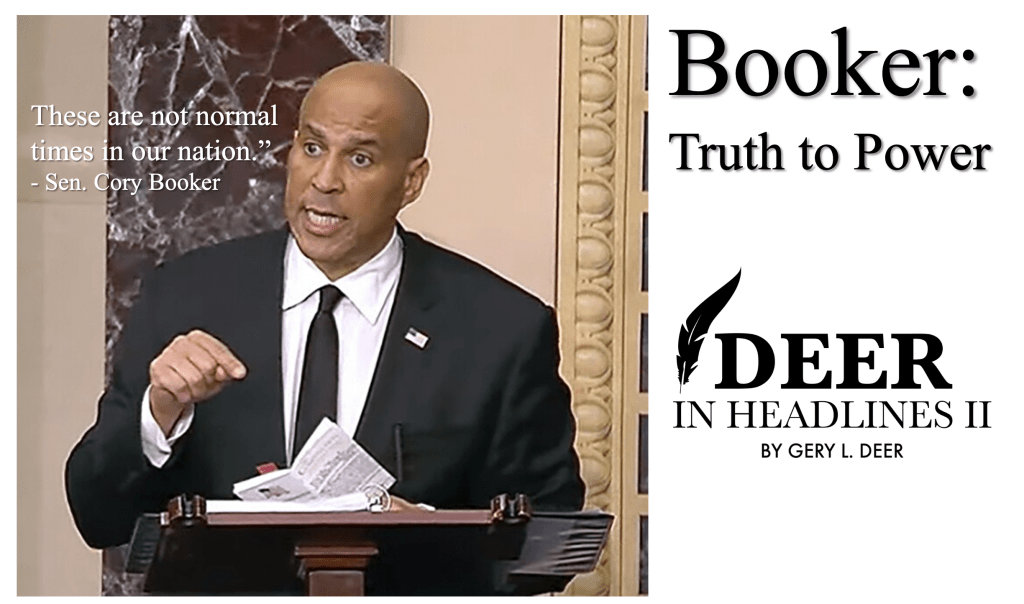
Last week, we saw an incredible example of unmitigated patriotism to provide a voice for those who have none in the face of a president who runs roughshod over anyone who dares oppose him. Cory Anthony Booker, the senior senator from New Jersey, took and held the Senate floor for 25 hours and 5 minutes in a marathon speech in opposition to President Trump’s haphazard and potentially illegal actions during the first three months of his term.

Until now, congressional resistance toward the president has been lackluster, to say the least. This is understandable considering the GOP’s control in both houses and the way this administration has reacted to any opposition, as a petulant child would on a playground when denied an ice cream cone. It’s embarrassing and troubling. Congressional town hall meetings across the country have been disrupted by constituents demanding that Trump be held accountable for the repercussions of his actions.

Most disruptors are ushered out or jailed for the disturbances, but their point is well taken. This president has been actively, deliberately, and defiantly testing the limits of his office and the ability of the other branches of government to keep him in check as designed.

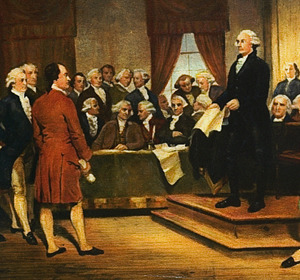
In 1787, the men governing the 13 original American colonies had been through a great deal. They’d declared independence from the most powerful country in the world, fought them in a bloody revolution, won, and finally managed to cobble together a set of laws to live by, unlike anything seen before. The newly minted Constitution was the single most important document ever drawn up to that point – and still is today. The Preamble and Bill of Rights (the first 10 amendments for those who slept through fourth grade) are the gold standard for governing a democratic republic.

It’s doubtful the Founding Fathers ever imagined their fledgling country, still in its infancy today by European standards, would end up being tested, not by a foreign enemy, but by a power-mad oligarch occupying the president’s office. And, until today, very few have had the courage or opportunity to openly stand up to him.

Monday, March 31st, Booker took to the Senate floor and stated he’d remain there as long as he was “physically able,” and that he did – and it was no small feat, even for a former football tight-end. To hold the floor, whoever is speaking must keep talking and can’t stop, sit, lean on anything, or leave the floor for any reason. Fellow Democrats helped out, though, per Senate rules, allowing them to interrupt and ask him questions.

Over a day later, the 55-year-old senator finished speaking and limped off the floor. But, during his time, he held nothing back, walloping Trump on everything from his sweeping cuts to social services to what he called the impending “constitutional crisis” created by the president’s authoritarian actions.

To be clear, several Republicans have taken the same long-winded action on various issues over the last few years, most unsuccessfully. Such a speech isn’t a liberal or conservative move but that of a legislator committed to being heard on behalf of their constituents or the country.

Booker’s record-breaking speech was patriotic because he spoke for more than just those in his voting district. He voiced the fears not just of New Jerseyans but Americans nationwide. His words begged for compassion, kindness, and common sense – from those on both sides of the aisle. After all, when Trump’s own party doesn’t stand up to him, knowing his actions are questionable at best, someone else must.

The real question is, will Booker’s speech fuel a more dauntless anti-Trump resistance? Possibly. For more than a day, the New Jersey senator knocked the president’s agenda off the front page of every news outlet website, here and abroad. Not to mention the 350 million “likes” during the live stream on TikTok.

One thing is sure. Democrat or Republican, people must realize that Trump’s actions prove his agenda is to serve himself and his billionaire friends, not the country. So, to quote Senator Booker, “These are not normal times in America,” he said. “And they should not be treated as such in the United States Senate” or anywhere else.

Absolute Power

In history, Opinion, Politics, psychology, Uncategorized, World News on March 26, 2025 at 1:58 pm

Deer In Headlines II

By Gery Deer

Power, like money, is nothing if you have enough, but everything if you don’t. But what is it? Who has it, and what are those without it supposed to do when faced off by those who do? I’m not sure I’m smart enough to answer any of those questions. If you’ll indulge me, however, I’ll make an attempt to do so and put it into a contemporary context. First, a little history – the kind we should learn from or be doomed to repeat.

It was 1887 England. In a series of letters to Bishop Creighton concerning the issue of writing history about the Inquisition, John Dalberg-Acton, the 1st Baron Acton, or better known as Lord Acton, wrote, “Power tends to corrupt, and absolute power corrupts absolutely.” Most people are familiar with the quote, but few know the preceding passage, which gives it perspective.

“I cannot accept your canon that we are to judge Pope and King unlike other men, with a favourable presumption that they did no wrong,” Acton wrote. “If there is any presumption it is the other way against holders of power, increasing as the power increases. Historic responsibility has to make up for the want of legal responsibility.”

That’s some pretty fancy, but important language. Put more simply, Lord Acton was saying that the same moral standards should apply to everyone, including political and religious leaders. Throughout history, kings and popes were permitted, essentially, to wield their authority unchecked.

America’s Founding Fathers shared the same concern. So much so that when they created a constitution for their new country, coincidentally ratified the same year as Acton’s historic correspondence, it established three separate but equal branches of government to prevent such authoritarian power.

Power is a dangerous thing, especially in the hands of two kinds of people – those who want it, and those who want to keep it from others. The first is driven by greed, the second by fear. Lord Acton was commenting on accountability, something the Constitution ensures by setting equal the Executive, Legislative, and Judicial branches of government. Should some power-hungry tyrant manage to occupy the White House, the other branches would be able to keep him or her in check.

If that individual managed to wield enough control over two of the three branches, the third would be able to mitigate some of the potential danger. But if all three branches were heavily influenced, even manipulated by one individual, then we have a problem. That lands our country in Lord Acton’s absolute power corrupting absolutely territory, and on a much larger scale.

Let’s not forget the second kind of power broker (to borrow a term from one of my favorite authors, Robert A. Caro), the kind who want power out of fear. This individual, or group, is afraid that someone else will gain the power to control them or do things they don’t like.

These people tend to be all-or-nothing types. In other words, if they can’t have it, they don’t want anyone else to because they fear it will weaken their position. Those who are afraid of minority advancement fit this category. 

But what if you’re on the receiving end of all this – the powerless. Powerless people are led to believe, by a government or other authoritative body, that they don’t deserve power. Classism, racism, ageism, and most other “isms” are examples of one group trying to maintain power over another. To quote a great role model of the late 1980s, Ferris Bueller, “Isms, in my opinion, are not good. A person should not believe in an -ism, he should believe in himself.”

When the people lose the power over government, when their elected representatives act in blind service to one policy or individual rather than the best interest of their constituents, when power begins to corrupt absolutely, freedom no longer exists. The trouble is, corrupted power often goes unrecognized until it’s too late.

Corruption dons the cloak of misdirection, intended to fool those who are unwilling to see the danger. Try to remember that power can also be a good thing that benefits all instead of one person or ideology. Unfortunately, that doesn’t make for very good reality television, now does it?

News Incredulity

In Economy, Local News, News Media, Opinion, Politics, Print Media, Technology, Uncategorized on March 15, 2025 at 3:38 pm

Deer In Headlines II

By Gery Deer

I’ve been a freelance journalist for most of my adult life, going back to my days as a staff writer on a college newspaper. Since then, I’ve been published hundreds of times in everything from weekly newspapers to regional trade magazines. Much of my work consists of feature stories, opinion columns, and a few hard news pieces.

I was trained by an old-school newspaper editor who demonstrated consistent ethics and integrity. I was taught never to take a story to press without three primary sources and on-the-record statements from those directly involved to back up the information.

As the Internet became an easy way for the citizen journalist to publish news and information, credibility and fact gave way to sensationalism and uninformed opinion. Click bait replaced proper headlines. Soon, what was once referred to as “the press,” was suddenly renamed, “the media.” In this reporter’s humble opinion, they are not the same.

Webster’s Dictionary defines media (plural of the word medium) as a means of communication, such as radio, TV, newspapers, social, the internet, and so on. In other words, it refers to the delivery system rather than the content or its source.

For example, social media is a primary source of news for many Americans. Unless the information originates from a reputable news source, the content may have no oversight, no editorial integrity, no fact-checking, nothing.

You may have no idea where the information came from or how it may have changed. Think of it as a game of telephone. The more the word spreads, the less accurate it becomes. To reiterate, the social media platform (or app), such as Facebook, X, or Instagram, is just the vehicle – the medium. Reputable or not, the message originates elsewhere.

“The Press,” on the other hand, is guaranteed by the First Amendment of the U.S. Constitution. Like the three branches of government, it’s literally set up right there in black and white – which is why it’s called the Fourth Estate.

The Press should serve as a watchdog to help hold those in power accountable and provide the public with the information they need to make informed decisions. Trained Press journalists gather facts, verify information, and present it objectively across a variety of media.

A functional and qualified Press works within the realm of fact – not truth (that’s for philosophers). It should present information without bias or commentary (there’s a page for that and you’re looking at it now) and demonstrate integrity in the process.

Before I have people shouting at the screen or tearing up the paper, I agree the problem of misinformation spread by so-called news outlets is in epidemic proportions. Unfortunately, many news agencies have traded integrity for revenue, to say nothing about a complete disregard for journalistic expertise.

Cable news programs often fall into this category. They base their content on current news stories, targeting the biases and interests of a single segment of audience to grow advertising revenue. This is not news – it’s entertainment.

Even worse is when a news outlet censors content to favor the business or political interests of their owners. For example, once a paragon of investigative journalism, “The Washington Post is rapidly losing credibility because of interference with its newsroom by its owner, Amazon founder Jeff Bezos.

Between social media, so-called citizen journalists, bloggers, and whatever else is out there, unvetted, unqualified, and often false content is cranked at an alarming rate. Their goal is to spread as much click bait as possible and deliver customers to advertisers – it’s all about money. That makes it hard to sift through the noise for qualified, factual news.

In the end, the Press should be rooted in ethics and accuracy. Sadly, many news outlets now prioritize profit, sensationalizing content to stay competitive in digital media. That’s muddied the journalistic waters, making it harder for the public to distinguish between fact and opinion.

My only advice is to check the source and remember that perspective isn’t the same as bias. News should be factual and accurate, not “fair.” There is no such thing as “fair and balanced” news. Fairness suggests compromise, whereas facts stand alone. The standard should be: is it factual, or not?

Efficacious Electoral College

In Books, Children and Family, Economy, Education, history, Local News, Politics, sociology, Uncategorized on October 19, 2024 at 10:20 am

Deer In Headlines II

By Gery Deer

Without question, 2024 has been and will continue to be one of American history’s most charged and controversial election years. Among the points of contention is the continued argument regarding the necessity – and validity – of the Electoral College.

Political operatives and pundits alike have been outspoken on the subject from all political viewpoints. There seems to be no consensus because, quite frankly, even some government officials don’t understand its purpose. So, before I give you my thoughts, here’s some non-partisan history.

During the first Constitutional Convention of 1787, a significant debate unfolded about the method of electing a president to lead the executive branch of our newly established government. It was a pivotal moment in our history after the decision to have a single individual in the office rather than two or even a triumvirate. Just imagine the complexity of electing three people every four years.

The primary issue was whether a congressional vote should elect a president or do it by popular vote.  The latter eventually won out until the smaller states began to weigh in, concerned that those with a larger population would wield more control.

Another lesser-known concern was that the political elite of the time were worried about a mass of uneducated voters swaying the results. Discussions continued for several months until, one day, in a closed-door subcommittee, James Madison laid down the concept for what became known as the Electoral College.

Enacted as a compromise and safeguard, Article II of the U.S. Constitution (later the 12th and 23rd Amendments), as well as the Electoral Count Act (ECA) of 1887) formally established the Electoral College. These laws regulated the voting process and defined the events between Election Day and the Inauguration.

Now, to clear up some misconceptions. Regardless of rhetoric to the contrary, I assure you that the Electoral College is an entirely democratic process. It is not, however, easy to explain. But I’ll try anyway (insert a deep breath here).

In a presidential election year, the political parties hold conventions where they nominate “presidential electors.” That’s simple enough to understand, but hang on. Here’s where it can get… confusing.

When a party’s presidential and vice presidential candidates win the popular vote, that party’s electoral nominees become “Electors.” Each state has the same number of Electors as members of Congress, and each Elector votes for their party’s ticket on separate ballots – one for president and one for vice president. So, your individual vote is still vitally important because the candidates cannot earn Electors without it.

For example, if Richard Nixon and Barry Goldwater (president and vice president, respectively) won the popular vote in California, the Republican nominees from that state would become Electors and cast their votes to the Electoral College. Once all the electoral votes are cast, the candidate who reaches 270 out of a possible 538 wins – and this is only triggered if the candidates win that state’s popular vote in the first place.

In the news, the results sound something like this: Nixon has won California and its 54 electoral votes. Of course, those results still have to be certified. As you might recall, there was a slight hiccup during the 2020 election certification. However, new security measures have been taken to reduce any potential repeat of those terrible events.

Remember, this is just a glance at the process, but I hope it helps. If it’s still puzzling, a good analogy is Major League Baseball’s World Series. Every year, the winner is determined not by which team got the most runs per game but by which won the most games in the series. The Electoral College works the same way.

In my opinion, the Electoral College is the only practical, efficient, and fair way to ensure everyone’s voice is heard because we’re represented just as we are in Congress. The Founders realized that the popular election alone could and would eventually bring chaos.

If we want an election process that stays in constant contention, then eliminate the EC. But if we’re going to have all our citizens represented equally, let the system do what it was designed to do. If you want to make a real difference, make sure you vote.