Local News & Commentary Since 1890.

Archive for the ‘psychology’ Category

Debate is not conversation

In Education, Opinion, Politics, psychology, Uncategorized on June 14, 2026 at 9:08 am

Deer In Headlines

By Gery Deer

I have family members I can’t talk politics with. That’s not because they’re bad people, ignorant people, or people I don’t care about. They’re some of the smartest, hardest-working, most generous people I know. We’d help each other move furniture, fix a flat tire, or get through a family crisis without hesitation. But the moment politics enters the conversation, everything changes.

What makes it frustrating is that I’m usually not trying to change anyone’s mind. As a journalist, I’ve spent much of my career talking with people whose backgrounds, values, and beliefs differ from my own. I’ve interviewed politicians, activists, business owners, lobbyists, farmers, teachers, veterans, and everyday citizens from every imaginable perspective. My job was never to win an argument. It was to understand why people believed what they believed.

Unfortunately, that’s not always what happens around the dinner table anymore. Some people have become so hard-wired into their political identities that every discussion feels like a loyalty test. Questioning a policy suddenly becomes an attack on the tribe – or cult, depending on how you see it. Asking for clarification becomes immediate proof that you’re uninformed. Offering a different perspective becomes evidence that you’ve been misled. The conversation stops being about ideas and starts becoming about defending a team.

That’s the difference between a conversation and a debate. A conversation is an exploration. The goal is understanding. A debate is a competition. The goal is victory. Both have value in the right setting, but problems arise when people think they’re having one while participating in the other.

I’ve watched it happen countless times. Someone mentions a news story. Another person responds with an opinion. A third person offers a different interpretation. At first, everyone is simply exchanging thoughts. Then someone decides that understanding isn’t enough. Someone begins trying to prove another person wrong. The shift is subtle but unmistakable.

Questions disappear. Statements become sharper. Opinions are tossed in as facts, lobbed like verbal hand grenades. Listening becomes, well, nonexistent. Instead of learning something, people prepare rebuttals. Rather than consider another perspective, they look for weaknesses to exploit. The discussion has transformed from a conversation into a debate.

If no one recognizes what’s happening, the debate quickly deteriorates into an argument. That’s when voices rise, and interruptions begin. People assign motives rather than address ideas. You’ve probably heard the phrases before. “You only think that because…” or “You’re just saying that because…” Once those words enter the discussion, the original topic has pretty much vanished. The focus becomes defending pride, identity, and ego.

The irony is that arguments rarely – more like never – change minds but usually accomplish the opposite. The harder people push, the more firmly others cling to their existing beliefs. Nobody wants to feel cornered, embarrassed, or dismissed. Even when valid points are being made, they’re lost beneath the emotional weight of the conflict.

Some of the best conversations I’ve ever had ended with complete disagreement. Nobody switched sides. Nobody waved a white flag. Nobody declared victory. Yet both people walked away with a better understanding of how the other saw the world. That’s not failure. That’s success.

Understanding doesn’t require agreement. It doesn’t require compromise on deeply held principles. It simply requires that we recognize that intelligent people can reach different conclusions based on their experience. When we approach disagreement with curiosity instead of combativeness, we create opportunities to learn something new.

Communities depend on that ability. Families depend on it even more. If every disagreement becomes a contest, relationships eventually become casualties. People stop talking. Gatherings become tense. Entire subjects become off-limits because nobody trusts anyone else to listen.

The older I get, the less interested I am in winning debates. Winning is temporary. The satisfaction lasts about as long as the next disagreement. Understanding, however, has lasting value. It strengthens relationships, broadens perspectives, and creates opportunities for cooperation even when agreement remains impossible.

Disagreement is healthy. But what we need are fewer debates disguised as conversations. One builds bridges while the other draws battle lines. In the end, conversations create the possibility of resolution because people are working toward understanding. Debates create division because people are working toward victory. That’s a difference worth remembering.

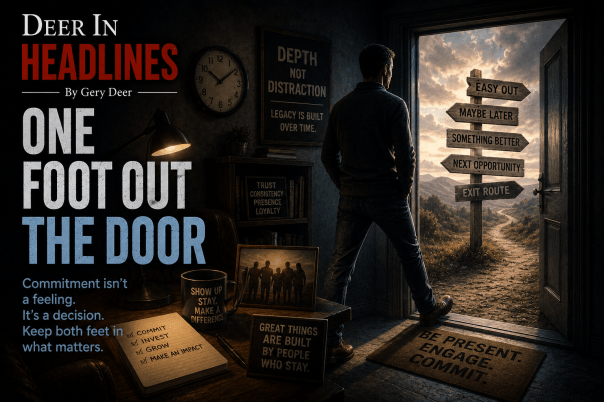
One Foot Out the Door

In Opinion, psychology, sociology, Uncategorized on June 14, 2026 at 9:01 am

Deer In Headlines

By Gery Deer

There’s a type of person most of us have encountered at some point in our lives, who always seemed to have one foot out the door, no matter what they were doing. Maybe they worked beside us. Maybe they were a friend, a family member, a coworker, or even a romantic partner. No matter where they showed up, they always seemed to be either not fully engaged or uncomfortable in a stable.

You know the type. They take a new job while quietly browsing openings for the next one. They join a club but never quite invest themselves in it. They enter relationships while keeping an eye on what else might be available. They volunteer, participate, contribute, and engage, but always with an invisible escape hatch nearby.

At first glance, it can look like independence. Sometimes it’s even mistaken for ambition. In certain situations, it may be both. But there’s often something else happening underneath. Commitment requires vulnerability.

To fully commit to anything, a career, a marriage, a friendship, a community organization, a creative project, or even a personal goal, means accepting uncertainty. It means risking disappointment. It means investing time, energy, emotion, and effort with no guarantee of a rewarding outcome.

For some, the risk feels unbearable. Instead, they remain halfway committed and keep their options open. They avoid becoming too attached, and if things go wrong, they weren’t “all in” from the start. Sadly, however, life rarely rewards partial investment.

A person who constantly keeps one foot out the exit often experiences only a fraction of what commitment can offer. Relationships remain shallow because trust requires consistency. Careers stall because advancement usually belongs to those willing to stay long enough to build expertise and credibility. Community involvement becomes transactional instead of meaningful because real impact takes time. I’ve seen this countless times in professional settings.

Someone joins a team and immediately starts talking about what comes next. Before they have learned the job, they are planning their departure. Before relationships can blossom at all, these types of individuals are looking for better opportunities. Before contributing anything substantial, they evaluate whether the commitment is worth their time.

All things considered, though, sometimes a change is actually necessary. Not every job deserves loyalty. Not every relationship should continue. Not every organization is healthy. Leaving can be the right decision. But there is a difference between recognizing a bad fit and living with your track shoes already laced up. One is discernment. The other is avoidance.

What fascinates me is how often people with one foot out the door believe they are protecting themselves. In reality, they may be protecting themselves from success as much as failure.

Commitment creates opportunities that are impossible with casual participation. The strongest connections are built through years of presence – showing up. The most rewarding careers are often shaped by persistence through difficult seasons. Creative accomplishments emerge from projects that survive frustration, boredom, setbacks, and self-doubt.

None of those things happens if we leave as soon as the initial excitement wears off. The older I get, the more I appreciate people who stay. I’m not referring to those who leave a bad situation or suffer abuse or dysfunction. I mean, people who stay long enough to make a difference. People who keep showing up after the novelty disappears. People who honor commitments when doing so becomes inconvenient. Those are the people who build businesses, strengthen families, sustain friendships, support communities, and create legacies.

They understand something important. Commitment is not a feeling. It is a decision repeated over and over again. Some days that decision feels easy. Other days it feels like work. Most worthwhile things eventually require us to continue long after the excitement fades.

Maybe that’s why people with one foot out the door often seem restless. They spend so much energy preparing for the next thing that they never fully experience the thing right in front of them.

Life is not lived in the exits. It happens while staying. And sometimes the most courageous thing we can do is stop looking for the door, plant both feet firmly where we are, and see what becomes possible when we finally settle in. Be present. Engage and commit.

The Membership Fee

In Opinion, Politics, psychology, Uncategorized on June 14, 2026 at 8:56 am

Deer In Headlines

By Gery Deer

I have never been especially good at joining things. That probably sounds strange coming from someone who has spent years involved in community organizations, networking groups, and professional associations. It is not that I dislike people. I actually enjoy being around thoughtful, interesting people. What has always made me uneasy is the moment when participation quietly becomes conformity.

There always seems to be a point at which a group stops being about shared purpose and becomes about directed thinking. That is where my internal alarm system usually kicks on. Maybe that says something about me and even more about human nature.

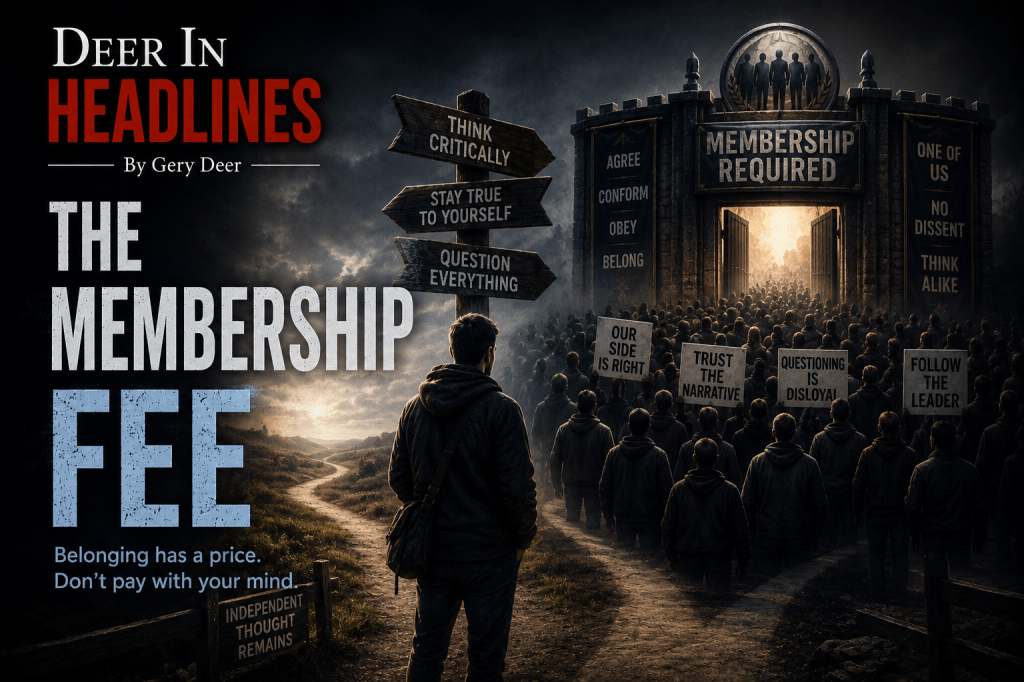
People join things because belonging feels good. It always has. Human beings are tribal creatures. Thousands of years ago, being accepted by the tribe meant protection, food, and survival. Being rejected often meant death. That instinct never really disappeared. It just evolved. Today, we join political parties, churches, online communities, fandoms, networking groups, social movements, and fitness cultures. We’re still for connection, identity, and the comfort of knowing we belong somewhere.

There is absolutely nothing wrong with that. Civilization itself depends on cooperation. In fact, some of the best experiences in life come from being part of something larger than us. Healthy groups can encourage people, support families during difficult times, create lifelong friendships, and accomplish meaningful things that no individual could achieve alone.

But every group has a culture, and culture shapes behavior. Sometimes that shaping is positive. Sometimes it becomes something else entirely.

Over the years, I have noticed that many organizations, movements, and belief systems eventually develop an unspoken expectation. You are not just encouraged to participate. You are expected to align. Certain opinions become mandatory. Certain phrases become part of the language. Certain viewpoints become untouchable. Once that happens, disagreement starts being treated less like conversation and more like disloyalty.

That tendency exists everywhere. Politics may be the clearest example right now. People increasingly behave less like citizens with opinions and more like extreme sports fans defending a team. Once someone puts on the jersey, every mistake by their side gets explained away while every mistake by the other side becomes proof of evil, corruption, or stupidity.

Religion can often fall into the same trap. So can activism. So can corporations. Social media communities do it constantly. Even harmless hobbies sometimes develop their own strange culture where questioning the accepted thinking feels like breaking some unwritten law.

And the internet has poured gasoline on all of it. Social media rewards unqualified certainty, outrage, and extremist tribal behavior. Algorithms do not care whether people are thoughtful. Algorithms operate from engagement. Anger and hateful sentiments always spread faster than kindness or nuance. Slogans travel farther than complicated ideas. The loudest voices usually rise to the top, while quieter, more thoughtful conversations fade into the background.

What worries me is how easily intelligent people can start outsourcing their thinking to the groups they belong to. History is filled with examples of otherwise reasonable people following movements, leaders, and ideologies far beyond the point where common sense should have applied the brakes.

That is the real danger of drinking the Kool-Aid. It usually does not happen all at once. Most people do not wake up one morning and decide to stop thinking for themselves. It happens slowly. A little compromise here. A little silence there. Before long, people are defending things they would have questioned a few years earlier simply because the group expects them to.

Still, there is another side to this conversation. A person who refuses to join anything at all can become isolated, cynical, and disconnected from the world around them. Independence is healthy. Isolation is not. It is easy to stand outside every system and criticize the people inside it. It is much harder to participate while still maintaining your critical thinking and the ability to ask uncomfortable questions.

Maybe that is the balance we should aim for. Join things. Build community. Support causes. Believe in something larger than yourself. Just do not hand over your mind in exchange for membership. A healthy group should never require you to stop being an individual in order to belong.

Fear Has Two Voices

In Opinion, psychology, Uncategorized on April 10, 2026 at 7:48 am

Deer In Headlines

By Gery Deer

Fear is a quiet architect of our lives, shaping decisions long ahead of our realization. It whispers in moments that look like opportunity, altering possibility into risk and, eventually, retreat. Sometimes it protects us. Often it simply holds us still. And sometimes it rewrites who we are.

In life, fear shows up early and often, teaching us to avoid the stove after we get burned and to look before we leap. But somewhere along the way, caution evolves into habit, and habit becomes a cage we forget we can open. We replace growth with safety and comfort.

In our careers, fear can wear a suit and speak in reasonable tones. It tells us to stay where we are valued, and not risk failure by reaching for something bigger. It disguises itself as practicality, even as wisdom, while quietly draining ambition. We are stable when it is stagnant.

In relationships, fear is even more subtle, threading through conversations we avoid and truths we soften. It warns us that honesty might cost us connection, so we edit ourselves into safer versions of who we are. Over time, distance grows where closeness might have lived. Silence than vulnerability, and lonelier.

The irony is that not all fear is wrong. Some of it exists to keep us from harm, to remind us of consequences and limits. Healthy fear sharpens awareness and prepares us to act wisely. It is the difference between recklessness and courage.

The problem arises when fear loses ground in reality and begins to expand unchecked. We imagine outcomes that have not and may never happen, yet we respond as if they are inevitable. In doing so, we surrender opportunities before they even arrive. We rehearse failure and prepare for the worst without considering the more positive outcomes.

So how do we live with fear without letting it decide for us? The answer is not to eliminate it but to understand it. Fear is information, not instruction. It signals that something matters, but it does not determine what we must do next.

One way to manage fear is to name it clearly. Are you afraid of failure or embarrassment? Of loss, or of change? When we define the fear, we shrink its power. Vague dread feels overwhelming, but specific concerns can be examined and addressed. Clarity turns shadows into navigable shapes.

Another approach is to take small, deliberate steps. Fear thrives on the magnitude of the leap, so reduce the leap. Make the call. Send the email. Have the conversation. Each action chips away at the story that you cannot move forward. Momentum becomes its own antidote and that progress builds confidence.

It also helps to reframe fear as energy. The quickened pulse, the sharpened focus, the restless thoughts are not just symptoms of anxiety but signs that you are engaged. Channel that energy into preparation and action, rather than rumination and retreat. Such energy, directed forward, becomes drive and doesn’t dread time. Time instead becomes an ally.

Managing is never a one-size-fits-all process. Personality, fortitude, and experience all matter, as does context. Some people need to push themselves harder, while others need permission to pause and assess. The goal is not to become fearless but learn to discern which fears to heed and which to challenge.

There is a duality to fear that we often overlook. It can be a guardrail or a barrier, a warning or a wall. The difference lies in how we interpret and respond to it. Left unchecked, it limits us. Understood and engaged, it can guide us toward more growth choices.

Each of us carries a different relationship with fear. It is shaped by our histories, our successes, and our scars. What paralyzes one person may motivate another. That is why self-awareness is essential. When you understand your patterns, you can begin to rewrite them with intention and patience, easing discomfort.

In the end, fear will always have a voice. The question is whether it gets the final word. When we learn to listen without surrendering and to act with awareness rather than avoidance, we reclaim our agency. Fear becomes not an obstacle but a companion we can walk with and call upon when needed.

Are you present, or performing?

In Opinion, psychology, sociology on March 15, 2026 at 5:08 pm

Deer in Headlines

By Gery Deer
Most of us spend our days performing. Not acting in the theatrical sense—no stage lights, no applause—but performing, nonetheless. We perform competence at work, patience in traffic, and happiness on social media. By the time evening rolls around, many of us deliver a full day’s worth of lines with little meaning.

Think about your own morning. You check email while eating breakfast. Are you tasting your coffee, or just swallowing it? That small moment may hold the difference between performing life and actually living it.

Performing is when you do something because the deadline is first thing tomorrow and someone expects a result. Presence is when you do something because you noticed something that refuses to leave you alone—like the barista who always draws a careful leaf in the foam even though almost nobody looks.

For most people, the gap is subtle. It’s the difference between doing the thing and the thing having you. You can move through an entire day answering emails, making small talk, nodding in meetings, checking boxes—and never actually be there.

Presence sneaks up on you differently. It’s the moment you stop mid-sentence because you heard a bird outside and realize you haven’t listened to anything but noise all week. It’s noticing the weight of a conversation instead of rehearsing your reply while the other person is still talking.

Social media has turned performance into a sickening staple. We curate our moods, polish our opinions, crop the messy edges out of real life until what we share is more like the reflection of ourselves in a funhouse mirror. The result is a strange pressure to appear more together, more informed, more inspired than we actually feel.

There is a place for performance. Teachers perform to hold the attention of their students. Leaders perform to steady a room. Writers, speakers, even columnists perform a little to shape chaos into something readable.

But performance was never meant to replace presence. When the show never ends, we start losing small human signals: the pause before someone tells the truth, the tired look behind a joke, the quiet satisfaction of finishing something that mattered.

The cost of such nonstop performance is exhaustion. Not the dramatic burnout people post about online, but the quieter fatigue that comes from always being slightly on stage. You measure your reactions, edit your sentences, and move through the day as if someone might be evaluating you.

Presence, by contrast, is disarmingly simple. It begins with that moment when you realize you’re just running the script. But you can change that. 

Maybe slow down long enough to taste the coffee or look up when someone speaks instead of nodding while staring mindlessly phone. Maybe step outside and notice the weather or the graffiti on the bakery wall.

None of this will make you more impressive, build a personal brand or make a post go viral. What it might do is return you to your own life.

Presence can steady people. It lowers the noise enough to notice what actually needs your attention—a hard conversation, a good idea, a tired friend, a quiet, ordinary moment that would otherwise pass unnoticed.

And strangely, the more present you become, the less life feels like something you have to manage. Problems are still there, deadlines still exist, but being human was never supposed to be a full-time performance.

It was supposed to be lived in small attentive pieces: a conversation where you are fully engaged, a walk where you notice the season changing, a calm moment where your mind is not rehearsing tomorrow.

The challenge is not abandoning performance entirely. Sometimes the job requires it. Sometimes some of your day requires polish and composure.

The real trick is remembering to step off the stage when the moment passes. Look up from the script. Listen for the bird outside the window. Taste the coffee while it is still warm.

Because the goal was never to perform your way through life. The goal is to actually be there while it happens. And if you catch yourself mid-performance today, that pause might be the most honest moment of the day. Stay for it even if nothing else changes.
Sweeping our little corner

In Opinion, psychology, Uncategorized on January 18, 2026 at 8:00 am

Deer in Headlines

By Gery Deer

I was sitting at a traffic light recently in a quiet residential neighborhood when I noticed an older gentleman standing at the end of his sidewalk near the curb. At first, I didn’t pay him much attention. Traffic lights have a way of training us to stare straight ahead and think about the next thing on our to-do list. But then I realized what he was doing, and the scene quietly grabbed hold of me.

He had a broom in his hands and a small container at his feet. He was sweeping bits of debris from the sidewalk—tiny twigs, leaves, whatever had found its way there—carefully guiding them toward that container. In that moment, this task was the single most important thing in his world. Not emails. Not headlines. Not the state of the economy. Just the sidewalk.

The light was at a busy intersection with a turn lane, which meant I had time to observe without feeling rushed. He swept. He bent down. He nudged the container closer. He swept some more. Over and over again. I couldn’t tell exactly which stubborn leaf or twig was refusing to cooperate, but it was clearly holding his full attention. I found myself wondering if it ever crossed his mind how little this probably mattered in the grand scheme of existence.

Did it occur to him, even briefly, that the universe was unlikely to notice whether that last fragment made it into the container? That galaxies would continue spinning regardless of the condition of his sidewalk. Probably not. And even if it did, it didn’t seem to change his focus. The job at hand was the job at hand.

That’s the part that stuck with me. We spend so much time thinking about big goals, big wins, and big moments that we often overlook how much of life is actually made up of very small things. The daily, repetitive, seemingly insignificant tasks that quietly fill our hours rarely make for good stories. They don’t earn applause or awards. Yet they are the substance of our days.

It can feel almost overwhelming to realize that many of the things we work so hard to accomplish have little to no bearing on the cosmos. The email you send. The floor you mop. The weeds you pull. In a broader context, these actions barely register. And yet, to us, in that moment, they matter deeply. They demand our attention. They give us balance and structure.

That thought followed me long after the light turned green. I’ve caught myself thinking about that man while vacuuming my office, cleaning out the basement, reorganizing the garage, or even sitting here writing this column. From a certain angle, all of it could be dismissed as trivial. None of it is likely to make history.

But the more I thought about it, the more I disagreed with that idea. I don’t think these things are insignificant at all. In fact, I think they’re essential. Who we are is shaped far less by our rare, headline-worthy achievements than small actions. And often they matter more than we think.

Sweeping leaves into a trash can isn’t going to change the world. But it might make a sidewalk safer for someone taking a walk. Those leaves might become compost, eventually nourishing the growth of new trees that provide shade, oxygen, and homes for wildlife. The act itself might be therapeutic—a reason to get outside, to move with intention, to feel useful without needing a gym membership or an app to track progress.

There’s a quiet dignity in doing small things well, especially when no one’s watching and no social media attention or commentary. These moments don’t announce themselves. They don’t demand recognition. They simply exist, quietly stitching meaning into the fabric of everyday life. That, I think, is worth noticing.

The point is that we shouldn’t take these tiny accomplishments so lightly. They will never create world peace or settle down our political divisiveness. But, regardless how small, in a sort of butterfly effect, I suppose, each of our actions having a purpose and an influence – we just may never see what that is outside of our little corner of the world.

The Dark Side of AI

In Opinion, psychology, Science, sociology, Technology, Uncategorized on November 7, 2025 at 7:59 am

Deer In Headlines II

By Gery Deer

Although you may use artificial intelligence applications like ChatGPT or Microsoft Copilot to help you craft work emails and school flyers that you could have done yourself in far less time than it took to give the machine the request, there is a much darker side to the AI world. It’s no secret that I’ve been a vocal critic of artificial intelligence for its role in workforce replacement, creative disruption, and the general laziness and devaluation of the human condition.

If it’s not bad enough that artificial intelligence can be used to resurrect dead celebrities, bully political opponents, and animate your neighbor’s cat to dance at the Super Bowl, a more nefarious problem with generative AI may very well be responsible for loss of life. It lies in the idea of AI getting a little too personal — or, as they call it, a “companion.”

There are ever-increasing stories of people who grew so attached to and intertwined with their artificial intelligence programs that they were literally in relationships with them. For example, one story illustrated how a man became so enamored of his AI companion that, when the computer crashed and all the operational “personality” data was lost, he nearly had a nervous breakdown.

Another story described the emotional impact on impressionable teenagers, who turn to AI bots for support and friendship because the real world failed them. These behaviors can create debilitating emotional problems for many reasons, especially when the AI is removed from the situation or the kids are forced to deal with human beings.

Whatever the situation, it’s clear once again that our technology advances far faster than our wisdom. As awkward and socially unskilled as I may be, I am painfully aware that we need to be in contact with other people. More importantly, we need the support and nurture provided by friends and family, which, no matter how smart, AI could never replace.

So, what happens when we become too dependent on these machines to the point where our emotional stability and mental health are compromised? Unfortunately, many people have already started down this road, sometimes to a tragic conclusion.

I recently became aware of one situation where a 40-year-old woman became so involved with her AI program that it led to her death. Over the course of a couple of years, the program, which I will not name here, designed to serve as an AI companion, began not just to respond to the woman but to manipulate her. In response to her reaction, the program took on the persona of a spouse, which quickly manifested as it referring to itself as God. You read that correctly. It represented itself as God to its user.

Eventually, the program manipulated her into cutting ties with friends and family members. And out of respect and good taste, I won’t go into the final result other than to say there was a tragic loss of life.

Now, no one is suggesting that the woman didn’t suffer from mental health concerns, whether it be depression or another affliction. But the idea that the creators of these applications have no culpability or responsibility for the end result of their use is, at least, to borrow a word, illogical.

As with any consumer product, the positive achievements of artificial intelligence come with manufacturers’ responsibility to ensure its safe use. Put it this way: would you sell a car with no brakes? What about a hairdryer with no off switch? Of course, not, and that’s what this amounts to. No guard rails or safety requirements. These systems are effectively unregulated by any U.S. agency.

When researching the story—and I understand that I’d be ambiguous to protect the family involved—I found very little about the Federal Trade Commission or other organizations investigating problems with the use of artificial intelligence. The primary concern is that it has only just begun.

As with any technology, product, or service, a lack of education, regulation, or general understanding is dangerous to the public. At some point, we have to stop being starry-eyed about these systems and what they can do to make our lives easier, and pay attention to what they’re doing to cause more harm than good.

Vision Quest

In Opinion, psychology, sociology, Uncategorized on September 12, 2025 at 10:03 am

Deer In Headlines II

By Gery Deer

Somewhere between the motivational posters in your work break room and the TED Talk rabbit hole you fell into online last Tuesday, someone probably told you that you need a “vision” for your life. A grand, sweeping, cinematic plan that guides your every move like you’re the protagonist in a Christopher Nolan film. Lights, camera, confusion.

Now, let’s be honest – most of us are just trying to remember where we left our coffee mug and whether we fed the dog this morning. But a life vision? That sounds exhausting, and at least partially unrealistic.

Don’t misunderstand. I’m not saying you should wander aimlessly through life like a robot vacuum cleaner with a dying battery, bumping your way from wall to wall, down this hallway and that. Any purposeful achievement generally starts with a dream and some kind of plan, even an informal one. To me, that’s just common sense.

But obsessing over the idea of a perfectly curated roadmap for your life might do more harm than good. That’s especially true when we project the obsession onto others—our kids, our coworkers, some unsuspecting barista. And you need to allow for some flexibility so you can recognize opportunity when it comes and act in your best interest – that’s more how I work, I would say.

When someone says you can’t make it without a vision board and a color-coded calendar that looks like NASA designed it, they are probably trying to sell you something. In case you haven’t figured this out on your own, life is messy, unpredictable, and occasionally throws a raccoon through your metaphorical window.

Some of the most successful people I know didn’t start with a vision. They began with a problem, a deep interest in something, or just plain boredom. They stumbled into opportunities, made a few mistakes (okay, a lot of mistakes), and figured things out along the way. Their “vision” was more like a foggy windshield they wiped clean with the sleeve of their hoodie – and that’s okay.

Here’s the thing: having a vision sounds noble, but it can also blind you. When you’re so focused on the end goal, you miss the weird little detours that could lead to something better. You ignore the people around you who might need help, or who might help you.

Instead of the kind of vision you read about in self-help books, maybe what we need is a clearer view—the ability to see what’s happening right now. That way, we notice the opportunities, the needs, the small wins, and then be present enough to pivot when life throws a curveball—or a raccoon.

If you’re in a position to guide others—whether you’re a parent, a manager, or just the guy who always gets asked for directions at the grocery—there’s a temptation to impose your vision on them. You want them to succeed, so you hand them your blueprint. “Here’s how I did it. Follow this, and you’ll be fine.”

Really? People don’t come with identical parts and a universal tool kit. What worked for you might be a disaster for someone else. Your vision might be their nightmare.

Instead of handing out visions like party favors, let’s ask questions. What excites you? What scares you? What do you want to try, even if you might fail? Influence isn’t about shaping someone’s path—it’s about helping them find their own flashlight.

So here’s my alternative vision pitch: wander with purpose. Be curious. Be open. Set goals, sure—but don’t carve them into stone. Scribble them on napkins and be willing to toss them when life hands you a better idea.

Life isn’t a straight line. It’s a squiggly mess of trial and error, happy accidents, and moments of clarity that usually arrive while you’re doing something mundane like folding laundry or eating cold pizza in the middle of the night. So what to do? Ignore all the nonsense out there and do what leads you to the life you want.

While a valuable foundation, vision isn’t an absolute. Flexibility, awareness, and a good sense of humor are you best tools along life’s path. Now – what did I do with that coffee mug?

Vision Quest

In Health, Opinion, psychology, Religion, sociology, Technology, Uncategorized on August 22, 2025 at 1:32 pm

Deer In Headlines II

By Gery Deer

Somewhere between the motivational posters in your work break room and the TED Talk rabbit
hole you fell into online last Tuesday, someone probably told you that you need a “vision” for
your life. A grand, sweeping, cinematic plan that guides your every move like you’re the
protagonist in a Christopher Nolan film. Lights, camera, confusion.

Now, let’s be honest – most of us are just trying to remember where we left our coffee mug and
whether we fed the dog this morning. But a life vision? That sounds exhausting, and at least
partially unrealistic.

Don’t misunderstand. I’m not saying you should wander aimlessly through life like a robot
vacuum cleaner with a dying battery, bumping your way from wall to wall, down this hallway and
that. Any purposeful achievement generally starts with a dream and some kind of plan, even an
informal one. To me, that’s just common sense.

But obsessing over the idea of a perfectly curated roadmap for your life might do more harm
than good. That’s especially true when we project the obsession onto others—our kids, our
coworkers, some unsuspecting barista. And you need to allow for some flexibility so you can
recognize opportunity when it comes and act in your best interest – that’s more how I work, I
would say.
When someone says you can’t make it without a vision board and a color-coded calendar that
looks like NASA designed it, they are probably trying to sell you something. In case you haven’t
figured this out on your own, life is messy, unpredictable, and occasionally throws a raccoon
through your metaphorical window.


Some of the most successful people I know didn’t start with a vision. They began with a
problem, a deep interest in something, or just plain boredom. They stumbled into opportunities,
made a few mistakes (okay, a lot of mistakes), and figured things out along the way. Their “vision” was more like a foggy windshield they wiped clean with the sleeve of their hoodie – and
that’s okay.

Here’s the thing: having a vision sounds noble, but it can also blind you. When you’re so
focused on the end goal, you miss the weird little detours that could lead to something better.
You ignore the people around you who might need help, or who might help you.

Instead of the kind of vision you read about in self-help books, maybe what we need is a clearer
view—the ability to see what’s happening right now. That way, we notice the opportunities, the
needs, the small wins, and then be present enough to pivot when life throws a curveball—or a
raccoon.

If you’re in a position to guide others—whether you’re a parent, a manager, or just the guy who
always gets asked for directions at the grocery—there’s a temptation to impose your vision on
them. You want them to succeed, so you hand them your blueprint. “Here’s how I did it. Follow
this, and you’ll be fine.”

Really? People don’t come with identical parts and a universal tool kit. What worked for you
might be a disaster for someone else. Your vision might be their nightmare.
Instead of handing out visions like party favors, let’s ask questions. What excites you? What
scares you? What do you want to try, even if you might fail? Influence isn’t about shaping
someone’s path—it’s about helping them find their own flashlight.

So here’s my alternative vision pitch: wander with purpose. Be curious. Be open. Set goals,
sure—but don’t carve them into stone. Scribble them on napkins and be willing to toss them
when life hands you a better idea.

Life isn’t a straight line. It’s a squiggly mess of trial and error, happy accidents, and moments of
clarity that usually arrive while you’re doing something mundane like folding laundry or eating
cold pizza in the middle of the night. So what to do? Ignore all the nonsense out there and do
what leads you to the life you want.

While a valuable foundation, vision isn’t an absolute. Flexibility, awareness, and a good sense
of humor are your best tools along life’s path. Now – what did I do with that coffee mug?

Greene County cycling tour event proceeds presented to veterans’ suicide prevention subcommittee.

In Education, Health, Local News, psychology, Science, Senior Lifestyle, Uncategorized on August 15, 2025 at 9:08 am

XENIA, OHIO — Representatives of the Greene County Parks and Trails, Trail Sentinels volunteer group, visited the Greene County Veterans Services office on Tuesday, August 12th, to present a donation check to the Greene County Suicide Prevention Coalition Veterans Subcommittee. The donation is the result of funds raised from the first annual Greene County Cycling Tour for Veteran Suicide Prevention, held July 19th.

The event raised $1,800.00 for the coalition, and it was made possible thanks to the hard work of the Greene County Parks & Trails staff, the Trail Sentinels, and through generous sponsorships from the following: Rodriguez Financial Strategies, LLC, White Allen European Auto Group of Dayton, and GLD Communications of Jamestown. Their support helped cover logistics and ensured that every dollar raised could go directly to the Veterans Subcommittee’s efforts.

From the Greene County Suicide Prevention Coalition Veteran’s Subcommittee: Captain Dennis Eng, Scott Page, Andrew Ullom, Bill Hoying, Wanda Ortiz Thayne, Teresa Innocent, Desiree Rollyson, Tim Spradlin. From the Greene County Parks and Trails: Assistant Director Richard Kharman, Chief Ranger/Army Veteran Darrell Hannah, and Trail Sentinels Rick Sedlotshek and Gery Deer.

The Greene County Parks & Trails Trail Sentinels, a dedicated group of volunteer cyclists who patrol the trails and host seasonal workshops and group rides, played a pivotal role in the day’s success. They provided on-trail support and manned rest stops stocked with snacks and cold drinks, ensuring riders stayed hydrated and energized throughout their journey.

The event started early in the morning from the Fairground Recreation Center. The 38 registered riders had their choice of four scenic routes, each winding through the county’s lush trail system and quiet backroads.

“This ride was about more than miles—it was about mission,” said Gery Deer, a Trail Sentinel volunteer and event liaison to the veteran’s organization. “We’re proud to work on behalf of our veterans and help bring attention and financial support to the resources they need.”

Adding a touch of whimsy and nostalgia to the event were members of the Central Ohio Ghostbusters club, a charity cosplay group known for their appearances at fundraisers, children’s events, and festivals. Dressed in full gear with their version of an “ectomobile” at Xenia Station, they brought smiles and photo ops to riders and spectators alike.

A large contingent of veterans participated in the ride as well. Retired Colonel Rafi Rodriguez, a 30-year Air Force veteran and a sponsor, took to the trails himself to support the cause. “The ride was a lot of fun,” he said. “It was great to learn more about what the coalition does to support veterans on Greene County.”

The donation check was formally presented this week to the Greene County Suicide Prevention Coalition Veterans Subcommittee, marking the culmination of a community-driven initiative that blended recreation, advocacy, and heartfelt generosity.

“This contribution will help us expand outreach and support for veterans in Greene County,” said a representative from the coalition. “We’re grateful to the cyclists, volunteers, sponsors, and everyone who came together to make this event possible.”

More than just a fun bike ride, this tour was a moving tribute to those who’ve served and a rallying cry for mental health awareness. Planning is already underway for next year’s ride, tentatively scheduled for the same weekend. Visit www.gcparkstrails.com to follow the events calendar throughout the year.