(Video production services provided by GLD Communications)
XENIA — Cyclists, families and community supporters are invited to celebrate America’s 250th anniversary this fall at the United Way Americana 250 Cycling Classic, set for Sunday, Oct. 11, at the Greene County Fairgrounds and Expo Center.
The event combines cycling, local history and family fun while raising money for the United Way of the Greater Dayton Area, serving Montgomery, Greene and Preble counties. Registration is now open, with four routes designed for everyone from casual family riders to experienced cyclists seeking a metric century challenge.
The rides will begin and end at the fairgrounds, located at 120 Fairground Road in Xenia, and are part of the well-known Tour de Gem Cycling Series. Greene County serves as the centerpiece of the event because of its extensive paved trail network, the largest in the nation.
Participants can choose from the 10-mile Liberty Ride for families, the 25-mile Pioneer Expedition, the 40-mile Heritage Quest, or the 64-mile Patriot Tour, a metric century route connecting several Greene County communities. But organizers emphasize that the event is about more than cycling.
While riders pay a registration fee, the on-site fairgrounds festivities, known as the Heritage Hub, will be free and open to the public. Visitors can enjoy food trucks, vendor displays, demonstrations and the Young Explorer Zone, featuring a bike course designed especially for small children.
“This event is a celebration of community, history and healthy living,” said Tom Kelley, President and CEO of the United Way of the Greater Dayton Area. “Whether you ride 10 miles or 64, volunteer, sponsor the event or simply bring your family out to enjoy the Heritage Hub, you’re helping us strengthen our community while celebrating this important milestone in our nation’s history.”
Businesses and organizations still have time to get involved. Sponsorship opportunities and vendor booths remain available, giving companies a chance to showcase their products and services while supporting a regional cause. Sponsorship levels range from major corporate partnerships to rest stop sponsorships, while vendor spaces are available in multiple sizes.
Community participation will be key to making the inaugural event a success. Kelley said “United Way really wants this to become a signature event for Greene County and the Miami Valley because it’s an opportunity to bring people together, celebrate our shared heritage and invest in programs that improve lives throughout our region.”
All proceeds from the Americana 250 Cycling Classic will benefit programs and services of the United Way of the Greater Dayton Area, supporting initiatives focused on youth opportunity, financial security, health and community resiliency throughout Montgomery, Greene and Preble counties.
Event organizers say they hope the day will bring together cyclists, families, local businesses and history enthusiasts alike for a celebration that honors the past while investing in the future. The event runs from 8 a.m. to 4 p.m. Sunday, Oct. 11, at the Greene County Fairgrounds and Expo Center in Xenia. Registration, sponsorship information and vendor applications are now available. For more information, visit https://www.dayton-unitedway.org/americana-250-cycling-classic.
Sponsors include The Dayton Foundation, Trek Dayton, CareSource, Greene County Convention and Visitors Bureau, GLD Communications, Warriors On Wheels, Miami Valley Regional Planning Commission. Media requests should be directed to GLD Communications, the official public relations agency for the event.
The Greene County Engineer’s Office announces that John R. Jurgensen Co and Butler Paving, on behalf of Hillside Farms Development, will be milling and paving Trebein Road between Dayton-Xenia Road/Hilltop Road and Stonebury starting Wednesday, June 17, 2026, and lasting 2 days, weather and equipment permitting.
Trebein Road will be under construction from 7 am to 7 pm. Traffic will be maintained using flaggers. Travelers can expect delays, and we encourage you to use alternative routes.
When traveling through these areas, please slow down and use caution, as there are unmarked no-passing zones. We appreciate your patience and cooperation during the resurfacing process and apologize for any inconvenience.
Note: this was previously scheduled for June 8, 2026, but the contractor had to reschedule it.
(JAMESTOWN) — One of Jamestown’s newest small-business success stories is taking another step forward.
Jamestown Cafe has launched its first-ever website, giving customers a new way to stay connected with the downtown café while making it easier to learn about menu offerings, hours, events, specials, and online ordering opportunities.
The new site serves as a digital front door for the café, which has quickly become a gathering place in downtown Jamestown since opening in 2025. Visitors can browse menu items, learn about the café’s story, view operating hours, find contact information, and stay informed about upcoming events and seasonal offerings.
Owner Ashley Mannier said the website represents another milestone in the café’s continued growth and its commitment to serving the community.
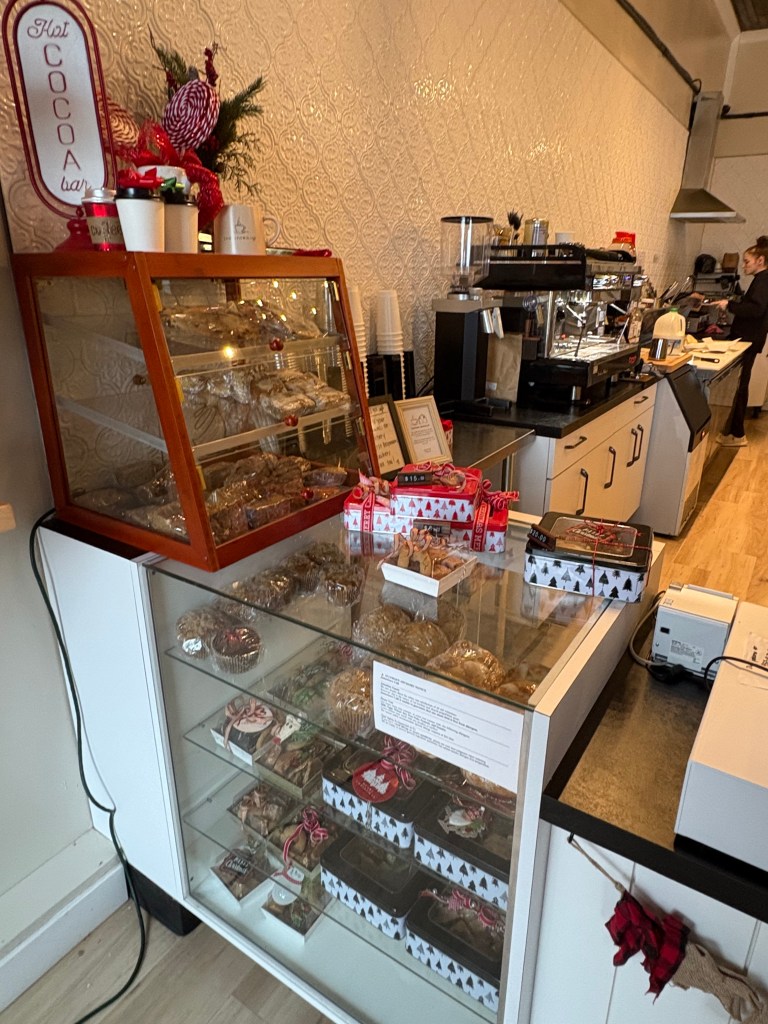
Located at 9 W. Washington St., the café occupies a restored historic downtown building that Mannier and her family transformed from a vacant storefront into a welcoming neighborhood destination. Since opening, the business has become known for specialty coffee drinks, breakfast and brunch selections, sandwiches, pastries, and baked goods served in an atmosphere that celebrates local history and community connections.
The Jamestown Cafe‘s new website provides online ordering and updates on hours, and new drink, and food item information.
The website, developed by Ryan Patt Solutions, in Jamestown, allows customers to quickly check current hours, view menu offerings, and learn about featured items ranging from breakfast paninis and specialty coffee drinks to sandwiches and bakery selections. The online platform also provides a central location for announcements about new menu additions, special promotions, and community events hosted by the café.
For customers who rely on social media for updates, the website complements the café’s existing Facebook and Instagram presence while offering a more permanent and easily accessible source of information. Future updates are expected to include expanded online ordering features, event notifications, and regular announcements about new drinks, sandwiches, baked goods, and seasonal specialties.
The launch reflects a growing trend among small-town businesses investing in professional online presences to better serve customers and provide convenient access to information outside regular business hours. For Jamestown Café, it offers another way to strengthen the connection between the business and the community it was created to serve.
Those interested in learning more about the café, viewing menu options, checking hours, or staying informed about upcoming specials and events can visit the new website at thejamestowncafe.com.
The café is open Wednesday through Friday from 7 a.m. to 5 p.m., Saturday from 7 a.m. to 4 p.m., and Sunday from 8 a.m. to 3 p.m.
Ohio Senator Jon Husted will speak at the Greene County Republican Party Lincoln Day Dinner on Friday, March 6, at the Fairborn DoubleTree by Hilton (2800 Presidential Drive, Fairborn, OH). Senator Husted was appointed by Governor DeWine to replace then-Senator JD Vance after Vance was elected Vice President. Senator Husted will be introduced by Congressman Mike Turner from Ohio’s 10th District (Montgomery, Greene, and part of Clark Counties).
The evening will begin with an opportunity for underwriters and table sponsors to meet with Senator Husted from 4:30 to 5:15pm. The doors open for general admission at 5:15pm and the program will begin at 6:00pm with opening formalities, guest speaker remarks, and dinner.
In addition to Senator Husted and Congressman Turner, many elected officials and candidates for state and county offices are expected to attend. Tickets may be purchased from this site: https://tinyurl.com/4dy93ha9 For more information, call (937)974-7917.
Information provided by Carolyn Uecker, Lt Col, USAF (Ret) (937)974-7917
Every day I hear people comment about the exhausting pace of modern life. Most of us have felt that strange acceleration where time seems to pick up speed as birthdays pile on. It’s the moment you’re pulling holiday decorations from the attic and swear you just put them away. Of course you didn’t. A full year passed while you were looking at your phone.
Some of that is age, sure, but some of it is engineered. Modern life has a way of nudging us forward faster than we’re built to move, and the most persistent nudge lives in our pockets. The internet, and especially social media, has turned time into a moving sidewalk that never stops. You can stand still, but you’re still being carried somewhere.
I remember my first cell phone that could send text messages and, if memory serves, receive email. At the time it felt revolutionary. I worked outside an office most days, and suddenly important updates could find me without firing up a laptop. It was convenient, efficient, and undeniably useful. This is usually the part of the story where someone asks, “What could possibly go wrong?”
Then the iPhone arrived and the rock started rolling downhill, with all of us sprinting after it. Today we’re permanently connected. Texts, emails, alerts, pings, buzzes, banners, and badges stack up like unread magazines on a coffee table. Studies now link constant device use to anxiety, high blood pressure, and other ailments. The bigger question is why we tolerate it. The answer is uncomfortable. We asked for it.
The more we demand speed and convenience, the more manufacturers and app developers provide. They’re not just selling phones. They’re selling attention, collecting data, and turning it into a high return product. That data fuels more selling, more targeting, and more noise aimed right back at us. This isn’t a conspiracy theory. It’s the business model, printed in very small type.
The byproduct is a permanent state of urgency. Time no longer feels as it once did. Information arrives in six second micro bites, and our brains are expected to digest it like a full meal. But they can’t. We skim, react, and move on. We mistake motion for understanding and speed for knowledge.
We’re all worried about so much – insane politics, societal division, jobs, kids, and the high cost of – well everything. The pressure never lets up. Instead of slowing down to understand what’s happening, we consume only fragments of information and make decisions about our lives with incomplete – or false – information. We don’t reflect. We react, often loudly, and too quickly.
As technology grows more invasive and we become more dependent on it, our reaction time decreases. Important decisions are made without context, sometimes without consideration. That should worry us. I’m convinced it’s one of many contributors to the unsettled mood of the country right now.
So, what do you do? I wish I had a good answer for you. Personally, I’ve been increasingly drawn to the analog and just setting the phone aside whenever I can. Unfortunately, the demands of my work prevent a complete disconnection from social or other digital media. But I write on a manual typewriter at some point in my workday, listen to vinyl on a turntable in my office, and just try to be aware of it all.
Occasionally, I’ll buy a print newspaper and spend several days reading every article. Cover to cover. It’s my way of appreciating the work the writers put into it while absorbing each story. It might seem a bit excentric, but I get the complete picture – without the anxiety that comes with doomscrolling. Plus, I can put it down, then go back to it whenever I want without feeling like I am missing something.
This isn’t about technology, but our resignation to life at a fever pace. Our techno-crutches are just symptoms of a more pervasive problem. We need to slow down. When everything is urgent, nothing is important. And slowing down isn’t quitting. It’s a choice about when to move, listen, or think. That small choice can quietly change the tone of a day, and sometimes an entire life if you let it.
Gery Deer is the editor and publisher of The Jamestown Comet.com and a regional columnist for several other publications.
By now, you’ve probably heard it. A winter storm is headed our way this weekend, with forecasts calling for up to 12 inches of snow across Jamestown, Greene County, and other parts of the Miami Valley. Cue the dramatic music, the urgent weather graphics, and—if history is any guide—the sudden disappearance of milk, bread, and eggs from grocery store shelves. Not to mention the appearance of the all too familiar grocery store meme of the panicked little kid running with milk and bread in tow.
How about we all just calm down for a minute? A dose of common sense would be great right about now.
Yes, 12 inches of snow is nothing to shrug off. It deserves respect and preparation. But it does not require panic, hoarding, or acting like we’re about to be snowed in until spring. Around here, heavy snow is usually cleared from main roads within a day or two. Life slows down briefly, then it gets back to normal. That’s how it’s gone for decades.
The problem is that winter storm coverage often turns preparation into panic. Words like crippling, paralyzing, and historic get thrown around, and suddenly people are fighting over the last loaf of white bread as if it’s the final one on Earth. We’ve all seen it. We’ve all laughed about it later. And yet, here we are again.
So, let’s try something different this time: calm, common sense.
Here’s what actually makes sense to do.
First, stock enough essentials for about three days. Not three weeks. Three days. Food you already eat, medications you need, pet supplies, and a little extra drinking water. If the power stays on, great. If it doesn’t, you’ll still be fine for a short stretch.
Second, be ready for possible power outages. Heavy snow combined with wind can bring down tree limbs and power lines. Have flashlights with fresh batteries, or candles if you use them safely and responsibly. If you rely on fuel-burning space heaters, make sure they are properly vented. This is important enough to repeat: never run generators, grills, or fuel-burning heaters inside your home or garage. Carbon monoxide is silent, invisible, and deadly.
Third, think about warmth. Extra blankets, warm clothing, and closing off unused rooms can help conserve heat. Even if your home cools down, layers and common sense go a long way.
Fourth, limit travel. If you don’t absolutely have to be on the roads, stay home. Snow-covered roads, reduced visibility, and impatient drivers are not a great combination. Staying put helps snow crews do their jobs faster and safer, which gets everyone back on the move sooner.
Fifth, charge your devices. Phones, tablets, battery packs—anything that keeps you connected. Reliable communication matters in an emergency, and it’s a lot easier to top off batteries before the lights go out.
A few other smart reminders:
• Park cars away from trees if possible.
• Keep your gas tank at least half full.
• Check on elderly neighbors or those who might need assistance—by phone if travel isn’t safe.
• If you shovel, take it slow. Snow shoveling is more dangerous than the snow itself for many people.
And finally—this is the most important advice of all— don’t panic. Not because the news says everything will be fine. Not because someone on social media claims this storm is “nothing.” But because panic doesn’t help anyone.
Be informed. Be prepared. Be smart.
Winter happens in Ohio. It always has. We get snow, we deal with it, and we move on. A calm, level-headed community handles storms far better than a frantic one. So, skip the panic buying, ignore the hype, and focus on what actually matters: keeping yourself, your family, and your neighbors safe.
The snow will fall. The plows will roll. And in a day or two, we’ll all be talking about how it really wasn’t as bad as everyone thought—again.
(Shared with our partners at the Xenia Daily Gazette)
At Jamestown Café, customers are greeted by a welcoming smile, the smell of fresh coffee, baked treats, and comfort food, and an atmosphere that feels more like a home kitchen than a café. Behind the counter, the staff moves easily from customer to customer, greeting familiar faces and making newcomers feel just as welcome.
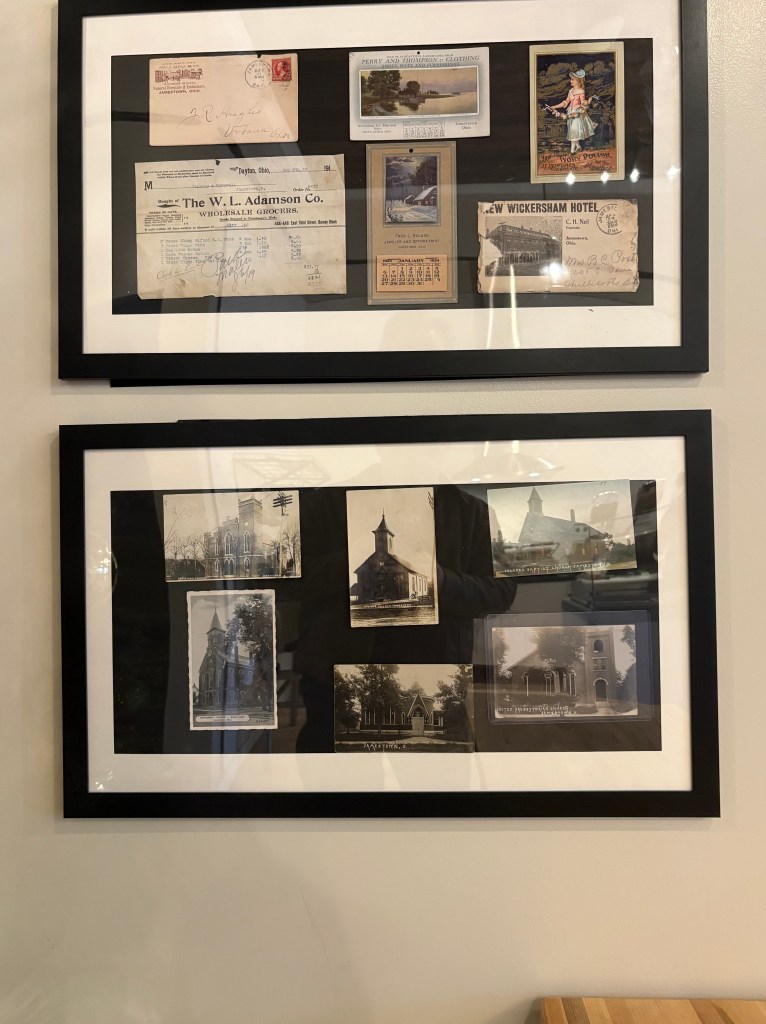
Along the wall, people linger over sandwiches, bakery items, ice cream, and specialty drinks, with photos and relics from more than two centuries of Jamestown’s history hanging just above their heads. The café opened in September, and the space feels new, but familiar — warm, relaxed and comfortable, like a place you’ve been invited to stay a while.
This is no ordinary coffee shop, and that feeling didn’t come from a design book or a business plan. It came from the heart, and figuring things out the hard way. Ashley Mannier is not what you’d expect when you picture a café owner — and neither is the path that led her to opening Jamestown Café. But the place, the people, and the story all seem like they were ripped from the script of a Hallmark movie.
When she bought the building, at 9 W. Washington St., Mannier didn’t know how to run a coffee shop. Years earlier, she hadn’t known how to remodel a house either. She was a single mom putting herself through college and barely scraping by financially. “I wasn’t living paycheck to paycheck,” she says. “It was more like paycheck to Wednesday.”
Mannier took advantage of an Obama-era first-time homebuyer tax credit and was approved for a mortgage to buy a foreclosure, despite having little construction or remodeling experience, and with much of her family living overseas. So, she did what a lot of people do when they don’t know where to start: she went to YouTube. “I always joke that I graduated from YouTube University,” Mannier said.
That self-taught education—watching videos, learning by trial and error, and not being afraid to make mistakes—would later prove essential when she decided to turn an aging, long-vacant building on Washington Street into a place where the community could gather. Because for Mannier, the Jamestown Café was never just about coffee. It was about building something real, one lesson at a time, and it started with her family.
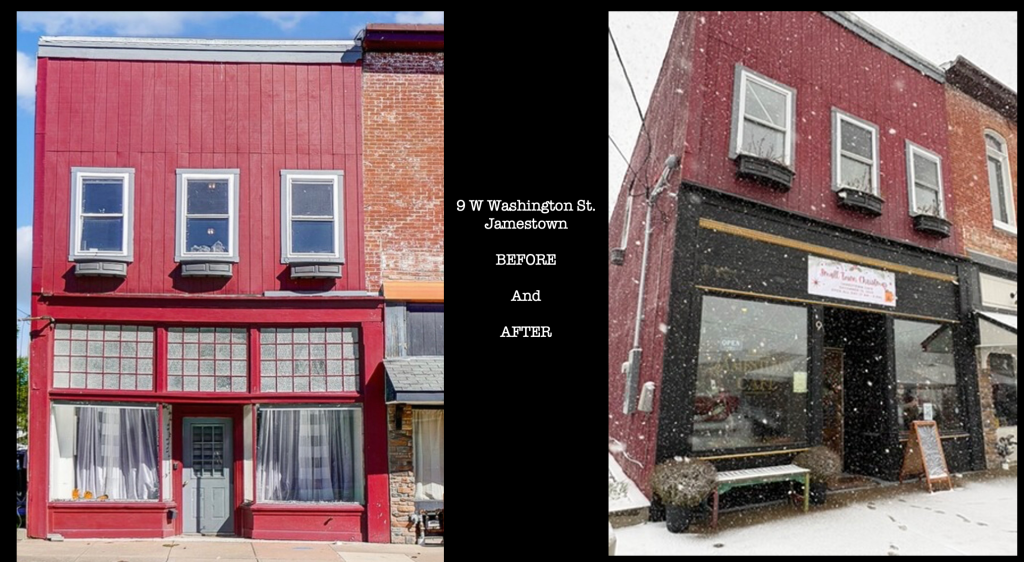
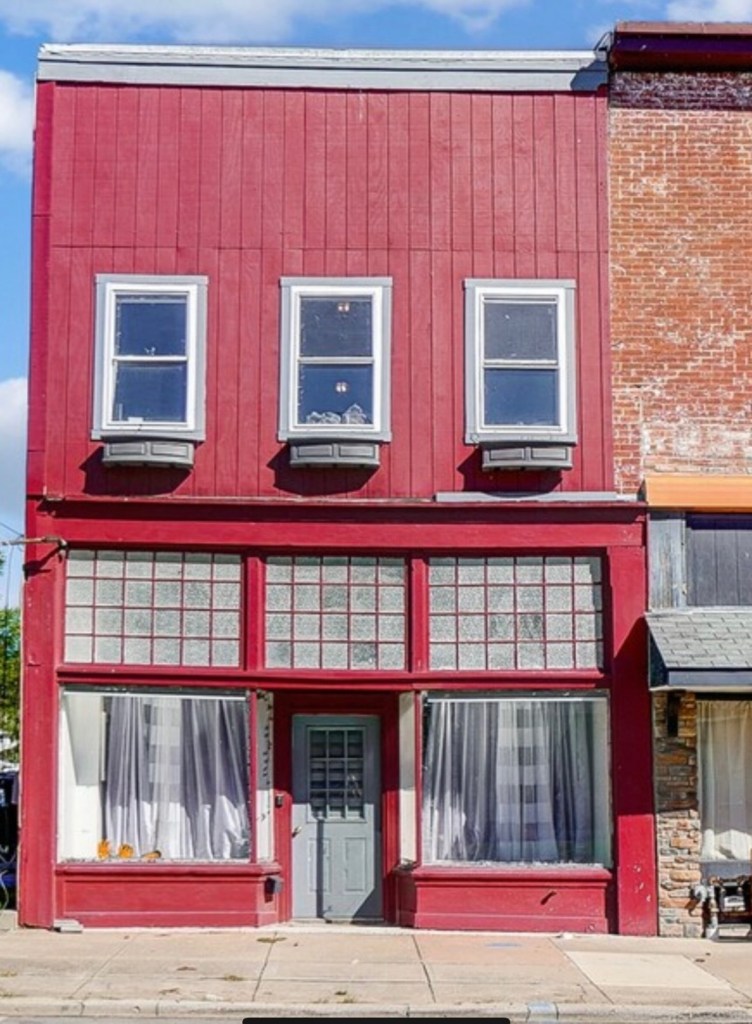
Built around 1900, the structure had lived several lives over the years — a shoe store, a tanning and nail salon, and other businesses — before sitting empty and neglected for far too long.
Relics and photos from Jamestown’s history, donated by local residents, hang in frames along the wall.
Inside, nearly everything needed attention. There was leaky, corroded plumbing, outdated electrical wiring, and damage from water and mold. It was the kind of project that can quickly overwhelm even experienced renovators. Mannier, however, wasn’t doing it on her own.
“It’s very expensive to do this kind of work,” she said. “I’m the oldest of ten kids, so I recruited my family to help out, and everyone had their role.” One brother helped with the architectural planning, while her brother-in-law and father built the café counter. “We did it all together.”
With help from village officials, neighboring business owners, her family, and the community, Mannier worked her way through the maze of permits, demolition, construction, and final occupancy. Even with that support, there were moments when the project felt overwhelming.
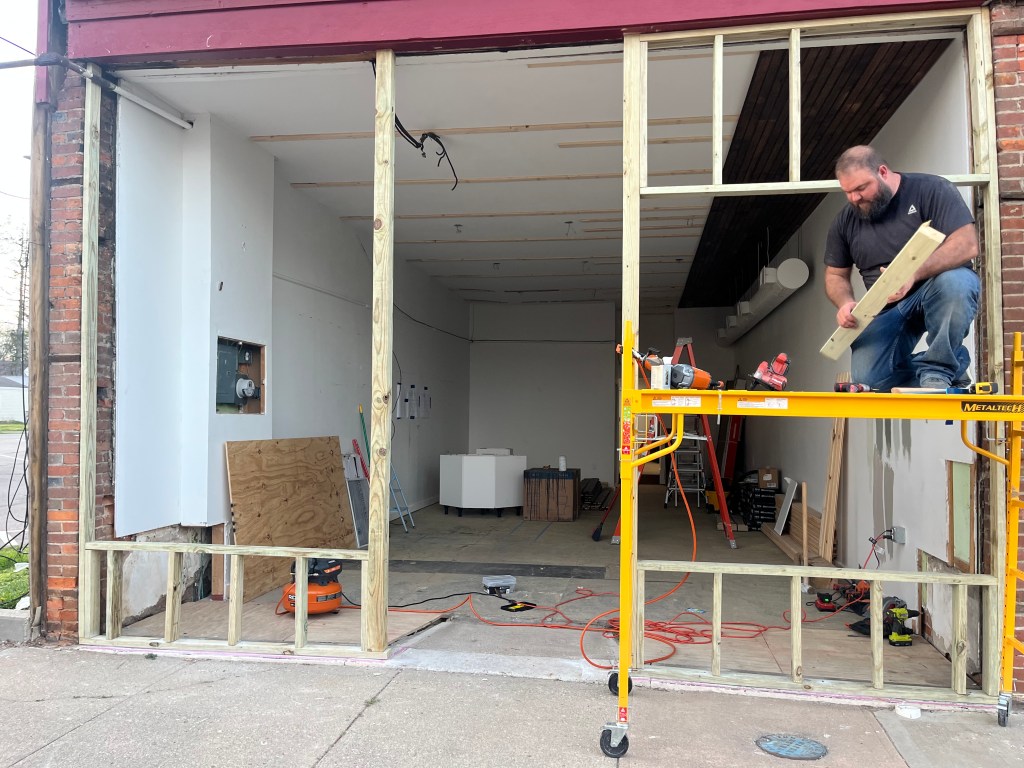
The challenges extended outside as well. “We rebuilt the entire front of the building,” Mannier said. “We jacked up the main beam and ripped everything out to put in new joists.”
Many of the café’s furnishings came from materials Mannier had collected over the years, often without knowing exactly how or where they would be used. Over time, those pieces found their place. “I’d had this front door for a while and didn’t know what to do with it,” she said. “But here, it’s perfect.”
Before and after renovation photos of the cafe’s building at 9 W. Washington St.
Today, the brickwork and large front windows give the building a classic small-town look. The updates bring it squarely into the present while still honoring its past, much like the café itself. For longtime residents who remember the building in its earlier lives, the transformation is almost hard to believe. Their first reactions tend to be wide-eyed, followed by a slow smile.
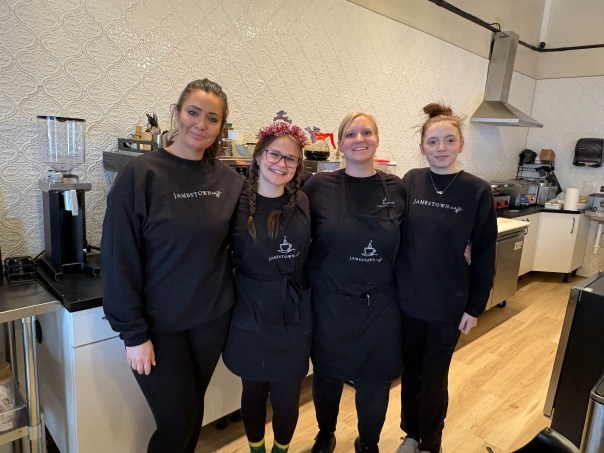
Jamestown Café’s warmth isn’t just from a hot cup of coffee; it radiates from the crew behind the counter – including Kearra, Sarah, and Abbey – a group of employees who clearly enjoy being there. Their energy fills the space, turning a renovated building into something more than a café: a place that feels alive.
Jamestown Café Staff (L to R) Owner, Ashley Mannier, Kearra Anthony, Sarah Davidson, and Abbey Yates.
Nineteen-year-old Kearra Anthony was somewhat surprised when her parents decided to move from Jeffersonville to Jamestown, but she came with them.
“One of my friends got a job here first, and I’ve always wanted to work at a coffee shop,” Anthony said. “Ashley was up on a ladder tiling and gave me an interview.” She said the job is a perfect fit for her because, “I like people and I like being around people.”
Sarah Davidson, 31, is a stay-at-home parent who was looking for a flexible, part-time work option. The café was ideal: a woman-owned small business with a flexible schedule and a real sense of family.
Mannier told Davidson she was hiring some younger women and needed a “mom figure.” Davidson was sold. “I bring the mother energy, and I love it,” Davidson said, who is also the master blender behind all the café’s tea selections.
Abbey Yates is 19 and lives in Jamestown. “In May, I emancipated from foster care and moved into an apartment, and I was looking for employment,” Yates said. “I was walking downtown and noticed someone working inside and asked if they were hiring.” But it took a little more than that before she was brought aboard. “Abbey asked me for a job three different times,” Mannier said, smiling. “I’m so glad I hired her; she’s one of our best workers.”
Each of the women lights up when they talk about their work and Mannier. They exude such excitement and pride that it is apparent they have found a sense of purpose and family with Mannier and the café.
Speaking of family, it wasn’t just the men in Mannier’s family who contributed to the business. Her mother, Jackie, plays a significant role in this endeavor too – she’s the café’s official baker. “A mother of ten, my mom was a little nervous to start this,” Mannier said. “But she’d been cooking for the masses for years, and her best skill is being a giving person.”
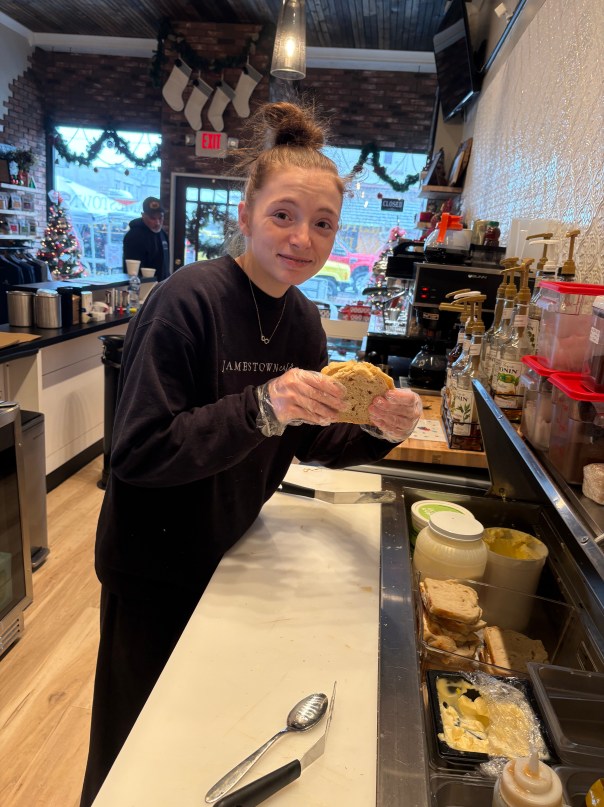
Abbey Yates has become known as the “Panini Slinger” at Jamestown Café.
Mannier said her mom came to her and offered to help, and is now an invaluable part of the team. “She does all of the baked goods, and she’s always trying to come up with something new every week,” she said. “Fudge, cookies, muffins, cinnamon rolls – she does all of it and spends a lot of time researching all of it. And she loves being part of something bigger than herself. This place is glued together by what she’s doing, and it wouldn’t exist if she weren’t willing to be a part of it. I couldn’t do it without her.”
And the rest of the menu? That didn’t happen until a couple of weeks before they opened. From the outset, the concept was to keep it simple: café fare with homemade flair. At first, Mannier and her staff were learning the ropes together, how to use the equipment, which drinks to offer, and the best way to make them. But they’ve hit the old standards too – recently introducing a morning biscuits and gravy recipe that regularly sells out.
Public reaction has been overwhelmingly positive. First fueled by curiosity, the café is gaining a regular following and great reviews. “When we first opened, people were really excited,” Yates said. “There weren’t really like good sitting places, and now there are people who are coming in every day, we get to know them.”
What’s next for Jamestown Café? According to Mannier, more of the same, keeping with her original vision. “We have space in the back, and we’re going to put a patio area back there,” she explained. “And I want to continue to work more with other downtown building owners and local businesses to keep doing more to bring people down here.”
Right from the beginning, Mannier envisioned Jamestown Café to be all about offering her community a routine, a third place. It has become exactly that, and it’s run by Jamestown residents who believe their customers are much more than just a coffee order. They’re family.
For more information visit the shop. Check out their Facebook page for regular posts on hours and specials.
Gallery – Photos by Gery Deer (unless otherwise noted)
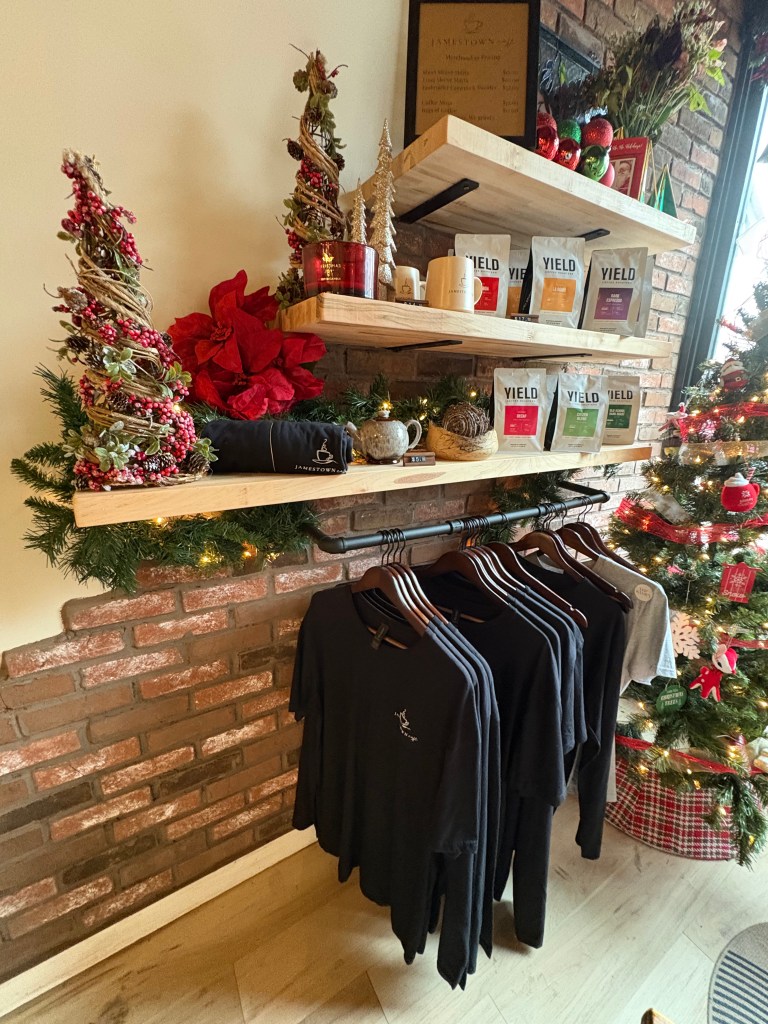
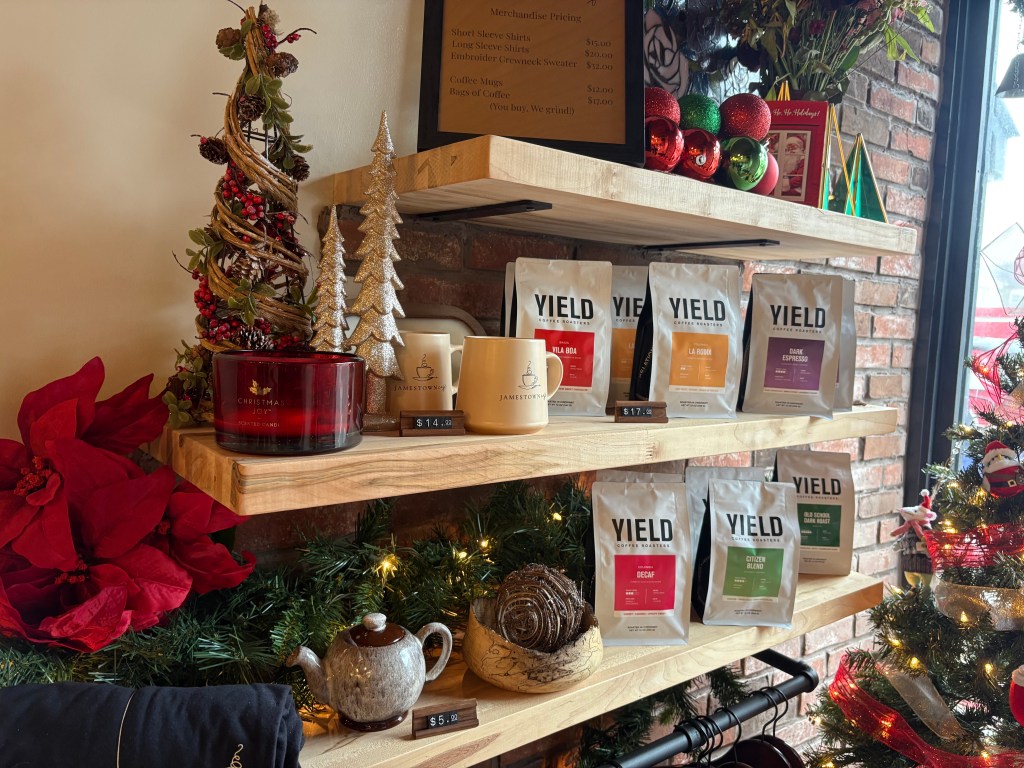
Front facade framing after demolition. (photo provided by A. Mannier)Interior of the cafe building looking forward to W. Washington St. – Before renovation. (Photo provided by A. Mannier)Before renovations. (Photo provided by A Mannier)Merchandise. Photo by Gery DeerCoffees, teas, mugs. Photo by Gery DeerSpecialty items. Photo by Gery Deer Mugs Photo by Gery DeerBakery and fudge counter. Photo by Gery Deer
To protect yourself in extreme cold, layer clothing, cover extremities (hats, mittens, warm boots), and stay dry; for your home, seal drafts with weatherstripping and caulk, insulate pipes, keep thermostats around 65°F (or higher), close curtains at night, and gather emergency supplies like blankets, flashlights, and food for potential power outages.
Personal Protection
Layer Up: Wear multiple layers of loose, lightweight, warm clothing, including a wind-resistant outer layer, to trap heat.
Protect Extremities: Mittens (warmer than gloves), hats, scarves, and waterproof, insulated boots are crucial.
Cover Your Mouth: Protect your lungs from the extreme cold by covering your mouth.
Stay Dry: Change out of wet clothes immediately to prevent chilling.
Stay Aware: Recognize signs of hypothermia (shivering, confusion) and frostbite; seek warmth immediately if symptoms appear.
Home Protection (Preventing Damage & Heat Loss)
Seal Drafts: Caulk cracks, use weatherstripping on doors/windows, and add foam seals to exterior outlets.
Insulate: Add insulation to attics, walls, and especially around exposed pipes in unheated areas like garages.
Protect Pipes: Disconnect hoses, drain outdoor faucets, and wrap indoor pipes in unheated spots.
Windows & Doors: Keep blinds/curtains closed at night to trap heat; use plastic window kits for extra insulation.
Manage Heat: Keep your thermostat at least at 65°F, use space heaters safely, and consider closing off unneeded rooms.
Check on Seniors
As always, check on seniors and disabled family and neighbors.
Watch your local news and the National Weather Service for the latest on the cold and snow.
Xenia, Ohio – The holiday season is getting a cheerful kickstart at the Community STE[A]M Academy, where families are invited to a “Very Merry Open House” on Wednesday, Dec. 18, from 5 to 7 p.m. at 855 Lower Bellbrook Rd. in Xenia.
The school promises a relaxed, family-friendly evening—complete with holiday fun and a special appearance from the big guy himself. Santa will be on hand to hear Christmas wishes and spread plenty of festive spirit.
But the event isn’t just about holiday magic. It’s also a chance for prospective families to get a closer look at what makes the Community STE[A]M Academy unique. Visitors can tour the building, chat with teachers and staff, and learn more about the school’s hands-on, project-based approach.
If you’re wondering about that extra “A” in STE[A]M, the academy is happy to explain. While STEM focuses on Science, Technology, Engineering, and Math, STEAM adds the Arts into the mix—recognizing creativity, design thinking, and expression as essential parts of problem-solving. At the Community STE[A]M Academy, students use both technical skills and artistic thinking to explore and innovate, whether they’re studying robotics, environmental science, or digital design.
That blend of creativity and science will be on display during the open house, as middle and high school students present their latest sustainability projects. Guests can also roll up their sleeves for some hands-on holiday fun, including cookie decorating and watercolor card making—starting with making the paint from scratch.
School leaders say the evening is meant to be fun, festive, and informative. Whether you’re exploring enrollment or just want to enjoy a little holiday cheer, everyone is welcome.
“It’s a night you won’t want to miss,” organizers said. “Bring the family, join the fun, and see what makes our STE[A]M community so special.” For more information, contact Kim Haines, Communications Coordinator at 937-800-2720.
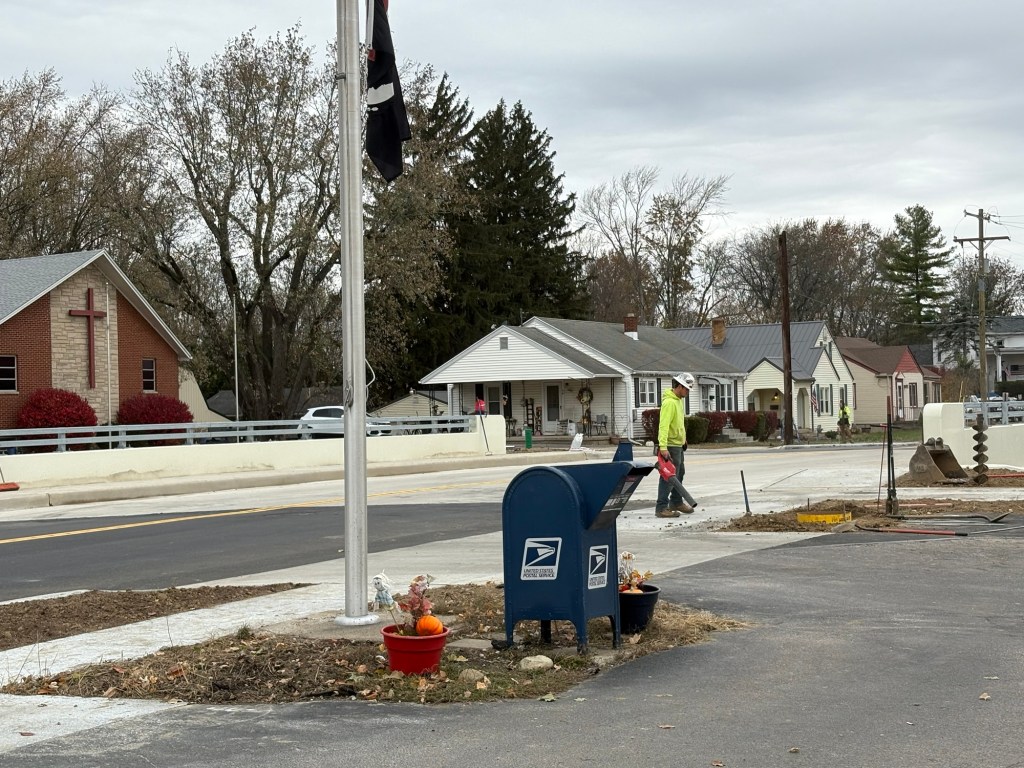
The Ohio State Route 72 bridge over Caesar Creek in Jamestown is open to traffic. The main construction project on SR 72 in Greene County, which included pavement repairs and resurfacing, is largely complete as of August 2024. Minor finishing work may still be occurring, but it should have little impact on motorists.
A workmen clears debris from the newly completed bridge and sidewalks over Cedar Creek in Jamestown on State Route 72.
At an estimated cost of $2,060,000, the bridge preservation project began in late 2024 and completed on schedule. the new three span bridge was expanded from the two span and modified to promote better hydraulic flow of the creek below.
Photo taken from the east (post office) side of the new three span bridge illustrates a more substantial structure, where the old one stood. 
Finishing touches are being completed on the bridge now, but all through traffic, including access to the Jamestown location of the United States post office, and all sidewalks are open for business.












 The Jamestown Comet