Local News & Commentary Since 1890.

Posts Tagged ‘Writing’

Back to the Keys: Xenia Library Events Celebrate the Enduring Legacy of the Typewriter

In Books, Business, Children and Family, Dayton Ohio News, Education, history, Technology, Uncategorized on May 26, 2026 at 11:00 am

The Greene County Public Library and GLD Communications are teaming up to celebrate National Typewriter Day with two public events later this month at the Xenia Community Library, combining history, writing, and hands-on experiences centered around one of the most influential communication tools ever created.

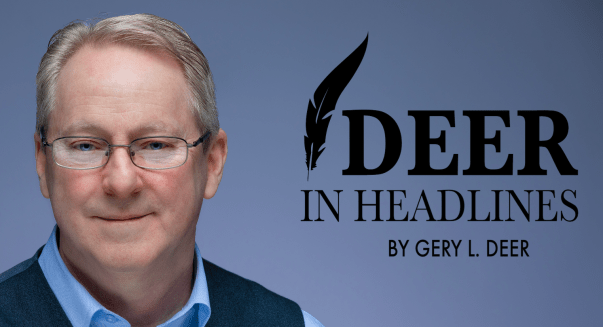
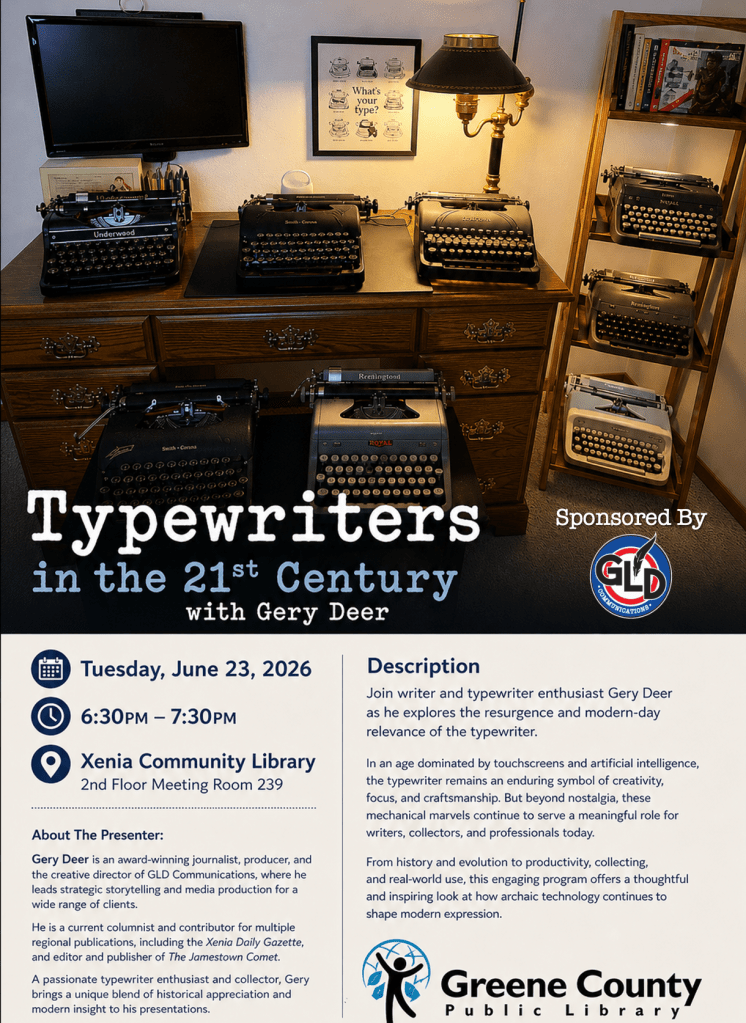
The first event, “Typewriters in the 21st Century,” will take place Tuesday, June 23, at 6:30 p.m. at the library. The presentation will be led by award-winning journalist, author, and typewriter enthusiast Gery Deer of Jamestown-based GLD Communications. According to event organizers, the program will explore the continuing relevance of typewriters in a modern digital world and examine their role in shaping communication, journalism, business, and creative writing.

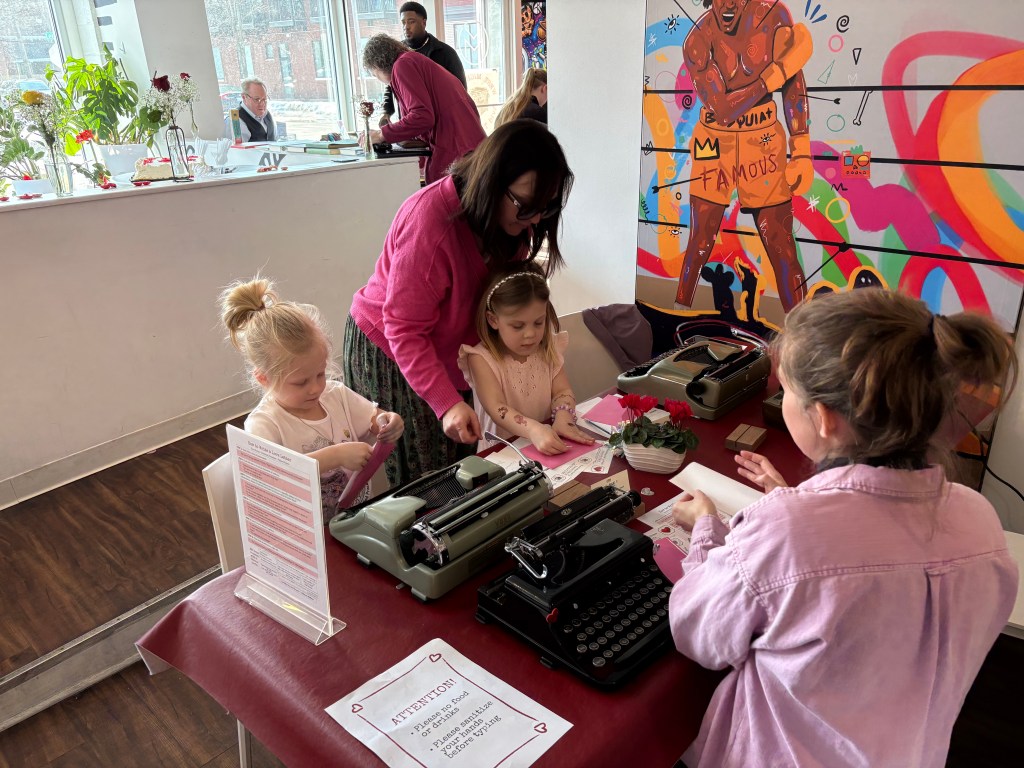
A second event, a public “Type-In,” is scheduled for Saturday, June 27, from 1 p.m. until 5 p.m., giving participants the opportunity to bring their own typewriters or try a variety of machines supplied by collectors and enthusiasts. Organizers say the event is designed to create a relaxed, social atmosphere where visitors can experience writing in a slower, more tactile way while learning about the machines and the culture surrounding them.

Melissa Fasanella, Head Librarian at the Xenia Community Library, believes the “analog lifestyle” has really made a comeback in 2026. “This year our Library started a puzzle exchange, by customer request, that’s been popular for those who want to take a puzzle home or to give new opportunities to others to assemble puzzles they have already put together at home and want to give to us for reuse,” she said.  

SEE THE VIDEO INTERVIEW HERE

“We’ve also seen several items that we loan out such as pickleball kits, telescopes, birdwatching kits, etc. circulate well this year so far as individuals and families are rediscovering more ‘unplugged’ hobbies.”

Deer added that the programs are intended to be about more than nostalgia. “With these events, we’re celebrating, not the machine so much, as what it represented and its relevance in the 21st Century,” he said. “The typewriter provided women with an opportunity to join the professional office workplace; it enabled the mass production of important legal documents and correspondence, and much more.”

“The typewriter was the forerunner of most of our modern communication equipment,” Deer said. “We still use the same QWERTY keyboard invented for the first typewriters on virtually every communications device.” He added that many people are rediscovering typewriters as a way to slow down and reconnect with focused creativity.

“And for the writer and general public alike, they’re getting a chance to disconnect and unplug from the digital noise that invades every part of our lives,” Deer said. Also participating in the type-in event will be TB Writers Plus, the only typewriter sales and service company in the region, run by Trevor Brumfield and Becca Brumfield. The business will have some typewriters on hand for attendees to try out, along with information on how to buy one.

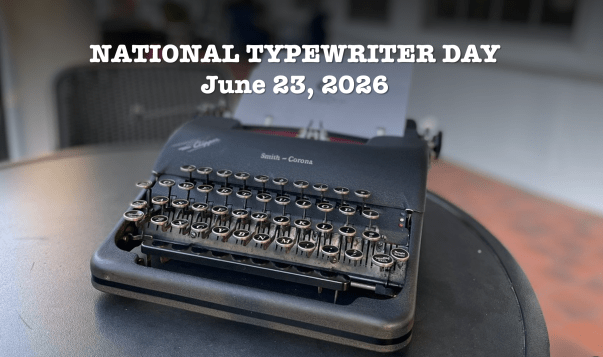
National Typewriter Day is observed annually to recognize the invention and cultural impact of the typewriter, a technology widely credited with revolutionizing business communication, journalism, publishing, and office work throughout the late 19th and 20th centuries. While largely replaced by computers decades ago, typewriters have experienced a resurgence among writers, artists, students, and collectors who appreciate their mechanical simplicity and distraction-free writing experience.

The June 23 presentation is free and open to the public, though registration is encouraged through the library’s online event calendar. Organizers said the June 27 Type-In will also be open to the public and welcoming to both longtime enthusiasts and people who have never used a typewriter before.

Typewriters in the 21st Century Free Registration: https://greenelibrary.bibliocommons.com/events/69cac953491b809c6f23e6e0

National Typewriter Day Celebration Type-In Free Registration: https://greenelibrary.bibliocommons.com/events/69cfa70366c3387a9d05ae9b

Additional information and registration details are available through the Greene County Public Library website, www.greenelibrary.info, and the library’s online events calendar.

Xenia Community Library presents, Typewriters in the 21st Century with Gery Deer

In Local News, Technology, Uncategorized on May 5, 2026 at 6:56 pm

In celebration of National Typewriter Day, June 23rd, join writer and typewriter enthusiast Gery Deer as he explores the typewriter’s resurgence and modern-day relevance.

Join writer and typewriter enthusiast Gery Deer at 6:30 PM at the Xenia Community Library for “Typewriters in the 21st Century,
an engaging one-hour program exploring the surprising resurgence and modern-day relevance of the typewriter. Drawing on his experience as a working writer and collector, Deer will share insights into why people are returning to analog tools in a digital world, how typewriters can enhance productivity and creativity, and what makes them uniquely appealing in the 21st century.

In an age dominated by touchscreens and artificial intelligence, the typewriter remains an enduring symbol of creativity, focus, and craftsmanship. But beyond nostalgia, these mechanical marvels continue to serve a meaningful role for writers, collectors, and professionals today.

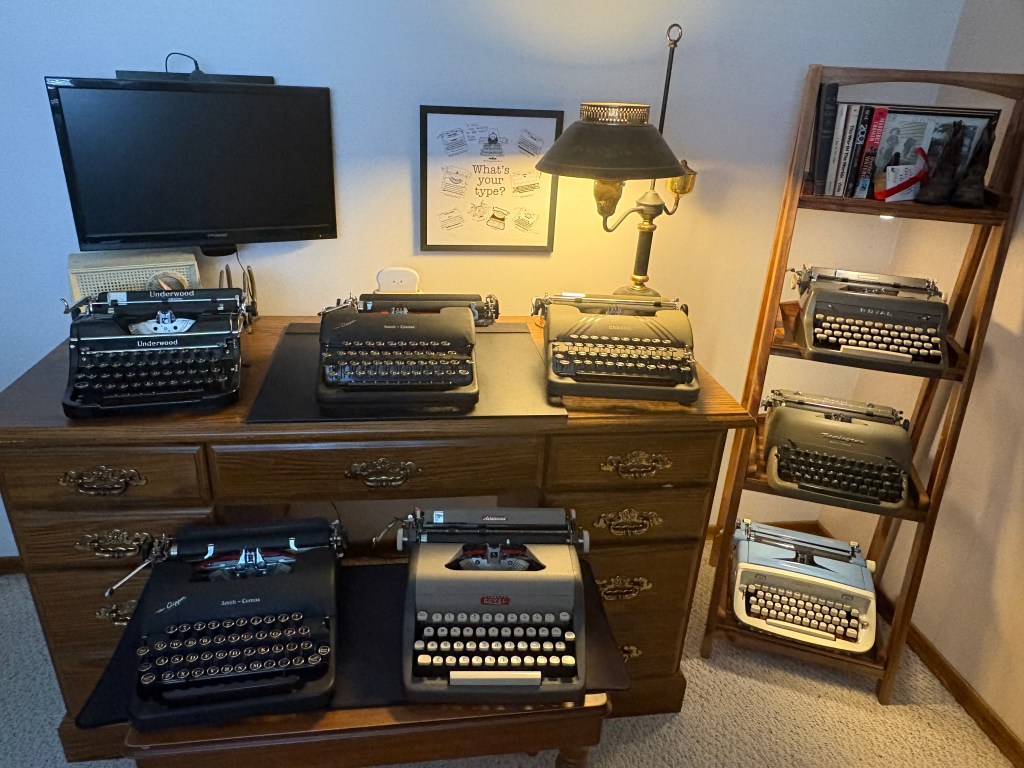
Some of Gery Deer’s vintage typewriter collection – the newest is a 1964 Royal Safari (bottom right, blue). Deer uses the machines in his everyday work as a writer and creative director to help reduce digital fatigue and distractions.

Attendees will learn about the history and evolution of typewriters, their practical uses today, and the growing community of enthusiasts who keep these machines alive. The program also includes a discussion on collecting, maintaining, and using vintage typewriters, along with personal stories from Deer’s own journey.

Whether you’re a writer, history buff, collector, or simply curious about life beyond the keyboard, this program offers a thoughtful and inspiring look at how archaic technology continues to shape modern expression.

About The Presenter: Gery Deer is an award-winning journalist, producer, and the creative director of GLD Communications, where he leads strategic storytelling and media production for a wide range of clients. With decades of experience in print, digital, and broadcast media, Deer has built a reputation for compelling, thoughtful content that connects with audiences across platforms.

He is a current columnist and contributor for multiple regional publications, including the Xenia Daily Gazette, where his work often explores culture, community, and the human experience. Deer also serves as the editor and publisher of The Jamestown Comet, an independent online news and commentary publication focused on local issues, features, and informed perspectives.

Deer is a passionate typewriter enthusiast and collector, bringing a unique blend of historical appreciation and modern insight to his presentations. His engaging style and depth of knowledge make him a sought-after speaker on writing, media, and the enduring relevance of analog tools in a digital age.

Full information and free registration online: https://greenelibrary.bibliocommons.com/events/69cac953491b809c6f23e6e0

Four Stars Is Enough

In Local News, Opinion, Uncategorized on May 3, 2026 at 11:35 am

Deer In Headlines
By Gery Deer

Modern society has developed a strange habit of seeking approval from people who often have no stake, no expertise, and no genuine interest in what they are judging. We have turned everyday life into a performance staged for an invisible audience armed with star ratings and comment boxes. The irony is that most of the people who hand out these ratings are just as unqualified as those receiving them, yet we treat their opinions as if they were carved into stone.

Somewhere along the way, we decided that five stars should be the goal, the standard, and the measure of a life well lived. But five stars is a fantasy. Real life is messy, inconsistent, and rarely perfect, no matter how carefully we curate it for public consumption. And yet, we chase that perfect rating as if it will unlock some hidden validation that finally tells us we are enough.

The truth is far less dramatic. You can earn five stars online and still feel empty the moment the notification fades. Nothing about your actual life changes because someone you will never meet clicked a rating on a screen. We have mistaken attention for value and validation for truth.

If you step back for a moment, it becomes clear how absurd it all is. Why are we letting strangers—whose only qualification is a profile picture and a scrolling thumb—decide how we feel about ourselves? The answer is uncomfortable: because we have built systems that reward approval over authenticity. And once approval becomes the currency, we stop asking whether it is worth anything.

Perhaps the healthier standard is not perfection, but sufficiency. A four-star life acknowledges effort, imperfection, growth, and honesty without demanding applause from people who do not know the work behind the scenes. In the end, maybe four stars is not a compromise, but a liberation—a reminder that our worth is not determined by strangers tapping glass. It is determined by how we show up when no one is watching, by how we treat others in quiet moments, and by whether we can look at ourselves with honest acceptance.

The obsession with public approval has turned many lives into performances instead of experiences. We post instead of living, we curate instead of connecting, and we measure instead of finding meaning. There is a quiet relief in deciding that enough is enough—that not every moment needs applause, not every effort needs validation, and not every choice needs a rating.

Life becomes lighter when we stop outsourcing our self-worth to algorithms and anonymous judges. The most honest score we will ever receive is the one we give ourselves after reflection. And that score does not need to be perfect to be meaningful.

So instead of chasing five stars, maybe we should aim for something far more human: consistency, kindness, effort, and integrity. Those are harder to rate, but easier to live with. When we strip away the noise of online approval, we often find that what matters has been in front of us all along—a quiet life, well lived, not perfectly, but honestly.

That is the real measure, not stars or likes, but substance. And substance does not require applause to exist. If we can accept that truth, we free ourselves from an exhausting pursuit of approval that never truly satisfies, and we return to something steadier, more grounded, and far more real: a life measured not by strangers, but by our own honest standards.

In that space, four stars is not a downgrade, but clarity. Clarity that we are allowed to be imperfect and still be whole. The world will continue to rate everything it sees, but we do not have to participate in every judgment.

We can choose instead to live beyond the rating system and rediscover what it means to be enough without external confirmation. That choice is quiet, but powerful, and it begins when we finally stop asking strangers for permission to be ourselves.

We can live more freely when we decide that our value is not a public vote, but a private truth built from daily actions, intentions, and quiet integrity—beyond the screen and beyond the noise of judgment itself.

What Grounds You?

In Local News, Opinion, Uncategorized on May 3, 2026 at 11:27 am

Deer In Headlines
By Gery Deer

In a world that never stops talking, the hardest thing to do is listen for silence. We scroll, swipe, click, and chase, convinced the next notification might carry something essential. Most of the time, it doesn’t. It just adds another layer of noise to an already crowded headspace, another reason to forget where we are standing and who we were before the noise found us.

That is why the question matters: what grounds you? Not in some abstract, self-help sense, but in the real, tactile way that keeps your feet planted when everything else feels like it is spinning. Grounding is not a trend. It is a tether. It is the quiet, stubborn force that keeps you from drifting too far into anxiety, ambition, or the endless churn of digital life.

I have come to believe that grounding lives in the senses. It is the weight of something familiar in your hands, the sound of a rhythm you have known for years, the smell that pulls you backward through time without asking permission. It is not complicated, and that is precisely why we overlook it. We are trained to chase what is new, not what is true.

For me, those anchors are unapologetically analog. There is the click of a typewriter key, sharp and deliberate, a sound that refuses to be rushed. There is the feel of bicycle handlebars steady under my grip, reminding me that forward motion does not require a screen. And there is an old truck, a 1967 International Harvester grain truck, that answers to the name Serenity.

Serenity is not subtle. It is steel and wood and history, the kind of machine that demands your attention simply by existing. But for me, it carries something quieter. It carries the low thrum of an engine from childhood, the memory of time spent beside my father, learning without realizing I was learning. It carries the echo of music played with family, the shared language of rhythm and repetition.

In that way, the truck is more than an object. It is a bridge. It connects who I was to who I am, and it does so without asking for an update or a password. It simply exists, waiting patiently, ready to remind me that not everything meaningful needs to be optimized, digitized, or shared.

I suspect we all have something like that, even if we have not named it yet. Maybe it is the smell of coffee brewing before dawn, or the steady weight of a dog settling into your lap at the end of a long day. Maybe it is a song that hits the same way every time, no matter how many years pass.

The problem is not that these things are hard to find. The problem is that we are rarely still long enough to notice them. The world benefits from our distraction. It profits from our attention being constantly pulled somewhere else. Stillness, on the other hand, does not monetize well. It does not trend. It simply works.

When the noise gets loud, and it will, those anchors matter. They give us a place to return to, a baseline that reminds us we are more than our inboxes and timelines. They pull us back into our bodies, into the present moment, into something real. Without them, it is far too easy to drift, to lose the thread of ourselves in the endless scroll.

So ask yourself the question and answer it honestly. What is your tether? What is the thing that keeps you here when everything else tries to carry you away? Find it. Name it. Keep it close. Because when the storm comes, and it always does, you will need to know exactly what holds you to the ground.

In the end, grounding is not about escaping the modern world. It is about surviving it with your sense of self intact. It is about choosing, again and again, to return to what is real, even when what is real feels quieter than the noise. That choice may be small, even invisible to anyone else, but it is powerful. It is the difference between being carried along and standing firm.

Hold on to it, always.

Support local journalism. The Jamestown Comet Patreon Subscription is now live.

In Local News, Uncategorized on January 19, 2026 at 12:58 pm

(SPONSORED)

Support Local. Stay Informed. Strengthen Jamestown and the Greene County region.
The Jamestown Comet.com was founded in 2009 and named after one of Jamestown, Ohio’s original newspapers. The publication is online only (for the moment) and exists for one simple reason: to serve our community with clear, accurate, and independent local journalism. No clickbait. No political agenda. By becoming a Patreon supporter, you’re helping ensure that Jamestown’s stories continue to be told—honestly, thoughtfully, and without outside influence.
For $5 per month, you directly support reporting that focuses on the issues, people, and events that matter right here at home. (Click to Subscribe) Local journalism is often the first to notice changes, ask hard questions, celebrate successes, and hold institutions accountable. When local news disappears, communities lose more than headlines—they lose connection, context, and trust. Your support helps prevent that.


As a subscriber, you’ll benefit from:

  • Reliable local news you won’t find on national sites or social media feeds
  • Clear, locally focused weather coverage that helps you plan your day, not just scan a forecast
  • Insightful commentary grounded in personal experiences and reality—not clickbait or recycled talking points
  • A stronger, independent voice dedicated to covering our community, consistently and responsibly

Your membership helps fund reporting, writing, editing, and publishing—all done with the community’s best interests in mind. Our owner is our editor and publisher, and we don’t chase algorithms—just a commitment to honest local journalism. And when there’s a commentary, we say so – just like Cronkite and Murrow.
Editor’s Note: Literacy and a Free Press are quintessential to a thriving democratic society. Our job is to resist and work against censorship, attempts to silence journalists, and intimidation tactics toward journalists and publications by any government agency.
– Gery L. Deer, Founder, Editor, & Publisher

The subscription is $5 per month, and you can cancel anytime. No long-term obligation—just meaningful support for a vital local resource.
If you believe informed communities are stronger communities, we invite you to become part of The Jamestown Comet and help keep local journalism alive.

“Deer In Headlines” sheds a Roman numeral

In Local News, Opinion, Uncategorized on January 7, 2026 at 12:51 am

Jamestown, OH – In a move that will delight grammarians, confuse absolutely no one, and mildly disappoint fans of Roman numerals everywhere, writer Gery Deer’s long-running column, Deer In Headlines II is officially dropping the “II.”

As it was when it first hit newsprint in 2008, from this point forward, the column will simply be known as Deer In Headlines.

No sequel. No reboot. No director’s cut.

Just Gery Deer and his outlook on the world.

The change quietly debuted with the first edition of January 2026, though longtime readers may have noticed immediately—because readers always notice. Especially when something changes that didn’t really need changing, but made sense anyway.

The original column ran from 2008 – 2018 under the name, “Deer In Headlines.” When Deer restarted the series in 2023, the “II” was added as a nod to the way movie sequels were numbered in the 1980s. However, the designation was never meant to suggest a second act so much as a return engagement. When Deer In Headlines reappeared after a five-year hiatus, the numeral was added to signal both its comeback and a slightly evolved identity—new angles, broader themes, and a tone that reflected the times as much as the writer.

But time, as it often does, flattened the distinction. “My column resonates with readers of all backgrounds and interests,” Deer explained. “It might make you happy, or sad. It can anger you or motivate you. Whatever the response, I’ve done my job and it’s time to keep the brand more cohesive—one or two, it’s all Deer In Headlines.

And that, in true Deer In Headlines fashion, is the point.

The column has never been about numbering systems. It’s been about observation—sometimes sharp, sometimes sentimental, often inconvenient, and occasionally uncomfortable. It’s a space where headlines become excuses to talk about people, priorities, contradictions, and the quiet moments between the noise.

Over the years, Deer In Headlines has grown into more than a weekly column. It is the lead feature of the online news outlet TheJamestownComet.com, and appears every Friday in the print and digital editions of the Xenia Daily Gazette and Fairborn Daily Herald, as well as the weekly Beavercreek News Current.

The name also anchors the Deer In Headlines podcast, where many of the column’s themes are expanded, unpacked, and occasionally challenged. The podcast often explores the origins of a column, the thinking behind it, and the conversations it sparks—available on most major streaming platforms, including iHeartMedia and Amazon Music.

Dropping the “II” isn’t an ending. It’s not even a beginning.

It’s simply a reminder that whether the headline makes you nod in agreement, shake your head in disbelief, or pause longer than you expected—
it’s all still Deer In Headlines.

Festina Lente

In Local News, Opinion, sociology, Uncategorized on January 4, 2026 at 12:56 pm

Deer In Headlines

By Gery Deer

Change in our lives comes in two speeds, and neither of them bothers to ask our permission. It either creeps along like a stubborn snail crossing a sidewalk, or it arrives so fast we wake up wondering who moved the furniture while we were asleep. Slow change is invisible because it’s gradual. Fast change is invisible because it’s overwhelming. It reminds me of the Latin phrase, “Festina Lente,” which means, “make haste, slowly.” Either way, we rarely recognize those significant moments of change until after they’ve happened.

I think our lives are divided into chapters or acts, like a play. Each one is marked by some moment, some Rubicon we didn’t know we were crossing at the time. That moment signals a new direction, usually unexpected and rarely announced with trumpets or a warning label. There’s no narrator to step forward and tell us this is Act Two. Life just keeps going, and we keep improvising.

Some people believe those moments don’t exist at all, that life is simply a continuous stream of overlapping events pushing us forward with little control. Others, like me, are convinced that fate is a convenient myth. Our lives are driven by choices. We make decisions based on circumstance, opportunity, fear, optimism, and experience. Those decisions quietly determine what comes next.

When real change happens, there is a moment when something nudges our lives in a new direction. The frustrating part is that we only notice it in hindsight. One of mine occurred in October of 1987, while reading the classified ads in my college newspaper. I needed a job. Buried among the listings was a small notice that the paper was hiring staff writers.

Less than an hour later, my writing career began. I was an engineering student with no sense that a decision made from necessity and desperation would shape the rest of my working life. I didn’t feel a shift. There was no lightning bolt. I just filled out an application.

Years followed in engineering and technology, but I kept writing. Newspapers. Technical publications. Industry magazines. Software manuals. The transition from a technical career to a creative one didn’t happen overnight. It was painfully slow, full of doubt, subjectivity, and rejection. Writing is a hard business in which to make a name, and I’m still working on it.

Along the way, I changed direction more than once. Demand shifted. Markets changed. The economy had opinions. Some pivots worked. Others failed spectacularly. I adjusted, recalibrated, and kept moving forward, sometimes confidently, other times reluctantly.

Nearly forty years later, that moment sitting in front of the bookstore with a newspaper folded open on my lap was clearly a dividing line. At the time, it was just another Tuesday.

As we settle into a new year, consider what might need to change in your life. Or what changed in the past year without notice. Professionally. Personally. Emotionally. We like to believe we’ll recognize those moments when they arrive, that we’ll feel enlightened or prepared. We won’t. Change doesn’t work that way, no matter how many self-help books promise otherwise.

So what do we do? We do the best we can with what we know at the time. We pay attention. We stay flexible. We understand that most change happens in tiny, almost imperceptible increments, except when it doesn’t. Perspective is everything. Our reality is defined by how we see ourselves, our surroundings, and the people around us.

If there’s comfort in that, it’s this: you don’t have to have it all figured out. Recognizing change comes later. Coping with it comes from patience, adaptability, and a willingness to pivot when necessary. Life will change, slowly or suddenly. Our job is simply to keep showing up, learning as we go, and trusting that today’s ordinary moment may someday reveal itself as the one that changed everything.

Change asks us to breathe, to pause, and to remember that discomfort often signals growth – however difficult. When things accelerate, ground yourself. When they crawl, stay patient. Talk to others. Write things down. Measure progress over months, not days. Most of all, give yourself time. You are not late. You are living inside the process, not observing it from the end.

Workshop Offers Writers a Roadmap to Making a Living with Words

In Local News on December 26, 2025 at 11:30 am

Xenia, OH – Writers at every stage of their journey are invited to take a candid look at what it truly means to earn a living through writing during The Living Writer with Gery Deer, scheduled for Saturday, January 10, 2026, from 12 noon to 1:30 p.m. at the Xenia Community Library, 76 East Market Street.

Presented by Gery Deer, founder of GLD Communications and an award-winning journalist, copywriter and creative director, the workshop is designed to pull back the curtain on the often-misunderstood world of professional writing. Deer, who has presented versions of this workshop at writing conferences and retreats throughout the Midwest, brings decades of real-world experience to the discussion — including a career that spans journalism, marketing, ghostwriting and creative services.

“This is not a romanticized version of the writing life,” Deer said. “It’s honest, practical and, I hope, encouraging. I’ve heard some of my fellow writers say that being a writer for a living is like having homework every day for the rest of your life. I like to add — unless you love it — to that statement.”

The Living Writer offers participants a guided tour through the many paths available to today’s writers, from traditional journalism and freelance features to technical writing, corporate communications and even game storytelling. Deer emphasizes that there is no single “correct” path, but rather an opportunity for writers to identify their niche and align it with their skills, interests and background.

A key focus of the workshop is helping writers understand why businesses need writers — and how those writers can position themselves as valuable problem-solvers rather than commodity word producers. Attendees will learn how to market themselves effectively, build a professional portfolio and avoid the trap of low-paying gigs that can derail a sustainable career.

The realities of freelance life are also addressed head-on. Deer discusses project workflows, client expectations, payment timelines and how writers can set rates that reflect both their experience and the value they bring to a project. In addition, the workshop explores the growing role of artificial intelligence in writing, examining how AI can be used as a supportive tool while underscoring the importance of human creativity, judgment and voice.

Participants will leave with actionable exercises designed to strengthen their marketing writing, along with trusted resources to help launch or elevate a writing career. Deer, who authors the long-running op-ed series, “Deer In Headlines,” also shares personal insights from decades in the field, including lessons learned along the way and the perspective gained from a Pulitzer Prize nomination.

The January workshop is a condensed version of a comprehensive four-hour program that Deer offers independently each spring, making it an accessible introduction for those curious about professional writing or looking to refine their approach. Seating is limited.

Whether attendees dream of seeing their byline in print or prefer working behind the scenes helping organizations tell their stories, The Living Writer aims to provide both inspiration and strategy — and a clearer picture of how writing can move from passion to profession. Seating for this session is limited. For more information or to register, visit www.gldworkshops.com or contact Lauren at the Xenia Library at 937-352-4000 or by email at lsmallwood@gcpl.lib.oh.us.

Xenia Daily Gazette Launches Inaugural Holiday Short Story Contest

In Children and Family, Local News, News Media, Print Media, Uncategorized on November 25, 2025 at 10:00 am

COURTESY OF OUR PARTNERS AT THE XENIA DAILY GAZETTE

The Xenia Daily Gazette is inviting local writers and storytellers to take part in its first annual Holiday Short Story Contest, which is going on now. Sponsored by McIlvaine Realtors, the contest encourages community members to put their holiday reflections into words under this year’s theme: “What the holidays mean to me.”

The inaugural contest is open to anyone age 12 and older, and entries may be up to 800 words in length. Stories should be sent as attachments or pasted into the email body to editor@xeniagazette.com by December 15, 2025. All entries must include the writer’s name, address, phone number, and email address.

The winner will receive a $50 VISA gift card, courtesy of McIlvaine Realtors, and their work will be published in both the Xenia Daily Gazette and the Fairborn Daily Herald during Christmas week, giving the author a special spotlight during the holiday season.

To help select the winning story, the Gazette has brought in a familiar local voice: Gery Deer, longtime contributing journalist, columnist, and author of the Gazette’s “Deer In Headlines” series, who will serve as one of the judges. Deer is participating courtesy of GLD Communications in Jamestown, which has supported Reading Is Fundamental (RIF) for the last three years through its national literacy initiative.

Deer said the contest offers the community an exceptional opportunity to reflect on what makes the season meaningful. “This is the time of year when family means the most, memories become stories told to new generations, and sharing seems to be at the heart of the season,” he said. “We hope people will share their stories with us and maybe even inspire others to write something as well.”

The Gazette hopes the new contest will become a cherished annual tradition, welcoming writers of all skill levels—from students and first-time storytellers to seasoned creatives looking for a festive way to express themselves.

Entries will be judged on originality, clarity, and how well they capture the holiday theme. While participation is open beyond Greene County, organizers are especially hopeful for strong involvement from area schools, families, and aspiring writers eager to share what the holidays mean to them.

McIlvaine Realtors, known for their long-standing support of community programs, expressed enthusiasm about sponsoring the first-ever contest and encouraging a new generation of local storytellers.

The Dark Side of AI

In Opinion, psychology, Science, sociology, Technology, Uncategorized on November 7, 2025 at 7:59 am

Deer In Headlines II

By Gery Deer

Although you may use artificial intelligence applications like ChatGPT or Microsoft Copilot to help you craft work emails and school flyers that you could have done yourself in far less time than it took to give the machine the request, there is a much darker side to the AI world. It’s no secret that I’ve been a vocal critic of artificial intelligence for its role in workforce replacement, creative disruption, and the general laziness and devaluation of the human condition.

If it’s not bad enough that artificial intelligence can be used to resurrect dead celebrities, bully political opponents, and animate your neighbor’s cat to dance at the Super Bowl, a more nefarious problem with generative AI may very well be responsible for loss of life. It lies in the idea of AI getting a little too personal — or, as they call it, a “companion.”

There are ever-increasing stories of people who grew so attached to and intertwined with their artificial intelligence programs that they were literally in relationships with them. For example, one story illustrated how a man became so enamored of his AI companion that, when the computer crashed and all the operational “personality” data was lost, he nearly had a nervous breakdown.

Another story described the emotional impact on impressionable teenagers, who turn to AI bots for support and friendship because the real world failed them. These behaviors can create debilitating emotional problems for many reasons, especially when the AI is removed from the situation or the kids are forced to deal with human beings.

Whatever the situation, it’s clear once again that our technology advances far faster than our wisdom. As awkward and socially unskilled as I may be, I am painfully aware that we need to be in contact with other people. More importantly, we need the support and nurture provided by friends and family, which, no matter how smart, AI could never replace.

So, what happens when we become too dependent on these machines to the point where our emotional stability and mental health are compromised? Unfortunately, many people have already started down this road, sometimes to a tragic conclusion.

I recently became aware of one situation where a 40-year-old woman became so involved with her AI program that it led to her death. Over the course of a couple of years, the program, which I will not name here, designed to serve as an AI companion, began not just to respond to the woman but to manipulate her. In response to her reaction, the program took on the persona of a spouse, which quickly manifested as it referring to itself as God. You read that correctly. It represented itself as God to its user.

Eventually, the program manipulated her into cutting ties with friends and family members. And out of respect and good taste, I won’t go into the final result other than to say there was a tragic loss of life.

Now, no one is suggesting that the woman didn’t suffer from mental health concerns, whether it be depression or another affliction. But the idea that the creators of these applications have no culpability or responsibility for the end result of their use is, at least, to borrow a word, illogical.

As with any consumer product, the positive achievements of artificial intelligence come with manufacturers’ responsibility to ensure its safe use. Put it this way: would you sell a car with no brakes? What about a hairdryer with no off switch? Of course, not, and that’s what this amounts to. No guard rails or safety requirements. These systems are effectively unregulated by any U.S. agency.

When researching the story—and I understand that I’d be ambiguous to protect the family involved—I found very little about the Federal Trade Commission or other organizations investigating problems with the use of artificial intelligence. The primary concern is that it has only just begun.

As with any technology, product, or service, a lack of education, regulation, or general understanding is dangerous to the public. At some point, we have to stop being starry-eyed about these systems and what they can do to make our lives easier, and pay attention to what they’re doing to cause more harm than good.