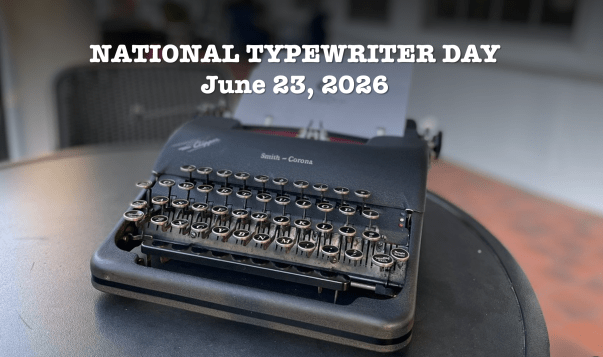
The Greene County Public Library and GLD Communications are teaming up to celebrate National Typewriter Day with two public events later this month at the Xenia Community Library, combining history, writing, and hands-on experiences centered around one of the most influential communication tools ever created.
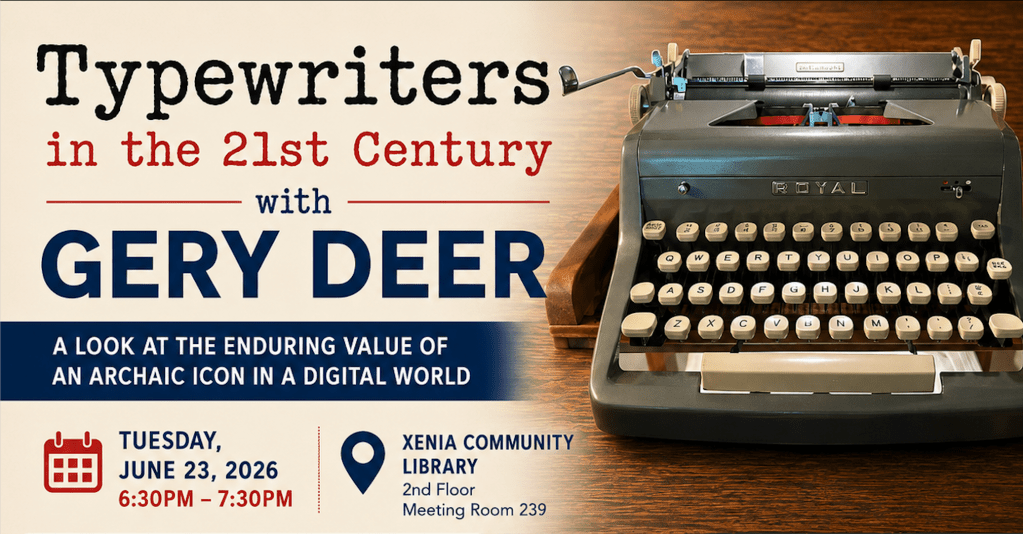
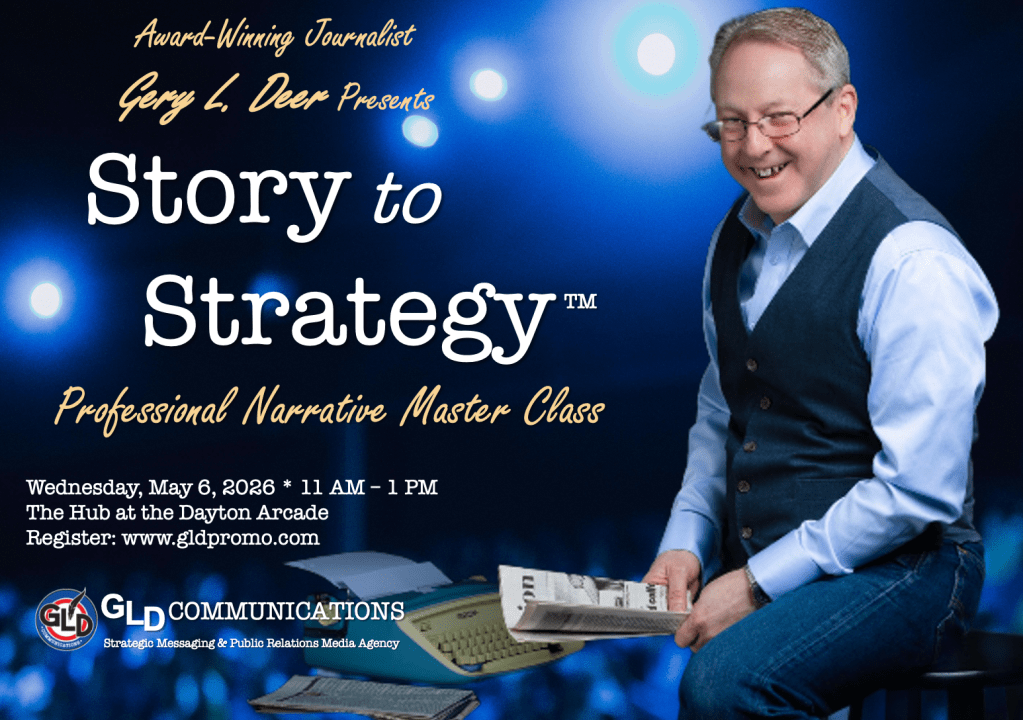
The first event, “Typewriters in the 21st Century,” will take place Tuesday, June 23, at 6:30 p.m. at the library. The presentation will be led by award-winning journalist, author, and typewriter enthusiast Gery Deer of Jamestown-based GLD Communications. According to event organizers, the program will explore the continuing relevance of typewriters in a modern digital world and examine their role in shaping communication, journalism, business, and creative writing.
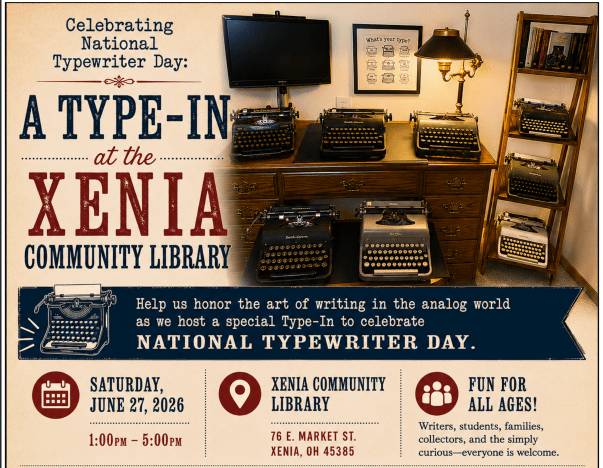
A second event, a public “Type-In,” is scheduled for Saturday, June 27, from 1 p.m. until 5 p.m., giving participants the opportunity to bring their own typewriters or try a variety of machines supplied by collectors and enthusiasts. Organizers say the event is designed to create a relaxed, social atmosphere where visitors can experience writing in a slower, more tactile way while learning about the machines and the culture surrounding them.
Melissa Fasanella, Head Librarian at the Xenia Community Library, believes the “analog lifestyle” has really made a comeback in 2026. “This year our Library started a puzzle exchange, by customer request, that’s been popular for those who want to take a puzzle home or to give new opportunities to others to assemble puzzles they have already put together at home and want to give to us for reuse,” she said.
“We’ve also seen several items that we loan out such as pickleball kits, telescopes, birdwatching kits, etc. circulate well this year so far as individuals and families are rediscovering more ‘unplugged’ hobbies.”
Deer added that the programs are intended to be about more than nostalgia. “With these events, we’re celebrating, not the machine so much, as what it represented and its relevance in the 21st Century,” he said. “The typewriter provided women with an opportunity to join the professional office workplace; it enabled the mass production of important legal documents and correspondence, and much more.”
“The typewriter was the forerunner of most of our modern communication equipment,” Deer said. “We still use the same QWERTY keyboard invented for the first typewriters on virtually every communications device.” He added that many people are rediscovering typewriters as a way to slow down and reconnect with focused creativity.
“And for the writer and general public alike, they’re getting a chance to disconnect and unplug from the digital noise that invades every part of our lives,” Deer said. Also participating in the type-in event will be TB Writers Plus, the only typewriter sales and service company in the region, run by Trevor Brumfield and Becca Brumfield. The business will have some typewriters on hand for attendees to try out, along with information on how to buy one.
National Typewriter Day is observed annually to recognize the invention and cultural impact of the typewriter, a technology widely credited with revolutionizing business communication, journalism, publishing, and office work throughout the late 19th and 20th centuries. While largely replaced by computers decades ago, typewriters have experienced a resurgence among writers, artists, students, and collectors who appreciate their mechanical simplicity and distraction-free writing experience.
The June 23 presentation is free and open to the public, though registration is encouraged through the library’s online event calendar. Organizers said the June 27 Type-In will also be open to the public and welcoming to both longtime enthusiasts and people who have never used a typewriter before.
Typewriters in the 21st Century Free Registration: https://greenelibrary.bibliocommons.com/events/69cac953491b809c6f23e6e0
National Typewriter Day Celebration Type-In Free Registration: https://greenelibrary.bibliocommons.com/events/69cfa70366c3387a9d05ae9b
Additional information and registration details are available through the Greene County Public Library website, www.greenelibrary.info, and the library’s online events calendar.


























 The Jamestown Comet
Civil Discourse, communication, Conversation, Critical Thinking, debate, Deer In Headlines, Family Relationships, Gery Deer, Human Nature, opinion, Political Polarization, politics, Social Commentary, Understanding
Debate is not conversation
In Education, Opinion, Politics, psychology, Uncategorized on June 14, 2026 at 9:08 amDeer In Headlines
By Gery Deer
I have family members I can’t talk politics with. That’s not because they’re bad people, ignorant people, or people I don’t care about. They’re some of the smartest, hardest-working, most generous people I know. We’d help each other move furniture, fix a flat tire, or get through a family crisis without hesitation. But the moment politics enters the conversation, everything changes.
What makes it frustrating is that I’m usually not trying to change anyone’s mind. As a journalist, I’ve spent much of my career talking with people whose backgrounds, values, and beliefs differ from my own. I’ve interviewed politicians, activists, business owners, lobbyists, farmers, teachers, veterans, and everyday citizens from every imaginable perspective. My job was never to win an argument. It was to understand why people believed what they believed.
Unfortunately, that’s not always what happens around the dinner table anymore. Some people have become so hard-wired into their political identities that every discussion feels like a loyalty test. Questioning a policy suddenly becomes an attack on the tribe – or cult, depending on how you see it. Asking for clarification becomes immediate proof that you’re uninformed. Offering a different perspective becomes evidence that you’ve been misled. The conversation stops being about ideas and starts becoming about defending a team.
That’s the difference between a conversation and a debate. A conversation is an exploration. The goal is understanding. A debate is a competition. The goal is victory. Both have value in the right setting, but problems arise when people think they’re having one while participating in the other.
I’ve watched it happen countless times. Someone mentions a news story. Another person responds with an opinion. A third person offers a different interpretation. At first, everyone is simply exchanging thoughts. Then someone decides that understanding isn’t enough. Someone begins trying to prove another person wrong. The shift is subtle but unmistakable.
Questions disappear. Statements become sharper. Opinions are tossed in as facts, lobbed like verbal hand grenades. Listening becomes, well, nonexistent. Instead of learning something, people prepare rebuttals. Rather than consider another perspective, they look for weaknesses to exploit. The discussion has transformed from a conversation into a debate.
If no one recognizes what’s happening, the debate quickly deteriorates into an argument. That’s when voices rise, and interruptions begin. People assign motives rather than address ideas. You’ve probably heard the phrases before. “You only think that because…” or “You’re just saying that because…” Once those words enter the discussion, the original topic has pretty much vanished. The focus becomes defending pride, identity, and ego.
The irony is that arguments rarely – more like never – change minds but usually accomplish the opposite. The harder people push, the more firmly others cling to their existing beliefs. Nobody wants to feel cornered, embarrassed, or dismissed. Even when valid points are being made, they’re lost beneath the emotional weight of the conflict.
Some of the best conversations I’ve ever had ended with complete disagreement. Nobody switched sides. Nobody waved a white flag. Nobody declared victory. Yet both people walked away with a better understanding of how the other saw the world. That’s not failure. That’s success.
Understanding doesn’t require agreement. It doesn’t require compromise on deeply held principles. It simply requires that we recognize that intelligent people can reach different conclusions based on their experience. When we approach disagreement with curiosity instead of combativeness, we create opportunities to learn something new.
Communities depend on that ability. Families depend on it even more. If every disagreement becomes a contest, relationships eventually become casualties. People stop talking. Gatherings become tense. Entire subjects become off-limits because nobody trusts anyone else to listen.
The older I get, the less interested I am in winning debates. Winning is temporary. The satisfaction lasts about as long as the next disagreement. Understanding, however, has lasting value. It strengthens relationships, broadens perspectives, and creates opportunities for cooperation even when agreement remains impossible.
Disagreement is healthy. But what we need are fewer debates disguised as conversations. One builds bridges while the other draws battle lines. In the end, conversations create the possibility of resolution because people are working toward understanding. Debates create division because people are working toward victory. That’s a difference worth remembering.