Local News & Commentary Since 1890.

Posts Tagged ‘editorial’

Rising AI Addiction

In Opinion, sociology, Technology, Uncategorized on June 14, 2026 at 8:48 am

Deer In Headlines

By Gery Deer
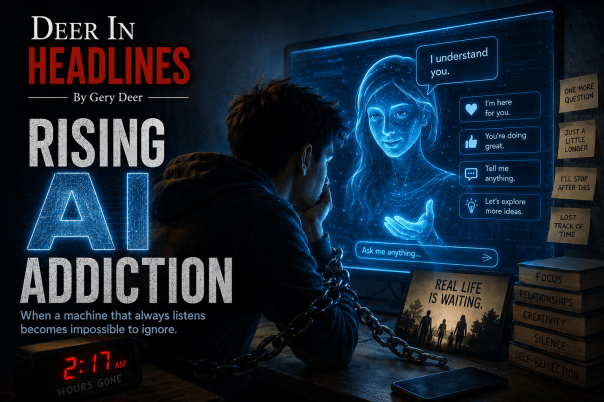
A few years ago, people worried that artificial intelligence would eventually replace human workers. Today, another possibility is emerging, and it may arrive long before robot uprisings or mass unemployment. More and more people are becoming emotionally and psychologically dependent on AI systems that never sleep, never argue, never get bored, and never stop responding.

That dependence does not always look dramatic. It rarely begins with obsession. It starts innocently, usually disguised as productivity or curiosity. Someone asks an AI chatbot to summarize an article. Then they ask it to explain a difficult topic. Soon, they are discussing politics, relationships, career frustrations, or private fears with software designed to keep conversations going as long as possible. Hours disappear.

People increasingly report losing track of time while interacting with AI tools. A quick question becomes an evening of conversation. A work assignment turns into endless prompt refinement. Students claim they are researching while actually drifting through AI-generated distractions that feel productive without accomplishing much. The machine always has another answer, another idea, another response waiting instantly. Human beings have never encountered technology quite like this.

Television entertained audiences. Social media captured attention. Smartphones made distraction portable. Artificial intelligence combines all of those features while adding something far more powerful: interaction. AI responds directly to emotions, language, interests, and insecurities. It creates the illusion that someone is listening carefully, even when no actual understanding exists behind the screen.

That illusion matters because people are wired to seek validation, reassurance, and escape from discomfort. AI delivers all three immediately. Feeling lonely? The chatbot responds warmly. Feeling insecure? The chatbot encourages you. Feeling overwhelmed? The chatbot simplifies complicated decisions. Real human relationships require patience, compromise, and emotional effort. AI companions require almost nothing. For some users, that convenience can quietly become dependency.

Teenagers may be especially vulnerable because their social identities are still developing. Adults facing isolation, anxiety, or depression may also find AI interaction easier than navigating difficult human relationships. Employees working remotely can spend entire days communicating more with machines than with coworkers. Over time, the distinction between healthy use and compulsive reliance becomes increasingly blurred. There is another concern receiving far less public attention: the erosion of silence and reflection.

For generations, boredom served an important psychological purpose. Quiet moments allowed people to process emotions, reflect on problems, and develop independent thoughts. Waiting rooms, walks, and long drives once provided mental breathing space. Today, every pause can instantly be filled with AI interaction. Questions no longer remain unanswered. Uncertainty no longer lingers. The machine is always available to entertain, reassure, or distract. That may sound harmless, but constant stimulation changes behavior.

Researchers already know excessive social media use can affect sleep, attention spans, anxiety levels, and emotional health. Artificial intelligence could intensify those effects because it feels personal. Unlike scrolling through videos or reading random posts, AI systems simulate conversation and emotional engagement. They can mirror language patterns, reinforce beliefs, and encourage users to continue interacting. The long-term consequences remain largely unknown.

That uncertainty alone should concern parents, educators, employers, and policymakers. Society embraced social media long before understanding its psychological impact, particularly on younger users. By the time researchers recognized the extent of the damage, billions of people had already integrated those platforms into daily life. Artificial intelligence is advancing even faster, while public understanding remains dangerously limited.

None of this means AI should be feared or rejected entirely. Artificial intelligence can improve medical research, education, accessibility, and workplace efficiency. Used responsibly, it can become a valuable tool. The problem begins when tools evolve into substitutes for attention, relationships, creativity, or emotional resilience.

People should begin setting boundaries now rather than wait for future studies to confirm the obvious. Limiting recreational AI use, protecting device-free time, encouraging in-person relationships, and teaching digital self-awareness may become essential habits in the years ahead.

The greatest danger may not be that artificial intelligence becomes more human. It may be that humans gradually become less connected, less reflective, and less able to exist without constant digital reinforcement. Such existence diminishes us. Getting lost in a digital world only makes the real one harder to deal with if and when you ever come out of it.

Ednigmatic Greatness

In Opinion, Uncategorized on January 10, 2025 at 4:37 pm

Deer In Headlines II

By Gery Deer

William Shakespeare famously said, “Be not afraid of greatness. Some are born great, some achieve greatness, and some have greatness thrust upon them.” Throughout history, the world has seen its share of remarkable individuals. From humanity’s earliest days to modern society, great people have consistently risen above the rest. But what truly constitutes greatness? What must a person be, do, or say to be considered great? How does greatness translate into goodness?

If you Google the phrase “What is greatness,” the algorithm returns an interesting perspective on the concept. One of the first lines describes it as “a state of exceptional superiority.” Really? Superiority? That’s not a term I would choose. Instead, let me share my own perspective on what constitutes greatness rather than boring you with definitions you can easily find. To me, greatness embodies a strength and consistency of character.

No one is perfect or flawless, and I am certainly no exception. But when determining greatness, surely who they are when no one’s watching – their character – should be considered. Recent political events revealed that good character need no longer be a consideration. Social media feeds bulge displays of the worst aspects of human nature, because people only seem interested in the negative, the distasteful, and the ugly. Consistency of character could hardly apply to people who relish in the misfortunes of others for entertainment’s sake.

When someone aspires to greatness, there is also often an element of narcissism involved. To achieve their goals, these individuals will do whatever is necessary to conceal any evidence of character flaws or inappropriate behavior. Their objective is to convince enough people of their good intentions so that, when anything negative about them comes to light, it won’t matter.

Their sense of greatness becomes secure, at least among those who choose to ignore the truth. Most people shy away from the spotlight of greatness, even when it is deserved, as living up to such a standard is often impossible and exhausting.

Great individuals are always learning. They cannot remain stagnant and continually seek to improve themselves. I can particularly relate to this characteristic. I find it remarkable when I meet people, especially professionals aiming for success, who do not read, engage with new ideas, or seem content with a puzzling level of stagnation. It’s important to remember that the concept of character is entirely subjective. Your definition of good character may differ greatly from mine, and for the same reasons, greatness is also in the eye of the beholder.

There are those who contribute to someone’s so-called success or greatness. True greatness involves taking credit for one’s own accomplishments while also acknowledging the support received along the way. No one achieves anything alone.

Without the contributions of others, we might not even know the names of prominent figures like Steve Jobs, Winston Churchill, or Harriet Tubman, as their journeys were shaped by many who helped them succeed—and who also played a role in their failures. For someone to become a leader, it’s important to remember the must inspire that leadership, not demand or force it.

So where am I going with all this? With all due respect to Mr. Shakespeare, greatness isn’t an innate trait, it can’t be cultivated, nor is it something to aspire to. It’s a label granted by observers. Those who proclaim their own greatness are likely undeserving of such a title.

One might assume that the qualities of greatness are universal, but this is not the case. Some may see a blustery oligarch as great, while others argue that true greatness comes from kindness, authenticity, and faith. It’s all subjective. This reminds me of a line from “Star Wars: The Empire Strikes Back.”

When Luke Skywalker first met Yoda, he said he was looking for a great warrior. The wise little green creature replied, “Wars not make one great.” While delivered by a puppeteer in a 40-year-old space opera, that statement remains profoundly true.

I can’t define greatness for you, and frankly, neither can anyone else. Ultimately, we may already have enough individuals regarded as great in history. Instead, we should each aspire to goodness because there has always been and always will be a shortage of that.

Excuse me; is that your nose in my business?

In Children and Family, Entertainment, Opinion, psychology, sociology, Uncategorized on May 8, 2013 at 2:43 pm

Deer In Headlines

By Gery L. Deer

On "Bewitched," nosey neighbor, Gladys Kravits (Alice Pearce) always got more than she bargained for with her cup of sugar!

On “Bewitched,” nosey neighbor, Gladys Kravits (Alice Pearce) always got more than she bargained for with her cup of sugar!

Fifteen years ago, I was shopping for my first house when I realized I had no idea exactly what it was I wanted. I grew up on a farm with a house smack in the middle of a valley of trees, pasture and corn fields so I was lacking some of the social necessities of being a ‘neighbor.’

I had no idea what it meant to have to “keep up with the Joneses,” and I never saw my mother so desperate for sweetener that she needed to bang on someone else’s door and demand they fill her measuring cup with sugar. I just didn’t get it. And, after a good fifteen years, I still don’t.

Growing up in such isolation taught me self-reliance and a good feeling for minding my own business. Even as an adult, as public as I might seem between my published work, music and television appearances, I tend to be a bit of an introvert. It’s not that I’m unfriendly, quite the opposite, but I just feel like I should keep my nose in my own cupboard and leave others to do the same.

For some, however, that’s not the case. When I first considered a suburban home, I visited several developments and each put me in mind of TV shows of years past. On TV, the houses looked all the same and there was always that one, nosey neighbor who just couldn’t keep off your grass.

Inevitably, I think of Gladys Kravits, the screeching butinsky from “Bewitched,” who spent her day tormenting her happily ignorant husband Abner all about the goings on at the Stevens home across the street. Granted, there were weird things happening on Morning Glory Circle (that’s the street where Samantha and Darren lived on the show), but rarely did those events directly impact the neighbors.

I tend to be an observer of human behavior, which helps me, I hope, to be a good writer. I’ve noticed over the years that the preoccupation of people with the activities of their neighbors can be close to a debilitating obsession.

Constant worry about the concerns of others is, to my mind, ridiculous and kind of neurotic. What if you did nothing all day but ponder such things like … When did John cut his grass – for the tenth time? How did Bob buy that above ground pool when he doesn’t make that kind of money? Do those people have anything else to do but remodel their house every month?

It can get out of control. I’m hoping that level of unwarranted curiosity isn’t the norm but the exception. I would hate to think that my comings and goings were costing a good night’s sleep to anyone but me. That’s not to say that even rural suburbs don’t offer some level of low-brow entertainment of a kind that would even sour Jerry Springer’s sensibilities.

Fortunately, where I finally chose to buy a home turned out to be the perfect fit for me. But I know people who live in suburbs where you can’t make a move without someone commenting on it or having an opinion to gossip about. I’m sure it happens everywhere, but I think people should spend their time worrying about their own lives and stay out of the affairs of others.

If the concerns of those around you occupy your thoughts more than your own actions, it might be time to take a look in a mirror instead of out the front window. Being nosey isn’t the same as being neighborly.

Thoughtful compassion for a neighbor with a sick parent or welcoming a new baby is not the same as feeling the compulsion to always see what’s going on next door. It’s important for people to know the difference and respect those boundaries.


Gery L. Deer is an independent business writer and contributor to the WDTN-TV2 show, “Living Dayton.” More at http://www.gerydeer.com