Local News & Commentary Since 1890.

Posts Tagged ‘Gery L. Deer’

Are you present, or performing?

In Opinion, psychology, sociology on March 15, 2026 at 5:08 pm

Deer in Headlines

By Gery Deer

Most of us spend our days performing. Not acting in the theatrical sense—no stage lights, no applause—but performing, nonetheless. We perform competence at work, patience in traffic, and happiness on social media. By the time evening rolls around, many of us deliver a full day’s worth of lines with little meaning.

Think about your own morning. You check email while eating breakfast. Are you tasting your coffee, or just swallowing it? That small moment may hold the difference between performing life and actually living it.

Performing is when you do something because the deadline is first thing tomorrow and someone expects a result. Presence is when you do something because you noticed something that refuses to leave you alone—like the barista who always draws a careful leaf in the foam even though almost nobody looks.

For most people, the gap is subtle. It’s the difference between doing the thing and the thing having you. You can move through an entire day answering emails, making small talk, nodding in meetings, checking boxes—and never actually be there.

Presence sneaks up on you differently. It’s the moment you stop mid-sentence because you heard a bird outside and realize you haven’t listened to anything but noise all week. It’s noticing the weight of a conversation instead of rehearsing your reply while the other person is still talking.

Social media has turned performance into a sickening staple. We curate our moods, polish our opinions, crop the messy edges out of real life until what we share is more like the reflection of ourselves in a funhouse mirror. The result is a strange pressure to appear more together, more informed, more inspired than we actually feel.

There is a place for performance. Teachers perform to hold the attention of their students. Leaders perform to steady a room. Writers, speakers, even columnists perform a little to shape chaos into something readable.

But performance was never meant to replace presence. When the show never ends, we start losing small human signals: the pause before someone tells the truth, the tired look behind a joke, the quiet satisfaction of finishing something that mattered.

The cost of such nonstop performance is exhaustion. Not the dramatic burnout people post about online, but the quieter fatigue that comes from always being slightly on stage. You measure your reactions, edit your sentences, and move through the day as if someone might be evaluating you.

Presence, by contrast, is disarmingly simple. It begins with that moment when you realize you’re just running the script. But you can change that. 

Maybe slow down long enough to taste the coffee or look up when someone speaks instead of nodding while staring mindlessly phone. Maybe step outside and notice the weather or the graffiti on the bakery wall.

None of this will make you more impressive, build a personal brand or make a post go viral. What it might do is return you to your own life.

Presence can steady people. It lowers the noise enough to notice what actually needs your attention—a hard conversation, a good idea, a tired friend, a quiet, ordinary moment that would otherwise pass unnoticed.

And strangely, the more present you become, the less life feels like something you have to manage. Problems are still there, deadlines still exist, but being human was never supposed to be a full-time performance.

It was supposed to be lived in small attentive pieces: a conversation where you are fully engaged, a walk where you notice the season changing, a calm moment where your mind is not rehearsing tomorrow.

The challenge is not abandoning performance entirely. Sometimes the job requires it. Sometimes some of your day requires polish and composure.

The real trick is remembering to step off the stage when the moment passes. Look up from the script. Listen for the bird outside the window. Taste the coffee while it is still warm.

Because the goal was never to perform your way through life. The goal is to actually be there while it happens. And if you catch yourself mid-performance today, that pause might be the most honest moment of the day. Stay for it even if nothing else changes.

Only at this table.

In Opinion, Uncategorized on March 6, 2026 at 11:20 pm

Deer In Headlines

By Gery Deer

It was late evening at a hotel restaurant in Washington, D.C. Most of the restaurant crowd were either deep in their own discussions or had eyes glued to televisions broadcasting college basketball. And there we were. A handful of adults who were born with or a parent of someone with bladder exstrophy, all of us in town as patient advocates preparing to take on Congress. 

We laughed and talked, as burgers, salads and something fried occupied most of the real estate between us. Someone had to move a basket of fries so we could make room for desserts and more drinks.

On the surface, we didn’t look so different from anyone else in the room. Just another group decompressing after a long day. But the conversation? That could have only happened there. Only at this table.

Bladder exstrophy is rare – very rare. So, when you’re born with a condition that requires extensive surgery – or surgeries – and lifelong management, there are very few who can relate. Explaining it often brings sighs of pity, confused expressions, and a host of questions. 

At this table, there was none of that. We didn’t have to define the anatomy. We didn’t have to summarize childhood surgical histories or explain why insurance preauthorization feels less like paperwork and more like gladiator combat. We could start mid-story.

We compared hospital experiences the way other people compare hometowns. We talked about the benefits and challenges of living with something so unusual it was often hard to explain, even to those closest to us.

That shared experience can lead to its own sort of verbal shorthand. It strips away the introductory chapter and drops you straight into the middle of the book. And shared experiences from birth? There’s no need to tiptoe around things, perform bravery or package vulnerability in tidy language. You can be direct. You can be specific. You can be understood.

There was a moment — and I won’t detail it, because some conversations belong only to those who were present — when the tone softened. Someone shared a memory from adolescence, a time when feeling different felt especially sharp. No one rushed to fix it. No one offered a motivational poster response. Instead, there was safety in letting go, in the expression of feelings and thoughts that only others like us could understand.

It manifests as a shared laugh, or a look, or a nod. It’s not dramatic. It doesn’t require a spotlight. It’s a quiet acknowledgment that says, “Yeah, I know.”

Every community has a version of this table. Veterans find it with other veterans. Cancer survivors with survivors. Parents of children with complex needs with others who speak that language fluently. I experience it whenever I talk to those who have cared for elderly parents. Even journalists have our own version — around a busy lunch counter or late dinner table, arguing about headlines.

The table isn’t about exclusivity. It’s about the rare and deeply emotional relief of not having to translate your life for someone else, and timing matters.

We weren’t children navigating surgeries for the first time. We were adults who had built careers, relationships and resilience. We had come to Washington to advocate, to push for better systems. That context shaped the conversation. 

We were recounting the past, but also connecting it to the future. Even more incredible to me was the fact that the congenital flaw that made us the objects of both fascination and ridicule as children was now quite literally our superpower. It was what brought us to Capitol Hill to help others – because we can. 

When we finally stood up, games still flickering on the screens and the crowd still rumbling, I looked at that table and felt the weight of its ordinariness. It was just wood and silverware and a stack of dishes.

But for a couple of hours one evening, amid basketball fans and bar noise, it was something far more. It was a place where five people shared something unique to them – an understanding. No, it was more than that. It was something as rare as the condition that we shared, but as unique as each one of us. But only at this table.

Jamestown Advocate Takes Urological Care Concerns to Capitol Hill

In Business, Environment, Health, Uncategorized on March 6, 2026 at 11:02 pm

JAMESTOWN – Greene County journalist and communications professional Gery Deer joined more than 300 physicians and patient advocates in Washington in February to press federal lawmakers on policies that directly affect access to urological care in Ohio and across the country.

Deer served on one of two Ohio delegations to the 2026 American Urological Association’s Annual Urology Advocacy Summit, held the week of Feb. 22 in Washington, D.C. He represented patients as a member of the Association for the Bladder Exstrophy Community’s Adult Patient Advisory Council.

The summit is designed to bring the voice of the specialty, and the patients it serves, directly to federal lawmakers — creating a bridge between medicine and policy. Over four days, physician and patient advocates receive briefings on pending legislation, reimbursement policy and insurance practices that shape how — and whether — patients can obtain urological treatment.

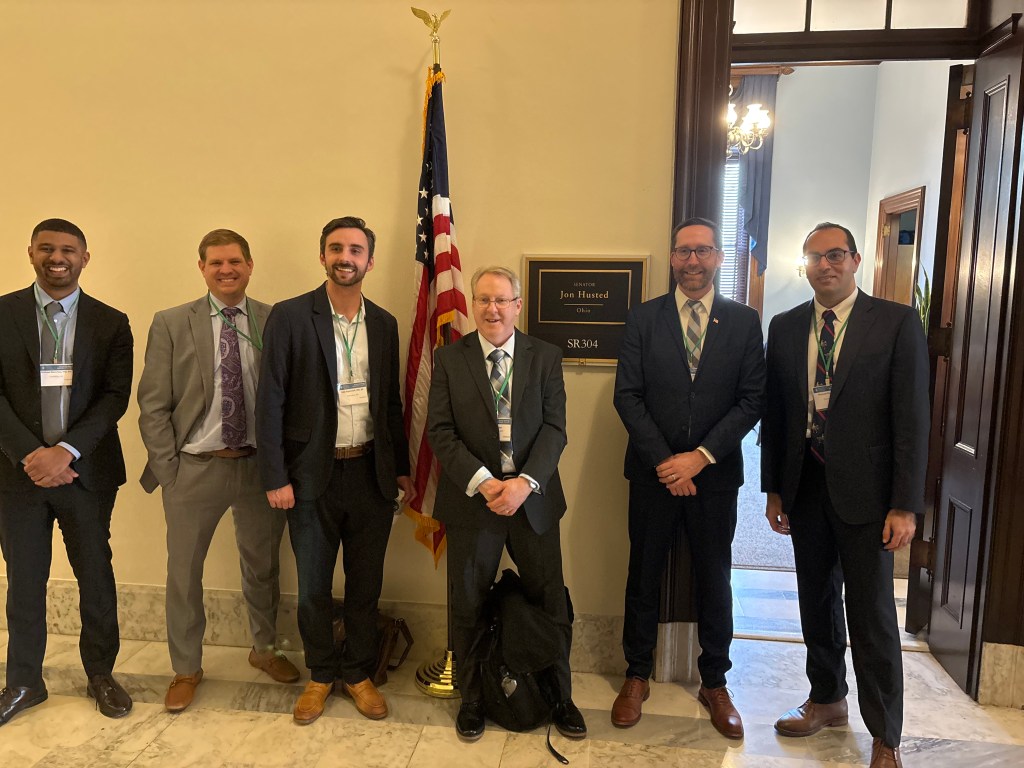
Here are both AUA Ohio delegations after a meeting at the office of U.S. Senator Jon Husted (R, OH-13). L to R – Urologists, Dr. Michael Bacchus (OSUMC), Dr. Scott Lundy (Cleveland Clinic), Dr. Kyle Kopechek (OSUMC), patient advocate Gery Deer (A-BE-C APAC), Dr. Bradley Gill (Cleveland Clinic), and Dr. Michael Sourial (OSUMC).

For communities in Greene County and the broader Miami Valley, those discussions are not abstract. Federal decisions about Medicare reimbursement, prior authorization and insurance oversight often determine how quickly patients can see specialists, whether recommended procedures are approved and how long physicians can continue offering certain services.

The Association for the Bladder Exstrophy Community is a global organization supporting patients and families affected by bladder exstrophy, a congenital urological condition that occurs in about one in every 50,000 births in the United States and worldwide. Deer, owner and creative director of GLD Communications, is one of eight patient advocates serving on the national council and chairs its communications efforts.

The council was formed three years ago by Kimberly Allen and Thomas Vincent of Seattle, both bladder exstrophy patients who saw gaps in long-term support for adults living with the rare condition. Since its founding, the group has developed an adult patient provider list, hosted physician-led webinars and organized patient-centered focus groups.

Participation in the AUA summit allows the organization to connect directly with urologists from around the country and to collaborate on legislation aimed at improving patient care. For Deer, the policy debate over insurance preauthorization stood out as especially urgent.

“Of all the legislation we were discussing with congressional representatives, insurance preauthorization was most important to me,” Deer said. “Bladder exstrophy presents a unique set of lifelong conditions and symptoms that rarely line up with those established within the narrow and often inaccurate coverage guidelines of insurance providers.”

Prior authorization — the requirement that physicians obtain insurer approval before certain treatments or procedures — has become a flashpoint in specialty care. Supporters say it helps control costs and prevent unnecessary procedures. Critics, including many physicians, argue it can delay care and override clinical judgment.

Deer said that during the summit he was surrounded by more than 300 of the nation’s leading urologists. Of those, only about 10 percent have treated or even met a bladder exstrophy patient, underscoring how specialized and rare the condition is.

At an invitation-only insurance roundtable attended by roughly 60 participants, Deer raised concerns about who ultimately decides what care is appropriate. Speaking as a patient advocate, he asked, “If these highly qualified physicians wouldn’t have the skills needed to treat someone like me, how is it remotely possible that an AI program or part time medical advisor would be capable of deciding what treatments are necessary and appropriate?”

He continued: “Urologists willing to treat a bladder exstrophy patient take on a long-term commitment and should have the final say in what treatments are necessary. Insurance companies, however, often disagree.”

For patients in southwestern Ohio, including those treated at major centers such as Cleveland Clinic, those disagreements can translate into delayed surgeries, postponed follow-up appointments or denied procedures. Physicians must devote additional staff time to appeals and documentation, while patients navigate uncertainty about whether recommended care will be covered.

Preauthorization remains a significant barrier in complex, lifelong conditions, Deer said, and he believes the issue extends far beyond rare diagnoses. Patients with cancer, kidney disease and other urological disorders may also face treatment delays tied to insurer review processes.

On Feb. 24, Deer and fellow members of the Ohio delegation met with congressional offices representing their home districts. The group included Dr. Scott Lundy and Dr. Bradley Gill of Cleveland Clinic, along with Hill guide Mykelle Richburg. They met with representatives of Sens. Bernie Moreno and Jon Husted and Reps. Max Miller and Shontel Brown. The office of Rep. Mike Turner declined a meeting.


Square Kids, Round Desks

In Opinion, Health, Education, Children and Family on February 22, 2026 at 6:11 am

Deer In Headlines

By Gery Deer

For decades, we have told ourselves a comforting story about education. If we standardize it, measure it, test it, rank it, and repeat it often enough, we will somehow produce better students and, by extension, better adults. It sounds reasonable. It feels orderly. It also happens to be deeply flawed.

If the system worked as advertised, we would be surrounded by confident graduates who understand their strengths, know how they learn, and are excited to apply their talents to the world. Instead, many students leave school disengaged, uncertain, and convinced they are “bad at learning,” when the real problem is that learning was never designed with them in mind.

Somewhere along the way, we stopped teaching the A, B, C’s and started teaching to a test. Those tests promise clarity and accountability, but their ability to predict a student’s future success is questionable at best. Believing a standardized exam can forecast a child’s career potential is like believing the tea leaves at the bottom of your cup can tell you who will win the next Super Bowl. The charts look official. The conclusions feel authoritative. The accuracy is another matter entirely.

What these measurements consistently ignore is the single most important factor in learning: individuality. Every student arrives with a unique mix of curiosity, aptitude, temperament, and interest. Some think spatially. Some think musically. Some learn best by doing, failing, and doing again. Others need time, reflection, and quiet focus. These differences are not inconveniences. They are early indicators of where a student might thrive.

This is why education models that emphasize science, technology, engineering, arts, and math point in the right direction. When done well, they recognize that creativity and logic coexist, that problem-solving is rarely linear, and that imagination is not the enemy of rigor. Hands-on experimentation, design challenges, and interdisciplinary projects allow students to see relevance in what they are learning, not just requirements.

Still, even these programs can fall into the same trap if they are forced into rigid pacing guides and uniform assessments. When curiosity is scheduled and creativity is graded into submission, engagement disappears. Students become compliant rather than curious, efficient rather than inventive.

Traditional public school systems were not designed around individual learning styles. They were built for efficiency and uniform outcomes. That made sense in an industrial era that valued standardization. It makes far less sense in a world that rewards adaptability, specialization, and original thinking. We continue asking students to sit still, move together, and absorb information the same way, then wonder why so many tune out.

There are alternatives, and they are no longer fringe ideas. Some learning environments emphasize individualized study plans that allow students to move at their own pace, diving deeper into subjects that capture their interest. Others use project-based education, where students learn math, science, communication, and critical thinking by solving real problems and building tangible outcomes. In these settings, a student’s natural curiosity is not a distraction; it is the engine.

Non-traditional environments often replace rows of desks with collaborative spaces, mentorship with lectures, and progress portfolios with letter grades. Students learn how to manage time, pursue questions, and reflect on their work. They fail safely, revise often, and understand why their learning matters. These experiences mirror the real world far more closely than memorization ever could.

The goal is not to eliminate traditional schools or abandon standards. The goal is to expand the definition of what school can be. Public education should adapt by offering flexible pathways alongside conventional ones, giving families and students real options instead of one-size-fits-all solutions.

When we stop forcing square kids into round desks and start honoring natural gifts, education becomes preparation instead of endurance. That shift does not weaken schools. It strengthens students. And that is the outcome worth measuring.

Adapting these options requires courage, policy support, and a willingness to trust educators and students alike. It means valuing progress over uniformity and recognizing that success can look different without being lesser. When schools evolve to meet students where they are, learning stops being something done to them and becomes something they actively claim as their own. That shift benefits communities, employers, families, and democracy itself long term.

Snow Drifts

In Environment, Local News, Opinion, Uncategorized, weather on February 1, 2026 at 1:34 pm

Deer In Headlines

By Gery Deer

I was 10 when the Blizzard of ’78 hit our small farm in southwestern Ohio. Holed up in an 8 by 10-foot room of our tiny farmhouse, with no power and only a small, very 1970s cone-shaped fireplace for heat, the five of us survived because of the experience and fortitude of my parents. 

It was 36 degrees in our kitchen that first morning and, without electricity, we had no water, and no other heat source. Plus, we had to figure out how to mix formula for 14 bottle-fed feeder calves in the barn. The temperature continued to drop, the wind was relentless, and a seven-foot snow drift sealed our back door. 

My father and brother tunneled like gofers from our basement walkout, creating a passable though treacherous path to the barn. Diesel fuel siphoned from a tractor filled nearly every one of our 15 or so antique kerosene lamps. Some provided light while others were placed next to open cabinet doors to warm water pipes. As it turned out, those weren’t the only family antiques that were called into service.

Me, my mother, and my brother’s very pregnant wife, melted snow in large canning pots and used the water to feed the calves – one bottle at a time. It took hours. Oddly, the barn was warmer than you might expect since the walls of stacked hay provided good insulation. Mom also found a way to feed us too. She cobbled together foil packs of vegetables and beef and cooked them in the little fireplace.

On day two, the national guard plowed our quarter mile-long driveway, and my father and brother took one of our farm trucks into the village to get supplies for us and the elderly couple who lived at the orchard across the road. It took them almost eight hours to make the seven-mile round trip. Once they made it back, they didn’t go out again. We had enough challenges at home.

Our electricity was out for almost four days. Over the next year, my father gutted our home’s heating system, replacing the electric oil furnace with a wood-burning version he designed. They also added generators, and a 1905 wood-burning cook stove. They were determined we’d never be so crippled again. 

I still use the lessons I learned during that very cold week and the events that followed. Our electricity was knocked out on a more than regular basis, but we were well prepared for most situations, thanks to my family’s know-how and tenacity. As a different kind of pioneer once said, “Failure is not an option.”

This past week, our small part of the world, as well as most of the Midwest and northeastern United States, experienced a similar winter event. As I prepared our home for the coming snow and cold, I was reminded of every moment during that frigid week on our farm all those years ago. For me, it was like my folks were still here because I could hear their words and see their actions in my mind – the lessons of growing up in a remarkable place with uncommon people. 

Sadly, it seems to me that such self-sufficiency is less common than years gone by. Instead of a calm thoughtful response to something like a snowstorm, people today seem more likely to overreact. Not even those who take preparedness to an extreme level can be ready for everything. But for situations like this, we have more resources, better access to information, and more reliable infrastructure than anything available a half century ago. Still, most people panic, clearing store shelves of bread and milk, while doing little to adequately prepare.  

I’m incredibly fortunate to have grown up at a time and with a family who gave me the knowledge and resourcefulness to look after myself in most situations. Probably like many of those reading this, I take whatever steps I can to manage a situation and try to help others whenever possible. General observers might see my heightened sense of urgency as anxiety, but I’m generally the calm one. Even so, there’s always that thing you didn’t plan on. That’s when improvisation, fueled by experience and common sense, can literally save your life.

Slow Down

In Children and Family, Opinion, Uncategorized on January 27, 2026 at 8:42 am

Deer In Headlines

By Gery Deer

Every day I hear people comment about the exhausting pace of modern life. Most of us have felt that strange acceleration where time seems to pick up speed as birthdays pile on. It’s the moment you’re pulling holiday decorations from the attic and swear you just put them away. Of course you didn’t. A full year passed while you were looking at your phone.

Some of that is age, sure, but some of it is engineered. Modern life has a way of nudging us forward faster than we’re built to move, and the most persistent nudge lives in our pockets. The internet, and especially social media, has turned time into a moving sidewalk that never stops. You can stand still, but you’re still being carried somewhere.

I remember my first cell phone that could send text messages and, if memory serves, receive email. At the time it felt revolutionary. I worked outside an office most days, and suddenly important updates could find me without firing up a laptop. It was convenient, efficient, and undeniably useful. This is usually the part of the story where someone asks, “What could possibly go wrong?”

Then the iPhone arrived and the rock started rolling downhill, with all of us sprinting after it. Today we’re permanently connected. Texts, emails, alerts, pings, buzzes, banners, and badges stack up like unread magazines on a coffee table. Studies now link constant device use to anxiety, high blood pressure, and other ailments. The bigger question is why we tolerate it. The answer is uncomfortable. We asked for it.

The more we demand speed and convenience, the more manufacturers and app developers provide. They’re not just selling phones. They’re selling attention, collecting data, and turning it into a high return product. That data fuels more selling, more targeting, and more noise aimed right back at us. This isn’t a conspiracy theory. It’s the business model, printed in very small type.

The byproduct is a permanent state of urgency. Time no longer feels as it once did. Information arrives in six second micro bites, and our brains are expected to digest it like a full meal. But they can’t. We skim, react, and move on. We mistake motion for understanding and speed for knowledge.

We’re all worried about so much – insane politics, societal division, jobs, kids, and the high cost of – well everything. The pressure never lets up. Instead of slowing down to understand what’s happening, we consume only fragments of information and make decisions about our lives with incomplete – or false – information. We don’t reflect. We react, often loudly, and too quickly.

As technology grows more invasive and we become more dependent on it, our reaction time decreases. Important decisions are made without context, sometimes without consideration. That should worry us. I’m convinced it’s one of many contributors to the unsettled mood of the country right now.

So, what do you do? I wish I had a good answer for you. Personally, I’ve been increasingly drawn to the analog and just setting the phone aside whenever I can. Unfortunately, the demands of my work prevent a complete disconnection from social or other digital media. But I write on a manual typewriter at some point in my workday, listen to vinyl on a turntable in my office, and just try to be aware of it all.

Occasionally, I’ll buy a print newspaper and spend several days reading every article. Cover to cover. It’s my way of appreciating the work the writers put into it while absorbing each story. It might seem a bit excentric, but I get the complete picture – without the anxiety that comes with doomscrolling. Plus, I can put it down, then go back to it whenever I want without feeling like I am missing something.

This isn’t about technology, but our resignation to life at a fever pace. Our techno-crutches are just symptoms of a more pervasive problem. We need to slow down. When everything is urgent, nothing is important. And slowing down isn’t quitting. It’s a choice about when to move, listen, or think. That small choice can quietly change the tone of a day, and sometimes an entire life if you let it.

Gery Deer is the editor and publisher of The Jamestown Comet.com and a regional columnist for several other publications.

Sweeping our little corner

In Opinion, psychology, Uncategorized on January 18, 2026 at 8:00 am

Deer in Headlines

By Gery Deer

I was sitting at a traffic light recently in a quiet residential neighborhood when I noticed an older gentleman standing at the end of his sidewalk near the curb. At first, I didn’t pay him much attention. Traffic lights have a way of training us to stare straight ahead and think about the next thing on our to-do list. But then I realized what he was doing, and the scene quietly grabbed hold of me.

He had a broom in his hands and a small container at his feet. He was sweeping bits of debris from the sidewalk—tiny twigs, leaves, whatever had found its way there—carefully guiding them toward that container. In that moment, this task was the single most important thing in his world. Not emails. Not headlines. Not the state of the economy. Just the sidewalk.

The light was at a busy intersection with a turn lane, which meant I had time to observe without feeling rushed. He swept. He bent down. He nudged the container closer. He swept some more. Over and over again. I couldn’t tell exactly which stubborn leaf or twig was refusing to cooperate, but it was clearly holding his full attention. I found myself wondering if it ever crossed his mind how little this probably mattered in the grand scheme of existence.

Did it occur to him, even briefly, that the universe was unlikely to notice whether that last fragment made it into the container? That galaxies would continue spinning regardless of the condition of his sidewalk. Probably not. And even if it did, it didn’t seem to change his focus. The job at hand was the job at hand.

That’s the part that stuck with me. We spend so much time thinking about big goals, big wins, and big moments that we often overlook how much of life is actually made up of very small things. The daily, repetitive, seemingly insignificant tasks that quietly fill our hours rarely make for good stories. They don’t earn applause or awards. Yet they are the substance of our days.

It can feel almost overwhelming to realize that many of the things we work so hard to accomplish have little to no bearing on the cosmos. The email you send. The floor you mop. The weeds you pull. In a broader context, these actions barely register. And yet, to us, in that moment, they matter deeply. They demand our attention. They give us balance and structure.

That thought followed me long after the light turned green. I’ve caught myself thinking about that man while vacuuming my office, cleaning out the basement, reorganizing the garage, or even sitting here writing this column. From a certain angle, all of it could be dismissed as trivial. None of it is likely to make history.

But the more I thought about it, the more I disagreed with that idea. I don’t think these things are insignificant at all. In fact, I think they’re essential. Who we are is shaped far less by our rare, headline-worthy achievements than small actions. And often they matter more than we think.

Sweeping leaves into a trash can isn’t going to change the world. But it might make a sidewalk safer for someone taking a walk. Those leaves might become compost, eventually nourishing the growth of new trees that provide shade, oxygen, and homes for wildlife. The act itself might be therapeutic—a reason to get outside, to move with intention, to feel useful without needing a gym membership or an app to track progress.

There’s a quiet dignity in doing small things well, especially when no one’s watching and no social media attention or commentary. These moments don’t announce themselves. They don’t demand recognition. They simply exist, quietly stitching meaning into the fabric of everyday life. That, I think, is worth noticing.

The point is that we shouldn’t take these tiny accomplishments so lightly. They will never create world peace or settle down our political divisiveness. But, regardless how small, in a sort of butterfly effect, I suppose, each of our actions having a purpose and an influence – we just may never see what that is outside of our little corner of the world.

Rogue nation: USA

In National News, Opinion, Politics, Uncategorized, World News on January 11, 2026 at 11:24 pm

Deer In Headlines

By Gery Deer

I’ve avoided direct political commentary but, on this subject, it’s hard to remain silent. I’m sickened by the recent behavior of our federal government – all three branches. Whatever your political affiliation, it is impossible to look at the behavior of the current American administration and call it normal. 

What we are witnessing is not tough diplomacy or considered leadership, but a pattern of outlandish conduct that mocks international law and the values the United States claims to champion. When power is exercised without restraint, justification becomes propaganda and accountability disappears.

First, there’s the kidnapping and prosecution of a sitting president of Venezuela. Nicolás Maduro may be a corrupt, authoritarian, drug-trafficking criminal. But none of that gives the U.S. Government legal or moral authority to invade a sovereign nation, seize its head of state, and drag him into an American courtroom without extradition or due process.

Defenders argue that Venezuela’s constitution explicitly prohibits extraditing its own citizens, and the bilateral extradition treaty has long been shaky, suspended in practice by Caracas itself. However, that does not excuse abduction. When lawful avenues are blocked, the answer is not to ignore law altogether. The absence of a workable treaty is not permission to kidnap; it is proof that diplomacy and international pressure, however slow, are the legitimate tools.

This is not how a nation behaves that claims to respect due process. When the world’s most powerful democracy discards extradition treaties and international courts, it signals that rules apply only to the weak. History demonstrates that such a precedent will not protect Americans when the balance of power shifts.

We have been down a similar road before. In 2003, the United States invaded Iraq and removed its leader under the banner of national security. In hindsight, no weapons of mass destruction were found – the years-long operation failed. Hundreds of thousands died. A region was destabilized. Extremism flourished. American credibility was deeply damaged. The lesson should have been clear: removing leaders by force creates chaos, not democracy. Yet here we are again, acting as though power excuses everything.

As if that were not reckless enough, the same administration now speaks openly about literally stealing Greenland from Denmark, as though the territory were merely a trinket to be bought, bullied, or taken by force. Denmark is a NATO ally and Greenland’s people have repeatedly said, “no thanks.” The insanity of a United States military invasion and seizure is unprecedented. It’s forced occupation and shatters trust with allies.

We are told these actions keep us safe and project strength. Instead, they isolate us, invite retaliation, and encourage other nations to discard restraint. When America behaves like regimes it once condemned, the moral high ground collapses beneath our feet.

What is perhaps most alarming is the resistant silence. Congress, entrusted by the Constitution with oversight, war powers, and the duty to restrain executive excess, appears paralyzed. Some lawmakers mutter concerns and look away. Too many say nothing, whether from fear or calculation. This is not how a functioning republic responds to dangerous overreach.

The Democratic Party looks toothless. Republicans who should speak out remain complicit. Checks and balances mean nothing if not exercised. History will not be kind to those who watched democracy collapse and did nothing to prevent it.

Once respected because it claimed to stand for something great and honorable, the U.S. now risks becoming a cautionary tale. Feared and mocked rather than trusted and admired. 

And all of this would be just as wrong if the other party did it and none of it is patriotic. Patriotism is not blind loyalty to a leader or party. Patriotism is fidelity to principles: the rule of law, respect for sovereignty, restraint in the use of force, and accountability at home. Plus, when billions are spent on coercion while vulnerable children, seniors, and veterans lose essential services, moral priorities have evaporated. 

If this behavior continues unchecked, the damage will outlast any presidency. Democracy demands courage from lawmakers who will resist, and citizens unwilling to excuse abuses of power perpetrated in their name. Laws can be repaired, and alliances restored, but only if someone is finally willing to draw a line and Congress acts with courage, and constitutional responsibility.

“Deer In Headlines” sheds a Roman numeral

In Local News, Opinion, Uncategorized on January 7, 2026 at 12:51 am

Jamestown, OH – In a move that will delight grammarians, confuse absolutely no one, and mildly disappoint fans of Roman numerals everywhere, writer Gery Deer’s long-running column, Deer In Headlines II is officially dropping the “II.”

As it was when it first hit newsprint in 2008, from this point forward, the column will simply be known as Deer In Headlines.

No sequel. No reboot. No director’s cut.

Just Gery Deer and his outlook on the world.

The change quietly debuted with the first edition of January 2026, though longtime readers may have noticed immediately—because readers always notice. Especially when something changes that didn’t really need changing, but made sense anyway.

The original column ran from 2008 – 2018 under the name, “Deer In Headlines.” When Deer restarted the series in 2023, the “II” was added as a nod to the way movie sequels were numbered in the 1980s. However, the designation was never meant to suggest a second act so much as a return engagement. When Deer In Headlines reappeared after a five-year hiatus, the numeral was added to signal both its comeback and a slightly evolved identity—new angles, broader themes, and a tone that reflected the times as much as the writer.

But time, as it often does, flattened the distinction. “My column resonates with readers of all backgrounds and interests,” Deer explained. “It might make you happy, or sad. It can anger you or motivate you. Whatever the response, I’ve done my job and it’s time to keep the brand more cohesive—one or two, it’s all Deer In Headlines.

And that, in true Deer In Headlines fashion, is the point.

The column has never been about numbering systems. It’s been about observation—sometimes sharp, sometimes sentimental, often inconvenient, and occasionally uncomfortable. It’s a space where headlines become excuses to talk about people, priorities, contradictions, and the quiet moments between the noise.

Over the years, Deer In Headlines has grown into more than a weekly column. It is the lead feature of the online news outlet TheJamestownComet.com, and appears every Friday in the print and digital editions of the Xenia Daily Gazette and Fairborn Daily Herald, as well as the weekly Beavercreek News Current.

The name also anchors the Deer In Headlines podcast, where many of the column’s themes are expanded, unpacked, and occasionally challenged. The podcast often explores the origins of a column, the thinking behind it, and the conversations it sparks—available on most major streaming platforms, including iHeartMedia and Amazon Music.

Dropping the “II” isn’t an ending. It’s not even a beginning.

It’s simply a reminder that whether the headline makes you nod in agreement, shake your head in disbelief, or pause longer than you expected—
it’s all still Deer In Headlines.

Festina Lente

In Local News, Opinion, sociology, Uncategorized on January 4, 2026 at 12:56 pm

Deer In Headlines

By Gery Deer

Change in our lives comes in two speeds, and neither of them bothers to ask our permission. It either creeps along like a stubborn snail crossing a sidewalk, or it arrives so fast we wake up wondering who moved the furniture while we were asleep. Slow change is invisible because it’s gradual. Fast change is invisible because it’s overwhelming. It reminds me of the Latin phrase, “Festina Lente,” which means, “make haste, slowly.” Either way, we rarely recognize those significant moments of change until after they’ve happened.

I think our lives are divided into chapters or acts, like a play. Each one is marked by some moment, some Rubicon we didn’t know we were crossing at the time. That moment signals a new direction, usually unexpected and rarely announced with trumpets or a warning label. There’s no narrator to step forward and tell us this is Act Two. Life just keeps going, and we keep improvising.

Some people believe those moments don’t exist at all, that life is simply a continuous stream of overlapping events pushing us forward with little control. Others, like me, are convinced that fate is a convenient myth. Our lives are driven by choices. We make decisions based on circumstance, opportunity, fear, optimism, and experience. Those decisions quietly determine what comes next.

When real change happens, there is a moment when something nudges our lives in a new direction. The frustrating part is that we only notice it in hindsight. One of mine occurred in October of 1987, while reading the classified ads in my college newspaper. I needed a job. Buried among the listings was a small notice that the paper was hiring staff writers.

Less than an hour later, my writing career began. I was an engineering student with no sense that a decision made from necessity and desperation would shape the rest of my working life. I didn’t feel a shift. There was no lightning bolt. I just filled out an application.

Years followed in engineering and technology, but I kept writing. Newspapers. Technical publications. Industry magazines. Software manuals. The transition from a technical career to a creative one didn’t happen overnight. It was painfully slow, full of doubt, subjectivity, and rejection. Writing is a hard business in which to make a name, and I’m still working on it.

Along the way, I changed direction more than once. Demand shifted. Markets changed. The economy had opinions. Some pivots worked. Others failed spectacularly. I adjusted, recalibrated, and kept moving forward, sometimes confidently, other times reluctantly.

Nearly forty years later, that moment sitting in front of the bookstore with a newspaper folded open on my lap was clearly a dividing line. At the time, it was just another Tuesday.

As we settle into a new year, consider what might need to change in your life. Or what changed in the past year without notice. Professionally. Personally. Emotionally. We like to believe we’ll recognize those moments when they arrive, that we’ll feel enlightened or prepared. We won’t. Change doesn’t work that way, no matter how many self-help books promise otherwise.

So what do we do? We do the best we can with what we know at the time. We pay attention. We stay flexible. We understand that most change happens in tiny, almost imperceptible increments, except when it doesn’t. Perspective is everything. Our reality is defined by how we see ourselves, our surroundings, and the people around us.

If there’s comfort in that, it’s this: you don’t have to have it all figured out. Recognizing change comes later. Coping with it comes from patience, adaptability, and a willingness to pivot when necessary. Life will change, slowly or suddenly. Our job is simply to keep showing up, learning as we go, and trusting that today’s ordinary moment may someday reveal itself as the one that changed everything.

Change asks us to breathe, to pause, and to remember that discomfort often signals growth – however difficult. When things accelerate, ground yourself. When they crawl, stay patient. Talk to others. Write things down. Measure progress over months, not days. Most of all, give yourself time. You are not late. You are living inside the process, not observing it from the end.