Local News & Commentary Since 1890.

Posts Tagged ‘bladder exstrophy’

Jamestown Advocate Takes Urological Care Concerns to Capitol Hill

In Business, Environment, Health, Uncategorized on March 6, 2026 at 11:02 pm

JAMESTOWN – Greene County journalist and communications professional Gery Deer joined more than 300 physicians and patient advocates in Washington in February to press federal lawmakers on policies that directly affect access to urological care in Ohio and across the country.

Deer served on one of two Ohio delegations to the 2026 American Urological Association’s Annual Urology Advocacy Summit, held the week of Feb. 22 in Washington, D.C. He represented patients as a member of the Association for the Bladder Exstrophy Community’s Adult Patient Advisory Council.

The summit is designed to bring the voice of the specialty, and the patients it serves, directly to federal lawmakers — creating a bridge between medicine and policy. Over four days, physician and patient advocates receive briefings on pending legislation, reimbursement policy and insurance practices that shape how — and whether — patients can obtain urological treatment.
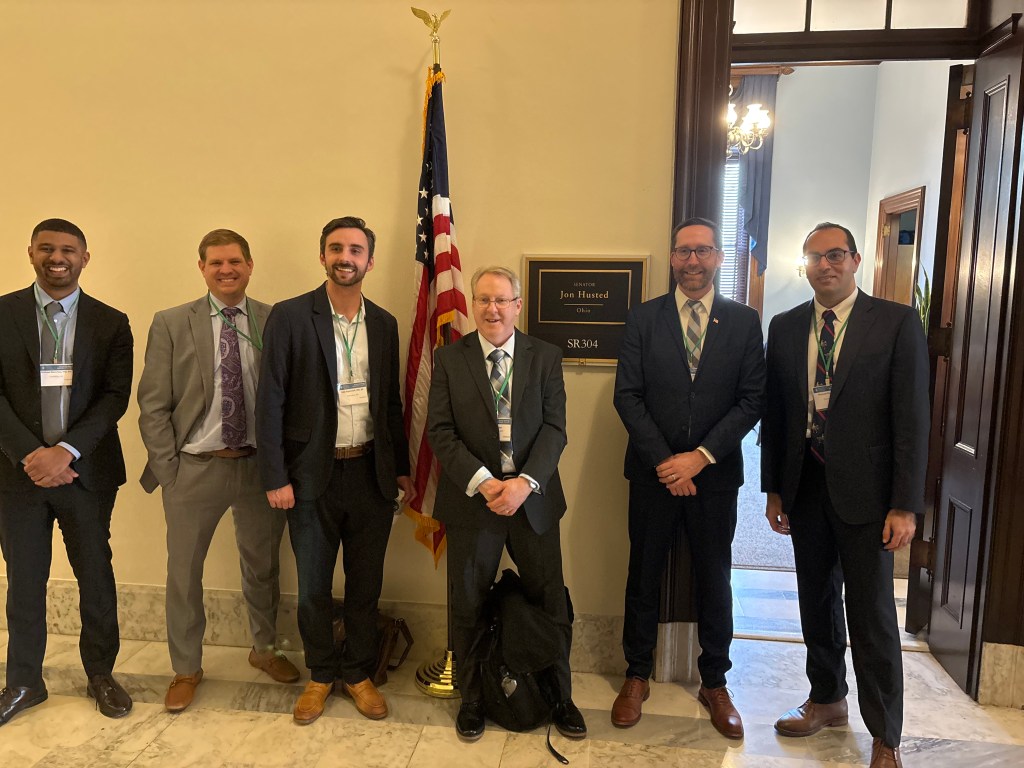
Here are both AUA Ohio delegations after a meeting at the office of U.S. Senator Jon Husted (R, OH-13). L to R – Urologists, Dr. Michael Bacchus (OSUMC), Dr. Scott Lundy (Cleveland Clinic), Dr. Kyle Kopechek (OSUMC), patient advocate Gery Deer (A-BE-C APAC), Dr. Bradley Gill (Cleveland Clinic), and Dr. Michael Sourial (OSUMC).

For communities in Greene County and the broader Miami Valley, those discussions are not abstract. Federal decisions about Medicare reimbursement, prior authorization and insurance oversight often determine how quickly patients can see specialists, whether recommended procedures are approved and how long physicians can continue offering certain services.

The Association for the Bladder Exstrophy Community is a global organization supporting patients and families affected by bladder exstrophy, a congenital urological condition that occurs in about one in every 50,000 births in the United States and worldwide. Deer, owner and creative director of GLD Communications, is one of eight patient advocates serving on the national council and chairs its communications efforts.

The council was formed three years ago by Kimberly Allen and Thomas Vincent of Seattle, both bladder exstrophy patients who saw gaps in long-term support for adults living with the rare condition. Since its founding, the group has developed an adult patient provider list, hosted physician-led webinars and organized patient-centered focus groups.

Participation in the AUA summit allows the organization to connect directly with urologists from around the country and to collaborate on legislation aimed at improving patient care. For Deer, the policy debate over insurance preauthorization stood out as especially urgent.

“Of all the legislation we were discussing with congressional representatives, insurance preauthorization was most important to me,” Deer said. “Bladder exstrophy presents a unique set of lifelong conditions and symptoms that rarely line up with those established within the narrow and often inaccurate coverage guidelines of insurance providers.”

Prior authorization — the requirement that physicians obtain insurer approval before certain treatments or procedures — has become a flashpoint in specialty care. Supporters say it helps control costs and prevent unnecessary procedures. Critics, including many physicians, argue it can delay care and override clinical judgment.

Deer said that during the summit he was surrounded by more than 300 of the nation’s leading urologists. Of those, only about 10 percent have treated or even met a bladder exstrophy patient, underscoring how specialized and rare the condition is.

At an invitation-only insurance roundtable attended by roughly 60 participants, Deer raised concerns about who ultimately decides what care is appropriate. Speaking as a patient advocate, he asked, “If these highly qualified physicians wouldn’t have the skills needed to treat someone like me, how is it remotely possible that an AI program or part time medical advisor would be capable of deciding what treatments are necessary and appropriate?”

He continued: “Urologists willing to treat a bladder exstrophy patient take on a long-term commitment and should have the final say in what treatments are necessary. Insurance companies, however, often disagree.”

For patients in southwestern Ohio, including those treated at major centers such as Cleveland Clinic, those disagreements can translate into delayed surgeries, postponed follow-up appointments or denied procedures. Physicians must devote additional staff time to appeals and documentation, while patients navigate uncertainty about whether recommended care will be covered.

Preauthorization remains a significant barrier in complex, lifelong conditions, Deer said, and he believes the issue extends far beyond rare diagnoses. Patients with cancer, kidney disease and other urological disorders may also face treatment delays tied to insurer review processes.

On Feb. 24, Deer and fellow members of the Ohio delegation met with congressional offices representing their home districts. The group included Dr. Scott Lundy and Dr. Bradley Gill of Cleveland Clinic, along with Hill guide Mykelle Richburg. They met with representatives of Sens. Bernie Moreno and Jon Husted and Reps. Max Miller and Shontel Brown. The office of Rep. Mike Turner declined a meeting.


Mr. Deer Goes To Washington

In Health, Local News, National News, Opinion, Science, Technology, Uncategorized, World News on February 28, 2025 at 4:55 pm

Deer In Headlines II

By Gery Deer

According to the National Kidney Foundation, more than 20 million Americans are affected by renal (kidney) and urological conditions. It goes on to say that millions more, currently unaccounted for, are at risk. The causes range from congenital issues to diseases that affect the urological system.

I happen to be in the category of the former. In March, I’m joining a couple of hundred other patients, caregivers, and advocates to meet with congressional representatives about more support to care for, as I will explain in my case, adult patients with congenital urological conditions.

I was born with a rare condition known as bladder exstrophy. It affects about 40,000 people worldwide, and only a few specialty hospitals in the United States specialize in the predominantly pediatric component of treatment. As a child, I was treated in Dayton, Ohio, by some of the best pediatric surgeons in the country who were, it’s safe to say, figuring it out as they went. But they did a tremendous job, and here I am.

From just a few hours old, I was looked after by a contingent of physicians and specialists in what I’ve come to refer to as the “pediatric bubble.” My healthcare providers communicated with each other and consulted on various issues as they perfected this procedure or completed that surgery. As complex as it might seem, my parents were kept well-informed and had direct lines of communication with my general practitioner and my surgeons.

Unfortunately, once you hit about 21 or 22 years old, your pediatric bubble bursts and you are unceremoniously dumped into the world without proper adult urological care. Fortunately, my pediatric surgeon handed me off to someone he trained with, an adult urologist who looked after me for 25 years until his recent retirement. For the first time in my life, I was without a specialist, and my particular problem created a barrier to finding new care.

This situation is familiar to patients with many congenital conditions that carry over into adulthood. To maintain continuity of care, most continue to see their specialists for decades, long after the primary reconstructive surgeries are complete. Thankfully, I was left with few residuals as I grew up, but maintenance needs require somewhat more specialized attention. In addition, as patients age, their physicians must know something about the situation.

Bladder exstrophy, or BE, like many other congenital problems, requires a specific set of surgical skills, reconstructive knowledge, and urological and renal expertise. There is also a critical shortage of practicing urologists. All of this, combined with the potentially long-term commitment to the patient, leaves most urologists choosing not to treat BE patients, and therein hangs the problem.

Enter the Association for the Bladder Exstrophy Community, or A-BE-C, and its newly formed Adult Patient Advisory Council (APAC), of which I am an organizing member. While A-BE-C’s global mission began as primarily pediatric, the advisory council was established to provide resources for adult patients. The goal is to ease the transition from pediatric BE care into adulthood. That’s where me and my plane ticket to Washington, D.C. come into the story.

I’ll represent our organization at the American Urological Association’s annual patient advocacy summit. It’s an opportunity to share these concerns and potential solutions with congressional representatives.

I hope they’ll listen to some of my ideas, including a subsidy or tax credit funded to help encourage young doctors to specialize in urology and, even more so, help them to dedicate some of their practice to adult BE care. With all the tragically unsympathetic, uninformed budget cuts, I wish I was more optimistic. But I will still try, and you may be able to help.

Patient advocacy isn’t about awareness and support. It’s about action. Sadly, urological problems are generally the subject of lousy humor, ignorance, and ageism. But I assure you, there’s nothing funny about it for the patients and caregivers. For them, it’s a daily struggle to maintain proper care.

You can help by following A-BE-C on social media and sharing educational content. You can also contact your congressional representatives to remind them about this. These patients don’t need more research. They need qualified specialists and the peace of mind that their cause matters.