Local News & Commentary Since 1890.

Archive for August, 2026|Monthly archive page

United Way of the Greater Dayton Area Hosts Greene County Strong Families Classic

In Charities, Children and Family, Local News, Uncategorized on August 20, 2026 at 10:18 am

DAYTON, OH — The United Way of the Greater Dayton Area (UWGDA) is thrilled to announce the return of its highly anticipated 5th Annual Strong Families Classic Golf Outing. Benefiting families throughout the Greene County area, the charity tournament will take place on Friday, September 18, 2026, at the premier Beavercreek Golf Club.

For over 100 years, the United Way of the Greater Dayton Area (UWGDA) has led a united community effort to uplift neighbors across Montgomery, Greene, and Preble counties. By supporting vital programs and services offered by local organizations, UWGDA works daily to build a stronger, more resilient region. Event proceeds will directly benefit UWGDA’s Strong Families initiative, an impactful program focusing on housing security, academic success, and economic mobility to help local families thrive.

Golfers and community members are invited to hit the links for a day filled with camaraderie and a shared community purpose. Beavercreek Golf Club is a premier public course offering top-tier amenities, including a beautifully maintained 18-hole course, a full-service driving range, and professional practice greens.

Participants will enjoy a dynamic day on the course featuring a variety of specialty contests and challenges. Highlights include the high-energy Air Cannon Challenge, the Dixon Fiesta Bowl Hole-in-One Contest, and the Aurelius Challenge. Players will also go head-to-head in traditional longest drive and closest-to-the-pin competitions. The day will conclude with an official awards ceremony and a recognition luncheon hosted by popular local Emcee Dan Edwards.

This year’s tournament is made possible through the continued generous support of Presenting Sponsors SRC, Inc. and SierTek, Ltd.

Additional key community support includes:

  • Birdie Sponsors: Rodriguez Financial Services (Ask Rafi), McCalister’s Deli, IH Credit Union, BI-SI Solutions, and Harley-Davidson of Xenia.
  • Par Sponsors: CDO Technologies, IUE/CWA, and Beavercreek Rotary.
  • Hole Sponsors: CareSource, Joe & Amanda Jenkins, Lampton, Engle & Associates Insurance, Reynolds Machinery, I Supply Company, City Barbeque, Fairborn Lions, Fairborn Rotary, and the Fairborn Chamber

Event Schedule & Details:

  • Date: Friday, September 18, 2026
  • Location: Beavercreek Golf Club, 2800 New Germany Trebein Road
  • 8:00 a.m. – Registration, Driving Range Opens & Breakfast
  • 9:00 a.m. – Shotgun Start
  • Conclusion – Awards Ceremony & Recognition Luncheon

To register to play, sign up as a volunteer, or explore remaining corporate sponsorship opportunities, please visit the official event page at charitygolftoday.com/strongfamilies2026. For more on the United Way, visit, www.Dayton-UnitedWay.org or call (937) 225-3001.

United Way Americana 250 Cycling Classic to Celebrate America’s 250th on Two Wheels

In Charities, Dayton Ohio News, Entertainment, Local News, Sports News, Uncategorized on August 18, 2026 at 4:10 pm

(Video production services provided by GLD Communications)

XENIA — Cyclists, families and community supporters are invited to celebrate America’s 250th anniversary this fall at the United Way Americana 250 Cycling Classic, set for Sunday, Oct. 11, at the Greene County Fairgrounds and Expo Center.

The event combines cycling, local history and family fun while raising money for the United Way of the Greater Dayton Area, serving Montgomery, Greene and Preble counties. Registration is now open, with four routes designed for everyone from casual family riders to experienced cyclists seeking a metric century challenge.

The rides will begin and end at the fairgrounds, located at 120 Fairground Road in Xenia, and are part of the well-known Tour de Gem Cycling Series. Greene County serves as the centerpiece of the event because of its extensive paved trail network, the largest in the nation.

Participants can choose from the 10-mile Liberty Ride for families, the 25-mile Pioneer Expedition, the 40-mile Heritage Quest, or the 64-mile Patriot Tour, a metric century route connecting several Greene County communities. But organizers emphasize that the event is about more than cycling.

While riders pay a registration fee, the on-site fairgrounds festivities, known as the Heritage Hub, will be free and open to the public. Visitors can enjoy food trucks, vendor displays, demonstrations and the Young Explorer Zone, featuring a bike course designed especially for small children.

“This event is a celebration of community, history and healthy living,” said Tom Kelley, President and CEO of the United Way of the Greater Dayton Area. “Whether you ride 10 miles or 64, volunteer, sponsor the event or simply bring your family out to enjoy the Heritage Hub, you’re helping us strengthen our community while celebrating this important milestone in our nation’s history.”

Businesses and organizations still have time to get involved. Sponsorship opportunities and vendor booths remain available, giving companies a chance to showcase their products and services while supporting a regional cause. Sponsorship levels range from major corporate partnerships to rest stop sponsorships, while vendor spaces are available in multiple sizes.

Community participation will be key to making the inaugural event a success. Kelley said “United Way really wants this to become a signature event for Greene County and the Miami Valley because it’s an opportunity to bring people together, celebrate our shared heritage and invest in programs that improve lives throughout our region.”

All proceeds from the Americana 250 Cycling Classic will benefit programs and services of the United Way of the Greater Dayton Area, supporting initiatives focused on youth opportunity, financial security, health and community resiliency throughout Montgomery, Greene and Preble counties.

Event organizers say they hope the day will bring together cyclists, families, local businesses and history enthusiasts alike for a celebration that honors the past while investing in the future. The event runs from 8 a.m. to 4 p.m. Sunday, Oct. 11, at the Greene County Fairgrounds and Expo Center in Xenia. Registration, sponsorship information and vendor applications are now available. For more information, visit https://www.dayton-unitedway.org/americana-250-cycling-classic.

Sponsors include The Dayton Foundation, Trek Dayton, CareSource, Greene County Convention and Visitors Bureau, GLD Communications, Warriors On Wheels, Miami Valley Regional Planning Commission. Media requests should be directed to GLD Communications, the official public relations agency for the event.

21st Century Typewriters Club inaugural meeting August 22nd

In Local News, Technology, Uncategorized on August 18, 2026 at 3:12 pm

XENIA, OHIO — The familiar click and clack of typewriter keys will have a new home in Greene County beginning Saturday, Aug. 22, from 2 to 4 p.m., when the 21st Century Typewriters Club holds its first monthly gathering at the Xenia Community Library, 76 E. Market Street. The event is free and open to the public, but registration is encouraged.

Anyone interested in typewriters will enjoy this program. Whether they are longtime collectors, writers who still use the machines regularly, people who have recently rediscovered an old family typewriter, or those who simply want to learn more about them.

The idea behind the 21st Century Typewriters Club is not simply to look backward at typewriters as antiques, but to explore why people continue to use, collect and enjoy them well into the digital age.

Participants are encouraged to bring a typewriter if they have one, along with questions, stories and an interest in exploring the history, continued use and future of the machines in an increasingly digital world. Owning a typewriter is not required to attend.

The new club is being organized by local writer, journalist and longtime typewriter enthusiast Gery L. Deer, who has presented several typewriter-related programs through the Greene County Public Library.

“Typewriters have certainly become collectible, but they’re not just museum pieces,” Deer said. “People, like me, are still writing with them, restoring them, learning about them and, in many cases, discovering them for the first time. This club will provide somewhere local to get together and share that interest.”

“Faster isn’t always better,” Deer is fond of saying, and he’s not alone. The so-called “typewriter revolution” inspired a dedicated subculture of typewriter enthusiasts numbering in the tens of thousands worldwide, including prominent celebrities such as actor Tom Hanks.

The first hour of Saturday’s inaugural meeting will be devoted to an informal discussion about the club itself, including what participants would like to see from future gatherings and how the organization might develop over time. Each monthly meeting is also expected to include discussion of a topic related to typewriter history, use, collecting, writing or preservation.

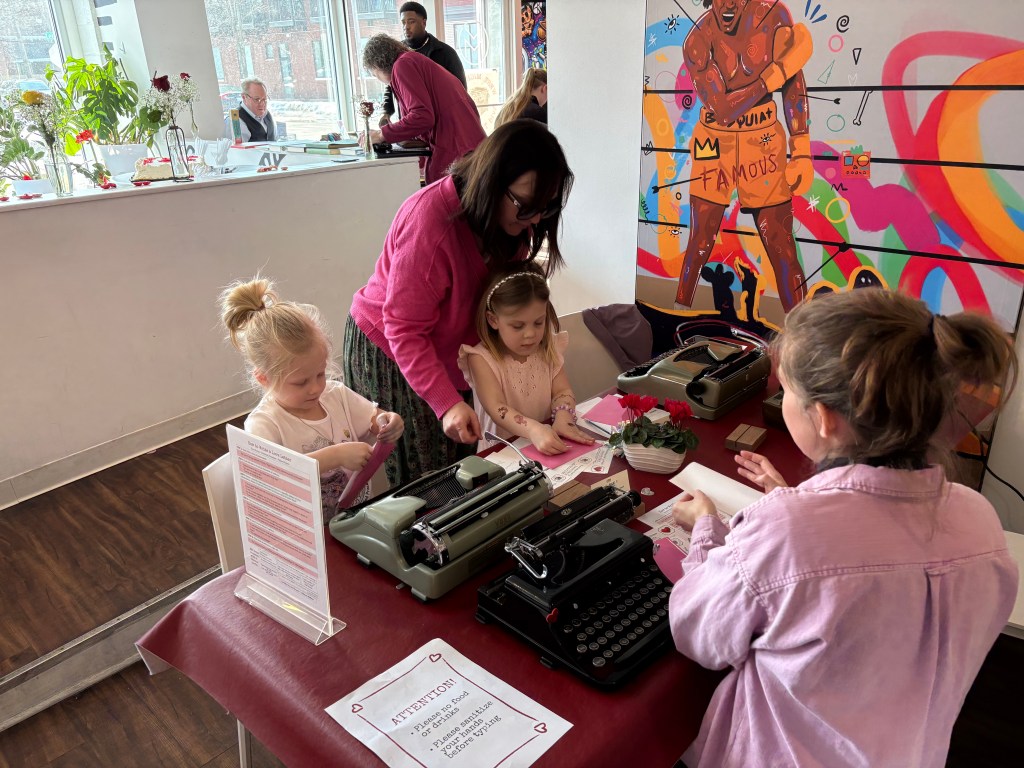
During the second hour, participants will turn from talking about typewriters to actually using them with a mini “type-in.” Type-ins are informal gatherings where people bring manual and electric typewriters, set them up together and spend time writing, trying different machines and comparing the sometimes dramatically different feel and personality of various models.

Unlike a computer or smartphone, a typewriter offers no notifications, automatic corrections or electronic distractions. For many modern users, that limitation is part of the appeal.

The club is intended to provide a place for experienced collectors and complete newcomers alike. Participants can compare machines, ask questions about operation and maintenance, share information about typewriter history, and learn from others in the group.

Future meetings will continue to combine conversation and hands-on activities, with the club’s direction shaped in part by those who participate. The inaugural meeting of the 21st Century Typewriters Club will be held Saturday, Aug. 22, from 2 to 4 p.m. at the Xenia Community Library. Attendance is free.

Those attending are welcome to bring their own typewriters, but a machine is not necessary to participate. Anyone with an interest in the history, mechanics, writing experience or future of typewriters is welcome.

Additional information about the program is available through the Greene County Public Library event calendar. The official library listing is here: 21st Century Typewriters Club with Gery Deer.

The event is sponsored by GLD Communications.

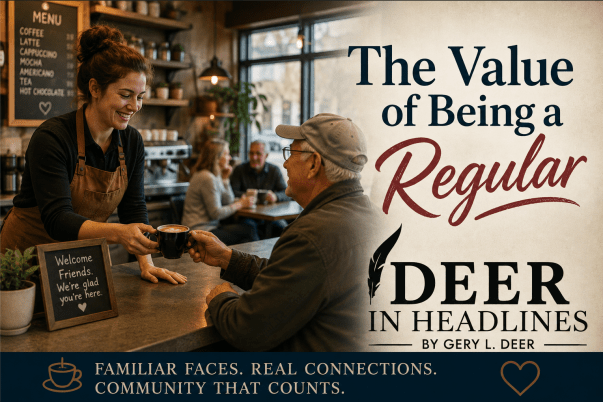
The Value of Being a Regular

In Opinion, Uncategorized on August 18, 2026 at 10:47 am

Deer In Headlines

By Gery Deer

When I was a boy, my mother worked at a local diner in my hometown. We were a farm town, so early mornings were filled with everyone who’d been up since dawn, or had to be somewhere and finish their work before most people put their shoes on in the morning. Mom would fill their coffee cups, without an order, just a, “Good morning, Eddie,” or Max, or whatever the names of the regulars who occupied the same stool or booth, ordered the same breakfast, drank the same coffee every single day.

To them, the restaurant and my mother were part of the rhythm of life. They didn’t have to explain themselves. She knew exactly how they liked their eggs, when to leave them alone, and when they needed someone to ask, “How are you doing?” They belonged.

I’ve recently become a regular at a local cafe. It’s new, but that’s not what attracted me. The owner and her family are just good people. They care about their customers, and, maybe more importantly, their town. When they ask how you are, they mean it. They notice if they haven’t seen you for a few days and ask if you need anything. Somewhere along the way I realized I had become one of the familiar faces instead of just another customer.

I’ve been thinking about that lately because becoming a regular seems old-fashioned. We chase the newest restaurant, the latest app, the next experience. We pride ourselves on variety, yet quietly wonder why we sometimes feel disconnected.

There’s something reassuring about walking into a place where someone recognizes your face before you say a word. It might be the woman behind the counter who starts making your coffee when she sees your truck pull in. It might be the librarian who points toward the new history book she knows you’ll enjoy. It might be the barber who asks about your family because he remembers the conversation from three weeks ago. Those moments seem ordinary until you realize they are becoming increasingly rare.

Being a regular is not about habit for habit’s sake. It is about investing enough of yourself somewhere that meaningful relationships have time to grow. Familiarity is not boring when it is rooted in genuine human connection. It becomes oddly comforting. It reminds us that we occupy a place in someone else’s memory as well as our own.

In a world where so much interaction happens through screens, there is real value in showing up often enough to become familiar. Algorithms may remember what we clicked yesterday, but they cannot replace the smile of someone genuinely glad to see us. That kind of recognition cannot be automated or downloaded. It has to be earned over time, one visit at a time.

Not every regular gathers in a diner, either. Some find that feeling at the neighborhood hardware store, the park trail, a weekly church service, the library, or the local ballpark. The location matters less than the consistency. Showing up says something about us. It tells other people they can expect to see us, and eventually they begin to notice when we are missing. That simple recognition is a quiet reminder that our lives intersect in meaningful ways.

Community is rarely built during extraordinary moments. More often it grows through ordinary Tuesdays, familiar greetings, shared laughter, and countless cups of coffee poured without asking. Those small rituals become the threads that hold neighborhoods together long after the meal is finished and the check is paid. They remind us that belonging is something we practice, not something we purchase. Perhaps that’s why those memories still matter to me today. They taught me that familiarity is one of life’s quietest blessings, worth protecting every day.

Maybe that is why I still remember those mornings at my mother’s diner. She wasn’t simply serving breakfast. She was helping create a place where people felt seen before they headed out to face another day.

We spend so much time trying to discover new places that we sometimes forget the value of being known somewhere. Maybe the richest communities aren’t built on grand events at all. Maybe they’re built one familiar face at a time.

Living Your Best Life

In Opinion, Uncategorized on August 18, 2026 at 10:26 am

Deer In Headlines

By Gery Deer

One summer afternoon, not that long ago, I was sitting near the beach at the lake where I live when I noticed families scattered across the shoreline. Children splashed, parents chatted, and a young lifeguard watched everything with quiet confidence. It looked ordinary, which is probably why it caught my attention.

A little girl sat alone on a wooden bench swing, happily working through a Drumstick ice cream cone. She wore a bathing suit covered with colorful cupcakes. Her grandparents rested beneath a nearby shade tree, smiling and keeping watch without interrupting. She seemed completely content. She had sunshine, a swing, an ice cream cone, a lake, and people who loved her. What else did she need? Apparently, nothing. She was, as they say, living her best life.

That phrase, “living your best life,” has become part of our modern lexicon. We hear it or read it nearly every day. It appears beneath vacation photos, fitness posts, images of expensive dinners, and carefully staged moments designed to convince everyone that life’s rewards have reached their highest possible level. Somewhere along the way, we started believing that our best life should be permanent. I am not sure that is true. How could it be? Life is all about change. We may not like it, but it is.

Maybe living your best life is not a destination. Maybe it is something that quietly appears for a few minutes before slipping away. Maybe those instances are unrelated to the ones that preceded or followed them.

That little girl was not thinking about tomorrow. She was not worried about retirement accounts, deadlines, insurance premiums, or whether mindless online doomscrollers approved of her choices. She was not comparing herself with strangers or wondering if she should have accomplished more by now. She simply existed inside that afternoon, on that swing, with that ice cream cone. It was her entire world.

Adults rarely allow themselves that gift. We’re always planning away every moment. We carry calendars in our pockets and unfinished conversations in our heads. We worry about what happened yesterday and rehearse what might happen tomorrow. Even while sitting beside a beautiful lake, we are often somewhere else entirely.

Children remind us that joy does not always arrive wrapped inside major accomplishments. Sometimes it comes wearing cupcake swimwear, dripping vanilla ice cream down your hand while your feet swing freely above the ground. Those moments still exist for us, but they become harder to notice because we keep expecting fireworks instead of fireflies.

Looking back, I doubt that little girl will remember that specific afternoon. The details will probably fade from her memory over time, like an old photo in a scrapbook. Yet something more important will remain. She will remember what it felt like to be safe, loved, carefree, and wonderfully present.

Perhaps that is what we are really chasing when we talk about living our best lives. Not perfection, but presence. Maybe our best lives are never measured in years, careers, possessions, or achievements. Maybe they are measured in moments that seem almost too ordinary to matter until we realize they were the moments that mattered most.

Years from now, I probably will not remember what color the lifeguard’s chair was or how many people were swimming. I might forget the weather forecast or whether the parking lot was full. But I have never forgotten that little girl because she unknowingly answered a question adults keep asking.

Happiness is rarely complicated. We complicate it. We convince ourselves that one more promotion, one bigger house, one better vacation, or one perfect opportunity will finally unlock contentment. Then we reach those milestones and immediately invent another finish line.

Children, thankfully, have not learned that habit yet. They celebrate the cone before worrying about the wrapper. They feel the breeze before checking the forecast. They wave at strangers without wondering whether it looks silly. There is wisdom there if we are willing to see it.

Perhaps growing older does not have to mean growing away from wonder. Maybe the real challenge is protecting enough of our childlike gratitude to recognize life’s quiet gifts while they are still in our hands today and simply say thanks.

The Kitchen Index

In Economy, Opinion, Uncategorized on August 18, 2026 at 9:56 am

Deer In Headlines
By Gery Deer

We hear it all the time. The stock market is up. The Dow set a record. Corporate earnings are strong. Investors are feeling confident. Therefore, we’re told, the economy is doing well. Maybe it is. But I have to wonder whether we’re checking the wrong end of the receipt.

Most people don’t experience the economy by watching a ticker crawl across the bottom of a television screen. They experience it at Kroger, Walmart, the gas station, the pharmacy and when the electric bill arrives. The economy becomes considerably less theoretical when you’re standing in the grocery aisle wondering whether you really need that package of hamburger this week.

That’s not to say the stock market doesn’t matter. It does. Retirement accounts, pensions and investments belonging to plenty of ordinary working people depend on healthy markets. Businesses rely on investment to expand, hire people and develop new products. A strong stock market can certainly be good news. But it doesn’t necessarily mean everybody is sharing in that good news.

So here’s a thought. What if we measured the health of the American economy from the other direction? Instead of concentrating so heavily on how investors and the largest corporations are doing, what if one of our most important measurements was how the lowest-income 30 percent of households were getting along?

Can they afford groceries? Can they pay the electric bill and the rent in the same week? Can they put gas in the car without moving money from somewhere else? If the transmission goes out, can they repair it without creating a financial crisis that follows them for six months?

Maybe we need something I’ll call the Kitchen Table Index. Nothing fancy. No complicated charts that require an economist to explain them. Just bread, milk, eggs, hamburger, coffee, cereal, toilet paper, laundry detergent, gasoline, utilities and housing. The boring stuff. The things nobody posts pictures of after buying, but everybody needs.

Imagine hearing on the evening news that the Kitchen Table Index had improved because the average household in the bottom third of the income scale had more money left after paying for basic necessities. Wouldn’t that tell us something useful about the economy?

In fact, people with the least disposable income may be some of our most sensitive economic instruments. Someone earning a comfortable six-figure salary may notice that groceries cost another $40 this week, but probably won’t change dinner plans because of it. For someone living paycheck to paycheck, that same $40 has to come from somewhere. Maybe it’s gasoline. Maybe it’s medicine. Maybe it’s the phone bill. Maybe something simply doesn’t get paid. Economic pressure shows up there quickly.

That doesn’t mean we should throw out the Dow, the S&P 500, unemployment numbers, gross domestic product or any of the other measurements economists use. An economy as enormous and complicated as ours can’t possibly be described by one number. The problem comes when one set of numbers says things are going wonderfully while millions of people look at their bank accounts and wonder who, exactly, is having this wonderful time.

Perhaps that’s part of why conversations about the economy become so frustrating. Two people can look at the same country and see entirely different realities. One sees investments growing and businesses reporting record earnings. The other sees a grocery receipt that used to be $125 creeping toward $175. Neither is necessarily imagining things.

We tend to measure prosperity from the top down, even though economic stress is usually experienced from the bottom up. Maybe that’s worth changing, or at least reconsidering.

The stock market can tell us what investors believe companies may be worth tomorrow. A grocery receipt tells us what it costs a family to live today. Both matter. Both are part of the same economy.

But if we really want to know how healthy that economy is, perhaps we should spend a little less time staring at Wall Street and occasionally look across the kitchen table. Maybe the question isn’t simply whether the economy is growing.

Maybe it’s who can actually feel it growing. Because prosperity that never reaches the grocery cart may look impressive on paper, but it probably feels pretty hollow at dinnertime.