Deer In Headlines
By Gery Deer
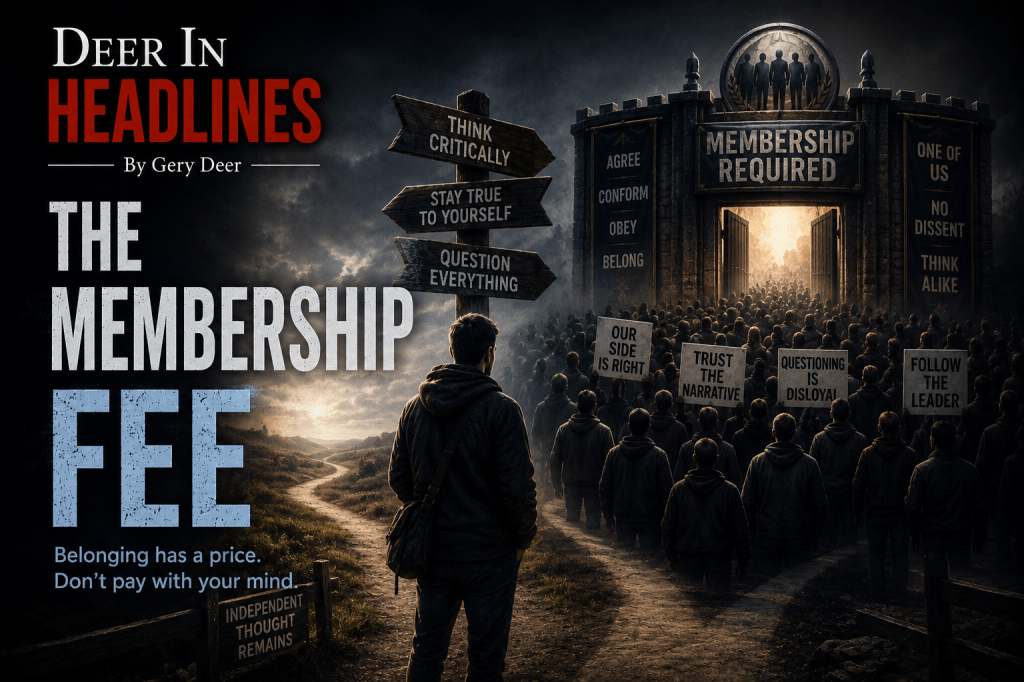
I have never been especially good at joining things. That probably sounds strange coming from someone who has spent years involved in community organizations, networking groups, and professional associations. It is not that I dislike people. I actually enjoy being around thoughtful, interesting people. What has always made me uneasy is the moment when participation quietly becomes conformity.
There always seems to be a point at which a group stops being about shared purpose and becomes about directed thinking. That is where my internal alarm system usually kicks on. Maybe that says something about me and even more about human nature.
People join things because belonging feels good. It always has. Human beings are tribal creatures. Thousands of years ago, being accepted by the tribe meant protection, food, and survival. Being rejected often meant death. That instinct never really disappeared. It just evolved. Today, we join political parties, churches, online communities, fandoms, networking groups, social movements, and fitness cultures. We’re still for connection, identity, and the comfort of knowing we belong somewhere.
There is absolutely nothing wrong with that. Civilization itself depends on cooperation. In fact, some of the best experiences in life come from being part of something larger than us. Healthy groups can encourage people, support families during difficult times, create lifelong friendships, and accomplish meaningful things that no individual could achieve alone.
But every group has a culture, and culture shapes behavior. Sometimes that shaping is positive. Sometimes it becomes something else entirely.
Over the years, I have noticed that many organizations, movements, and belief systems eventually develop an unspoken expectation. You are not just encouraged to participate. You are expected to align. Certain opinions become mandatory. Certain phrases become part of the language. Certain viewpoints become untouchable. Once that happens, disagreement starts being treated less like conversation and more like disloyalty.
That tendency exists everywhere. Politics may be the clearest example right now. People increasingly behave less like citizens with opinions and more like extreme sports fans defending a team. Once someone puts on the jersey, every mistake by their side gets explained away while every mistake by the other side becomes proof of evil, corruption, or stupidity.
Religion can often fall into the same trap. So can activism. So can corporations. Social media communities do it constantly. Even harmless hobbies sometimes develop their own strange culture where questioning the accepted thinking feels like breaking some unwritten law.
And the internet has poured gasoline on all of it. Social media rewards unqualified certainty, outrage, and extremist tribal behavior. Algorithms do not care whether people are thoughtful. Algorithms operate from engagement. Anger and hateful sentiments always spread faster than kindness or nuance. Slogans travel farther than complicated ideas. The loudest voices usually rise to the top, while quieter, more thoughtful conversations fade into the background.
What worries me is how easily intelligent people can start outsourcing their thinking to the groups they belong to. History is filled with examples of otherwise reasonable people following movements, leaders, and ideologies far beyond the point where common sense should have applied the brakes.
That is the real danger of drinking the Kool-Aid. It usually does not happen all at once. Most people do not wake up one morning and decide to stop thinking for themselves. It happens slowly. A little compromise here. A little silence there. Before long, people are defending things they would have questioned a few years earlier simply because the group expects them to.
Still, there is another side to this conversation. A person who refuses to join anything at all can become isolated, cynical, and disconnected from the world around them. Independence is healthy. Isolation is not. It is easy to stand outside every system and criticize the people inside it. It is much harder to participate while still maintaining your critical thinking and the ability to ask uncomfortable questions.
Maybe that is the balance we should aim for. Join things. Build community. Support causes. Believe in something larger than yourself. Just do not hand over your mind in exchange for membership. A healthy group should never require you to stop being an individual in order to belong.
 The Jamestown Comet
Civil Discourse, communication, Conversation, Critical Thinking, debate, Deer In Headlines, Family Relationships, Gery Deer, Human Nature, opinion, Political Polarization, politics, Social Commentary, Understanding
Debate is not conversation
In Education, Opinion, Politics, psychology, Uncategorized on June 14, 2026 at 9:08 amDeer In Headlines
By Gery Deer
I have family members I can’t talk politics with. That’s not because they’re bad people, ignorant people, or people I don’t care about. They’re some of the smartest, hardest-working, most generous people I know. We’d help each other move furniture, fix a flat tire, or get through a family crisis without hesitation. But the moment politics enters the conversation, everything changes.
What makes it frustrating is that I’m usually not trying to change anyone’s mind. As a journalist, I’ve spent much of my career talking with people whose backgrounds, values, and beliefs differ from my own. I’ve interviewed politicians, activists, business owners, lobbyists, farmers, teachers, veterans, and everyday citizens from every imaginable perspective. My job was never to win an argument. It was to understand why people believed what they believed.
Unfortunately, that’s not always what happens around the dinner table anymore. Some people have become so hard-wired into their political identities that every discussion feels like a loyalty test. Questioning a policy suddenly becomes an attack on the tribe – or cult, depending on how you see it. Asking for clarification becomes immediate proof that you’re uninformed. Offering a different perspective becomes evidence that you’ve been misled. The conversation stops being about ideas and starts becoming about defending a team.
That’s the difference between a conversation and a debate. A conversation is an exploration. The goal is understanding. A debate is a competition. The goal is victory. Both have value in the right setting, but problems arise when people think they’re having one while participating in the other.
I’ve watched it happen countless times. Someone mentions a news story. Another person responds with an opinion. A third person offers a different interpretation. At first, everyone is simply exchanging thoughts. Then someone decides that understanding isn’t enough. Someone begins trying to prove another person wrong. The shift is subtle but unmistakable.
Questions disappear. Statements become sharper. Opinions are tossed in as facts, lobbed like verbal hand grenades. Listening becomes, well, nonexistent. Instead of learning something, people prepare rebuttals. Rather than consider another perspective, they look for weaknesses to exploit. The discussion has transformed from a conversation into a debate.
If no one recognizes what’s happening, the debate quickly deteriorates into an argument. That’s when voices rise, and interruptions begin. People assign motives rather than address ideas. You’ve probably heard the phrases before. “You only think that because…” or “You’re just saying that because…” Once those words enter the discussion, the original topic has pretty much vanished. The focus becomes defending pride, identity, and ego.
The irony is that arguments rarely – more like never – change minds but usually accomplish the opposite. The harder people push, the more firmly others cling to their existing beliefs. Nobody wants to feel cornered, embarrassed, or dismissed. Even when valid points are being made, they’re lost beneath the emotional weight of the conflict.
Some of the best conversations I’ve ever had ended with complete disagreement. Nobody switched sides. Nobody waved a white flag. Nobody declared victory. Yet both people walked away with a better understanding of how the other saw the world. That’s not failure. That’s success.
Understanding doesn’t require agreement. It doesn’t require compromise on deeply held principles. It simply requires that we recognize that intelligent people can reach different conclusions based on their experience. When we approach disagreement with curiosity instead of combativeness, we create opportunities to learn something new.
Communities depend on that ability. Families depend on it even more. If every disagreement becomes a contest, relationships eventually become casualties. People stop talking. Gatherings become tense. Entire subjects become off-limits because nobody trusts anyone else to listen.
The older I get, the less interested I am in winning debates. Winning is temporary. The satisfaction lasts about as long as the next disagreement. Understanding, however, has lasting value. It strengthens relationships, broadens perspectives, and creates opportunities for cooperation even when agreement remains impossible.
Disagreement is healthy. But what we need are fewer debates disguised as conversations. One builds bridges while the other draws battle lines. In the end, conversations create the possibility of resolution because people are working toward understanding. Debates create division because people are working toward victory. That’s a difference worth remembering.