XENIA, Ohio — On any given day, the trails of Greene County provide a scenic escape for cyclists and nature lovers alike. But on Saturday, July 19th, they will play host to a much deeper purpose: supporting the Greene County Suicide Prevention Coalition (GCSPC) Veteran Subcommittee. Registration is $50 per rider and those registered before June 30 will receive a commemorative t-shirt.
The ride will begin at the Fairgrounds Recreation Center with flexible start times between 8 a.m. and 9 a.m., allowing cyclists to ease into the event at their own pace. The event is made possible by the Greene County Parks and Trails, the volunteer Trail Sentinels, and various sponsors including Rodriguez Financial Strategies, LLC of Beavercreek, and White Allen Auto Group.
According to the GCSPC Facebook page, the non-profit organization is, “A group of dedicated mental health, law enforcement, education and other professionals and volunteers, working to reduce suicide in our community.” The subcommittee focuses on mental health and suicide prevention for veterans, service members, and their families.
“This event is about more than just cycling; it’s about community,” said Gery Deer, a Greene County Trail Sentinel volunteer and event liaison. “Our trails offer connection—both with nature and with each other—and we’re channeling that spirit into something truly impactful for veterans in our area.” Deer’s company, GLD Communications, is also a sponsor of the event.
Those who register before June 30 will receive this commemorative t-shirt.
Three planned routes of 10, 30, and 60 miles are available, accommodating cyclists of all skill levels. Along the way, participants will traverse some of the county’s most iconic pathways, including the Creekside Trail, The Little Miami Scenic Trail, Xenia-Jamestown Connector, and the Ohio to Erie Trail. Rest stops stocked with refreshments will be strategically placed to ensure riders remain energized and hydrated, and the ever-dependable Greene County Trail Sentinel volunteers will be on hand throughout the day to assist participants.
“Our role as Trail Sentinels isn’t just about ensuring safety,” said Deer. “We’re here to make the experience enjoyable and memorable for every rider. Whether someone’s doing the 10-mile route or tackling all 60 miles, we’re committed to helping them have a great day while supporting a critical cause.” In addition to riding the routes to assist riders, the Trail Sentinels will also have a support table under the shelter at Xenia Station, joined also by volunteers from the Greene County Suicide Prevention Coalition Veteran Subcommittee.
Participants and visitors to Xenia Station will have the opportunity to connect with like-minded individuals, share stories, and learn more about the impactful work of the Subcommittee. Funds raised from this event will go directly to supporting programs that provide essential resources for veterans, including mental health services and outreach initiatives.
“This is a chance for people to do something they love—riding bikes—while making a real difference in the lives of our veterans and their families,” Deer added. “At a time when critical services are underfunded and undermanned, this event is proof that even a simple activity like cycling can have a profound impact when it’s done for a cause.”
(Editor’s note: This edition also appears in other publications under the title “Checked Out.”)
As a kid, the local branch of the public library was in the old opera house near the center of our small farm town. It was cramped and dimly lit, and the reference desk was under the boarded-up grand staircase, giving it a sort of cubby-hole feel. I spent a good bit of time there. After school, I’d do my homework and wait for my mom to get off work. In the decades before the Internet, our library was the window to the world. But now, that window may be closing.
Ohio public libraries are funded, in part, by the Public Library Fund (PLF), which provides 1.7% of the state’s General Revenue Fund (GRF) as of this writing. However, the Republican-sponsored Ohio House Bill 96, proposed in early April of this year, would cut library funding by more than $100 million across the state. Why?
Governments have historically manipulated populations by controlling education and the media. They ban books that don’t align with their values, use defunding threats to force public and school libraries to cultivate materials for their purposes, and limit access to information. That way, voters remain ignorant, subjugated, out of touch, and pliable.
And before anyone says, “you just hate republicans,” they’re not the only ones to try this. Ohio Governor Ted Strickland, a democrat, proposed the same budget cuts a dozen years ago, and the republicans cried foul. Remember, the liberal left still regularly tries to “rewrite” some books to remove language and ideas they find offensive. So, it has gone both ways. This time, however, the danger is more palpable.
Over the last decade, public libraries have become frequent targets for budget cuts, with some policymakers arguing that digital access negates their necessity. But here’s the truth: libraries remain vital to the well-being of communities, and continued funding by federal and state governments is not just important—it’s essential. Without it, we risk depriving countless individuals of educational opportunities, civic engagement, and economic mobility.
Public libraries provide free access to knowledge for everyone (so long as their contents are not censored), regardless of socioeconomic status. Whether it’s a student researching for school, a small business owner seeking resources, or a job seeker brushing up on interview skills, libraries level the playing field in ways no digital paywall ever could. Eliminate government funding, and these services vanish, disproportionately affecting low-income communities. Instead of fostering informed citizens, we create a deeper knowledge divide, where only those who can afford education can access it.
A democratic society thrives when its citizens are informed, and libraries serve as safe spaces where people can access unbiased, factual information. They offer literacy programs, historical archives, and meeting spaces for community discussions—all of which help create engaged and empowered citizens. Where do people go for credible information when libraries close because of defunding? Unfortunately, they turn to the Internet and social media – the global misinformation machines. That’s a terrifying thought.
Libraries don’t just provide books—many offer essential services that help individuals improve their financial stability. They provide free internet access for job searches, resume-building workshops, business mentorship programs, and resources to help entrepreneurs. Government officials profess at nauseum about supporting small businesses and the workforce. Then they gut library funding and undermine those initiatives directly. If libraries disappear, so do these essential services, making it much harder for people to improve their situations.
Defunding libraries erodes the foundation of an educated, informed, and economically mobile society, which is exactly what this administration hopes to achieve. Without them, misinformation flourishes, the digital divide widens, and people lose access to critical resources for success. Libraries are not relics of the past—they are the lifeblood of communities, supporting everything from literacy to local economies.
So, before cutting another dollar from public libraries, policymakers should ask themselves: Do they really want a future where only the privileged have access to knowledge? Without funding, that’s exactly where we’re headed.
Good people on both sides of the aisle must speak out against this kind of censorship and ignorance. In Ohio, you can contact your state representative or State Representative Matt Huffman, currently Speaker of the Ohio House of Representatives: email rep78@ohiohouse.gov or call 614-466-6344.
I was a staff writer and later an editor for my college newspaper. During that time, I learned the single, most important lesson from all my years of education. Our administration-appointed supervisor once told me, “Whatever else you learn as you go through your college career,” she said, “learn to write and speak well. If you have that, you’ll be able to do anything.” She was right.
My mother also shared those views, though she had a head start by teaching me to read early. On the other hand, I would depend on my communication skills to pave my way to a multi-faceted career. She was determined to give me every possible advantage, mostly because she didn’t get them.
Literacy is one of the most critical indicators of a strong society. It reduces poverty, bigotry, ignorance, and social and professional inequality. It shouldn’t be limited to the academically gifted. Everyone should have the opportunity to learn effective communication.
Just because you don’t have an interest or aptitude for high academia, that doesn’t mean literacy is less important. I feel fortunate that I had the best of both worlds. I’ve always been an avid reader and writer and a lifelong student of all the sciences. But I also learned to rebuild a car engine, install a new water heater in my house, or change a faulty electrical outlet.
Every one of those tasks requires the ability to learn, understand, follow instructions, and cope with the unexpected. All of my “book learning” occurred while surrounded by some of the best tradespeople in the world. Even better, they were all teachers. One thing that has changed over the years is how literacy is emphasized in our public and private schools.
Do you remember when kids used to get in trouble for reading comic books at school? I will say “we” instead of “they” because I did this too. We put comic books inside large textbooks so we could read during class. From the teacher’s perspective, we seemed engrossed in our educational process. Instead, we were engaged in the exploits of Superman, Batman, or Spider-Man.
Some argued that even reading comic books was good for us because at least we were reading. But it was more than that. Comic books are a good literacy metaphor because they aren’t just about words, grammar, and sentence structure.
For our society to consider itself truly literate, we must understand language, not just the written word but communication. We also need to understand art, storytelling, and critical thinking. In an ironic twist, one way to do all that is by reading comic books. Many of the Batman stories from the 1930s and 40s are loaded with material you only find in today’s best crime novels by authors like Michael Connolly, James Patterson, and David Baldacci.
Unfortunately, some use the comic book analogy to justify spending hours on social media. That’s not the same thing. Reading is calming, focuses our minds, and relaxes our bodies. If anything, social media has dumbed us down and created an entire society nearly paralyzed by anxiety and inferiority. Scrolling doesn’t count as reading.
Still, literacy doesn’t require you to wade through “War and Peace,” “Catcher in the Rye,” or any other long-winded literary work. I supplemented my education by reading everything I could get my hands on. Whatever I had an interest in, I had books about it, encyclopedias, or topic-specific material – there was no internet back then. Now, resources are nearly endless, provided you learn the difference between credible and non-credible sources.
Advanced education isn’t required either. Truth be told, much of what I do for a living was self-taught – thanks to my early introduction to books. Self-education is mainly frowned upon in today’s society. I find it ironic that Benjamin Franklin, Thomas Jefferson, and others who wrote some of the most important documents in history would be unemployable by today’s arbitrary and unfounded standards.
My point is that American culture currently reads at a U.S. 5th-grade level. That’s unfortunate, ridiculous, and easily corrected. We must eliminate the stigmas of functional illiteracy, focus more on reading and writing in our schools, and spend more time with books than cell phones.
Without question, 2024 has been and will continue to be one of American history’s most charged and controversial election years. Among the points of contention is the continued argument regarding the necessity – and validity – of the Electoral College.
Political operatives and pundits alike have been outspoken on the subject from all political viewpoints. There seems to be no consensus because, quite frankly, even some government officials don’t understand its purpose. So, before I give you my thoughts, here’s some non-partisan history.
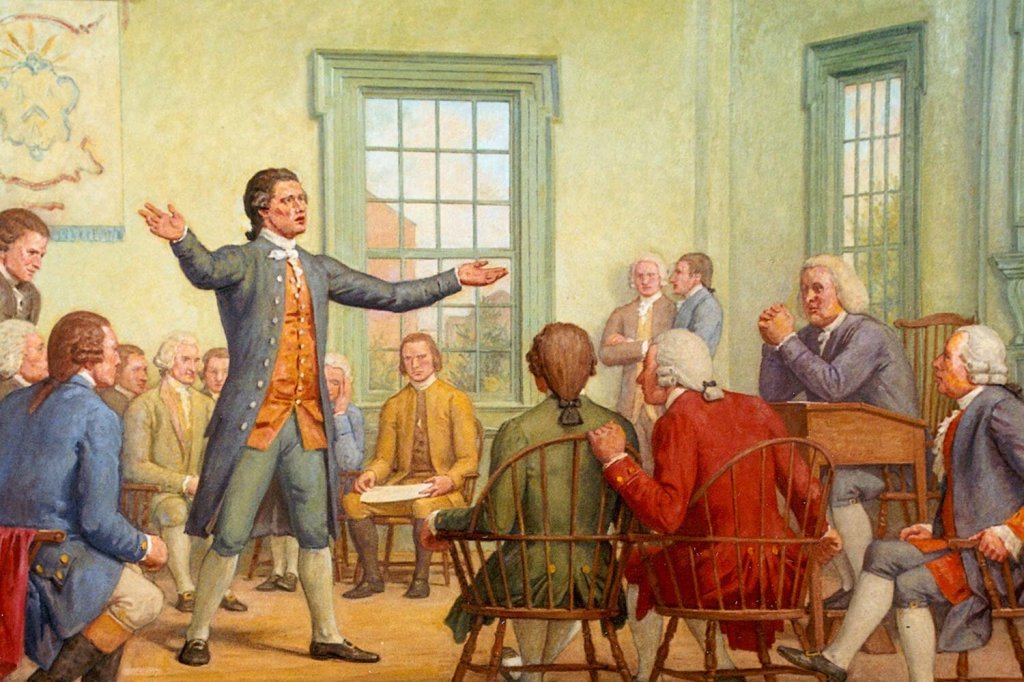
During the first Constitutional Convention of 1787, a significant debate unfolded about the method of electing a president to lead the executive branch of our newly established government. It was a pivotal moment in our history after the decision to have a single individual in the office rather than two or even a triumvirate. Just imagine the complexity of electing three people every four years.
The primary issue was whether a congressional vote should elect a president or do it by popular vote. The latter eventually won out until the smaller states began to weigh in, concerned that those with a larger population would wield more control.
Another lesser-known concern was that the political elite of the time were worried about a mass of uneducated voters swaying the results. Discussions continued for several months until, one day, in a closed-door subcommittee, James Madison laid down the concept for what became known as the Electoral College.
Enacted as a compromise and safeguard, Article II of the U.S. Constitution (later the 12th and 23rd Amendments), as well as the Electoral Count Act (ECA) of 1887) formally established the Electoral College. These laws regulated the voting process and defined the events between Election Day and the Inauguration.
Now, to clear up some misconceptions. Regardless of rhetoric to the contrary, I assure you that the Electoral College is an entirely democratic process. It is not, however, easy to explain. But I’ll try anyway (insert a deep breath here).
In a presidential election year, the political parties hold conventions where they nominate “presidential electors.” That’s simple enough to understand, but hang on. Here’s where it can get… confusing.
When a party’s presidential and vice presidential candidates win the popular vote, that party’s electoral nominees become “Electors.” Each state has the same number of Electors as members of Congress, and each Elector votes for their party’s ticket on separate ballots – one for president and one for vice president. So, your individual vote is still vitally important because the candidates cannot earn Electors without it.
For example, if Richard Nixon and Barry Goldwater (president and vice president, respectively) won the popular vote in California, the Republican nominees from that state would become Electors and cast their votes to the Electoral College. Once all the electoral votes are cast, the candidate who reaches 270 out of a possible 538 wins – and this is only triggered if the candidates win that state’s popular vote in the first place.
In the news, the results sound something like this: Nixon has won California and its 54 electoral votes. Of course, those results still have to be certified. As you might recall, there was a slight hiccup during the 2020 election certification. However, new security measures have been taken to reduce any potential repeat of those terrible events.
Remember, this is just a glance at the process, but I hope it helps. If it’s still puzzling, a good analogy is Major League Baseball’s World Series. Every year, the winner is determined not by which team got the most runs per game but by which won the most games in the series. The Electoral College works the same way.
In my opinion, the Electoral College is the only practical, efficient, and fair way to ensure everyone’s voice is heard because we’re represented just as we are in Congress. The Founders realized that the popular election alone could and would eventually bring chaos.
If we want an election process that stays in constant contention, then eliminate the EC. But if we’re going to have all our citizens represented equally, let the system do what it was designed to do. If you want to make a real difference, make sure you vote.
Some kids in school have a built-in homing device for bullies. I was one of those kids. I was ten when I started my fifth-grade year at a new school. It was great for the first couple of months. My teacher was nice. The homemade-style country food in the cafeteria was fantastic. I mean, biscuits and gravy for lunch. How amazing is that? My schoolwork was going well, and I even made a few friends. But things changed pretty quickly—for the worse.
Being new was the first thing that automatically marked me as target zero for the persecutor of the week. I was fresh meat. Unless they were influential athletes or just scary, the new kids always got subjugated first. There is nothing like a playground shakedown for milk money on the first day of school. Yikes. The worst part was that my oppressors didn’t even buy milk with it. Oh, come on.
Next, I was smart – too smart, it seemed. After all, nobody likes a kid who waltzes in from nowhere and changes the grading curve. Seriously? Couldn’t those losers have just cracked a book once in a while? Or maybe if they’d actually listened during class… bygones. Eventually, I just didn’t care anymore. From that time forward, my grades rose and fell like yo-yos.
Also, I was “sick” a lot. At least, that’s what everyone said (even the teachers). There are few things worse than a bully. However, one worse thing would be when faculty members went along with the abuse (and there were many of them). No joke. Sometimes, they made it worse by reinforcing kids’ ridiculous ideas about me.
I’ve written many times about the fact that I had a severe birth defect, which required a couple of major surgical procedures every year until I was about 13. I know, bummer, right?
However, my parents and the doctors did their best to give me as normal a life as possible, scheduling procedures around my academic calendar. Occasionally, surgeries were scheduled during the school year, which meant I’d sometimes miss a few days. Once kids got wind of this information, my tyrannization value skyrocketed.
I had no cane, prosthetic, wheelchair, or any other sort of apparatus to suggest that there was anything wrong with me. I think that confused students and faculty alike. Maybe they expected someone who’d been through so much to exhibit more visible signs of it? The truth is, I was never weak or infirmed. After surgery, they had me up and around almost immediately – not that they could keep me in bed much anyway. So, I recovered quickly.
Unfortunately, rumors and false statements made by teachers confused things further and left my classmates anxious about being around me. From there, the bully brain (that’s what I called it) distorted the facts even further. All I ever wanted was a supportive, positive school experience. But that just wasn’t in the cards for me. Even my bus rides to and from school were unbearable. Worse yet, thanks to the internet, today’s bullies can torment victims anywhere, anytime.
In theory, nobody likes a bully. The idea that it’s become politically correct, woke, or whatever the term, to be anti-bullying seems ridiculous. I guess I’ve never understood what kind of person would favor bullying in the first place, except maybe the bullies. I could write an entirely different piece on that question.
So, what’d I do about it? Almost nothing. “Did you tell the teacher?” My mother would ask. Exactly how much did my parents dislike me? Did they want me to get the crap beat out of me repeatedly? If you’re going to snitch, you might as well wear a big sign saying, “Hey, I’m over here. Come, beat me up!” But that’s what parents always want you to do.
Bullying isn’t funny. It’s neither a rite of passage nor acceptable behavior. As for me, I hold no malice toward the kids who bullied me, but I still have nothing but contempt for the school officials who allowed it. No one should have to endure that kind of trauma, and the powers that be should better protect our kids, whether in school or online.
(Editor’s Note: This is an extended edition of the June 19, 2024 print edition of Deer In Headlines II. Throughout the piece you’ll find links to IMDB pages and YouTube videos which give you more information and even let you watch episodes of the shows mentioned. One link is a full documentary of the events surrounding a 1984 episode of the show, “Press Your Luck.” I hope you enjoy it.)
See if any of these titles spin your wheel: “To Tell the Truth,” “Truth or Consequences,” “Press Your Luck,” “Password,” “Card Sharks,” “The $64,000 Question,” “Who Wants to Be a Millionaire,” “$100,000 Pyramid,” “What’s My Line.” – the list goes on. Welcome to the world of television gameshows, a uniquely American invention that has endured long past the time any survey might have said it would.
Television game shows hit the air almost the moment picture tubes began to glow in households nationwide. The genre may change over the years, and some are downright ridiculous. But whatever you think of them, these programs continue to be a popular influencer of American culture.
According to broadcast historians, the first game show was a radio quiz show called “Brooklyn Eagle Quiz on Current Events.” It debuted in 1923 on WNYC, New York, but eventually achieved national broadcast status, setting the stage for all that would follow.
Game shows are categorized by how the contestants play. Quiz shows, like “Who Wants to Be A Millionaire,” rely on a question-and-answer trivia format. Panel shows, like “Match Game,” use groups of celebrities to move the game along. Activity-oriented programs, such as the more recent “Total Wipeout,” require contestants to do something physical. Reality game shows and talent contests, like “Survivor” and “American Idol,” are relatively new formats. However, it could be argued that shows like “The Gong Show” and possibly Ed McMahon’s “Star Search” were Simon Cowell’s inspiration for programs like “Britain’s Got Talent” and “Idol.”
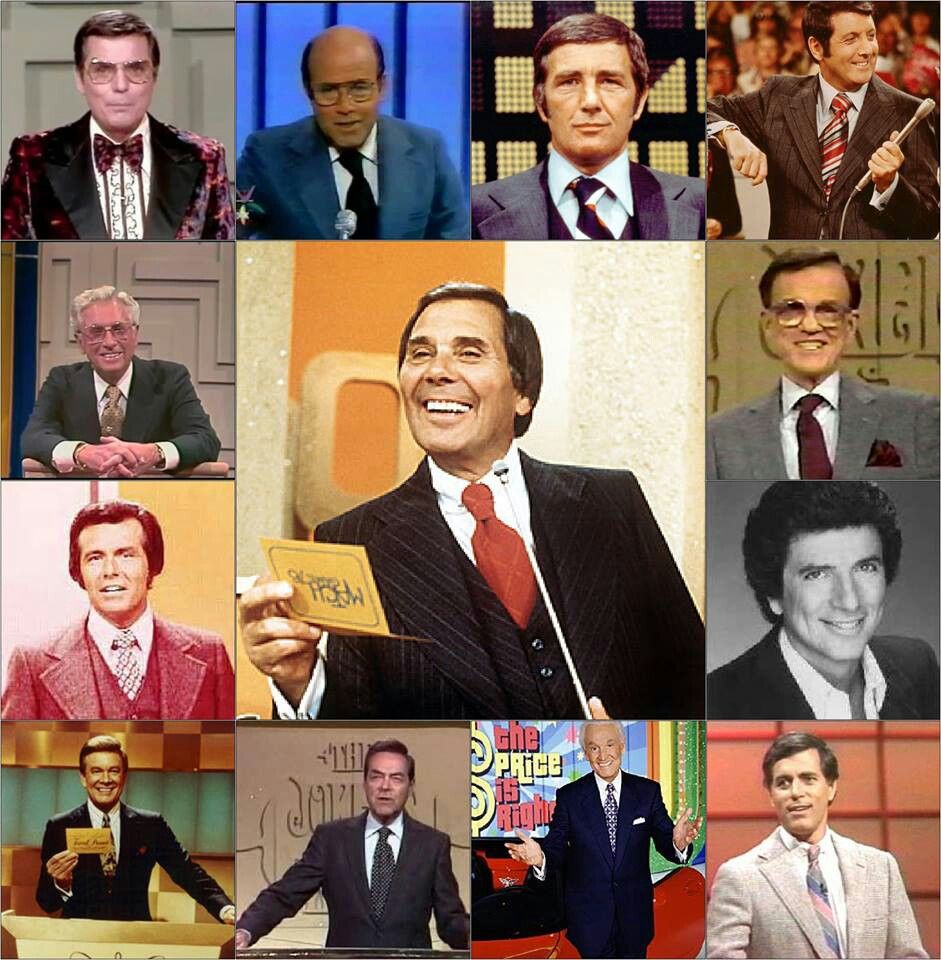
From the 1960s through the 80s, producers of these programs were prolific and turned their hosts into stars. The list includes such performers as Gene Rayburn (Match Game), Monty Hall (Let’s Make A Deal), Allen Ludden (Password), Gary Moore (To Tell the Truth), Chuck Woolery (Wheel of Fortune/Love Connection),Tom Kennedy (Name That Tune), the late Alex Trebek of “Jeopardy!” fame, and many others. As “Wheel of Fortune” host Pat Sajak takes his final spin in June 2024, Ryan Seacrest joins the ranks with other more recent additions like Steve Harvey (Family Feud), Howie Mandell (Deal or No Deal), Keke Palmer (Password, 2022), and Jane Lynch (The Weakest Link, US).
A “host” of hosts … Peter Marshall, Joe Garigiola, Richard Dawson, Monte Hall, Allen Ludden, Gene Rayburn, Bill Cullen, Bob Eubanks, Burt Convey, Wink Martindale, Jack Barry, Bob Barker, and Peter Tomarken.
Many shows started at local TV stations and grew in popularity until they became network products. Although most began at the network level, produced either in New York or Los Angeles, there were a few locals. Around 1975, the Dayton, Ohio edition of “Bowling for Dollars,” a sort of franchised show package that any station could license, was hosted weeknights by long-time radio personality, David G. McFarland. Most local stations chose the cheaper option, however, which was simply to air pre-produced programs like “Wheel of Fortune,” saving thousands on production costs.
At the network level, a staggering amount of money was generated by advertising, and show producers wielded a great deal of power over daytime television. Mark Goodson and Bill Todman produced such long-running shows as “The Price is Right” and “Match Game.” Their programs still generate ratings and money, even the reruns. Chuck Barris helmed “The Newlywed Game” and several others. Talk show host and producer Merv Griffin is responsible for two of the most popular shows still in production: “Jeopardy!” and “Wheel of Fortune.”
“Beat the Clock” started on the radio in 1948 and continued on television in various formats through 1980. Mark Goodson and Bill Todman produced the network TV versions.
Virtually every network scrambled to fill morning daytime slots with gameshows, from card games to shopping sprees. Every type of game or activity was being turned into a gameshow. Even PBS had a game show at one point called “Think Twice,” starring Monteria Ivey. Needless to say, it didn’t last very long.
Like other media, game shows have had their share of scandals over the years. The one with the farthest-reaching repercussions was the 1950s quiz show, “Twenty-One.” Advertisers and producers colluded to provide breakout contestants with quiz answers to keep them in the game longer and drive drama and viewership. Once discovered, convened hearings to determine how the scandal would affect future programs. Eventually, legislation was passed to limit advertisers’ influence over the outcome of these contests.
When he finally became a contestant on the show, Larsen focused on one particular pattern with every spin and timed his hit of the buzzer to stop the board at just the right moment. Through 40 spins, he avoided the prize-stealing “Whammy,” racked up his cash, and went home. The incident was not exactly scandalous, but it was certainly embarrassing for the network.
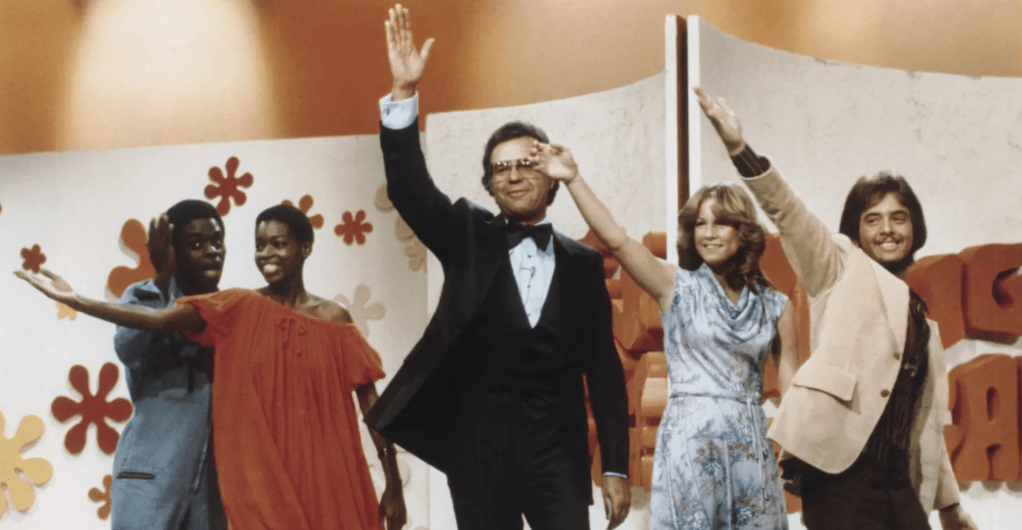
Photo: Jim Lange (center) on ‘The Dating Game’. EVERETT COLLECTION. The Dating Game (1965–1973, 1978–1980, 1986–1989, 1996–1999, 2021)
“Press Your Luck” has seen at least one reboot over the years, but after that incident, the gameboard’s electronics were greatly modified. As for Larsen, he lost a good bit of his money to a home robbery and bad financial decisions. Sadly, he died of cancer just 15 years later at the young age of 49.
Today, three long-running game shows still rule the airwaves: “Jeopardy!,” “The Price is Right,” and “Wheel of Fortune.” “Wheel” and “Jeopardy!” are syndicated programs airing at different times in local markets. However, “The Price is Right” remains a network behemoth that still anchors the CBS daytime lineup.
With its famous phrase, “Come on down,” inviting audience members to Contestants’ Row, “The Price is Right” is the longest-running game show on television. It debuted in 1956 but was revamped some years later. Prior to that, the program was hosted by the venerable “dean of game show hosts,” Bill Cullen. Don Pardo, later of “Jeopardy” and “Saturday Night Live” fame, was one of his announcers.
In 1972, CBS debuted a new, more modern version of the program. The network eventually broke convention by expanding from the typical 30-minute format to a full hour, capitalizing on the show’s wild popularity. They also tapped popular “Truth or Consequences” host Bob Barker to become master of ceremonies. The success of the new format led to a syndicated evening version hosted by Dennis James, also one of the earliest game show hosts.
Today, “Price” is the longest-running television game show at more than 9,000 episodes and Barker spent the last 35 years of his career holding the mic. Upon Barker’s retirement, comedian Drew Carey stepped in during the 2007 season, again giving it a fresh look and attracting a younger demographic.
As Ryan Seacrest assumes the role of spin-maestro on “Wheel of Fortune,” the rest of the show will stay pretty much the same. Vanna White will stay on, although her purpose seems superfluous at this point given the electronic nature of the puzzle board’s letters. She is apparently still needed to tap on a digital screen while someone in the control room pushes a button to reveal the letter.
Game shows generally offer a glimpse of ordinary people in an extraordinary, albeit artificial, situation. Behind door number three, each contestant can hope for a new car, and Monty Hall (and now Wayne Brady) always has a smile and a cash prize for finding that one random object in their pocket.
Those not lucky enough to appear on stage or failed to beat the clock, the buzzer, or whatever received the “home version” of the game they were on.
Some game shows, like Hall’s “Let’s Make A Deal,” are pure silliness, while others offer contestants the unrealistic promise of fulfilling their dreams (at least financially). But modern talent and reality gameshows, like “American Idol,” “Survivor,” and CBS’s “Big Brother,” dangle fame and fortune before their contestants, luring viewers in with contrived drama and fake infighting.
I know what I’m talking about, here. I was a compensated performer on NBC’s “America’s Got Talent” (AGT) in 2006. I met many of the contestants and witnessed their hope and agony as they struggled to meet sometimes impossible demands of producers. The show is crushing to those who compete, some of whom are seasoned, talented performers hoping for a break.
These programs never reveal to the audience the manipulation that goes on behind the scenes as producers subject the performers to the scrutiny of unqualified, B-list celebrity judges. Easy money? Hardly. Quiz shows can be fun and quick entertainment for contestant and viewer. But contests like AGT are arduous, dejecting, sometimes even humiliating for the contestants.
Sadly, it’s unlikely this particular form of gameshow is going away anytime soon. Talent and reality gameshows rake in millions of dollars in ad revenue for every episode, each artificially sweetened and chock full of “unscripted” flavor.
Fear not—the old-school gameshow format is making a resurgence. Thanks to connected TV, you can stream hundreds of these daytime diversions from nearly every decade since their inception. Amazon Prime even includes a channel called Buzzr, a gameshow buff’s paradise that runs them all day, all the time. (Buzzr is owned by Fremantle, the successor owner of the Mark Goodson-Bill Todman game show library.)
Like any other television programming, gameshows must be taken for what they are – mindless diversion. They were never meant to be Shakespeare or Ibsen. As children they often helped pass sick days home from school or gave our mothers something to do while ironing. However you experience them, they’re here to stay. So, until next time, this is Gery Deer saying, “Help control the pet population. Have your pet spayed or neutered. Goodbye, everybody.” (Special thanks to Bob Barker.)
“Books are uniquely portable magic.”—Stephen King, On Writing: A Memoir of the Craft.
I’ve often quoted classic books in this column for several reasons. For one thing, those brilliant writers of old had wisdom that still eludes me, and I need to borrow it occasionally.
I also enjoy the opportunity to share my love of books with those of you who are kind enough to give me your attention for a few minutes each week. My hope is that, in addition to my humble observations, I can share some words from those scribes who were (or are) far wiser and more eloquent than me.
Of course, I don’t just cite the classics. I toss in something fun and modern here and there as well. You may not realize it, but I’ve shared some words from the likes of Douglas Adams, George R.R. Martin, J.K. Rowling, and more.
I wasn’t a voracious reader when I was young, but that changed as I grew up. In high school, I became interested in Charles Dickens. Later, it was the stories of Mark Twain. From “The Little Red Lighthouse and the Great Gray Bridge” to “Lord of the Flies,” one book led to another. It’s interesting how that happens. Once you’re hooked…
That said, here are my questions of the day: Have books become obsolete in the shadow of the internet and social media? As some try to ban classics like Huckleberry Finn and To Kill A Mockingbird, what has become of literature’s social significance? What does the future hold for the classics and all the unwritten works yet to come? I don’t have the column inches to answer these questions, so here are my brief thoughts.
In my humble opinion, Stephen King had it right. Books are magical. They transport us to faraway lands, introduce us to people around the globe, and inspire imagination and dreams. But books are far more than mere escapism from our daily grind into the worlds of Harry Potter and Captain Nemo.
Books are the arks of our history. They help us learn from the past, hold a mirror to the present, and prepare for the future. Every published page offers a tiny glimpse into who we are as a species—warts and all. When you read a book, you have no choice but to learn something. Ignorance is replaced with knowledge and understanding, and then a funny thing happens—people get along better. Books provide the knowledge that breaks down all the barriers that separate us.
Booksellers are struggling, however. In many American communities, there might be a Starbucks or a parking lot where the neighborhood bookstore once stood. Instead of the pages of some great new novel, many people seem far more interested in scrolling through social media.
Although I prefer the printed page for most of my reading, my appreciation for books is more about content than construction. I typically read two or three books simultaneously, each in a different medium—audio, digital, or print.
A book is a book. Unless you can convince me that words read aloud are less meaningful than those read by eye, listening to an audiobook still counts as reading. You should read however you feel comfortable.
Concerning book bans, I won’t get into the obviously paranoid politics involved. If you don’t like a book, don’t read it. But the concept of book banning should horrify us because it casts a long shadow backlit by terrors of the past.
Some writers spend decades crafting the perfect book, hoping it will positively impact the reader. No matter your age, the genre, or the medium, reading a book will improve critical thinking and creativity and release dopamine, the brain’s “happy” chemical.
If you haven’t done so for a while, it’s time to get some of that happiness for yourself or give it to someone else. A book is one of the most meaningful gifts you can give. Libraries and bookstores offer a fun, affordable family experience you will remember forever.
Thankfully, books, even printed ones, aren’t going away anytime soon. But if they were ever to disappear, so would our society, our humanity, and, eventually, the record of our very existence.
*************
More Information:
Your local library is a great, free resource for the whole family to explore the unlimited world of books!
If you want to learn more about the book industry, the future of printed books and bookstores, check out these documentary films: The Booksellers. And Hello, Bookstore.
BEAVERCREEK, Ohio – March 12, 2024 – The seventh annual Rafi’s Amigos Golf Outing is scheduled for Friday, May 31st, 2024, beginning at 8:00 AM EDT, at Beavercreek Golf Club, 2800 New Germany Trebein Rd., Beavercreek, Ohio. For the second year, proceeds will fund a one-day, immersive experience at Air Camp for Junior Reserve Officer Training Corps (JROTC) students from three Greene County Schools. Full details are available at https://www.askrafi.com/events/7th-annual-rafis-amigos-golf-outing
José “Rafi” Rodriguez, Colonel (Retired) USAF, president of Rodriguez Financial Strategies, LLC, organizes and hosts the event. “I started Rafi’s Amigos Golf Outing to raise funds for causes dear to my heart, and I am grateful for the incredible community support,” Rodriguez said.
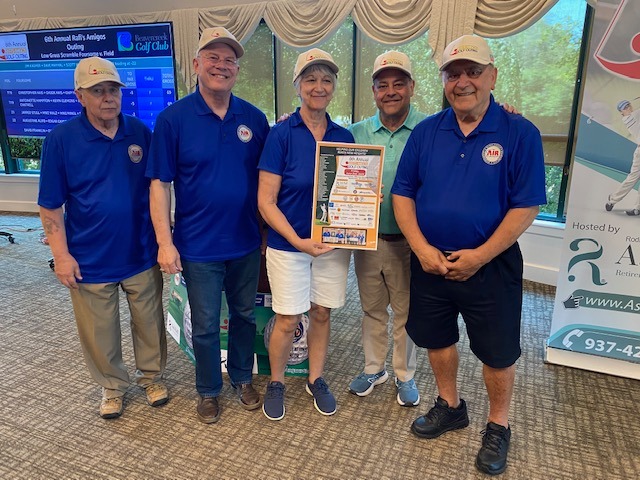
Jose “Rafi” Rodriguez (second from right) with representatives of Air Camp, who will host JROTC students benefiting from the golf outing.
Originally from Puerto Rico, Rodriguez joined the Air Force ROTC at the University of Puerto Rico in Mayaguez, where he was a distinguished graduate. After a 26-year career in the Air Force, Rodriguez retired as a senior officer while serving at Wright Patterson Air Force Base in Dayton.
Over the last six years, Rafi’s Amigos Golf Outing, which Rodriguez describes as a “scramble,” raised money for several regional organizations, such as United Way of Greater Dayton Area, and continues to grow. Last year’s event exceeded expectations by several thousand dollars, allowing 40 students and their instructors to attend Air Camp.
Air Camp again was a natural partnership given Rodriguez’s background, the region, and the goal—to support the youth of his community. Based in Dayton, Ohio, Air Camp, Inc. was founded in 2006 by Dr. Vince Russo and Dick Reynolds, Lieutenant General (Retired) USAF.
Russo currently serves as the organization’s President and Chairman. “Early on, we decided to use aviation as the learning medium because the real language of aviation is math,” he said. Our goal is to use aviation to help the students understand the importance of Science, Technology, Engineering, and Math (STEM) and inspire them to pursue careers related to those fields.” More information about Air Camp is available at aircampusa.org.
This year’s presenting sponsor is the White-Allen Auto Group / White-Allen Family of Companies in Dayton. Tim White is the president and grandson of the company’s founder. White explained why his company has supported the golf outing for the last several years. “When you’re dealing with the future of STEM education for the young members of society, that’s a wonderful mission to get behind.”
Rodriguez proudly chose “Rafi’s Amigos” because he wanted it to be where people could enjoy a community event for a great cause. “Amigos” is the Spanish word for ‘friends,’ I consider this an event where friends come together, old or new, to support a common cause in our community,” Rodriguez explained. “I hope people will come to support these future leaders of our country.”
In conjunction with International Networking Week, GLD Communications has scheduled a Referral Marketing Master Class at The Hub in the Dayton Arcade, 31 South Main Street, Dayton, OH 45402, on Wednesday, February 7th,11:30 AM until 1:00 PM. The class typically costs more than $250, but this session has been specially priced at just $40 per person.
Presented by GLD Communications’s founder and creative director, Gery Deer, the 90-minute lunch-and-learn session includes techniques for identifying and developing referral partnerships. Pre-registration is required. Seats sell out quickly. Register at gldcommunications.com.
GLD Communications Creative Director, Gery Deer, will present the class.
Deer started GLD Communications in 1997 as a part-time job. Today, it is an old-school public relations firm with media production and content distribution all under one roof. The company provides newswire stories, documentary-styled film productions, podcasting, reputation and crisis management, and copywriting services. This master class is part of the agency’s business success coaching services.
Deer said people rarely learn to turn passive networking into proactive referral partnerships. It requires strategy, time, and commitment. He also noted that most people confuse networking with referral marketing when they are symbiotic.
“People mistakenly interchange the words networking’ and referral marketing, but the two have a causal relationship,” said Deer. “This master class explains how strategic networking is just the beginning and provides the opportunity for Referral Marketing partnerships that can generate revenue for years.”
An award-winning writer and creative director, Deer has navigated many changes in his business over the years. “We have withstood recession, lagging sales, and staffing issues,” he said. “I built and maintained our public relations media agency on referrals, but it was a massive learning curve. I wish someone had a class like this back when I started.”
Deer said the course also offers insight into leveraging your current networking opportunities to identify potential referral partners. He will also cover the various networking organizations ranging from service clubs like Rotary to professional referral organizations, specifically Business Networking International (BNI). Nikki Gates, Managing Director of the Miami Valley Ohio Region of BNI, will also be in attendance to offer information on her organization’s growth in the Dayton market.
Event parking is not included but is available at Reibold Parking, 25W W. 5th St., Dayton, 45422. For more information and a direct link to register, visit www.gldcommunications.com.
(Author’s Note: The following is an edited repost of an article originally published December 30, 2013)
I have never hidden the fact that I don’t drink alcohol. When I say that, I mean that I really don’t. When some people say it, what they are implying is that they don’t drink hard liquor, or they only have a beer at a baseball game or something. But trust me when I say, I don’t drink. Period. I just wanted to make that absolutely clear so what follows carries the proper weight.
An alumnus of one of the oldest national college fraternities – Sigma Phi Epsilon – I’ve never had an alcoholic beverage of any kind – nothing. I didn’t steer clear of the bubbly because of some religious or deep, philosophical reason. It just wasn’t part of my experience growing up and, fortunately, I never developed the interest.
To be quite honest, at this stage in my life, the very smell of the stuff, particularly beer, makes me kind of sick. That said, drinking is a big part of adult social and business functions and thus, alcohol-focused events are hard to avoid. I am well know how hard it can be to resist pressure from others. But, for those who are trying to steer clear of the juice, please try to remember that it’s OKNOT to drink. Really, it is.
Some people might think peer pressure is limited to the adolescent or collegiate years. Untrue Even as an adult, people are often pushed to drink alcohol at social and business events. Otherwise they feel ostracized or singled out.
Despite opinions to the contrary, it really is OK not to drink. Here are some ideas for anyone trying to abstain but who still wants to feel included in the fun of the party.
First, and this is really important, you must be comfortable with yourself and your decision not to indulge. If not, then you’ll probably make others feel uncomfortable too. Ambivalence with your own choices will result complacency and resignation. At that point, giving in will be your own decision and not because of peer pressure.
Next, always remember – and young people reading this please, please try to hang on to this concept – if anyone takes issue with you’re not drinking, or pressures you in some way, the problem is with them, not you!
As I said earlier, I have no interest in drinking and nothing will change my mind. I am very comfortable with my choice and feel no need to explain it. But, people can be relentless, particularly as they grow more inebriated. There is nothing wrong with your choices and if others object, in my opinion, they’re people of questionable character.
So how do you decline? If offered, politely decline, but don’t make excuses. After all, unless you’ve been on some soapbox about abstinence, and I recommend you don’t do that, the offer was not made to offend you.
Just say something like, “No thanks. I’d really like a cup of tea (coffee, soda, whatever), though, if you have it?” It’s polite and expresses your appreciation for the offer.
It’s not a good idea to launch into some long-winded explanation, however, or rattle off a list of excuses about why you’re abstaining.
I don’t have many close friends, who drink regularly, if at all, and those who do rarely do so in my presence. And, I’m rarely in a position where alcohol is any sort of focus of the event.
Oddly, the most baffling experiences I have had to deal with with in my non-alcoholic life is the expectation to defend my choice. It’s really kind of backwards to my own sense of logic.
Early on, I realized that many people who find out I don’t drink immediately think I’m some kind of religious nut or recovering alcoholic. I’m not. Hard to get hooked… no, let me rephrase that. It’s impossible to get hooked if you never start.
Still the question remains. Truth be told, I think it’s ridiculous that the sober guy in the room has to explain himself while all around him people are dropping, face first, into the toilet bowl. I just don’t get it.
So, my next piece of advice is to never defend yourself. Walk away or just change the subject and divert attentions elsewhere. Or you can simply be appreciative of their interest and just say, “Thanks, I just don’t want anything.”
Regardless of your reasons, I guarantee you’re not going to change anyone’s mind or alter their opinion of your choices, and you shouldn’t try. Plus, I’ve learned when someone takes so strong an issue with my not drinking, it’s generally because they carry some sense of guilt or other feelings about their own alcohol use and suddenly feel extremely self-conscious.
If you’re at a social or business gathering, carrying a decoy drink can help avoid questions from people – since most people are standing around with some sort of cup or glass in their hand. But, don’t pretend it is alcohol. In other words, avoid the mock-tail. There is no need to call attention to the drink in your hand.
Some people will advise you to accept an alcoholic drink and just hold it all night. No. That is not only pointless and dishonest, but could actually make you feel even more self-conscious. People will expect you to sip from your drink now and again during long conversations, so just have something else in your glass.
Participating and socializing, without any sort of focus on the refreshments, will also help you be more involved in the event. If, however, there is still a particularly high level of pressure on you to drink or otherwise be left out or ridiculed, you should extricate yourself from the situation. I would also recommend you rethink attending activities with the same group of people.
Regardless of other steps you might take to distract from your abstinence, never, ever try to change the behavior of others. A social or business function is not the proper setting for a personal mission or intervention. If you live alcohol-free because of some personal crusade, leave your soap box at home. No one will hear you and it’ll just serve to further ostracize you from others.
Once again, you have to be comfortable with yourself, but you need to accept that others have not chosen your way and booze is a way of life out there in the world. Deal with it. You, alone, have made the conscious decision to attend an event where alcohol is being served and to be included you must live and let live. Needless to say, if you see someone about to drink and drive, act accordingly as your circumstances permit.
Finally, always remember that there is no “down side” to abstaining from alcohol. None. Only good can come of it – that’s not something drinkers can say with any measure of confidence. When you don’t drink, you’re probably less likely to do things that have negative consequences. So, provided you don’t have some kind of a deviant propensity toward misbehavior anyway, you should make it through the event unscathed. Your social position may suffer, especially if you typically surround yourself with partiers. I say, it’s their loss. And to you I’d recommend finding a better group of friends – those who accept you for who you are, not what you drink.
Negative people have a negative effect on us. I have lost relationships of every kind because of my choice not to drink. “I don’t trust a man who doesn’t drink,” is a backwards way of thinking and a bit on the ignorant side, I might add. I’d say, logically, it should go the other way around, but I’d end up having to mistrust pretty much everyone outside my immediate family. Maybe a proper way to say it is, “It’d be hard for me to trust anyone who thinks the bottle in their hand is more important than a friend or family member.”
Consider what kind of a “friend” abandons you because you don’t want to use alcohol? If you were always a non-drinker, it’s probably easier for others to accept because they know from the start. But going on the wagon, for whatever reason, can be challenging. Once again, just remember that it’s OK not to drink. Just be yourself. It’s you that should matter to your friends and colleagues, not what’s in your glass.
Deer In Headlines and Gery Deer are brought to you courtesy ofGLD Communications.














 The Jamestown Comet