Local News & Commentary Since 1890.

Posts Tagged ‘donald-trump’

In the news from the wire, April 18, 2025 – Maryland Sen. Chris Van Hollen posted photos of himself meeting in El Salvador with Abrego Garcia and much more…

In Local News on April 18, 2025 at 8:03 am
By Jayakumar MadalaApril 18, 2025
 Good morning, I’m Jayakumar Madala, filling in for Sarah Naffa.

In the news today: The Kilmar Abergo Garcia case pulls Democrats into the immigration debate Trump wants to have; a deep staff cut at the Consumer Financial Protection Bureau is the latest step in an extraordinary reshaping of the federal government; and survivors talk about the lessons of the 1995 Oklahoma City bombing. Also, scientists find possible chemical signs of life on a faraway planet.  AP Morning WireMaryland Sen. Chris Van Hollen, right, speaks with Kilmar Abrego Garcia in a hotel restaurant in San Salvador, El Salvador, on Thursday. (Press Office Senator Van Hollen, via AP)POLITICSThe Abrego Garcia case pulls Democrats into the immigration debate Trump wants to haveFor Democrats, the Kilmar Abrego Garcia case is about fundamental American ideals — due process, following court orders, preventing government overreach. For the Trump administration and Republicans, it’s about foreigners and gang threats and danger in American towns and cities. Read more
Recent developments:This dichotomy is playing out as Democrats double down on their defense of Abrego Garcia, a Salvadoran man mistakenly deported and imprisoned without communication. On Thursday evening, Maryland Sen. Chris Van Hollen posted photos of himself meeting in El Salvador with Abrego Garcia. The lawmaker did not provide an update on the status of Abrego Garcia, whose attorneys are fighting to force the Trump administration to facilitate his return to the U.S.

In defending his administration’s position, Trump says he is doing what he was elected to do and justifying the need to deport millions. “I was elected to get rid of those criminals — get them out of our country or to put them away, but to get them out of our country. And I don’t see how judges can take that authority away from the president,” Trump said Thursday.
RELATED COVERAGE ➤Rubio suggested the US will drop Ukraine-Russia peace efforts if no progress within days
Supreme Court keeps hold on Trump’s restrictions on birthright citizenship but sets May arguments

Absolute Power

In history, Opinion, Politics, psychology, Uncategorized, World News on March 26, 2025 at 1:58 pm

Deer In Headlines II

By Gery Deer

Power, like money, is nothing if you have enough, but everything if you don’t. But what is it? Who has it, and what are those without it supposed to do when faced off by those who do? I’m not sure I’m smart enough to answer any of those questions. If you’ll indulge me, however, I’ll make an attempt to do so and put it into a contemporary context. First, a little history – the kind we should learn from or be doomed to repeat.

It was 1887 England. In a series of letters to Bishop Creighton concerning the issue of writing history about the Inquisition, John Dalberg-Acton, the 1st Baron Acton, or better known as Lord Acton, wrote, “Power tends to corrupt, and absolute power corrupts absolutely.” Most people are familiar with the quote, but few know the preceding passage, which gives it perspective.

“I cannot accept your canon that we are to judge Pope and King unlike other men, with a favourable presumption that they did no wrong,” Acton wrote. “If there is any presumption it is the other way against holders of power, increasing as the power increases. Historic responsibility has to make up for the want of legal responsibility.”

That’s some pretty fancy, but important language. Put more simply, Lord Acton was saying that the same moral standards should apply to everyone, including political and religious leaders. Throughout history, kings and popes were permitted, essentially, to wield their authority unchecked.

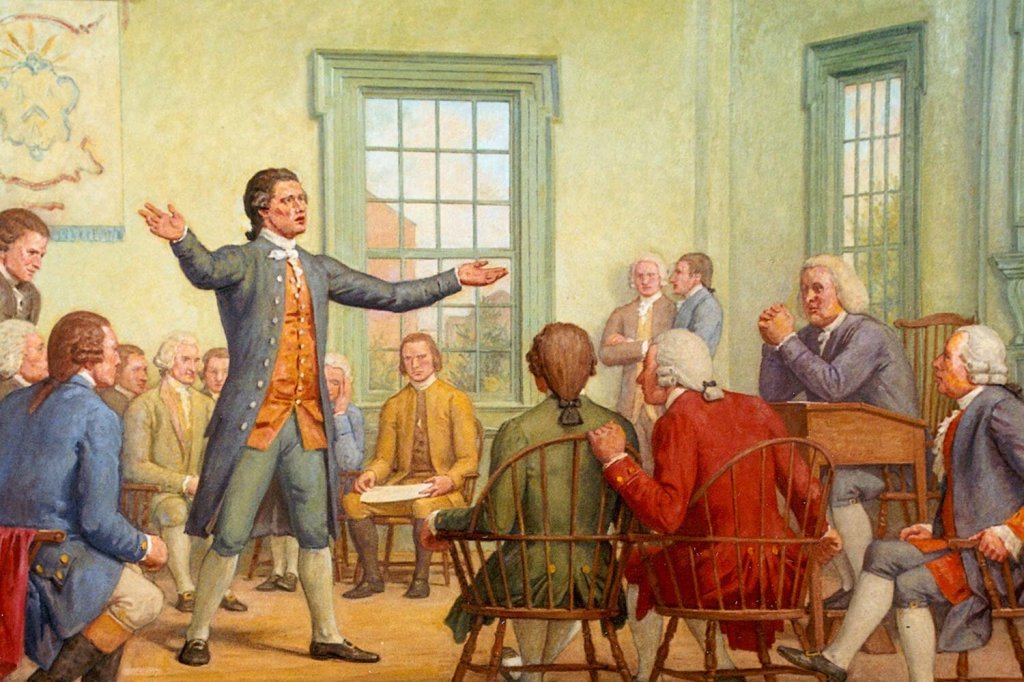
America’s Founding Fathers shared the same concern. So much so that when they created a constitution for their new country, coincidentally ratified the same year as Acton’s historic correspondence, it established three separate but equal branches of government to prevent such authoritarian power.

Power is a dangerous thing, especially in the hands of two kinds of people – those who want it, and those who want to keep it from others. The first is driven by greed, the second by fear. Lord Acton was commenting on accountability, something the Constitution ensures by setting equal the Executive, Legislative, and Judicial branches of government. Should some power-hungry tyrant manage to occupy the White House, the other branches would be able to keep him or her in check.

If that individual managed to wield enough control over two of the three branches, the third would be able to mitigate some of the potential danger. But if all three branches were heavily influenced, even manipulated by one individual, then we have a problem. That lands our country in Lord Acton’s absolute power corrupting absolutely territory, and on a much larger scale.

Let’s not forget the second kind of power broker (to borrow a term from one of my favorite authors, Robert A. Caro), the kind who want power out of fear. This individual, or group, is afraid that someone else will gain the power to control them or do things they don’t like.

These people tend to be all-or-nothing types. In other words, if they can’t have it, they don’t want anyone else to because they fear it will weaken their position. Those who are afraid of minority advancement fit this category. 

But what if you’re on the receiving end of all this – the powerless. Powerless people are led to believe, by a government or other authoritative body, that they don’t deserve power. Classism, racism, ageism, and most other “isms” are examples of one group trying to maintain power over another. To quote a great role model of the late 1980s, Ferris Bueller, “Isms, in my opinion, are not good. A person should not believe in an -ism, he should believe in himself.”

When the people lose the power over government, when their elected representatives act in blind service to one policy or individual rather than the best interest of their constituents, when power begins to corrupt absolutely, freedom no longer exists. The trouble is, corrupted power often goes unrecognized until it’s too late.

Corruption dons the cloak of misdirection, intended to fool those who are unwilling to see the danger. Try to remember that power can also be a good thing that benefits all instead of one person or ideology. Unfortunately, that doesn’t make for very good reality television, now does it?

Efficacious Electoral College

In Books, Children and Family, Economy, Education, history, Local News, Politics, sociology, Uncategorized on October 19, 2024 at 10:20 am

Deer In Headlines II

By Gery Deer

Without question, 2024 has been and will continue to be one of American history’s most charged and controversial election years. Among the points of contention is the continued argument regarding the necessity – and validity – of the Electoral College.

Political operatives and pundits alike have been outspoken on the subject from all political viewpoints. There seems to be no consensus because, quite frankly, even some government officials don’t understand its purpose. So, before I give you my thoughts, here’s some non-partisan history.

During the first Constitutional Convention of 1787, a significant debate unfolded about the method of electing a president to lead the executive branch of our newly established government. It was a pivotal moment in our history after the decision to have a single individual in the office rather than two or even a triumvirate. Just imagine the complexity of electing three people every four years.

The primary issue was whether a congressional vote should elect a president or do it by popular vote.  The latter eventually won out until the smaller states began to weigh in, concerned that those with a larger population would wield more control.

Another lesser-known concern was that the political elite of the time were worried about a mass of uneducated voters swaying the results. Discussions continued for several months until, one day, in a closed-door subcommittee, James Madison laid down the concept for what became known as the Electoral College.

Enacted as a compromise and safeguard, Article II of the U.S. Constitution (later the 12th and 23rd Amendments), as well as the Electoral Count Act (ECA) of 1887) formally established the Electoral College. These laws regulated the voting process and defined the events between Election Day and the Inauguration.

Now, to clear up some misconceptions. Regardless of rhetoric to the contrary, I assure you that the Electoral College is an entirely democratic process. It is not, however, easy to explain. But I’ll try anyway (insert a deep breath here).

In a presidential election year, the political parties hold conventions where they nominate “presidential electors.” That’s simple enough to understand, but hang on. Here’s where it can get… confusing.

When a party’s presidential and vice presidential candidates win the popular vote, that party’s electoral nominees become “Electors.” Each state has the same number of Electors as members of Congress, and each Elector votes for their party’s ticket on separate ballots – one for president and one for vice president. So, your individual vote is still vitally important because the candidates cannot earn Electors without it.

For example, if Richard Nixon and Barry Goldwater (president and vice president, respectively) won the popular vote in California, the Republican nominees from that state would become Electors and cast their votes to the Electoral College. Once all the electoral votes are cast, the candidate who reaches 270 out of a possible 538 wins – and this is only triggered if the candidates win that state’s popular vote in the first place.

In the news, the results sound something like this: Nixon has won California and its 54 electoral votes. Of course, those results still have to be certified. As you might recall, there was a slight hiccup during the 2020 election certification. However, new security measures have been taken to reduce any potential repeat of those terrible events.

Remember, this is just a glance at the process, but I hope it helps. If it’s still puzzling, a good analogy is Major League Baseball’s World Series. Every year, the winner is determined not by which team got the most runs per game but by which won the most games in the series. The Electoral College works the same way.

In my opinion, the Electoral College is the only practical, efficient, and fair way to ensure everyone’s voice is heard because we’re represented just as we are in Congress. The Founders realized that the popular election alone could and would eventually bring chaos.

If we want an election process that stays in constant contention, then eliminate the EC. But if we’re going to have all our citizens represented equally, let the system do what it was designed to do. If you want to make a real difference, make sure you vote.