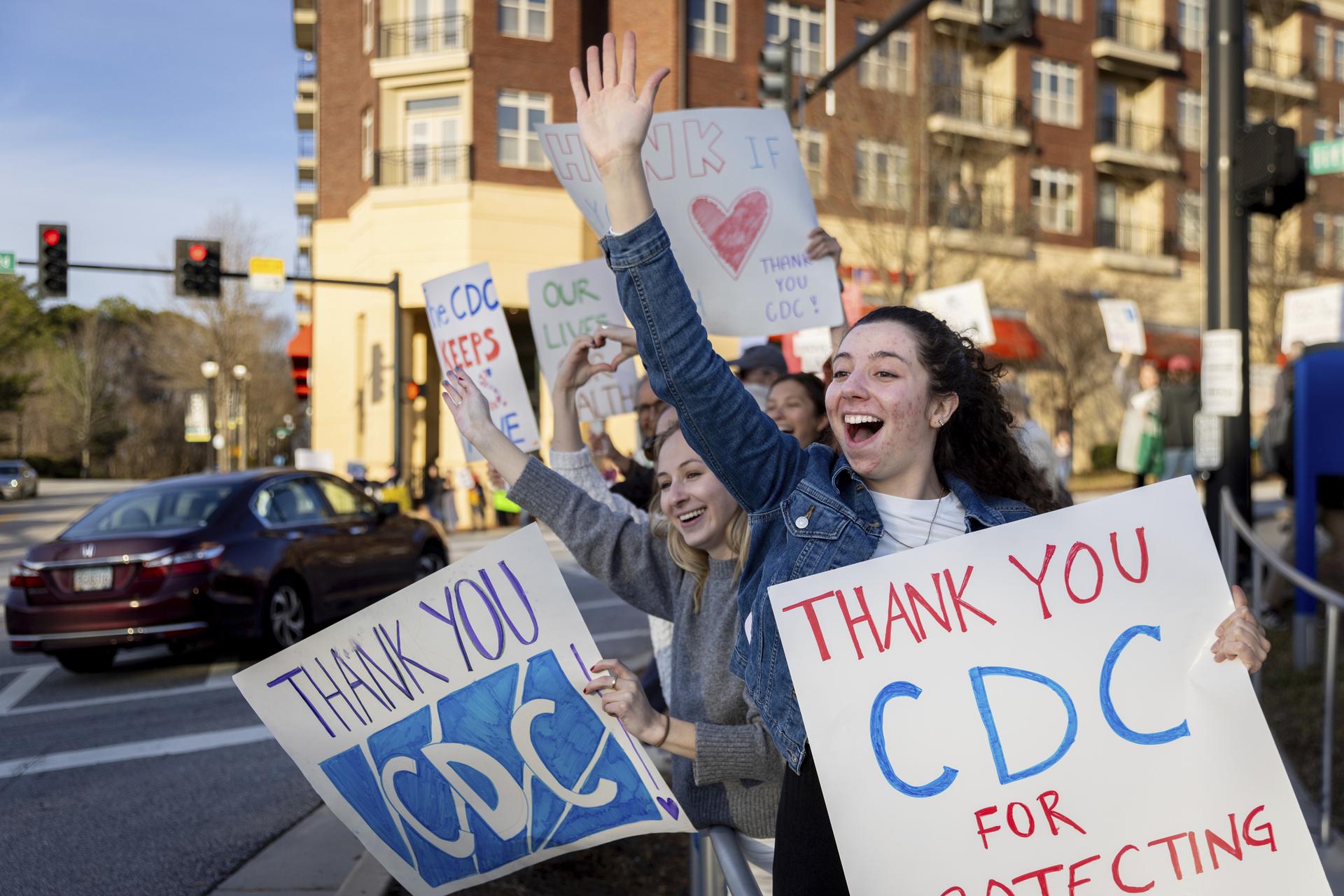
In the news today: The top public health agency in the United States says some employees who were laid off can come back to work; the Trump administration drops a high-profile abortion case in Idaho; and France’s Macron and allies will discuss protecting Europe with French nuclear deterrence. Also, how healthy eating could be tied to good sleep. Supporters of Centers for Disease Control and Prevention employees protest CDC layoffs, in Atlanta, Feb. 18. (Arvin Temkar/Atlanta Journal-Constitution via AP)
POLITICS CDC rescinds termination notice, calls about 180 fired employees back The nation’s top public health agency says about 180 employees who were laid off two weeks ago can come back to work. Emails went out Tuesday to some Centers for Disease Control and Prevention probationary employees who got termination notices last month, according to current and former CDC employees. Read more.
What to know:A message seen by the AP was sent with the subject line, “Read this e-mail immediately.” It said that “after further review and consideration,” a Feb. 15 termination notice has been rescinded and the employee was cleared to return to work on Wednesday. “You should return to duty under your previous work schedule,” it said.
Health and Human Services Secretary Robert F. Kennedy Jr. last month pledged “radical transparency” at the department, but HHS officials have not provided details about CDC staff changes and did not respond to emailed requests on Tuesday and Wednesday.
How many of the reinstated employees returned to work Wednesday is unclear. It’s also unclear whether the employees will be spared from widespread job cuts that are expected soon across government agencies.
According to the National Kidney Foundation, more than 20 million Americans are affected by renal (kidney) and urological conditions. It goes on to say that millions more, currently unaccounted for, are at risk. The causes range from congenital issues to diseases that affect the urological system.
I happen to be in the category of the former. In March, I’m joining a couple of hundred other patients, caregivers, and advocates to meet with congressional representatives about more support to care for, as I will explain in my case, adult patients with congenital urological conditions.
I was born with a rare condition known as bladder exstrophy. It affects about 40,000 people worldwide, and only a few specialty hospitals in the United States specialize in the predominantly pediatric component of treatment. As a child, I was treated in Dayton, Ohio, by some of the best pediatric surgeons in the country who were, it’s safe to say, figuring it out as they went. But they did a tremendous job, and here I am.
From just a few hours old, I was looked after by a contingent of physicians and specialists in what I’ve come to refer to as the “pediatric bubble.” My healthcare providers communicated with each other and consulted on various issues as they perfected this procedure or completed that surgery. As complex as it might seem, my parents were kept well-informed and had direct lines of communication with my general practitioner and my surgeons.
Unfortunately, once you hit about 21 or 22 years old, your pediatric bubble bursts and you are unceremoniously dumped into the world without proper adult urological care. Fortunately, my pediatric surgeon handed me off to someone he trained with, an adult urologist who looked after me for 25 years until his recent retirement. For the first time in my life, I was without a specialist, and my particular problem created a barrier to finding new care.
This situation is familiar to patients with many congenital conditions that carry over into adulthood. To maintain continuity of care, most continue to see their specialists for decades, long after the primary reconstructive surgeries are complete. Thankfully, I was left with few residuals as I grew up, but maintenance needs require somewhat more specialized attention. In addition, as patients age, their physicians must know something about the situation.
Bladder exstrophy, or BE, like many other congenital problems, requires a specific set of surgical skills, reconstructive knowledge, and urological and renal expertise. There is also a critical shortage of practicing urologists. All of this, combined with the potentially long-term commitment to the patient, leaves most urologists choosing not to treat BE patients, and therein hangs the problem.
Enter the Association for the Bladder Exstrophy Community, or A-BE-C, and its newly formed Adult Patient Advisory Council (APAC), of which I am an organizing member. While A-BE-C’s global mission began as primarily pediatric, the advisory council was established to provide resources for adult patients. The goal is to ease the transition from pediatric BE care into adulthood. That’s where me and my plane ticket to Washington, D.C. come into the story.
I’ll represent our organization at the American Urological Association’s annual patient advocacy summit. It’s an opportunity to share these concerns and potential solutions with congressional representatives.
I hope they’ll listen to some of my ideas, including a subsidy or tax credit funded to help encourage young doctors to specialize in urology and, even more so, help them to dedicate some of their practice to adult BE care. With all the tragically unsympathetic, uninformed budget cuts, I wish I was more optimistic. But I will still try, and you may be able to help.
Patient advocacy isn’t about awareness and support. It’s about action. Sadly, urological problems are generally the subject of lousy humor, ignorance, and ageism. But I assure you, there’s nothing funny about it for the patients and caregivers. For them, it’s a daily struggle to maintain proper care.
You can help by following A-BE-C on social media and sharing educational content. You can also contact your congressional representatives to remind them about this. These patients don’t need more research. They need qualified specialists and the peace of mind that their cause matters.
There was a big announcement regarding the local television scene this week. To say that is an understatement. It’s more like a monumental announcement.
WHIO-TV Anchor Cheryl McHenry told viewers on February 20th that she will retire after almost 44 years at the station. She joined the staff in August 1981 as a reporter and eventually joined Jim Baldridge at the anchor desk ten years later. (Baldridge retired in 2009.)
McHenry will remain on air for a short time longer, saying she will conclude her work in late May. Before her time in Dayton, she reported for Cincinnati’s WCKY-AM, then a full-service radio station with a substantial news department.
I can add a personal view to this story. I had the good fortune to work with Cheryl McHenry in the late 1990s when I worked at Channel 7 as a newscast producer. I worked with many good anchors, but producing for Cheryl and Jim was a career highlight for me. She is a class act with high professional standards. When things went wrong, as they often do in television news, she always had helpful thoughts and encouragement and was never demeaning. What you see is what you get; no false airs. And she has a great sense of humor. (Lest I leave him out, I had a very similar experience working with Jim Baldridge. He, too, is a top-notch journalist and a friendly and patient fellow who taught us a lot about what makes for excellent broadcast news.)
The Newscenter 7 team in 1988. (Photos courtesy WHIO.com)
It’s a sight to behold and one we will see less of as time goes on. Television and radio have changed for many reasons, and it’s doubtful we will witness many others like Cheryl McHenry, whose careers span five decades at a single station. She has witnessed and shared an impactful array of events during the arc of her career.
McHenry says she is looking forward to more time with her family and friends, as well as more time for reading and other activities. Time moves on for all of us, and we can’t blame her for that.
As always with events like these, I want to remember: It’s never goodbye. It’s “we’ll see you later.”
Imagine it’s 2030, and you sit down at your digital interface to send an email. A wave of your hand over an invisible sensor brings up a holographic menu that floats before you. Just thinking about what you want to say activates an artificial intelligence (AI) chip implanted in your head, and text appears on the holographic page without a single word.
Across town, an artist stands before a digital canvas. Imagination and inspiration spiral through her mind, and she waves her hands like a sorcerer conjuring magical images out of thin air. Colors and patterns appear on the canvas, enhanced by the AI built into the electronic easel. Within moments, a brilliant painting has been created that will sell for thousands in an online gallery.
In the heart of the Midwest, a racetrack grandstand is filled with spectators. They wave banners, cheer, and call out to their favorites as the field speeds around the track. But there are no Dale Earnhardts or Danica Patricks behind the steering wheels of these unbelievably quiet vehicles.
There aren’t even steering wheels. These cars are electric and entirely autonomous. Advanced, self-driving AI technology pilots the cars in fierce, robotic competition. Skilled drivers trained the AI well before the race, but now the cars compete with each other, and millions of dollars in sponsorship and sports betting are on the line.
Sounds crazy, right? Not that long ago, all this would have been the stuff of science fiction, but we’re not as far from it as you might imagine. Although, you don’t have to because the AI is doing the imagining for you. Well, sort of.
Before I get into all that, some full disclosure. As someone with a highly technical education and professional background, I agree AI has some amazing potential. We’re seeing incredible applications in medicine, logistics, customer experience, fraud prevention, and communications. At the same time, technology has once again advanced faster than our wisdom. The fledgling technology is increasingly misused as a means of cost reduction by eliminating the need for creatives.
Human nature to date implores us to find the quickest route to success, and AI offers that very thing – especially to the do-it-yourselfers. Why train and compensate a person when the computer can handle the job without benefits or sick days?
Skill, expertise, creativity, integrity, and inspiration become valueless if the job is handed off to an AI bot. Can artificial intelligence and creativity coexist? That depends on the user. The real question we should ask is how the technology is applied in any given situation.
AI has neither inspiration nor imagination. Contrary to popular opinion, AI can’t “create” anything. It only assembles information from known sources, organizes it based on the required parameters, and then spits it back out in the requested pattern. Everything is driven and interpreted by the user, including the result.
True creativity comes from the person, the human being who holds the pen, the brush, the welding torch, or the race car steering wheel. Unlimited, on-the-fly, daredevilish creativity is inherent to the human condition. For most people, however, it goes unrealized because of circumstance. This fledgling technology may mature to help those people fulfill their creative potential.
Without emotional intelligence or ethical considerations, AI is a potential devil in the dark. The creative world scrambles to adapt to a technology poised to devalue it. But it doesn’t have to be that way. With thoughtful imagination, professional ethics, and a healthy dose of common sense, human creativity can flourish and even take ownership of the technology.
Again, my only issue with the technology is its ethical application. AI’s value is unlimited if used to benefit rather than replace the process. If they haven’t already done so, creative professionals should begin to apply AI tools, but not as a substitute for artistic imagination – it can’t do that anyway. Instead, use these tools to free time from repetitive tasks, analyze online and social media data, facilitate collaborative efforts, and streamline production.
The goal here is not to yield to the buzz but instead benefit from the potential. Deliberate motivation toward applied expertise in artificial intelligence offers another tool for creative augmentation and increased professional value.
Someone asked me a question this week to which I had no response. “Are you doing anything special for the game on Sunday?” Game? Sunday? I had nothing. As it turns out, the Super Bowl is this weekend, and I had no idea. What red-blooded American doesn’t know when the Super Bowl is – or who’s playing? Well, me, for one.
Sports was never a focus in my house when I was growing up, so I never developed an interest. All I remember about football in my teens is how cold it was on Friday nights in high school, sitting in the stands in my marching band uniform and wishing for that last play of the night.
As an adult, I’m just not wired for any of it. I don’t drink, I’m not interested in the game, and the idea of barbecuing sends me into a panic. So, what do people like me do on the day of the “big game?” More than you might imagine. Here are some suggestions if you’re looking for an alternative this Sunday – or any Sunday, for that matter.
First, it would be ideal to get outside and get some exercise ourselves. Unfortunately, at least here in Ohio, the winter weather in February is still subject to change on a momentary basis. That eliminates some outdoor activities unless you’re willing to be a bit on-demand about your plans. You could always hit the YMCA or your favorite gym for a workout or swim.
The great thing about taking an outing on Super Bowl Sunday, provided your goal isn’t a sports bar, is you won’t have to deal with crowds. To me, Sunday afternoons are a great time to slow down, decompress from a busy week, and regroup. You can even start new DIY projects, do some purging and decluttering, or just chill with a book.
If you want to share in the more reclined weekend activities, what about a movie or TV show marathon? I remember one year, I decided I’d do a Mission Impossible film festival. One after the other, I sat through hours of Tom Cruise running… running… and running some more. I made popcorn, ice cream sundaes and burned through a 12-pack of Cherry Coke. I highly recommend Blue Ray or DVD – no buffering, no commercials, just six hours of Cruise’s IMF crew, and don’t forget the snacks.
Your mission, should you choose to accept it, is to find that series of films or TV that you want to just plow through, one after another. Isn’t there some guilty pleasure out there you haven’t seen in a while? Maybe it’s “Downton Abbey,” “Star Trek: The Next Generation,” or lounge around in your scrubs and get a relapse of “ER.” Be aware, though, people might be calling to see if you’re OK when you’re so immersed in all this that you don’t answer text messages. So be sure to come up for air now and again.
Sundays are also perfect for families to spend some time together. When the kids are small, they’re usually pretty agreeable to whatever the family is up to. As they grow up, however, they want less and less to do with us. But, if you’re lucky and your kids’ friends are ensconced in football activities, you may be able to steal some time with them and there are lots of things to do.
Pick a local museum to visit, take a day trip somewhere fun, or spend some time at a local library or independent bookstore. You might even just stay home. What about a board game? Nothing gets families interacting like Monopoly or Scrabble. The point is to spend some time together and reconnect. Oh, and turn off the devices. Go analog for a while and give your brain a break.
For some people, the Super Bowl is about the shared experience of cheering on their favorite team, complaining about the halftime show, and talking about the commercials. Whatever you choose to do this Sunday, football-related or not, enjoy yourself. There’s so much bad going on around us that we all need something positive to share, whether it’s a football game, or a walk in the park.
Regardless of your politics – D or R or whatever – certainly, those with common sense can see nothing good coming from the unelected, unconfirmed power Elon Musk has been given.
This unelected interloper has infiltrated needed foreign aid funding, helped Trump to eliminate the jobs of those who challenge his totalitarian agenda, and now he has his crosshairs on the Department of the Treasury – that means he’s looking to gut social security (that’s YOUR money, BTW) – to eliminate it – as well as Medicaid. This has to stop.
But sitting by and complaining at the TV or your phone won’t do the job. For now, our congressional representatives are under the illusion that elections will still exist in two years, so we need to act. They need to be told that these actions are unacceptable. Musk is an unconfirmed thug being given cabinet-level authority to melt down the structure of public services. This isn’t about Republicans or Democrats. It’s about decency and the rule of law.
Below are links to the contact lists for the House and Senate. Simply find your state, and you’ll see the names and contact information for the offices of your representatives. My recommendation is to call – repeatedly – send email, postal mail – again, repeatedly – telling them to act now before more damage is done.
Be aware Trump’s team is ordering the purging of information like this from federal websites, so don’t wait. Access the list now and write down all of the pertinent information – including the office of the clerk of each organization.
I’ve also included an image of the contact list of the U. S. Senate – 119th Congress… this list could change. Compare it to the website before you call or write.
This is #nationalmentoringmonth and although I’ve had a few people I would agree had a mentoring roll with me, they came and went. But my father and my brother have been my lifelong mentors.
A #mentor isn’t just someone who teaches you something. They show you by example the value of those skills or lessons. They help you shape yourself into the person you want to be.
My father, Gary, Sr., was many things – a mechanic, mason, contractor, heavy equipment operator, truck driver, farmer, and agricultural mechanics teacher. He and my mother, Lois, were the right and wrong of my world. From both of them I leaned my work ethic, the value of patience, integrity and a drive to get where you want to go whatever the obstacles. Even since both have passed, I still hear them in my ear sometimes reminding me who I am and why.
My brother, Gary, Jr., is still a constant influence as well. He’s many things too – an architect, mechanic, #HVAC expert, welder, fabricator, truck driver, adult #education teacher, electrician, and a great deal more. Our age difference (16 years) put him in the position of second father. His goal was always to make sure I was as self-sufficient as possible. I’ve also had the good fortune to have him beside me at some of life’s most treasured and defeating moments.
Thanks to all of them, I am many things as well – mechanic, #electrician, truck driver, #heavy #equipment #operator, and a dozen other things. My education at #school was important but without the #mentorship of my #parents and #brother, life would have been a great deal more challenging – and not in a good way.
Who are your #mentors? If they’re still with us, thank them. Make sure they know how important they have been to the person you are today.
William Shakespeare famously said, “Be not afraid of greatness. Some are born great, some achieve greatness, and some have greatness thrust upon them.” Throughout history, the world has seen its share of remarkable individuals. From humanity’s earliest days to modern society, great people have consistently risen above the rest. But what truly constitutes greatness? What must a person be, do, or say to be considered great? How does greatness translate into goodness?
If you Google the phrase “What is greatness,” the algorithm returns an interesting perspective on the concept. One of the first lines describes it as “a state of exceptional superiority.” Really? Superiority? That’s not a term I would choose. Instead, let me share my own perspective on what constitutes greatness rather than boring you with definitions you can easily find. To me, greatness embodies a strength and consistency of character.
No one is perfect or flawless, and I am certainly no exception. But when determining greatness, surely who they are when no one’s watching – their character – should be considered. Recent political events revealed that good character need no longer be a consideration. Social media feeds bulge displays of the worst aspects of human nature, because people only seem interested in the negative, the distasteful, and the ugly. Consistency of character could hardly apply to people who relish in the misfortunes of others for entertainment’s sake.
When someone aspires to greatness, there is also often an element of narcissism involved. To achieve their goals, these individuals will do whatever is necessary to conceal any evidence of character flaws or inappropriate behavior. Their objective is to convince enough people of their good intentions so that, when anything negative about them comes to light, it won’t matter.
Their sense of greatness becomes secure, at least among those who choose to ignore the truth. Most people shy away from the spotlight of greatness, even when it is deserved, as living up to such a standard is often impossible and exhausting.
Great individuals are always learning. They cannot remain stagnant and continually seek to improve themselves. I can particularly relate to this characteristic. I find it remarkable when I meet people, especially professionals aiming for success, who do not read, engage with new ideas, or seem content with a puzzling level of stagnation. It’s important to remember that the concept of character is entirely subjective. Your definition of good character may differ greatly from mine, and for the same reasons, greatness is also in the eye of the beholder.
There are those who contribute to someone’s so-called success or greatness. True greatness involves taking credit for one’s own accomplishments while also acknowledging the support received along the way. No one achieves anything alone.
Without the contributions of others, we might not even know the names of prominent figures like Steve Jobs, Winston Churchill, or Harriet Tubman, as their journeys were shaped by many who helped them succeed—and who also played a role in their failures. For someone to become a leader, it’s important to remember the must inspire that leadership, not demand or force it.
So where am I going with all this? With all due respect to Mr. Shakespeare, greatness isn’t an innate trait, it can’t be cultivated, nor is it something to aspire to. It’s a label granted by observers. Those who proclaim their own greatness are likely undeserving of such a title.
One might assume that the qualities of greatness are universal, but this is not the case. Some may see a blustery oligarch as great, while others argue that true greatness comes from kindness, authenticity, and faith. It’s all subjective. This reminds me of a line from “Star Wars: The Empire Strikes Back.”
When Luke Skywalker first met Yoda, he said he was looking for a great warrior. The wise little green creature replied, “Wars not make one great.” While delivered by a puppeteer in a 40-year-old space opera, that statement remains profoundly true.
I can’t define greatness for you, and frankly, neither can anyone else. Ultimately, we may already have enough individuals regarded as great in history. Instead, we should each aspire to goodness because there has always been and always will be a shortage of that.
January 3, 2025, DAYTON, OHIO – As a major winter storm approaches Ohio, the Humane Society of Greater Dayton urges pet owners to take extra precautions to keep their animals safe. Freezing temperatures, snow, and ice can pose severe risks to pets, but their safety and well-being can be ensured with proactive care.
Top Winter Storm Tips for Pet Owners
1. Keep Pets Healthy and Indoors
Stay Indoors: Whenever possible, bring pets indoors during the storm. Even animals with thick fur are vulnerable to frostbite and hypothermia during extreme cold.
Schedule an Exam: Pets may face health challenges in cold weather. Schedule a preventive care exam with your vet to ensure your furry friend is ready and healthy for the chilly season. Arthritis and other conditions can worsen in the cold, so a wellness check is a pawsitively good idea! Don’t have a vet? Schedule an appointment with us at the Dayton Humane Veterinary Hospital by calling (937) 965-4399.
2. Outdoor Shelters for Companion Animals Although keeping pets outdoors is not ideal, Ohio law permits animals to remain outside as long as they have adequate shelter and access to fresh food and water. For pets that must remain outdoors, proper shelter is essential:
Bedding Materials: Never use blankets or hay as bedding. These materials absorb moisture, freeze, and can do more harm than good. Instead, use straw, which is naturally water-repellant and provides warmth, comfort, and insulation.
Shelter Design: Ensure your pet’s shelter is sturdy, waterproof, and insulated. Position the entrance away from prevailing winds, and keep the shelter off the ground to prevent moisture buildup.
Access to Food and Water: Ensure pets have fresh, unfrozen water and adequate food to maintain their energy levels. Heated water bowls can be helpful in sub-freezing conditions.
3. Protect Paws and Skin
Paw Care: Wipe paws clean after walks to remove salt, ice, and chemical de-icers that can irritate or harm you pet’s feet.
Booties or Balm: Use protective booties or paw balm for added protection from the elements.
Check Regularly: Frequent paw checks are essential. Cracked or bleeding paw pads can result from cold-weather injuries. Clip hair between the toes to reduce ice accumulation during walks.
4. Avoid Toxic Hazards Many things used by humans this time of year can be toxic to your pets. Antifreeze can smell sweet and appealing to your pets, so if you spill anything, clean it up quickly to keep them safe. De-icers can also be toxic if swallowed. Protect your pet by avoiding these hazards. If you pet does ingest these items, contact your veterinarian immediately.
5. Limit Outdoor Exposure Pets have varying tolerances to cold based on factors like coat thickness and health. Adjust outdoor activities according to your pet’s tolerance. Remember, arthritic and elderly pets may need extra care, while long-haired breeds still need protection. Also, be aware of signs of discomfort, such as whining, shivering, or weakness in your pet. These could be signs of hypothermia.
6. Emergency Preparedness As the storm approaches, have a disaster kit ready for your pets, including:
Five days’ worth of food, water, and medications.
Updated identification tags and microchip information.
Blankets, toys, and other comfort items.
7. Increase Food Portions
Outdoor pets may need more calories to stay warm, so consult your vet about their nutritional needs. As it takes pets more energy to stay warm, you may need to feed them more in the colder months to help their bodies produce more energy.
Resources for Pet Owners
The Humane Society of Greater Dayton offers resources to help keep pets safe this winter, including microchipping services and disaster preparedness checklists. For more information, visit www.hsdayton.org or call us at (937) 268-7387.
About the Humane Society of Greater Dayton For more than 120 years, the Humane Society of Greater Dayton has been a trusted advocate for animals in the Dayton community. As a 501(c)(3) nonprofit organization, we are dedicated to improving the lives of pets and their owners through education, outreach, wellness, and comprehensive animal welfare programs.
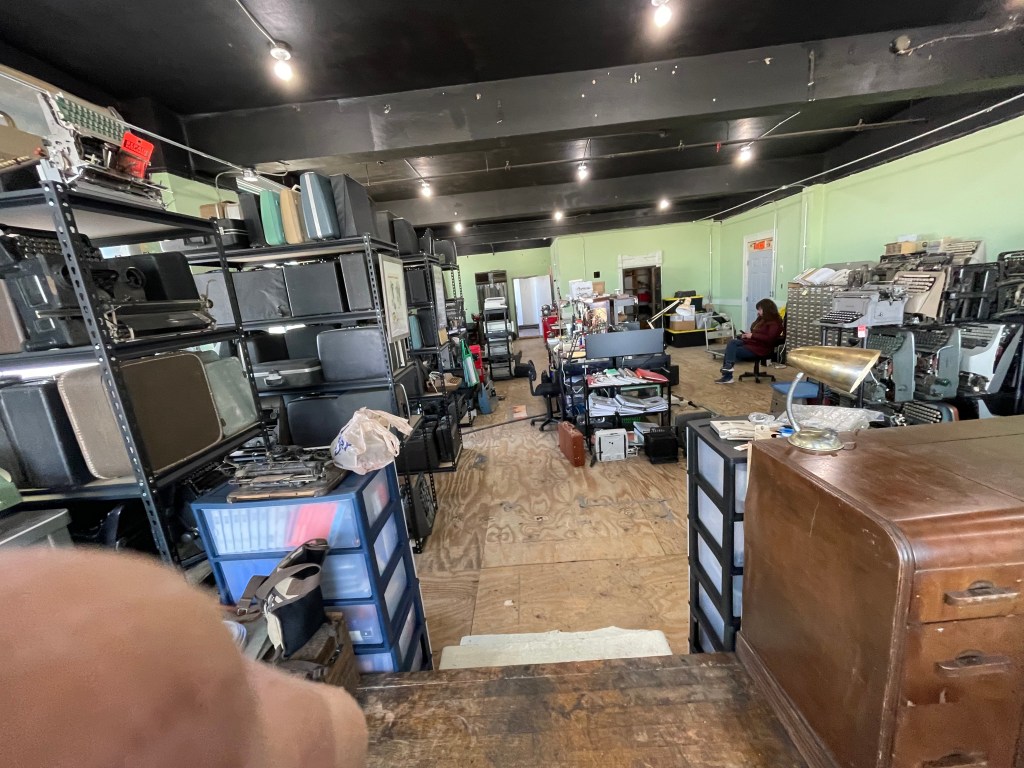
In a once abandoned sewing machine and bicycle factory on the corner of Linden and Davis Avenues, in an old, industrial section of east Dayton, Becca Brumfield carries cooler bags up two flights of stairs with two small children in her wake. At the end of a massive hallway on the top floor, they arrive at a door labeled “TB Writers Plus.” She taps a code into a keypad, an electronic lock opens, and the kids pop through the door ahead of her like prizes from a gumball machine.
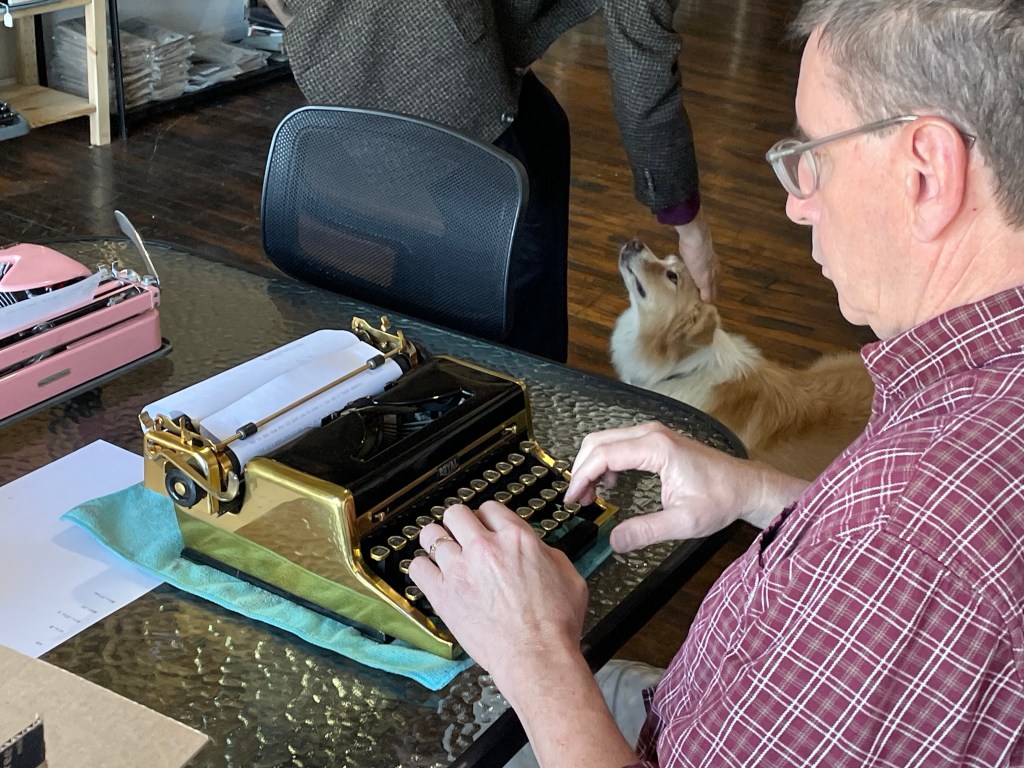
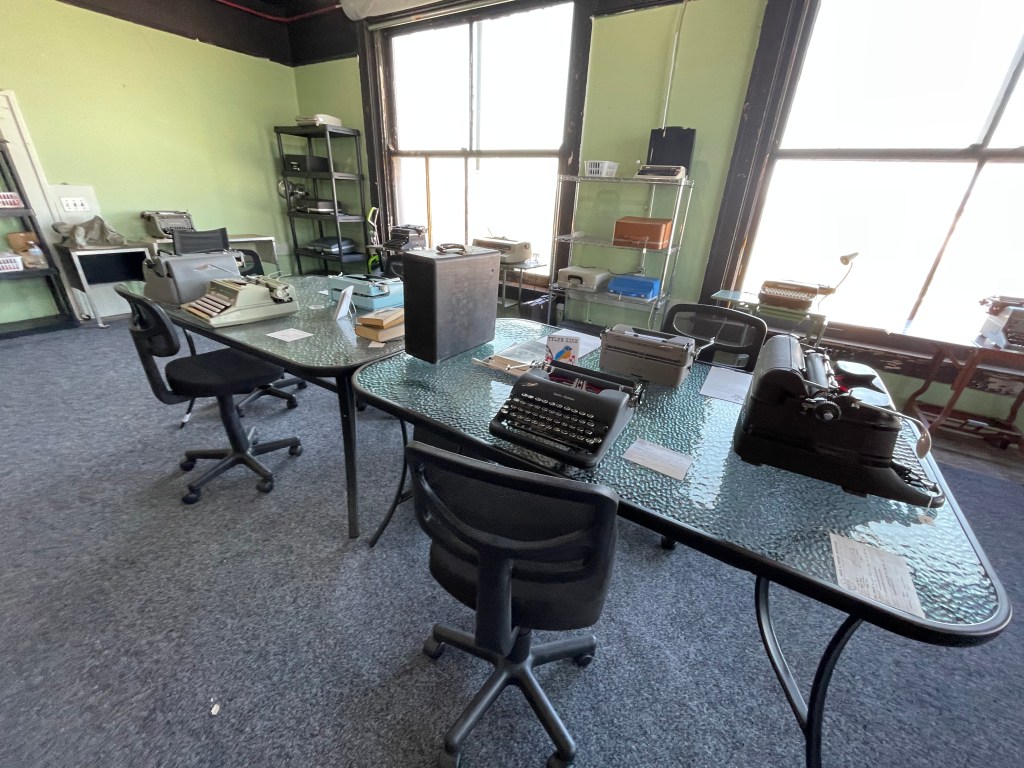
They pass workbenches and shelves loaded down with antique typewriters. On an elevated platform at one end of the room, a long glass table is flanked at one end by a floor-to-ceiling shelf of refurbished typewriters for sale.
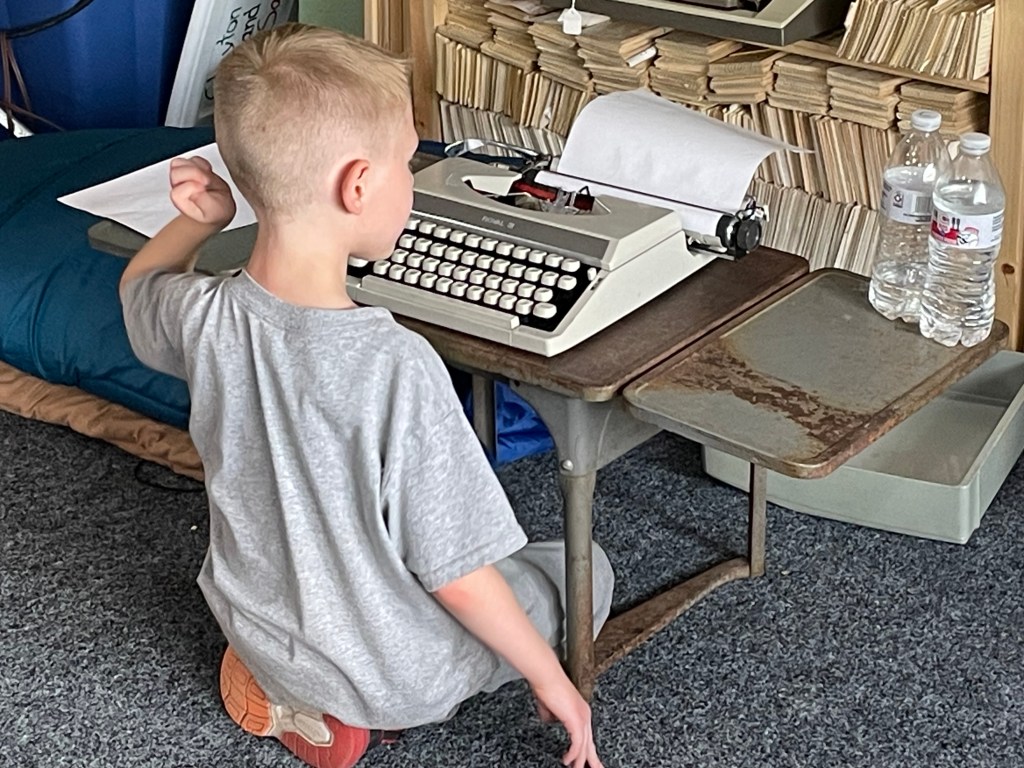
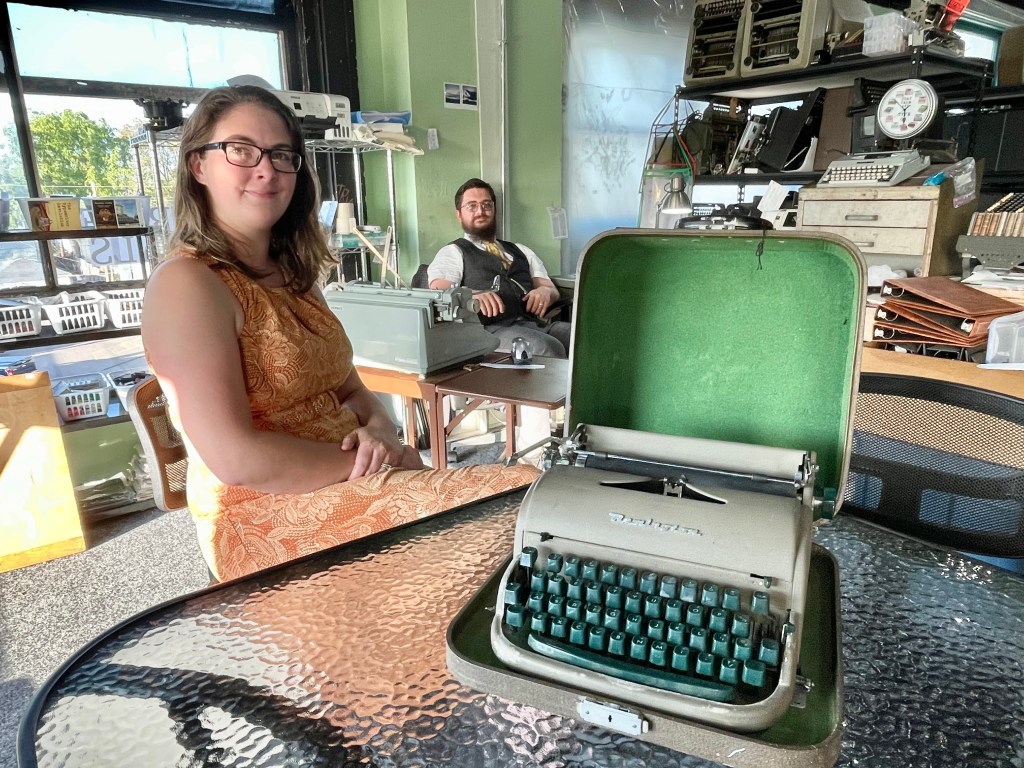
Becca lays out place settings and dishes up the food. Young Clayton, 6, and Sam, 5, who’d immediately started playing on typewriters and drawing, clamber to the table and plop down to eat. Her husband, Trevor, joins them. One of their employees sits down, too, and now it’s a typical evening at their typewriter shop.
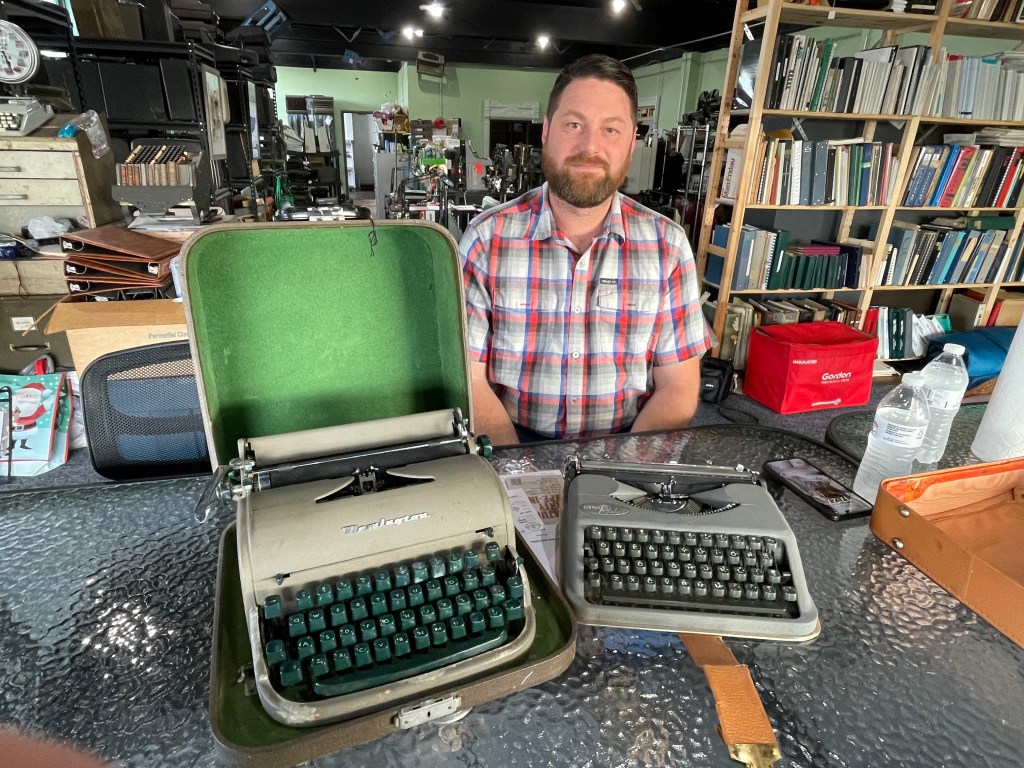
Becca and Trevor Brumfield at TB Writers Plus in Dayton, Ohio.
The Brumfield family started down this path more than a year ago when Trevor bought a typewriter online, repaired it, and started using it. Before long, he lost it to his wife and, as he puts it, “Naturally, had to buy another one.”
“That turned into several more, which became 60, which turned into 100, and that became, I gotta sell some of these,” Trevor laughed. A full-time auto mechanic, it might seem odd for someone just 26 years old to start down such an arcane career path.
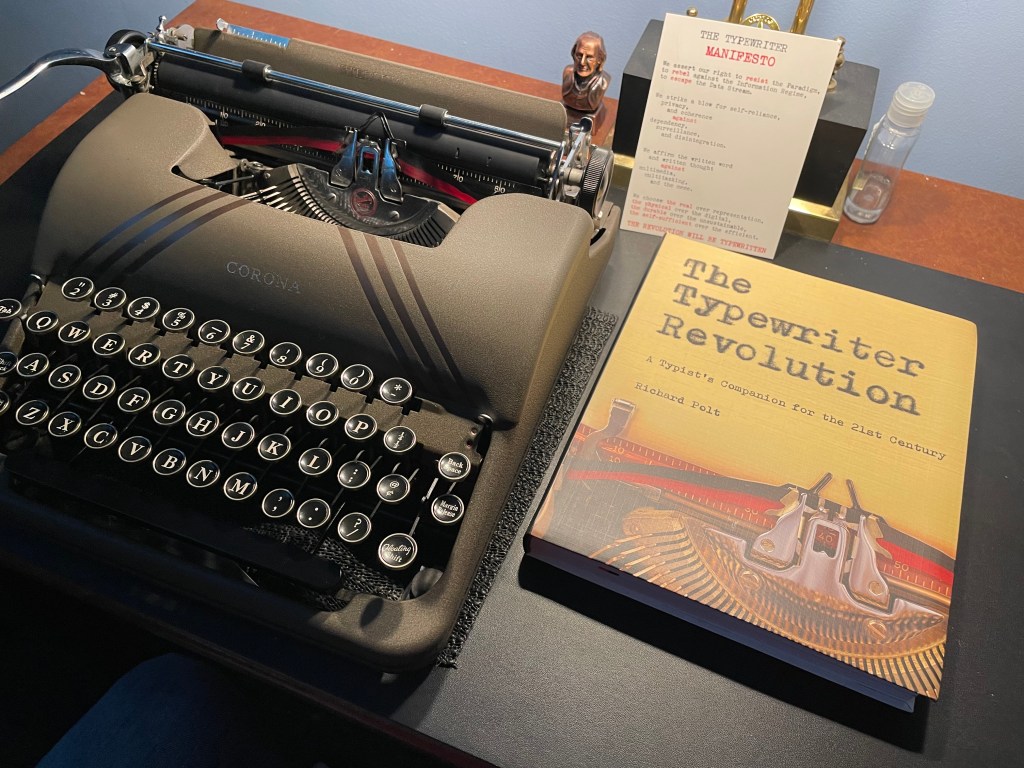
Over the last twenty years, typewriters have seen something of a renaissance. Fueled first by internet insecurities and one enthusiast’s declaration of a “Typewriter Insurgency,” writers, artists, business professionals, and college professors continue challenging the digital paradigm. “It’s not a booming industry,” Trevor admitted. “But the interest is there, and business goes in waves.” The industry got a secondary boost from the recent Taylor Swift video, “Fortnight,” which featured the megastar with an old Royal 10.
Taylor Swift’s Royal 10 in ‘Fortnight.’
Swift had them as props, but a few famous people are actual typewriter fans and users. Most notable is Tom Hanks, whose collection and passion for the machines are well known. The exposure has helped Trevor’s shop steadily grow. “I’m not sure exactly how many machines we have serviced in total,” he said, noting the expansion from his home garage last year. But we can typically get through 30-50 machines a month depending on what needs to be done to each.”
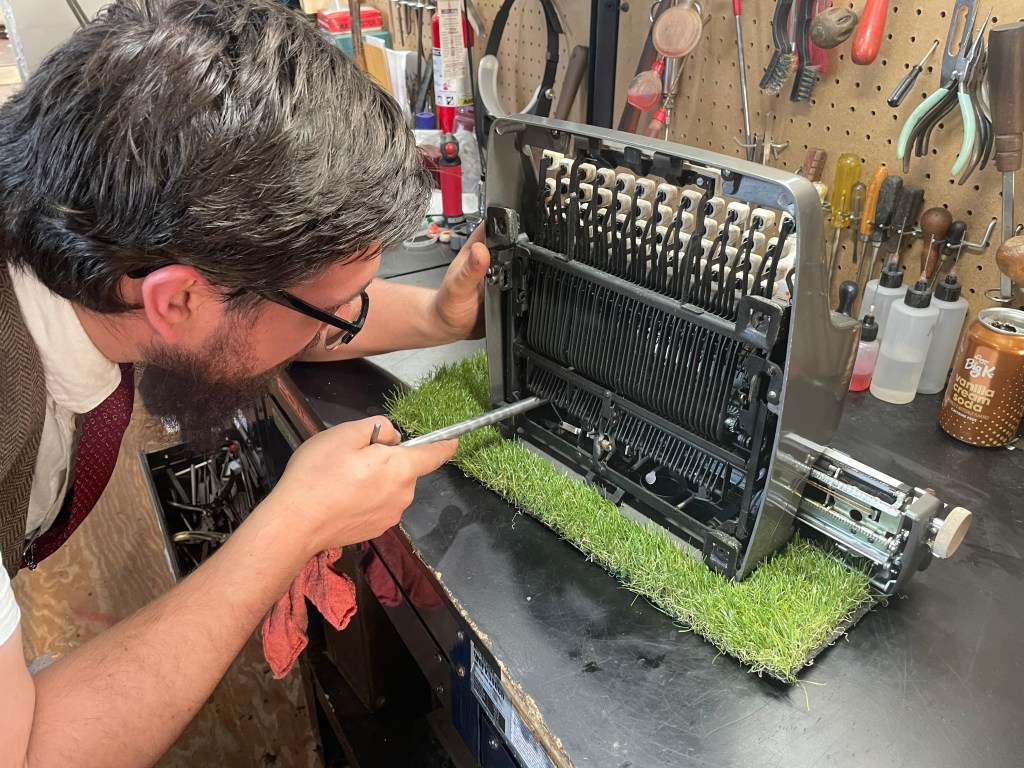
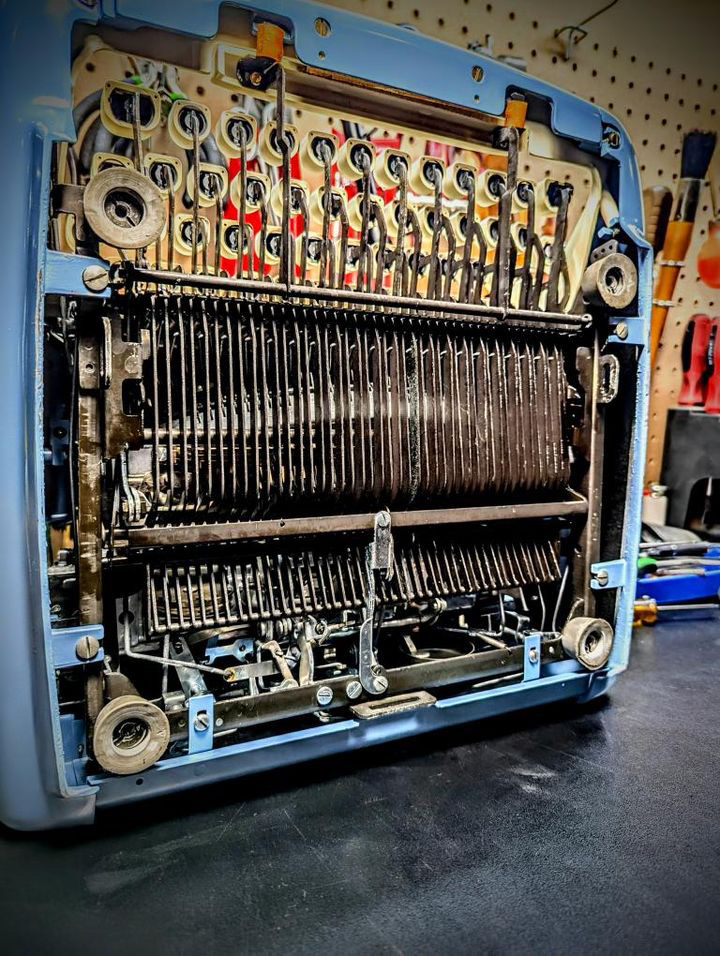
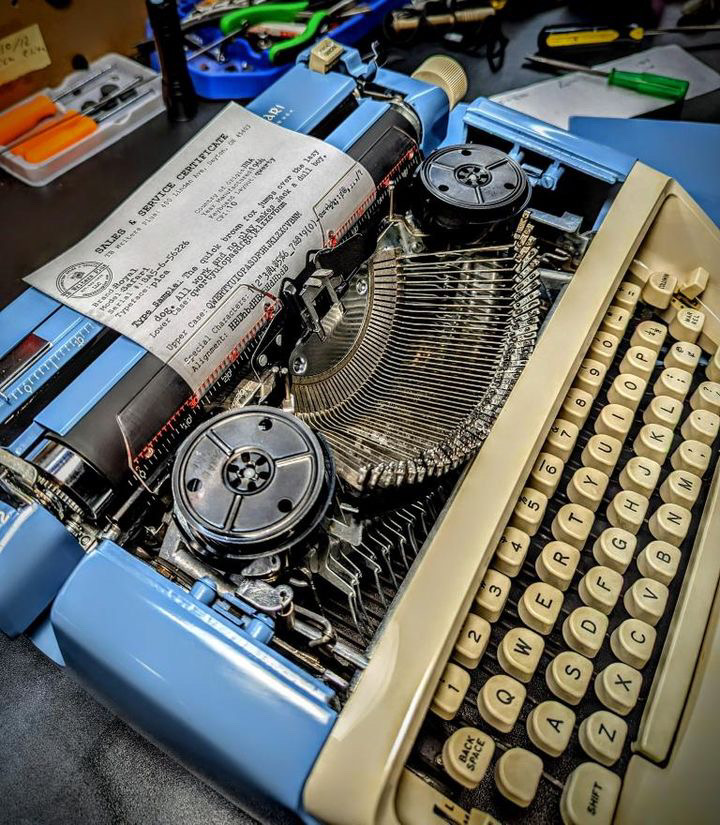
At last count, TB Writers Plus has inventoried more than 600 machines. Many are cannibalized for parts, and others are refurbished for sale. Trevor does the bulk of that work but has also trained Becca. An atmosphere of learning and openness permeates the shop. No organized training program exists, and factory training was discontinued years ago. Everyone who works here is an unofficial apprentice.
PART II – HE DOESN’T DO IT ALONE
Three part-time employees, Tyler, Keenan, and Torii, have been learning on the job, guided by Trevor’s experience. Each tackles the intricacies of these incredibly complex machines in their own way.
Tyler Lewis, of Fairborn, began as a technician in November 2023. “I mostly refurbish and repair, taking apart the machines, cleaning them, and putting them back together.” He learned about TB Writers Plus from an article in a local zine. A zine is, in his words, “An underground, independent magazine that people publish usually by using copy machines.”
Tyler should know since he’s the primary writer and publisher of his own zine, appropriately named “Tylerzine.” He was working at the Wright State University college newspaper and pitched his own article idea. “I met Trevor, immediately liked his openness, and ended up hanging out that first day for like six hours,” he said.
He sits at a typewriter loaded with purple ribbon and cranks out a short poem based on a prompt suggested by someone else in the room. Tyler’s passion and personal brand of artistic expression suit the typewriter world. “My entry point has always been the literary aspect of typewriters,” he said. “I am a devout believer in language, so what typewriters represent as a means of expression greatly appeals to me.”
Technician Keenan started as a hobby when Trevor was still working out of his garage back in 2023 but took some time off for school. The 28-year-old Kettering resident came back in May of this year. “I wanted to learn more about how typewriters work, and it was an enjoyable way to spend my time,” he said.
“I enjoy the simplicity of the process compared to modern technology that feels invasive at times,” Keenan explained. “It’s just a simple typewriter on the workbench that needs fixing. Nothing more, nothing less.”
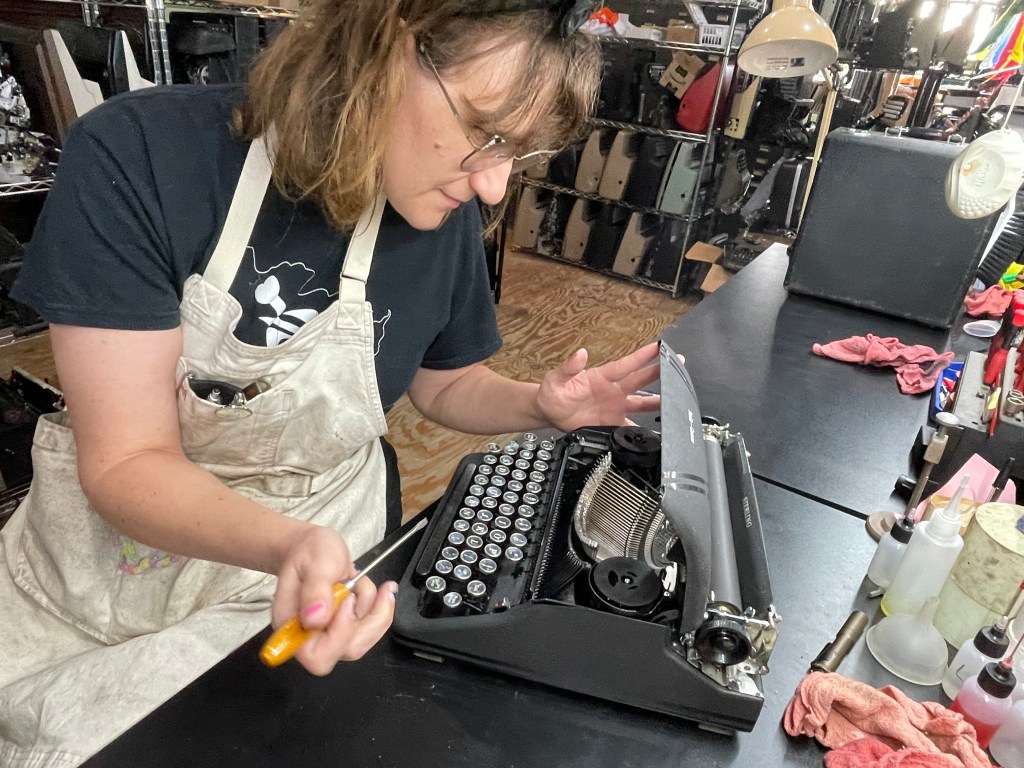
Tori’s B checks out a 1930s era Smith-Corona manual.
At the workbench, technician Torii B, from Bellbrook, hovers over an antique Smith-Corona. She scrutinizes the machine, evaluating any repairs needed before it’s put up for sale. Torii is a 36-year-old marketing and design professional and working mom. Although she has freelance design clients, she left a full-time marketing job last May. She’s applied for permanent positions in her field, but nothing’s been a good fit so far.
About a month ago, a friend told her about an anachronistic typewriter repair shop whose owner sought part-time help. As it happened, she and the friend have a role-playing game involving type-written note cards and the adventures of two fictional journalists. Her interest peaked, she reached out to TB Writers Plus, and before long, she signed on as a part-time tech and general worker.
Her diverse background fits this very mechanically oriented job. “I went to school for visual communications,” Torii said, pausing momentarily. “But, before that, I studied mechanical engineering.”
“I like the physical act of working on the machines,” she explained. “Watching the machines move keeps my mind like a well-oiled machine. Each one is like solving a puzzle.” She points to three small containers, each filled with tiny machine parts, springs, levers, and knobs. Her task is identifying and cataloging them for future repair work. It might seem tedious, but there are no more typewriter parts in production. Every part salvaged is vital to the shop’s operation.
PART III – THE TYPEWRITER COMMUNITY
A team can only function well with good leadership, and this one is no different. Trevor is doing his best to help his crew find their way. “Each works a little differently than their coworkers and has their own skill set,” he said. “Tyler is really good at detail-oriented work. Keenan’s strength is getting a lot of work done quickly. Torii is still finding her place in the shop,” Trevor continued.” She’s helped us with inventory ideas and graphic design and handles other odds and ends around the shop.”
Trevor Brumfield adjusts a 1955 Royal Quiet De Luxe.
Trevor’s interests and skills are well-suited, and he clearly enjoys this work. But what he likes most about the job is the people. “All of our customers treat my shop like a safe haven. I’m not sure why, but people drop their guard when they walk in here,” Trevor explained. “We’ve heard some crazy stories from people; war stories, childhood traumas, business plans, just about anything you can think of.”
“We have customers that will leave work in the middle of the day just to come here to vent because they are having a bad day. Next thing you know, they’ve been here for 3 hours, and their boss is calling.”
Brumfield’s modesty won’t allow for his own kindness and personability as reason enough for people to gravitate to him and his family. “I don’t know what it is about this place that makes people feel so at home, but I don’t think it is just me – or any one person here. But as soon as they walk in, they get this look like they just had a weight removed from their shoulders.”
Customer and typewriter enthusiast, Greg Parker, of Urbana, Ohio, with two of his growing collection.
TB Writers Plus customers are an eclectic mix of artists, collectors, and businesspeople from all over the country. Greg Parker, for example, is from Urbana and has purchased three typewriters from the shop. The 40-year-old, married Army veteran has been collecting typewriters for about ten years. He currently has seven, including two Royals, an Underwood, and an Olympia. He explained his interest in the machines is mainly about the experience.
“I grew up with typewriters and used them when I was young,” he said. “But I really like the aesthetics.” Parker’s not a writer or artist but a welder by trade. “I do some journaling, and I have some memoir stories I’d like to put down on paper someday,” he said. “But I feel like I was born too late, like in another time. I enjoy the mechanics of the machines. The sound and the feel are very different from a computer. When you type something on paper, it’s like you really created it yourself.”
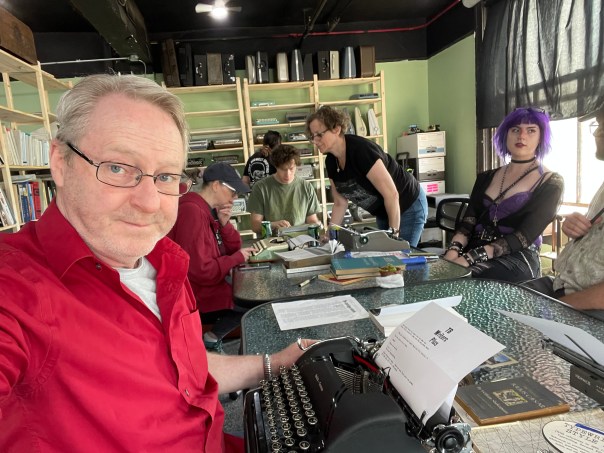
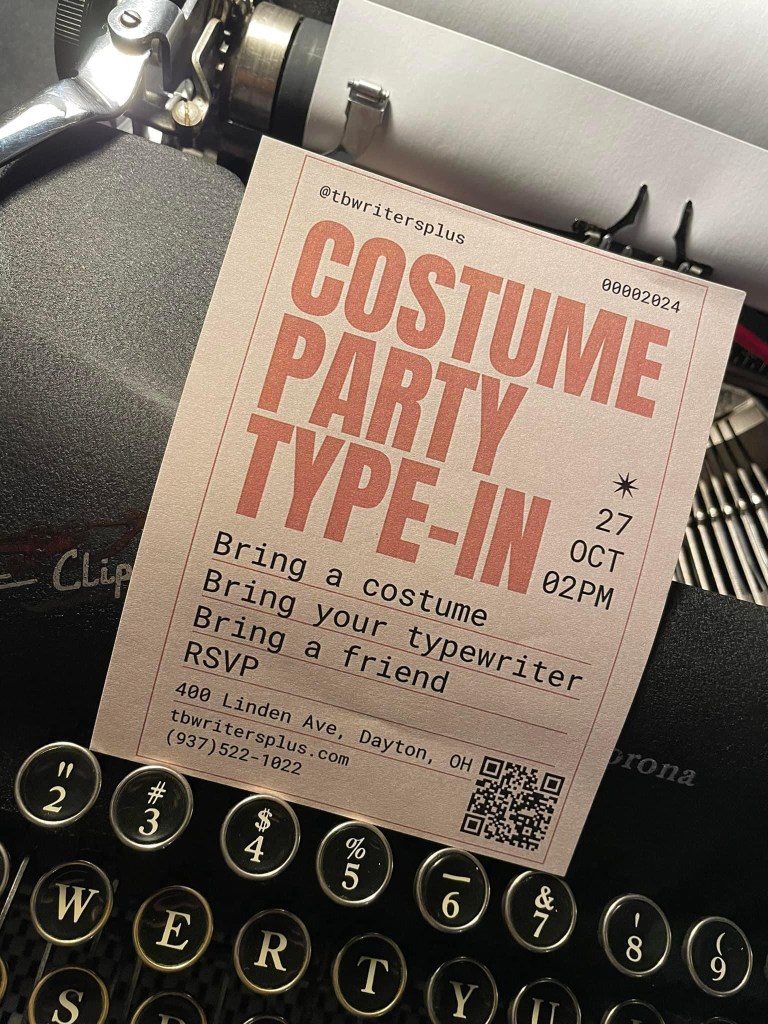
“Type-ins” attract enthusiasts from all over the country for a common purpose. TB Writers Plus has hosted several, including a costumed Halloween event and a 4th of July fireworks type-in.
Creativity and the personal connection with a simpler time is common throughout the typewriter community. For example, on Sunday, October 27th, TB Writers Plus is hosting a costumed “type-in” event, encouraging people to come dressed in the same era as the typewriters they bring. Type-ins are most easily explained as cruise-ins for typewriter enthusiasts. Scattered around the country, these predominantly social events, provide the opportunity for aficionados to talk typewriters, socialize, and even do some typing.
Back at the dinner table, the boys are no longer interested in their meals and require some encouragement. Trevor digs into his food as he and Becca talk about their day. Eventually, they would like TB Writers Plus to be independently sustainable as afull-time career. For now, they, their crew, and, of course, Clayton and Sam, are enjoying the work and the people who share in the simplicity and resurrection of a by-gone era. To learn more, visit www.tbwritersplus.com.
Author’s Note 1:While researching this article, I had the good fortune to meet many of the shop’s customers and supporters. The loyalty they seem to share is remarkable, not just for the typewriter community in general, but for Trevor and his staff in particular. I want to note, for the record, how honored I am that they welcomed me into the circle. It’s truly an amazing community.
Author’s Note 2:While typewriter shops are still operating throughout the U.S., their numbers are dwindling. Trevor Brumfield has been buying out the inventory, tools, and parts in an effort to stay ahead of those closings and keep up with demand.
Author’s Note 3:Update August 2025 – As of this date, TB Writers Plus has expanded its footprint in the Davis-Linden Building. The shop now includes a larger typing and show room, community space, equipment washing room, additional storage and much more. They’ve also seen a change in personnel in the past year.

















 The Jamestown Comet