Local News & Commentary Since 1890.

Archive for the ‘Uncategorized’ Category

Corruption fears the press

In history, National News, News Media, Opinion, Politics, Uncategorized on June 22, 2025 at 10:47 am

Deer In Headlines II

By Gery Deer

It’s one thing to feel your job is in danger—industries evolve, businesses close, and livelihoods shift. It’s another thing to fear that your work and profession could be criminalized. For those of us in the press, in my opinion, that moment has arrived.

Not long ago, journalists were considered the fourth estate, so-called because the press was seen as the fourth, unofficial, branch of government – the public’s eyes and ears, so to speak. A free press is a necessary check on power, the watchdogs of democracy. Today, Trump and company would rather call any of us who dare question them troublemakers, agitators—enemies of the people. And now, with the Supreme Court’s recent decision to uphold the White House’s ban on the Associated Press (AP), we stand on the edge of something far more dangerous than a bruised ego or a contentious press conference.

The justification? National security – as always. A vague, malleable excuse that’s nearly impossible to challenge or verify. Too convenient to ignore, too broad to oppose. It sets a precedent with sharp teeth. If AP can be barred, who’s next? The Washington PostReuters, or maybe any reporter who dares ask uncomfortable questions?

When a government moves to silence journalism, it isn’t just about limiting press access—it’s about controlling the public’s perception of facts. A free press must do more than inform; it should hold power accountable on behalf of the citizenry. That accountability is inconvenient, even infuriating, for those who prefer not to be held accountable for their actions.

We don’t have to delve deeply into history to see what happens when dissenting voices are silenced. Totalitarian regimes have long understood the value of controlling the narrative. In Nazi Germany, Joseph Goebbels, the minister of propaganda, ensured that only state-approved messaging reached the public. In Stalinist Russia, independent journalism became synonymous with treason. And now, in a supposed beacon of freedom, we find ourselves edging toward a similar state.

Perhaps some believe these measures are justified—that journalism has gone too far and biased reporting warrants a firm correction. Some might even argue that disinformation (a great deal of which originates with the White House) has muddied the waters so thoroughly that restricting the press helps protect the public from chaos. The question we must ask ourselves is not whether we like the press—it’s whether we need it. And if those in charge are willing to erase dissent under the guise of security, we may not have much time left to answer.

The implications go well beyond a single news outlet losing access or presidential attempts to discredit them. If a major institution like the Associated Press can be barred from the White House, and with Supreme Court approval, every journalist in America faces the same risk.

What happens when smaller, independent outlets push too hard? What happens when investigative reporters publicize facts surrounding corruption at the highest levels? This is how truth becomes dictated rather than discovered. This is how governments rewrite history while the present unfolds in silence.

The press has never been perfect—it has biases, it makes mistakes, and yes, sometimes it gets the story wrong. But journalism, at its core, is a profession based on the pursuit of facts. A reporter’s job is not to flatter or cater to power, but to question, to dig, to expose injustice and demand answers.

Our democracy was built on the idea that those in power answer to the people, not the other way around. That principle is maintained through open discourse, through transparency, through a press that is free to ask uncomfortable questions and uncover uncomfortable truths. Of course, that’s not how Trump sees it. He doesn’t answer to you or me – only to his donors.

Still, the president can boot them out of the West Wing, but he can’t stop them from reporting – yet. If we allow this moment to pass unchallenged, accepting that barring journalists is just another policy decision, we lose the foundation of informed democracy set in place under the First Amendment of the United States Constitution. Once the press is muzzled, once silence replaces scrutiny, and propaganda overshadows fact, there’s no telling what comes next.

Supplemental Information:

(Courtesy https://www.carnegielibrary.org/the-first-amendment-and-censorship/)

The First Amendment Defined

The First Amendment to the U.S. Constitution protects what are commonly known as The Five Freedoms: freedom of religion, freedom of the press, freedom of speech, freedom of assembly, and freedom of petition. The amendment is one of the first ten amendments to the Constitution, known as the Bill of Rights, which was adopted in 1791. 

The First Amendment Reads:

“Congress shall make no law respecting an establishment of religion, or prohibiting the free exercise thereof; or abridging the freedom of speech, or of the press; or the right of the people peaceably to assemble, and to petition the Government for a redress of grievances.” (Source: National Archives

This amendment gives Americans the right to express themselves verbally and through publication without government interference. It also prevents the government from establishing a “state” religion and from favoring one religion over others. And finally, it protects Americans’ rights to gather in groups for social, economic, political, or religious purposes; sign petitions; and even file a lawsuit against the government. (Source: History.com)

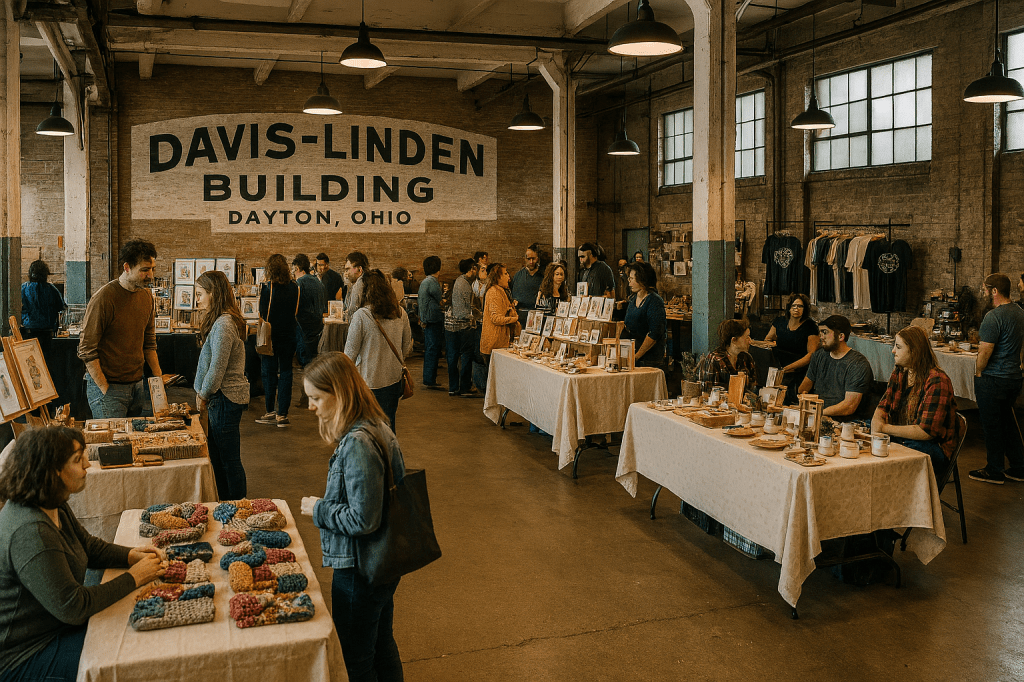
Decades of Imagination: The Creative Legacy of Dayton’s Historic Davis Linden Building

In Dayton Ohio News, Economy, Entertainment, Local News, Technology, Uncategorized on June 19, 2025 at 9:29 am

Dayton, Ohio – The Davis Linden Building, an historic landmark located at 400 Linden Avenue in Dayton, Ohio, has long been a beacon for creative professionals seeking customized commercial spaces. Owned by Matt Dieringer of Dieringer Development, the facility continues to thrive and expand, offering a nurturing environment for artists, businesses, sculptors, photographers, and other creative professionals.

Over the years, the facility has seen good times and bad. But Matt Dieringer’s vision for the Davis Linden Building has been, and will continue to be, one of growth and community. “We are committed to provide spaces that not only meet the unique needs of our tenants but also foster a sense of belonging and collaboration,” says Dieringer. This commitment is evident in the building’s diverse range of tenants, each contributing to a vibrant and supportive community.

One of the most notable tenants is Michael Bashaw, a musician and sculptor who has located his studio in the Davis Linden Building since the 1980s. Bashaw’s long-term presence is a testament to the building’s ability to provide a stable and inspiring environment for creative professionals. “My grandfather was a tenant in the building in the 1950s, so I was well aware of it,” says Bashaw. “I was originally looking for a space where I could work on my sculpture and do music rehearsals. I’m very grateful and very fortunate to be here.”

Click here for a video interview with Bashaw.

“I’m on year two and have already outgrown one space,” says tenant Tiffany Lewis, owner of Immortelle Bijouterie, an era-inspired jewelry and clothing shop. “I love the atmosphere here – the big windows, the open concept, and that there are other artists here.”

Becca Brumfield, the building’s office manager, shared her view as both a tenant and employee. She described The Davis Linden Building as a center of creativity, business, and community. Her husband, Trevor, operates one of Ohio’s last full-service typewriter repair and sales shops, TB Writers Plus, located in the building since 2023.

The dedication of the Davis Linden Building’s management to promote a sense of community among its tenants is one of its defining features. This collaborative spirit is what sets the facility apart from other commercial spaces. In that spirit, the management will soon unveil “The C2 Initiative,” based on the idea of Creativity and Commerce. The initiative is intended to expand on that sense of community with memberships, access to shared creative space, and much more.

As Dieringer Development continues to invest in the growth and development of the Davis Linden Building, the future looks bright for this creative hub. With its commitment to providing customized spaces and fostering a strong sense of community, the Davis Linden Building will undoubtedly remain a cornerstone of Dayton’s creative scene for years to come.

For more information about the Davis Linden Building and its available spaces, visit their website, www.davislindenbuilding.com/, or call 937-498-8635.

Radio Waves

In Dayton Ohio News, history, Opinion, Technology, Uncategorized on June 16, 2025 at 8:29 am

Deer In Headlines II

By Gery Deer

A long time ago, in a glowing box, far, far away, radio was the primary means by which most Americans received their news and entertainment. Frontline news from overseas wars, sketch comedy shows, and soap operas – all of it started on the radio. Growing up, I spent hours listening to the radio, everything from music and radio plays to late-night talk shows and Casey Kasem’s American Top 40 countdown.

Nearly all of these are gone now, but if you listen closely, you can still hear it—the crackle of an AM signal, the smooth transition of an FM dial, and the hair-raising tones of the emergency broadcast system. Well, OK, that one’s not so nostalgic. But is such a long-running, analog medium still relevant in a digital era of podcasts, streaming services, and algorithm-driven playlists?

Despite predictions of its demise, radio lives. According to Nielsen’s Q3 2023 Total Audience Report, radio remains the most popular media in America, reaching 84% of the population aged 18 and above. That’s right—more people tune in to traditional radio than watch television or scroll endlessly through social media.

Dayton, Ohio, radio personality Steve Kirk ruled the Miami Valley airwaves for decades. Is there a need for this kind of talent in the 21st Century?

Radio is still around because, for the most part, stations and owners have adapted, shifting to digital platforms, streaming services, and podcasts. For example, this column’s podcast counterpart is featured on iHeartRadio, which operates more than 850 stations nationwide.

Additionally, over-the-air broadcasting remains a popular option, particularly in cars. Every week, approximately 92% of Americans listen to the radio—roughly 272 million people—proving that radio remains the dominant medium for commuting.

Local radio ad revenue, however, isn’t what it once was. In 2025, sales are expected to reach only around $2.4 billion—a sharp contrast to the nearly $22 billion radio generated just 20 years ago. Radio stations have had to rethink their business models due to stiff competition from digital platforms. Some have survived and prospered by embracing digital, while others struggle to keep the lights on.

Cumulus and Townsquare Media recently shut down twenty radio stations. Many of these were AM stations that had lost their audience decades ago, unable to compete with the convenience of streaming. While this thinning of the herd might seem like bad news, some argue it’s a necessary evolution—fewer stations mean less competition for ad dollars, potentially stabilizing the industry.

That said, AM remains profitable, thanks in part to FCC deregulation by Presidents Reagan and Clinton, and conservative talk programming has become its cash cow. Unlike the early 1980s, when call-in talk shows were relatively new, less restrictive laws eventually allowed companies to own and operate nearly unlimited radio stations.

Suddenly, extreme political hosts like Rush Limbaugh, who held the daytime ad money, reached millions over a network of AM stations. More entertainment-focused programs, such as Sally Jessy Raphael’s call-in show, also thrived, ruling the airwaves at night.

Then there’s traditional radio’s subscription-based cousin – satellite. Since its inception, satellite radio has been marketed as the premium alternative—no static, initially with no commercials, and a seemingly infinite selection of niche stations.

Satellite radio carved out a loyal audience, particularly among drivers who want uninterrupted entertainment on long commutes. SiriusXM, the dominant player in the satellite radio market, boasts over 34 million subscribers. While that’s a fraction of traditional radio’s reach, it’s still significant, proving that people are willing to pay for curated content.

Satellite radio offers exclusive content—think Howard Stern and live sports. However, it faces stiff competition from podcasts, which offer similar content for free. Streaming services like Spotify and Apple Music offer listeners more control over their audio experience, making it harder for satellite radio to justify its subscription fees.

Even with these checkmarks in radio’s “cons” column, in my opinion, there are still plenty of pros, so long as the medium continues to evolve. “Because that’s how we’ve always done it” isn’t a phrase anyone working in radio wants to hear from management these days.

Whether it’s delivering local news, playing your favorite tunes, or keeping you company on a long drive, radio is still a faithful companion for whatever you’re doing. If you don’t believe me, turn on your car stereo. Chances are, you’ll find something worth listening to.

Suspect captured in Minnesota shootings

In National News, Politics, Uncategorized on June 16, 2025 at 8:09 am
By Sarah Naffa June 16, 2025
 In the news today: A suspect in the Minnesota lawmaker shootings is charged with two counts of murder; Donald Trump directs ICE to expand deportations in Democratic-run cities; and Israel claims it now has air superiority over Tehran. Also, the next head of the U.K.’s foreign intelligence agency is currently the agency’s head of technology and innovation — the real-world equivalent of the James Bond gadget-master Q. Vance Luther Boelter, the man accused of assassinating the top Democrat in the Minnesota House, as he was arrested late Sunday.Vance Luther Boelter, the man accused of assassinating the top Democrat in the Minnesota House, as he was arrested late Sunday. (Ramsey County Sheriff’s Office via AP)
U.S. NEWSMan suspected of shooting 2 Minnesota lawmakers is in custody
The man suspected of killing a Minnesota lawmaker and wounding another crawled to officers in surrender Sunday after they located him in the woods near his home, bringing an end to a massive, nearly two-day search. Read more.
What to know:Vance Boelter was arrested and charged with two counts of murder and two of attempted murder. He is accused of posing as a police officer and fatally shooting former Democratic House Speaker Melissa Hortman and her husband, Mark, in their home early Saturday in the northern Minneapolis suburbs. Authorities say he also shot Sen. John Hoffman, a Democrat, and his wife, Yvette.

Brooklyn Park police officers arrived early Saturday just in time to see Boelter shoot Mark Hortman through the open door of the home, the criminal complaint says. It says they exchanged gunfire with Boelter, who fled inside the home before escaping the scene.

A list of about 70 names was found in writings recovered from the fake police vehicle that was left at the crime scene, said two law enforcement officials who spoke to The Associated Press on condition of anonymity.
RELATED COVERAGE ➤Minnesota’s slain Democratic leader lived the political divisions in the US every day

Friends say Minnesota shooting suspect was deeply religious and conservative

WATCH: Officials announce suspect in shootings of Minnesota lawmakers is caught

Courtesy Associated Press – All rights reserved.

Open Mic Night

In Environment, Health, Local News, Opinion, Uncategorized on June 9, 2025 at 8:22 am

Deer In Headlines II

By Gery Deer

It takes a special kind of bravery to step onto a stage, armed with nothing but your talent and a willingness to bare your soul to strangers. Open mic nights embody this raw courage, where artists of all kinds—musicians, poets, comedians—challenge themselves not only to be heard but to connect. To say they are anything less than extraordinary would be missing the heart of the matter entirely.

As I write this, I’m sitting with my brother and cousin after just stepping off the stage at Plain Folk Café in Pleasant Plain, Ohio. My family group, The Brothers & Co., which now consists of my older brother and our cousin, has been performing together for over 30 years. We’ve played at casinos, festivals, theaters, just about everywhere – as professional entertainment.  But I’d never experienced an open mic event until my cousin invited us to go as a group. He was a regular here, receiving a very “Cheers” like welcome from fellow performers when we arrived.

Every Thursday night since 2012, performers and patrons alike enjoy good food and entertainment, and the stage isn’t just a platform; it’s a crucible where artistry takes shape. The sign-in sheet, held aloft by a sombrero-wearing ceramic frog, sets the tone: quirky, welcoming, and uniquely communal. Each participant scribbles their name with a mix of anticipation and trepidation, knowing they’re stepping into an unfiltered arena. Some are regulars, others are first-timers, all are committed.

The pull of an open mic is multifaceted. For some, it’s a chance to test new material, an incubator for ideas that might someday grow into greatness. Writers spend hours pouring their souls into words; musicians craft melodies that echo with personal truths. They arrive not knowing whether their work will elicit applause, laughter, or silence—but they come anyway, driven by the need to express and improve.

Then there’s the process itself—learning not just to perfect the art, but to perform it before a living, breathing audience. Open mic performers are incredibly brave, hoping their work connects with even one person in the crowd. That’s where the beauty lies: that vulnerability becomes their strength. It’s almost a superpower, one which, for all my professional experience, can’t comprehend.

Gary Deer Jr and Gery Deer, two of the trio, The Brothers & Co., watch other performers on stage at Plain Folk Cafe.

The first time I was on stage, I was in first grade, doing a ventriloquist act in my elementary school talent show. I had studied the art for a year or so, and my mom thought I might like to show people. I agreed, and the next thing I knew, I was smack in the spotlight of the ultimate open mic set — me, a ventriloquist dummy, 250 schoolmates, teachers, and parents.

One joke, a laugh; another, some applause, and, at the end, I won first prize for my grade. That moment led to a lifetime of performing in front of audiences, from lecturing and emcee work to appearances at hometown festivals and on national TV. Yet, with all that, I can’t fathom getting up there alone, week after week, in front of a cafe full of patrons and performers. It requires a very different kind of courage.

Open mic nights strip away the barriers between artist and audience. Whether it’s a musician pouring their soul into an original ballad or a comic braving the silence between punchlines, the essence of their art is laid bare. Every strum of a guitar or carefully penned word reveals hours of effort, doubt, and hope. It’s humanity, distilled.

Most importantly, these evenings foster connection. In the glow of the stage lights, an unspoken camaraderie develops among performers and listeners alike. The applause isn’t just polite acknowledgment; it’s a collective celebration of effort and heart. That shared experience is what makes open mic nights so much more than casual entertainment—they’re gatherings where creativity finds its voice and its audience.

If you’ve never been to an open mic event, I urge you to go, not as a critic, but as a witness to the raw courage and artistry on display. You may not love every performance, but you will leave with a renewed appreciation for the grit it takes to share oneself so openly, and for all the creative souls who fearlessly challenge themselves week after week.

********

To learn more about The Brothers & Co. Entertainers or Plain Folk Cafe, visit them on Facebook at:

https://www.facebook.com/TheBrothersandCo

https://www.facebook.com/plainfolklive

Loretta Swit, Emmy-winner who played Houlihan on pioneering TV series ‘M.A.S.H.,’ has died at 87

In Entertainment, National News, Uncategorized on May 30, 2025 at 4:08 pm

From the Associated Press

BY  MARK KENNEDYUpdated 3:41 PM EDT, May 30, 2025

NEW YORK (AP) — Loretta Swit, who won two Emmy Awards playing Major Margaret Houlihan, the demanding head nurse of a behind-the-lines surgical unit during the Korean War on the pioneering hit TV series “M.A.S.H.,” has died. She was 87.

Publicist Harlan Boll says Swit died Friday at her home in New York City, likely from natural causes. 

Swit and Alan Alda were the longest-serving cast members on “M.A.S.H.,” which was based on Robert Altman’s 1970 film, which was itself based on a novel by Richard Hooker, the pseudonym of H. Richard Hornberger.

The CBS show aired for 11 years from 1972 to 1983, revolving around life at the 4077th Mobile Army Surgical Hospital, which gave the show its name. The two-and-a-half-hour finale on Feb. 28, 1983, lured over 100 million viewers, the most-watched episode of any scripted series ever.

Rolling Stone magazine put “M.A.S.H.” at No. 25 of the best TV shows of all time, while Time Out put it at No. 34. It won the Impact Award at the 2009 TV Land annual awards. It won a Peabody Award in 1975 “for the depth of its humor and the manner in which comedy is used to lift the spirit and, as well, to offer a profound statement on the nature of war.”

Swit transforms the character of Houlihan

In Altman’s 1970 film, Houlihan was a one-dimensional character — a sex-crazed bimbo who earned the nickname “Hot Lips.” Her intimate moments were broadcast to the entire camp after somebody planted a microphone under her bed.

The early years of MASH saw Swit’s character much as the film predecessor had been. That would change as she was allowed to evolve and gain more substance.

Sally Kellerman played Houlihan in the movie version and Swit took it over for TV, eventually deepening and creating her into a much fuller character. The sexual appetite was played down and she wasn’t even called “Hot Lips” in the later years.

The growing awareness of feminism in the ’70s spurred Houlihan’s transformation from caricature to real person, but a lot of the change was due to Swit’s influence on the scriptwriters. 

“Around the second or third year I decided to try to play her as a real person, in an intelligent fashion, even if it meant hurting the jokes,” Swit told Suzy Kalter, author of “The Complete Book of ‘M.A.S.H.’”

“To oversimplify it, I took each traumatic change that happened in her life and kept it. I didn’t go into the next episode as if it were a different character in a different play. She was a character in constant flux; she never stopped developing.”

“M.A.S.H.” wasn’t an instant hit. It finished its first season in 46th place, out of 75 network TV series, but it nabbed nine Emmy nominations. It was rewarded with a better time slot for its sophomore season, paired on Saturday nights with “All in the Family,” then TV’s highest-rated show. At the 1974 Emmys, it was crowned best comedy, with Alda winning as best comedy actor.

The series also survived despite cast churn. In addition to Swit and Alda, the first season featured Wayne Rogers, McLean Stevenson, Larry Linville and Gary Burghoff. Harry Morgan, Mike Farrell and David Ogden Stiers would later be added, while Jamie Farr and William Christopher had expanded roles.

Swit appeared in all but 11 episodes of the series, nearly four times longer than the Korean War itself, exploring issues like PTSD, sexism and racism. Swit pushed for a better representation for women.

“One of the things I liked, with Loretta’s prodding, was every time I had a chance to write for her character, we’d get away from the Hot Lips angle and find out more about who Margaret was. She became more of a real person,” Alda told The Hollywood Reporter in 2018.

The series ended on a happy note for Houlihan, who spends much of the finale debating whether she wants to head to Tokyo or Belgium for her next overseas post. Ultimately she opts to return to America and work at a hospital, citing her father — a career Army man. 

Swit didn’t personally agree that was the correct decision for a military-minded official: “I didn’t think that was correct for my Margaret,” she told Yahoo Entertainment in 2023. “I think her next move was Vietnam. So I didn’t agree with that, but that’s what they wanted her to do.”

But the actor did get to write the speech that Houlihan delivers to her fellow nurses on their final night together, in which she says: “It’s been an honor and privilege to have worked with you. And I’m very, very proud to have known you.”

null

“I was consumed with writing that. And I still get letters from women all over the world who became nurses because of Margaret Houlihan. To have contributed to someone’s life like that is remarkable,” she told Yahoo Entertainment.

During her run, Houlihan had an affair with Hawkeye’s foil, the bumbling Frank Burns, played by Linville in the TV version, and in Season 5, Houlihan returns from a stay in Tokyo engaged to a handsome lieutenant colonel, a storyline that Swit says she advocated for with the writers.

“I told them: ‘Can you imagine what fun you’re going to have with Larry when I come back to town and I tell him I’m engaged? He’ll rip the doors off of the mess tent!’ And that’s exactly what they had him do. So we were all of the same mind.”

Toward the end, Swit was tempted to leave the show. She played the role of Chris Cagney in a 1981 television movie, “Cagney & Lacey,” and was offered the part when it was picked up as a mid-season series for the spring of 1982. But producers insisted she stay with “M.A.S.H.” for its last two seasons.

Swit told The Florida Times-Union in 2010 she might have stayed with “M.A.S.H.” anyway. “You can’t help but get better as an actor working with scripts like that,” she said. “If you’re in something that literate, well, we got spoiled.”

In 2022, James Poniewozik, The New York Times’s chief television critic, looked back on the show and said it held up well: “Its blend of madcap comedy and pitch-dark drama — the laughs amplifying the serious stakes, and vice versa — is recognizable in today’s dramedies, from ‘Better Things’ to ‘Barry,’ that work in the DMZ between laughter and sadness.”

After the TV series, Swit became a vocal animal welfare activist, selling SwitHeart perfume and her memoir through her official website, with proceeds benefiting various animal-related nonprofit groups.

In 1983, she married actor Dennis Holahan, whom she’d met when he was a guest star on “M.A.S.H.” They divorced in 1995.

Swit was born in New Jersey

Born in Passaic, New Jersey, the daughter of Polish immigrants, Swit enrolled in the American Academy of Dramatic Arts, then paid her dues for years in touring productions.

In 1969, she arrived in Hollywood and was soon seen in series such as “Gunsmoke,” “Hawaii Five-O,” “Mission Impossible” and “Bonanza.” Then in 1972, she got her big break when she was asked to audition for the role of “Hot Lips.”

She would regularly return to theater, starring on Broadway in 1975 in “Same Time, Next Year” and “The Mystery of Edwin Drood” in 1986. She was in “Amorous Crossing,” a romantic comedy, at Alhambra Theatre & Dining in 2010 and in North Carolina Theatre’s production of “Mame” in 2003.

MARK KENNEDY

MARK KENNEDY

Kennedy is a theater, TV, music, food and obit writer and editor for The Associated Press, as well as a critic for theater, movies and music. He is based in New York City.

The top 9 grilling mistakes and how to fix them

In Children and Family, Food, Health, Holiday, Uncategorized on May 23, 2025 at 7:42 am

Courtesy Associated Press

By  ELIZABETH KARMEL

A man grills hamburgers and hot dogs in Arlington, Va., July 4, 2012. (AP Photo/Alex Brandon, File)

1 of 4 |  

A man grills hamburgers and hot dogs in Arlington, Va., July 4, 2012. (AP Photo/Alex Brandon, File)

Hamburgers are tended to on a grill in Washington, Aug. 4, 2011. (AP Photo/Carolyn Kaster, File)

2 of 4 |  

Hamburgers are tended to on a grill in Washington, Aug. 4, 2011. (AP Photo/Carolyn Kaster, File)

Hot dogs cook on a grill in New York's Times Square, June 10, 2008. (AP Photo/Mark Lennihan, File)

3 of 4 |  

Hot dogs cook on a grill in New York’s Times Square, June 10, 2008. (AP Photo/Mark Lennihan, File)

Steaks cook on a grill in New York, Nov. 27, 2018. (AP Photo/Mary Altaffer, File)

4 of 4 |  

Steaks cook on a grill in New York, Nov. 27, 2018. (AP Photo/Mary Altaffer, File)

Updated 9:54 AM EDT, May 20, 2025

I love to grill, and barbecue, and I have devoted my career to outdoor cooking for more than two decades. In that time, I’ve seen a lot of mistakes, and people tend to make them over and over. So I put together a list of the biggest grilling don’ts and how to avoid them. Print this list and refer to it the next time you get ready to grill!

Never oil the grill

Many people oil the cooking grates — big blunder! Follow my mantra: “Oil the food, not the grates!” If you brush oil on hot cooking grates (and a lit grill), you run the risk of a big flare-up. The oil that you have brushed on will instantly burn, leaving a sticky residue that will “glue” your food to the grates, making it stick, break apart and dry out_like dehydrating food. If you oil the food, it will stay juicy and promote caramelization_those great grill marks! And help to prevent “stickage.”

Don’t put food on a cold grill

Always preheat a gas grill with all burners on high, or wait until charcoal briquettes are covered with a white-gray ash. Preheating also burns off residue and makes it easier to clean the grill. Contrary to popular belief, you don’t ever need to cook on a grill that is hotter than 550 F. The hotter the grill, the more likely you will burn the outside of the food before the inside is cooked.

Clean that dirty grill

An outdoor grill is like a cast-iron skillet. It gets better and better the more you use it, but you do need to clean it every time you use it. Clean the grill grates twice every cookout with a stiff, metal-bristle grill cleaning brush — before and after you cook. If you do this, it will never be a big job to clean your grill. If you don’t have a grill cleaning brush, crumble a ball of heavy-duty aluminum foil and hold it in a pair of 12-inch locking chef tongs to use to clean the grill.

Know the difference between direct and indirect heat

The most frequent mistake is to choose the wrong cooking method. To be a good griller, you must know the difference between direct, indirect or combo grilling and when to use them. Direct grilling means that the food is set directly over the heat source — similar to broiling in your oven. Indirect grilling means the heat is on either side of the food and the burners are turned off under the food — similar to roasting and baking in your oven. Combo grilling means that you sear the food over direct heat (i.e., to sear a tenderloin, or large steak) before moving it to indirect heat to finish the cooking process. Remember this general rule of thumb: If the food takes less than 20 minutes to cook, use the DIRECT METHOD. If the food takes more than 20 minutes to cook, use the INDIRECT METHOD.

The right way to deal with flare-ups

Never use a water bottle to extinguish a flare-up. Spraying water on a hot fire can produce steam vapors which may cause severe burns. The water can also crack the porcelain-enamel finish, resulting in damage to your grill. Fire loves oxygen, so cook with the lid down and don’t peek. Repeatedly lifting the lid to “peek” and check the food while it’s cooking lengthens cooking time. If you have a full-on fire, turn all the burners off, remove the food and extinguish the flames with kosher salt or baking soda. In a worst-case scenario, use a fire extinguisher, but know that it will ruin your grill.

Avoid frequent flipping

If you are cooking food by the direct method (hamburgers, hot dogs, boneless chicken breasts, small steaks, vegetables, etc.), flip only once halfway through the cooking time. All protein will stick to the grates as soon as it makes contact with the hot grill grates. As it cooks, it will naturally release itself, and that is when you can turn it over with a pair of tongs. Just remember to oil the food, not the grates!

Dodge cross-contamination

One of the most common mistakes backyard cooks make is using the same tongs for raw and cooked foods. This creates cross-contamination and can result in food-borne illness. It’s easy to fix this problem. I have been color-coding my 12-inch locking chef tongs with red and green duct tape for as long as I have been grilling. The different colors help me to remember which pair of tongs I used for raw food (red), like chicken, and which are safe to use for the cooked food (green). And remember to use a separate clean platter for your cooked food, too.

Don’t sauce too soon

If I had a dime for every time I saw someone pour thick sweet barbecue sauce on bone-in-chicken pieces or a whole rack of ribs while they were raw, I would be a very wealthy griller! All barbecue sauces have a lot of sugar in them and sugar burns quickly, almost always burning the outside of the food before the inside cooks. Generally I only brush food with sauce during the final 10-15 minutes of cooking time. With ribs that cook 2-3 hours, I will brush with a diluted sauce (1/2 beer and 1/2 sauce) for the final 30 minutes of cooking time.

Resist testing for doneness by cutting

Cutting your food to test for doneness is another common way people bungle their food. When you cut any protein, you are letting the precious juices escape, and if the food is under-cooked, the area where it was cut will be over-cooked when you put it back on the grill. Use an instant-read meat thermometer to test for doneness, and always let your food rest for at least 5 minutes before cutting into it.

___

EDITOR’S NOTE: Elizabeth Karmel is grilling, barbecue and Southern foods expert, a media personality and the author of four cookbooks, including “ Steak and Cake .”

Exploring Radio Independence at Dayton Hamvention 2025

In Dayton Ohio News, Local News, National News, News Media, Technology, Uncategorized, World News on May 20, 2025 at 4:12 pm

By Gery Deer

Courtesy Xenia Daily Gazette

Editor’s Note:

An update from the Dayton Hamvention officials on May 28th reads as follows: The 2025 Hamvention set a new high attendance record with 36,814 attendees. The general chair, Brian Markland, said he felt fabulous about watching large crowds of amateur radio enthusiasts from all over the world enjoying exhibits, forums, and the flea market. 

XENIA — Before cell phones or the internet, there was amateur, or “ham,” radio.

Once a year, thousands of enthusiasts descend on the Greene County Fairground and Expo Center in Xenia for the largest amateur radio convention in the world – Dayton Hamvention. Although final numbers will not be tallied for some time, organizers estimate that this year’s turnout exceeded the 35,000 attendees of 2024.

During Dayton Hamvention, participants from as many as 30 countries had the opportunity to see and buy the latest technology, attend educational and informational forums, sit for radio license exams, and take part in youth activities. This year’s event also included groups of young radio enthusiasts, organizations from all over the country made up of young people interested in both the analog and digital nature of amateur radio.

Jim Gifford, call sign N8KET, is the chairman of the media committee for Dayton Hamvention. He shared this year’s theme – Radio Independence – noting that what makes this event so important and impactful to the amateur radio community is the people. One of his favorite moments of this year’s event happened on Friday. “We had 73 students of the Community STEAM Academy (Science Technology Engineering Art and Math) in Xenia here,” he said. “They were really excited to learn how amateur radio relates to science and even space communication.”

With some 800,000 licensed ham radio operators in the United States alone, there is a remarkable sense of community among radio operators, regardless of geography. “It’s so nice for all of us in the local area to be able to come to Hamvention, but then you have to stop and think, this is a big ham fest,” said Glenn Rodgers, WI80, assistant chairman of the event’s media committee. “This is the biggest ham gathering in the world, and we’re so fortunate to be able to come to something like this in this area and it’s an honor to work here.”

Amateur radio enthusiasts, vendors, and organizations from around the world converged at the Dayton Hamvention. Here’s a promotional booth for Tokyo Hamfair.

With such widespread interest, one might expect the world’s current geopolitical tension would hamper those relationships. According to Gifford, it does not. “We have a multitude of political views here,” he said. “But we’re ham operators, we take care of each other.”

“Because you meet people,” Gifford continued. “We talk to people all over the world. Just the other day, I spoke to somebody from Norway, and somebody from Italy, and it crosses barriers. It really does.”

Most amateur radio enthusiasts are known on the air, and to each other, only by their call sign, an alphanumeric identification given to each license holder by the Federal Communications Commission (FCC).

Jesse Walker, N8XC, is U.S. Navy Veteran, and business development manager with Aegis Protective Services in Eaton. He’s been involved in amateur radio since the age of 15. He explained that, although the call signs are assigned, they become part of your identity.

“Many of us only know each other by our call sign,” Walker explained, who is a member of the Preble Amateur Radio Association in Preble County. “Coming here, we get to meet face-to-face often for the first time.”

Both Rodgers and Gifford also noted that, apart from being a hobby for some, ham operators play an important role in the community during emergencies. “Amateur radio groups work as sky spotters during severe weather, they work with and support our area first responders, providing backup communications and volunteers during local emergencies,” Gifford said.

“Essentially, the Preble Amateur Radio Association is involved in public service,” said Jesse Walker. “We work with the Preble County emergency management agency. Our motto in amateur radio emergency service is, ‘when all else fails.’”

Other amateur radio convention organizers also attend to promote their own events. Huntsville Hamfest, held annually in Huntsville, Alabama, is one such organization. Mark Brown, N4BCD, is the chairperson for the Huntsville Hamfest Association. “Ours is the third largest Ham radio convention in the country, behind Dayton and Orlando, Florida,” Brown said. “We all cooperate and help support each other’s events.”

Mark Brown, N4BCD, and Kelley Johns, W4VPZ, (pictured) provided information about the Huntsville Hamfest in Alabama.

Brown suggested the consistent growth of these events and interest in amateur radio is due in part to younger people learning about its technical diversity. “I think to attract kids, we’ve got to show different aspects of the hobby, like the satellite communications, the youth on the air, and the parks on the air,” he said. “Get youth involved in it. That’s one thing these events do is bring all ages together.”

Planning for next year’s Dayton Hamvention is already underway. For more information visit hamvention.org.

Chamber event sheds light on food insecurity

In Local News, Uncategorized on May 16, 2025 at 8:29 am

By Gery Deer

Courtesy Xenia Daily Gazette / Greene County News

XENIA — The Greene County FISH Pantry hosted the Xenia Area Chamber of Commerce after-hours event Wednesday.

The monthly networking program offered participants an opportunity to learn more about the food pantry’s mission and meet Mike Reeves, the new executive Director and operations manager.

After-Hours visitors were given tours of the pantry facility and its newest addition, a food storage warehouse they call “the barn.”

Each month, the Xenia Area Chamber of Commerce presents the event at different member locations throughout the city. The after-hours event allows other chamber members, residents, and civic leaders to learn more about the host organization and their contributions to the region.

Xenia Area Chamber of Commerce President Donna Saraga opened the event by introducing Reeves and sharing why they chose to have the event at the pantry.

“We know many people have never been in the building or haven’t been for a long time, and we thought it was a great opportunity to learn more about the facility and meet Mike,” Saraga said.

Discussion topics included the continuing need for food security in Greene County through food and monetary contributions from residents and businesses. Members of the board of directors and the executive director provided guests with tours of the facility, including the newly constructed food storage warehouse, recently named in honor of the previous executive director of the pantry, Gail Matson.

Reeves provided some history about the pantry and the facility, then spoke of the people involved with the organization such as their clients and volunteers.

“It absolutely warms your heart to see these people, and the volunteers are what makes this place work,” Reeves said. “I really appreciate everyone coming to see the building and learn more about what we do, and thanks to Donna and the Xenia Chamber for having this here today.”

He also noted that the pantry serves more than 100 clients during each day’s distribution, up to 90 on those days reserved for veterans and active military service families. More information on the Greene County FISH Pantry is available online at http://www. gcfp.org.

The next Xenia Area Chamber of Commerce After Hours will be on June 11, hosted at Toward Independence in Xenia.

For more information about the chamber, visit its website at xacc.org, and for more information on the FISH pantry, visit its website at gcfp.org.

Library Fines

In Books, Children and Family, Education, Local News, Opinion, Politics, Uncategorized on May 2, 2025 at 10:24 am

Deer In Headlines II

By Gery Deer

(Editor’s note: This edition also appears in other publications under the title “Checked Out.”)

As a kid, the local branch of the public library was in the old opera house near the center of our small farm town. It was cramped and dimly lit, and the reference desk was under the boarded-up grand staircase, giving it a sort of cubby-hole feel. I spent a good bit of time there. After school, I’d do my homework and wait for my mom to get off work. In the decades before the Internet, our library was the window to the world. But now, that window may be closing.

Ohio public libraries are funded, in part, by the Public Library Fund (PLF), which provides 1.7% of the state’s General Revenue Fund (GRF) as of this writing. However, the Republican-sponsored Ohio House Bill 96, proposed in early April of this year, would cut library funding by more than $100 million across the state. Why?

Governments have historically manipulated populations by controlling education and the media. They ban books that don’t align with their values, use defunding threats to force public and school libraries to cultivate materials for their purposes, and limit access to information. That way, voters remain ignorant, subjugated, out of touch, and pliable.

And before anyone says, “you just hate republicans,” they’re not the only ones to try this. Ohio Governor Ted Strickland, a democrat, proposed the same budget cuts a dozen years ago, and the republicans cried foul. Remember, the liberal left still regularly tries to “rewrite” some books to remove language and ideas they find offensive. So, it has gone both ways. This time, however, the danger is more palpable.

Over the last decade, public libraries have become frequent targets for budget cuts, with some policymakers arguing that digital access negates their necessity. But here’s the truth: libraries remain vital to the well-being of communities, and continued funding by federal and state governments is not just important—it’s essential. Without it, we risk depriving countless individuals of educational opportunities, civic engagement, and economic mobility.

Public libraries provide free access to knowledge for everyone (so long as their contents are not censored), regardless of socioeconomic status. Whether it’s a student researching for school, a small business owner seeking resources, or a job seeker brushing up on interview skills, libraries level the playing field in ways no digital paywall ever could. Eliminate government funding, and these services vanish, disproportionately affecting low-income communities. Instead of fostering informed citizens, we create a deeper knowledge divide, where only those who can afford education can access it.

A democratic society thrives when its citizens are informed, and libraries serve as safe spaces where people can access unbiased, factual information. They offer literacy programs, historical archives, and meeting spaces for community discussions—all of which help create engaged and empowered citizens. Where do people go for credible information when libraries close because of defunding? Unfortunately, they turn to the Internet and social media – the global misinformation machines. That’s a terrifying thought.

Libraries don’t just provide books—many offer essential services that help individuals improve their financial stability. They provide free internet access for job searches, resume-building workshops, business mentorship programs, and resources to help entrepreneurs. Government officials profess at nauseum about supporting small businesses and the workforce. Then they gut library funding and undermine those initiatives directly. If libraries disappear, so do these essential services, making it much harder for people to improve their situations.

Defunding libraries erodes the foundation of an educated, informed, and economically mobile society, which is exactly what this administration hopes to achieve. Without them, misinformation flourishes, the digital divide widens, and people lose access to critical resources for success. Libraries are not relics of the past—they are the lifeblood of communities, supporting everything from literacy to local economies.

So, before cutting another dollar from public libraries, policymakers should ask themselves: Do they really want a future where only the privileged have access to knowledge? Without funding, that’s exactly where we’re headed.

Good people on both sides of the aisle must speak out against this kind of censorship and ignorance. In Ohio, you can contact your state representative or State Representative Matt Huffman, currently Speaker of the Ohio House of Representatives: email rep78@ohiohouse.gov or call 614-466-6344.