Local News & Commentary Since 1890.

Archive for the ‘psychology’ Category

Are you happy, or just think so?

In Education, Opinion, psychology, sociology on January 15, 2014 at 9:22 am

DIH LOGOThey say … and I admit I’m not totally certain who “they” are in this context. But they say, happiness is just a state of mind. In fact, the same, “they” also believe all reality is just in your head; that your own thoughts create the authenticity of the world around you. Yes, I know, that’s too much heavy thought for such a short column, but it offers an interesting concept.

If everything we know as reality is determined, not by the people and things around us, but, instead, from our own thoughts then how real is it, really? OK, that’s a bit much to take in, even for me. But suffice to say emotions are created and altered by thoughts. So, are you happy? Or, do you just think you are? In the end, if “they” are correct, it doesn’t even matter.

Most people can change how they feel simply by altering their thoughts or, at least, their perception of a situation. That is, unless you suffer from some type of chemical issue in the brain that causes your feelings to spin out of control no matter what you’re thinking. And we’re not going to get into any of that because I am simply not qualified to talk about the subject.

But for most, it is entirely possible to alter your state of emotion and change how you react to outside influences just by shifting your thoughts. For example, many people get upset when a child breaks or spills something. Unless someone is done physical harm, what is there to get upset about? Have you ever heard the saying, “don’t cry over spilt milk?” It’s a bit of good advice telling you not to whine about the accident, just clean it up and move on.

GDEER-BLUE_SHIRT_FROM_ABOVEIn my opinion, sometimes it’s really hard to get that one, nagging negative thought out of your head. So, I think that altering your way of thinking is more about prioritizing than anything else. In other words, pick your battles.

If you drop a dish or your child dumps Kool-Aid all over that new white rug, does it, in the grand scheme, really matter? Assuming, of course, there is no malicious intent involved. After all, regardless of the political incorrectness of the idea, kids really are just bad sometimes. Either way, getting angry and blowing your top at yourself or the child isn’t going to put the dish back together or “unspill” the drink.

Now what if your husband decided to fire up the new grill he got for Christmas inside the garage? No, I don’t know why someone would even … never mind, just go with me here. In this situation, there is a potential danger to your family so it’s worth getting a bit more upset, but you have to control your thoughts to keep from becoming hysterical.

It will serve you better and help you remain calm if you focus on preventing a potentially devastating situation than to immediately punish your idiot husband. Take the proper steps, ensure everyone’s safety and solve the problem. That’s what I mean by changing the way you think.

Needless to say, altering lifelong behavior, good or bad, doesn’t happen overnight and it’s certainly not easy. It takes practice and diligence. Whenever something happens that throws your day into an uproar, try not to get upset. Try hard to focus on a solution to whatever’s gone wrong and look forward to the positive outcome.

I’ve often argued that people make some of the most important decisions in life based solely on emotion rather than rational thought. Even the faithful are guided almost entirely by pure emotion. Making decisions actually becomes easier, and more productive when done from a logical perspective.

Gery L. Deer is an independent columnist and business writer based in Jamestown, Ohio. More at www.gerydeer.com.

What was the “crucible event” that changed your life?

In Opinion, psychology, Religion, sociology, Uncategorized on October 30, 2013 at 9:15 am

DEER IN HEADLINES

By Gery L. Deer

GDEERDIH3Some people believe one is destined to become whatever is predetermined by their god, with all of life’s events planned in advance by some divine manifest destiny. For others, that destiny is in a constant state of change, altered by the ebb and flow of cause and effect, guided not by the hand of a supreme being but by our own choices.

Generally, however, there are some events in life that we can pinpoint as our time of transformation; a crucible, if you will. Within it, parts of us are burned away leaving a changed, newly-formed person, sometimes for the better, sometimes not.

Divorce, extended health problems, the loss of a home, personal income or a job, can all bring about emotions and primal reactions for which we are rarely well prepared. Perhaps the most powerful events that permanently change us are related to the death of someone close such as a family member, mentor or good friend.

For many the death of a loved one can be a crucible, forcing to the surface thoughts and emotions perhaps long buried, or never before experienced. How we deal with death is at least as important as how we deal with life, but we seldom take that concept to heart.

Even as a topic of conversation, death is to be avoided. Its unmistakable finality has so marked humanity that coping with the end of life has served as a catalyst for the formation of enduring religious beliefs, some of which comfort, others frighten.

What may be surprising is that a ‘crucible event’ does not necessarily have to be a negative or unhappy experience. The same kinds of life-changing occurrence can come from positive influences as well such as the birth of a child, a marriage or sudden financial windfall.

The events themselves, however, aren’t what change us; we do that on our own. Most people don’t realize they have the power, for the most part, to alter how they react to outside influence. Feelings are generated by thoughts, so if we control our thoughts, we can better manage our feelings and make more productive decisions during difficult times. That’s a tall order though when it feels like the world is collapsing around you.

I’ve had many challenges in life, from an early age, but the most influential times were during my mother’s long struggle with Alzheimer’s disease. The role reversal (the child becomes the parent), watching helplessly as the illness ravaged her mind and body, and helping to do everything from administer medication to hand-feeding her took a toll on me emotionally that I probably have yet to fully realize. But it did change me; in ways I can’t even imagine yet.

I look at the world a little differently now, having experienced for myself, largely for the first time, the fragility of life. But it was the experience of caring for my mom over the course of a couple of years that slowly burned away layers of my rigid exterior, making me “feel” more than I had previously been accustomed.

It’s really what we do with those feelings that make the difference in the long run. While an experience like I had with my mother could have left me bitter and resentful, I ended up taking to heart a more positive side and a greater appreciation for my family as a whole. Others aren’t so lucky.

Many people emerge from crucible events in a much darker place, filled with resentment or guilt or other emotions that eat away at their core, keeping them from seeing the good that came out of whatever had happened. And, there is always some good – sometimes it’s just very hard to see. Either way, we are changed, different, but it’s up to each of us to decide how those events ultimately affect our lives.


Watch independent columnist Gery L. Deer monthly on WDTN-TV2’s Living Dayton. More at http://www.gerydeer.com.

Over-medicated and under-educated

In Children and Family, Education, Health, Media, National News, Opinion, psychology, Science, Senior Lifestyle, Technology, Uncategorized on September 18, 2013 at 9:18 am

DIH LOGOA recent report by the Centers for Disease Control and Prevention (C.D.C.) noted that at as many as two-million Americans become ill from antibiotic-resistant infections annually, killing at least 23,000. The report notes that less than half of the antibiotics prescribed for patients are unnecessary or incorrectly used increasing the potential for more drug-resistant germs to evolve, exacerbating the problem.

Over time, the use of broad-spectrum antibiotics rather than ones targeting specific infections can cause various strains of bacteria to become immune and render conventional treatment ineffective. According to C.D.C. Director, Thomas Frieden, as the trend towards overuse of antibiotics continues, “The medicine cabinet may be empty for patients with life-threatening infections in the coming years.” Additionally, the overuse of antibiotics on farms as preventative medicine in healthy animals is also a contributing factor.

All of that said, these drugs are not prescribing themselves. Doctors know better than to continually prescribe broad-spectrum antibiotics unnecessarily or to treat viral infections, for which the drug is completely ineffective. But, many still do both, either at the insistence of the patient or as a preventative measure. Beyond the issue of nagging patients who want a prescription every time they have a sniffle is the point where the medical professional should say, “no.”

medsIn addition to antibiotics, it seems as though doctors are passing out a pill for everything and never seem to try to dig deep enough to address the real cause of various health problems.  For people with chronic illness it seems like that would be extremely frustrating. Apart from something like long-term, degenerative diseases like Parkinson’s or Multiple Sclerosis, there should be a way to find the cause to a problem and treat that, rather than just trying to drown the symptoms in medication.

More often than not, patients get, maybe, 10 minutes with their doctor after a two-hour office wait only to be handed a prescription and shuffled out the door. People spend far more time filling out forms and waiting to be seen than ever actually getting attention from a person who bills hundreds of dollars an hour for a few minutes work per patient.

An additional problem arises when the drug manufacturers spend far more time and money marketing to the patient than educating the physician about the proper use and potential hazards of a medication. However unethical it should be, doctors are given trial samples and kick-backs for going with one drug-over another. All the while, patients are inundated by drug ads on television, the Internet and in periodicals with no understanding of the treatment process.

Which actually contributes to another step in the downfall of health care is the all-knowing, internet-browsing patient himself. These home-spun experts come in with a fist-full of self-diagnosis printouts from Web MD and a stack of drug ads from Cosmo.  They demand medication for what they are certain is their particular ailment and there is no swaying their shade tree expertise. Except that’s exactly what the doctors should be doing – dissuading them and refusing to prescribe medicine without a thorough examination of the problem.

So what is to be done? Unfortunately, not much can be done. Unless healthcare providers are going to be more proactive and limit use of antibiotics except for targeted need, and other drugs are prescribed only after the cause of the symptoms is determined, it’s unlikely that anything will change soon.

It just seems as if everyone is sick all the time. Chronic illness like fibromyalgia (long-term, body wide tenderness and pain) seem to be affecting more and more people and early-onset dementia appears to be far more common than it once was. Could these diseases the result of long-term misuse of various drugs, including antibiotics?

The truth is, no one really knows for sure. Many of these drugs are relatively new and scientists are only now learning how the long-term use of previous medications is affecting second and third generations. From birth defects to chronic disease, overuse of drugs and under-education of patients definitely has the potential for some serious side effects.


Be considerate of those around you

In Food, Health, Opinion, psychology, Senior Lifestyle, sociology, Uncategorized on September 10, 2013 at 9:20 am

DIH LOGODid you ever see someone behaving a certain way at work or in the grocery store and it made you just want to walk up and say to them, “What is wrong with you?” I have; more times than I can remember. On the whole, people annoy me. Maybe it’s because as I get older, I have less patience for “stupid.” It could also be that people are becoming less thoughtful and far more self-centered than ever.

Here’s an example. One afternoon, I had stopped in at on of the big-box, discount megastores to get some orange juice and aspirin. As I stood patiently in the “20 Items or Less” lane, a middle-aged woman in a leopard-print blouse and hair curlers motored past me on one of those electric shopping cart scooters. She was steering the scooter with one hand and with the other she dragged another full sized cart behind her like a trailer.

STORELINEBoth carts were filled to capacity with loads of healthy foods like barrels of cheese balls, cases of beer and soda and, of course, spray cheese. Although there were other check-out lanes open for larger purchases, the woman obliviously whizzed by everyone in the line and parked her rig right in front of me. All of the adjacent lanes were equally full and what was going to be a 5 minute wait was now bordering on a half hour because either she couldn’t read or didn’t understand the meaning of the words, “express lane.”

For a few minutes, I just stood there; a bit stunned at the woman’s total ignorance that she’d completely jumped over at least four others in line ahead of her. I debated whether to say anything but kept quiet. After all, no matter how rude she had been, I would just end up being the mean guy who scolded an apparently disabled older woman on a scooter. It’s a no win. So, I bit my tongue, opened my aspirin bottle, downed two tablets with some of the juice, and waited.

We all have moments when we’re in a hurry, totally consumed by our own interests and feeling like whatever we’re doing should be just as urgent to those around us. But, short of a natural disaster, that’s almost never the case. In fact, most people have absolutely no concern for your interests because they, themselves, are too wrapped up in their own issues. That doesn’t excuse a complete lack of common courtesy, however.

Lately, I’ve noticed it more often in younger people, walking along, even in a store or down the street, with their noses buried in their cell phones, unconscious to the world around them. No one looks up anymore. No one smiles. No one says, “Hello.” People act as if they are traveling in a bubble, where it’s unnecessary or at least undesirable to interact with anyone else in the real world.

I’d like to be able to blame social media and technology for all of this, and it definitely has altered how we behave towards one another. But, ultimately, it’s our own fault. We choose how to act and interact. If all of your interpersonal relations come through Facebook or by text, you might want to consider taking a class or getting a hobby that requires you to intermingle with other people outside of cyberspace.

As for those like my scooter-riding line jumper, I doubt anything will alter their way of thinking. Society will always have its share of self-centered people who have little regard for common sense or good manners. How the rest of us react to their behavior is really what will make the difference.

Maybe if I had complained to the woman in some polite, diplomatic manner, I could have quietly helped her to another line. But, given that she didn’t seem to notice there were other people around her, it’s unlikely she would have responded to reason.

In the end, it was best to keep the peace and let each of my fellow shoppers decide on their own alternate course of action. But to those of you with no regard for others, keep in mind that I may not be so polite next time. Be nice to people. When all is said and done, all we have is each other.


We see the 1950s with rose-colored glasses

In Entertainment, Opinion, psychology, sociology, Uncategorized on August 20, 2013 at 6:31 pm

DIH LOGOI recently read a CBS News poll asking people to choose a decade back to which they’d like to time travel. Overwhelmingly, the leading answer was the 1950s. What I can’t wrap my head around is, why?

Some people see those times as simpler, easier to manage, with fewer concerns and more security. Gas was 23-cents per gallon and you could get a really nice home for $22,000. A good price when you consider the average annual salary – hold onto your hats – just over $4,100.

So, yes, things were cheaper but only when compared to today’s prices. Actually, I think we have a fairly tainted view of the 1950s, America’s so-called, “Golden Age.” The “Leave it to Beaver” family unit and less-complicated lifestyles of those days simply wouldn’t work in modern society, for a number of reasons.

First, we had all the same problems back then that we have today, but we perceived and dealt with them differently. The country probably wasn’t as politically fractured as it is today, only because we were all riding a bit of a patriotic “high” after the end of World War II.

Technology or the lack thereof made a difference to our perceptions in those days too. There was the radio, a morning newspaper, an evening newspaper, sometimes an “extra” mid-day edition, and an evening television newscast. We didn’t get all the bad news of the world every moment it was happening. If we were going to tell people how our vacation was going, we had to mail out post cards.

According to the 1955 United States Census, America’s population was 166 million and the average unemployment rate was 4.9 percent, or about 81 million people. Today it’s about 314 million with a 7.4 percent unemployment factor, around 23 million.

So, barring some kind of economic cataclysm, as the population doubled, the unemployment rate followed suit. From a ratio standpoint, there were actually more people out of work 60 years ago than there are now. That’s good news, right? Sort of, yes.

What makes this a steeper hill to climb today is, once again, technology related. Labor-intensive, blue collar jobs like those at GM, NCR and other big manufacturers just don’t exist anymore. Many have been eliminated or sent overseas to take advantage of cheaper labor costs.

Additionally, many people – myself included – believe Americans to be lazier than ever and a good number of us simply don’t want to work. People are especially hard to motivate when employee benefits and pensions are a thing of the past and there is no longer any sort of job security.

Speaking of security, remember the “duck and cover” drills of the 50s and 60s? How much of a pointless endeavor was that? “Here, little Johnny, get under this desk so the Russian atomic bomb won’t hurt you.” Really, I mean, how dumb were we?

I suppose at least it gave us all something to do in the face of the unthinkable. In reality, there was nothing secure about the 50s, especially considering we were always on the brink of war with Russia and it only got worse as 1960 approached.

Personally, I think we spend far too much time looking back and not nearly enough looking forward. The past is done and you can plan for the future to some degree, but, reasonably, all we have is the here and now. Focus on making your present more fruitful and your future will follow along.


Author Shares Journey of Love and Despair as Caregiver for a Mother Ravaged Dementia

In Books, Education, Entertainment, Health, psychology, Senior Lifestyle, sociology, Uncategorized on May 30, 2013 at 1:43 pm

Elaine Pereira yearbookGREENE COUNTY, OH –  Author Elaine Pereira shared the seemingly never-ending journey of caring for her mother stricken with dementia in her newly-released book I Will Never Forget: A Daughter’s Story of Her Mother’s Arduous and Humorous Journey through Dementia (ISBN 978-1-4759-0690-5). The award-winning author will be visiting Xenia for two public events, June 6 and 7.

I Will Never Forget is a powerful true story of the author’s talented mother, Betty, and her poignant and humorous journey through dementia. As their mother-daughter relationship evolves, Elaine copes with her mom’s uncharacteristic verbal assaults and watches as her brilliant mind is slowly destroyed by dementia’s insatiable appetite for brain cells.

Elaine Pereira earned a BS in Occupational Therapy and an MA in Family and Consumer Resources from Wayne State University and worked as a school occupational therapist for more than 35 years before retiring in June 2010. In this moving account, Pereira shares warm and humorous incidents as well as tragic and overwhelming encounters from the death of her father, sister-in-law, brother and her mother’s journey through a new world after her familiar world fades from her memory.

“This is a true story which validates the incredible events that happened in my mother’s life,” says Pereira. “From writing nine checks to the same payee, on five consecutive days, and later on the Great Houdini Escape when she nearly froze to death, Mom’s journey through bewildering dementia is real.

Cover I Will Never Forget 1-15-13I Will Never Forget is educational and therapeutic but is a journal full of insights that will provide helpful assistance and tips to other caregivers of dementia patients. “I want newly-commissioned caregivers to learn from my unwitting mistakes, to realize that reasoning and logic are rarely helpful dialogue techniques with a dementia patient,” explains the author.

“That approach is confrontational and often creates agitation and a fear response in someone. Redirection, re-phrasing, waiting and patience are the most helpful response strategies to diffuse potentially hostile situations.”

During the year long writing process, Pereira was able to put the troubling incidents in her mother’s final years in perspective. “The little problems faded away and the core of her wonderful life surfaced for me. That is how I want to remember her, as she was in my eyes as a child.”

Pereira’s book was named a finalist in the Best New Non-Fiction category of the 2012 USA Book Award and was an honorable mention finalist in non-fiction in the 2012 Hollywood Book Festival and was bestowed a ‘Rising Star’ and ‘Editor’s Choice award by iUniverse. The book most recently won the aging category in the 2013 National Indie Excellence Awards.

At 7PM, Thursday June 6, Pereira will speak to the members of the Western Ohio Writers Association at  Blue Jacket Books, 30 S. Detroit St. in Xenia, Ohio, with an emphasis on how and why she wrote the memoir about her experience. The event is $5 per person, open to the public, and RSVP is requested by emailing the organization’s director, Gery L. Deer, wowainprint@gmail.com

The next evening, Friday June 7, beginning at 7PM, the author will be at Blue Jacket Books, 30 S. Detroit St. in Xenia, Ohio, to speak about the experiences so many people now have in caring for a parent or other loved one suffering the ravages of dementia and Alzheimer’s disease. There is no charge for this event and seating is first come first served. For information call 937-376-3522. The author will be selling and signing books at both events.

Disasters help us appreciate the easy things

In Children and Family, Opinion, psychology, Senior Lifestyle, Uncategorized on May 22, 2013 at 11:13 pm

Deer In Headlines

By Gery L. Deer

What’s your life like? Are you regularly faced with life-changing decisions? Is your life in danger with uncommon regularity? Fortunately, not many of us have to face such situations in our daily routines.

First response officers (police, fire, EMS), U.S. Secret Service agents and military personnel in war zones are probably some of the few groups of Americans who routinely face life-threatening events. For the rest of us, a visit to Walmart can put us into fight of flight mode.

A favorite author of mine once noted that when faced with a completely hopeless, potentially life-ending situation, one should consider how good life has been up to that point. On the other hand, if life hadn’t been so good, one should think about how lucky it is that it won’t be troubling you for much longer. The point is that usually, life’s situations are rarely as hopeless as we think.

Nearly two decades ago, on a beautiful summer day, on a quiet country road in the middle of nowhere, I was faced with just that kind of situation, but it all happened in the blink of an eye. While driving one of our farm trucks to pick up hay, a massive cement mixing truck struck my vehicle, head on, left front fender to left front fender, with unbelievable speed and force.

The power of the collision destroyed my truck and literally cut the front wheels and axle out from under me, burying the frame, nose first, into the asphalt below. A heartbeat later, I was sitting motionless in a shower of debris, dust and glass as the big Louisville Ford crashed to a halt in the hot sun.

Without sounding overly dramatic, had the other vehicle been six inches further to my right when it struck my truck, I’d have been killed instantly. There is much more to the story, but what stands out here is how different your life’s perspective is when you come that close to death. In fact, I actually remember bursting out in laughter.

My father had been in front of me, helplessly watching all of this unfold in his rear view mirrors. As we stood in the street surveying the wreckage, I busted out laughing and said, “My brother’s going to kill me.” After all, it was his truck and he hadn’t had it too long. Oh well, I thought, that’s life.

When faced with life-threatening events like the massive tornado in Oklahoma on May 20th, our perspectives change in an instant and what seemed important one second becomes the last thing on your mind a moment later. Maybe the lesson to take away from these events is about how much we value our day-to-day lives, or rather, how much we devalue them.

Every day without suffering, disease, pain or trauma is a gift. We should appreciate anytime we can just sit back, take a deep breath and think how calm and good life is at that moment. Most of us don’t do that, though.

In our country, we seem to be a little too preoccupied with what we don’t have to appreciate what we do. I remember times at family events when I literally stopped, sat there and looked around, and, like on a camera or video tape, tried to capture the image of family and friends laughing, smiling and being happy to be together, just in that instant. I have stored countless gigabytes of space in my head full of nothing but that – appreciation for the moment.

Admittedly, I don’t do it as much as I should and I don’t think I’ve ever met anyone else who does that. But when life’s hard, or you can’t seem to find the good in a moment, it’s nice to be able to close your eyes and go back to those times to give yourself a sense of peace and calm. It makes you appreciate every moment just a little more.


Gery L. Deer is an independent columnist and business writer from Jamestown, Ohio. More at http://www.gerydeer.com

Who am I, and what am I doing here?

In Entertainment, Health, Opinion, psychology, Religion, Senior Lifestyle, sociology, Uncategorized on May 15, 2013 at 12:04 pm

Deer In Headlines

By Gery L. Deer

We’ve all had moments when we’ve turned to someone, a father, a brother, a God and asked, “What was I meant for? Am I doing what I was supposed to do?” It’s a normal exercise for us to question our situation, regardless of its status.

But we have to be careful to realize, regardless of how much we’d like the world to be a mystical place, our own choices landed us where we are and nothing was “meant to be,” that wasn’t directed by personal decisions.

I think it’s pretty normal to think we were meant for something more than we are, at least most of us probably feel that way. What many people tend to miss is how much value their lives have to others and how much would be different in the world without their contributions.

Over the last few years, I’ve written a great deal about my late mother, Lois. She passed away in November of 2011 after long battle with Alzheimer’s disease which among other things robbed her of a lifetime of memories.

Mom wasn’t an overly complicated person but she was very smart and caring, always putting others ahead of her – particularly her children and grandchildren. She only ever worked as a school volunteer, on the farm with Dad and for a time as a waitress in a little hometown restaurant where I grew up.

She might not have had the life people grow up dreaming about, but I’d like to think she felt like she had made a difference in the world. I know she did for me and my family. She didn’t have money or status or important connections, but she had wisdom and a level of understanding of her world and those in it that I truly wish I could emulate.

To some people a basic, down-home lifestyle could seem like Purgatory; a futile, pointless existence. Even though she didn’t have a list of college degrees after her name, nor did she work some high-powered job (unless you count managing my dad), her mere influence upon those around her probably had far greater reach than she ever knew.

In my mind, Mom had the life she was “meant” to live, evidenced by the efforts of those who helped care for her and offer support to our family as her illness advanced. We all have a place in the world and it might not seem like it matters at the time, but we are often more influential than we realize.

Since the kind of work life I have chosen does not lend itself to earning fistfuls of cash, far from it, I have always hoped that my labors have at least helped to enhance someone’s life, even in the slightest. Whether I am making people laugh on stage during The Brothers & Co. variety shows, or passing along my worldly observations in my writing, I always try to give people something that will help make their life better, even if it’s only for a moment. To me, that’s rewarding in itself.

Even when people don’t agree with something I’ve written, the point to take away is that they read it, and it made them think. I don’t want everyone to agree with me, nor am I trying to persuade them to alter their life paths based on my opinion of something. My job is to enhance someone’s life just by giving them something new to think about and that is the accomplishment.

So, a sense of accomplishment isn’t always derived from academic or financial achievement, and in my limited view of the world, it almost never comes from material success. Sometimes just being who you are and contributing to the world around you makes the longest-lasting difference.

Were you “meant” to be who you are, though? That’s a question best left to you. Only you can evaluate your level personal satisfaction from the world you’ve created for yourself. You are who you are, right or wrong. So like I heard once in a song, “This is it. This is life, the one you get, so go and have a ball.” And enjoy being you. It doesn’t matter how you got there.

 
Gery L. Deer is an independent columnist and business writer based in Jamestown, Ohio. More at www.gerydeer.com.

Excuse me; is that your nose in my business?

In Children and Family, Entertainment, Opinion, psychology, sociology, Uncategorized on May 8, 2013 at 2:43 pm

Deer In Headlines

By Gery L. Deer

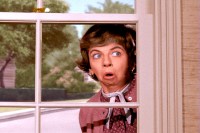
On "Bewitched," nosey neighbor, Gladys Kravits (Alice Pearce) always got more than she bargained for with her cup of sugar!

On “Bewitched,” nosey neighbor, Gladys Kravits (Alice Pearce) always got more than she bargained for with her cup of sugar!

Fifteen years ago, I was shopping for my first house when I realized I had no idea exactly what it was I wanted. I grew up on a farm with a house smack in the middle of a valley of trees, pasture and corn fields so I was lacking some of the social necessities of being a ‘neighbor.’

I had no idea what it meant to have to “keep up with the Joneses,” and I never saw my mother so desperate for sweetener that she needed to bang on someone else’s door and demand they fill her measuring cup with sugar. I just didn’t get it. And, after a good fifteen years, I still don’t.

Growing up in such isolation taught me self-reliance and a good feeling for minding my own business. Even as an adult, as public as I might seem between my published work, music and television appearances, I tend to be a bit of an introvert. It’s not that I’m unfriendly, quite the opposite, but I just feel like I should keep my nose in my own cupboard and leave others to do the same.

For some, however, that’s not the case. When I first considered a suburban home, I visited several developments and each put me in mind of TV shows of years past. On TV, the houses looked all the same and there was always that one, nosey neighbor who just couldn’t keep off your grass.

Inevitably, I think of Gladys Kravits, the screeching butinsky from “Bewitched,” who spent her day tormenting her happily ignorant husband Abner all about the goings on at the Stevens home across the street. Granted, there were weird things happening on Morning Glory Circle (that’s the street where Samantha and Darren lived on the show), but rarely did those events directly impact the neighbors.

I tend to be an observer of human behavior, which helps me, I hope, to be a good writer. I’ve noticed over the years that the preoccupation of people with the activities of their neighbors can be close to a debilitating obsession.

Constant worry about the concerns of others is, to my mind, ridiculous and kind of neurotic. What if you did nothing all day but ponder such things like … When did John cut his grass – for the tenth time? How did Bob buy that above ground pool when he doesn’t make that kind of money? Do those people have anything else to do but remodel their house every month?

It can get out of control. I’m hoping that level of unwarranted curiosity isn’t the norm but the exception. I would hate to think that my comings and goings were costing a good night’s sleep to anyone but me. That’s not to say that even rural suburbs don’t offer some level of low-brow entertainment of a kind that would even sour Jerry Springer’s sensibilities.

Fortunately, where I finally chose to buy a home turned out to be the perfect fit for me. But I know people who live in suburbs where you can’t make a move without someone commenting on it or having an opinion to gossip about. I’m sure it happens everywhere, but I think people should spend their time worrying about their own lives and stay out of the affairs of others.

If the concerns of those around you occupy your thoughts more than your own actions, it might be time to take a look in a mirror instead of out the front window. Being nosey isn’t the same as being neighborly.

Thoughtful compassion for a neighbor with a sick parent or welcoming a new baby is not the same as feeling the compulsion to always see what’s going on next door. It’s important for people to know the difference and respect those boundaries.


Gery L. Deer is an independent business writer and contributor to the WDTN-TV2 show, “Living Dayton.” More at http://www.gerydeer.com

Money cannot buy eternal salvation

In Charities, Media, National News, Opinion, psychology, Religion, television, Uncategorized on April 30, 2013 at 10:55 am

EVANGDeer In Headlines

By Gery L. Deer

Have you ever turned on the TV early on a weekend morning and heard something like this, “Friends, dig deep for those green rockets of salvation. Help us to lead the sheep to His lovin’ care with your kind love offering. Operators are standing by to pray with you – all for just $49.99.” A cross between an infomercial and a bad Saturday Night Live parody, television evangelists have been conning millions from the pockets of the devout since the medium was invented.

These clergy-covered con men (and women) take the stage amidst gold-plated, throne-like chairs, religious statuary and acrylic podiums to convince us all that we’re damned to the fiery pits of Hell unless we give and give generously. Armani-suited, well-quaffed, jewel-bedazzled TV preachers spout dramatic sermons from a teleprompter while holding up a Bible as if it were the newly presented cub in the Lion King movie.

If that’s not enough drama, it’s is followed by repeated moments of squint-eyed, hand-raised prayer and Lord praising before thousands of onlookers in the audience who are doing the same. Without opening their eyes, the host preacher prays that God will direct the viewers to the telephone number that appears at the bottom of the screen and give generously to the ministry so that more souls can be saved.

At home, viewers dial quickly, handing over millions upon millions of dollars to what could easily be compared to a guy begging on a highway exit ramp. The difference is that at least you know the panhandler is exactly that. He’s not pretending to give you a direct phone line to eternal salvation at the same time.

Holier-than-thou in their demeanor and testimony, eventually they fall from their pedestals in some kind of sex scandal or tax evasion allegations. I’m sure everyone remembers the rise and fall of Jim and Tammy Baker, Oral Roberts and Jimmy Swaggart.

Religious panhandling – might as well call it by name – is a real problem in America and, unfortunately, it’s completely legal and largely tax-exempt. For the truly devout, there is a clear understanding that man is meant to be humble and kneel before God. That doesn’t mean we were meant to live in abject poverty, but we’re not supposed to use the Almighty as a way to dupe billions of dollars out of unsuspecting people searching for answers in a life full of uncertainty and hardship.

With multi-million-dollar homes, limousines and servants, there is nothing holy about these so-called “evangelists.” In fact, in my opinion, it’s just flat out criminal. These people soil the image and intentions of faithful, honest people all over the country who are genuinely trying to do some good in the world. Most live modestly, often with a second job or from a share of whatever comes in the offering on Sunday morning. There are no limousines, golden thrones or evangelical stadiums.

There is nothing to excuse the fact that some of the poorest people in America, the elderly, are the most common victims to this kind of nonsense. Looking for spiritual leadership and often lonely and shut-in, seniors often send money to these TV charlatans before even paying for food and medicine.

Of course, these religious phonies don’t care who they hurt because they can hide out in tax-sheltered mansions, go for a dip in their Olympic-sized swimming pools or jet off to vacation homes in the Cayman Islands.

Not convinced? According to CelebrityNetWorth.Com, one of the most popular TV evangelists, Benny Hinn, is worth more than $42 million; all from donations to his “ministry.” Another extremely popular – and rich – television pastor, Joel Osteen, is reportedly roughing it on only $40 million. And more money is still pouring in.

I don’t have a problem with people living prosperously and giving generously from hard work and the success built from that labor. I am deeply offended, however, when those claiming to be men and women of God live in luxury at the expense and from the charity of lost souls desperately searching for comfort. It would do them well to go read that book they’re always waiving around on TV; particularly the book of Matthew, Chapter 19, Verse 24.