Local News & Commentary Since 1890.

Archive for the ‘psychology’ Category

Learning from McHenry’s vicious rant

In Business, Entertainment, Media, National News, Opinion, psychology, television, Uncategorized on April 24, 2015 at 10:07 am

DIH LOGOHave you ever had a really bad day? I mean one of those days when the slightest thing will set you off and you bite someone’s head off for no particular reason? Having a rough day can cause anyone to lash out for no apparent reason. The unfortunate recipient of such wrath could be your kids, a co-worker, or even a clerk at a towing company.

Last week ESPN sports broadcaster Britt McHenry did just that, but she added a few frills and dressings that she now most likely regrets. More accurately, she probably regrets that there was a security camera recording every moment of her vicious tirade leveled at a towing company clerk in Arlington, Virginia.

Britt McHenry on security camera ranting at towing clerk.

Britt McHenry on security camera ranting at towing clerk.

By suggesting that McHenry may have been reacting to a bad day, I am certainly not defending her. She clearly has some deep-seated personal insecurities to be so mean to, well, anyone. She had her back to the wall and we may have seen a glimpse of the real person behind the media façade. But, ignoring the woman’s obvious personal shortcomings, how many of us would be appalled to see our behavior replayed for the entire world after a difficult experience?

As for McHenry, I’ll grant her that it’s not easy to be a normal human being in the public eye, although, in truth, not being a sports consumer, I’d never heard of her until this incident surfaced. Still, no one is perfect. We all have our warts, but, for some of us, sometimes they’re a bit uglier than we realize, no matter how much we try to conceal them.

A difficult experience can bring all of that ugliness to the surface with great force, sometimes beyond our awareness. And, once it’s out there, it’s out there, particularly if you happen to be a public figure in a world of constant surveillance and instantaneous social media.

One op-ed I read after the incident commented more on McHenry’s apparent self-image, suggesting that she clearly exhibited an, “overblown sense of entitlement and evidence of a mean girl who never left high school.” The writer then went on to defend her somewhat, noting how quickly she was judged by the public without the other side of the story ever being revealed.

Well, since this is my op-ed column, I will say that, given her behavior, the other side doesn’t really matter much. Being angry at the situation and lashing out is understandable, particularly if you just had your car towed. But McHenry’s personal, demeaning attacks against the clerk were just plain vial. If you haven’t seen it, I won’t go into detail, but suffice to say she was arrogant, snobby, and just plain brutal.

Others in defense of McHenry call the release of the video a “public shaming,” but I can’t agree. McHenry shamed herself, no one made her behave that way. We all make choices and we have to live with the consequences. The pretty, popular and famous people of the world can’t be held to a higher standard (since they’re human too), but they are certainly no exception.

One thing struck me even more oddly. I have worked in media for many years and I have to ask how it never occurred to McHenry that there were probably security cameras on her? Even after the camera was pointed out by the clerk, she continued her rant, which became even more despicable.

After that, she got what she deserved. In my professional opinion, from a public relations standpoint, the best thing her bosses could do is show her the door – permanently. She’s bad for business and constant judgment and public scrutiny are the price of life in the media. Those who choose that life don’t get to whine about it.

Everyone has the right to be upset in difficult circumstances but no one has the right – not even the rich and famous – to belittle a person because of his or her own delusions of grandeur and privilege. Perhaps we could all learn an important lesson from McHenry’s behavior? Difficult situations might be more tolerable if everyone involved behaved as though the cameras are on them.


Gery L. Deer is an independent columnist and business writer. Deer In Headlines is distributed by GLD Enterprises Communications. More at gerydeer.com.


Don’t expect privacy at work.

In Jobs, Opinion, Politics, psychology, sociology, Technology, Uncategorized on February 23, 2015 at 2:49 pm

DIH LOGOPrivacy issues are some of the most complex problems facing Americans today. At home, we enjoy at least a certain level of privacy, but expecting the same at the workplace is, in a word, unrealistic.

According to information provided on the website of the American Civil Liberties Union, “Back in 1928, Supreme Court Justice Louis Brandeis wrote that the right most valued by the American people was ‘the right to be left alone.’” The site goes on to complain that private businesses are not limited by the constitution since, “the Bill of Rights addresses only state actions.”

In many parts of the country, advanced workplace privacy legislation is still being hashed out and may vary greatly from state to state. The ACLU has spent countless hours and probably just as much money arguing for workers, but, just for argument’s sake, let’s take a moment to see this issue from the employer’s point of view.

privacyNefarious intentions aside, why would an employer want to “monitor” the communications (phone, e-email, Internet) activities of employees while on the job? Usually, monitoring is performed for the security, legal liability and fiscal stability of the company and its employees. They’re not (or shouldn’t be) doing it to check up on your political affiliations or see how many cups of coffee you’re drinking before noon. Honestly, whatever you might think of yourself, your personal habits just aren’t that important.

With regard to using office equipment for personal communication, as a business owner, it’s not the employer’s responsibility to provide workers with the means for private conversation during business hours. Since the company owns the equipment and pays employees for work, he or she should have a right to monitor how it is used. If that seems unreasonable, consider the following scenario.

Suppose you hire a plumber to repair a bathroom drain. He starts work, then after a few minutes, asks to use your phone or excuses himself to use a cell phone to check in with the babysitter. As a compassionate person, you say, “No problem,” and go about your business.

Since he’s within earshot you overhear him fully engaged in a detailed conversation about something the neighbor did to the dog, which drags into a quarter hour, then a half. You are paying the man by the hour to repair your plumbing and, so far, that still hasn’t happened.

As he is in your home (private property, just as a business would be), using your utilities (if he’s using your private telephone) and you are paying him to do so, would you not have every right to monitor what’s going on and ask him to stop and complete his work? Even if he’s using his own cell phone, he’s still doing it on your dime. Does any of that seem fair to you? Of course not, but workers expect employers to put up with this same kind of situation on a daily basis.

The fact is that employees are there to work, not use the office communications equipment to order Christmas gifts online or have extended personal phone conversations. If there is an emergency, there are likely rules in place to cover those situations and provide a means of communication if necessary.

In order to keep personal communications private at the workplace, most experts suggest using your own mobile phone and (this is a big one) leave the premises to do it — at lunch or break time. To be clear, if you want to ensure privacy (from the employer anyway) never use only a phone provided to you by the employer, but a cell phone registered to and paid for by you.

For workers, expectations of privacy are usually outlined upon hiring or they’re included in an employee handbook, which almost no one reads. Otherwise, a human resources professional can answer any of these questions.

Private communication, whether by phone or computer, should be done on personal time, on personal equipment. From surveillance cameras to keystroke tracking software, an employer owns the property of his or her business and expects employees to at least respect that, even if they don’t agree with it. Ω


Gery L. Deer is an independent columnist and business writer. Deer In Headlines is distributed by GLD Enterprises Communications

Water: Here’s to your health.

In Education, Health, Opinion, psychology, Religion, Science, Senior Lifestyle, Uncategorized on February 9, 2015 at 1:37 pm

DIH LOGOHi, I’m Gery and I’m a recovering soda-holic (or “pop”-aholic if you prefer). There was a time when I would drink a 12-pack of soda (generally Cherry Coke) within a couple of days. I was an addict – sugar and caffeine were my drugs of choice.

Since I come from a family with a propensity for diabetes, I’d have to guess that drinking that much soda would only push me closer to the Insulin fan club. But all of that changed for me when I was helping to care for my mother and discovered, first hand, the health-promoting properties of water.

My mother, Lois, had already been diagnosed with Alzheimer’s dementia when she broke her hip and entered a local nursing home for physical therapy. During her stay, her dementia symptoms seemed to worsen more quickly than anticipated.

Soon she more anxious and unresponsive and always seemed to be suffering from some kind of urinary infection. Most of these issues were waved away by the staff as “normal” for a medicated, bed and wheelchair-bound senior with Alzheimer’s disease. Not in my book it wasn’t.

I paid closer attention to her daily care and noticed that she rarely drank anything. Once in a while a staffer would fill a plastic hospital-style pitcher with water and place it on the night table. But that was all; they just sat it down and left.

By this time dementia had diminished Mom’s awareness of hunger or thirst and even if she had wanted a drink she wouldn’t have been able to get it herself. Unless I, or another family member, poured it for her, the water usually sat there, untouched.

Gery and his family used the green tumbler in the photo to measure the amount of water Lois Deer received. It was filled twice per day - apx 0.5 gallons total.

Gery and his family used the green tumbler in the photo to measure the amount of water Lois Deer received. It was filled twice per day – apx 0.5 gallons total. (Photo Copyright 2015 GLD Enterprises Communications.)

She seemed to get worse so we decided to take her home and care for her ourselves. First on the agenda was to increase her water intake to around a half-gallon a day. That may not sound like much but, since water makes up approximately 60-percent of a person’s body weight, at 78 pounds the volume was significant.

Mom was given water regularly throughout the day and at meal time. With proper hydration and more consistent, personalized care, her physical and mental health improved more than I can adequately express.

Alzheimer’s disease continued its rampage, but we cared for her full time until her death in 2011. Still, I am convinced that better hydration increased her quality of life over those last two years in ways no medication could have achieved.

I’ve also since learned we had been right about the relationship between her behavioral deterioration and dehydration. In seniors, dehydration can lead to serious health problems, such as constant urinary tract infections, skin deterioration, and even present symptoms such as confusion and behavioral changes, much like classic dementia.

Many seniors resist drinking water, but I couldn’t tell you why except there may be a generational component perhaps related to quality. My parents, for example, grew up in the Appalachian foothills of southern Ohio where most of the drinking water came from creeks and shallow wells where the water probably wasn’t too palatable.

While I was caring for Mom I nearly eliminated soda from my diet and quadrupled the amount of water. It was an acquired taste, to be sure, but now my glucose levels are much lower and I genuinely “feel” better. It may not seem like much but I consider this achievement significant, particularly since it was pretty much the only major change I’ve made.

I still have a Coke a couple of times a week (which I rarely seem to finish) but I’m convinced that more water has made all the difference in improving my overall health. Hopefully by starting now, I won’t be so hard to convince at age 70 when any level of dehydration could cause more serious problems.

As for how much you should drink, the typical recommendation for adults is 8 glasses of “fluid” each day. But there really is no precise amount. You’ll have to judge for yourself based on the needs of your own body. Either way, you’ll feel better.

Gery L. Deer is an independent columnist and business writer. Deer In Headlines is provided by GLD Enterprises Communications. More at gerydeer.com.

New laws won’t stop bullying.

In Children and Family, Crime, Education, Health, Local News, National News, Opinion, Politics, psychology, sociology, State News, Uncategorized on January 26, 2015 at 11:25 am

DIH LOGOOn January 1st of 2015, a new state law took effect in Illinois giving school district officials broader power to investigate accusations of bullying – including cyberbullying – even if the activity took place outside administrative jurisdiction. After word spread of the bill’s passing, some media outlets reported, somewhat mistakenly, that school officials now had the right to order students to surrender social media passwords.

According to a report by The Huffington Post, however, the wording actually says, “that if cyberbullying is reported to the school, school administrators can investigate the claim even if the cyberbullying occurred outside of school hours and buildings.”

The report goes on to explain that a bill which took effect in January of 2014 made it unlawful for school officials to force parents or students to hand over online passwords. Brian Schwartz, general counsel for the Illinois Principals Association, told The Huffington Post, “I think there’s some misinformation about [the new bill], because that’s been on the books for over a year.”

bullying2There is no question that schools need to do more to curtail bullying. But, while all the attention has focused these new laws and free speech infringement, the media, and pretty much everyone else, missed the more important issue. Where are the parents in all of this?

School administrators have always been charged with maintaining discipline within the confines of their educational responsibility. However, it was never intended for educators to police kids after school hours or away from district property. They have neither the manpower nor the training to do so.

Worse still, civil liberties organizations have managed to tie the hands of educators to the point that, eventually, even detention will be a violation of a student’s civil rights. Regardless, the big question remains, when did parents abdicate the responsibility of actually “parenting” to school administrators?

Without question, this is a complicated issue, but the long and short of it is this: maintaining discipline after hours should be up to parents. If people are going to have children, they should be prepared to educate them in ways of civilized behavior and establish consequences if those rules are violated.

If a child is threatening or causing harm to others outside of school, it should be dealt with by parents and local police or other authorities – not the district administration. To repeat, they have neither the manpower nor the training for this kind of work.

Expanded powers like those granted in Illinois might seem like a good idea, but granting investigative overreach to teachers and administrative bureaucrats just seems, on every level, like a lawsuit waiting to happen. Imagine if a dangerous bully skipped through some loophole in the legal system simply because the investigation was handled by amateurs?

Such legislation is a knee-jerk reaction during midterm election season which will result in skyrocketing education costs and, in all likelihood, increased legal expenses for school districts. There is no reason school administrators should have such broad-reaching power outside of their areas of responsibility. Once again, it begs the question, where are the parents?

Instead of focusing on it after the fact, it might be a good idea for more parents to take a look at the problem and take responsibility for the behavior of their children before such events occur. Many parents overlook bullying as normal, growing pains. But that couldn’t be farther from the truth.

According to the National Crime Prevention Council, bullying consists of any and all of the following: fighting, threatening, name-calling, teasing, or excluding someone repeatedly and over time, an imbalance of power (such as size or popularity), physical, social, and emotional harm, or hurting another person to get something.  Cyberbullying includes similar issues, but inflicted over social media.

Some parents might ignore some of this behavior as “just kids being kids,” but it’s not. Kids who bully won’t come out and say so and neither will their victims. Bullying is a form of assault and it’s already illegal. New laws and stricter schools are not the solution. It’s up to parents to be more involved and help prevent this terrible problem.


Gery L. Deer is an independent columnist and business writer and distributed by GLD Enterprises Communications. More at gerydeer.com.

A short discussion of time.

In Entertainment, history, Literature, Opinion, psychology, Religion, Science, sociology, Technology, Uncategorized on January 12, 2015 at 12:51 pm

DIH LOGOTime is a concept, at least on Earth, unique to humans. No other creature has a sense of time nor do they seem to miss it. When deprived of its constant ticking, however, humans do indeed miss it – sometimes to the point of madness. People can go insane without the ability to follow the hands around the clock, chasing them as if to pursue food or shelter.

But time simply doesn’t exist. With all due respect to clock makers and the people who force you wait incredulously for an hour after arriving on punctually for a doctor’s appointment, time has no basis in reality; none, whatsoever. Oh sure, early man followed the sun up and down and watched moon phases to generate a calendar with which he soon began measuring the march of days. But he (figurative “he,” not intended to slight the fairer sex) is the only creature on the planet that has done so.

Contrary to the beliefs of theoretical physicists and science fiction fans, the “space-time continuum” is, for lack of a better word, hooey. Time travel will never be possible, forward or backward, regardless of whether one climbs into a souped-up DeLorean or a Frigidaire. It’s just impossible to physically move through a “concept.”

GLD_DIH_JAN15_TIMEThe great physicist, Albert Einstein, couldn’t have said it better when he theorized that time was relative to the position of the spectator. Time exists only in a single instant and even then only in the mind of the observer. There is no yesterday; no tomorrow. Man has no future and no past.

“History,” as it is referred to, is merely the recorded experience of one onlooker in a particular moment, captured in human memories, cave paintings, crayon, photos, writings, and now selfies. One cannot pass to and fro through history and every moment is affected by whom or whatever is present at that instant, without exception; otherwise referred to as “causality.”

For creatures with such a self-confident understanding of the passage of time, human beings certainly spend a great deal of it wastefully, ignoring the precious moments that can never be revisited or repeated. Mankind can be so caught up in his own affairs that important lessons whiz right by his primate-anchored brain cells, forcing him to forget to learn from his recorded past.

In youth, human beings tend to feel, somewhat accurately, that time is endless. In fact, since it is nothing more than a concept, time is endless, but the lifetime of the person is what turns out to be far more limited.

Young people burn up their early years in the ridiculous pursuit of high school glory, good grades, the first of a string of hopeless romantic partnerships, and, eventually, trying to get into the latest night spot by claiming to be older. Sadly, none of these efforts generally result in a fortunate use of time, mostly ending in yet another suitcase on the ever overstuffed baggage cart of life.

As the cart grows, letting go of some of that baggage is something with which humans have an incredibly difficult time. Resolving the past often requires thousands of dollars and hours on the analysts couch, but to no end. Life is cumulative, but time isn’t.

Eventually, humans created machines to measure time’s conceptual passing. Clocks are designed to offer a graduated visual representation of the passage of conceptual time based originally on the movements of the sun. In reality, it was the movement of the earth that was being marked.

Clocks and calendars are man’s way of trying to wrangle time to behave the way he wants it to. The fact is, since he created the idea of time, he has had complete control of it all along but never realized it.

Whether it’s being measured or not life goes on. Human beings would be far happier if they spent less time wallowing in the past or worrying about the future.

As hair turns grey and bones go brittle, the clock continues to tick down the conceptual passage of time. But real or not, the most important thing anyone can do is try to appreciate that one, amazing, wondrous moment of time within which everyone exists.


The Jamestown Comet.com Publisher / Editor Gery L. Deer is an independent columnist and business writer based in Jamestown, Ohio. More at gerydeer.com.


Let go of the past, focus on tomorrow

In Education, Holiday, Opinion, psychology, Uncategorized on January 1, 2015 at 1:48 am

DIH LOGOAs we come to the close of a tumultuous 2014, I am reminded that, as a society, we seem to be obsessed with looking over our shoulders with barely a single glance toward the road ahead. Using contemporary terms, our most common mistakes as a people might actually be labeled, “distracted living.” We are so focused on yesterday that we forget to prepare for tomorrow.

Someone much smarter than I once said that those who ignore history are doomed to repeat it. The statement generally refers to preventing the recurrence of negative events. But if something good happened, it’s only logical that you would want to repeat that success. To truly progress, however, we must learn from the past while at the same time keeping our attention focused on the future.

Unfortunately, we are often more affected by the negative in life than the positive; a death in the family, lost job, financial struggle, and so on. People and events from the past have us constantly looking over our shoulders, dwelling on our sadness, sense of loss and nostalgia. But while they may provide momentary comfort, these feelings also tend to hold us in place and keep us from advancing to a better future.

clock-2As 2014 comes to an end, I implore my readers to look to the horizon and make an effort to work towards better things in the coming year. Life is all about making the best choices possible based on personal experience, the current situation, consequences of your actions and your own needs going forward.

Writers are generally encouraged to omit anything – settings, objects, characters – that do not serve to keep the plot of a story moving forward. To keep life moving ahead we must do the same thing by eliminating anything that keeps us stagnant.

First, you need to focus on yourself more. It may sound selfish, but it’s necessary. As someone who has had to help care for aging parents, I have learned that in order to help them, I have to keep myself going. Maintaining your mental and physical health is vital if you are to be of any use to anyone else.

Dismiss negative people from your life and don’t get mixed up in the drama of others. Some people exist solely in their own world, completely unaware of how their behavior affects others. If someone is literally exhausting you from drama or they’re incredibly high-maintenance, it’s time to cut them loose. You can’t move ahead if someone like this is always dragging you down.

Stop repeating pointless behavior while expecting a different outcome. Very often, we can get stuck in a pattern of useless behavior, always doing the same thing and hoping that “this time,” it will come out differently. But it never does and it never will.

Stop procrastinating. Yes, this is probably the hardest piece of the puzzle. How to do today what you can very easily put off until tomorrow. But if you’re someone who constantly complains about your situation yet does little to change it, procrastination could be a big chunk of the problem.

Most people find excuses to cover procrastination; “they’ll never hire me for that new job,” “that’s too hard,” or, “she’ll never say yes.” Get over yourself – and your fear – and take that first step forward. And yes, most procrastination is the result of being afraid, not of failure but success.

Finally, I’ve never been a big believer that writing down a list of goals does anything more than make you feel inadequate. “Self-help” nonsense puts so much pressure on goals that if you don’t meet the ones you wrote down, then you must be a failure and that can result in its own devastating effect.

Forget goals, but at least have an idea of what a better, more successful tomorrow looks like to you. In the end, the future belongs to you, no one else. Get off your tail and do something about it and stop looking backward. Happy New Year! Now get out there and make this one your best ever!

Gery L. Deer is an independent columnist and business writer based in Jamestown, ohio. More at gerydeer.com.

Propaganda still has power over Americans

In Dayton Ohio News, Health, Local News, National News, News Media, Opinion, Politics, psychology, Religion, State News, Uncategorized, World News on October 27, 2014 at 9:42 pm

DIH LOGOPolitics and religion both thrive on propaganda, some of it factual, some creatively manufactured. Either way, people will buy into almost anything when you hit them at the gut level. Emotions ride highest when fear is used as the manipulation point.

In 1938, Orson Welles managed to terrify the radio listening public as he destroyed America by Martian invasion in his version of H.G. Wells’, “War of the Worlds.” Of course, it was all a Halloween offering, a prank, “the radio equivalent of dressing up in a sheet and jumping out from behind a bush and saying, ‘boo,’” as Welles put it. But it was, for lack of any other analogy, an hour of “propaganda;” a radio play written to sound exactly like genuine news bulletins, and people fell for it.

According to the dictionary definition, propaganda is information, especially of a biased or misleading nature, often used to promote or publicize a particular political cause or point of view. A deceptive radio broadcast may not be likely to have the same effect today, but if the current Ebola virus scare is any indication, Americans are still far from immune to the effects of well-crafted media spin.

With virtually no qualified medical information being distributed within the propaganda (probably the best word to describe most of the information being circulated), politicians, the media, and the endless barrage of know-it-all cable TV commentators are spreading speculation, misinformation and fear, unabated.

As one might expect, election season has to be one of the most prominent times for the spread of heavy-handed, negative propaganda. Despite laws to limit how “misleading” political ads can be, there is still so much being dispersed that it staggers the imagination of the thinking person as to how it is even allowed.

With fewer people concerned about the accuracy of news reporting these days, believing any blog they run across on Google, media spin no longer needs even to be well-crafted for the masses to fall victim to its intent. There are still, bafflingly, people out there who think that what they see on the news or Internet must be the truth. Not so much “fact,” but truth.

Is the Ebola scare really the menace it's made out to be by politicians and media?

Is the Ebola scare really the menace it’s made out to be by politicians and media?

The spread of propaganda does not require facts but implies truth. Make enough people believe in an idea, factual or not, and it becomes “truth,” at least to those people. Once spread, that truth ends up being the predominant viewpoint and changing the minds of those who fall for it is a challenge, to say the least. Oddly enough, this is the same basis upon which every religion in history has been established.

As pointed out many times in “Deer In Headlines,” decisions are rarely made from factual information but more often based on emotional satisfaction. What makes a person feel good is far more powerful than a list of unemotional statistics. Once again, fear can be one of the most powerful emotions of them all and that is exactly the point.

Without fear, propaganda has much less of an effect. Political propaganda plays on the fear of the voter, suggesting that he or she will suffer under the rule of the opposing candidate – higher taxes, less food on the table, fewer jobs, and so on. In religious propaganda, the fear is purgatory, Hell, or whatever the particular denomination chooses to promote as the reason to show up every Sunday and ante up in the plate as it goes by.

There is, without question, a serious problem concerning the spread of the Ebola virus in the United States. But there is also, sadly, a tremendous opportunity here for politicians to cash in on the fears of those who are probably already paranoid about such things, enhancing the real threat enough to justify the need for such publicity.

Those fifteen minutes of fame come with a high cost, mainly in the stress and emotional trauma experienced by the people who trust their government to take care of them. Avoiding future panic means that people simply need to be cautious about what they take as “fact,” versus what they believe to be “truth.”


The Jamestown Comet.com editor Gery L. Deer is an independent columnist and business writer based in Jamestown, Ohio. More at deerinheadlines.com.

Support religious freedom by defending rights of atheists

In Education, history, Local News, Media, National News, Opinion, Politics, psychology, Religion, sociology, Uncategorized on September 3, 2014 at 11:24 pm

dih-logo-SEFor what is apparently the first time ever, an openly atheist candidate is running for United States Congress this fall. James Woods, an atheist Democrat, is seeking election in the Arizona 5th Congressional District, a region well known as strictly Republican. According to a CNN op-ed piece by columnist Carlos S. Moreno, Woods will be the only congressional candidate to ever run after outing himself as a non-believer.

As it turns out, under the constitutions of eight American states, atheists are banned from holding public office: Arkansas, Maryland, Mississippi, North Carolina, Pennsylvania, South Carolina, Tennessee, and Texas (Source: The Washington Post). More accurately, the restriction applies to those who deny the existence of, “a Supreme Being,” or “Almighty God,” the wording varies.

Regardless of whether people agree with it, such bans would seem to violate Article VI of the U.S. Constitution, which states, “no religious test shall ever be required as a qualification to any office or public trust under the United States.” It’s probable that any related civil suit would eventually land at the feet of the United States Supreme Court which would undoubtedly have to rule these laws unconstitutional.

Even so, most atheists stay, “in the closet,” so to speak, to avoid social repercussions and public scrutiny and rarely do they attempt to run for political positions. It might be assumed that the anti-atheist rules were originally established to ensure that public servants would have a predictable moral fiber.

But, the very idea that the religious are inherently “moral,” is, in a word, ridiculous. History is full of religiously-sanctioned violations of God’s moral commandments, from centuries of open warfare to decades of child abuse. As usual, many of the devout try to pretend none of it ever happened. So, in a completely predictable act of contradiction, violations of God’s laws are fine so long as they serve a “higher purpose.”

Likewise, the moral character of a politician is supposed to be part of the reason why people choose to elect him or her to office. Sadly, a disturbing lack of morality is evident in many high-ranking politicians, who spend much of their time lying, cheating and stealing. These are the same men and women who, at some point, stood up in front of their God and everyone else and swore to their personal integrity and commitment.

Easy examples come to mind like John F. Kennedy and Bill Clinton, who were known to be serial adulterers, and it could be argued that the very definition of politician should include, “liar.” In any case, one needn’t be a Christian, nor a member of any other religion, to have a well-aligned moral compass.

Put simply, being frightened into morality by the threat of fire and brimstone only goes so far in keeping people on the straight and narrow, particularly those who crave power and believe themselves at some point to be above retribution. It seems like it would be better to have a public servant who has found his or her own moral direction rather than having it lorded over them by fear of suffering in the hereafter.

Regardless of how the devout are behaving when no one is looking, however, what Americans need to understand from all of this is that freedom from religion must be protected in order to preserve its uninhibited practice. The fine balance between freedom “from” and “of” religion is necessary to ensure every citizen can practice his or her faith openly, all while any other may enjoy none at all. It goes both ways.

Put another way, no one likes to have religious groups going door to door pedaling their ideology. So why is it alright for anyone else to do the same thing simply using more socially acceptable methods, such as being coerced into declaring a religion before qualifying for political office?

Up until now a great many public servants who have affirmed a religious affiliation and filled speeches with thanks to God for their success have managed to shame both their religion and their office with shaky morality. In the end, the most devout Christian can take the same oath as their atheist counterpart and guarantee no greater a moral platform. If history is any indicator, it might even be less.

 
Gery L. Deer is the editor and publisher of The Jamestown Comet.com and a syndicated independent columnist.


More family advocacy needed for elder care

In Children and Family, Health, Opinion, psychology, Religion, Senior Lifestyle, sociology, Uncategorized on April 16, 2014 at 1:31 pm

DIH LOGOCaring for an aging parent is, in my opinion, one of the most difficult and often painful experiences life throws our way. Providing a safe, healthy environment for an elderly family member is just as taxing as doing the same for a child.

What makes this process even harder is when the parent is resistant to help or simply won’t accept that they are no longer in a position to take care of themselves. Poor decisions, an inability to recognize when driving has become hazardous and, worst of all, when they will listen to anyone’s advice but that of their children, complicates the care process and causes serious damage to the parent/child relationship.

It’s hard to watch parents age and knowing you’re headed the same direction only solidifies the reality of it all. It’s harder still when they resist every attempt to maintain their health and sometimes doctors undermine your efforts by telling them they don’t have to do anything they don’t want to.

I understand that people need to make their own choices, but some shrink in a hospital cannot possibly know an individual’s mental status by talking to them once for three minutes and asking a half dozen pointless questions. “Do you know where you are? Do you know what day it is? Can you draw this box? Write your name.” “Draw this box,” are they kidding?

How about we ask them what their checking account number is, or the name of their insurance company? How about asking when they last paid their phone bill? These are vital questions to someone who is supposedly “competent” and yet this is not what is included in a psychiatric evaluation for a senior’s ability to make his or her own decisions.

Then there are those who are intent on taking advantage of the elderly person’s desire to feel “needed” and useful. These individuals worm their way into the lives of the elderly, showering them with compliments and creating a rift between the senior and his or her family. These unscrupulous people are trying to get money and property away from the senior and alienate children and others who are trying to protect their interests.

Deer In Headlines author Gery Deer is helping his brother Gary Jr and sister Cathy to take care of their father, Gary Sr. and it's rarely easy work.

Deer In Headlines author Gery Deer is helping his brother Gary Jr and sister Cathy to take care of their father, Gary Sr. and it’s rarely easy work.

Laws addressing the rights of seniors, as well as those regarding patient rights, seem to take no account to dementia and speak only to protecting them from family members bent on securing money or locking them away in a nursing home. What about those of us who are trying to protect our parents and provide a safe, secure life for them in their own home as long as possible? Where is our protection and support? There is none.

Preserving a person’s dignity is difficult enough without being able to handle even the most basic decisions absent a mile of legal documents in place only to provide more money for lawyers. Power of attorney documents are meaningless unless the person is thoroughly incapacitated and no one will help without signing over deeds and financial statements.

Believe it or not, sometimes money has nothing to do with it! There are actually situations when families are trying to preserve an aging parent’s lifestyle, dignity and financial security. Someone should be out there advocating for us, not making it harder. Unless you’re loaded with money, there is just no support for people dealing with this kind of problem.

So what is to be done? Good question. I am all for protecting the rights of the elderly and maintaining their ability to make decisions, but there are many degrees of incompetence between fully cognizant and Alzheimer’s dementia and that should be taken into account.

My mother lost all of her reasoning ability as Alzheimer’s set in and it nearly bankrupted my family to get her under a guardianship so we could keep her safe and well-cared for. But when a senior has some competence but not all, that needs to be addressed and the family should be able to have some advocacy for protecting the interest of that individual without so many roadblocks.

Legislation should be put into place for the varying degrees of dementia and stop relying on the ‘one size fits all’ psychiatric evaluations that prove nothing more than the person can read a calendar.


Gery L. Deer is the editor and publisher of The Jamestown Comet.com an independent columnist and business writer based in Jamestown, Ohio. More at http://www.gerydeer.com.


It takes a maverick to make a difference

In Education, National News, Opinion, Politics, psychology, Religion, Science, sociology, State News, Uncategorized, World News on March 24, 2014 at 7:59 am

DIH LOGOAccording to one definition, a maverick is, “an unorthodox or independent-minded person.” But a maverick is also someone who chooses not to give in to the pressures of society, breaking ranks, not for personal gain, but in an effort to improve conditions or expand knowledge for everyone.

In the 16th Century, the now revered scientist Galileo Galilei would certainly have fit the definition of maverick. At a time when the church kept tight control over the public’s understanding of the world around them, Galileo’s challenge that the earth was not actually the center of the universe but instead part of a solar system with our sun at its center was controversial.

Of course he was eventually proven right, but standing against such a powerful entity as the Catholic Church sent Galileo to be tried for heresy. There are countless cases like this throughout history, most related to individuals who chose to challenge long-standing beliefs in politics or religion.

Today, as in Galileo’s time, society is taught and expected, from an early age, to keep quiet; never to upset the status quo for fear of retribution. Those willing to stand up and be heard shape the most change in the world, but often pay a high price for their contribution to progress. Much of what society deems acceptable is dependent on one’s position and the sphere of influence there encompassed.

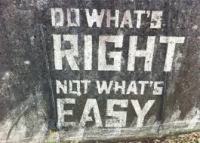
whatsrightFor example, it is unacceptable in many religious groups for a married couple to divorce. They are expected to remain together indefinitely for the good of the church, their families and so on, regardless of the situation, even in cases of physical abuse. It stands to reason, therefore, that the first few individuals who challenged these rules were certainly dealt with harshly. Fortunately, over time, this type of censure has eased somewhat, at least publically.

On the whole, it is difficult to greatly influence public perception and alter the behavior of a society or to get people to remove the blinders of ideology and accept the possibility that there are other ways of thinking. Ignorance, prejudice and misunderstanding usually lead to fear and resistance.

It should also be made clear that religious groups are certainly not alone in such ridiculously judgmental behavior. Anyone who challenges established norms can find themselves on the receiving end of some pretty unpleasant retribution, particularly in the workplace.

Often employees are never to question authority or decisions made by their superiors, otherwise face reprisal. But what does one do when superiors are actually breaking the law? In 1989, Congress passed the Whistleblower Protection Act. The law is designed to shield workers against retaliatory personnel action – meaning, essentially, it keeps them from being fired – for “blowing the whistle” on illegal activities perpetrated by their employers.

Unfortunately, there is no such protection for the everyday person who simply wants to do the right thing. From Moses and Lady Godiva to Rosa Parks and Martin Luther King, taking a stand to alter deeply engrained social beliefs has never been a task for the weak-hearted.

Most people are discouraged by how much retribution might be taken out on them for going against the grain. Sometimes, however, just standing up for the little things can help to affect larger changes. Making a difference in the boardroom, at school or even in the hallowed halls of church might ruffle some feathers, but if the purpose is worthwhile, it would be wrong not to do something.

So, what about those by-standers who agree with the maverick but are afraid to stand with her? If only one other person supported the cause then another would as well, then another, and another. That’s how revolutions are started in the face of resistance. So the next time you see an injustice being done and you have the opportunity to act, what will it be: Maverick or conformist?  Ω

Gery L. Deer is an independent columnist and business contributor to the WDTN-TV2 program, “Living Dayton.” More at www.gerydeer.com.