Local News & Commentary Since 1890.

Archive for the ‘sociology’ Category

We see the 1950s with rose-colored glasses

In Entertainment, Opinion, psychology, sociology, Uncategorized on August 20, 2013 at 6:31 pm

DIH LOGOI recently read a CBS News poll asking people to choose a decade back to which they’d like to time travel. Overwhelmingly, the leading answer was the 1950s. What I can’t wrap my head around is, why?

Some people see those times as simpler, easier to manage, with fewer concerns and more security. Gas was 23-cents per gallon and you could get a really nice home for $22,000. A good price when you consider the average annual salary – hold onto your hats – just over $4,100.

So, yes, things were cheaper but only when compared to today’s prices. Actually, I think we have a fairly tainted view of the 1950s, America’s so-called, “Golden Age.” The “Leave it to Beaver” family unit and less-complicated lifestyles of those days simply wouldn’t work in modern society, for a number of reasons.

First, we had all the same problems back then that we have today, but we perceived and dealt with them differently. The country probably wasn’t as politically fractured as it is today, only because we were all riding a bit of a patriotic “high” after the end of World War II.

Technology or the lack thereof made a difference to our perceptions in those days too. There was the radio, a morning newspaper, an evening newspaper, sometimes an “extra” mid-day edition, and an evening television newscast. We didn’t get all the bad news of the world every moment it was happening. If we were going to tell people how our vacation was going, we had to mail out post cards.

According to the 1955 United States Census, America’s population was 166 million and the average unemployment rate was 4.9 percent, or about 81 million people. Today it’s about 314 million with a 7.4 percent unemployment factor, around 23 million.

So, barring some kind of economic cataclysm, as the population doubled, the unemployment rate followed suit. From a ratio standpoint, there were actually more people out of work 60 years ago than there are now. That’s good news, right? Sort of, yes.

What makes this a steeper hill to climb today is, once again, technology related. Labor-intensive, blue collar jobs like those at GM, NCR and other big manufacturers just don’t exist anymore. Many have been eliminated or sent overseas to take advantage of cheaper labor costs.

Additionally, many people – myself included – believe Americans to be lazier than ever and a good number of us simply don’t want to work. People are especially hard to motivate when employee benefits and pensions are a thing of the past and there is no longer any sort of job security.

Speaking of security, remember the “duck and cover” drills of the 50s and 60s? How much of a pointless endeavor was that? “Here, little Johnny, get under this desk so the Russian atomic bomb won’t hurt you.” Really, I mean, how dumb were we?

I suppose at least it gave us all something to do in the face of the unthinkable. In reality, there was nothing secure about the 50s, especially considering we were always on the brink of war with Russia and it only got worse as 1960 approached.

Personally, I think we spend far too much time looking back and not nearly enough looking forward. The past is done and you can plan for the future to some degree, but, reasonably, all we have is the here and now. Focus on making your present more fruitful and your future will follow along.


 

Definitely not the Weiner the world awaited

In Media, National News, Opinion, Politics, sociology, Uncategorized, World News on July 31, 2013 at 5:47 pm

DIH LOGO

Whoever holds the position as Mayor of New York City carries a level of political power that may be second only to that of the White House. It’s a daunting task requiring political savvy, brains and, eh-hem, character. If Anthony Weiner is the “best” option for that job, we have a sad political landscape in America today.

Regardless of his political accomplishments, this man has made himself into little more than a late night punch line. Perfectly named for receiving a repeated black eye from pundits, Weiner’s online “sextcapades” seem to have no end in sight.

When asked if any more of this material would be uncovered the guy actually said, and this is a quote, “I don’t know.” You don’t know? How can you not know? In the immortal words of Bill Cosby, “Has your head been with you all day?”

weinerismWeiner has become a complete laughing stock and there is absolutely no way he can win an election now. Yet, puzzlingly enough, Bill Clinton was re-elected for a second presidential term following his real-life trysts. In Clinton’s case, there was little more evidence than an accusation from a disgruntled intern – and a stained dress.

In Weiner’s situation you have to wonder how much more his wife is going to take before she walks. Her name is Huma Mahmood Abedin, and she happens to be a high-ranking aide to Hillary Clinton so I’m not sure that’s the best example to follow when it comes to dealing with infidelity. She could ignore Hillary’s playbook though. I’m hearing Tammy Wynette singing, “Stand By Your Man,” when suddenly the record scratches off and Abedin storms off the stage.

Whatever happens, if the democrats re-elect this guy to, well, any office at all, they really are crazy. Either that or they’re incredibly short-sighted and intend to definitively prove that liberals care nothing about character in their candidates.

It’s important to note, however, that there is nothing new about this kind of behavior from powerful executives on either side of the aisle. Expecting otherwise is probably about as unrealistic as thinking a cat is suddenly going to enjoy a bath.

The real issue, with regard to integrity, is that these men (and a few women) flat deny anything ever happened; at least until evidence surfaces to make liars out of them. Subsequently, they’re forced to come clean with a tearful apology and a carefully written statement from the safety of a podium, often with the humiliated wife standing nearby appearing to be supportive.

But as long as the American public keeps giving politicians a pass on this kind of behavior it will continue. Voters seem outraged one minute and re-elect them in the next. It makes no sense.

No one is perfect, least of all those who have chosen a life in the public eye, but when you are charged with representing the best interests of a constituency, you should at least behave like an adult, not an adolescent. Grow up, already.

Beyond that, voters need to have more integrity themselves. It’s time to stop choosing the lesser of, “Who cares?” Our local representatives have much more of an effect on our day-to-day lives than those in Washington and should live up to a much higher standard for that very reason.

But in order for them to be held accountable and to let them know that irresponsible behavior does have an effect on job performance, it takes a message sent from the polling place. There are many more “Weiners” out there, and smartphones and social media will be the professional death of them.

All we can do here on Main Street is try to convince people of higher sense of integrity and civic duty to run for office and help improve things one step at a time. As you visit the fairs and festivals going on throughout the end of summer and into fall, talk to those campaigning there and ask them the hard questions. We deserve better from our representatives but it will only happen if we demand it.

Gery L. Deer is an independent columnist and business writer from Jamestown, Ohio. Deer In Headlines is syndicated by GLD Enterprises Commercial Writing. (c) 2013, GLD Enterprises / Gery L. Deer. All Rights Reserved.

Navigating the Ohio Bureaucracy of Motor Vehicles

In Business, Economy, Education, Local News, Opinion, sociology, State News, Uncategorized on July 24, 2013 at 9:14 am

Deer In Headlines

By Gery L. Deer

???????????????????????Before I launch into the meat of this week’s column, it is important to point out that the majority of people I’ve encountered at the Ohio Bureau of Motor Vehicles have been kind, courteous and helpful, and often apologizing profusely for the inconsistency of their employer’s policies. Most spend whatever time is necessary to help you sort out problems and do their best to make your visit more pleasant. But, as they say, one bad apple can spoil the whole barrel.

With the possible exception of going to the dentist or some invasive medical procedure, nothing is more agonizing than the thought of standing in line at the BMV. Trapped like cattle to slaughter in a snaking rope line, people wait anxiously; subdued by a system that takes in an unbelievable amount of money and possesses a level of control surpassed only by the Internal Revenue Service.

According to the Ohio BMV website, in 2012 the agency collected nearly $40 million from driver license reinstatement fees alone. At the same time, it processed more than 14 million vehicle registrations. No revenue figure was available on those services but at roughly $50 a shot, that number has to be dizzying. One would think with that much money coming in someone could spring for a customer service lesson.

Recently I went to the BMV to renew the registration for one of my father’s vehicles. Having repeated this procedure for several years in a row, I had all of the previously accepted documentation and waited patiently for over an hour. Once at the counter, I was told my power of attorney form, issued by the BMV authorizing me to make the transaction in my dad’s absence, was unacceptable.

“That one’s for the title office,” they spouted with fervent authority, like proud kings of their particular hill. The document in question has no markings specifying such information but instead contains wording that suggests it can be used for any and all BMV transactions as a legal POA. In addition, that same document had been accepted by that same branch for the previous two years for the same transaction, on the same vehicle.

When I attempted to explain these facts, I was quickly interrupted by one clerk who felt it necessary to demonstrate his dime store knowledge of the law as he described how a durable power of attorney should be configured. Really? Perhaps Mr. Matlock is in the wrong line of work.

As it turned out, the “acceptable” document is not even a POA and requires no notarization. With no official confirmation of the proper owner’s signature, I could simply have gone out into the hallway, signed my father’s name and brought it back in. Good to know that the BMV is on top of helping keep your identity secure. (Yes, that was sarcasm.)

Since I teach people how to handle business situations and deal with customers in a more fruitful manner, even when the customer is wrong (which seems an inevitable constant at the BMV) I offer this advice to clerks in similar situations. Since the document I possessed was a legal power of attorney for the vehicle in question, accept it as such.

Instead of showing me how powerful and rigid you are, ask that I fill out the new form in your presence and sign for the vehicle owner based on the permission granted by the notarized POA. Then say something like, “We can do this now, but here’s the new form you need for next time.” That’s all it would have taken to solve the problem.

To those of you about to make the painful trek to the BMV, knowledge is power so do your homework! The Ohio BMV website – www.bmv.ohio.gov – contains all the documents and information you need to be better prepared. Being a little pro-active can make your day easier when dealing with an unknowledgeable, control-freak teller, and demonstrates your understanding for those clerks who are doing their best to help you navigate an imperfect system.

Media distorts facts in high profile cases

In Education, Health, history, National News, Opinion, Politics, Senior Lifestyle, sociology, Uncategorized on July 16, 2013 at 9:40 am

DIH LOGOUnless you’re one of those people who can outwit the trivia nerds on Jeopardy!, you probably don’t remember the name, Stella Liebeck. It’s a sure bet, though, that you more than likely remember hearing of a woman awarded millions after spilling hot McDonald’s coffee on herself while driving – except that’s not exactly what happened.

In 1992, 79-year-old Liebeck sued McDonald’s Corporation after being severely burned by coffee spilled in her lap. Her case drew national attention to the idea of “frivolous lawsuits,” igniting a firestorm of conservative push for swift and devastating tort reform.

For those of you who slept through high school civics class, a tort is a wrongful act or infringement of rights leading to a legal liability. In other words, if someone hurts you in some way and they may be liable for the injury (physical, emotional, financial, or otherwise), that’s called a tort.

Torts exist to help protect the public from the negligence of others, whether the fault of an individual or a business. Without them, no one would ever be held legally accountable for causing accidents and injuries. Like other well-meaning legislation, sometimes greedy people abuse the system – or attempt to – just out to make an easy buck. The majority of, what might be considered “frivolous,” lawsuits die out in the first hearings or are settled out of court to avoid public scrutiny.

With rampant distortion of the facts in the Liebeck case, it’s easy to understand why people really didn’t know what happened and just assumed she was looking for a big payday from a huge corporation. Sadly, the particulars were lost in the hype, turning this poor woman into a media joke, even inspiring a groin-scalding episode of “Seinfeld.”

At the time, the media’s fractured reporting stated Liebeck was herself negligent because she was driving at the time of the spill when, in fact, she was a passenger in a stationary vehicle at the time. It really would have made little difference anyway, since the coffee in question was estimated to have been around 180 degrees Fahrenheit. Medical experts suggest that any skin in contact with liquid of that temperature for more than a few seconds would experience severe burns of, at minimum, second degree and potentially surpassing third.

As it turned out, evidence in the case showed that the fast food giant’s franchisees were required to maintain coffee at a sitting temperature between 180 and 190 degrees Fahrenheit. The searing heat of the fast food giant’s coffee had resulted in hundreds of documented injuries. Liebeck’s burns were located on her inner and back thigh and were so severe as to require a series of major skin grafts over several months and caused agonizing pain.

HERE IS A LINK TO PHOTOS OF MRS. LIEBECK’s INJURIES – PLEASE NOTE, THEY ARE GRAPHIC IN NATURE. PARENTAL DISCRETION IS ADVISED.

Initially, the Liebeck’s family wrote a letter to McDonald’s merely asking they cover medical bills for her treatment but with no response, they were forced to take legal action. In the end, the jury found McDonald’s liable for the severity of the injuries due to temperature policy and frequency of documented injuries.

Punitive damages (additional monetary punishment to the wrong-doer) were awarded by the jury in the amount of $2.7 million. That figure was later reduced by the judge to $480,000, but Liebeck eventually settled with McDonald’s for an undisclosed amount.

Sensational news stories like the Liebeck case should always be taken a dose of skepticism because. The court of public opinion can be devastating to a case like this, and like so many more recent ones. No media outlet is fair or balanced and no one reports all the facts because reporters are not privy to everything. Guilt or innocence should be based on the decision of the jury, not the news media.

Those thrilling days of yesteryear

In Children and Family, Entertainment, Media, Movies, National News, Opinion, sociology, television, Uncategorized on July 9, 2013 at 8:39 am

DIH LOGOThe Lone Ranger first debuted in 1933 from the studios of WXYZ radio in Detroit, Michigan. Created by station owner George W. Trendle and writer Fran Striker, the character is said to have been based on the exploits of Bass Reeves, a real life federal peace officer who worked in Indian Territory during the late 1870s. Accompanied by his trusty Indian sidekick, Tonto, and themed by the thrilling rhythm of Gioachino Rossini’s operatic William Tell Overture, The Lone Ranger became an immediate success.

By the time that last surviving ranger hit the airways Wild West lore had been incredibly popular for more than two decades, particularly in dime novels, on the radio and in traveling shows. Originally aimed at children, it is estimated that more than half the audience for the program were adults, many of whom had grown up with stories about western legends like Billy the Kid, Bat Masterson and Wyatt Earp.

Unlike his historical counterparts who clearly had bad sides to their character, The Lone Ranger would be the ultimate good guy, with a mask to both maintain his anonymity and help confound corrupt government officials as to his true nature. In order to keep continuity for the character, the original writers created a set of guidelines that established who and what The Lone Ranger is meant to be. Some of the guidelines were a little silly, but others far ahead of their time.

For example, one of the rules stated that the Ranger would never be pitted against an adversary who was not American so as to avoid criticism from minority groups. In other words, it was already practicing political correctness. Another said that he could never drink or smoke and any “saloon” scenes had to be portrayed as cafes with waiters serving food instead of bartenders pouring drinks. One of the most interesting was a rule that stated he would always use perfect grammar and diction, devoid of slang and colloquialisms.

Many people who remember those days believe that actor William Conrad, star of the 1970s P.I. show, “Cannon,” was the original voice of The Lone Ranger on radio, but that is not so. In fact, Conrad voiced another famous western lawman, Gunsmoke’s Marshall Matt Dillon.

In 1949, the show made the ultimate leap from radio to the fledgling technology known as television, with Clayton Moore donning the famous mask and Native American actor Jay Silverheels as Tonto. After eight seasons on ABC, two of which with a different actor in the lead role, the show was cancelled in 1957. A year later, a theatrical feature was released starring the TV actors in a new adventure but the demand for the masked man never quite returned to its former pitch, though a couple of other failed attempts were made to return him to both the theatre and the small screen.

In 1981, a big screen version of The Lone Ranger was met with the harshest of criticism and dismal box office receipts. The movie failed partly because it was just a bad film, but mostly because the producers sued former star, Clayton Moore, to forbid him from wearing the signature mask in public appearances. Who says there’s no such thing as bad press?

The most recent incarnation of the Masked Man hit the silver screen this summer as a tongue-in-cheek Disney flick featuring Armie Hammer as Ranger John Reid (The Lone Ranger) and Johnny Depp as his trusted Indian partner. Unfortunately the campy tone that worked so well for Depp in the Pirates of the Caribbean series falls flat in this film, detracting from the nature of the characters and overshadowing the story.

Disney had the opportunity here to introduce two beloved characters of Americana to a new generation. But, instead of using the elements that made the show a success originally, they changed the formula and merely created another summer flop from a classic franchise. Hopefully, The Lone Ranger has not forever ridden off into the sunset and will get another chance to let audiences experience, “a cloud of dust and a hardy ‘Hi-Yo Silver!’”


Daredevil Performances: Is the spectacle worth the risk?

In Education, Entertainment, history, Local News, Media, National News, Opinion, sociology, Technology, television, Theatre, Uncategorized, World News on June 25, 2013 at 6:27 pm

DIH LOGODanger as a spectacle has long been a past time of human culture. Death-defying stunts have graced stages of theatres and circus tents for centuries. Never has there been a more awe-inspiring sight, however, than the dramatic aerobatics of stunt pilots and wing walkers. On Saturday, June 22nd, wing walker Jane Wicker and her pilot Charlie Schwenker died in a fiery crash during a performance at the Dayton Vectren Air Show in Vandalia, Ohio.

Wicker, who had been involved with aerobatics for more than a quarter-century, was sitting on the wing of the inverted plane as it dove, nose-first, into the ground and exploded. The aftermath of the crash left a burning wreck, two people dead and hundreds of spectators horrified.

News of the accident quickly spread around the country, landing on the lead story of every print, broadcast and online media outlet from the New York Daily News to the Huffington Post. Preliminary investigations of the cause of the crash from the Federal Aviation Administration and the National Transportation Safety Board are as yet inconclusive.

The very next day, high wire performer Nik Wallenda spent his evening engaged in a heart-stopping, quarter-mile tightrope walk across a 1,500 foot deep section of the Grand Canyon. As a record number of viewers tuned in to the Discovery Channel to watch, they were treated to more than a half hour of listening to Wallenda continually pray or thank God and praising Jesus with nearly every successful step. One might wonder if they would think he’s crazy too.

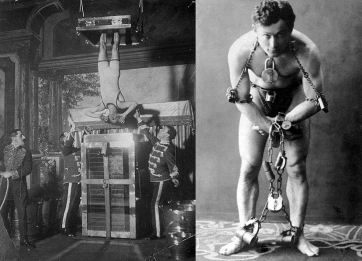
Harry Houdini

Harry Houdini

From escape artist Harry Houdini to motorcycle stunt rider Robert “Evil” Knievel, daredevils have long attracted crowds of spectators and generated millions upon millions of dollars for their promoters over the years. While Houdini eventually died of a ruptured appendix, he was nearly killed several times by his own hand as a result of escape attempts gone wrong. Many of his compatriots, like Wicker, were not so lucky; which begs the question, is the spectacle worth the risk? Apparently it is because the public keeps going to see them, like sadistic voyeurs almost hoping to see something go horribly wrong.

Local government, concerned about the staggering level of liability involved, does everything it can to discourage people from attempting these kinds of stunts by requiring miles of paperwork and expensive permits before allowing these kinds of activities on public lands. Some simply don’t allow it to happen at all.

Wallenda’s high wire walk, for example, didn’t actually cross over the Grand Canyon, but the gorge of the Little Colorado River Navajo Tribal Park. His 1,400 foot steel cable was actually suspended over land of the Navajo Nation, near Cameron, Arizona.

Could these daredevils have what Freud called a “death wish,” a desire, often deeply repressed, for self-destruction, accompanied by feelings of depression, hopelessness, and self-reproach? That might be said of Houdini, given his almost obsessive interest in death and the afterlife. But for most everyone else in this line of work, it’s about attention and a desire to push the envelope – that need for the adrenaline rush associated with doing what no one else is brave enough to do (or stupid enough, depending on your point of view).

In the end, there would be no market for these kinds of acts if the public wasn’t thoroughly fascinated by them. As for the performers themselves, it’s probably best to take into account Jane Wicker’s own words.

“Why do I do this? There is nothing that feels more exhilarating or freer to me than the wind and sky rushing by me as the earth rolls around my head,” Wicker once wrote. The day before the crash she told WDTN TV2, “I’m never nervous or scared because I know if I do everything as I usually do everything’s going to be fine.”

For those left behind, there is a great sense of loss when these daring entertainers pass doing what they love. But they will be remembered for their spirit and the smiles on the face of those who sat in awe of their skill and passion to defy the very fabric of nature.

Gery L. Deer is an independent columnist and business writer based in Jamestown, Ohio. More at http://www.deerinheadlines.com.

I pledge allegiance, on Flag Day

In Education, history, National News, Opinion, Politics, sociology on June 13, 2013 at 12:11 pm

DIH LOGO

“I pledge allegiance to the flag, of the United States of America and to the republic for which it stands, one nation, under God, indivisible, with liberty and justice for all.” This is how the Pledge of Allegiance is worded today. When it was originally penned in 1892, however, the author of the oath, socialist minister Francis Bellamy, included no references to America or God.

ros123Bellamy’s hope was that the pledge could be used by any citizen around the world to honor their own country’s flag. Later, it was adopted as a pledge to the American flag and the words, “under God,” were added in 1923.

To some Americans, there is no more powerful a symbol of liberty and freedom. To others, the flag is a symbol to be used in protest of government tyranny. Whatever the semiotics involved, the American flag has profound meaning around the world.

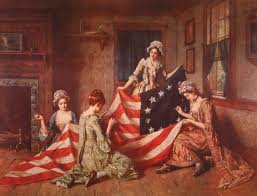
Legend has it that Betsy Ross, a Philadelphia seamstress who made flags for the navy, was commissioned by George Washington to create the first flag for the colonies. As charming a story as that may be, however, there is no verifiable information to support the tale.

What is known, historically, is that the first unofficial national flag, called the Grand Union Flag or the Continental Colours, was raised near George Washington’s headquarters outside Boston on January 1, 1776. It had 13 alternating red and white horizontal stripes and the complete British Union Flag in the canton (the upper corner, where the blue field and stars are located today). Another early flag included a rattlesnake and the motto “Don’t Tread on Me,” emblazoned on it; a design popular today with the conservative Tea Party movement.

The design of the Grand Union flag was altered about a year later to include the better known blue field in the canton with a circular pattern of stars representing each of the original 13 colonies. On June 14, 1777, the Second Continental Congress adopted this version as the flag of the United States. More than two centuries later, the date is still honored throughout the country as a holiday called, Flag Day.

Since its creation, the “Stars and Stripes” has been one of the single most recognized symbols in the world. Sadly, some people in America today believe that honoring the flag is no longer relevant, that it’s distasteful to fly or display the flag, or even offensive.

There is no question that our country is not perfect, and our leaders have made their share of mistakes. But the ideals of peace, justice and freedom are worth honoring, regardless of your political views, and that’s what Old Glory represents.

Today, children are no longer encouraged, sometimes even prohibited, to say the Pledge of Allegiance in school. The Pledge is seen by some as indoctrination to an ideology or worship of a false idol or some other such nonsense.

The truth is, indoctrination is everywhere and is usually voluntarily accepted without question. It’s in our social organizations, our schools, our businesses and especially in our political parties, churches, synagogues and mosques.

Each of these doctrines tend to divide us as a people, but getting behind a common symbol, the one that is intended to represent the best in us, the honor and sacrifice of those who came before, that is an indoctrination that can unite us in a way not found anywhere else on earth. It’s not forced, commanded or required – it’s our choice, each and every one of us.

Our flag has been burned, spat upon, dragged in the dirt, destroyed in battle, and shredded in conflict. It has withstood civil war, social unrest and political mudslinging. Far too many times, it has also covered the remains of those who died to defend it.

It may only be a red, white and blue piece of cloth, but it represents blood and sacrifice and signifies your right to find it distasteful, continuing to be a symbol of those rights whether or not you appreciate it. So happy Flag Day and may God (whoever your god happens to be) bless the United States of America.

Deer In Headlines is distributed by GLD Enterprises Commercial Writing. More information at http://www.gerydeer.com.

Author Shares Journey of Love and Despair as Caregiver for a Mother Ravaged Dementia

In Books, Education, Entertainment, Health, psychology, Senior Lifestyle, sociology, Uncategorized on May 30, 2013 at 1:43 pm

Elaine Pereira yearbookGREENE COUNTY, OH –  Author Elaine Pereira shared the seemingly never-ending journey of caring for her mother stricken with dementia in her newly-released book I Will Never Forget: A Daughter’s Story of Her Mother’s Arduous and Humorous Journey through Dementia (ISBN 978-1-4759-0690-5). The award-winning author will be visiting Xenia for two public events, June 6 and 7.

I Will Never Forget is a powerful true story of the author’s talented mother, Betty, and her poignant and humorous journey through dementia. As their mother-daughter relationship evolves, Elaine copes with her mom’s uncharacteristic verbal assaults and watches as her brilliant mind is slowly destroyed by dementia’s insatiable appetite for brain cells.

Elaine Pereira earned a BS in Occupational Therapy and an MA in Family and Consumer Resources from Wayne State University and worked as a school occupational therapist for more than 35 years before retiring in June 2010. In this moving account, Pereira shares warm and humorous incidents as well as tragic and overwhelming encounters from the death of her father, sister-in-law, brother and her mother’s journey through a new world after her familiar world fades from her memory.

“This is a true story which validates the incredible events that happened in my mother’s life,” says Pereira. “From writing nine checks to the same payee, on five consecutive days, and later on the Great Houdini Escape when she nearly froze to death, Mom’s journey through bewildering dementia is real.

Cover I Will Never Forget 1-15-13I Will Never Forget is educational and therapeutic but is a journal full of insights that will provide helpful assistance and tips to other caregivers of dementia patients. “I want newly-commissioned caregivers to learn from my unwitting mistakes, to realize that reasoning and logic are rarely helpful dialogue techniques with a dementia patient,” explains the author.

“That approach is confrontational and often creates agitation and a fear response in someone. Redirection, re-phrasing, waiting and patience are the most helpful response strategies to diffuse potentially hostile situations.”

During the year long writing process, Pereira was able to put the troubling incidents in her mother’s final years in perspective. “The little problems faded away and the core of her wonderful life surfaced for me. That is how I want to remember her, as she was in my eyes as a child.”

Pereira’s book was named a finalist in the Best New Non-Fiction category of the 2012 USA Book Award and was an honorable mention finalist in non-fiction in the 2012 Hollywood Book Festival and was bestowed a ‘Rising Star’ and ‘Editor’s Choice award by iUniverse. The book most recently won the aging category in the 2013 National Indie Excellence Awards.

At 7PM, Thursday June 6, Pereira will speak to the members of the Western Ohio Writers Association at  Blue Jacket Books, 30 S. Detroit St. in Xenia, Ohio, with an emphasis on how and why she wrote the memoir about her experience. The event is $5 per person, open to the public, and RSVP is requested by emailing the organization’s director, Gery L. Deer, wowainprint@gmail.com

The next evening, Friday June 7, beginning at 7PM, the author will be at Blue Jacket Books, 30 S. Detroit St. in Xenia, Ohio, to speak about the experiences so many people now have in caring for a parent or other loved one suffering the ravages of dementia and Alzheimer’s disease. There is no charge for this event and seating is first come first served. For information call 937-376-3522. The author will be selling and signing books at both events.

Who am I, and what am I doing here?

In Entertainment, Health, Opinion, psychology, Religion, Senior Lifestyle, sociology, Uncategorized on May 15, 2013 at 12:04 pm

Deer In Headlines

By Gery L. Deer

We’ve all had moments when we’ve turned to someone, a father, a brother, a God and asked, “What was I meant for? Am I doing what I was supposed to do?” It’s a normal exercise for us to question our situation, regardless of its status.

But we have to be careful to realize, regardless of how much we’d like the world to be a mystical place, our own choices landed us where we are and nothing was “meant to be,” that wasn’t directed by personal decisions.

I think it’s pretty normal to think we were meant for something more than we are, at least most of us probably feel that way. What many people tend to miss is how much value their lives have to others and how much would be different in the world without their contributions.

Over the last few years, I’ve written a great deal about my late mother, Lois. She passed away in November of 2011 after long battle with Alzheimer’s disease which among other things robbed her of a lifetime of memories.

Mom wasn’t an overly complicated person but she was very smart and caring, always putting others ahead of her – particularly her children and grandchildren. She only ever worked as a school volunteer, on the farm with Dad and for a time as a waitress in a little hometown restaurant where I grew up.

She might not have had the life people grow up dreaming about, but I’d like to think she felt like she had made a difference in the world. I know she did for me and my family. She didn’t have money or status or important connections, but she had wisdom and a level of understanding of her world and those in it that I truly wish I could emulate.

To some people a basic, down-home lifestyle could seem like Purgatory; a futile, pointless existence. Even though she didn’t have a list of college degrees after her name, nor did she work some high-powered job (unless you count managing my dad), her mere influence upon those around her probably had far greater reach than she ever knew.

In my mind, Mom had the life she was “meant” to live, evidenced by the efforts of those who helped care for her and offer support to our family as her illness advanced. We all have a place in the world and it might not seem like it matters at the time, but we are often more influential than we realize.

Since the kind of work life I have chosen does not lend itself to earning fistfuls of cash, far from it, I have always hoped that my labors have at least helped to enhance someone’s life, even in the slightest. Whether I am making people laugh on stage during The Brothers & Co. variety shows, or passing along my worldly observations in my writing, I always try to give people something that will help make their life better, even if it’s only for a moment. To me, that’s rewarding in itself.

Even when people don’t agree with something I’ve written, the point to take away is that they read it, and it made them think. I don’t want everyone to agree with me, nor am I trying to persuade them to alter their life paths based on my opinion of something. My job is to enhance someone’s life just by giving them something new to think about and that is the accomplishment.

So, a sense of accomplishment isn’t always derived from academic or financial achievement, and in my limited view of the world, it almost never comes from material success. Sometimes just being who you are and contributing to the world around you makes the longest-lasting difference.

Were you “meant” to be who you are, though? That’s a question best left to you. Only you can evaluate your level personal satisfaction from the world you’ve created for yourself. You are who you are, right or wrong. So like I heard once in a song, “This is it. This is life, the one you get, so go and have a ball.” And enjoy being you. It doesn’t matter how you got there.

 
Gery L. Deer is an independent columnist and business writer based in Jamestown, Ohio. More at www.gerydeer.com.

Excuse me; is that your nose in my business?

In Children and Family, Entertainment, Opinion, psychology, sociology, Uncategorized on May 8, 2013 at 2:43 pm

Deer In Headlines

By Gery L. Deer

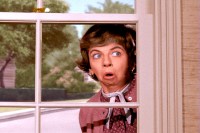
On "Bewitched," nosey neighbor, Gladys Kravits (Alice Pearce) always got more than she bargained for with her cup of sugar!

On “Bewitched,” nosey neighbor, Gladys Kravits (Alice Pearce) always got more than she bargained for with her cup of sugar!

Fifteen years ago, I was shopping for my first house when I realized I had no idea exactly what it was I wanted. I grew up on a farm with a house smack in the middle of a valley of trees, pasture and corn fields so I was lacking some of the social necessities of being a ‘neighbor.’

I had no idea what it meant to have to “keep up with the Joneses,” and I never saw my mother so desperate for sweetener that she needed to bang on someone else’s door and demand they fill her measuring cup with sugar. I just didn’t get it. And, after a good fifteen years, I still don’t.

Growing up in such isolation taught me self-reliance and a good feeling for minding my own business. Even as an adult, as public as I might seem between my published work, music and television appearances, I tend to be a bit of an introvert. It’s not that I’m unfriendly, quite the opposite, but I just feel like I should keep my nose in my own cupboard and leave others to do the same.

For some, however, that’s not the case. When I first considered a suburban home, I visited several developments and each put me in mind of TV shows of years past. On TV, the houses looked all the same and there was always that one, nosey neighbor who just couldn’t keep off your grass.

Inevitably, I think of Gladys Kravits, the screeching butinsky from “Bewitched,” who spent her day tormenting her happily ignorant husband Abner all about the goings on at the Stevens home across the street. Granted, there were weird things happening on Morning Glory Circle (that’s the street where Samantha and Darren lived on the show), but rarely did those events directly impact the neighbors.

I tend to be an observer of human behavior, which helps me, I hope, to be a good writer. I’ve noticed over the years that the preoccupation of people with the activities of their neighbors can be close to a debilitating obsession.

Constant worry about the concerns of others is, to my mind, ridiculous and kind of neurotic. What if you did nothing all day but ponder such things like … When did John cut his grass – for the tenth time? How did Bob buy that above ground pool when he doesn’t make that kind of money? Do those people have anything else to do but remodel their house every month?

It can get out of control. I’m hoping that level of unwarranted curiosity isn’t the norm but the exception. I would hate to think that my comings and goings were costing a good night’s sleep to anyone but me. That’s not to say that even rural suburbs don’t offer some level of low-brow entertainment of a kind that would even sour Jerry Springer’s sensibilities.

Fortunately, where I finally chose to buy a home turned out to be the perfect fit for me. But I know people who live in suburbs where you can’t make a move without someone commenting on it or having an opinion to gossip about. I’m sure it happens everywhere, but I think people should spend their time worrying about their own lives and stay out of the affairs of others.

If the concerns of those around you occupy your thoughts more than your own actions, it might be time to take a look in a mirror instead of out the front window. Being nosey isn’t the same as being neighborly.

Thoughtful compassion for a neighbor with a sick parent or welcoming a new baby is not the same as feeling the compulsion to always see what’s going on next door. It’s important for people to know the difference and respect those boundaries.


Gery L. Deer is an independent business writer and contributor to the WDTN-TV2 show, “Living Dayton.” More at http://www.gerydeer.com