
Local News & Commentary Since 1890.

Archive for the ‘sociology’ Category

India vs. China: Economic growth and national security

In Economy, history, National News, Opinion, sociology, Uncategorized on June 9, 2014 at 9:47 pm

DIH LOGOOn June 4, 1989, after three weeks of civil rights protests by nearly a million Chinese, many of them students, Chinese troops stormed a packed square in Beijing, killing and arresting thousands. The Tiananmen Square Massacre shocked the world and confirmed the belief, not that there was any doubt, that China’s political system is completely incompatible with that of the United States and pretty much any other democratic nation.

A quarter of a century later, it’s still largely incomprehensible why America is so tied to a country with no decency with regard to human rights. It’s about two things that shouldn’t surprise anyone, money and political power. There’s a little fear thrown into the mix as well associated with China’s massive military might and a government with no reservations about using it.

Labor costs are incredibly also low in China, with the average factory worker earning just one-tenth of what their American counterparts bring home, according to the Bureau of Labor Statistics. Cheap labor is an attractive prospect to American companies looking to expand production with fewer tax and employment expenses. It seems there is no end to U.S. manufacturers relocating in China; producing cheaper goods to be shipped back America and sold at a premium profit.

Contrary to popular belief, however, according to the Council on Foreign Relations, only 15-percent of U.S. imports come from China. That comes out to something like $29 billion of a $1 trillion monthly output. There are more than 1.3 billion people in China, many of whom, like their American counterparts, want, more than ever, the latest technology, fashions, entertainment and so on. Although it is generally exaggerated, a definite trade deficit exists between the two nations, which is unlikely to change anytime soon.

China or India? Which makes more sense for the US?

China or India? Which makes more sense for the US?

It’s entirely possible the United States should be looking a little further southwest for political and economic growth in Asia – India. After all, which would seem a much more stable and amiable political and economic ally? With more than 1.2 billion people living in 29 states, India is the world’s second-largest country and second-largest democracy, English speaking and primed for growth.

If India is a more lucrative and stable prospect, what’s holding America back from a greater fueling of the fire of partnership, economically and socially? Unfortunately, recent years have seen the U.S./India relationship strained over trade and intellectual property disputes. Plus, the Indian economy has had some rocky spots recently.

In 2013, the average median income per capita in India was around $1,200 (Compared to China at $2,100). Add to that, India’s economy has fallen off nearly 5-percent with 8-percent inflation and the country’s fiscal health is a major barrier. However, the election of a new prime minister, Narendra Modi has encouraged investors and the economy has reflected that confidence.

According to CNN Money, “The prospect of a government led by Modi has boosted Indian stocks by 15 percent so far this year. The rupee has responded too, gaining six percent against the dollar after a dismal performance in 2013.”

There are other more politically charged issues slowing down a more aggressive relationship with India, but most U.S. officials see the country as a thriving democracy and a strategic gold mine. Close to Afghanistan and Pakistan, a more advanced partnership between America and India would benefit both countries in terms of economic growth and national security.

America imposed sanctions against India in 1998 because of nuclear testing. But, thanks to former presidents Clinton and Bush, relations improved greatly and the two nations even signed a ground-breaking defense and civil nuclear (power) agreement.

With the possible exception of the political unknowns surrounding a new prime minister, previously a Hindu Nationalist, there is little reason to spend so much time courting the stagnant communist regime in China instead of nurturing a reasonably stable democracy, and growing economy, in India. In the end, it certainly seems that it would be much wiser for Washington to advance trade and economic partnerships with India.


Gery L. Deer is an independent columnist and business writer based in Jamestown, Ohio. More at http://www.gerydeer.com.

 

More family advocacy needed for elder care

In Children and Family, Health, Opinion, psychology, Religion, Senior Lifestyle, sociology, Uncategorized on April 16, 2014 at 1:31 pm

DIH LOGOCaring for an aging parent is, in my opinion, one of the most difficult and often painful experiences life throws our way. Providing a safe, healthy environment for an elderly family member is just as taxing as doing the same for a child.

What makes this process even harder is when the parent is resistant to help or simply won’t accept that they are no longer in a position to take care of themselves. Poor decisions, an inability to recognize when driving has become hazardous and, worst of all, when they will listen to anyone’s advice but that of their children, complicates the care process and causes serious damage to the parent/child relationship.

It’s hard to watch parents age and knowing you’re headed the same direction only solidifies the reality of it all. It’s harder still when they resist every attempt to maintain their health and sometimes doctors undermine your efforts by telling them they don’t have to do anything they don’t want to.

I understand that people need to make their own choices, but some shrink in a hospital cannot possibly know an individual’s mental status by talking to them once for three minutes and asking a half dozen pointless questions. “Do you know where you are? Do you know what day it is? Can you draw this box? Write your name.” “Draw this box,” are they kidding?

How about we ask them what their checking account number is, or the name of their insurance company? How about asking when they last paid their phone bill? These are vital questions to someone who is supposedly “competent” and yet this is not what is included in a psychiatric evaluation for a senior’s ability to make his or her own decisions.

Then there are those who are intent on taking advantage of the elderly person’s desire to feel “needed” and useful. These individuals worm their way into the lives of the elderly, showering them with compliments and creating a rift between the senior and his or her family. These unscrupulous people are trying to get money and property away from the senior and alienate children and others who are trying to protect their interests.

Deer In Headlines author Gery Deer is helping his brother Gary Jr and sister Cathy to take care of their father, Gary Sr. and it's rarely easy work.

Deer In Headlines author Gery Deer is helping his brother Gary Jr and sister Cathy to take care of their father, Gary Sr. and it’s rarely easy work.

Laws addressing the rights of seniors, as well as those regarding patient rights, seem to take no account to dementia and speak only to protecting them from family members bent on securing money or locking them away in a nursing home. What about those of us who are trying to protect our parents and provide a safe, secure life for them in their own home as long as possible? Where is our protection and support? There is none.

Preserving a person’s dignity is difficult enough without being able to handle even the most basic decisions absent a mile of legal documents in place only to provide more money for lawyers. Power of attorney documents are meaningless unless the person is thoroughly incapacitated and no one will help without signing over deeds and financial statements.

Believe it or not, sometimes money has nothing to do with it! There are actually situations when families are trying to preserve an aging parent’s lifestyle, dignity and financial security. Someone should be out there advocating for us, not making it harder. Unless you’re loaded with money, there is just no support for people dealing with this kind of problem.

So what is to be done? Good question. I am all for protecting the rights of the elderly and maintaining their ability to make decisions, but there are many degrees of incompetence between fully cognizant and Alzheimer’s dementia and that should be taken into account.

My mother lost all of her reasoning ability as Alzheimer’s set in and it nearly bankrupted my family to get her under a guardianship so we could keep her safe and well-cared for. But when a senior has some competence but not all, that needs to be addressed and the family should be able to have some advocacy for protecting the interest of that individual without so many roadblocks.

Legislation should be put into place for the varying degrees of dementia and stop relying on the ‘one size fits all’ psychiatric evaluations that prove nothing more than the person can read a calendar.


Gery L. Deer is the editor and publisher of The Jamestown Comet.com an independent columnist and business writer based in Jamestown, Ohio. More at http://www.gerydeer.com.


It takes a maverick to make a difference

In Education, National News, Opinion, Politics, psychology, Religion, Science, sociology, State News, Uncategorized, World News on March 24, 2014 at 7:59 am

DIH LOGOAccording to one definition, a maverick is, “an unorthodox or independent-minded person.” But a maverick is also someone who chooses not to give in to the pressures of society, breaking ranks, not for personal gain, but in an effort to improve conditions or expand knowledge for everyone.

In the 16th Century, the now revered scientist Galileo Galilei would certainly have fit the definition of maverick. At a time when the church kept tight control over the public’s understanding of the world around them, Galileo’s challenge that the earth was not actually the center of the universe but instead part of a solar system with our sun at its center was controversial.

Of course he was eventually proven right, but standing against such a powerful entity as the Catholic Church sent Galileo to be tried for heresy. There are countless cases like this throughout history, most related to individuals who chose to challenge long-standing beliefs in politics or religion.

Today, as in Galileo’s time, society is taught and expected, from an early age, to keep quiet; never to upset the status quo for fear of retribution. Those willing to stand up and be heard shape the most change in the world, but often pay a high price for their contribution to progress. Much of what society deems acceptable is dependent on one’s position and the sphere of influence there encompassed.

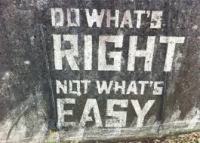
whatsrightFor example, it is unacceptable in many religious groups for a married couple to divorce. They are expected to remain together indefinitely for the good of the church, their families and so on, regardless of the situation, even in cases of physical abuse. It stands to reason, therefore, that the first few individuals who challenged these rules were certainly dealt with harshly. Fortunately, over time, this type of censure has eased somewhat, at least publically.

On the whole, it is difficult to greatly influence public perception and alter the behavior of a society or to get people to remove the blinders of ideology and accept the possibility that there are other ways of thinking. Ignorance, prejudice and misunderstanding usually lead to fear and resistance.

It should also be made clear that religious groups are certainly not alone in such ridiculously judgmental behavior. Anyone who challenges established norms can find themselves on the receiving end of some pretty unpleasant retribution, particularly in the workplace.

Often employees are never to question authority or decisions made by their superiors, otherwise face reprisal. But what does one do when superiors are actually breaking the law? In 1989, Congress passed the Whistleblower Protection Act. The law is designed to shield workers against retaliatory personnel action – meaning, essentially, it keeps them from being fired – for “blowing the whistle” on illegal activities perpetrated by their employers.

Unfortunately, there is no such protection for the everyday person who simply wants to do the right thing. From Moses and Lady Godiva to Rosa Parks and Martin Luther King, taking a stand to alter deeply engrained social beliefs has never been a task for the weak-hearted.

Most people are discouraged by how much retribution might be taken out on them for going against the grain. Sometimes, however, just standing up for the little things can help to affect larger changes. Making a difference in the boardroom, at school or even in the hallowed halls of church might ruffle some feathers, but if the purpose is worthwhile, it would be wrong not to do something.

So, what about those by-standers who agree with the maverick but are afraid to stand with her? If only one other person supported the cause then another would as well, then another, and another. That’s how revolutions are started in the face of resistance. So the next time you see an injustice being done and you have the opportunity to act, what will it be: Maverick or conformist?  Ω

Gery L. Deer is an independent columnist and business contributor to the WDTN-TV2 program, “Living Dayton.” More at www.gerydeer.com.

Are you happy, or just think so?

In Education, Opinion, psychology, sociology on January 15, 2014 at 9:22 am

DIH LOGOThey say … and I admit I’m not totally certain who “they” are in this context. But they say, happiness is just a state of mind. In fact, the same, “they” also believe all reality is just in your head; that your own thoughts create the authenticity of the world around you. Yes, I know, that’s too much heavy thought for such a short column, but it offers an interesting concept.

If everything we know as reality is determined, not by the people and things around us, but, instead, from our own thoughts then how real is it, really? OK, that’s a bit much to take in, even for me. But suffice to say emotions are created and altered by thoughts. So, are you happy? Or, do you just think you are? In the end, if “they” are correct, it doesn’t even matter.

Most people can change how they feel simply by altering their thoughts or, at least, their perception of a situation. That is, unless you suffer from some type of chemical issue in the brain that causes your feelings to spin out of control no matter what you’re thinking. And we’re not going to get into any of that because I am simply not qualified to talk about the subject.

But for most, it is entirely possible to alter your state of emotion and change how you react to outside influences just by shifting your thoughts. For example, many people get upset when a child breaks or spills something. Unless someone is done physical harm, what is there to get upset about? Have you ever heard the saying, “don’t cry over spilt milk?” It’s a bit of good advice telling you not to whine about the accident, just clean it up and move on.

GDEER-BLUE_SHIRT_FROM_ABOVEIn my opinion, sometimes it’s really hard to get that one, nagging negative thought out of your head. So, I think that altering your way of thinking is more about prioritizing than anything else. In other words, pick your battles.

If you drop a dish or your child dumps Kool-Aid all over that new white rug, does it, in the grand scheme, really matter? Assuming, of course, there is no malicious intent involved. After all, regardless of the political incorrectness of the idea, kids really are just bad sometimes. Either way, getting angry and blowing your top at yourself or the child isn’t going to put the dish back together or “unspill” the drink.

Now what if your husband decided to fire up the new grill he got for Christmas inside the garage? No, I don’t know why someone would even … never mind, just go with me here. In this situation, there is a potential danger to your family so it’s worth getting a bit more upset, but you have to control your thoughts to keep from becoming hysterical.

It will serve you better and help you remain calm if you focus on preventing a potentially devastating situation than to immediately punish your idiot husband. Take the proper steps, ensure everyone’s safety and solve the problem. That’s what I mean by changing the way you think.

Needless to say, altering lifelong behavior, good or bad, doesn’t happen overnight and it’s certainly not easy. It takes practice and diligence. Whenever something happens that throws your day into an uproar, try not to get upset. Try hard to focus on a solution to whatever’s gone wrong and look forward to the positive outcome.

I’ve often argued that people make some of the most important decisions in life based solely on emotion rather than rational thought. Even the faithful are guided almost entirely by pure emotion. Making decisions actually becomes easier, and more productive when done from a logical perspective.

Gery L. Deer is an independent columnist and business writer based in Jamestown, Ohio. More at www.gerydeer.com.

Obamacare: Politicians lie to cover bad legislation

In Economy, Health, National News, Opinion, Politics, sociology, Uncategorized on November 19, 2013 at 5:03 pm

DIH LOGOHow ever the White House and the Democrats want to spin it, President Obama lied about the Affordable Care Act – and he wasn’t the only one. But it’s “his” plan and legacy that are on trial now.

Denying that he ever said the line is ridiculous and just makes liberals look worse. It has been fact-checked repeatedly even by liberal news media. The first appearance of the empty promises came at a town hall on August 15, 2009 when the President said, “I just want to be completely clear about this; I keep on saying this but somehow folks aren’t listening — if you like your health care plan, you keep your health care plan. Nobody is going to force you to leave your health care plan.”

Less than a year later, he said essentially the same thing at a speech on March 25, 2010 in Iowa City, Iowa. Speaking of those who were skeptical and cynical of his health reform President Obama said, “They’ll have to finally acknowledge this isn’t a government takeover of our health care system. They’ll see that if Americans like their doctor, they’ll be keeping their doctor. You like your plan? You’ll be keeping your plan. No one is taking that away from you.” If you’re curious, none of this is out of context and full texts for these speeches are available at the White House website.

Without beating a dead horse, this is thoroughly inaccurate or, as the Democrats would say about a Republican president, he lied. There is no caveat stated in any of these remarks related to grandfather provisions or referring to existing medical plans that must meet some set standard required by the new law. It says, very clearly, no one would lose their existing coverage.

In a live address July 25th, President Obama urged Americans to pressure congressional leaders to move toward a compromise. (AP Photo)

So how can anyone say he did not lie about it? Making excuses for lying politicians – on either side of the aisle – does not an honest man make. It’s no secret I’ve never really been a fan of this president, nor the last one either for that matter. But regardless of your loyalties, to deny that he misled the public is just feigning ignorance. He didn’t misspeak or stumble on his phrasing, and leaving out a vital piece of information is a lie by omission, so Dems need to stop trying to defend it.

The Affordable Care Act is a badly written piece of legislation that was pushed through to meet a political agenda rather than to benefit the population as a whole. Overall, I agree with the concept that we need some way to cover those people who cannot afford health care. But at the same time, those already paying their own way shouldn’t be punished by having their current policies systematically cancelled just to meet a set of arbitrary requirements established to force enrollment in the government’s new insurance monopoly.

Speaking of monopolies, wouldn’t it have made sense to have something in the law requiring premium caps and policy cost regulations? What about some kind of legislation that would control the pricing of health care services and keep the cost lower in the first place? One would think our government is more concerned with the expensive cost of a pack of bubble gum than the outrageous price of a critical medical test.

Lobbyists from the medical and insurance industries are extremely powerful, far more so than the average small business owner or individual health insurance consumer. Since most legislators are in the pocket of some major lobbying group, it would be financial suicide for them go against anything as massive as the insurance industry.

The only practical solution to this issue is to correct the problems within the content of the Affordable Care Act; not by presidential mandate, but through the legislative system. Congress needs to re-open the letter of the law and grab an eraser. Force the insurance companies and hospitals to lower costs and let people keep their insurance. Bad legislation only gets worse and wastes taxpayer dollars instead of more efficiently allocating that money to more productive purposes.

What was the “crucible event” that changed your life?

In Opinion, psychology, Religion, sociology, Uncategorized on October 30, 2013 at 9:15 am

DEER IN HEADLINES

By Gery L. Deer

GDEERDIH3Some people believe one is destined to become whatever is predetermined by their god, with all of life’s events planned in advance by some divine manifest destiny. For others, that destiny is in a constant state of change, altered by the ebb and flow of cause and effect, guided not by the hand of a supreme being but by our own choices.

Generally, however, there are some events in life that we can pinpoint as our time of transformation; a crucible, if you will. Within it, parts of us are burned away leaving a changed, newly-formed person, sometimes for the better, sometimes not.

Divorce, extended health problems, the loss of a home, personal income or a job, can all bring about emotions and primal reactions for which we are rarely well prepared. Perhaps the most powerful events that permanently change us are related to the death of someone close such as a family member, mentor or good friend.

For many the death of a loved one can be a crucible, forcing to the surface thoughts and emotions perhaps long buried, or never before experienced. How we deal with death is at least as important as how we deal with life, but we seldom take that concept to heart.

Even as a topic of conversation, death is to be avoided. Its unmistakable finality has so marked humanity that coping with the end of life has served as a catalyst for the formation of enduring religious beliefs, some of which comfort, others frighten.

What may be surprising is that a ‘crucible event’ does not necessarily have to be a negative or unhappy experience. The same kinds of life-changing occurrence can come from positive influences as well such as the birth of a child, a marriage or sudden financial windfall.

The events themselves, however, aren’t what change us; we do that on our own. Most people don’t realize they have the power, for the most part, to alter how they react to outside influence. Feelings are generated by thoughts, so if we control our thoughts, we can better manage our feelings and make more productive decisions during difficult times. That’s a tall order though when it feels like the world is collapsing around you.

I’ve had many challenges in life, from an early age, but the most influential times were during my mother’s long struggle with Alzheimer’s disease. The role reversal (the child becomes the parent), watching helplessly as the illness ravaged her mind and body, and helping to do everything from administer medication to hand-feeding her took a toll on me emotionally that I probably have yet to fully realize. But it did change me; in ways I can’t even imagine yet.

I look at the world a little differently now, having experienced for myself, largely for the first time, the fragility of life. But it was the experience of caring for my mom over the course of a couple of years that slowly burned away layers of my rigid exterior, making me “feel” more than I had previously been accustomed.

It’s really what we do with those feelings that make the difference in the long run. While an experience like I had with my mother could have left me bitter and resentful, I ended up taking to heart a more positive side and a greater appreciation for my family as a whole. Others aren’t so lucky.

Many people emerge from crucible events in a much darker place, filled with resentment or guilt or other emotions that eat away at their core, keeping them from seeing the good that came out of whatever had happened. And, there is always some good – sometimes it’s just very hard to see. Either way, we are changed, different, but it’s up to each of us to decide how those events ultimately affect our lives.


Watch independent columnist Gery L. Deer monthly on WDTN-TV2’s Living Dayton. More at http://www.gerydeer.com.

Author celebrates first anniversary of children’s book with reading November 2

In Books, Children and Family, Education, Entertainment, Literature, Local News, Print Media, sociology, Uncategorized on October 24, 2013 at 8:50 pm
Author Teasha Seitz, "Little Leah Lou and her Pink Tu"

Author Teasha Seitz, “Little Leah Lou and her Pink Tu”

XENIA, OH – Author Teasha Seitz is a Miami Valley native who has always enjoyed sharing and discovering stories with children. Her stories entertain, enlighten, and encourage young readers to explore their own world and discover who they are. Her first children’s book “Little Leah Lou and Her Pink Tu,” was released last year (ISBN 0985662506).

To help celebrate the book’s first anniversary, Blue Jacket Books in Xenia is hosting a reading and signing event beginning at 10:30 a.m. on Saturday, November 2. The author will read from her book and the store will have free printed activities for children to do as well.

Illustrated by Jean Ditslear, “Little Leah Lou and Her Pink Tu” tells the story of Little Leah Lou, who loved to wear her pink tutu. She wore it everywhere she went and pretended to be a princess. But when she wore it to the zoo she encountered a giraffe with the munchies and Little Leah Lou was left with just half a tutu. Her tutu was ruined! Could this mean she’s no longer a princess? Little Leah Lou was shocked, but not for long. Her solution to the tutu tragedy will not only surprise and amuse readers; it will win her the admiration of one of the zoo’s flashiest residents.

In addition to copies of “Leah Lou” at a dollar off the cover price, children’s tutus will also be available for purchase as a “package” with the books. Blue Jacket Books is located at 30 S. Detroit St. in Xenia, Ohio. For more information call the store at (937) 376-3522 or go online to http://www.teashaseitz.com.

Little-Leah-Lou-and-Her-Pink-Tu-Seitz

Western Ohio Writers present live Halloween reading at Books & Co., Oct 26.

In Books, Children and Family, Dayton Ohio News, Education, Entertainment, Literature, Local News, Media, sociology, Uncategorized on October 16, 2013 at 10:11 pm
WOWA editorial committee member Bill Bicknell reads from his work at Books & Co. during last year’s “Beatnik Café” event.   Photo by Debra Bays, GLD Enterprises

WOWA editorial committee member Bill Bicknell reads from his work at Books & Co. during last year’s “Beatnik Café” event. Photo by Debra Bays, GLD Enterprises

Beavercreek, OH – Beginning at 7 pm on Saturday, October 26, author members of the Western Ohio Writers Association (WOWA) will take the microphone at Books & Co. to present their popular, “Beatnik Café” event. Writers from all genres will regale visitors with tales of Halloween through short works of fiction and poetry. The event is free and open to the public.

The live reading pays homage to the hole-in-the-wall poetry clubs of the 1960’s, but with a more modern style. Reading aloud from original work, each writer will take the stage for 10 to 12 minutes, dazzling audiences with short stories, poetry or who knows what.

Greene County native, Gery L. Deer is the co-founder and executive director of the organization. A professional freelance journalist, editorial columnist and commercial writer, he started WOWA in October of 2008. “WOWA was intended to provide a regular resource for peer critique, educational programs and networking opportunities to local writers of all genres, both amateur and professional,” he says.

“Annual workshops are held all around the country, with two of the most well-known right here in the Miami Valley. But for most writers to thrive that type of support needs to come on a more regular basis,” Deer says. “Our group consists of professional writers and editors, college professors and everyone is ready and willing to offer help, a fresh eye and, sometimes more importantly, an honest opinion about the quality of the work – good or bad.”

Writers come from all around the region – southwest central Ohio, eastern Indiana and northern Kentucky – to attend monthly critique sessions, educational lectures and write-in events. Meetings are held on the first Thursday of the month at the Event Connections, 4140 Linden Ave. in Dayton, near the intersection of US 35 and Woodman Drive.

Flights of Fiction. Cover art by Michael Martin

Flights of Fiction. Cover art by Michael Martin

October 2013 marks the organization’s fifth anniversary and these talented scribes definitely have plenty to celebrate. In addition to the many individual members who have been published on their own, in May of this year eleven of them were featured in an anthology titled, “Flights of Fiction,” produced by GLD Enterprises Commercial Writing and published by Handcar Press (ISBN: 978-0-9885289-4-9). The book features stories set in and around the southwest Ohio region and is available in print and electronic formats from the WOWA website as well as Amazon and BN.com.

The Beatnik Café is a family-friendly, free, public presentation of WOWA and GLD Enterprises Commercial Writing. Books & Co. is located at 4453 Walnut St. at The Greene in Beavercreek. For more information, go online to www.westernohiowriters.org or call (937) 902-4857.

Follow the WOWA on Facebook and Twitter.

T-Willy’s Yogurt Emporium celebrates first anniversary with customer appreciation day

In Business, Children and Family, Dayton Ohio News, Economy, Entertainment, Food, Local News, Senior Lifestyle, sociology, Uncategorized on September 17, 2013 at 5:52 pm
T-Willy's owner Wendy Preiser

T-Willy’s owner Wendy Preiser – Click the photo to watch WDTN-TV2’s Living Dayton host Shaun Kraisman as he takes on the adventure of T-Willy’s!

CENTERVILLE / WASHINGTON TWP. – When Wendy Preiser opened T-Willy’s Yogurt Emporium last year she invited patrons to come and express their creative, adventurous side – and that they did. As her way of saying, “thanks,” Preiser will celebrate the store’s first anniversary with a customer appreciate day from 11:00 a.m. until 10:00 p.m., on Saturday, September 28. Visitors to the unique, frozen yogurt shop can enjoy spin art, win door prizes, get a temporary tattoo or even enter to win a year of free yogurt.

Located in Washington Square Shopping Center, T-Willy’s offers a rotating menu of specially blended frozen yogurt flavors including Lemon Pound Cake, Salted Caramel Pretzel, Peanut Butter, and Key Lime Pie. Of course chocolate and vanilla are available for those who want an old favorite. All of the yogurt and toppings are sold by the ounce, in cups.   Mixing and matching is highly encouraged. There are always options that have no sugar added and most are gluten free.

T-Willy’s Yogurt Emporium brought about a brand-new way of enjoying frozen soft-served yogurt. Inspiration can be found everywhere inside the store, from the adventurous mural on the wall to the huge, tree-trunk toppings table.

According to Preiser, T-Willy’s frozen soft serve offers one of the highest counts of live and active yogurt cultures. The average 4-ounce serving contains less than 0.5 grams of dairy butter fat. “Yogurt is such a great basis because it is healthy, tasty and fun,” Preiser says. “My philosophy on food is that we should pay more attention to what we put in our bodies and less about what we leave out.  If we eat consciously, the occasional treat can be good for us physically and especially emotionally.”

Just one example of the favorite flavor creations is this months’s Oompa-Octoberfest.  It starts with swirls of vanilla yogurt and a squirt of peanut butter topping dusted with fresh coconut.  Then they throw on a scoop of chocolate covered pretzels and a dollop of cherry pie filling.  “Our store is about trying something new,” Preiser says. “There will always be something to intrigue and inspire our customers.”

T-Willy’s Frozen Yogurt Emporium is located at 6085 Far Hills Ave., across from Siebenthalers  and shares a parking lot with  Dorothy Lane Market. For more information go online to www.twillysyogurt.com or call 937-567-7818.

Be considerate of those around you

In Food, Health, Opinion, psychology, Senior Lifestyle, sociology, Uncategorized on September 10, 2013 at 9:20 am

DIH LOGODid you ever see someone behaving a certain way at work or in the grocery store and it made you just want to walk up and say to them, “What is wrong with you?” I have; more times than I can remember. On the whole, people annoy me. Maybe it’s because as I get older, I have less patience for “stupid.” It could also be that people are becoming less thoughtful and far more self-centered than ever.

Here’s an example. One afternoon, I had stopped in at on of the big-box, discount megastores to get some orange juice and aspirin. As I stood patiently in the “20 Items or Less” lane, a middle-aged woman in a leopard-print blouse and hair curlers motored past me on one of those electric shopping cart scooters. She was steering the scooter with one hand and with the other she dragged another full sized cart behind her like a trailer.

STORELINEBoth carts were filled to capacity with loads of healthy foods like barrels of cheese balls, cases of beer and soda and, of course, spray cheese. Although there were other check-out lanes open for larger purchases, the woman obliviously whizzed by everyone in the line and parked her rig right in front of me. All of the adjacent lanes were equally full and what was going to be a 5 minute wait was now bordering on a half hour because either she couldn’t read or didn’t understand the meaning of the words, “express lane.”

For a few minutes, I just stood there; a bit stunned at the woman’s total ignorance that she’d completely jumped over at least four others in line ahead of her. I debated whether to say anything but kept quiet. After all, no matter how rude she had been, I would just end up being the mean guy who scolded an apparently disabled older woman on a scooter. It’s a no win. So, I bit my tongue, opened my aspirin bottle, downed two tablets with some of the juice, and waited.

We all have moments when we’re in a hurry, totally consumed by our own interests and feeling like whatever we’re doing should be just as urgent to those around us. But, short of a natural disaster, that’s almost never the case. In fact, most people have absolutely no concern for your interests because they, themselves, are too wrapped up in their own issues. That doesn’t excuse a complete lack of common courtesy, however.

Lately, I’ve noticed it more often in younger people, walking along, even in a store or down the street, with their noses buried in their cell phones, unconscious to the world around them. No one looks up anymore. No one smiles. No one says, “Hello.” People act as if they are traveling in a bubble, where it’s unnecessary or at least undesirable to interact with anyone else in the real world.

I’d like to be able to blame social media and technology for all of this, and it definitely has altered how we behave towards one another. But, ultimately, it’s our own fault. We choose how to act and interact. If all of your interpersonal relations come through Facebook or by text, you might want to consider taking a class or getting a hobby that requires you to intermingle with other people outside of cyberspace.

As for those like my scooter-riding line jumper, I doubt anything will alter their way of thinking. Society will always have its share of self-centered people who have little regard for common sense or good manners. How the rest of us react to their behavior is really what will make the difference.

Maybe if I had complained to the woman in some polite, diplomatic manner, I could have quietly helped her to another line. But, given that she didn’t seem to notice there were other people around her, it’s unlikely she would have responded to reason.

In the end, it was best to keep the peace and let each of my fellow shoppers decide on their own alternate course of action. But to those of you with no regard for others, keep in mind that I may not be so polite next time. Be nice to people. When all is said and done, all we have is each other.