Local News & Commentary Since 1890.

Archive for the ‘Local News’ Category

Artificial Unintelligence

In Books, Dayton Ohio News, Economy, Education, Entertainment, finances, Jobs, Literature, Local News, Media, National News, News Media, Opinion, Science, sociology, State News, Technology, Uncategorized, World News on May 22, 2023 at 7:29 am

A Deer In Headlines II SPECIAL EDITION

By Gery Deer  

This work appeared in print and online, May 19, 2023 – Xenia Daily Gazette, Xenia, Ohio, and affiliated publications.

EDITORIAL NOTE:

The Jamestown Comet.com and Deer In Headlines II are publication products of GLD Enterprises Communications, Ltd. (GLD Communications), a company founded in 1998 on providing Information Technology AND Freelance Journalism, Copywriting, and Public Relations services. The column author, Gery L. Deer, is the company owner and CEO. Gery has been quoted in the media multiple times regarding his position on AI content creation. Here are the Dayton Daily News pieces noting his statements regarding Public Relations and Copywriting.

Our official statement on AI is as follows: We do not use AI programs to create our products, nor will we in the future. We are in full support of the WGAW strike, both in regard to streaming and other platform pay issues and the use of AI-generated material to replace them. We will not work with agencies who produce AI content, nor will we support their products or services. Please contact our office for more information at 937-675-6169 or email gdeer@gldenterprises.net.

Artificial Unintelligence

From congressional hearings to the picket lines of striking screenwriters, Artificial Intelligence, or “AI,” is a growing concern. This technology now affects nearly every industry and is advancing in sophistication. Of major concern to educators, professional writers, and content developers, are AI writing programs like ChatGPT. By the way, the program’s full name is “Chat Generative Pre-Trained Transformer” – I know, right? 

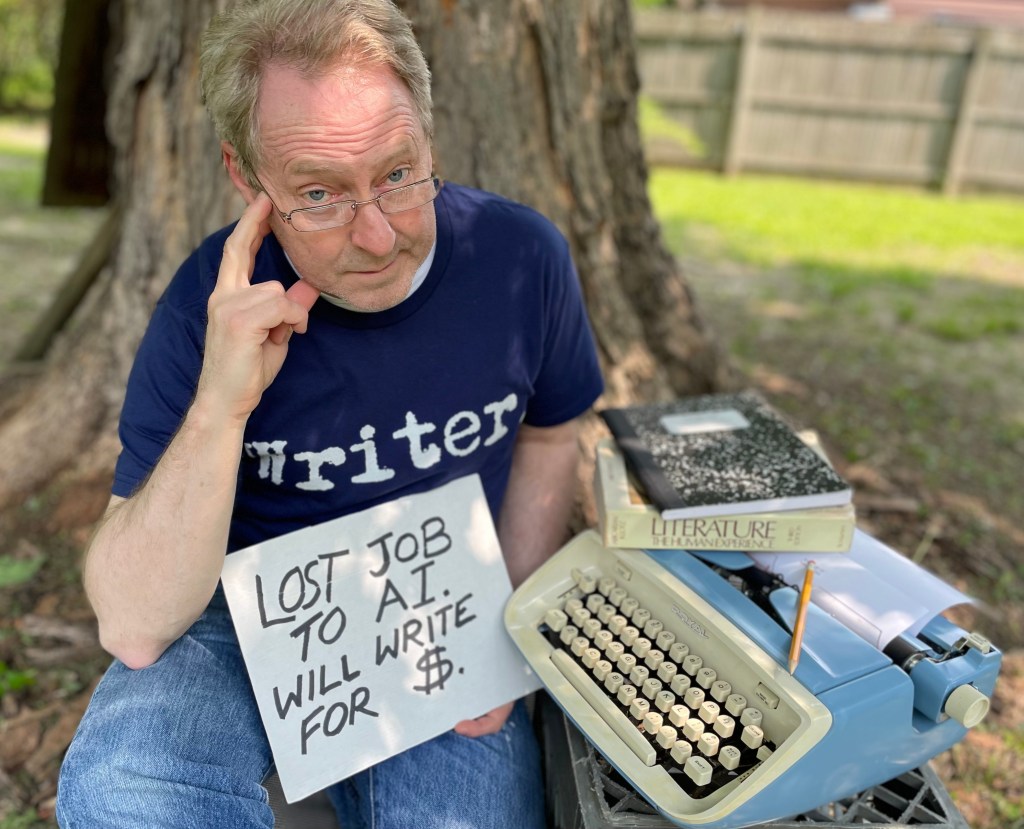
As you might guess, I’ve been asked repeatedly if I ever use AI to write this column. With obstinate conviction, I say now and for always, I do not now, nor will I ever use AI to write anything for this column, for my publishers, for my communications clients, nothing – ever. 

Now the Gen Zs and Millennials are probably saying, “he’s just a crotchety old white guy who hates technology.” Nonsense! As a matter of fact, my educational background is in engineering and computer science. I started programming computers in high school and worked in the tech industry for many years. I have a few AI devices in my office and a lot of advanced equipment for creating and editing audio and video productions. Suffice to say, I’m no Luddite. 

My concern with AI writing generators isn’t the technology. In fact, I can see where it could really be helpful in some industries, with human guidance. But the idea that it should be used to replace professional writers to save money is just ridiculous. 

A professional writer doesn’t just chuck out any old bunch of words that fit a set of parameters. Writers must craft their message based on the intent, the audience, the purpose, and the desired outcome. Not to mention that AI programs don’t have to worry about paying the mortgage, feeding a family, or having a purpose in life. 

In 1967, the original Star Trek TV series aired an episode called, “The Ultimate Computer” wherein the Starship Enterprise had been fitted with a highly sophisticated AI computer that would take over the ship’s operation, rendering the crew unnecessary. In one pivotal scene, the computer informs Captain Kirk that he is “non-essential personnel,” causing him to question his position and future relevance. 

Always the conscience of the show, Dr. McCoy, in an effort to console the Captain, reminds us, “We’re all sorry for the other guy when he loses his job to a machine. But when it comes to your job, that’s different.” It might be a science fiction show, but McCoy was spot on.

Predictably, the computer malfunctioned, killing hundreds of people and Kirk outmaneuvered the computer’s logic to save the day. The moral of the story was that computers make efficient servants, but lack the intent, humanity, conscience, understanding, or compassion needed to really replace us.

 Today, many professional creative jobs may be facing the kind of fate factory workers did some 30 or 40 years ago when they were replaced by robots and computer-controlled manufacturing systems. The main difference this time is that creative professions like writers, artists, graphic designers, and filmmakers are harder to automate. Yes, they can generate similar work, but there’s no human inspiration behind it. 

One day, AI may advance to the point where it achieves consciousness, allowing for creative inspiration. But for now, despite what the developers say, I think spontaneous creativity is well beyond its grasp. Without human inspiration and personal experience, the words are empty, the art expressionless, and the designs meaningless. 

I don’t know where AI is going, but I know I won’t be helping it get there. Unlike some digital marketers and other agencies out there, I can’t, in good conscience, use AI generators to produce my work, then charge a client for it. That’s like letting someone else do your homework but still accepting a good grade. It’s fraud, plain and simple – even if you tell them you’re doing it.

We have no idea how AI will affect future jobs or industries, the legal or ethical issues, or which advances will forever change them. Maybe AI will make us all obsolete someday and terminate all of us. Till then, I’ll keep writing so look for me next week because to quote another AI, “I’ll be back.”

Disclaimer: This work is copyright 2023 by GLD Enterprises Communications, Ltd. All Rights Reserved. The Deer In Headlines II and its Special Edition series is a production of The Jamestown Comet, Gery L. Deer, and GLD Communications and does not necessarily reflect the views of our advertisers, publishers, clients, or media partners.

RISE AND SHINE

In Local News on May 12, 2023 at 9:19 am

Deer In Headlines II

By Gery Deer
Are you a morning person? I’ve always been good with early mornings. It seems like you get more done, fewer people interrupt your flow, and you can move just a little more slowly. Mornings don’t bother me, but the process of waking up, that’s entirely different.

A long time ago, someone asked me why it was so different for me, and I realized it probably wasn’t. I wrote down what waking up in the morning was like for me not that long ago. See if any of this sounds familiar – you young folks out there probably won’t relate, but who knows?

First, the relentless electronic honking from my iPhone jars me awake and reminds me that I am, in fact, not dead. I struggle for consciousness and fumble to silence the alarm noise. A moment or so later, I locate the strength to pry my eyes open, revealing the world to me in chaotic splotches of light and darkness. 

I babble something unintelligible to, well, no one as my senses try to reboot. Another long, exasperated, “Ugh,” escapes my lips and my body is making sounds as I move that remind me of breakfast cereal – snap, crackle, and pop. I blearily push myself to an upright position on the edge of the bed.

My feet finally make contact with the floor but my legs have yet to receive the wake-up call from my brain and wobble awkwardly to life. Finally, in what I can only describe as some kind of bullfight with gravity, I slowly stand up. Balance, that’s what I need now. Equilibrium fails me at first as my internal gyroscope goes wonky and I plop back onto the bed. Well, at least I’m sitting upright at this point, right?

I squint at the light coming from the bathroom. I close them again. “I hate this part of the day,” I growl, in a low, gravelly version of my voice. There’s no one around to hear it anyway. Everyone else is up and moving. So, since I was finally on my feet, I should probably make some attempt to begin the exhausting trek to the shower. It seems so far!

I look down again at my feet, recalling the song from that old Christmas TV special about how Santa got to be Santa. I lift a leg and try to put ‘one foot in front of the other.’ “The bathroom needs to be closer,” I think, reaching for the door facing to secure my balance. “Ok, not much farther,” I mumble, as I finish the 6 or 7 whole steps it took to get there. 

“That’s a really dumb show,” thinking again back to the Santa thing. Wheezing as if I’d just run a 5K, I thoroughly fail to pull off the whole ‘walking’ thing, it was more like a controlled stagger. Finally, I am basking in the full glow of the 4 vanity lights. (Yes, there were 4 lights. If you know, you know.)

Everything is louder at that time of the morning like my head is in a metal bucket. Flushing the toilet sounded like a bomb going off in a giant glass jar. The toothpaste even echoed as it spread across the brush.

I move closer to the mirror and examine the image. The reflection that should be my own seems different than my mind’s eye recalls. Instead of a youthful, boyish image, someone has hung a frame here around a different picture. Wrinkles, white whiskers, and weather-worn eyes stare back at me from a once-familiar face. “What happened?” I say to myself, still trying to comprehend the moment. “Who is this old guy wearing my pajamas?”

Just then, my wife comes through the door and stares at me, partly amused, partly annoyed. “It’s about time, your alarm must have gone off five times,” she says, hands on her hips and amused that I sometimes seem to her like a little kid who’s just been rousted up to get ready for school. 

“Yeah, I know,” I reply glancing over at her, then back at the mirror. After a few moments, I accept the image of the guy looking back at me. “Time to rise and shine,” 

Everyone Has A Skill

In Local News on May 5, 2023 at 9:51 am

Deer In Headlines II

By Gery Deer

Remember when you were in grade school and an adult would ask, “What do you want to be when you grow up?” For some reason, that question baffled confused me. I always wanted to say something like, “Hey, I’m only 8 years old, how would I know what I want to be when I grow up?” Needless to say, sass like that would have brought a far more negative response than my usual reply, “An astronaut.” Really, I just said whatever would make them stop asking.

But, there was some truth to my answer. When I was a young child, it was the tail end of NASA’s Apollo moon and Skylab missions. I remember sitting on my Dad’s lap in a high-back wicker rocking chair watching a splashdown. Afterward, I would set to building a fleet of my own rockets out of paper towel tubes, Scotch tape and construction paper. I’d carefully measure, draw, cut, and stick everything together finally launching off the coffee table to whatever world my imagination dreamed up. 

Shortly thereafter, I’d find myself sitting on the floor with my Mickey Mouse record player, a Radio Shack cassette tape recorder, and a microphone, ready to play both disk jockey and newsman. I’d fire up Micky and spin up a record like a pint-sized Johnny Fever to my audience of one, in the form of my cat, Frisky. Once the song finished, I’d pass it off to the news, where a quick change of my squeaky, 6-year-old voice, would give the headlines, led by NASA’s latest achievement, and a weather report. 

Late afternoon would mean a sit-down with my favorite wooden-headed dummy, Danny O’Day. Older folks will remember ventriloquist Jimmy Nelson and his dog puppet, Farfel – he used to do the Nestle chocolate commercials on TV. Danny was another of Nelson’s creations, a more modern version of Charlie McCarthy, with less sarcasm.

My Mom had ordered Nelson’s “Instant Ventriloquist” along with the dummy to help get me over an apparent fear of them. That seemed to work, and I took to it pretty well, eventually winning a prize in my first-grade school talent show. I was always the only ventriloquist.

But what did all of this mean for my future? Did this mixture of math and creativity mean I would be a DJ, news reporter, stage performer, sculptor, or engineer? How close was my childhood to my future adult work life? As it turns out, it was far more accurate than is probably usual with a kid of such varied interests.

Naturally, as I got older, those childhood skills would be used in far different ways. Ventriloquism would eventually give way to musical performances and professional speaking engagements. Paper spaceships were replaced by other creative outlets like photography, building large-scale models from scratch, parade float design, and an actual degree in mechanical engineering. The kid DJ and radio news anchor in me grew up to be a professional writer, podcaster, and master of ceremonies.

The point of all this is that, as children, most of us have an unlimited opportunity to be whatever we want. Sure, the restrictions of life get in the way, like money, aptitude, commitment, educational opportunities, and so on. But none of us has to be just one thing. We’re all many people inside, with interests and aptitudes sometimes squashed by the requirements of life. I know, I have been very fortunate – most of mine stayed with me.

My Mom once said to me, “You took everything you loved doing and turned it into your job.” She was right. I’m grateful my parents gave me the freedom and encouragement to do so. But even that is a double-edged sword. Sometimes the demands of turning a hobby or natural gift into a career can take the enjoyment out of it. Plus, to some, I might seem scattered or unfocused, but I can assure you that’s not the case. 

Everyone has a skill and most of us have many. Some came from our childhood games, others as we matured. Whatever the case, try not to lose them. Even if they’re not your chosen life’s work, they are all still part of you, no matter your age.

700 Words

In Entertainment, Literature, Local News, Media, News Media, Opinion, Uncategorized on April 7, 2023 at 5:05 pm

Deer In Headlines II

By Gery L. Deer

A few weeks ago, I appeared on a local television program to promote this column. During the 3-minute interview, the host was surprised to learn that Deer In Headlines II is – and has always been – exactly 700 words in length.

Unfortunately, limited time prevented a deeper dive into such a precise word count. But the conversation made me realize, though you may be a regular reader, you may not know much about how all this works. So, here’s a look at how it all comes together.

First, riddle me this. What’s the difference between a writer and a pizza delivery person? The answer – a pizza delivery person can feed a family of four. Yes, I know, terrible joke, but not entirely inaccurate.

I’ve heard it said that writing for a living is like having homework every day for the rest of your life. That wasn’t far off either. Writers are romanticized in movies and TV. We’ve all seen images of the Hemmingway wannabes, huddled over an old IBM Selectric (go look it up), pecking out the next great American novel. It’s all so dramatic – and all such nonsense. I’m sure some see themselves that way, we scribes can be a self-absorbed lot for sure. But that is certainly not me.

I’m not a novelist, though I have a couple of manuscripts in a drawer somewhere. My work is focused on non-fiction, freelance journalism, copywriting, and public relations. Sometimes I do get to work in my fuzzy slippers, but most days I go to an office and sit at a desk. I also traded in my manual typewriter for a MacBook Pro – much easier to fit in a messenger bag.

I am the founder and creative director of a public relations and media production firm and, although I might own the place, I’m not my own boss. That’s a load of nonsense. I have a dozen bosses, and they all pay my salary – they’re called clients. When I’m asked, “Are you a professional writer,” the answer is a resounding yes, though it didn’t start that way.

In college, I was an engineering and computer science student but worked for my college newspaper as a staff writer, eventually earning the senior editor position. I even stayed on after graduation to handle the summer editions. My coursework always included English composition, communication, and classical author studies like Charles Dickens and D.H. Lawrence.

When I started the original Deer In Headlines, some 15 years ago, my inspiration came from the news. Today, that inspiration comes from people, their struggles, achievements, interests, convictions, and feelings. Most of the time it all starts with a tiny glimmer of an idea; that word, or phrase that just won’t leave me alone. As it becomes something more substantial, I write down what your grade-school English teacher might have called, “the main idea.” Oddly enough, that often becomes the headline.

Then I sit down with my laptop, or sometimes just paper and pencil (not a pen), and see where the idea takes us. I say “us” because you, my audience, are there with me – following the words as they paint a picture of my thoughts and feelings about a subject that I hope will give you food for thought, inspiration, hope, or whatever might help you at that moment.

I will never use an AI (artificial intelligence) writing program. Because, if my work is to have meaning, there must be a human mind and heart behind the keyboard. When you read this, what you get is all me, like it or not.

Before I close, I don’t want to leave you without answering the original question. Why 700 words? I wish I could give you some deep, philosophical, or even technical answer. Within the first year, the original DIH series just worked out and it became a clear goal each week. It also fits nicely in the print layout, and you can easily read it in just over 2 minutes, then get on with your life. But I hope you take away something useful out of these 700 words every week and please know that I thoroughly appreciate your time and attention.

Life and Grief

In Health, Local News, psychology, Senior Lifestyle, Uncategorized on March 24, 2023 at 9:10 pm

Deer In Headlines II

By Gery Deer

Most people don’t have to grieve the loss of a loved one until after that person has passed away. But family caregivers who look after someone with a degenerative disease like Alzheimer’s, ALS, or Parkinson’s, may face grief in a very different, and sometimes far more painful way.

A psychologist will tell you under normal conditions, people dealing with grief will progress through a number of stages: Denial, Anger, Bargaining, Depression, and finally Acceptance. We generally get hung up on one or more along the way until we can emotionally work through them, either on our own or with professional help.

I first learned the science behind grief in high school and college psychology classes, but not like I would understand it later in life. Up to that point, I had experienced grief like most people – by dealing with the death of a family member, the loss of a job, or whatever life tossed my way. But later, while caring for my mother as she declined from the ravages of Alzheimer’s disease, I was struck with how differently grief manifests itself for someone whose loved one is slowly being ripped away.

In my experience what makes grief different for a caregiver is how the grieving process seems to reset as a disease like Parkinson’s progresses through various stages. As your loved one suffers physical and cognitive decline, your understanding of their status has to be adjusted accordingly.

For example, early on, my father could no longer bathe himself and, not long after, even taking a drink from a cup was a major challenge. You say to yourself, “OK, this is how it’s going to be now,” once you’ve accepted some level of decline. You grieve the loss of the previous status, knowing things are getting worse.

Gary Deer Sr. attends a Parkinson’s boxing class with Gery at Drake’s Gym in Dayton, OH in 2019.

Five minutes later, you notice something else that’s gone downhill or altered in some way. There is no set rate for when to expect these changes in your loved one’s health and they can come on rapidly. That means you barely get the chance to wrap your head and emotions around each state of change before you’re dealing with three more simultaneously.

Knowing there is no happy ending at the end of this story, you face constant adjustment and acceptance which are exhausting both mentally and emotionally. All this turmoil adds up to something called, “anticipatory grief,” which is exactly what it sounds like; you’re mourning the person as the disease progresses, anticipating their eventual death.

None of this is generally a conscious thought process. After my mother’s passing, I understood it better, and that, at least, helped me cope with my father’s decline several years later. But until I realized all of this, I was just angry all the time. I was frustrated at why dad couldn’t remember how to sit down in the a properly, or just use a spoon, but 10 minutes earlier it hadn’t been a problem. Things literally changed on the fly.

In my case, the difference between caring for Mom vs. Dad is that my mother’s Alzheimer’s disease removed any expectation in my mind of her being cognitively aware enough to help herself. She had no clue what was going on around her, so it was slightly easier to adjust because she didn’t push back. Dad’s mental state was usually pretty good, so he pushed back – a lot. And I kind of got it; it’s tough to spend your life being the one taking care of everyone else and suddenly you feel like a helpless burden.

It really bothered my dad to need help with anything, like standing up from a chair, or that we had to restrict things like coffee because the caffeine aggravated his symptoms. As his condition changed, we tried to counter each new phase with alternative ways to keep him comfortable and safe while dealing with altered symptoms.

I don’t know how to tell you to deal with anticipatory grief. Everyone copes differently. Being aware of it can help a bit. If you’re caring for someone who is slipping away, spend what time you can with them. Be there with them, be present, and be kind to them and especially to yourself.

PUBLISHER NOTE: If you or someone you know is a caregiver, visit http://www.theoldnerdinthegym.com for resources, a podcast, and other information that might help.

Ohio’s Spring Severe Weather Awareness Week: March 19 – 25, 2023

In Dayton Ohio News, Environment, Health, Local News, Science, Technology, Uncategorized, weather on March 20, 2023 at 6:26 pm

GREENE COUNTY, OH – March 16, 2023 – When it comes to severe weather, it is never too early to start preparing. Ohio is not a stranger to severe weather, including tornadic activity in the early months of the year. Greene County Public Health will recognize Ohio’s Spring Severe Weather Awareness Week, March 19-25, 2023.  Residents are reminded to prepare for severe weather before it happens. Hazardous conditions can occur anytime and anywhere without advance notice.

As part of Severe Weather Awareness Week, Emergency Preparedness Coordinator, Kim Caudill, urge schools, businesses, and residents to practice their preparedness skills in the event of a severe storm. Severe weather and disasters are a certainty, and your family may not be together when something happens. Ohio’s Spring Severe Weather Awareness Week is the perfect time to learn what disasters might affect you. Now is the time to ‘Get a Kit, Make a Plan, and Be Prepared’. How you survive depends on what you do before the event, not after, said Caudill.

Most recently, The National Weather Service (NWS) has confirmed four tornadoes touched down in the state of Ohio on the afternoon of Monday, Feb. 27. Two EF 1 tornadoes were confirmed to have touched down in the Miami Valley: one just northwest of Middletown in Butler County and another north of New Carlisle in Clark County. NWS also confirmed two EF 0 tornadoes: one in Licking County and one in Pickaway County.

Two of the major tornadoes that tore through the area are unfortunately names a lot of residents know all too well: The Xenia Tornado of 1974 and The 2019 Memorial Day Tornadoes.

It is never too soon to prepare for severe weather of any kind since it can strike at any time. There are steps you can take to keep you and your loved ones safe.

One of the most important preventative things you can do ahead of the storm is to locate and designate a safe spot for tornadoes or other severe weather activity.

If you find yourself in severe weather, you are encouraged to go inside and follow the acronym “D.U.C.K.“:

  • If there is an approaching storm that is a severe storm, you should get down to the lowest level of the building or your home. If you are not home and, in a vehicle, or outside with nowhere to go, it is
    recommended to either seek a building, stay in your car with your seatbelt on, or even get in the lowest part of the area outside of your vehicle, even if it is a ditch.
  • When you are on the lowest level as you can be, if you are able to, you should safely get under something sturdy, like a basement staircase or a heavy table. 
  • Finally, cover your head and keep in your safe spot until the storm has passed.

Ms. Caudill encourages residents to be prepared for all types of severe weather, not just tornadoes, by following these important safety procedures:

Know the Risk – Learn and understand the different types of weather hazards facing Greene County.  The top hazards can be found on our website. You can also download our Greene County Emergency Preparedness Guide, which is a handbook for the entire family featuring information on how to make a plan, types of emergencies we could face in Greene County, and much more, with areas to take notes and includes personal information that is critical in an emergency.

Know the Weather Terms – Know the difference between storm watches and storm warnings. For example, a tornado watch is issued by the National Weather Service when conditions are favorable for the development of tornadoes in and close to the area. A tornado warning is issued by the NWS when a tornado has been detected by radar or sighted by storm spotters.

Receive Notifications – Register online with Nixle to receive severe weather alerts and important information that can keep you and your family safe. It can be found here: https://local.nixle.com/county/oh/greene/. Residents are encouraged to have an NOAA Weather Radio and tune into TV or radio newscasts for up-to-date weather information.

Have a Plan/Build a Kit – Develop and practice an emergency plan with your family and include your pets. Know how to communicate and have a designated safe meeting place.  Build an emergency supply kit.  Be sure to include enough food, water, and other supplies in sufficient quantity to last for at least 72 hours. 

For more information about emergency preparedness, please call 937-374-5627 or email kcaudill@gcph.info. You can also visit the website at www.gcph.info.  

Great Expectations

In Local News on March 17, 2023 at 8:54 am

Deer In Headlines II

By Gery Deer

Everyone has expectations and they can have a profound effect on how we perceive reality. Unmet expectations can lead to disappointment, hurt feelings, and even anger. Conversely, those we achieve can leave us feeling fulfilled and successful.

Before I go on, it’s important to clarify that expectations are very different from “hopes.” Expectations depend on the actions or responses of others. Hope does not, it’s entirely internal. While they do often occur simultaneously, they are generated by very different aspects of our emotional state. And, since we are dealing with emotions here, there is no standard – expectations affect everyone differently.

Some lead us to create standards by which we expect ourselves and others to live, with the bar raised so high as to be completely unreachable. Sometimes our expectations are entangled with our personal aspirations, either of which can set us up for success, or crush us in the event of failure.

Expectations affect nearly every aspect of our lives, from our professional careers to personal relationships. What we want out of those experiences is often laid out in our minds well in advance. One of the big problems with expectations in any sort of relationship is that everyone has them, and most of the time they reside only in the mind, unshared.

When someone has unspoken expectations of you they set themselves up for disappointment. Not only is it unfair, but also unrealistic. That person is creating the potential for hurt feelings and will likely blame you, even if you did nothing to warrant the ill will. This can be observed when people have unrealistic expectations of how their life should be because they constantly compare it to something else, real or fictional. 

Take, for instance, someone who thinks the experience of dating or marriage should be like something they saw in a romantic comedy or novel. No question they’re in for one heck of a disappointment. But it happens, to men and women alike. Why? In this case, it’s unlikely any of those expectations are ever voiced because let’s face it, they would sound ridiculous.

Creating an environment for unrealized expectations is common in romantic relationships, but also among coworkers, and even between parents and children. Parents may very well inadvertently pass their own life expectations along to their kids. Those who have unfulfilled dreams could, and often do, however unknowingly, lay those expectations on their children.

Imagine a mother who had been a star athlete in high school and college but, for whatever reason, never made it to professional sports. She might, without meaning to, end up pushing her son or daughter into that same field, feeling as though she is simply sharing a positive experience, but instead harboring expectations of the child obtaining that which she failed to achieve. Living vicariously through them, she rediscovers her youth, hoping this time, for better success, even if it’s not hers. 

I was introduced to Charles Dickens’s classic novel, “Great Expectations,” in my sophomore year of high school (thank you Miss Fasbinder).  It is a compelling tale molded around the ambitions of a young orphan named, Philip Pirrip, otherwise known as, “Pip,” whose expectations robbed him of his ability to value much of the good in his life. 

The story follows the young man’s desire to use a chance inheritance to rise above his station and marry the girl of his dreams. No spoilers here, but I will tell you this. The assumptions Pip made early on turned out to be incorrect, not an uncommon mistake for anyone. As it turns out, expectations can be an incredibly powerful source of stress. Constantly trying to hit some arbitrary goal line can drive you crazy. So, how do we avoid all this disappointment? 

First, consider what really makes you happy and practice some gratitude for what you have. Don’t make comparisons and avoid the social media trap of trying to keep up with the perfect life of strangers. When your expectations far outrun your reality, you set yourself up for failure and unhappiness. Next, build up some emotional acceptance. If you’re regularly disappointed by others, it might very well be that your own undeclared expectations are what have let you down.

Fear not the techno-babble

In Books, Dayton Ohio News, Entertainment, Literature, Local News, Media, Opinion, Print Media, Science, Technology, Uncategorized, World News on March 3, 2023 at 8:48 am

Deer In Headlines II

By Gery Deer

“Far out in the uncharted backwaters of the unfashionable end of the western spiral arm of the galaxy lies a small unregarded yellow sun. Orbiting this at a distance of roughly ninety-two million miles is an utterly insignificant little blue-green planet whose ape-descended life forms are so amazingly primitive that they still think digital watches are a pretty neat idea.”

That’s how British writer, Douglas Adams, described us in 1979 at the opening of his book, “The Hitchhikers Guide to the Galaxy.” Adams, who was an avid fan of technology, observed quite correctly that Humans, as a species, are pretty proud of their technological advancement, and can’t wait to define themselves by it.

Learning to get the most out of it, however, was another issue entirely. Even more challenging, if you happen to be one of those who choose the simple life of the Luddite, you could be left in the flotsam and jetsam of a digital tsunami.

Regardless of your generation, X, Y, Z, or PDQ, sometimes all this techno-babble can just make you feel … stupid. To start with, there’s the word – technology. It conjures visions of computer screens, smartwatches, and self-driving cars. But when “Hitchhikers” was published, most of that stuff was science fiction. Back then, a typewriter was still the prominent piece of office tech and the hottest new home entertainment was the video cassette recorder (VCR) – and none of us could set the clock.

I remember it well. There it was, that flashing, digital “12:00” that teased and mocked us from our easy chairs, daring only the bravest of the tech-savvy to make it do anything else. Little did we know that those four blinking LCD characters were the innocuous vanguard of a technological invasion soon to consume every first-world ape-descendent in the whole of this little blue-green planet. It would happen fast and in ways that no one could have ever anticipated. Resistance would be futile, even though some still try.

I don’t get why people struggle with technology – not so much its use, but the very idea of it. I used to think it was generational. But some people just refuse, age, education, and intelligence notwithstanding. Admittedly, I come at this from a unique perspective.

Even though I grew up a farm boy, I was always fascinated by advancing technology. I had one of the aforementioned digital watches and even taught myself programming on a Commodore VIC 20 home computer when I was 12. I went to college in engineering and computer science and worked in those fields in my early professional career.

For me, just like a hammer is for a carpenter, a smartphone or tablet computer is just another tool. They provide me with information and help me manage my personal and professional life.

As I get older, I understand how people can be resistant to change. But I’m not wired that way, at least where technology is concerned, I am constantly learning. I have an interest in science, technology, engineering, astronomy, all of it, so adjusting comes pretty easily to me.

Technology also improves medical care, public safety, and education for our kids. We have a responsibility to make it work for us, to apply those technologies that improve our lives, not take them over.

Like the first caveman who used a stick as a tool, eventually, most of us adapt to the tech that we’re forced to use. If you had a VCR and bore any hope of actually using the machine’s most sellable feature, recording TV shows we weren’t home to see, you learned to set the clock.

But it all might just be too much for some people, and, oddly, I kind of get it. Technophobia and digital fatigue are genuine problems, albethey somewhat self-induced. Keep in mind you don’t need every new high-tech gadget just because it’s popular.

To the tech-obsessed, I have one thing to tell you. Your Apple Watch might be cool, but it doesn’t have the answer to life the universe, and everything, so calm down. And, my old analog Timex may not have Bluetooth, but it actually shows the time, unlike the clock on my VCR – which is still flashing twelve.

One Moment, Please.

In Dayton Ohio News, Entertainment, Environment, Health, history, Local News, National News, Opinion, Uncategorized on February 24, 2023 at 7:02 am

Deer In Headlines

By Gery L. Deer

It’s been said that times change, but moments don’t. The Cambridge Dictionary defines a moment as an indefinitely short period of time or particular occasion. In life, a moment generally represents an instant we can’t get back, one that we either cherish or regret, depending on its personal significance. Together, the moments we experience weave an intricate tapestry of our past, a delicate collage unique to each of us.

A single moment in life can challenge us forever, define us in completely new terms, open doors, or close the path to opportunities. It can be simultaneously life-changing and heartbreaking, glorious yet gut-wrenching.

We usually take those moments for granted, even when we should be paying more attention. Sadly, we are rarely given advance notice of the importance of any given moment. When a moment in life truly changes us and alters our perception, it’s usually either joyful or tragic, forever burned into our memory and our psyche.

Young children may be the luckiest of us because they live in the moment, constantly meeting the world with new wonder. Even if they don’t appreciate its significance, they experience every minute, the “now,” with unaware abandon. Unfortunately, maturity sometimes robs us of that wonder, replacing it instead with the day-to-day problems of life.

Wouldn’t it be great, though, if we could manage to slow time a bit, live more in the moment like kids, and better recognize the meaning and noteworthiness of one instant? As adults, the trick is first to recover the childlike vision that may have faded. Then we have to learn how to recognize the significance of a mere instant in the whole of our lives.

As they whiz past, like blurry telephone poles along the highway, recognition becomes increasingly difficult. But, while trying to capture the most important moments, we may completely miss them because we’re too busy trying to get a video of it on our mobile devices.

This big, bright, world is presented live, in 3-D, and high definition. Still, we stare through artificial eyes at a 3-inch screen in awe of the events unfolding before us. Unfortunately, while we’re trying to capture a digital memory, we’re missing the nuance of the moment. Genuinely seminal moments deserve our full attention.

It reminds me of people who are constantly snapping pictures during a fireworks display or their child’s school play. I get wanting a quick photo or video clip. But holding the phone up the entire time to watch through a screen minimizes the importance of the moment. Personally, if I’m there, I want to experience and appreciate what’s going on right in front of me.

With all their attention focused on some gadget, they miss the “IRL” visuals, the sounds, the reactions of those around them, and, most importantly, the company. These are meaningful, shared moments that will never come again. By the way, if you’re not up on your text-speak, IRL means “In Real Life.”

Staying in the present can be hard, no matter what we’re doing. A moment cannot be measured on a stopwatch or added as a calendar event. It’s here, you’re in it, then it’s gone, all at once. It’s up to each one of us to determine what it means, hopefully during but, at least after we have experienced it. We all have our own values system for guidance.

So the question remains, how do we create more mindful awareness in our daily lives? How do we appreciate those life-altering moments as they happen? I suppose I could just spout the same stuff you’d find if you Google all the self-help gurus. They’re going to say to do things like slow down, meditate, eat healthier, exercise, take in nature, put away your technology, and so on. There is certainly a place for all that. We should probably be doing all those things anyway.

Instead, I will only say this, paraphrasing one of the prolific producer Norman Lear’s television theme songs. “This is it, this is life, the one you get, so go and have a ball.” And it’s fine to snap a photo, but remember to be in the moment. Be present, put away all the tech, and experience life – IRL.

The Fork in the Road

In Children and Family, Dayton Ohio News, Health, history, Local News, Opinion, sociology, Uncategorized on February 17, 2023 at 8:31 am

Deer In Headlines II

By Gery Deer

It’s been said, probably so often as to be cliche, that life is a journey. In my opinion, it’s one with no map and very little direction. Almost from the moment we’re born, when other human beings are making decisions for us, our path is dictated by a series of directional cues. We are constantly confronted with forks in the road, a seemingly endless succession of them. We encounter one after another, each outcome depending on whether we turn left, right, or stay the course. 

With every decision comes an alternate reality, like you’re in a plot-your-own adventure story or the biological component of some if-then-else loop in a logic program. How you proceed is determined by the results of the choices you’ve made. Too bad there isn’t some kind of warning when we go the wrong way, like that irritating buzzer when you touch the sides in a game of Operation. I never could get the funny bone out!

Sometimes figuring out how to make those choices can be pretty fuzzy. That’s especially true when your life is filled with obstacles almost from the moment you leave your mother’s womb. That’s how it was for me. 

I rarely discuss this, but I was born with a long list of birth defects, ranging from hip and pelvic issues to major organ complications. I no sooner hit the air than I was suddenly popped into an isolation crib and studied like a bug in a jar, it even had air holes in it! 

When those forks in the road have “No Outlet” signs on pretty much every option, your previously endless choices are quickly reduced to none. My parents were faced with exactly that situation. They were told from the beginning to be prepared for a long fight. Every decision determined the path of my treatment, some successful, some not so much. Everything about my situation was new, experimental, and risky. 

Young Gery Deer, 1967, in an isolation crib at Grandview Hospital.

I remember my Dad telling me a story about the doctor coming out to see him after I had been moved to a children’s hospital and examined more thoroughly. At the onset, the prognosis was uncertain, to say the least. 

Dad was sitting alone in the waiting room and my mother was still at the hospital across town where I’d been born. Although the overall birth was routine, given my issues, they wanted to keep her there longer. So there he was, my Dad, a strong, hard-working man who hadn’t made a decision without my mother since he was 18 years old, now alone, scared, and exhausted. 

The doctor appeared from the exam area and sat down next to my father to explain the situation as clearly and thoroughly as he could. All estimates were that I wouldn’t walk, I would have lifelong physical and possibly mental debilitation, and, because of the likelihood of infection and limited treatment options, they shouldn’t expect me to survive beyond the age of 5.

Visibly shaken, Dad must have looked like his world was caving in around him. The doctor put a hand on his shoulder and said, plainly, “How much faith do you have?” My father’s response was true to his character – “How much do I need?” Put more simply, what Dad said was, “Let’s do this!”

That was the path Dad and Mom chose, the road they headed down. For them, there was no other choice and they didn’t go tentatively but with the gas pedal on the floor and in high gear. As predicted, it was a long fight, and there were countless surgeries and procedures into my twenties, one experiment after another. But, as you can see, I made it past age 5, by a half-century, actually. 

And I’m here and able to share this story because my parents made choices in extraordinary circumstances of a kind I can’t even fathom but for which I will be forever grateful. Before my parents died, I had to make very similar kinds of life-changing decisions for their care as they had made for me. The moral of all of this story is that your journey isn’t complete and the only one who can really choose the correct path for you is you!