Local News & Commentary Since 1890.

Posts Tagged ‘Writing’

The Carriage Returns

In Business, Local News, News Media, Opinion, Technology on April 20, 2024 at 1:22 pm

Deer In Headlines II
By Gery Deer

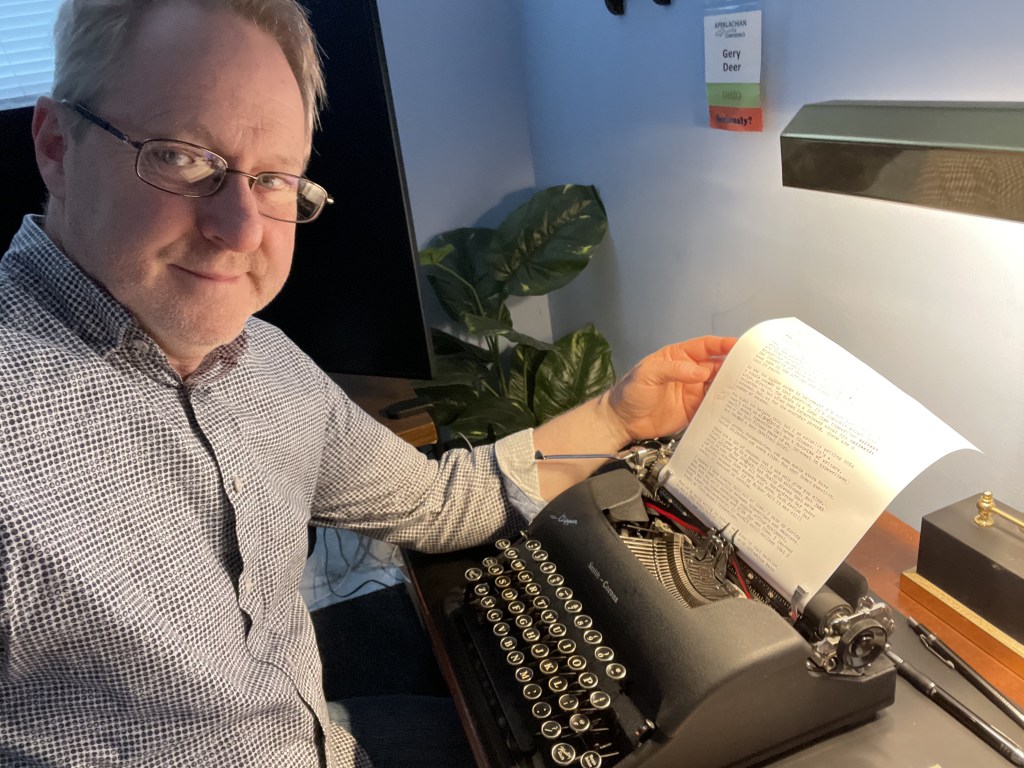
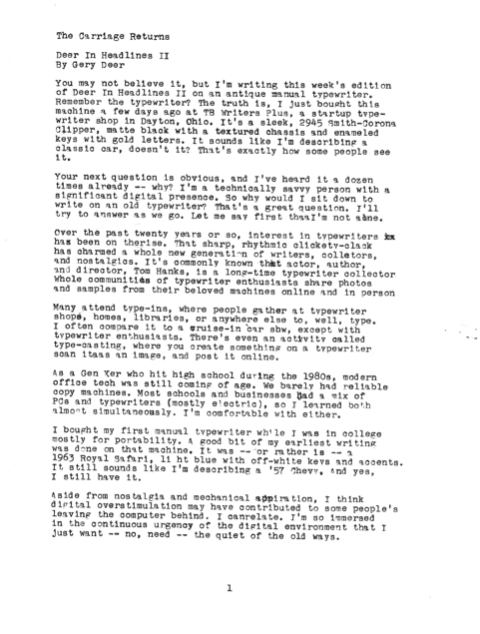
You may not believe it, but I’m writing this week’s edition of “Deer In Headlines” on an antique manual typewriter. Remember the typewriter? The truth is, I just bought this machine a few days ago at TB Writers Plus, a startup typewriter shop in Dayton, Ohio.

(Check out the Bonus Video and the Deer In Headlines Podcast episode that accompanies this piece!)

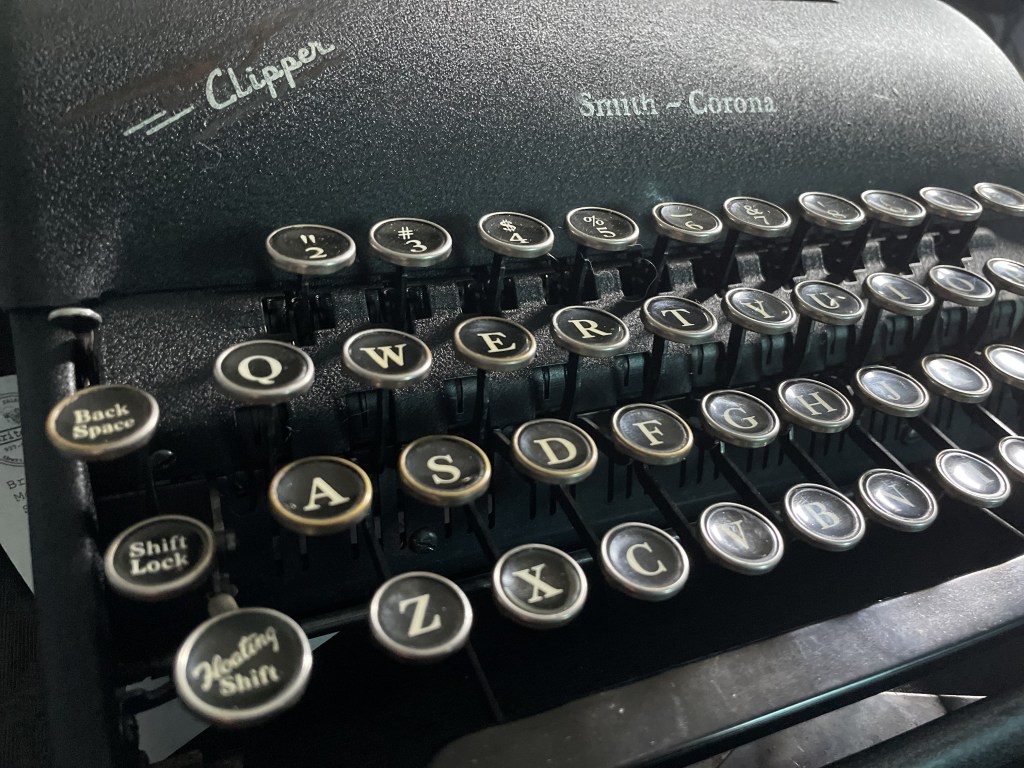
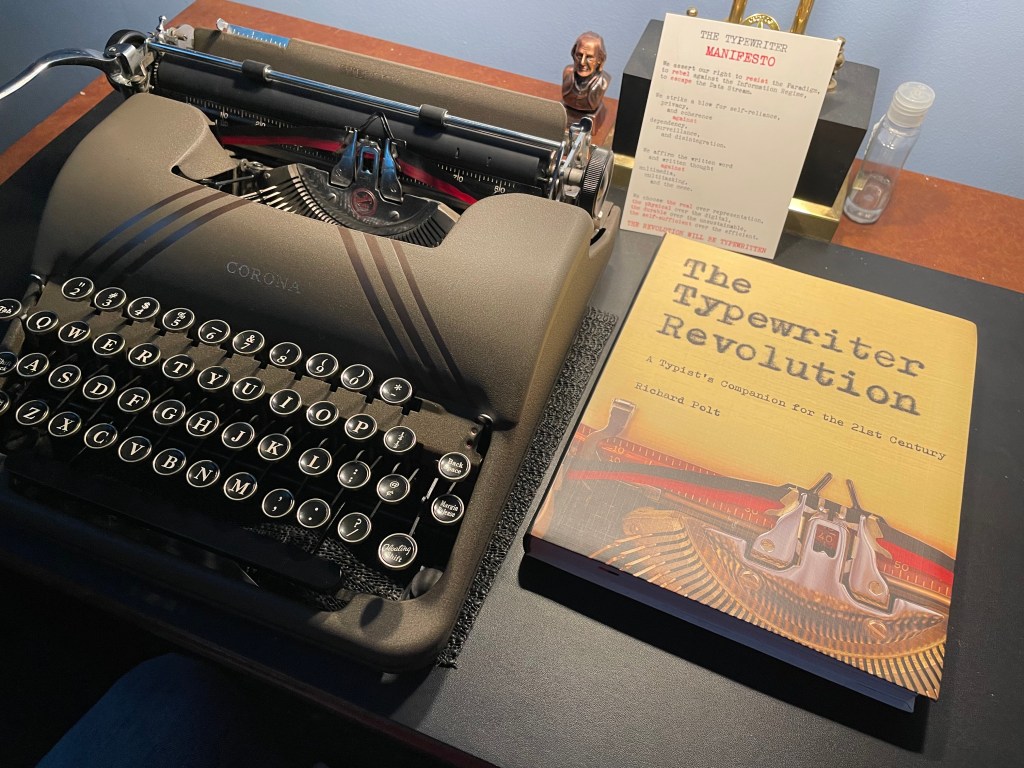
I have three manuals, but this is a sleek 1945 Smith-Corona Clipper, matte black, with a textured chassis and gold-lettered, enameled keys. It sounds like I’m describing a classic car, doesn’t it? That’s exactly how some people see it.

Your next question is obvious, and I’ve heard it a dozen times already – why? I’m a technically savvy person with a significant digital presence. So why would I sit down to write on an old typewriter? That’s a great question. I’ll try to answer as we go. Let me first say I’m not alone.

Over the last twenty years or so, interest in typewriters has been on the rise. That sharp, rhythmic clickety-clack has charmed a whole new generation of writers, collectors, and nostalgics. It’s commonly known that actor, author, and director Tom Hanks is a long-time typewriter collector. Whole communities of typewriter enthusiasts share photos and samples from their beloved machines online and in person.

Many attend type-ins, where people gather at typewriter shops, homes, libraries, or anywhere else to, well, type. I often refer to them as cruise-ins for typewriter enthusiasts. There’s even an activity called type-casting, where you create something on a typewriter, scan it as an image, and post it online. (Learn more about the so-called “Typewriter Insurgency” here.)

As a Gen Xer who hit high school during the 1980s, modern office tech was still coming of age. We barely had reliable copy machines. Most schools and businesses had a mix of PCs and typewriters (mostly electric), so I learned both almost simultaneously. I’m comfortable with either.

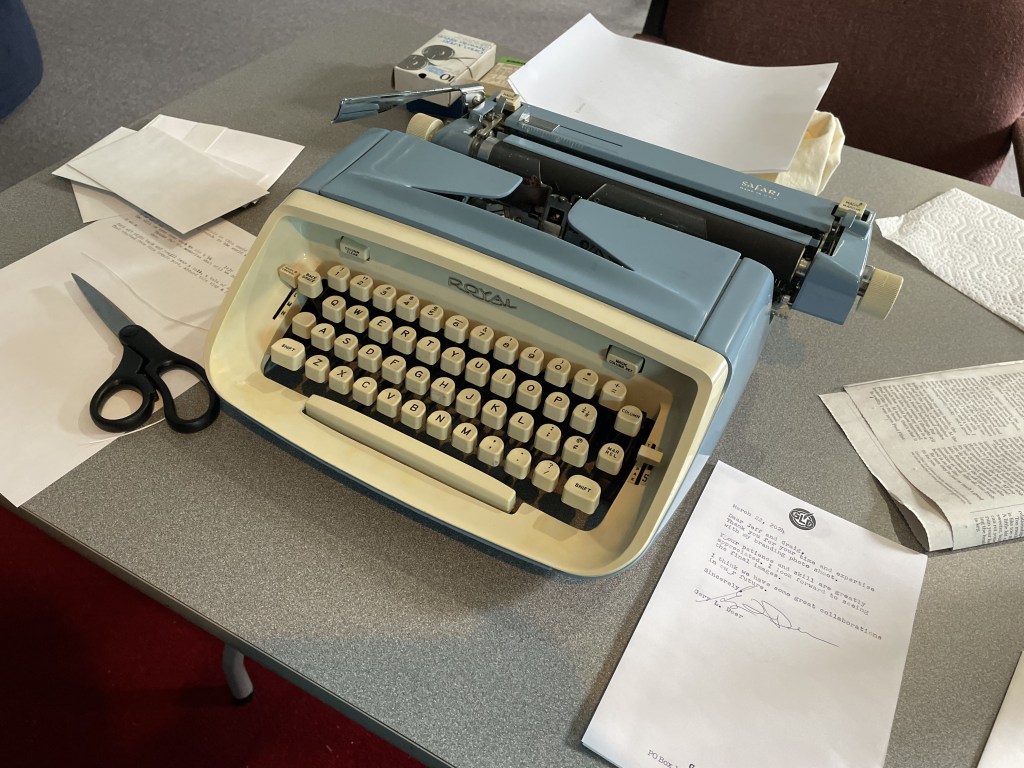
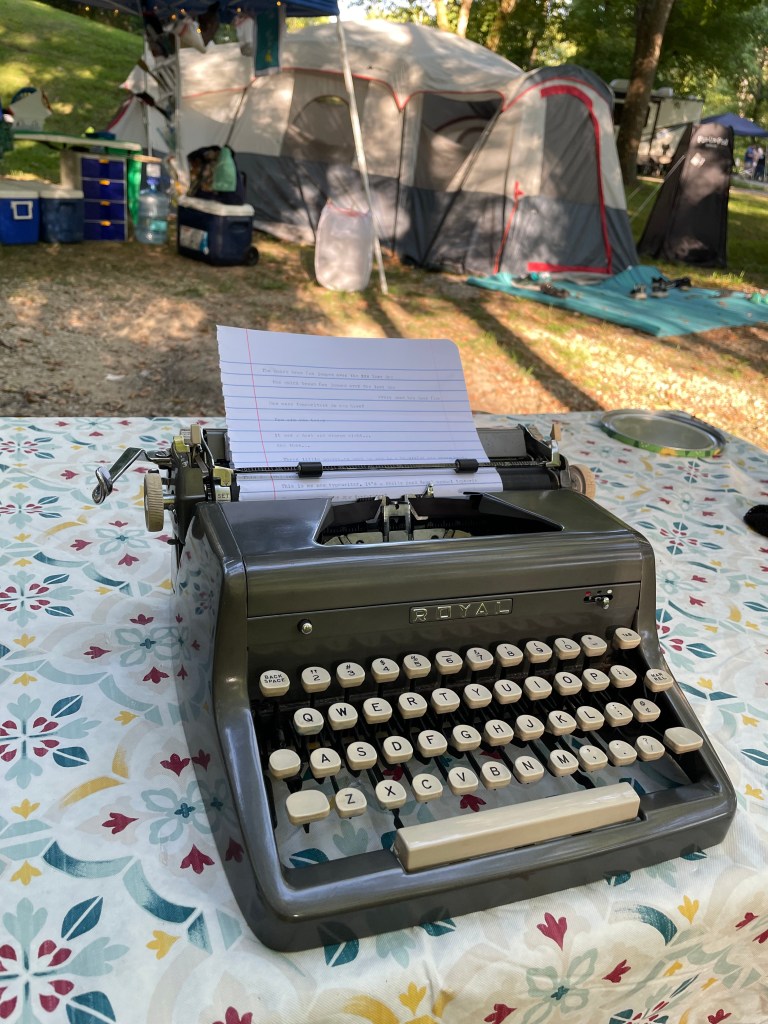
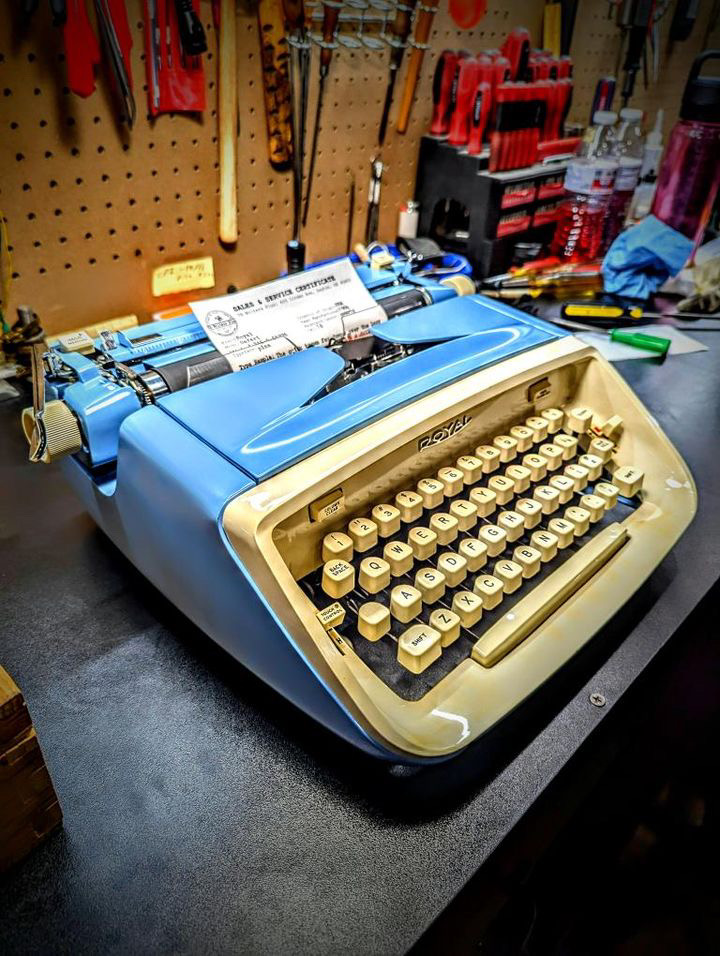
In the background, Gery’s 1964 Royal Safari. (Photo by Hue12 Studios, Dayton, OH)

I bought my first manual typewriter while I was in college, mostly for its portability. A good bit of my earliest writing was done on that machine. It was—or rather is—a 1964 Royal Safari, light blue with off-white keys and accents. It still sounds like I’m describing a ‘57 Chevy. And yes, I still have it.

Aside from nostalgia and mechanical admiration, I think digital overstimulation may have contributed to some people’s leaving the computer behind. I can relate. I’m so immersed in the continuous urgency of the digital environment that I just want—no, need—the quiet of the old ways.

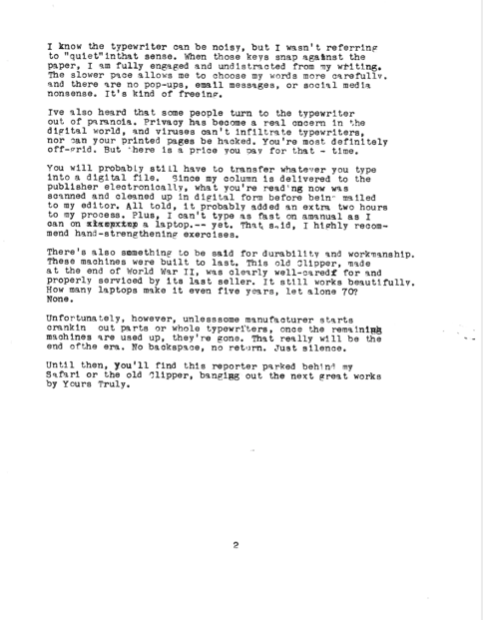
I know the typewriter can be noisy, but I wasn’t referring to “quiet” in that sense. When those keys snap against the paper, I am fully engaged and undistracted from my writing. The slower pace allows me to choose my words more carefully, and there are no pop-ups, email messages, or social media nonsense. It’s kind of freeing.

I’ve also heard some people turn to the typewriter out of paranoia. Privacy has become a real concern in the digital world, and viruses can’t infiltrate typewriters, nor can your printed pages be hacked. You’re most definitely off-grid. But there’s a price to pay for that: time.

You will probably still have to transfer whatever you type into a digital file. Since my column is delivered to the publisher electronically, what you’re reading now was scanned and cleaned up in digital form before being emailed to my editor. All told, it probably added an extra two hours to my process. Plus, I can’t type as fast on a manual as I can on a laptop – yet. That said, I highly recommend hand-strengthening exercises.

There is also something to be said for durability and workmanship. These machines were built to last. This old Clipper, made at the end of World War II, was clearly well-cared for and properly serviced by its last seller. It still works beautifully. How many laptops make it even five years, let alone 80? None.

Unfortunately, however, unless some manufacturer starts cranking out new parts or whole typewriters, once the remaining machines are used up, they’re gone. That really will be the end of an era. No backspace, no return. Just silence.

Until then, you’ll find this reporter parked behind my Safari or the old Clipper, banging out the next great works by Yours Truly.

(See the gallery for photos of the typewriters mentioned in this piece and more.)

No job is bulletproof, not even mine.

In Economy, finances, Media, National News, Opinion, Technology, Uncategorized on April 20, 2024 at 12:02 pm


Deer In Headlines II

By Gery Deer

Have you ever been afraid for your job? I laugh when people think I can’t lose my job since I work for myself. As a writer, even working under my public relations agency, I’m often called “self-employed.” The immediate assumption is that no one can fire you.

There’s a lot of nonsense to unpack there. First, and possibly most important, there’s no such thing as self-employed. Unless you have a magical chest of gold or cash that continuously refills itself, you’re working for somebody who’s paying you. Being independently employed (my preferred terminology) means you’ve traded one boss for many (customers).

Second, working on your own means constantly beating the bushes, knocking on doors, and continuously selling yourself to generate a pipeline of work. My father and brother created multiple, simultaneous jobs for themselves because they never wanted to be out of work—and they never were.

My family seemed to always have multiple income streams—cattle, trucking, engine work, welding, anything that brought a buck. However small the amount of revenue, it added up. Mom and Dad ran the farm and our trucking business, and I always knew my family worked hard for what we had. No two days were alike. Dad might be out on one of our trucks or auctioning cattle one day. The next, he and my brother might be rebuilding a tractor engine and welding a broken hay rake—all before dinner.

Over the years, I adopted the same philosophy, but I wasn’t always independently employed. Once upon a time, I worked for “the man,” and the woman, and the corporate overlords, and whatever else they’re called. From engineering technician and mechanical designer to database developer and coder, I did the 8-to-5 grind for many years before going out on my own.

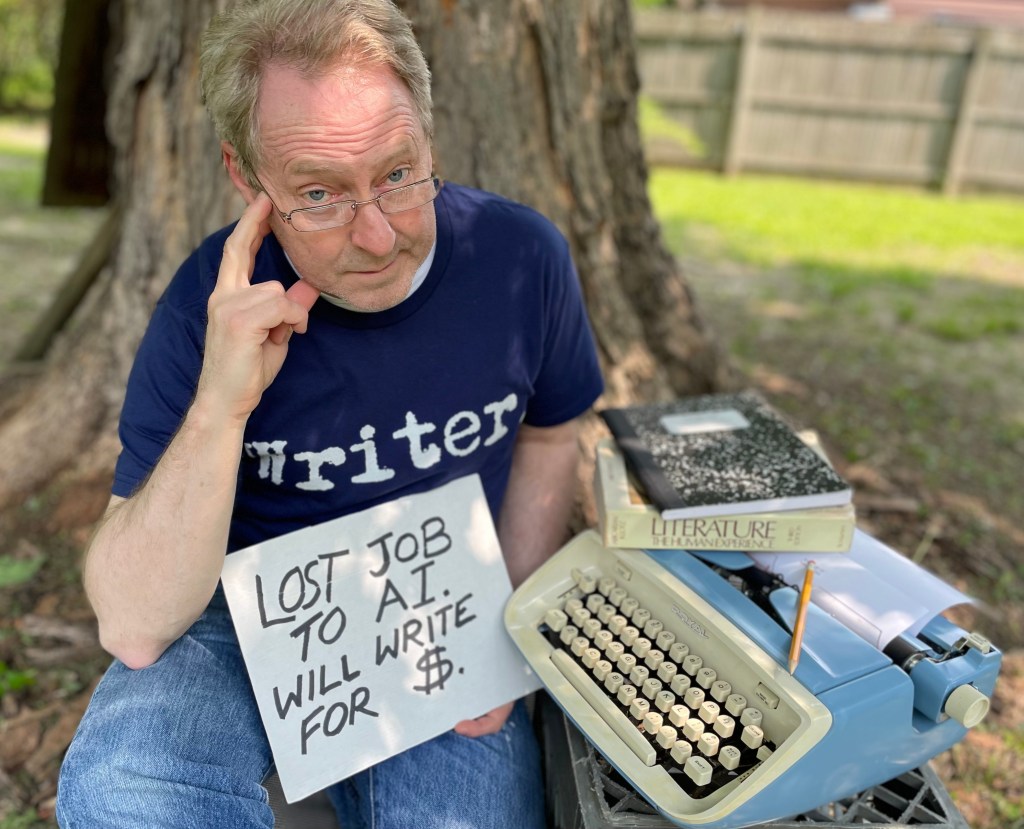
Writers in every industry are rapidly becoming an endangered species due to Artificial Intelligence.

Since much of what I did in the corporate arena was high-tech, the advanced skills required evolved rapidly. I constantly studied the latest technologies to avoid obsolescence. I’ve always been fascinated by computers, but keeping up with advances in computer technology during the 1990s was exhausting.

If that wasn’t enough to worry about, no matter my job, I always felt like something would ruin it. Someone would take it away from me or decide I wasn’t qualified, and that’d be that. I really did know what I was doing. But I suffered from terrible imposter syndrome. Then, one day, that was enough. I walked away.

Life as an independent professional can be tough, especially if you’re used to a steady paycheck and punching out at 5. At least no one ever gets fired, right? Wrong.

There’s a quote from the TV show “Mad Men” that goes, “The day you sign a client is the day you start losing them.” It means that every customer will eventually leave you—your fault, their fault, nobody’s fault. It’s just part of the process. So, when that happens, you are effectively fired. Depending on how many customers you have, that’s how many times you will be fired.

Despite the romanticization, self-employment is hard work and a bit like riding a bike. If you stop pedaling, you fall. You must exceed customer expectations the first time, or those firings I mentioned start sooner. Is that more secure than a corporate job? In many ways, yes. Let me explain.

If I am a “free agent,” I can play in whatever league I want. However, I only get to set some of the rules. I usually have to work within the guidelines of my profession or the client’s needs. One thing is sure, however. If I do my best, treat people with respect, and give them good value for their money, the work will continue.

That doesn’t mean I don’t worry about my job. I do, but for very different reasons. One is automation. Artificial intelligence, or AI, threatens the livelihood of writers in every industry, and what it generates is, at best, inadequate.

Another concern is that my skills will be devalued by a market flooded with amateurs and dabblers. These people produce inferior work, disparaging the profession and limiting potential business for the pros.

Ultimately, no one’s job is bulletproof—not even mine. Always demonstrate your best work. That will show your value, and you’ll stay employed – somewhere. In the meantime, try to remember that there’s always another job.

Uniquely Portable Magic

In Books, Education, Entertainment, Opinion, Print Media, Technology, Uncategorized on April 7, 2024 at 9:47 am

Deer In Headlines II

By Gery Deer

“Books are uniquely portable magic.”—Stephen King, On Writing: A Memoir of the Craft.

I’ve often quoted classic books in this column for several reasons. For one thing, those brilliant writers of old had wisdom that still eludes me, and I need to borrow it occasionally. 

I also enjoy the opportunity to share my love of books with those of you who are kind enough to give me your attention for a few minutes each week. My hope is that, in addition to my humble observations, I can share some words from those scribes who were (or are) far wiser and more eloquent than me. 

Of course, I don’t just cite the classics. I toss in something fun and modern here and there as well. You may not realize it, but I’ve shared some words from the likes of Douglas Adams, George R.R. Martin, J.K. Rowling, and more. 

I wasn’t a voracious reader when I was young, but that changed as I grew up. In high school, I became interested in Charles Dickens. Later, it was the stories of Mark Twain. From “The Little Red Lighthouse and the Great Gray Bridge” to “Lord of the Flies,” one book led to another. It’s interesting how that happens. Once you’re hooked…

That said, here are my questions of the day: Have books become obsolete in the shadow of the internet and social media? As some try to ban classics like Huckleberry Finn and To Kill A Mockingbird, what has become of literature’s social significance? What does the future hold for the classics and all the unwritten works yet to come? I don’t have the column inches to answer these questions, so here are my brief thoughts. 

In my humble opinion, Stephen King had it right. Books are magical. They transport us to faraway lands, introduce us to people around the globe, and inspire imagination and dreams. But books are far more than mere escapism from our daily grind into the worlds of Harry Potter and Captain Nemo. 

Books are the arks of our history. They help us learn from the past, hold a mirror to the present, and prepare for the future. Every published page offers a tiny glimpse into who we are as a species—warts and all. When you read a book, you have no choice but to learn something. Ignorance is replaced with knowledge and understanding, and then a funny thing happens—people get along better. Books provide the knowledge that breaks down all the barriers that separate us.

Booksellers are struggling, however. In many American communities, there might be a Starbucks or a parking lot where the neighborhood bookstore once stood. Instead of the pages of some great new novel, many people seem far more interested in scrolling through social media.

Although I prefer the printed page for most of my reading, my appreciation for books is more about content than construction. I typically read two or three books simultaneously, each in a different medium—audio, digital, or print. 

A book is a book. Unless you can convince me that words read aloud are less meaningful than those read by eye, listening to an audiobook still counts as reading. You should read however you feel comfortable.

Concerning book bans, I won’t get into the obviously paranoid politics involved. If you don’t like a book, don’t read it. But the concept of book banning should horrify us because it casts a long shadow backlit by terrors of the past. 

Some writers spend decades crafting the perfect book, hoping it will positively impact the reader. No matter your age, the genre, or the medium, reading a book will improve critical thinking and creativity and release dopamine, the brain’s “happy” chemical. 

If you haven’t done so for a while, it’s time to get some of that happiness for yourself or give it to someone else. A book is one of the most meaningful gifts you can give. Libraries and bookstores offer a fun, affordable family experience you will remember forever.

Thankfully, books, even printed ones, aren’t going away anytime soon. But if they were ever to disappear, so would our society, our humanity, and, eventually, the record of our very existence. 

*************

More Information:

Your local library is a great, free resource for the whole family to explore the unlimited world of books!

If you want to learn more about the book industry, the future of printed books and bookstores, check out these documentary films: The Booksellers. And Hello, Bookstore.

700 Words

In Entertainment, Literature, Local News, Media, News Media, Opinion, Uncategorized on April 7, 2023 at 5:05 pm

Deer In Headlines II

By Gery L. Deer

A few weeks ago, I appeared on a local television program to promote this column. During the 3-minute interview, the host was surprised to learn that Deer In Headlines II is – and has always been – exactly 700 words in length.

Unfortunately, limited time prevented a deeper dive into such a precise word count. But the conversation made me realize, though you may be a regular reader, you may not know much about how all this works. So, here’s a look at how it all comes together.

First, riddle me this. What’s the difference between a writer and a pizza delivery person? The answer – a pizza delivery person can feed a family of four. Yes, I know, terrible joke, but not entirely inaccurate.

I’ve heard it said that writing for a living is like having homework every day for the rest of your life. That wasn’t far off either. Writers are romanticized in movies and TV. We’ve all seen images of the Hemmingway wannabes, huddled over an old IBM Selectric (go look it up), pecking out the next great American novel. It’s all so dramatic – and all such nonsense. I’m sure some see themselves that way, we scribes can be a self-absorbed lot for sure. But that is certainly not me.

I’m not a novelist, though I have a couple of manuscripts in a drawer somewhere. My work is focused on non-fiction, freelance journalism, copywriting, and public relations. Sometimes I do get to work in my fuzzy slippers, but most days I go to an office and sit at a desk. I also traded in my manual typewriter for a MacBook Pro – much easier to fit in a messenger bag.

I am the founder and creative director of a public relations and media production firm and, although I might own the place, I’m not my own boss. That’s a load of nonsense. I have a dozen bosses, and they all pay my salary – they’re called clients. When I’m asked, “Are you a professional writer,” the answer is a resounding yes, though it didn’t start that way.

In college, I was an engineering and computer science student but worked for my college newspaper as a staff writer, eventually earning the senior editor position. I even stayed on after graduation to handle the summer editions. My coursework always included English composition, communication, and classical author studies like Charles Dickens and D.H. Lawrence.

When I started the original Deer In Headlines, some 15 years ago, my inspiration came from the news. Today, that inspiration comes from people, their struggles, achievements, interests, convictions, and feelings. Most of the time it all starts with a tiny glimmer of an idea; that word, or phrase that just won’t leave me alone. As it becomes something more substantial, I write down what your grade-school English teacher might have called, “the main idea.” Oddly enough, that often becomes the headline.

Then I sit down with my laptop, or sometimes just paper and pencil (not a pen), and see where the idea takes us. I say “us” because you, my audience, are there with me – following the words as they paint a picture of my thoughts and feelings about a subject that I hope will give you food for thought, inspiration, hope, or whatever might help you at that moment.

I will never use an AI (artificial intelligence) writing program. Because, if my work is to have meaning, there must be a human mind and heart behind the keyboard. When you read this, what you get is all me, like it or not.

Before I close, I don’t want to leave you without answering the original question. Why 700 words? I wish I could give you some deep, philosophical, or even technical answer. Within the first year, the original DIH series just worked out and it became a clear goal each week. It also fits nicely in the print layout, and you can easily read it in just over 2 minutes, then get on with your life. But I hope you take away something useful out of these 700 words every week and please know that I thoroughly appreciate your time and attention.

Western Ohio Writers Association Discontinues Operation After 11 Years

In Books, Business, Charities, Dayton Ohio News, Education, Literature, Local News, National News, Uncategorized on August 8, 2019 at 8:58 am

Writing workshops, live reading events to be offered publicly by parent organization

Dayton, Ohio August 8, 2019The executive editorial committee of the Western Ohio Writers Association (WOWA) has announced the organization will cease operation as of August 31, 2019. The group will hold a final, private author reading in mid-August to celebrate the successes of its members and provide a platform for one, final event they call “Beatnik Café.” Fee-based workshops and live readings will continue to be offered through the organization’s parent company, GLD Enterprises Communications, Ltd., but will now be open to the public.

About WOWA — From inception in October 2008 through August 2019, the Western Ohio Writers Association (WOWA) was a member-based, not-for-profit organization dedicated to supporting writers of all genres throughout the southwestern Ohio region. Through workshops, critique sessions, educational and networking opportunities, WOWA offered writers an outlet for support and creative feedback unmatched in the area.

Writer and entrepreneur, Gery L. Deer, is the co-founder and executive director of WOWA. “While discontinuing the organization was a difficult decision, we are proud of the work we have done over the last decade and,” he said. “Our parent organization, GLD Enterprises Communications, Ltd., will continue to offer fee-based writing and professional workshops previously provided through WOWA.”

Deer explained that the organization has been thriving over the last several years but the increase in expense of operation, time and level of participation has made it difficult to maintain. Many of the educational programs will still be offered through the parent company, at a limited cost, in the near future, without membership fees or obligations.

WOWA’s authors have experienced a variety of successes over the years, from individually published works to some becoming highly-paid, professional authors. In 2013 the organization published an anthology of fiction titled, “Flights of Fiction.” Made up of 11 original short stories by member authors, the book sold more than 200 copies on the first day of its release and is still available from Amazon.com.

For more information on the transition of writing workshops and other services now moving to GLD Enterprises Communications, Ltd., call 937-902-4857 or email gdeer@gldenterprises.net.

WOWA, Western Ohio Writers Association, and its affiliated logos, icons, and referenced content are trademarks of and copyrighted by GLD Enterprises Communications, Ltd. All rights reserved.

Extends Deadline, 2018 WOWA anthology now open for submissions

In Books, Dayton Ohio News, Entertainment, Literature, Print Media, Uncategorized on July 7, 2018 at 10:59 am

Dayton, Ohio, June 1, 2018 –The Western Ohio Writers Association (WOWA) is now accepting short story fiction submissions for their 2018 anthology themed, “Redemption, Reinvention, Revenge” (final title TBA), targeted for publication in Q4 2018.

The Western Ohio Writers Association was founded in 2008 as a resource for writers of all genre in the southwestern Ohio, southeastern Indiana, and northwestern Kentucky region. The organization provides monthly critique sessions, networking opportunities, workshops and education, and creative support.

This will be WOWA’s second anthology, having published its first, “Flights of Fiction,” in 2013. This time, however, rather than only member authors, submissions are open to writers outside the group.

“We are looking for innovative short fiction between 2,500 and 7,500 words. Stories should have diverse appeal and must incorporate one or more of the anthology theme’s concepts,” explained WOWA Executive Director, Gery L. Deer.  “All submissions must be original works that have not been previously published. We will choose approximately 15 stories for this anthology.”

Submissions are open to fiction writers 18 and up who are permanent residents of the following Ohio counties: Brown, Butler, Champaign, Clarke, Clermont, Clinton, Darke, Fayette, Franklin, Greene, Hamilton, Highland, Madison, Miami, Montgomery, Preble, Warren. Authors do not need to be members of WOWA in order to submit.

Submissions will be accepted between May 1, 2018 and now extended to August 31, 2018. Please either upload your manuscript document through our Submission Form page or send it as an email attachment to submissions@westernohiowriters.com. No more than two submissions per author, please. We will reject stories that include explicit sex, brutality, or pervasive profanity. We do not accept simultaneous submissions.

Full details and submission guidelines are available online at www.westernohiowriters.com, click on “WOWA Publications.”

Old Haunts Beatnik Cafe celebrates original Halloween stories by local authors

In Books, Children and Family, Dayton Ohio News, Entertainment, Holiday, Local News, Theatre, Uncategorized on September 11, 2015 at 8:37 am

Artwork by Michael Martin, WOWA Editorial Committee

Artwork by Michael Martin, WOWA Editorial Committee

Beavercreek, OH – Beginning at 7pm on Friday, October 16, author members of the Western Ohio Writers Association (WOWA) will take the microphone at Books & Co. to present the 2015 Halloween addition of their popular, “Beatnik Café” event. Writers from all genres will regale visitors with original works of poetry and prose to the theme, “Old Haunts.” The event is free and open to the public.

The live reading pays homage to the hole-in-the-wall poetry clubs of the 1960’s, but with a more modern style. Reading aloud from original work, each writer will take the stage for 10 to 12 minutes, dazzling audiences with short stories, poetry or who knows what. This is the 6th year for the quarterly event.

Barbara Deer is the co-founder of the organization. “WOWA was intended to provide a regular resource for peer critique, educational programs and networking opportunities to local writers of all genres, both amateur and professional,” she says.

Barbara Deer, WOWA co-founder.

Click to watch the video!

“Annual workshops are held all around the country, with two of the most well-known right here in the Miami Valley. But for most writers to thrive that type of support needs to come on a more regular basis,” Deer says. “Our group consists of professional writers and editors, college professors and everyone is ready and willing to offer help, a fresh eye and, sometimes more importantly, an honest opinion about the quality of the work – good or bad.”


Writers come from all around the region – southwest central Ohio, eastern Indiana and northern Kentucky – to attend monthly critique sessions, educational lectures and write-in events. Meetings are held on the first Thursday of the month at the Event Connections, 4140 Linden Ave. in Dayton, near the intersection of US 35 and Woodman Drive.

WOWA Logo 2Now in its seventh year, this talented group of scribes definitely have plenty to celebrate. In addition to the many individual members who have been published on their own, in May of this year eleven of them were featured in an anthology titled, “Flights of Fiction,” produced by GLD Enterprises Commercial Writing and published by Handcar Press (ISBN: 978-0-9885289-4-9). The book features stories set in and around the southwest Ohio region and is available in print and electronic formats from the WOWA website as well as Amazon and BN.com.

The Beatnik Café is a family-friendly, free, public presentation of WOWA and GLD Enterprises Communications. Books & Co. is located at 4453 Walnut St. at The Greene in Beavercreek. For more information, go online to www.westernohiowriters.org or call (937) 902-4857.

Improving American language skills: Reading and writing are fundamental

In Books, Children and Family, Education, Literature, Local News, Opinion, Technology, Uncategorized on June 30, 2014 at 3:53 pm

dih-logo-SENext to the United States Constitution, the Declaration of Independence may be the single most important document ever created in the history of America. It established our country’s formal separation from England and set in motion more than two centuries of global influence and an example of how a free republic can succeed.

But what would have happened if the men who founded our country lacked the basic language skills to create that first, all-important document? How would these men have properly and so effectively communicated the displeasure and intent of an entire people without such a firm grasp on the English language, not merely to speak it but to put it down in a document to be revered for centuries to come? In short, they couldn’t have.

On this 238th anniversary of the signing of the Declaration of Independence, we need to remember that it’s author had but two years of formal, college education. In those days, a man wishing to become a lawyer apprenticed under other attorneys, reading the law and learning to interpret and apply it for the good of the people for whom it was put in place. Jefferson eventually became a lawyer but not by obtaining any degree we might understand today.

Likewise, Benjamin Franklin went to school briefly but, because of financial issues, he had to stop to help support his family by going to work with his father. He furthered his own education, however, through reading and self-study, a practice that is, sadly, frowned upon today. Both of these men demonstrated the vast important of language and writing, and how the written word can change history. Some people, though, struggle with language skills or never learn to read at all.

One of my favorite books from childhood was called, “The Little Old Man Who Could Not Read,” by Irma Black. The book chronicles the story of a little, old toy maker who, despite his amazing craftsmanship for pleasing children, never learned to read. One day, his wife went to visit a sick friend and left him alone for what must have been the first time. He was forced to do the grocery shopping on his own, which turned out to be a very frustrating endeavor. Upon arriving home, he sadly discovered that what he thought was a spaghetti box turned out to be wax paper and the can of sauce, coffee instead. It was very disheartening. But it motivated him to learn and he did. The book was written many years before the technology age, but imagine what he would have to deal with today if he couldn’t read at all? It would be nearly debilitating in modern American culture.

little_old_manI have always been a writer, even back into childhood, but most of my language skills came from audio books and those children’s books that came with a 33 rpm record. I found later that I had been dealing with a learning disability that hindered my ability to retain what I had read. Over the years, I adjusted and coped, but was not diagnosed until my mid-30s. Today, I have new ways of dealing with the problem and read as much as I can. I learned to defy my disability because I wanted to read.

There’s no question that Jefferson and Franklin were above-average men, but we all have the ability to move past our limitations, just as Franklin taught himself what he needed to know and just as I worked past my reading issues. For those who want to improve their language skills across the board, here are a few tips and they work for pretty much all ages.

First, try to write as much by hand as possible. Using paper and pen will slow you down a bit and force you to think before you write. People were better writers in the old days because it took time to get thought to page. Today, technology has us whizzing through sentences without a thought to grammar and word usage.

Next, although it’s fallen out of favor with the public school set, use cursive writing as much as you can. As with the first point, handwriting something makes you think and use the right language. It even gives you the chance to look up a word before you use it.

Try to learn a new word every day. Vocabulary is the key to better language skills. Take the time to look up words you hear throughout your normal day. But if you don’t hear any that grab your attention, pick up a hard-bound dictionary, open it up, close your eyes, and point to a word on the page.  That’s your word for the day. One of those “word of the day” desk calendars is a great resource too. Of course, you need to put the word into use whenever possible to make it stick.

Read, read, read, read. And, did I mention, read? Newspapers, well-written blogs, congressional briefs, comic books, it doesn’t matter what you read, just make sure you read a lot. If you’re trying to improve your language skills, however, the more advanced the reading the better. It’s ok if it takes time, look up words you don’t know and charge ahead.

Finally, don’t write like you text. In fact, don’t text how you text, either. The wave of “texting shorthand” is maddening to those of us with good grammar and language skills. Use full words and sentences – even in texts. It’ll make a big difference in how you communicate in email and in other written documents as well. Take your time and say it right.

So this Fourth of July weekend, go out and enjoy the picnics and fireworks.  But remember, when you hear the words to the national anthem or the preamble to the constitution, think about the meaning of each word and be grateful that those guys were diligent enough to get every one of them right. Our very freedom depended on it.

If Illiteracy Is the Disease, Then Literacy Is the Cure

In Economy, Education, Health, Media, Opinion, Politics on March 13, 2012 at 10:32 pm

Michael Martin and Gery L. Deer give a public reading of their writing during a Western Ohio Writers Association event, promoting literacy through creative prose.

By Gery L. Deer

Deer In Headlines 

Most Americans probably take for granted the ability to read and understand the words on this page. As a writer, I depend on the ability of the media-consuming public for my livelihood. But according to the National Adult Literacy Survey more than 42 million of my fellow Americans will never be able to enjoy (or detest) what I write because they can’t read.

Back in college, I took a job with the school newspaper as a staff writer where I learned a great deal about journalism and the power of the written word. One of the best lessons came from our staff advisor who once said, “No matter what your career or life path, your communications skills, reading and writing, will be your most valuable asset.” She couldn’t have been more correct.

I spent several years in the engineering fields for which I earned my degree, but ultimately I found my place as a full-time business writer, editor and columnist. Unfortunately, I found my calling far later in life than I’d have liked to due to an undiagnosed learning disability that seriously impacted my reading speed and comprehension.

Thousands of Ohio school children with learning disorders that affect their reading and writing skills continue to slip through the proverbial cracks every year, for a multitude of reasons I’ll reserve comment on for another time.

Suffice to say, it’s our own fault, and by “our” I mean the taxpaying public that does far more to insist on a fancier football stadium than to demand instructional accountability and better support for these kids.

Yes, there are laws in place and special education professionals to help identify and establish individualized educational plans for them, but, somehow, that never seems enough. Far too many still grow up unable to interpret the instructions on a can of soup.

Growing up, a person with illiteracy will adopt various coping skills needed to get by, but are never able to fully realize their potential. Illiterate adults have more difficulty finding jobs, developing business relationships or even doing household chores like paying bills.

Many politicians believe that illiteracy is one of those liberal issues, best left to bleeding hearts. In fact, such a staggeringly high number of illiterate citizens can be phenomenally detrimental to productive nation with a stable economy.

As the economy crawls to recovery, illiteracy will continue to keep some people on the unemployment lines, thus, adding one more contributing factor to suffocating fiscal growth. Adults struggling with illiteracy earn, on average, less than $250 per week, work less than 20 weeks per year and are at least ten times more likely to live below the poverty line.

How do we solve the problem? That’s a good question, with no easy solution. It often boils down to manpower and, dare I say it, money. If we think of illiteracy as the disease, then, surely, literacy should be the cure. So the best first step is to seek out help. Whether a child or an adult with a reading problem, there is help available, but sometimes you may have to get things started.

If you believe your child is struggling, meet with his or her teacher as soon as you believe there might be a problem. With tighter budgets, class sizes are increasing and sometimes being pro-active is the best way to get individualized help from an overwhelmed, underpaid faculty. You can also find tutors at local colleges and civic centers.

The same goes for adults as well. Community and career centers, local libraries and even senior citizen organizations are now offering adult literacy classes, either free or at a minimal cost.

And schools can help too by reinforcing the importance in the curriculum of the Three R’s –Reading, Writing and Arithmetic – with sharp emphasis on the first R, which will make the other two far easier to learn.

And, while technological education is important, particularly in today’s world, it might be time to cut back on the advanced computing classes and focus more thoroughly on reading skills. After all, knowing how to click a mouse is pointless if you can’t read what’s on the computer screen.


Independent columnist Gery L. Deer is the founder and director of the Western Ohio Writers Association. More at http://www.westernohiowriters.org.