I was a staff writer and later an editor for my college newspaper. During that time, I learned the single, most important lesson from all my years of education. Our administration-appointed supervisor once told me, “Whatever else you learn as you go through your college career,” she said, “learn to write and speak well. If you have that, you’ll be able to do anything.” She was right.
My mother also shared those views, though she had a head start by teaching me to read early. On the other hand, I would depend on my communication skills to pave my way to a multi-faceted career. She was determined to give me every possible advantage, mostly because she didn’t get them.
Literacy is one of the most critical indicators of a strong society. It reduces poverty, bigotry, ignorance, and social and professional inequality. It shouldn’t be limited to the academically gifted. Everyone should have the opportunity to learn effective communication.
Just because you don’t have an interest or aptitude for high academia, that doesn’t mean literacy is less important. I feel fortunate that I had the best of both worlds. I’ve always been an avid reader and writer and a lifelong student of all the sciences. But I also learned to rebuild a car engine, install a new water heater in my house, or change a faulty electrical outlet.
Every one of those tasks requires the ability to learn, understand, follow instructions, and cope with the unexpected. All of my “book learning” occurred while surrounded by some of the best tradespeople in the world. Even better, they were all teachers. One thing that has changed over the years is how literacy is emphasized in our public and private schools.
Do you remember when kids used to get in trouble for reading comic books at school? I will say “we” instead of “they” because I did this too. We put comic books inside large textbooks so we could read during class. From the teacher’s perspective, we seemed engrossed in our educational process. Instead, we were engaged in the exploits of Superman, Batman, or Spider-Man.
Some argued that even reading comic books was good for us because at least we were reading. But it was more than that. Comic books are a good literacy metaphor because they aren’t just about words, grammar, and sentence structure.
For our society to consider itself truly literate, we must understand language, not just the written word but communication. We also need to understand art, storytelling, and critical thinking. In an ironic twist, one way to do all that is by reading comic books. Many of the Batman stories from the 1930s and 40s are loaded with material you only find in today’s best crime novels by authors like Michael Connolly, James Patterson, and David Baldacci.
Unfortunately, some use the comic book analogy to justify spending hours on social media. That’s not the same thing. Reading is calming, focuses our minds, and relaxes our bodies. If anything, social media has dumbed us down and created an entire society nearly paralyzed by anxiety and inferiority. Scrolling doesn’t count as reading.
Still, literacy doesn’t require you to wade through “War and Peace,” “Catcher in the Rye,” or any other long-winded literary work. I supplemented my education by reading everything I could get my hands on. Whatever I had an interest in, I had books about it, encyclopedias, or topic-specific material – there was no internet back then. Now, resources are nearly endless, provided you learn the difference between credible and non-credible sources.
Advanced education isn’t required either. Truth be told, much of what I do for a living was self-taught – thanks to my early introduction to books. Self-education is mainly frowned upon in today’s society. I find it ironic that Benjamin Franklin, Thomas Jefferson, and others who wrote some of the most important documents in history would be unemployable by today’s arbitrary and unfounded standards.
My point is that American culture currently reads at a U.S. 5th-grade level. That’s unfortunate, ridiculous, and easily corrected. We must eliminate the stigmas of functional illiteracy, focus more on reading and writing in our schools, and spend more time with books than cell phones.
Without question, 2024 has been and will continue to be one of American history’s most charged and controversial election years. Among the points of contention is the continued argument regarding the necessity – and validity – of the Electoral College.
Political operatives and pundits alike have been outspoken on the subject from all political viewpoints. There seems to be no consensus because, quite frankly, even some government officials don’t understand its purpose. So, before I give you my thoughts, here’s some non-partisan history.
During the first Constitutional Convention of 1787, a significant debate unfolded about the method of electing a president to lead the executive branch of our newly established government. It was a pivotal moment in our history after the decision to have a single individual in the office rather than two or even a triumvirate. Just imagine the complexity of electing three people every four years.
The primary issue was whether a congressional vote should elect a president or do it by popular vote. The latter eventually won out until the smaller states began to weigh in, concerned that those with a larger population would wield more control.
Another lesser-known concern was that the political elite of the time were worried about a mass of uneducated voters swaying the results. Discussions continued for several months until, one day, in a closed-door subcommittee, James Madison laid down the concept for what became known as the Electoral College.
Enacted as a compromise and safeguard, Article II of the U.S. Constitution (later the 12th and 23rd Amendments), as well as the Electoral Count Act (ECA) of 1887) formally established the Electoral College. These laws regulated the voting process and defined the events between Election Day and the Inauguration.
Now, to clear up some misconceptions. Regardless of rhetoric to the contrary, I assure you that the Electoral College is an entirely democratic process. It is not, however, easy to explain. But I’ll try anyway (insert a deep breath here).
In a presidential election year, the political parties hold conventions where they nominate “presidential electors.” That’s simple enough to understand, but hang on. Here’s where it can get… confusing.
When a party’s presidential and vice presidential candidates win the popular vote, that party’s electoral nominees become “Electors.” Each state has the same number of Electors as members of Congress, and each Elector votes for their party’s ticket on separate ballots – one for president and one for vice president. So, your individual vote is still vitally important because the candidates cannot earn Electors without it.
For example, if Richard Nixon and Barry Goldwater (president and vice president, respectively) won the popular vote in California, the Republican nominees from that state would become Electors and cast their votes to the Electoral College. Once all the electoral votes are cast, the candidate who reaches 270 out of a possible 538 wins – and this is only triggered if the candidates win that state’s popular vote in the first place.
In the news, the results sound something like this: Nixon has won California and its 54 electoral votes. Of course, those results still have to be certified. As you might recall, there was a slight hiccup during the 2020 election certification. However, new security measures have been taken to reduce any potential repeat of those terrible events.
Remember, this is just a glance at the process, but I hope it helps. If it’s still puzzling, a good analogy is Major League Baseball’s World Series. Every year, the winner is determined not by which team got the most runs per game but by which won the most games in the series. The Electoral College works the same way.
In my opinion, the Electoral College is the only practical, efficient, and fair way to ensure everyone’s voice is heard because we’re represented just as we are in Congress. The Founders realized that the popular election alone could and would eventually bring chaos.
If we want an election process that stays in constant contention, then eliminate the EC. But if we’re going to have all our citizens represented equally, let the system do what it was designed to do. If you want to make a real difference, make sure you vote.
Deer In Headlines Special Edition – October 14, 1993
It had been a long day for the freshman saxophone player and his high school marching band friends. By now, it was 4:30 in the afternoon, and the day had begun for them nearly eleven hours ago. They’d earned the opportunity to compete in a tri-state marching band competition in Huntington, West Virginia, some 200 miles from home.
The mid-October afternoon had become hot and muggy. Even the seats in the stadium were perspiring. The adventure had begun early that morning with all the spirit of the world’s most excellent universities. The performances were over, and they sat impatiently awaiting the judging results.
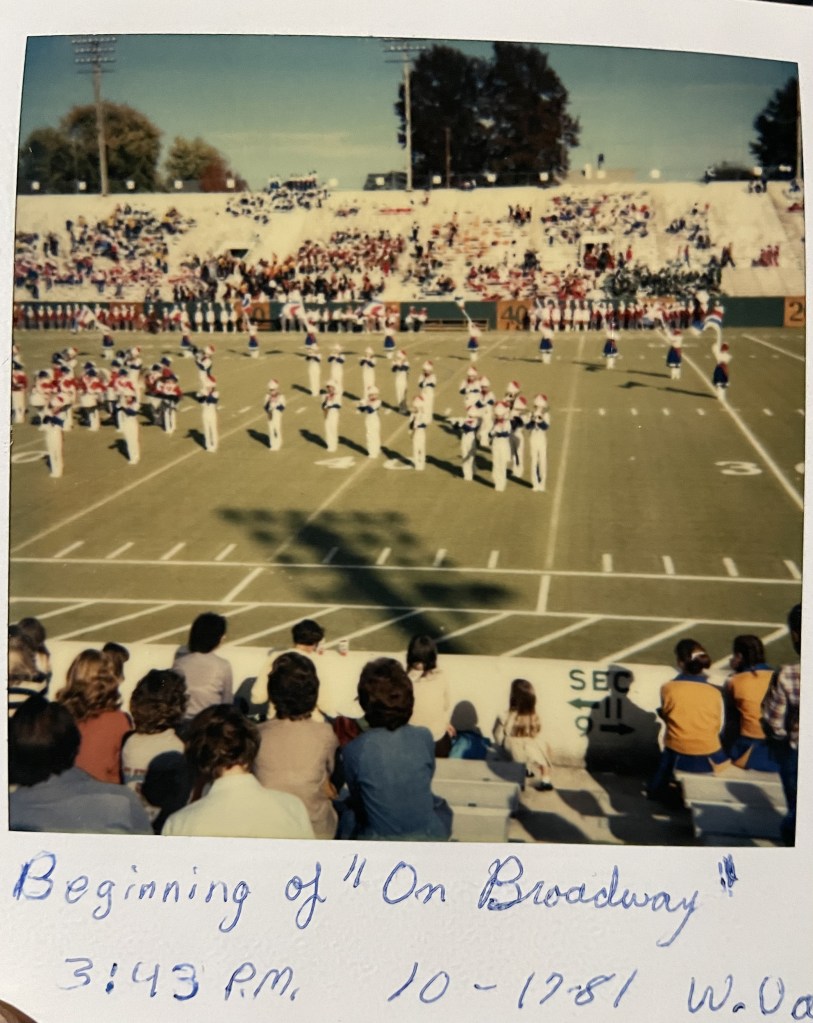
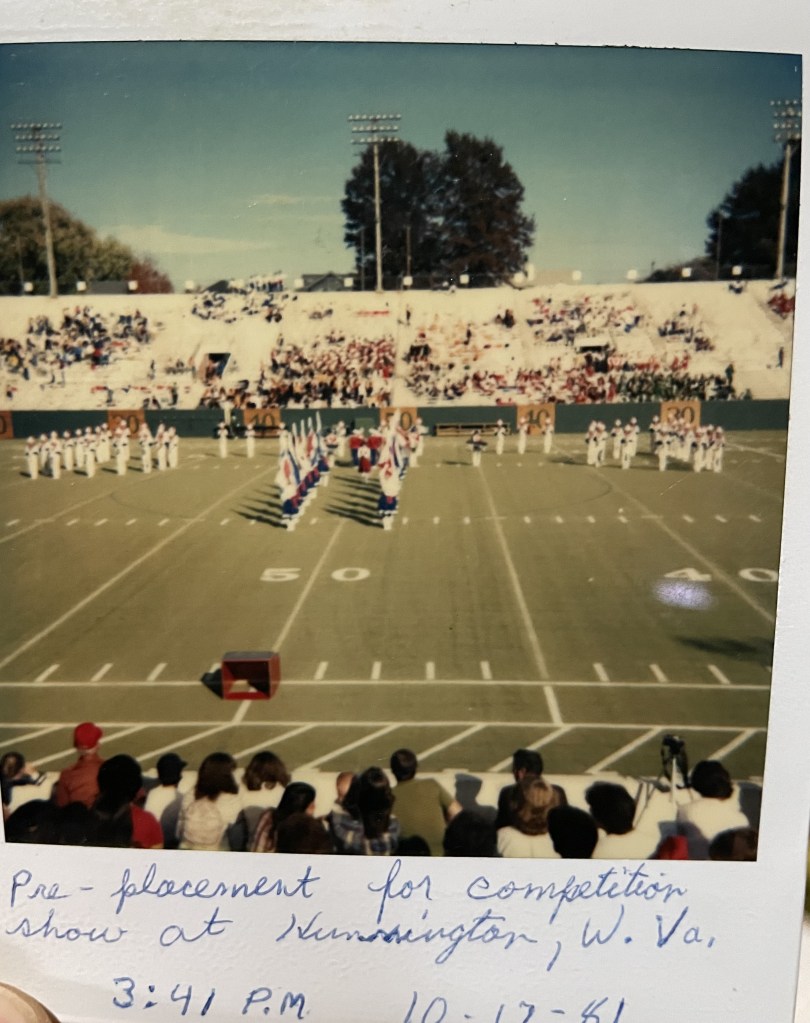
This is the view of the real Greeneview High School marching band during their first song of the contest—from the families’ perspective. (Photo by Lois Deer, 10-17-1981)
The bands were divided into three classes based on the size of their home schools. This group’s small, rural high school was in the last division, called class B, at this show. That meant it would be a long, hot wait by the time they went through each division, of each class, of each award. It was nerve-wracking, it was hot, and it was discouraging, but they waited. Patiently – well, sort of.
The university stadium buzzed with nervousness and emotion as the first awards were called. “Fifth place, class AA, goes to…,” A loud cheer bellowed from 100 yards down the bleachers, drowning out the anxious and irritated sigh from the young saxophonist and his group. The noise subsided. The announcer spoke again. “The fourth-place award goes to…” Another excited cheer came from the stands. The little band had worked hard all summer for this. It was one of the best shows they’d ever done, but this performance got off to a shaky start.
Their arrival at the host stadium was almost the exact time they were supposed to go on the field for their practice run, and things were rough. Heat exhaustion cost them one of the flag corps at the start of their competition show. The Astroturf-covered football field, new to most of the marchers, created its own set of problems. These kids were used to trotting through mud and grass. Now, wearing the slick-souled dress shoes, they had to contend with spongy ground and slippery artificial grass.
If that wasn’t enough, one of the trombone players nearly decapitated a field judge with his slide. During his morning pep talk, the director said, “Judges were fair game…” Meaning, if they got in the way, just keep doing what you’re supposed to do. Unfortunately, the aggravated trombonist took the recommendation literally. Somehow, they got through it all, and there they were. Hot. Sticky. Impatient. Every ingredient was added to create a group with a bad attitude, who, by this time, faintly resembled people sitting in a traffic jam.
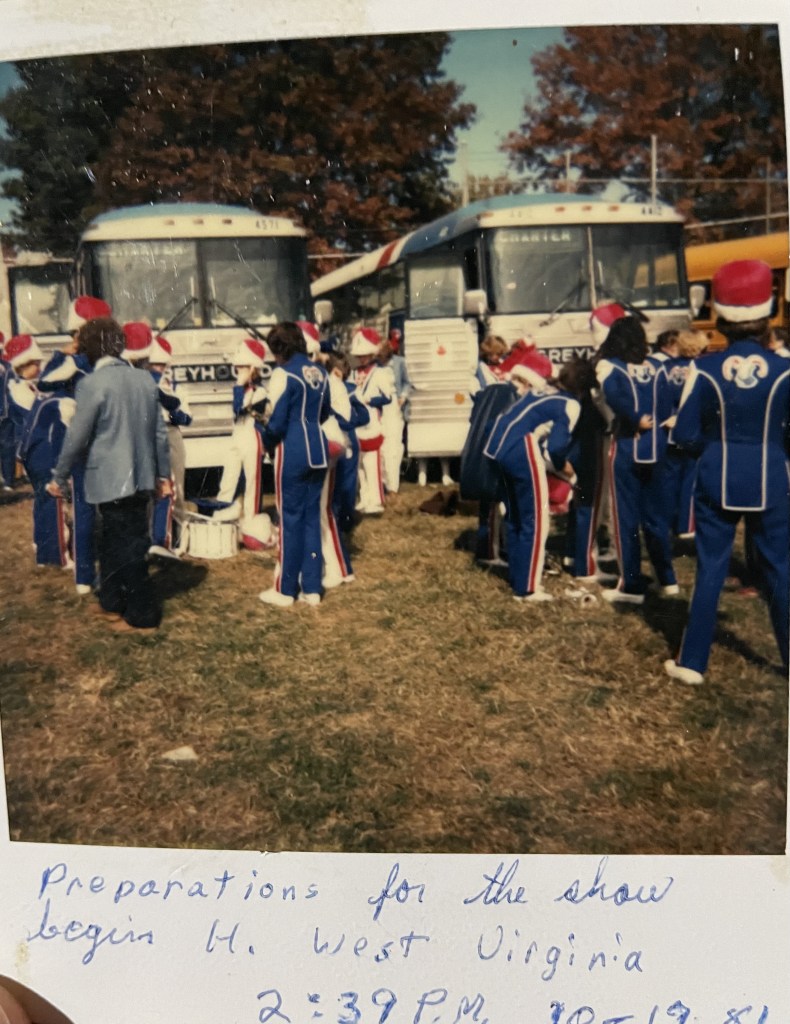
A lot was riding on this, though. Everyone was here. Parents and family friends had accompanied the band on the four-hour Greyhound bus ride that morning. The busses pulled out of the school lot at 6 a.m., scored by the groans of how you’d expect average high school kids to at that time on a Saturday morning.
Most slept on the ride down. Many brought weekend homework. Others reviewed their music to ensure they remembered that one bad note at the football game the night before. Whatever the case, they made it, and everyone was pumped. And a little scared. Friday night football games were never like this. The tension grew and hovered in the air over the little group just the way that bricks don’t.
The young saxophonist eyed the band’s director. He was down on the track on the opposite side of the field, pacing back and forth in front of the reviewing stand like an expectant father. Another announcement blared from the public address speakers. The director’s curly afro hair and kinky beard glistened in the fall sun with impatient perspiration, giving him more the appearance of a heavy metal rock singer than a high school band director.
Then again, everyone was starting to look like that. The group grew increasingly discouraged with each passing award. The announcer was up to their class now, and the fourth-place award was called. Rats! The saxophonist slumped back against the bleachers with an irritated gasp. So did everyone else.
“There’s no way, ” he thought. “All these huge bands from three states? We can’t possibly have a chance at anything higher than fourth.” That seemed to be the general opinion of the others as well.
Another award. More cheering. None of it from them. Now, the announcer was up to second place, and the morale-broken musicians began standing, a few at once. Each gathered their things to return to the busses and the quiet little farm town. Some had already left the stadium.
“Well, so much for that,” someone said. “This is embarrassing, ” said another, like a line plucked from a Peanuts cartoon. Even their band director dejectedly headed towards his disappointed students. The announcer began to speak again, but no one in the group was listening. It was over. They tried, but the odds were against them, and the game was rigged.
“Second place, class B goes to…” A long pause.
This seemed to be the announcer’s annoying trademark, meant to instill drama. It didn’t work. It was just irritating. When their band took the field for the show, he sounded like he’d been mugged midway through his address. “You may take the field for comp…” Everyone held their breath. “…etition.” Whew!
Suddenly… the words no one expected to hear. No, more than that. They were impossible, improbable, incomprehensible words.
“Second place, class B goes to… Greeneview High School Marching Band from Jamestown, Ohio!”
For a solid breath, someone blinking would have rung like a gong. No one moved. No one spoke. Those shambling out stopped and turned around. There was an oxygen-steeling collective gasp.
A slow, quiet calm settled over the group as their brains processed the words they’d just heard. Suddenly, explosive screams of joy shattered the silence. They cheered, cried, and hugged. In the stadium section where their families were, everyone was on their feet, jumping, crying, and yelling. Even the other schools called cheers of congratulations, and they were equally shocked by the news.
The little band’s director stood in silent shock for a moment, and then it hit him. His eyes were as big as saucers when he turned to face the band from across the field, raising one arm in victory to them as if this little band’s second-place win were Olympic gold. It might just as well have been, but that wouldn’t have meant as much to them.
At the reviewing stand far below, their field commander and flag corps captain proudly marched to the awards table and saluted the presenters. Their vibrant red, white, and Colombian blue uniforms were almost as brilliant as the sun itself as they spun around in a military-like snap to salute the ecstatic audience. The pair accepted the two-and-a-half-foot trophy and rejoined the line of representatives standing at attention in front of them – both in tears.
Back in the stands, the young saxophonist and his friends watched and beamed. This was truly their most honored time together. The young man shaded his eyes as he took a moment to look at these people and tried desperately to soak it all in before it was over. They had no idea what they meant to him. So much of their lives lay before them. But this day… this was a day they’d never forget. “Someday, this is going to make a great story,” he thought.
The bright sunlight brought a tear to his eye. Then again, maybe it wasn’t the sunlight at all. He wiped it away. The thundering applause, congratulations, and excitement continued for what, in reality, was only about a minute or two. But it wrang out for what seemed like a lifetime to… The Little Band That Could.
———
Epilogue
My name’s Gery Deer, and that’s a true story from October 17, 1981. I was the “young saxophonist,” and I was right. I never forget that day, and it did make a great story. The band, Greeneview High School Marching Band of Jamestown, was under the direction of Richard Turner.
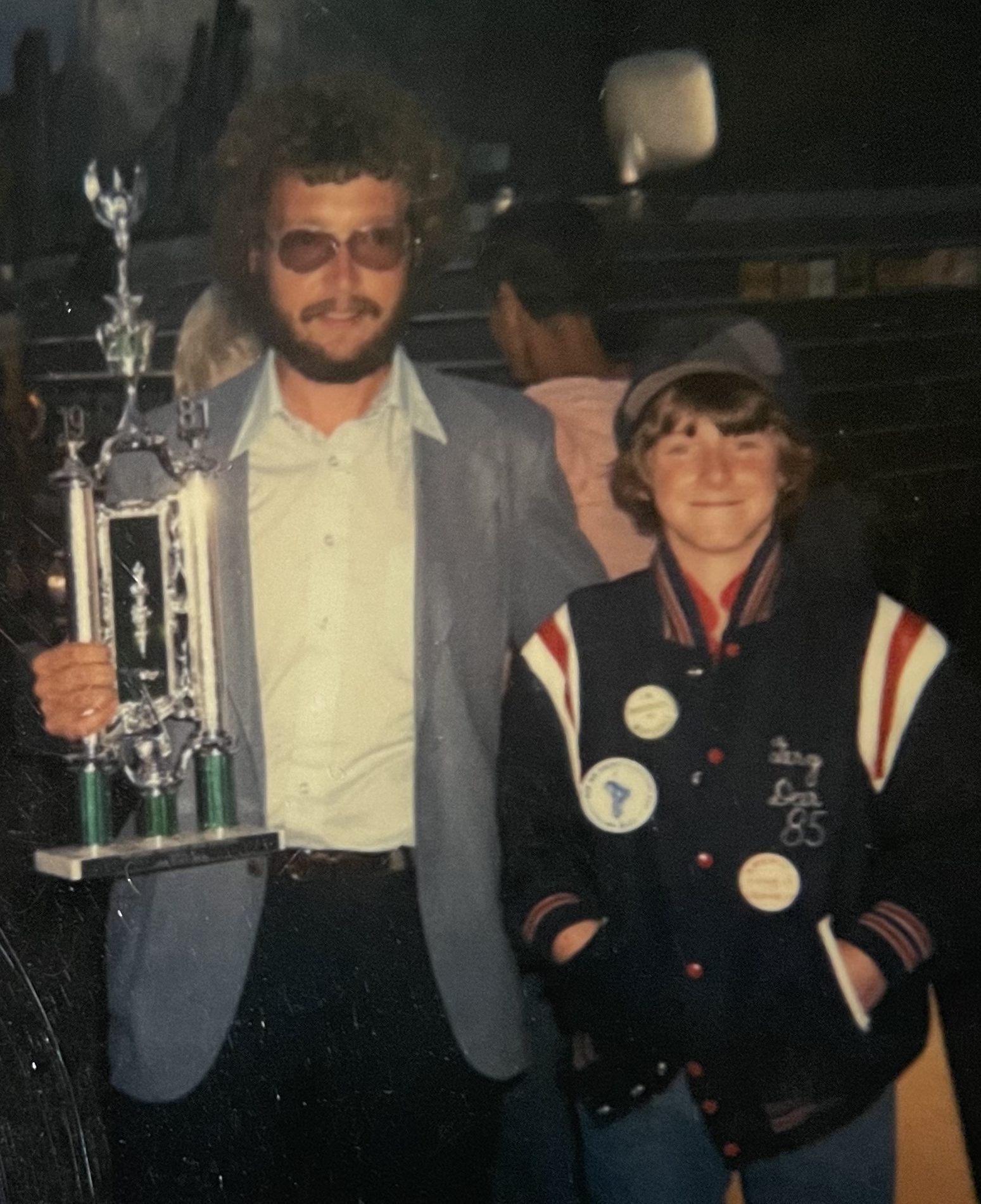
Band Director Richard Turner, the contest trophy, and me – Gery Deer in my newly-minted Greeneview school jacket.
I wrote this story after visiting Cooper Stadium in Columbus, Ohio, to see Greeneview perform in another competition show many years later. They competed in the Ohio Music Education Association’s state finals, and it was fascinating how little things changed from one era to the next. It was like reliving that day all over again.
Two of my four nieces were in the band in those days—now three decades ago. The oldest was the band’s field commander, a senior at the time, and a saxophone player like her uncle. The next oldest was a clarinetist and a freshman. They didn’t win their contest but took an honorable mention. Either way, I think they will still reflect on their day, as I do mine, and remember the feeling.
No one could have been prouder of my family and my school except maybe my parents, who were there again to watch their grandchildren as they did their own. And they, too, will remember. They say we can never be kids again. Well, no one could have gotten closer to it than I did that day. But to the “next generation,” I say, “When it seems like us old folks don’t understand, try to remember, we were there too.”
I just finished reading Friends star Matthew Perry’s autobiography, “Friends, Lovers, and the Big Terrible Thing.” As you may know, Perry died by drowning in 2023 after injecting ketamine. This dissociative anesthetic has become one of the injection hallucinogens of choice. He was only 53 years old.
In his book, released very shortly before his death, Perry detailed his life as what he calls an “unaccompanied minor,” the term given to children who fly commercially without an adult. He started drinking at the age of 14. At one point in his life, he was taking more than 50 oxycontin pills every day – still not achieving the high craved by his addiction-raddled brain.
Perry called addiction “the big terrible thing,” and it quite literally controlled his life. He had it all at one point – a million bucks a week on America’s number-one TV show, movies, and fame. But Perry suffered from terrible depression, fear, and insecurity. Pills were the only way he could feel, well, as he says it, nothing.
The National Institute of Drug Abuse defines addiction as a chronic, relapsing disorder characterized by compulsive drug seeking and use despite adverse consequences. It causes functional changes to the circuits of the brain responsible for self-control, reward, and stress, lasting long after the addict has stopped drug use.
Late ‘Friends’ star Matthew Perry struggled with addiction throughout his life.
I may seem out of depth on this topic to those who know me. I’ve been very, very lucky. My father’s side of the family is a tapestry of alcoholism. But, when my grandmother died, Dad was only three years old, and his alcoholic father left. A religious grandmother and strict aunt raised him, so he didn’t follow in his father’s footsteps. My mother wanted nothing to do with any of it either. So, growing up, I wasn’t exposed to any controlled substances because they weren’t in our home.
As I got older and went to college, then out into the business world, drinking and other drug use are far more prevalent. But I think somewhere down the line, I must have adopted an attitude of, “What do I need that for?” Even in my fraternity days, I was the non-drinker taking keys and getting people home safely. But I could have easily ended up on the pill side of things.
Many people with a substance use disorder start because of prescribed medications due to an injury or surgery. I think I’ve been lucky there, too, given the staggering number of surgeries I had as a child and young adult. I don’t think I ever got past the first two doses of any pain med, and even those were half-strength. I couldn’t handle the “out of control” feeling that euphoric high addicts live their lives trying to get. It was frightening. However, the problem for far too many people is that once they start, regardless of the reason, that may be the ball game.
Far too many people think addiction is about willpower or self-confidence. That’s ridiculous. According to the Cleveland Clinic, the disease of drug addiction may be woven into your DNA. They note that about half of your susceptibility to developing a substance use disorder (SUD) can be hereditary. That makes a person more prone to use alcohol, tobacco products, or drugs such as cocaine, heroin, and opioids. All it might take to put you on the road to addiction is that first high. From there, that’s your life.
As the lovable and hilarious Chandler Bing, Matthew Perry will forever live in our hearts. Sitting on a couch in a New York coffee shop with his five “friends,” he made millions cry laughing. Could he be any funnier? (If you know, you know.) But his passing shocked a generation, and the most painful part is that as sick as he was, it could have been prevented.
As of the time of this writing, five people, including two doctors, have been charged for supplying the drugs that led to Matthew Perry’s death. Hopefully, prosecutors can shut down the supply and save some lives. At least that would be something to give meaning to Perry’s death because, to those of us who admired him, that was the big terrible thing.
Fairborn, Ohio – September 17, 2024 – TCN Behavioral Health Services, Inc. will host a Chalk Walk for Recovery at their 1825 Commerce Center Blvd. office in Fairborn on Friday, September 27 from 4-7pm. The event will take place in TCN’s front parking lot.
The Chalk Walk is an opportunity for community members of all ages to come together to create chalk art and support those in recovery. TCN is providing the chalk and sidewalk space and anyone who would like to create art is invited to participate.
This year’s event will feature local artists and vendors as well as food and refreshments for sale. Water will be made available to participants free of charge, and there will be Recovery Month t-shirts for sale featuring TCN’s winning recovery month slogan: My past will remind me, but it will not define me.
“TCN takes great pride in its commitment to serving our communities. In recognition of September being Addiction and Recovery Awareness Month, TCN will be hosting a Chalk the Walk for Recovery event. We would love for you to come join us for this event!” says TCN Associate CEO Tom Otto.
Founded in 1990, TCN Behavioral Health Services, Inc. is a comprehensive behavioral health agency dedicated to improving lives by providing clinically excellent and accessible behavioral health services. TCN provides substance use, mental health and psychiatric services for adults and youth in Greene County and beyond. For more information or to donate to TCN call (937)376-8700 or visit www.tcn.org.
Some kids in school have a built-in homing device for bullies. I was one of those kids. I was ten when I started my fifth-grade year at a new school. It was great for the first couple of months. My teacher was nice. The homemade-style country food in the cafeteria was fantastic. I mean, biscuits and gravy for lunch. How amazing is that? My schoolwork was going well, and I even made a few friends. But things changed pretty quickly—for the worse.
Being new was the first thing that automatically marked me as target zero for the persecutor of the week. I was fresh meat. Unless they were influential athletes or just scary, the new kids always got subjugated first. There is nothing like a playground shakedown for milk money on the first day of school. Yikes. The worst part was that my oppressors didn’t even buy milk with it. Oh, come on.
Next, I was smart – too smart, it seemed. After all, nobody likes a kid who waltzes in from nowhere and changes the grading curve. Seriously? Couldn’t those losers have just cracked a book once in a while? Or maybe if they’d actually listened during class… bygones. Eventually, I just didn’t care anymore. From that time forward, my grades rose and fell like yo-yos.
Also, I was “sick” a lot. At least, that’s what everyone said (even the teachers). There are few things worse than a bully. However, one worse thing would be when faculty members went along with the abuse (and there were many of them). No joke. Sometimes, they made it worse by reinforcing kids’ ridiculous ideas about me.
I’ve written many times about the fact that I had a severe birth defect, which required a couple of major surgical procedures every year until I was about 13. I know, bummer, right?
However, my parents and the doctors did their best to give me as normal a life as possible, scheduling procedures around my academic calendar. Occasionally, surgeries were scheduled during the school year, which meant I’d sometimes miss a few days. Once kids got wind of this information, my tyrannization value skyrocketed.
I had no cane, prosthetic, wheelchair, or any other sort of apparatus to suggest that there was anything wrong with me. I think that confused students and faculty alike. Maybe they expected someone who’d been through so much to exhibit more visible signs of it? The truth is, I was never weak or infirmed. After surgery, they had me up and around almost immediately – not that they could keep me in bed much anyway. So, I recovered quickly.
Unfortunately, rumors and false statements made by teachers confused things further and left my classmates anxious about being around me. From there, the bully brain (that’s what I called it) distorted the facts even further. All I ever wanted was a supportive, positive school experience. But that just wasn’t in the cards for me. Even my bus rides to and from school were unbearable. Worse yet, thanks to the internet, today’s bullies can torment victims anywhere, anytime.
In theory, nobody likes a bully. The idea that it’s become politically correct, woke, or whatever the term, to be anti-bullying seems ridiculous. I guess I’ve never understood what kind of person would favor bullying in the first place, except maybe the bullies. I could write an entirely different piece on that question.
So, what’d I do about it? Almost nothing. “Did you tell the teacher?” My mother would ask. Exactly how much did my parents dislike me? Did they want me to get the crap beat out of me repeatedly? If you’re going to snitch, you might as well wear a big sign saying, “Hey, I’m over here. Come, beat me up!” But that’s what parents always want you to do.
Bullying isn’t funny. It’s neither a rite of passage nor acceptable behavior. As for me, I hold no malice toward the kids who bullied me, but I still have nothing but contempt for the school officials who allowed it. No one should have to endure that kind of trauma, and the powers that be should better protect our kids, whether in school or online.
Last night, I dreamt I was in front of a door with a sign. I pushed and pushed on that door, and I pushed, and I pushed. Then, I finally noticed that the sign, positioned over some keypad, read, “Please enter your password.”
From what I remember—it was a fuzzy dream at best—I tapped in something on the keypad. That was instantly answered by a blinding, flashing light and a horrendous honking noise. I tried another code. Same result. Then, a third, no change. The honking continued.
Suddenly, a sign lit up in front of me. “Please use two-step verification,” it glowed. I woke up. The horrible honking sound was my phone alarm. The irony is that I had to punch in a password to make it stop.
Passwords. They help keep your information secure. Still, they remain a constant source of frustration whether you’re trying to download coupons, make a simple phone call, or get access to your hard-earned money trapped behind the screen of an ATM.
Digital security measures can create an endless and unbreakable barrier to some of the simplest aspects of day-to-day living. And then what happens? Someone in Brazil hacks your bank account and charges a parasailing to your credit card. Seriously?
If all of that isn’t enough to make you throw your cell phone at the wall, now we have artificial intelligence demanding some cybernetic confab before allowing even the most innocuous transaction. It’s even more frustrating if you happen to be part of the older generation, including mine, who were suddenly and unabashedly confronted with these technologies.
I remember the days when, to withdraw some money from the bank, all you had to do was walk into your local bank, show a picture ID, give them your account number, and sign a piece of paper. That might sound complicated, but the whole process took less than a minute. If there was a problem, you were standing in front of a person who could solve it. You didn’t have to spend two hours proving who you were to some AI bot to withdraw 10 bucks. I know I sound like some grumpy old Luddite. I am, instead, quite a technically skilled person and even I concede that it’s become ridiculous.
Recent surveys indicate that the average person reuses the same password more than 14 times across all their digital accounts. So, it’s no surprise that, believe it or not, all that mucking around with passwords, usernames, and account verification can result in a potentially serious health issue known as password fatigue.
This phenomenon occurs when functionality and security conflict directly with the user’s perspective. We develop frustration, stress, and exhaustion from having to reset, remember, or otherwise manage an onslaught of passwords and other account security information.
How could we not experience stress from all of this? Sometimes, you just want to unlock your mobile phone but can’t manage to properly punch in the correct numbers. It locks. You wait the required time. Try again and again. Finally, it works. Your pulse and blood pressure have skyrocketed, your shoulders tense, and a simple phone call has become a project.
You’ll hate this advice, especially after all you’ve read here. But there are only a few ways to stay safe, or as secure as possible, in our cyber-consumed world. First, you can go entirely analog and off-grid. It’s not impossible, but it’s tough – especially when banking or handling healthcare issues. The other option is to minimize your stress by keeping a written – pen and paper – password log.
But you must be diligent. Since the best advice for cyber safety is to change your passwords often and make them increasingly complicated, you need to write them down and date-stamp them with every change. It would also benefit you to designate someone you trust to access your accounts in the unfortunate instance of your incapacity or death.
It might seem challenging, but with a little pre-planning and diligence, you can reduce your password fatigue moving forward. And with that, although I’m a bit sleep deprived, I will try to get some more work done. Fortunately, no password is required on a typewriter.
Dogs are our best friends. But they can also be a handful, especially when pet and parent aren’t communicating well. Retired police officer Steve Dunham began training dogs as a hobby while in the military. More than 25 years later, that passion still moves him to help families and dogs enjoy better, more stress-free lives together. Originally training only police dogs, he rebranded several years ago to work with family pets at Dog Training Personalized, LLC, Kettering, Ohio. Dunham’s unique, no-nonsense approach stems from more than 25 years of training and practice focused on better communication between the owner and the dog.
While in the service, Dunham got a German Shepherd puppy and worked out a deal to board with a local dog trainer who was starting. The trainer needed help, and Dunham wanted to learn how to train his dog, setting in motion a lifelong career.
Former police K9 officer turned family dog trainer Steve Dunham sits with Ardi. His training center, Dog Training Personalized, LLC, is located in Kettering, Ohio.
“Training and handling working dogs was my passion,” Dunham explained. I immersed myself in learning anything and everything I could by attending schools, workshops, reading, and working with hundreds of dogs.”
After the military, he entered police work. Dunham joined the Franklin Police Department in Warren County, Ohio, where he eventually became a K-9 handler. Over the years, he’s trained dogs for several southwestern Ohio police departments, from Beavercreek to Hamilton.
Dunham retired from the force in 2016 and opened a police canine training business. A few years later, he rebranded his company and shifted from working only with police dogs to focusing on family pets. Dog Training Personalized, LLC helps families and dogs overcome common behavioral issues such as barking, leash pulling, jumping, responding to calls, and more. (Video: How to teach your dog to heel with Steve Dunham.)
According to Dunham, the most critical aspects of practical dog training are consistency and timing. “One of the greatest hurdles as a dog trainer is teaching the owners that kind of timing and being consistent,” he explained. “When the animal is learning something new, they’re stressed, so is the owner.”
“For instance, if no one’s ever told the dog to ‘stay,’ they don’t know what that means. They want to get up and move,” Dunham continued. “When they do, you have to put them back into the same position and location and frequently reinforce the good behavior with a reward.” (Watch the full interview with Steve Dunham here.)
Dunham can also help with a variety of other, more specific issues a family and pet might be experiencing, such as aggressiveness and anxiety. Scent work, behavior medication, and other specialized training are also available.
Dog Training Personalized, LLC., is located at 2763 Culver Ave. in Kettering, Ohio. For more information, visit www.dogtrainingpersonalized.com or call Steve Dunham at 937-232-7034.
The theme for this year’s Kettering, Ohio Holiday At Home Festival is “Hometown Celebrities.” Everything kicks off on Saturday, August 31st, with the Annual Holiday at Home Gala and runs through Labor Day, Monday, September 2nd. This year’s honorary parade Grand Marshal is Kettering native, actor Gary Sandy, best known for his role as Andy Travis on TV’s “WKRP in Cincinnati.”
Originally known as the Coronation Ball, the Holiday at Home Gala started in 1969 as a tribute to the festival queen and her court. Although the event no longer crowns a queen, that tradition has been replaced by presenting a series of scholarships for young people in the community. Scholarship winners, along with this year’s grand marshal, city officials, and event sponsors, are recognized at the Gala. The semi-formal event includes dinner, music, and dancing.
On Sunday and Monday, the Children’s Zone offers free games and activities for children of all ages, free live music throughout the weekend, and various shopping and food options. The festival features arts and crafts vendors from all over the region and a wide variety of food vendors. This year’s sponsors include Alta Fiber, City of Kettering, DryTech Exteriors, Kettering Health Network, and Marion’s Piazza.
Car buffs will enjoy two shows during the festival. Sunday features a Volkswagen show, and Monday is the Invitational Car Show, which showcases a variety of classic vehicles specially chosen to exhibit at the event.
Lisa Rusak is the president of this year’s Holiday at Home Festival planning committee. “We appreciate all of our volunteers, committee members, and sponsors, and the City of Kettering for helping to make Holiday at Home the highlight of the community’s year,” she said. “We invite visitors from all over the region to come and enjoy everything Holiday at Home and the City of Kettering have to offer.”
This year’s festival musical entertainment includes Flashback Band, The Fries Band, 5 Band, Noah Kihn, Until Rust, Cory Breth, and Noah Back.
The highlight of the event, the Holiday at Home Labor Day Parade, kicks off at 10 a.m. Monday. This year’s Grand Marshal is Bruce Duke, a long-time resident and former Kettering City Council Member.
Duke came to Kettering in 1974 when he started working at the University of Dayton (U.D.) as a staff psychologist in the Counseling Center. He continued until his retirement as Assistant Director of the Counseling Center in 2001. During his time at U.D., he earned his PhD in Counseling from The Ohio State University in 1981.
Duke has been an active community member throughout his time in Kettering. Over the years, he’s served on the Board of Community Relations and the Board of Directors of the Kettering Children’s Choir, coached youth soccer, and, with his wife Jan, served on the Van Buren Parent Teacher Association. He’s been a member of the Dor-Wood Optimist Club for nearly two decades and served on the Kettering City Council, representing District 4, for 37 years.
As a wonderful addition to the parade festivities, actor Gary Sandy is this year’s Honorary Celebrity Grand Marshal. A hometown native and graduate of Wilmington College, Sandy is best known for his role as Andy Travis on TV’s “WKRP in Cincinnati.” Visit www.holidayathome.org for more details about this year’s Grand Marshal and a complete event schedule, including entry instructions for the car show and 5K.
“How did you go bankrupt?” Bill asked. “Two ways,” Mike said. “Gradually and then suddenly.” Ernest Hemingway’s characters in his 1926 novel, “The Sun Also Rises,” were speaking about money. But I think we go morally bankrupt pretty much the same way. I mean, when did people in our country become so mean to each other, so divisive? Has it always been that way, and I’ve just been too head-down in my own world to notice? Maybe it’s that the only people with a megaphone or resonant rhetoric tend to be the extremists. But the real question is, what is “morality?” That is a complicated question with no definitive answer.
I have always believed that, like so many of life’s perceptions, the idea of morality is in the eye of the beholder. I mean that the concept of decency or morality (and those aren’t the same things) is based on your perspective or what you absorb from those around you. For instance, if you were close to your parents, and they were friendly people who shared what they had, helped their neighbors, and worked hard every day to provide a good life for you, then, odds are, you’ll behave similarly. But it isn’t always so.
If you were not close to your parents or lived in animosity with them for some reason, you might end up the lay-about who steals from the cash register or kicks puppies. But I’m afraid this is slipping into a philosophical discussion of nature vs. nurture, which gets messy. So, let’s move on.
Isn’t it entirely possible that the idealistic concept of morality is simply imaginary, realistically unachievable, and that sometimes people are just bad? My unqualified opinion says yes. But wait, is my position unqualified? I know people, and I can tell when they intentionally cause harm to me or others. I’d say that pretty well qualifies me, or anyone else, to judge bad vs. good. Of course, that opinion remains relative to my point of view. And God knows we all have nasty relatives.
Speaking of God, which I don’t do very much because it’s one of those topics to be avoided at all the dinner parties I don’t go to, like sex and politics. But – when someone says, “God gives us a moral compass.” To that, I will only say this. To which “god” are you referring?
An estimated 700 different creator deities (gods) are worshipped worldwide. If you ask one follower of each, I would imagine they’d all say theirs is the only one. So be it. But, if the wrath of any one of those vengeful, judgmental deities was supposed to persuade people to behave themselves, I think it didn’t work. Think about it, more and bloodier wars have been – and still are – fought over tribal god images than any other reason in the history of mankind. Therefore, any idea of a religiously motivated morality strains credibility.
You alone must decide what morality is for yourself. Look, we all have good and bad in us; one person’s mistake is another person’s malice. A good deed to you might be torture for someone else. Some people think having a woman who displays her bare ankles is immoral, while there are likely people out there for whom any clothing at all would be considered offensive.
The real question is, are there unilateral rights and wrongs (morals)? It’s likely that most people would answer in the affirmative. For example, a vast majority would probably agree that killing is wrong. If you’re steering your morality ship by the Bible’s Ten Commandments, it’s right there in the text: “Thou shalt not kill.” However, it’s often argued by theologians that this is an incorrect translation. Some say the line should be, “Thou shalt not murder,” giving the commandment a very different meaning. Once again, it’s all about interpretation.
As to the original question of whether our society is going morally bankrupt, the interpretative relativity of the facts makes analysis impossible. But, given the constant reports of murder, war, greed, and fanatical extremism in the world gnawing at the very foundation of basic morality, I’d say our account is already in the red.









 The Jamestown Comet