Deer In Headlines
By Gery Deer
Fear is a quiet architect of our lives, shaping decisions long ahead of our realization. It whispers in moments that look like opportunity, altering possibility into risk and, eventually, retreat. Sometimes it protects us. Often it simply holds us still. And sometimes it rewrites who we are.
In life, fear shows up early and often, teaching us to avoid the stove after we get burned and to look before we leap. But somewhere along the way, caution evolves into habit, and habit becomes a cage we forget we can open. We replace growth with safety and comfort.
In our careers, fear can wear a suit and speak in reasonable tones. It tells us to stay where we are valued, and not risk failure by reaching for something bigger. It disguises itself as practicality, even as wisdom, while quietly draining ambition. We are stable when it is stagnant.
In relationships, fear is even more subtle, threading through conversations we avoid and truths we soften. It warns us that honesty might cost us connection, so we edit ourselves into safer versions of who we are. Over time, distance grows where closeness might have lived. Silence than vulnerability, and lonelier.
The irony is that not all fear is wrong. Some of it exists to keep us from harm, to remind us of consequences and limits. Healthy fear sharpens awareness and prepares us to act wisely. It is the difference between recklessness and courage.
The problem arises when fear loses ground in reality and begins to expand unchecked. We imagine outcomes that have not and may never happen, yet we respond as if they are inevitable. In doing so, we surrender opportunities before they even arrive. We rehearse failure and prepare for the worst without considering the more positive outcomes.
So how do we live with fear without letting it decide for us? The answer is not to eliminate it but to understand it. Fear is information, not instruction. It signals that something matters, but it does not determine what we must do next.
One way to manage fear is to name it clearly. Are you afraid of failure or embarrassment? Of loss, or of change? When we define the fear, we shrink its power. Vague dread feels overwhelming, but specific concerns can be examined and addressed. Clarity turns shadows into navigable shapes.
Another approach is to take small, deliberate steps. Fear thrives on the magnitude of the leap, so reduce the leap. Make the call. Send the email. Have the conversation. Each action chips away at the story that you cannot move forward. Momentum becomes its own antidote and that progress builds confidence.
It also helps to reframe fear as energy. The quickened pulse, the sharpened focus, the restless thoughts are not just symptoms of anxiety but signs that you are engaged. Channel that energy into preparation and action, rather than rumination and retreat. Such energy, directed forward, becomes drive and doesn’t dread time. Time instead becomes an ally.
Managing is never a one-size-fits-all process. Personality, fortitude, and experience all matter, as does context. Some people need to push themselves harder, while others need permission to pause and assess. The goal is not to become fearless but learn to discern which fears to heed and which to challenge.
There is a duality to fear that we often overlook. It can be a guardrail or a barrier, a warning or a wall. The difference lies in how we interpret and respond to it. Left unchecked, it limits us. Understood and engaged, it can guide us toward more growth choices.
Each of us carries a different relationship with fear. It is shaped by our histories, our successes, and our scars. What paralyzes one person may motivate another. That is why self-awareness is essential. When you understand your patterns, you can begin to rewrite them with intention and patience, easing discomfort.
In the end, fear will always have a voice. The question is whether it gets the final word. When we learn to listen without surrendering and to act with awareness rather than avoidance, we reclaim our agency. Fear becomes not an obstacle but a companion we can walk with and call upon when needed.






 The Jamestown Comet
advocacy summit, Deer In Headlines, Gery Deer, Gery L. Deer, healthcare advocacy, Jamestown, journalism commentary, Ohio, Only at this table, opinion column
Only at this table.
In Opinion, Uncategorized on March 6, 2026 at 11:20 pmDeer In Headlines
By Gery Deer
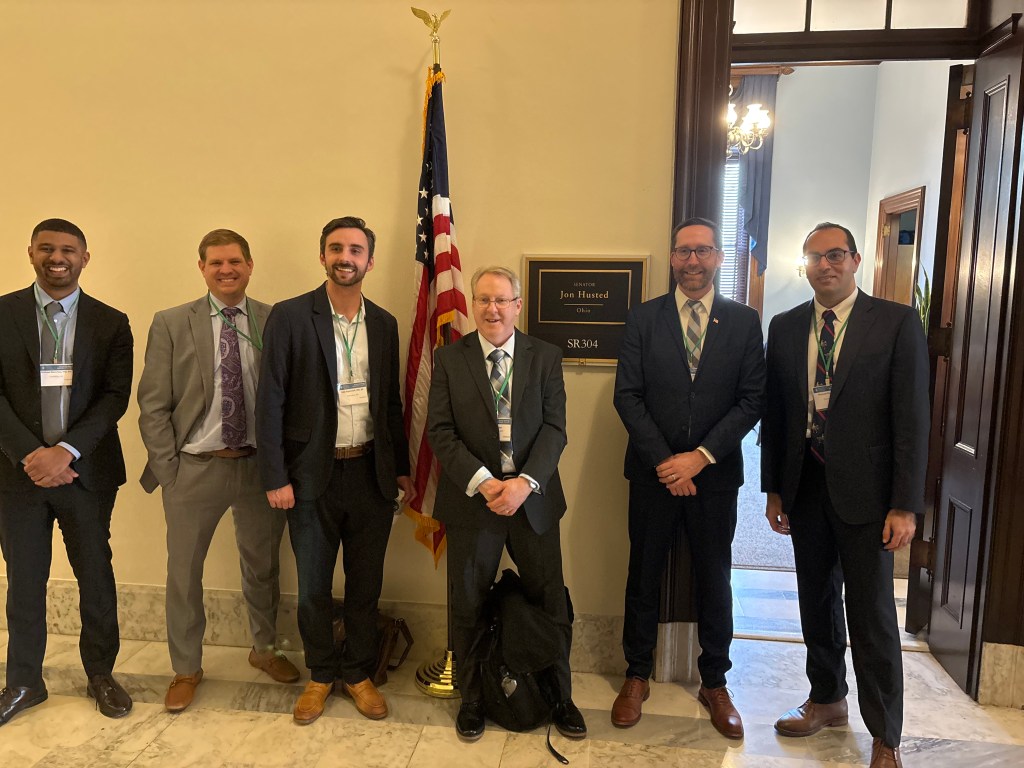
It was late evening at a hotel restaurant in Washington, D.C. Most of the restaurant crowd were either deep in their own discussions or had eyes glued to televisions broadcasting college basketball. And there we were. A handful of adults who were born with or a parent of someone with bladder exstrophy, all of us in town as patient advocates preparing to take on Congress.
We laughed and talked, as burgers, salads and something fried occupied most of the real estate between us. Someone had to move a basket of fries so we could make room for desserts and more drinks.
On the surface, we didn’t look so different from anyone else in the room. Just another group decompressing after a long day. But the conversation? That could have only happened there. Only at this table.
Bladder exstrophy is rare – very rare. So, when you’re born with a condition that requires extensive surgery – or surgeries – and lifelong management, there are very few who can relate. Explaining it often brings sighs of pity, confused expressions, and a host of questions.
At this table, there was none of that. We didn’t have to define the anatomy. We didn’t have to summarize childhood surgical histories or explain why insurance preauthorization feels less like paperwork and more like gladiator combat. We could start mid-story.
We compared hospital experiences the way other people compare hometowns. We talked about the benefits and challenges of living with something so unusual it was often hard to explain, even to those closest to us.
That shared experience can lead to its own sort of verbal shorthand. It strips away the introductory chapter and drops you straight into the middle of the book. And shared experiences from birth? There’s no need to tiptoe around things, perform bravery or package vulnerability in tidy language. You can be direct. You can be specific. You can be understood.
There was a moment — and I won’t detail it, because some conversations belong only to those who were present — when the tone softened. Someone shared a memory from adolescence, a time when feeling different felt especially sharp. No one rushed to fix it. No one offered a motivational poster response. Instead, there was safety in letting go, in the expression of feelings and thoughts that only others like us could understand.
It manifests as a shared laugh, or a look, or a nod. It’s not dramatic. It doesn’t require a spotlight. It’s a quiet acknowledgment that says, “Yeah, I know.”
Every community has a version of this table. Veterans find it with other veterans. Cancer survivors with survivors. Parents of children with complex needs with others who speak that language fluently. I experience it whenever I talk to those who have cared for elderly parents. Even journalists have our own version — around a busy lunch counter or late dinner table, arguing about headlines.
The table isn’t about exclusivity. It’s about the rare and deeply emotional relief of not having to translate your life for someone else, and timing matters.
We weren’t children navigating surgeries for the first time. We were adults who had built careers, relationships and resilience. We had come to Washington to advocate, to push for better systems. That context shaped the conversation.
We were recounting the past, but also connecting it to the future. Even more incredible to me was the fact that the congenital flaw that made us the objects of both fascination and ridicule as children was now quite literally our superpower. It was what brought us to Capitol Hill to help others – because we can.
When we finally stood up, games still flickering on the screens and the crowd still rumbling, I looked at that table and felt the weight of its ordinariness. It was just wood and silverware and a stack of dishes.
But for a couple of hours one evening, amid basketball fans and bar noise, it was something far more. It was a place where five people shared something unique to them – an understanding. No, it was more than that. It was something as rare as the condition that we shared, but as unique as each one of us. But only at this table.