Local News & Commentary Since 1890.

Archive for the ‘Technology’ Category

Shocking! Power companies mislead consumers.

In Business, Children and Family, Economy, Opinion, Senior Lifestyle, Technology, Uncategorized on September 4, 2013 at 9:39 am

DIH LOGO

Today, everyone is trying to save money. From groceries to utilities, we are all looking for a way to hold on to every dollar, particularly our seniors and others on fixed or limited incomes. Unfortunately, some companies are taking advantage of tough times by promising extensive savings on electric bills by switching to third party power suppliers.

Three years ago, my father’s electric bill was increasingly high. I had seen information on a company called “DPL Energy,” being advertised as a partner to Dayton Power and Light (DP&L), offering as much as a 25 percent savings. So, we signed up for the program and DPL Energy became our official service provider.

Confusingly, the electricity bill still comes from DP&L. As time went on, the savings was negligible and outweighed by a definite increase in additional fees for using the outside provider.

IMG_6295Essentially, these companies are “resellers” who broker DP&L’s electric power at a lower rate. Your electricity still originates with the main provider and you continue to call them for outages, emergencies and so on. Plus, once you’re signed up, they make it extremely hard to go back.

Much like cellular phone contracts, if you leave one of these third party plans, there is a termination fee or you must wait until the contract expires – and even then there may be a charge. Having saved nothing, we waited, and finally cancelled the plan. About a year after we left DPL Energy’s plan, my father was apparently signed up with another one of these companies called IGS Energy, although, we have no clear idea how.

According to IGS, someone came to his house and “signed him up by phone.” You read that right. We were told he was signed up in person, but the salesman called in the request for service. First, I don’t believe that anyone went all the way out to where he lives in the middle of nowhere on a cold call without getting any sort of signature verifying his enrollment. I am still investigating this part of the story.

In the end, dad made a couple of late payments and IGS dropped him anyway, but here’s where things get really expensive. According to the DP&L representative I spoke to, since we were signed up with a third party provider, the Public Utilities Commission of Ohio (PUCO) requires DP&L to charge a deposit equal to 130 percent of your average monthly usage. Dad’s deposit fee was over $600. You are essentially being punished for having left the behemoth power company.

Most dangerous of all is the fact that the only requirements to sign up for these misleading programs is your power company account number and the word “yes” anywhere in your conversation with them. Imagine a telemarketer speaking to an elderly person or someone hard of hearing and saying, “I am calling about your DP&L bill.” That’s all they’re going to hear. Panic, concern and fear take over and they listen to whatever the caller has to say because they are afraid of losing power for some reason. It’s really despicable.

Additionally, my investigation turned up the fact that these third party companies are unregulated by the PUCO. There was no explanation as to why there is no oversight, but nothing about their operation is managed by a government agency.

Since DPL Energy is misleadingly branded alongside DP&L while simultaneously claiming not to be the same company, it seems more to me like a way for the mammoth power provider to collect unregulated revenue with plausible deniability. Perhaps Ohio Attorney General DeWine could tear himself away from snooping in the personal records of honest citizens and focus his resources on investigating unscrupulous power companies?

The moral here is to be careful. In my experience, there is no savings with these third-party power companies. Exorbitant fees, inconsistent billing practices and misleading advertising all outweigh any potential benefit.


Watch the news story on this topic with Gery L. Deer and WKEF-TV, ABC 22 Dayton … 

http://abc22now.com/shared/news/top-stories/stories/wkef_vid_15751.shtml

 

Extra! Extra! Examining the plight of print.

In Books, Business, Entertainment, Local News, Media, National News, Opinion, Print Media, Technology on August 13, 2013 at 4:49 pm

Deer In Headlines

By Gery L. Deer

electronic_printAre newspapers dead? Since most of the mass distribution for Deer in Headlines is still in print media, then chances are if you’re reading this it’s probably printed in a newspaper. But it’s also circulated in a fair number of online publications as well so if the publication you’re reading ever went belly-up, you can still find it on the web.

When Amazon’s chairperson, Jeff Bezos purchased The Washington Post, the publication’s circulation had dropped by 40-percent over the last year. A seriously risky bet, Bezos picked up the media icon for pennies and paid for it out of his own pocket. The intention was to preserve the paper in its current state, but it’s just as likely he will take it to the next logical level – all digital.

Far more costly to produce than their digital counterparts, print publications still have a purpose among certain die-hards and the older generation. There’s something about holding that printed page in your hand that has brings about an emotional response unique to each reader.

I’m kind of caught in the middle. I like having a printed page in front of me, whether it’s a book, magazine or newspaper. But I like the convenience of digital media too. If you’re stuck waiting to be seated at a restaurant or in the doctor’s waiting room, you can always bring up something to read on your smart phone or Kindle.

Eventually, pretty much all periodicals (newspapers, magazines, etc.) will be converted to digital, but in my opinion, it’s not just the media format that’s killing print publications. Less ambitious salespeople and a lack of knowledge among advertisers have also helped contribute to their demise.

Publications, like any other media, survive by the vicious circle of subscribers and advertising. The more subscribers, the more profitable the ad revenue, but if the content is lacking no one is going to subscribe. The numbers drop and ad revenue falls along with circulation.

Plus, have you noticed how much smaller your newspaper is these days? Most have shrunken both in sheet size and number of pages, with some content located online to drive people to the publisher’s website. As a practical consumer, why would you pay $1.50 for a publication that has less content than it did when it was 75-cents? Unfortunately, if you want to keep getting a print publication you’ll have to pay whatever price they ask.

Advertising rates are going up too, though that one thoroughly perplexes me. Lower circulation should drive down ad prices, but many publishers are trying to recover lost revenue by adding web-based exposure in conjunction with print packages. For some, it’s too little, too late, however.

An ever more computer-savvy population will eventually drive print to its ultimate end. Attempting to preserve it will be a costly and finally pointless endeavor but some people are making the effort, as Bezos seems to be. But then again, he’s a billionaire and that’s what it would take – deep pockets.

No business can continue to operate in the red, always hemorrhaging money. Unless the operator is treating it like a hobby and has the disposable income to keep it going, it will die.

If you want to keep the presses running on your local newspaper, I suggest the following. First, contact the publisher and remind them how important the paper is to the community. If you are part of a business or organization, make sure to send press releases and other news-worthy information to the editors so they have good, local content to draw from. Include detailed contact information and artwork (photos).

Demand local coverage written by local correspondents. Small, hometown papers can do better financially on their own level than national publications when they have good, locally-created content to drive circulation and advertising.

If you own a business or are part of a community organization, advertise in the local newspaper but do it correctly. You need to display your ad regularly and consistently in the same publication for at least several months before you see a response. Be consistent and be patient. And finally, go buy a paper! You’re helping the community and the economy.


Deer In Headlines is syndicated by and intellectual property of Gery L. Deer / GLD Enterprises Commercial Writing. All rights reserved.


Greene County Combined Health District Announces “Public Health Heat Warning”

In Children and Family, Health, Local News, Science, Senior Lifestyle, Technology, Uncategorized on July 15, 2013 at 3:02 pm

dog2XENIA, OH – The upcoming days are going to be dangerously hot and humid if you’re working or playing outside, or living without air conditioning.  The Greene County Combined Health District is cautioning that weather conditions are going to remain hazardous for a few days.

The primary reason for the public notification is that GCCHD expects a stretch of days with daytime heat indices at least in the mid to upper 90’s, coupled with nighttime lows in excess of 70 degrees. These types of conditions may cause those without air conditioning to experience significant physical and mental stress. When nighttime lows fail to drop below 70 degrees, the human body has a difficult time recovering from the ongoing heat.

Greene County Combined Health District officials are stressing that everyone needs to take precautions to prevent heat-related illnesses. Physical activity should be limited as much as possible. Individuals are also encouraged to minimize prolonged exposure to high heat conditions.

It is recommended that everyone pay particular attention to the following suggestions to prevent heat-related illness:

  • Drink plenty of water and non-alcoholic fluids. Put the alcoholic beverages away until cooler weather. Alcoholic drinks can increase a person’s risk to heat-related illnesses.
  • Decrease physical activity. This is particularly advisable for joggers and high school or junior high school athletic teams. Exercise activities should occur in the morning or early in the evening. Stay in the shade as much as possible.  Greene County agencies and jurisdictions that have heat mitigation plans should implement those plans now.
  • Use air conditioning, if available. Many public buildings, libraries, malls, and other locations are air-conditioned.
  • Wear loose lightweight and light-colored cotton clothing.
  • Eat light meals.
  • Cool down with showers, baths, and recreational swimming.
  • Adjust blinds, shades, and awnings to keep out the sun.
  • Use your basement, if it is cool, during the hottest hours.
  • Be a good neighbor and check on those who may need assistance.
  • Individuals with chronic health problems, such as heart disease or lung problems, should minimize activities because the heat will add additional stress.
  • Extra caution should be taken for the elderly and young infants and children to assure that they are protected from the heat.
  • Children and pets should not be left unattended in closed vehicles. Temperatures can reach dangerous levels rapidly.
  • Individuals on various medications should check with their doctor to see if the heat puts them at increased risk.


Background on heat information

High temperatures and humidity stress the body’s ability to cool itself, and heat illness becomes a special concern. There are three major forms of heat illnesses: heat cramps, heat exhaustion, and heat stroke, with heat stroke being a life threatening condition.


Heat Cramps

Heat cramps are muscle spasms that usually affect the arms, legs, or stomach. Frequently they don’t occur until sometime later after work, at night, or when relaxing. Heat cramps are caused by dehydration. Although heat cramps can be quite painful, they usually don’t result in permanent damage. To prevent them, drink water every 15 to 20 minutes. Sports drinks that replace electrolytes help prevent a loss of sodium caused by excessive sweating. If nausea occurs discontinue fluids and seek medical attention.


Heat Exhaustion

Heat exhaustion is more serious than heat cramps. It occurs when the body’s internal air-conditioning system is overworked, but hasn’t completely shut down. This condition can occur when you don’t drink enough fluids to replace what you’re sweating away. The symptoms of heat exhaustion include headache, nausea, weakness, dizziness, heavy perspiration and extreme thirst.  Somebody suffering these symptoms should be moved to a cool location such as a shaded area or air-conditioned building. Have them lie down with their feet slightly elevated. Loosen their clothing, apply cool, wet cloths or fan them. Have them take sips of water or sports drinks. If nausea occurs, discontinue fluids.


If vomiting continues or if little to no improvement after 30 minutes, seek immediate medical attention. Victims of heat exhaustion should avoid strenuous activity for at least a day, and they should continue to drink water to replace lost body fluids.


Heat Stroke

Heat stroke is a life threatening illness with a high death rate. It occurs when the body has depleted its supply of water and salt, and the victim’s body temperature rises to deadly levels. A heat stroke victim may first suffer heat cramps and/or the heat exhaustion before progressing into the heat stroke stage, but this is not always the case. It should be noted that, heat stroke is sometimes mistaken for heart attack. It is therefore very important to be able to recognize the signs and symptoms of heat stroke and to check for them anytime someone collapses while in a hot environment.  The symptoms of heat stroke include confusion, irrational behavior, loss of consciousness, convulsions, lack of sweating, hot dry skin, and abnormally high body temperature. If someone is having any of these symptoms, call 911 immediately. Seconds count. It is vital to lower a heat stroke victim’s body temperature. Do not give fluids. Pour water on them, fan them, or apply cold packs until medical help arrives.

Beavercreek company celebrates second straight year of growth with grand opening of new location

In Business, Economy, Jobs, Local News, Technology, Uncategorized on July 9, 2013 at 3:54 pm
It was only a year ago that CT Beavercreek moved into their first commercial location on N. Fairfield Road. Now, expansion requires a change. (Photo by Gery L. Deer - The Jamestown Comet)

It was only a year ago that CT Beavercreek moved into their first commercial location on N. Fairfield Road. Now, expansion requires a change. (Photo by Gery L. Deer – The Jamestown Comet)

BEAVERCREEK, OH – It was only one year ago that Computer Troubleshooters of Beavercreek (CTB) moved from the home of owners Cliff and Genevieve Brust to their first commercial office on N. Fairfield Road. Thanks to the continued support and patronage of Beavercreek and the surrounding communities, CTB is growing again, expanding services and moving to a larger, storefront location at 3792 Dayton-Xenia Rd. Beavercreek, Ohio 45432.

Click to view the video clip from WDTN – Living Dayton.

To celebrate these great milestones, Computer Troubleshooters invites the public to attend an open house and ribbon cutting ceremony at the new location on Tuesday, July 16, from 4PM until 7PM. Visitors will enjoy free refreshments, door prizes and the formal ribbon cutting ceremony is scheduled for 4:30PM, hosted by the Beavercreek Chamber of Commerce.

Part of an international network of independently owned franchises, Computer Troubleshooters provides complete information technology (IT) support for residential and commercial clients. Services range from basic computer repair and managed business services to cloud computing for advanced medical documentation.

CTB President Cliff Brust is excited about the continued growth of his company. “We’ve been fortunate to find success in the Beavercreek area and we hope to continue to grow and improve to meet the ever-changing needs of our customers,” he says.

As technology changes, computer support companies have to make the constant effort to keep up through continued education, the addition of new services and increased expertise with current devices and software. According to Brust, CTB is doing just that by enhancing their product and service lines.

“Along with our state-of-the-art IT support services and computer sales, we are now offering customized training classes, technology recycling, digital photography and computer accessories,” Brust adds.

CTB’s new location is west of N. Fairfield Rd., situated between Knollwood Garden Center and Capitol Dry Cleaners. To attend the open house and ribbon cutting ceremony, RSVP by calling Genevieve Brust at (937) 458-2000 or email gbrust@comptroub.com. Further information about Computer Troubleshooters of Beavercreek is available online at www.ctbeavercreek.com.

Daredevil Performances: Is the spectacle worth the risk?

In Education, Entertainment, history, Local News, Media, National News, Opinion, sociology, Technology, television, Theatre, Uncategorized, World News on June 25, 2013 at 6:27 pm

DIH LOGODanger as a spectacle has long been a past time of human culture. Death-defying stunts have graced stages of theatres and circus tents for centuries. Never has there been a more awe-inspiring sight, however, than the dramatic aerobatics of stunt pilots and wing walkers. On Saturday, June 22nd, wing walker Jane Wicker and her pilot Charlie Schwenker died in a fiery crash during a performance at the Dayton Vectren Air Show in Vandalia, Ohio.

Wicker, who had been involved with aerobatics for more than a quarter-century, was sitting on the wing of the inverted plane as it dove, nose-first, into the ground and exploded. The aftermath of the crash left a burning wreck, two people dead and hundreds of spectators horrified.

News of the accident quickly spread around the country, landing on the lead story of every print, broadcast and online media outlet from the New York Daily News to the Huffington Post. Preliminary investigations of the cause of the crash from the Federal Aviation Administration and the National Transportation Safety Board are as yet inconclusive.

The very next day, high wire performer Nik Wallenda spent his evening engaged in a heart-stopping, quarter-mile tightrope walk across a 1,500 foot deep section of the Grand Canyon. As a record number of viewers tuned in to the Discovery Channel to watch, they were treated to more than a half hour of listening to Wallenda continually pray or thank God and praising Jesus with nearly every successful step. One might wonder if they would think he’s crazy too.

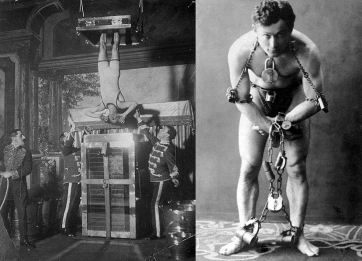
Harry Houdini

Harry Houdini

From escape artist Harry Houdini to motorcycle stunt rider Robert “Evil” Knievel, daredevils have long attracted crowds of spectators and generated millions upon millions of dollars for their promoters over the years. While Houdini eventually died of a ruptured appendix, he was nearly killed several times by his own hand as a result of escape attempts gone wrong. Many of his compatriots, like Wicker, were not so lucky; which begs the question, is the spectacle worth the risk? Apparently it is because the public keeps going to see them, like sadistic voyeurs almost hoping to see something go horribly wrong.

Local government, concerned about the staggering level of liability involved, does everything it can to discourage people from attempting these kinds of stunts by requiring miles of paperwork and expensive permits before allowing these kinds of activities on public lands. Some simply don’t allow it to happen at all.

Wallenda’s high wire walk, for example, didn’t actually cross over the Grand Canyon, but the gorge of the Little Colorado River Navajo Tribal Park. His 1,400 foot steel cable was actually suspended over land of the Navajo Nation, near Cameron, Arizona.

Could these daredevils have what Freud called a “death wish,” a desire, often deeply repressed, for self-destruction, accompanied by feelings of depression, hopelessness, and self-reproach? That might be said of Houdini, given his almost obsessive interest in death and the afterlife. But for most everyone else in this line of work, it’s about attention and a desire to push the envelope – that need for the adrenaline rush associated with doing what no one else is brave enough to do (or stupid enough, depending on your point of view).

In the end, there would be no market for these kinds of acts if the public wasn’t thoroughly fascinated by them. As for the performers themselves, it’s probably best to take into account Jane Wicker’s own words.

“Why do I do this? There is nothing that feels more exhilarating or freer to me than the wind and sky rushing by me as the earth rolls around my head,” Wicker once wrote. The day before the crash she told WDTN TV2, “I’m never nervous or scared because I know if I do everything as I usually do everything’s going to be fine.”

For those left behind, there is a great sense of loss when these daring entertainers pass doing what they love. But they will be remembered for their spirit and the smiles on the face of those who sat in awe of their skill and passion to defy the very fabric of nature.

Gery L. Deer is an independent columnist and business writer based in Jamestown, Ohio. More at http://www.deerinheadlines.com.

Science and the public benefit from storm chasers

In Education, Local News, Media, National News, Opinion, Science, Technology, Uncategorized on June 3, 2013 at 10:52 pm

Deer In Headlines

By Gery L. Deer

WHIO-TV's weather radar as it appeared on April 3, 1974 approximately 4:20PM as the Xenia Tornado touched down. Notice the "hook" echo indicating the twister.

WHIO-TV’s weather radar as it appeared on April 3, 1974 approximately 4:20PM as the Xenia Tornado touched down. Notice the “hook” echo indicating the twister.

In the 48 hour period between April 3rd and 4th, 1974, the Midwestern United States experienced one of the most devastating tornado outbreaks in history. Known as a “super outbreak,” 148 confirmed tornadoes touched down from Michigan to Alabama and Illinois to West Virginia, with 30 of them in the F4-F5 categories and resulting in the deaths of 300.

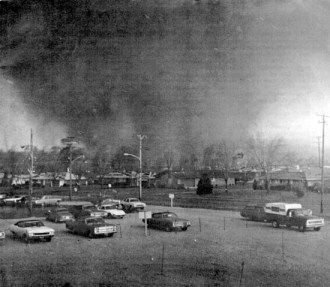
One of the most devastated towns was Xenia, Ohio, where a massive F5 funnel tore through the city leaving a mile-wide path of destruction, killing 33 and injuring more than 1,100. The low death toll is attributed to advanced warning provided by WHIO-TV weatherman, Gil Whitney using the first local weather radar system in the Dayton area.

Satellite, GPS and advanced warning networks, along with modern Doppler radar have all helped increase early warnings for tornado victims from less than 3 minutes to more than 15 minutes. Much advancement in severe weather detection might never have happened, however, without the work of the brave men and women who call themselves, storm chasers.

Storm chasers are serious scientists working to increase our knowledge of tornadoes and how they behave. Unlike those depicted in the 1996 movie, “Twister,” however, chasers experience little glory instead spending days and weeks in preparation that may result only in a few moments of tornado spotting.

As you might expect, purposely trying to outmaneuver the proverbial “finger of God” carries with it some inherent danger. Unfortunately, that danger can turn deadly at any moment.

On May 31st, revered storm chaser Tim Samaras, 55; his son, Paul, 24; and meteorologist Carl Young, 45, were killed near El Reno, Oklahoma as they tried to document one of several tornadoes moving through the area. Since their deaths, many have asked, “Is the data gathered from storm chasing worth the risk?” In my opinion, yes, it is.

I’ve always been fascinated by tornadoes. The day after the Xenia tornado of ’74, my parents took me along as they assisted with the cleanup efforts by using our grain trucks to help haul away debris. I never forgot what I saw there. Nor will I ever forget the darkened, green sky and the strange, coldness of the air as the monster storm was passing through. It marked my psyche for years to come.

Possibly the most famous photo of the Xenia Ohio 1974 Tornado. Taken from Greene Memorial Hospital by Fred Stewart.

Possibly the most famous photo of the Xenia Ohio 1974 Tornado. Taken from Greene Memorial Hospital by Fred Stewart.

The experience left me nearly terrified of storms, until one day in 1988, when I was alone at our family farm and stepped outside after hearing tree branches break during a storm. I stood on our front porch, paralyzed, as I watched a small funnel cloud worm its way across the pasture in front of me, parallel to our house.

My ears popped as I stood motionless, surrounded by completely still air except for the slim tube descending from the sky into a swirling mass of dust. With almost no sound at all, it smashed the wooden sideboards of one of our old trucks, crossed the field about a half mile away and totally demolished a neighbor’s barn.

As quickly as it came, it was gone. That day, my fear gave way to a new respect for one of nature’s most dangerous, ephemeral phenomena. Since then, I’ve been within eye-shot of two more tornadoes and educated myself about them as best I could without taking to the road as a chaser.

But, I have the utmost respect – not to mention appreciation – for those who have. While there are probably some storm chasers who are just thrill-seekers, I have no doubt that most are in it for the science and the potential benefit that comes from the effort.

Early warning systems now broadcast through TV, Internet and cell phones, and most air raid sirens have been re-purposed for use as tornado warning systems. Everyone in and around Tornado Alley should remain diligent when severe weather approaches and heed warnings when they are issued.

It’s doubtful we’ll ever be able to fully predict when and where a tornado will strike but, thanks to the work done by storm chasers, scientists can give people a fighting chance to be better prepared.


Gery L. Deer is an independent columnist and business writer based in Jamestown, Ohio. More at http://www.gerydeer.com.

Design Sleep in Yellow Springs offers free workshop on the healing power of sleep May 2nd

In Education, Health, Local News, Science, Senior Lifestyle, Technology, Uncategorized on April 10, 2013 at 10:05 pm
Mike Koveleski of Design Sleep and Dr. Alan Barnes from Living Well Spine Center.

Mike Koveleski of Design Sleep and Dr. Alan Barnes from Living Well Spine Center.

Yellow Springs, OH – According to Gallup Poll surveys more than 56-percent of American adults suffer from drowsiness during the daytime. As technology becomes more invasive and stress levels rise, people grow even more sleep deprived. In an effort to help people combat the problem, Design Sleep, LLC, in Yellow Springs, Ohio, has teamed up with Dr. Alan Barnes, of the Living Well Spine Center in Fairborn, to offer a free workshop that may help.

Barnes’ presentation will be at 7PM, Thursday May 2nd in Design Sleep’s showroom, 108 Dayton St. in Yellow Springs. He will cover the many ways sleep deprivation can negatively impact day-to-day life and explain how to achieve more restful, refreshing sleep to improve mental and physical health.

Design Sleep owner Mike Koveleski’s began his career building solid cherry beds, tables and chairs at Scott Jordan Furniture in the Brooklyn Navy Yard of New York. He opened Design Sleep in April of 2004, having left Manhattan following the events of 9/11. Seeking a more suitable place to raise their five children, he and his wife found that and more in Yellow Springs.

“I love people and furniture,” Koveleski says. “I found the most satisfaction and meaning from designing and selling beds because I believe sleep refreshes life.” His education-focused store offers a variety of ergonomic and organic mattresses and bedroom furniture options as well as sleeper sofas and recliners.

Koveleski suggests that most people have no idea how sleep deprived they are nor do they understand how it affects them physically and emotionally. Teaming up with Living Well Spine Center provides the perfect opportunity to enlighten his community and his customers.

Chiropractic science focuses on the structural misalignment of the spine which can compromise the overall function of the nervous system. Poor alignment during sleep can be particularly aggravating – position, posture, and so on – and may affect how the body heals and regulates itself.

“Our goal is to make people care about sleep because as a culture, we do not value sleep,” Koveleski says. “We need proper sleep to heal and most people fail to realize that. Dr. Barnes presentation will make you realize how much we take sleep for granted and how important it is to the healing process.”

There is no cost or obligation associated with the workshop. For more information or to RSVP for the workshop, call 937-767-7567 or email Mike Koveleski at mike@designsleep.com.

Watch the video featuring the two presenters:

Defeating Sleep Deprivation

Great books are hard to find on today’s shelves

In Business, Children and Family, Economy, Education, Entertainment, Literature, Local News, Opinion, Senior Lifestyle, sociology, Technology on March 20, 2013 at 2:47 am

Deer In Headlines

By Gery L. Deer

"Flights of Fiction" is an anthology of stories set in southwest Ohio by local authors from the Western Ohio Writers Association. It will hit shelves in mid-April 2013 and features local talent and production.

“Flights of Fiction” is an anthology by local authors will hit shelves in mid-April 2013.

Books are incredible things. They can make you laugh and cry. They can whisk you off to faraway places with strange sounding names and introduce you to characters and worlds that only exist in the mind’s eye.

This month, Disney released the film version of Oz, The Great and Powerful, a prequel story to the more familiar tale of Dorothy Gale’s trip down the Yellow Brick Road. Author L. Frank Baum wrote his 14 originally published Oz books between 1900 and 1920 and each one carried us over the rainbow to a world of magic and adventure.

Of course, it was movie magic that brought the Land of Oz to life on more than one occasion. Even with all of the high-tech special effects and brilliant colors, nothing can replace the written versions of these timeless classics.

Books have a way of exciting the mind and launching the imagination of children and adults alike. Sadly, instead of giving us amazing tales of adventure, modern publishing has turned its attention more towards anything that fits a hot-selling genre rather than keeping an eye out for the next Sherlock Holmes.

When Baum and his contemporaries like Sir Arthur Conan Doyle were writing their books, publishers were looking for great writing and engaging stories. Of course they wanted to make money, but they were less likely to sacrifice quality in favor of selling solely for the lowest common denominator. They knew that the best way to grow revenue was to publish a great book.

It seems that today’s publishers are looking, not so much for good literature, but sole marketability. Publishing companies are focusing on the bottom line with through a bit of astigmatism.

People often forget that the business of publishing fiction is part of the entertainment industry and is driven by the buying public. As major publishers shrink in size and revenue, they continue to blame the Internet and self-publishing authors rather than looking in a mirror to realize they’ve done this to themselves.

Occasionally, a publisher will take a chance on a unique story which then turns into a runaway success. The best examples are more recent series books like Harry Potter, Twilight and 50 Shades of Grey. But once those titles charge up the audience, the publishers start releasing knock-offs or genre-trapped titles based on similar characters and situations to pacify the desire for more of the same.

The problem comes when that’s all they put out, rather than trying to take advantage of a good book-buying market and release something different. All they’re publishing for is cash flow at that point, landing much better manuscripts in the trash bin.

Sadly, there’s really no way to change this trend as long as the public continues to follow hype instead of looking for quality. Until consumers demand better material to read, the status quo will remain low cost, high volume, all buildup and no substance.

So if readers don’t find what they want at the big-box bookstores, they should turn their attention to local authors. After all, everyone talks about buying local and here’s just another way to do that. Thanks to high-quality electronic and self-publishing options, some great local authors are making their work available on a regular basis.

A few minutes in a neighborhood bookstore, even used book shops like Xenia’s, “Blue Jacket Books,” on S. Detroit St., can turn up a treasure trove of locally produced work. From memoires to science fiction local authors have some great work out there to satisfy the hunger of the voracious reader.

Like with larger outlets, local authors can spin some stinkers too, but they often cost less and, even if the book isn’t that great, you’ve helped support the community. Local authors work and live in your community and often hold signings and attend area writing groups. Keep your eyes open. There might just be another L. Frank Baum out there somewhere, yet undiscovered by the big guys. So go hit the local bookstore and remember reading is fundamental.

LOOKING FOR A GREAT BOOK? HERE ARE OUR RECOMMENDATIONS! 

Lost in space, the salvation of classic TV online

In Children and Family, Entertainment, Media, Opinion, sociology, Technology, television, Uncategorized on March 13, 2013 at 12:00 am

Deer In Headlines

By Gery L. Deer

gsspI’ve written in the past about the lack of creativity coming out of Hollywood these days and it seems increasingly worse. Reality television flows through the airways like so much Typhoid-infested water, riddled with disease and parasites. Thankfully, like an oasis in the desert, modern technology has provided a welcome respite from the gunk that is today’s network television.

By monthly subscription, online video streaming services like Netflix, Hulu Plus and Amazon Instant Video offer TV junkies instant access to more than a half-century of programming. Forget waiting a whole week for the next fix of Gilligan’s Island, Cheers or NYPD Blue, now I can watch anytime I want to, day or night, episode after delicious episode from pilot to finale.

These services were originally intended to provide instant access to the same movies you used to go to the video store to rent. But for those of us who prefer bite after bite of tasty episodic television, they serve up a veritable buffet of broadcast entrees ranging from exciting 1950’s westerns like Gunsmoke to angst-filled dramas of the nineties like Beverly Hills 90210.

No more will my television fix need to be delayed by thoroughly staged yet somehow unscripted shows like The Bachelor or bad refits of The Gong Show like The Voice or American Idol. If you don’t’ know what the Gong Show was, your probably too young to understand any of these other references either.

But, Danger Wil Robinson! Because of Hollywood’s continual reinvention of the wheel, when you finally rediscover your favorite old show, you have to be sure which version you’re watching. Is it the new Knight Rider or classic Knight Rider. The Hoff is a classic? Now I just feel old.

Do you recognize this vehicle? Hint - it was on a live action Saturday morning kid's show in 1976.

Do you recognize this vehicle? Hint – it was on a live action Saturday morning kid’s show in 1976.

If you prefer your TV tray filled with something more modern but still thoughtful, well-written and engaging, you can forget the networks. You’ll need to subscribe to cable or satellite services for AMC, BBC America or other high-end channels.

Award-winning programs like Mad Men, The Walking Dead, Doc Martin, Sherlock and the new runaway hit, Downton Abbey, have successfully lured fastidious viewers from Fox, CBS, ABC and NBC for several years. What’s that you say? You don’t have cable? Fear not!

All you need is high-speed Internet, a computer, tablet or even a smart phone, and these programs are just an app download away. Faster than Trump can say, “You’re fired,” you’ll be whisked off to a land where all of life’s problems are solved in a half-hour and no one called Snookie would have ever been allowed on the air.

Ah, the good old days – when the same B movie actor in a rubber carrot suit tormented the Robinson family on Lost In Space one week and sent the crew of the Submarine Seaview rocking and rolling on Voyage to the Bottom of the Sea the next. Back then, no one worried whether the lines were politically correct and the very idea of product placement was barely a glimmer in some Mad Man’s eye.

With my remote as my time machine, I can go back there again with a mere click of the play button or a tap on my tablet screen. The down side is that there’s always another episode waiting out there, somewhere in the ether. I move from one to the next, losing all track of time and action. Did I feed the cat? Is this still Tuesday? Oh well, I can figure all that out after I find out who shot JR Ewing. Of course, they just went and killed him off again –this time for keeps (RIP Larry Hagman).

When the rest of the TV landscape seems empty and foreign, these characters feel safe and familiar, like old friends I’ve lost touch with. But even after just enough time to write these few words, I feel out of the loop again, so I better get back to watching. Sometimes you still wanna go where everybody knows your name.

Hooper’s Les Miserables film may set a theatrical precedent

In Business, Children and Family, Economy, Education, Entertainment, Media, National News, Opinion, psychology, sociology, Technology, Theatre on January 2, 2013 at 11:20 am

lesmisDeer In Headlines

By Gery L. Deer

Over the holidays, I was compelled to see the new movie, Les Miserables, based on the musical theatre version of the 1862 novel by Victor Hugo. In this big-budget film, director Tom Hooper’s version of Les Mis, as it is known colloquially, has set a precedent for helping to expose the masses to quality musical theatre without having to know that the word “gallery” is just rich people theatre speak for “nosebleed seats.”

In case you haven’t seen the show or read the novel, here’s the Reader’s Digest version. The story follows the plight of petty thief Jean Valjean the 1800’s when France was on the brink of revolution.

After breaking his parole, Valjean struggles to rebuild his life under assumed names as he is relentlessly pursued by police inspector Javert. He eventually winds up raising the daughter of a woman for whose death he felt ultimately responsible and finds himself tangled in the beginnings of the French Revolution.

Hugo’s novel was adapted into musical theatre in Paris in 1980 using music written by Claude-Michel Schönberg and original French lyrics by Alain Boublil and Jean-Marc Natel, as well as an English-language libretto by Herbert Kretzmer. Over the last 30-odd years, it’s been one of the most successful musicals of all time and the producers of this new film have made every effort to bring the sights and sounds of the stage show to the silver screen and to a wider audience.

Instead of having the actors lip-sync to a recorded track and overlay the vocals later, director Tom Hooper attempted something that hasn’t been done since the infancy of the industry. All of the singing parts were recorded as they were shot, right along with the video, just as if the audience was watching it happen live on stage.

The result was a wonderful mixture of visual and audio effects that brought the audience closer to the actors and the emotion of the story than could have ever been achieved before. But technical innovation was not the only potentially ground-breaking achievement demonstrated by this movie.

There is a direct correlation between the progress of a society and advancement in the arts. Unfortunately, in most countries including the United States, high quality theatre productions are often inaccessible but to the elite wealthiest few because of the staggeringly high ticket prices.

Occasionally, there will be lower-priced seating on lesser-known shows or locally produced events, but Broadway-quality performances are still usually out of reach of the average middle class, particularly once you factor in parking and other associated expenses.

Of course, organizers constantly tout that theatre should be available to everyone but the prices remain astronomical. However, Hooper’s Les Mis film may change that. For the price of one mezzanine seat at the theater, a family of four can go to a matinee movie or, later on, buy or rent the video of the production at a substantially lesser cost.

The challenge for filmmakers will be to create quality productions that mirror the stage show. In the case of Les Miserables, Hooper has captured the intent of the production and combined it with the grandeur available on the big screen and, in doing so, has the potential to reach millions more audience members than his stage-bound counterparts.

As so many people complain about the quality of today’s movies and television, Hooper’s version of Les Miserables provides a welcome respite from the violence and repetition in today’s mass entertainment industry.

As for my experience, it was fascinating. At the end of the movie when the final note was sung, there wasn’t a dry eye in the house and the audience broke into applause, just as if all of the actors were there to hear them. It was really something to see.

Nothing will ever replace the experience of seeing a live production on stage. But, at that moment I realized that films like this could change the face of theatre in the digital age and bring high quality shows more accessible to everyone.