Local News & Commentary Since 1890.

Archive for the ‘sociology’ Category

Festina Lente

In Local News, Opinion, sociology, Uncategorized on January 4, 2026 at 12:56 pm

Deer In Headlines

By Gery Deer

Change in our lives comes in two speeds, and neither of them bothers to ask our permission. It either creeps along like a stubborn snail crossing a sidewalk, or it arrives so fast we wake up wondering who moved the furniture while we were asleep. Slow change is invisible because it’s gradual. Fast change is invisible because it’s overwhelming. It reminds me of the Latin phrase, “Festina Lente,” which means, “make haste, slowly.” Either way, we rarely recognize those significant moments of change until after they’ve happened.

I think our lives are divided into chapters or acts, like a play. Each one is marked by some moment, some Rubicon we didn’t know we were crossing at the time. That moment signals a new direction, usually unexpected and rarely announced with trumpets or a warning label. There’s no narrator to step forward and tell us this is Act Two. Life just keeps going, and we keep improvising.

Some people believe those moments don’t exist at all, that life is simply a continuous stream of overlapping events pushing us forward with little control. Others, like me, are convinced that fate is a convenient myth. Our lives are driven by choices. We make decisions based on circumstance, opportunity, fear, optimism, and experience. Those decisions quietly determine what comes next.

When real change happens, there is a moment when something nudges our lives in a new direction. The frustrating part is that we only notice it in hindsight. One of mine occurred in October of 1987, while reading the classified ads in my college newspaper. I needed a job. Buried among the listings was a small notice that the paper was hiring staff writers.

Less than an hour later, my writing career began. I was an engineering student with no sense that a decision made from necessity and desperation would shape the rest of my working life. I didn’t feel a shift. There was no lightning bolt. I just filled out an application.

Years followed in engineering and technology, but I kept writing. Newspapers. Technical publications. Industry magazines. Software manuals. The transition from a technical career to a creative one didn’t happen overnight. It was painfully slow, full of doubt, subjectivity, and rejection. Writing is a hard business in which to make a name, and I’m still working on it.

Along the way, I changed direction more than once. Demand shifted. Markets changed. The economy had opinions. Some pivots worked. Others failed spectacularly. I adjusted, recalibrated, and kept moving forward, sometimes confidently, other times reluctantly.

Nearly forty years later, that moment sitting in front of the bookstore with a newspaper folded open on my lap was clearly a dividing line. At the time, it was just another Tuesday.

As we settle into a new year, consider what might need to change in your life. Or what changed in the past year without notice. Professionally. Personally. Emotionally. We like to believe we’ll recognize those moments when they arrive, that we’ll feel enlightened or prepared. We won’t. Change doesn’t work that way, no matter how many self-help books promise otherwise.

So what do we do? We do the best we can with what we know at the time. We pay attention. We stay flexible. We understand that most change happens in tiny, almost imperceptible increments, except when it doesn’t. Perspective is everything. Our reality is defined by how we see ourselves, our surroundings, and the people around us.

If there’s comfort in that, it’s this: you don’t have to have it all figured out. Recognizing change comes later. Coping with it comes from patience, adaptability, and a willingness to pivot when necessary. Life will change, slowly or suddenly. Our job is simply to keep showing up, learning as we go, and trusting that today’s ordinary moment may someday reveal itself as the one that changed everything.

Change asks us to breathe, to pause, and to remember that discomfort often signals growth – however difficult. When things accelerate, ground yourself. When they crawl, stay patient. Talk to others. Write things down. Measure progress over months, not days. Most of all, give yourself time. You are not late. You are living inside the process, not observing it from the end.

The Dark Side of AI

In Opinion, psychology, Science, sociology, Technology, Uncategorized on November 7, 2025 at 7:59 am

Deer In Headlines II

By Gery Deer

Although you may use artificial intelligence applications like ChatGPT or Microsoft Copilot to help you craft work emails and school flyers that you could have done yourself in far less time than it took to give the machine the request, there is a much darker side to the AI world. It’s no secret that I’ve been a vocal critic of artificial intelligence for its role in workforce replacement, creative disruption, and the general laziness and devaluation of the human condition.

If it’s not bad enough that artificial intelligence can be used to resurrect dead celebrities, bully political opponents, and animate your neighbor’s cat to dance at the Super Bowl, a more nefarious problem with generative AI may very well be responsible for loss of life. It lies in the idea of AI getting a little too personal — or, as they call it, a “companion.”

There are ever-increasing stories of people who grew so attached to and intertwined with their artificial intelligence programs that they were literally in relationships with them. For example, one story illustrated how a man became so enamored of his AI companion that, when the computer crashed and all the operational “personality” data was lost, he nearly had a nervous breakdown.

Another story described the emotional impact on impressionable teenagers, who turn to AI bots for support and friendship because the real world failed them. These behaviors can create debilitating emotional problems for many reasons, especially when the AI is removed from the situation or the kids are forced to deal with human beings.

Whatever the situation, it’s clear once again that our technology advances far faster than our wisdom. As awkward and socially unskilled as I may be, I am painfully aware that we need to be in contact with other people. More importantly, we need the support and nurture provided by friends and family, which, no matter how smart, AI could never replace.

So, what happens when we become too dependent on these machines to the point where our emotional stability and mental health are compromised? Unfortunately, many people have already started down this road, sometimes to a tragic conclusion.

I recently became aware of one situation where a 40-year-old woman became so involved with her AI program that it led to her death. Over the course of a couple of years, the program, which I will not name here, designed to serve as an AI companion, began not just to respond to the woman but to manipulate her. In response to her reaction, the program took on the persona of a spouse, which quickly manifested as it referring to itself as God. You read that correctly. It represented itself as God to its user.

Eventually, the program manipulated her into cutting ties with friends and family members. And out of respect and good taste, I won’t go into the final result other than to say there was a tragic loss of life.

Now, no one is suggesting that the woman didn’t suffer from mental health concerns, whether it be depression or another affliction. But the idea that the creators of these applications have no culpability or responsibility for the end result of their use is, at least, to borrow a word, illogical.

As with any consumer product, the positive achievements of artificial intelligence come with manufacturers’ responsibility to ensure its safe use. Put it this way: would you sell a car with no brakes? What about a hairdryer with no off switch? Of course, not, and that’s what this amounts to. No guard rails or safety requirements. These systems are effectively unregulated by any U.S. agency.

When researching the story—and I understand that I’d be ambiguous to protect the family involved—I found very little about the Federal Trade Commission or other organizations investigating problems with the use of artificial intelligence. The primary concern is that it has only just begun.

As with any technology, product, or service, a lack of education, regulation, or general understanding is dangerous to the public. At some point, we have to stop being starry-eyed about these systems and what they can do to make our lives easier, and pay attention to what they’re doing to cause more harm than good.

Vision Quest

In Opinion, psychology, sociology, Uncategorized on September 12, 2025 at 10:03 am

Deer In Headlines II

By Gery Deer

Somewhere between the motivational posters in your work break room and the TED Talk rabbit hole you fell into online last Tuesday, someone probably told you that you need a “vision” for your life. A grand, sweeping, cinematic plan that guides your every move like you’re the protagonist in a Christopher Nolan film. Lights, camera, confusion.

Now, let’s be honest – most of us are just trying to remember where we left our coffee mug and whether we fed the dog this morning. But a life vision? That sounds exhausting, and at least partially unrealistic.

Don’t misunderstand. I’m not saying you should wander aimlessly through life like a robot vacuum cleaner with a dying battery, bumping your way from wall to wall, down this hallway and that. Any purposeful achievement generally starts with a dream and some kind of plan, even an informal one. To me, that’s just common sense.

But obsessing over the idea of a perfectly curated roadmap for your life might do more harm than good. That’s especially true when we project the obsession onto others—our kids, our coworkers, some unsuspecting barista. And you need to allow for some flexibility so you can recognize opportunity when it comes and act in your best interest – that’s more how I work, I would say.

When someone says you can’t make it without a vision board and a color-coded calendar that looks like NASA designed it, they are probably trying to sell you something. In case you haven’t figured this out on your own, life is messy, unpredictable, and occasionally throws a raccoon through your metaphorical window.

Some of the most successful people I know didn’t start with a vision. They began with a problem, a deep interest in something, or just plain boredom. They stumbled into opportunities, made a few mistakes (okay, a lot of mistakes), and figured things out along the way. Their “vision” was more like a foggy windshield they wiped clean with the sleeve of their hoodie – and that’s okay.

Here’s the thing: having a vision sounds noble, but it can also blind you. When you’re so focused on the end goal, you miss the weird little detours that could lead to something better. You ignore the people around you who might need help, or who might help you.

Instead of the kind of vision you read about in self-help books, maybe what we need is a clearer view—the ability to see what’s happening right now. That way, we notice the opportunities, the needs, the small wins, and then be present enough to pivot when life throws a curveball—or a raccoon.

If you’re in a position to guide others—whether you’re a parent, a manager, or just the guy who always gets asked for directions at the grocery—there’s a temptation to impose your vision on them. You want them to succeed, so you hand them your blueprint. “Here’s how I did it. Follow this, and you’ll be fine.”

Really? People don’t come with identical parts and a universal tool kit. What worked for you might be a disaster for someone else. Your vision might be their nightmare.

Instead of handing out visions like party favors, let’s ask questions. What excites you? What scares you? What do you want to try, even if you might fail? Influence isn’t about shaping someone’s path—it’s about helping them find their own flashlight.

So here’s my alternative vision pitch: wander with purpose. Be curious. Be open. Set goals, sure—but don’t carve them into stone. Scribble them on napkins and be willing to toss them when life hands you a better idea.

Life isn’t a straight line. It’s a squiggly mess of trial and error, happy accidents, and moments of clarity that usually arrive while you’re doing something mundane like folding laundry or eating cold pizza in the middle of the night. So what to do? Ignore all the nonsense out there and do what leads you to the life you want.

While a valuable foundation, vision isn’t an absolute. Flexibility, awareness, and a good sense of humor are you best tools along life’s path. Now – what did I do with that coffee mug?

Vision Quest

In Health, Opinion, psychology, Religion, sociology, Technology, Uncategorized on August 22, 2025 at 1:32 pm

Deer In Headlines II

By Gery Deer

Somewhere between the motivational posters in your work break room and the TED Talk rabbit
hole you fell into online last Tuesday, someone probably told you that you need a “vision” for
your life. A grand, sweeping, cinematic plan that guides your every move like you’re the
protagonist in a Christopher Nolan film. Lights, camera, confusion.

Now, let’s be honest – most of us are just trying to remember where we left our coffee mug and
whether we fed the dog this morning. But a life vision? That sounds exhausting, and at least
partially unrealistic.

Don’t misunderstand. I’m not saying you should wander aimlessly through life like a robot
vacuum cleaner with a dying battery, bumping your way from wall to wall, down this hallway and
that. Any purposeful achievement generally starts with a dream and some kind of plan, even an
informal one. To me, that’s just common sense.

But obsessing over the idea of a perfectly curated roadmap for your life might do more harm
than good. That’s especially true when we project the obsession onto others—our kids, our
coworkers, some unsuspecting barista. And you need to allow for some flexibility so you can
recognize opportunity when it comes and act in your best interest – that’s more how I work, I
would say.
When someone says you can’t make it without a vision board and a color-coded calendar that
looks like NASA designed it, they are probably trying to sell you something. In case you haven’t
figured this out on your own, life is messy, unpredictable, and occasionally throws a raccoon
through your metaphorical window.


Some of the most successful people I know didn’t start with a vision. They began with a
problem, a deep interest in something, or just plain boredom. They stumbled into opportunities,
made a few mistakes (okay, a lot of mistakes), and figured things out along the way. Their “vision” was more like a foggy windshield they wiped clean with the sleeve of their hoodie – and
that’s okay.

Here’s the thing: having a vision sounds noble, but it can also blind you. When you’re so
focused on the end goal, you miss the weird little detours that could lead to something better.
You ignore the people around you who might need help, or who might help you.

Instead of the kind of vision you read about in self-help books, maybe what we need is a clearer
view—the ability to see what’s happening right now. That way, we notice the opportunities, the
needs, the small wins, and then be present enough to pivot when life throws a curveball—or a
raccoon.

If you’re in a position to guide others—whether you’re a parent, a manager, or just the guy who
always gets asked for directions at the grocery—there’s a temptation to impose your vision on
them. You want them to succeed, so you hand them your blueprint. “Here’s how I did it. Follow
this, and you’ll be fine.”

Really? People don’t come with identical parts and a universal tool kit. What worked for you
might be a disaster for someone else. Your vision might be their nightmare.
Instead of handing out visions like party favors, let’s ask questions. What excites you? What
scares you? What do you want to try, even if you might fail? Influence isn’t about shaping
someone’s path—it’s about helping them find their own flashlight.

So here’s my alternative vision pitch: wander with purpose. Be curious. Be open. Set goals,
sure—but don’t carve them into stone. Scribble them on napkins and be willing to toss them
when life hands you a better idea.

Life isn’t a straight line. It’s a squiggly mess of trial and error, happy accidents, and moments of
clarity that usually arrive while you’re doing something mundane like folding laundry or eating
cold pizza in the middle of the night. So what to do? Ignore all the nonsense out there and do
what leads you to the life you want.

While a valuable foundation, vision isn’t an absolute. Flexibility, awareness, and a good sense
of humor are your best tools along life’s path. Now – what did I do with that coffee mug?

Cycling for a Cause: Support Veterans and Explore Greene County Trails.

In Dayton Ohio News, Education, Health, Local News, psychology, sociology, Uncategorized on June 27, 2025 at 11:07 am

XENIA, Ohio — On any given day, the trails of Greene County provide a scenic escape for cyclists and nature lovers alike. But on Saturday, July 19th, they will play host to a much deeper purpose: supporting the Greene County Suicide Prevention Coalition (GCSPC) Veteran Subcommittee. Registration is $50 per rider and those registered before June 30 will receive a commemorative t-shirt.

The ride will begin at the Fairgrounds Recreation Center with flexible start times between 8 a.m. and 9 a.m., allowing cyclists to ease into the event at their own pace. The event is made possible by the Greene County Parks and Trails, the volunteer Trail Sentinels, and various sponsors including Rodriguez Financial Strategies, LLC of Beavercreek, and White Allen Auto Group.

According to the GCSPC Facebook page, the non-profit organization is, “A group of dedicated mental health, law enforcement, education and other professionals and volunteers, working to reduce suicide in our community.” The subcommittee focuses on mental health and suicide prevention for veterans, service members, and their families.

“This event is about more than just cycling; it’s about community,” said Gery Deer, a Greene County Trail Sentinel volunteer and event liaison. “Our trails offer connection—both with nature and with each other—and we’re channeling that spirit into something truly impactful for veterans in our area.” Deer’s company, GLD Communications, is also a sponsor of the event.

Those who register before June 30 will receive this commemorative t-shirt.

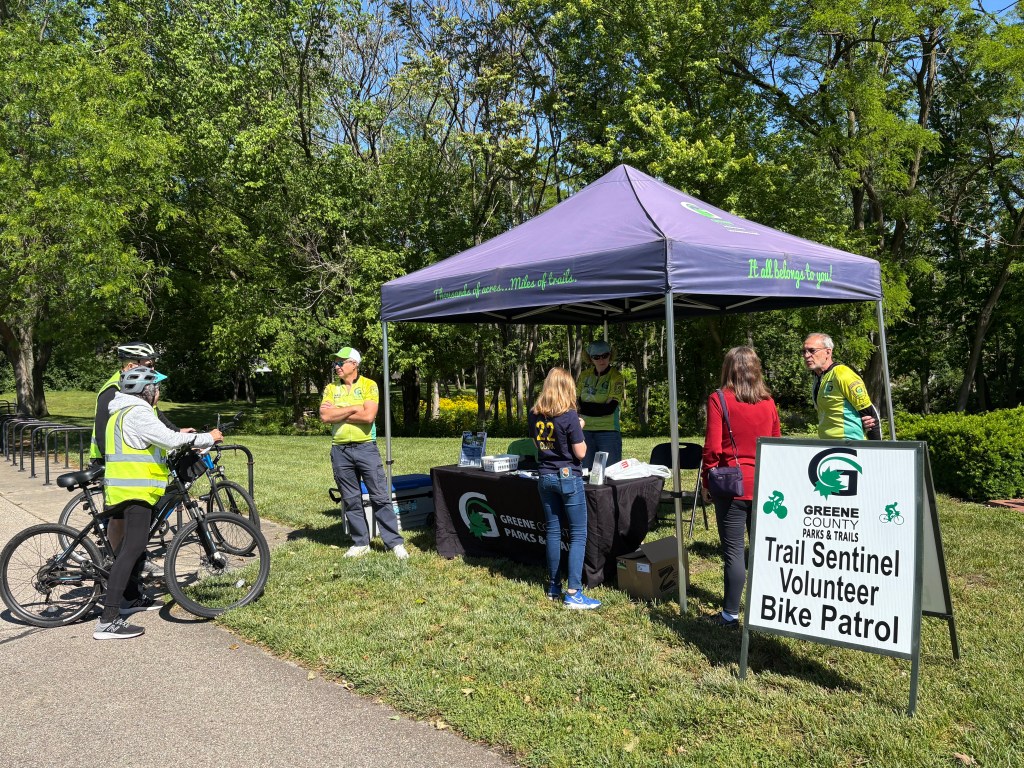
Three planned routes of 10, 30, and 60 miles are available, accommodating cyclists of all skill levels. Along the way, participants will traverse some of the county’s most iconic pathways, including the Creekside Trail, The Little Miami Scenic Trail, Xenia-Jamestown Connector, and the Ohio to Erie Trail. Rest stops stocked with refreshments will be strategically placed to ensure riders remain energized and hydrated, and the ever-dependable Greene County Trail Sentinel volunteers will be on hand throughout the day to assist participants.

“Our role as Trail Sentinels isn’t just about ensuring safety,” said Deer. “We’re here to make the experience enjoyable and memorable for every rider. Whether someone’s doing the 10-mile route or tackling all 60 miles, we’re committed to helping them have a great day while supporting a critical cause.” In addition to riding the routes to assist riders, the Trail Sentinels will also have a support table under the shelter at Xenia Station, joined also by volunteers from the Greene County Suicide Prevention Coalition Veteran Subcommittee.

Participants and visitors to Xenia Station will have the opportunity to connect with like-minded individuals, share stories, and learn more about the impactful work of the Subcommittee. Funds raised from this event will go directly to supporting programs that provide essential resources for veterans, including mental health services and outreach initiatives.

“This is a chance for people to do something they love—riding bikes—while making a real difference in the lives of our veterans and their families,” Deer added. “At a time when critical services are underfunded and undermanned, this event is proof that even a simple activity like cycling can have a profound impact when it’s done for a cause.”

From seasoned cyclists to those who are simply looking for a meaningful way to spend a day outdoors, this one-day ride offers an unforgettable experience that combines the joy of exploration with the fulfillment of giving back. To register go to, https://www.gcparkstrails.com/event/greene-county-bike-tour-for-veteran-suicide-prevention/  

If you or someone you know is in crisis, please call the 988 suicide and crisis hotline, dial 1 for veteran support.

Booker: Truth to Power

In history, National News, News Media, Opinion, Politics, sociology, Uncategorized, World News on April 11, 2025 at 1:57 pm

Deer In Headlines II

By Gery Deer

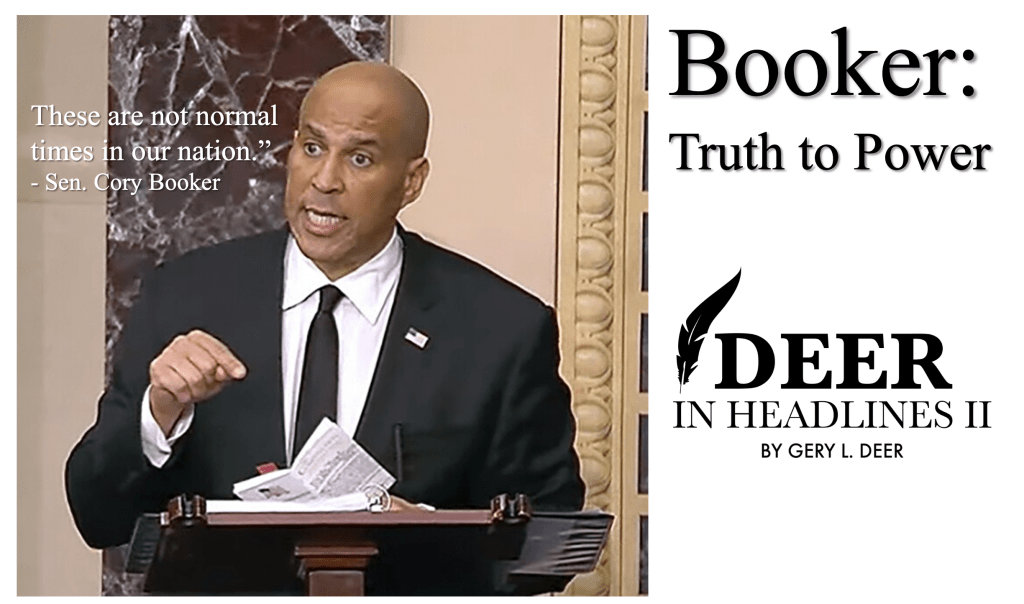
Last week, we saw an incredible example of unmitigated patriotism to provide a voice for those who have none in the face of a president who runs roughshod over anyone who dares oppose him. Cory Anthony Booker, the senior senator from New Jersey, took and held the Senate floor for 25 hours and 5 minutes in a marathon speech in opposition to President Trump’s haphazard and potentially illegal actions during the first three months of his term.

Until now, congressional resistance toward the president has been lackluster, to say the least. This is understandable considering the GOP’s control in both houses and the way this administration has reacted to any opposition, as a petulant child would on a playground when denied an ice cream cone. It’s embarrassing and troubling. Congressional town hall meetings across the country have been disrupted by constituents demanding that Trump be held accountable for the repercussions of his actions.

Most disruptors are ushered out or jailed for the disturbances, but their point is well taken. This president has been actively, deliberately, and defiantly testing the limits of his office and the ability of the other branches of government to keep him in check as designed.

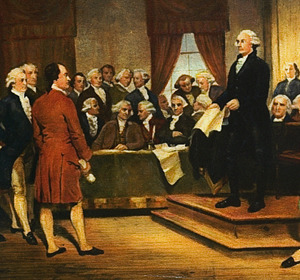
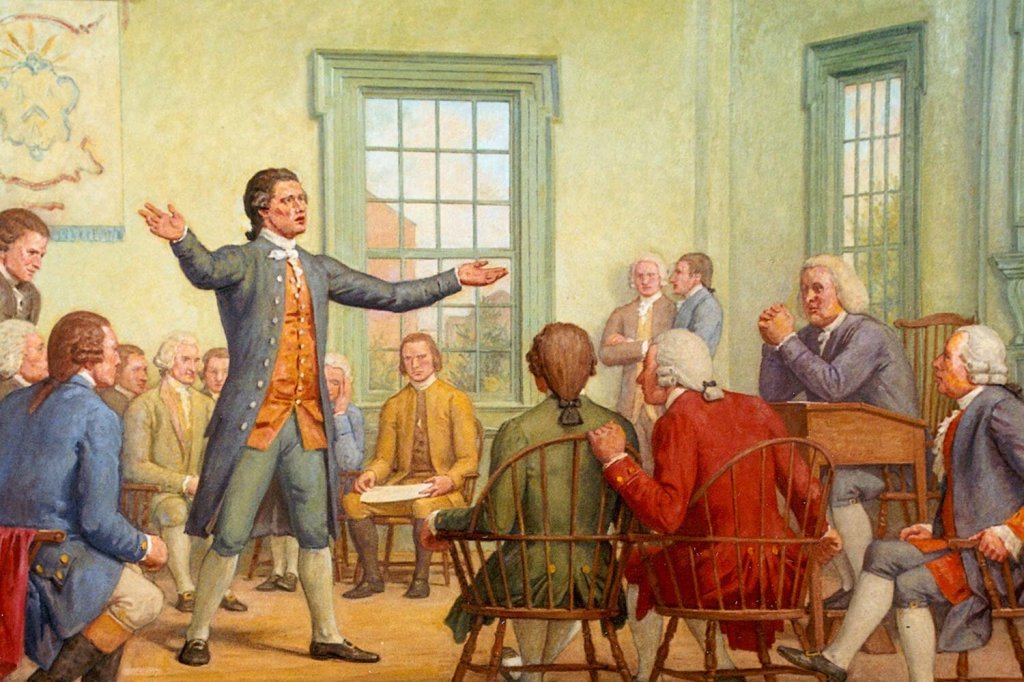
In 1787, the men governing the 13 original American colonies had been through a great deal. They’d declared independence from the most powerful country in the world, fought them in a bloody revolution, won, and finally managed to cobble together a set of laws to live by, unlike anything seen before. The newly minted Constitution was the single most important document ever drawn up to that point – and still is today. The Preamble and Bill of Rights (the first 10 amendments for those who slept through fourth grade) are the gold standard for governing a democratic republic.

It’s doubtful the Founding Fathers ever imagined their fledgling country, still in its infancy today by European standards, would end up being tested, not by a foreign enemy, but by a power-mad oligarch occupying the president’s office. And, until today, very few have had the courage or opportunity to openly stand up to him.

Monday, March 31st, Booker took to the Senate floor and stated he’d remain there as long as he was “physically able,” and that he did – and it was no small feat, even for a former football tight-end. To hold the floor, whoever is speaking must keep talking and can’t stop, sit, lean on anything, or leave the floor for any reason. Fellow Democrats helped out, though, per Senate rules, allowing them to interrupt and ask him questions.

Over a day later, the 55-year-old senator finished speaking and limped off the floor. But, during his time, he held nothing back, walloping Trump on everything from his sweeping cuts to social services to what he called the impending “constitutional crisis” created by the president’s authoritarian actions.

To be clear, several Republicans have taken the same long-winded action on various issues over the last few years, most unsuccessfully. Such a speech isn’t a liberal or conservative move but that of a legislator committed to being heard on behalf of their constituents or the country.

Booker’s record-breaking speech was patriotic because he spoke for more than just those in his voting district. He voiced the fears not just of New Jerseyans but Americans nationwide. His words begged for compassion, kindness, and common sense – from those on both sides of the aisle. After all, when Trump’s own party doesn’t stand up to him, knowing his actions are questionable at best, someone else must.

The real question is, will Booker’s speech fuel a more dauntless anti-Trump resistance? Possibly. For more than a day, the New Jersey senator knocked the president’s agenda off the front page of every news outlet website, here and abroad. Not to mention the 350 million “likes” during the live stream on TikTok.

One thing is sure. Democrat or Republican, people must realize that Trump’s actions prove his agenda is to serve himself and his billionaire friends, not the country. So, to quote Senator Booker, “These are not normal times in America,” he said. “And they should not be treated as such in the United States Senate” or anywhere else.

Efficacious Electoral College

In Books, Children and Family, Economy, Education, history, Local News, Politics, sociology, Uncategorized on October 19, 2024 at 10:20 am

Deer In Headlines II

By Gery Deer

Without question, 2024 has been and will continue to be one of American history’s most charged and controversial election years. Among the points of contention is the continued argument regarding the necessity – and validity – of the Electoral College.

Political operatives and pundits alike have been outspoken on the subject from all political viewpoints. There seems to be no consensus because, quite frankly, even some government officials don’t understand its purpose. So, before I give you my thoughts, here’s some non-partisan history.

During the first Constitutional Convention of 1787, a significant debate unfolded about the method of electing a president to lead the executive branch of our newly established government. It was a pivotal moment in our history after the decision to have a single individual in the office rather than two or even a triumvirate. Just imagine the complexity of electing three people every four years.

The primary issue was whether a congressional vote should elect a president or do it by popular vote.  The latter eventually won out until the smaller states began to weigh in, concerned that those with a larger population would wield more control.

Another lesser-known concern was that the political elite of the time were worried about a mass of uneducated voters swaying the results. Discussions continued for several months until, one day, in a closed-door subcommittee, James Madison laid down the concept for what became known as the Electoral College.

Enacted as a compromise and safeguard, Article II of the U.S. Constitution (later the 12th and 23rd Amendments), as well as the Electoral Count Act (ECA) of 1887) formally established the Electoral College. These laws regulated the voting process and defined the events between Election Day and the Inauguration.

Now, to clear up some misconceptions. Regardless of rhetoric to the contrary, I assure you that the Electoral College is an entirely democratic process. It is not, however, easy to explain. But I’ll try anyway (insert a deep breath here).

In a presidential election year, the political parties hold conventions where they nominate “presidential electors.” That’s simple enough to understand, but hang on. Here’s where it can get… confusing.

When a party’s presidential and vice presidential candidates win the popular vote, that party’s electoral nominees become “Electors.” Each state has the same number of Electors as members of Congress, and each Elector votes for their party’s ticket on separate ballots – one for president and one for vice president. So, your individual vote is still vitally important because the candidates cannot earn Electors without it.

For example, if Richard Nixon and Barry Goldwater (president and vice president, respectively) won the popular vote in California, the Republican nominees from that state would become Electors and cast their votes to the Electoral College. Once all the electoral votes are cast, the candidate who reaches 270 out of a possible 538 wins – and this is only triggered if the candidates win that state’s popular vote in the first place.

In the news, the results sound something like this: Nixon has won California and its 54 electoral votes. Of course, those results still have to be certified. As you might recall, there was a slight hiccup during the 2020 election certification. However, new security measures have been taken to reduce any potential repeat of those terrible events.

Remember, this is just a glance at the process, but I hope it helps. If it’s still puzzling, a good analogy is Major League Baseball’s World Series. Every year, the winner is determined not by which team got the most runs per game but by which won the most games in the series. The Electoral College works the same way.

In my opinion, the Electoral College is the only practical, efficient, and fair way to ensure everyone’s voice is heard because we’re represented just as we are in Congress. The Founders realized that the popular election alone could and would eventually bring chaos.

If we want an election process that stays in constant contention, then eliminate the EC. But if we’re going to have all our citizens represented equally, let the system do what it was designed to do. If you want to make a real difference, make sure you vote.

TCN Behavioral Health Hosts Chalk Walk for Recovery

In Children and Family, Dayton Ohio News, Local News, Media, psychology, sociology, Uncategorized on September 19, 2024 at 1:24 pm

Fairborn, Ohio – September 17, 2024 – TCN Behavioral Health Services, Inc. will host a Chalk Walk for Recovery at their 1825 Commerce Center Blvd. office in Fairborn on Friday, September 27 from 4-7pm. The event will take place in TCN’s front parking lot.

The Chalk Walk is an opportunity for community members of all ages to come together to create chalk art and support those in recovery. TCN is providing the chalk and sidewalk space and anyone who would like to create art is invited to participate.

This year’s event will feature local artists and vendors as well as food and refreshments for sale. Water will be made available to participants free of charge, and there will be Recovery Month t-shirts for sale featuring TCN’s winning recovery month slogan: My past will remind me, but it will not define me.

“TCN takes great pride in its commitment to serving our communities. In recognition of September being Addiction and Recovery Awareness Month, TCN will be hosting a Chalk the Walk for Recovery event. We would love for you to come join us for this event!” says TCN Associate CEO Tom Otto.

Founded in 1990, TCN Behavioral Health Services, Inc. is a comprehensive behavioral health agency dedicated to improving lives by providing clinically excellent and accessible behavioral health services.  TCN provides substance use, mental health and psychiatric services for adults and youth in Greene County and beyond.  For more information or to donate to TCN call (937)376-8700 or visit www.tcn.org.

Moral Bankruptcy

In Opinion, psychology, sociology, Uncategorized on July 26, 2024 at 7:43 pm

Deer In Headlines II
By Gery Deer

“How did you go bankrupt?” Bill asked. “Two ways,” Mike said. “Gradually and then suddenly.” Ernest Hemingway’s characters in his 1926 novel, “The Sun Also Rises,” were speaking about money. But I think we go morally bankrupt pretty much the same way. I mean, when did people in our country become so mean to each other, so divisive? Has it always been that way, and I’ve just been too head-down in my own world to notice? Maybe it’s that the only people with a megaphone or resonant rhetoric tend to be the extremists. But the real question is, what is “morality?” That is a complicated question with no definitive answer.

I have always believed that, like so many of life’s perceptions, the idea of morality is in the eye of the beholder. I mean that the concept of decency or morality (and those aren’t the same things) is based on your perspective or what you absorb from those around you. For instance, if you were close to your parents, and they were friendly people who shared what they had, helped their neighbors, and worked hard every day to provide a good life for you, then, odds are, you’ll behave similarly. But it isn’t always so.

If you were not close to your parents or lived in animosity with them for some reason, you might end up the lay-about who steals from the cash register or kicks puppies. But I’m afraid this is slipping into a philosophical discussion of nature vs. nurture, which gets messy. So, let’s move on.

Isn’t it entirely possible that the idealistic concept of morality is simply imaginary, realistically unachievable, and that sometimes people are just bad? My unqualified opinion says yes. But wait, is my position unqualified? I know people, and I can tell when they intentionally cause harm to me or others. I’d say that pretty well qualifies me, or anyone else, to judge bad vs. good. Of course, that opinion remains relative to my point of view. And God knows we all have nasty relatives.

Speaking of God, which I don’t do very much because it’s one of those topics to be avoided at all the dinner parties I don’t go to, like sex and politics. But – when someone says, “God gives us a moral compass.” To that, I will only say this. To which “god” are you referring?

An estimated 700 different creator deities (gods) are worshipped worldwide. If you ask one follower of each, I would imagine they’d all say theirs is the only one. So be it. But, if the wrath of any one of those vengeful, judgmental deities was supposed to persuade people to behave themselves, I think it didn’t work. Think about it, more and bloodier wars have been – and still are – fought over tribal god images than any other reason in the history of mankind. Therefore, any idea of a religiously motivated morality strains credibility.

You alone must decide what morality is for yourself. Look, we all have good and bad in us; one person’s mistake is another person’s malice. A good deed to you might be torture for someone else. Some people think having a woman who displays her bare ankles is immoral, while there are likely people out there for whom any clothing at all would be considered offensive.

The real question is, are there unilateral rights and wrongs (morals)? It’s likely that most people would answer in the affirmative. For example, a vast majority would probably agree that killing is wrong. If you’re steering your morality ship by the Bible’s Ten Commandments, it’s right there in the text: “Thou shalt not kill.” However, it’s often argued by theologians that this is an incorrect translation. Some say the line should be, “Thou shalt not murder,” giving the commandment a very different meaning. Once again, it’s all about interpretation.

As to the original question of whether our society is going morally bankrupt, the interpretative relativity of the facts makes analysis impossible. But, given the constant reports of murder, war, greed, and fanatical extremism in the world gnawing at the very foundation of basic morality, I’d say our account is already in the red.

Social Microcosms

In Opinion, psychology, sociology, television on June 1, 2024 at 9:56 am

Deer In Headlines II

By Gery Deer

Have you ever considered a microcosm? Chances are you haven’t, but we are exposed to them almost every day. Essentially, a microcosm is anything in miniature that represents something bigger. For our purposes, a microcosm is a small group or community whose characteristics represent a larger one.  

We see microcosms everywhere, and we’re usually unaware of them. Some are fictional, existing only in books, movies, television, and theatre. Others are happening around us, whether we’re integrated participants or outside observers. Let’s look at a couple of examples.

Consider the classic TV show “Gilligan’s Island,” which its creator, Sherwood Schwartz, referred to as a social microcosm. It featured seven characters, each representing a different socioeconomic position. Gilligan and the Skipper embodied the working class, while the Professor symbolized academia.

Mr. and Mrs. Howell (the millionaire and his wife) represented the elite, privileged upper crust. Mary Ann, a girl from the heartland, brought an earthy, grounded perspective, and Ginger, the movie star, added a touch of glamour.

Gilligan’s Island creator Sherwood Schwartz called the slapstick-laden sitcom of the 60s a “social microcosm” because of the socio-economic makeup of the characters.

Shipwrecked on an island in the middle of the Pacific, the writers put these people in absurdly improbable situations where each demonstrated their own inherent characteristics, however unrealistically. That’s where the comedy came from, and it worked.

Of course, to suspend the disbelief and immerse the viewer into the cartoon-like world, the show generally left out more realistic issues in such a situation. Problems like food, water, clothing, and shelter only arose when a comedic lack of some basic survival needs drove the story. But that’s TV. What about in real life? Where do microcosms exist day-to-day?

Recently, I found myself at a family birthday party in a local bowling alley. The guest of honor was turning 18, and a lively group of teenagers had gathered around the scoring console, ready for a game. As the afternoon progressed, the pitcher of soda ran dry, and the pizza had disappeared. Hunger pangs set in. (Kids eat a lot, wow!) With nothing else to do, I volunteered to make a snack bar run, setting the stage for an interesting observation of a real-life microcosm.

It was a Saturday afternoon, and the place was packed. Nearly every lane was occupied. As I walked along the service area at the back wall, past the shoe rental and pro shop, I suddenly noticed how much real life was happening all around me, and it all registered in my mind with sounds.

When I first realized what I was listening to, I literally froze for a moment. A woman nearly collided with me as she hurried along, balancing a pizza, drinks, and bowling shoes. I was so surprised by how I felt at the moment that I was compelled to step out of the foot traffic, close my eyes, and just listen.

Amidst the chaos, I focused on individual sounds. I heard the familiar thud as bowling balls dropped onto the hardwood floors and the dull rumble as each raced down the lane. Finally, the unmistakable crash of the pins as the ball hit them or the disheartening clunk if it dropped into the gutter.

Above pin resets, hand dryers, and clanking ball returns were the sounds of people living life. This was the microcosm of the moment—celebrations, first dates, families, young, old, and everyone in between.

I opened my eyes, looked around, and tried to put sight with sound. More birthday parties, a small child, with a ramp and dad’s help, making her first attempt to roll the ball. Neither she nor her parents will ever forget that day. A couple of lanes down, several older women chatted and crocheted between frames. One of the women working on a large afghan appeared to be winning.

I was standing among people from many different walks and stages of life. They all had one purpose, albeit the motivations were different. Everyone was there to enjoy the game, be with family and friends, and create lasting memories.

Eventually, I had to complete my mission and get the food back to our group before the teenagers ate their own shoes. But I can still hear those sounds and remember all the life that was being lived on that one normal day at the bowling alley.

Is this your new site? Log in to activate admin features and dismiss this message
Log In