Local News & Commentary Since 1890.

Archive for the ‘Opinion’ Category

The Hero Sandwich

In Opinion, Uncategorized on August 25, 2025 at 7:06 am

Deer In Headlines II

By Gery Deer

When I was a kid, we had an in-ground pool in our backyard. About the size of a two-car garage, my father, a skilled concrete worker and mason, built it himself. As spring gave way to summer, my dad would uncover, clean, and fill the pool for the season.

It was one of my favorite times of the year. The weather was still reasonably cool for early summer, and I was fascinated by the huge tanker truck that carried the water to our house. I grew up around trucks and other heavy equipment, so you’d think I would have little interest in such a thing. But when you’re five, everything is much bigger than life, and we didn’t have a water truck.

My brother and sister were pushing me around our pool in a plastic boat around 1969, a couple of years before the ham sandwich incident.

Although I could swim, my parents never learned. I always thought that was strange since my dad grew up on the banks of the Ohio River. So, unless my older brother or sister was in the pool too, I had to watch through the chain-link fence.

One particularly memorable pool opening day, when I was about 4 years old, the water truck arrived around lunchtime. I peered eagerly through the screen door. Mom stuck half of a boiled ham sandwich in my hand, told me to be patient, and she would take me outside when I’d finished my lunch.

I have an oddly specific memory of Mom commenting that this was the last of that particular lunch meat and not to waste it. I’m not sure why that stuck with me, but, at the time, it seemed pretty important.

At some point, I promised to finish the sandwich if she let me go outside, which did the trick. After all, Dad was out there, and I could stay by the fence. My case effectively pleaded, and the judge’s decision rendered, I happily toddled outside with my ham sandwich.

I think Dad was distracted. He chatted away with the water truck driver about whatever it is that truck drivers talk about when they’re waiting for gravity to do all their work for them. I adjusted the straw hat mom plopped onto my head on the way out the door, and clutched my sandwich as I stealthily made my way inside the enclosure and around to the opposite side of the pool.

I know – I wasn’t supposed to be there – and I knew it then too. But I was a handful back then and didn’t always do what I was supposed to do. Finally, I was near the filter vent – a favorite spot for me to sit and dangle my feet in the water.

This was the pool my father built for us – the fence I mentioned in the story has yet to be added. This is just after the construction was completed.

I tried my best to disappear behind a deck chair when Mom called for Dad to make sure I ate my sandwich. He relayed the orders, noticed where I was standing, but seemed unconcerned. I took a big bite of the sandwich, crept over to the edge, and peered into the water. A moment later – kerplop! There I was, like a fishing bobber, headfirst and feet sticking out of the shallow part of the pool. I can still recall the feeling of being swallowed by water.


As quickly as it happened, I was yanked out of the pool by my foot, now missing its sandal. My father was taken over by fear but never missed a beat. Worried I’d taken a lung full of water on the way in, he put me over his knee, face down, and started thumping on my back. “Spit,” he repeatedly shouted at me as the heel of his hand rapped on my back. I shook my head in defiance. “No.” After a minute or so, I complied. Out of my mouth spewed a wad of half-masticated ham and bread that hit the cement with a splat.

When I fell in, I had a mouthful of food, and I held my breath, which kept the water outside, where it belonged. Upon my rescue, I was reluctant to spit it out because I was afraid I’d get into trouble for wasting it. That ham sandwich and my father’s quick action saved my life. The moral? Do what your mom tells you – and hold onto your ham sandwich.

Vision Quest

In Health, Opinion, psychology, Religion, sociology, Technology, Uncategorized on August 22, 2025 at 1:32 pm

Deer In Headlines II

By Gery Deer

Somewhere between the motivational posters in your work break room and the TED Talk rabbit
hole you fell into online last Tuesday, someone probably told you that you need a “vision” for
your life. A grand, sweeping, cinematic plan that guides your every move like you’re the
protagonist in a Christopher Nolan film. Lights, camera, confusion.

Now, let’s be honest – most of us are just trying to remember where we left our coffee mug and
whether we fed the dog this morning. But a life vision? That sounds exhausting, and at least
partially unrealistic.

Don’t misunderstand. I’m not saying you should wander aimlessly through life like a robot
vacuum cleaner with a dying battery, bumping your way from wall to wall, down this hallway and
that. Any purposeful achievement generally starts with a dream and some kind of plan, even an
informal one. To me, that’s just common sense.

But obsessing over the idea of a perfectly curated roadmap for your life might do more harm
than good. That’s especially true when we project the obsession onto others—our kids, our
coworkers, some unsuspecting barista. And you need to allow for some flexibility so you can
recognize opportunity when it comes and act in your best interest – that’s more how I work, I
would say.
When someone says you can’t make it without a vision board and a color-coded calendar that
looks like NASA designed it, they are probably trying to sell you something. In case you haven’t
figured this out on your own, life is messy, unpredictable, and occasionally throws a raccoon
through your metaphorical window.


Some of the most successful people I know didn’t start with a vision. They began with a
problem, a deep interest in something, or just plain boredom. They stumbled into opportunities,
made a few mistakes (okay, a lot of mistakes), and figured things out along the way. Their “vision” was more like a foggy windshield they wiped clean with the sleeve of their hoodie – and
that’s okay.

Here’s the thing: having a vision sounds noble, but it can also blind you. When you’re so
focused on the end goal, you miss the weird little detours that could lead to something better.
You ignore the people around you who might need help, or who might help you.

Instead of the kind of vision you read about in self-help books, maybe what we need is a clearer
view—the ability to see what’s happening right now. That way, we notice the opportunities, the
needs, the small wins, and then be present enough to pivot when life throws a curveball—or a
raccoon.

If you’re in a position to guide others—whether you’re a parent, a manager, or just the guy who
always gets asked for directions at the grocery—there’s a temptation to impose your vision on
them. You want them to succeed, so you hand them your blueprint. “Here’s how I did it. Follow
this, and you’ll be fine.”

Really? People don’t come with identical parts and a universal tool kit. What worked for you
might be a disaster for someone else. Your vision might be their nightmare.
Instead of handing out visions like party favors, let’s ask questions. What excites you? What
scares you? What do you want to try, even if you might fail? Influence isn’t about shaping
someone’s path—it’s about helping them find their own flashlight.

So here’s my alternative vision pitch: wander with purpose. Be curious. Be open. Set goals,
sure—but don’t carve them into stone. Scribble them on napkins and be willing to toss them
when life hands you a better idea.

Life isn’t a straight line. It’s a squiggly mess of trial and error, happy accidents, and moments of
clarity that usually arrive while you’re doing something mundane like folding laundry or eating
cold pizza in the middle of the night. So what to do? Ignore all the nonsense out there and do
what leads you to the life you want.

While a valuable foundation, vision isn’t an absolute. Flexibility, awareness, and a good sense
of humor are your best tools along life’s path. Now – what did I do with that coffee mug?

Flawed democracy

In Opinion, Uncategorized on July 8, 2025 at 11:31 am

Deer In Headlines II

By Gery Deer

Two hundred and forty-nine years ago, 56 delegates of the Second Continental Congress, after long sessions of debate, and at great risk to their own safety and freedom, made the decision to formally declare revolution against the English government. The official vote came on July 2, 1776, although the war began more than a year earlier. It was the birth of a new nation that would forever change the world.

Today, some view modern America as being at odds with its idealistic founding. But put aside your political divisiveness for the next couple of minutes and consider what it really means to be an American.

As Americans, I believe we’ve grown complacent and with little appreciation for the sacrifice and intent of the men who signed the Declaration of Independence. Ask the average American what America stands for and most might answer, “freedom.” Unfortunately, the freedoms and rights set up in the constitution have, since day one, been in constant jeopardy. And for some, they haven’t existed at all.

No, freedom wouldn’t be my answer to such an inquiry. If I were asked what our country is all about, my reply would be, “change.” In fact, I would go so far as to say, “beautifully flawed change.” Let me explain.

If you’re one of those who believes that the United States has always been star-spangled awesome (thank you Aaron Sorkin), I’m sorry to have to disappoint you. We’ve generally been anything but.

As a relative teenager in the family of the sovereign nations of the world, we are a mess. From the witch hunts of the 1600s, to one of the bloodiest civil wars in history, to the frightening Japanese internment camps of World War II, to a dozen other black marks on our report card, we have yet to fully live up to the ideals of our Founding Fathers. Moreover, we never will – it’s impossible.

Our republic is made up of and governed by people flawed, self—absorbed, arrogant, human beings. We have and will continue to screw up over and over again. Albethey terrible sometimes, all these foul ups are also necessary – provided we learn from our mistakes. Change invites… no, demands failure, and we’ve had our share. But without change, we become stagnant, with little or no advancement as a society or a nation.

Most people resist change, especially when neither the process nor results are to their benefit. But our constitution begins boldly with, “We the people,” not, “We, some of the people.” To be positively effective, to progress our nation to something better, change must benefit all, not just a select few. It should improve conditions for each and every citizen but also protect the visitors to our shores. Otherwise, change merely serves to divide our country rather than unite it.

With all our flaws, however, the country usually rights itself one way or another. The correction may be incomplete or imperfect, but we usually get back on track. Unfortunately, such adjustments sometimes result in pain for some, and prosperity for others, generally in staggering disproportion.

Neither a sense of being an American, nor a patriot, is about flags, slogans, or parades. To me, a good American is a good citizen, someone who acts from a sense of duty and compassion, rather than a need for power. Good Americans remember the intent of those who sacrificed much to give us the right to resist oppression and injustice, to be free to worship, or not, as we choose, and that the survival of our democracy is more important than any individual or political agenda.

The second paragraph of the Declaration of Independence reads, partly, “We hold these truths to be self-evident, that all men are created equal, that they are endowed by their creator with certain inalienable rights…” “Men,” here refers to mankind and includes everyone – male, female, black, white, gay, straight, religious, or secular. Everyone.

What is America all about? It’s about the beautifully flawed change that allows for improvement, provided we always learn from the past and act in consideration of the future. Remember, our children’s, children’s, children will judge our generation accordingly. Have a safe and happy Independence Day.

Corruption fears the press

In history, National News, News Media, Opinion, Politics, Uncategorized on June 22, 2025 at 10:47 am

Deer In Headlines II

By Gery Deer

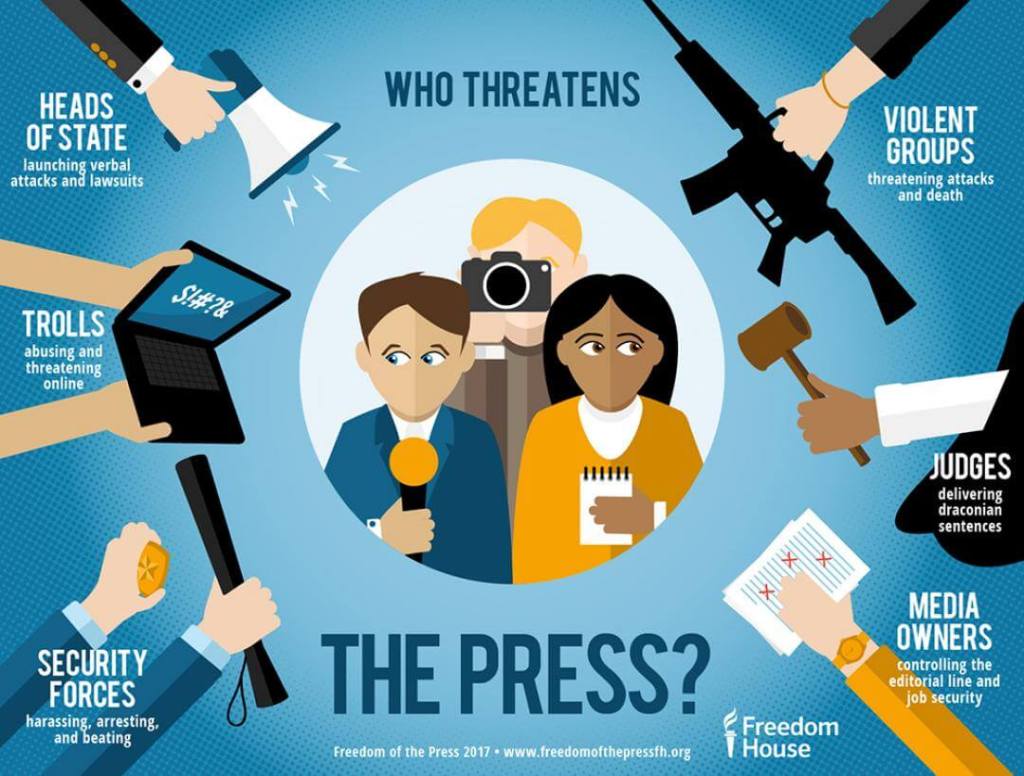
It’s one thing to feel your job is in danger—industries evolve, businesses close, and livelihoods shift. It’s another thing to fear that your work and profession could be criminalized. For those of us in the press, in my opinion, that moment has arrived.

Not long ago, journalists were considered the fourth estate, so-called because the press was seen as the fourth, unofficial, branch of government – the public’s eyes and ears, so to speak. A free press is a necessary check on power, the watchdogs of democracy. Today, Trump and company would rather call any of us who dare question them troublemakers, agitators—enemies of the people. And now, with the Supreme Court’s recent decision to uphold the White House’s ban on the Associated Press (AP), we stand on the edge of something far more dangerous than a bruised ego or a contentious press conference.

The justification? National security – as always. A vague, malleable excuse that’s nearly impossible to challenge or verify. Too convenient to ignore, too broad to oppose. It sets a precedent with sharp teeth. If AP can be barred, who’s next? The Washington PostReuters, or maybe any reporter who dares ask uncomfortable questions?

When a government moves to silence journalism, it isn’t just about limiting press access—it’s about controlling the public’s perception of facts. A free press must do more than inform; it should hold power accountable on behalf of the citizenry. That accountability is inconvenient, even infuriating, for those who prefer not to be held accountable for their actions.

We don’t have to delve deeply into history to see what happens when dissenting voices are silenced. Totalitarian regimes have long understood the value of controlling the narrative. In Nazi Germany, Joseph Goebbels, the minister of propaganda, ensured that only state-approved messaging reached the public. In Stalinist Russia, independent journalism became synonymous with treason. And now, in a supposed beacon of freedom, we find ourselves edging toward a similar state.

Perhaps some believe these measures are justified—that journalism has gone too far and biased reporting warrants a firm correction. Some might even argue that disinformation (a great deal of which originates with the White House) has muddied the waters so thoroughly that restricting the press helps protect the public from chaos. The question we must ask ourselves is not whether we like the press—it’s whether we need it. And if those in charge are willing to erase dissent under the guise of security, we may not have much time left to answer.

The implications go well beyond a single news outlet losing access or presidential attempts to discredit them. If a major institution like the Associated Press can be barred from the White House, and with Supreme Court approval, every journalist in America faces the same risk.

What happens when smaller, independent outlets push too hard? What happens when investigative reporters publicize facts surrounding corruption at the highest levels? This is how truth becomes dictated rather than discovered. This is how governments rewrite history while the present unfolds in silence.

The press has never been perfect—it has biases, it makes mistakes, and yes, sometimes it gets the story wrong. But journalism, at its core, is a profession based on the pursuit of facts. A reporter’s job is not to flatter or cater to power, but to question, to dig, to expose injustice and demand answers.

Our democracy was built on the idea that those in power answer to the people, not the other way around. That principle is maintained through open discourse, through transparency, through a press that is free to ask uncomfortable questions and uncover uncomfortable truths. Of course, that’s not how Trump sees it. He doesn’t answer to you or me – only to his donors.

Still, the president can boot them out of the West Wing, but he can’t stop them from reporting – yet. If we allow this moment to pass unchallenged, accepting that barring journalists is just another policy decision, we lose the foundation of informed democracy set in place under the First Amendment of the United States Constitution. Once the press is muzzled, once silence replaces scrutiny, and propaganda overshadows fact, there’s no telling what comes next.

Supplemental Information:

(Courtesy https://www.carnegielibrary.org/the-first-amendment-and-censorship/)

The First Amendment Defined

The First Amendment to the U.S. Constitution protects what are commonly known as The Five Freedoms: freedom of religion, freedom of the press, freedom of speech, freedom of assembly, and freedom of petition. The amendment is one of the first ten amendments to the Constitution, known as the Bill of Rights, which was adopted in 1791. 

The First Amendment Reads:

“Congress shall make no law respecting an establishment of religion, or prohibiting the free exercise thereof; or abridging the freedom of speech, or of the press; or the right of the people peaceably to assemble, and to petition the Government for a redress of grievances.” (Source: National Archives

This amendment gives Americans the right to express themselves verbally and through publication without government interference. It also prevents the government from establishing a “state” religion and from favoring one religion over others. And finally, it protects Americans’ rights to gather in groups for social, economic, political, or religious purposes; sign petitions; and even file a lawsuit against the government. (Source: History.com)

Radio Waves

In Dayton Ohio News, history, Opinion, Technology, Uncategorized on June 16, 2025 at 8:29 am

Deer In Headlines II

By Gery Deer

A long time ago, in a glowing box, far, far away, radio was the primary means by which most Americans received their news and entertainment. Frontline news from overseas wars, sketch comedy shows, and soap operas – all of it started on the radio. Growing up, I spent hours listening to the radio, everything from music and radio plays to late-night talk shows and Casey Kasem’s American Top 40 countdown.

Nearly all of these are gone now, but if you listen closely, you can still hear it—the crackle of an AM signal, the smooth transition of an FM dial, and the hair-raising tones of the emergency broadcast system. Well, OK, that one’s not so nostalgic. But is such a long-running, analog medium still relevant in a digital era of podcasts, streaming services, and algorithm-driven playlists?

Despite predictions of its demise, radio lives. According to Nielsen’s Q3 2023 Total Audience Report, radio remains the most popular media in America, reaching 84% of the population aged 18 and above. That’s right—more people tune in to traditional radio than watch television or scroll endlessly through social media.

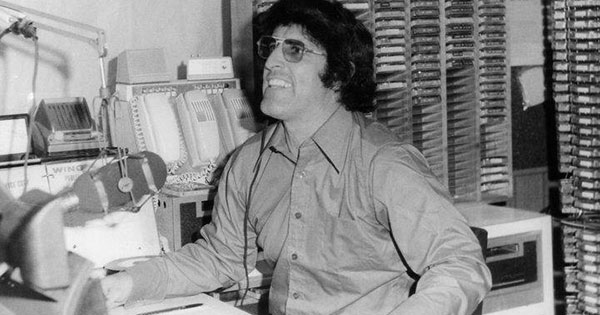
Dayton, Ohio, radio personality Steve Kirk ruled the Miami Valley airwaves for decades. Is there a need for this kind of talent in the 21st Century?

Radio is still around because, for the most part, stations and owners have adapted, shifting to digital platforms, streaming services, and podcasts. For example, this column’s podcast counterpart is featured on iHeartRadio, which operates more than 850 stations nationwide.

Additionally, over-the-air broadcasting remains a popular option, particularly in cars. Every week, approximately 92% of Americans listen to the radio—roughly 272 million people—proving that radio remains the dominant medium for commuting.

Local radio ad revenue, however, isn’t what it once was. In 2025, sales are expected to reach only around $2.4 billion—a sharp contrast to the nearly $22 billion radio generated just 20 years ago. Radio stations have had to rethink their business models due to stiff competition from digital platforms. Some have survived and prospered by embracing digital, while others struggle to keep the lights on.

Cumulus and Townsquare Media recently shut down twenty radio stations. Many of these were AM stations that had lost their audience decades ago, unable to compete with the convenience of streaming. While this thinning of the herd might seem like bad news, some argue it’s a necessary evolution—fewer stations mean less competition for ad dollars, potentially stabilizing the industry.

That said, AM remains profitable, thanks in part to FCC deregulation by Presidents Reagan and Clinton, and conservative talk programming has become its cash cow. Unlike the early 1980s, when call-in talk shows were relatively new, less restrictive laws eventually allowed companies to own and operate nearly unlimited radio stations.

Suddenly, extreme political hosts like Rush Limbaugh, who held the daytime ad money, reached millions over a network of AM stations. More entertainment-focused programs, such as Sally Jessy Raphael’s call-in show, also thrived, ruling the airwaves at night.

Then there’s traditional radio’s subscription-based cousin – satellite. Since its inception, satellite radio has been marketed as the premium alternative—no static, initially with no commercials, and a seemingly infinite selection of niche stations.

Satellite radio carved out a loyal audience, particularly among drivers who want uninterrupted entertainment on long commutes. SiriusXM, the dominant player in the satellite radio market, boasts over 34 million subscribers. While that’s a fraction of traditional radio’s reach, it’s still significant, proving that people are willing to pay for curated content.

Satellite radio offers exclusive content—think Howard Stern and live sports. However, it faces stiff competition from podcasts, which offer similar content for free. Streaming services like Spotify and Apple Music offer listeners more control over their audio experience, making it harder for satellite radio to justify its subscription fees.

Even with these checkmarks in radio’s “cons” column, in my opinion, there are still plenty of pros, so long as the medium continues to evolve. “Because that’s how we’ve always done it” isn’t a phrase anyone working in radio wants to hear from management these days.

Whether it’s delivering local news, playing your favorite tunes, or keeping you company on a long drive, radio is still a faithful companion for whatever you’re doing. If you don’t believe me, turn on your car stereo. Chances are, you’ll find something worth listening to.

Open Mic Night

In Environment, Health, Local News, Opinion, Uncategorized on June 9, 2025 at 8:22 am

Deer In Headlines II

By Gery Deer

It takes a special kind of bravery to step onto a stage, armed with nothing but your talent and a willingness to bare your soul to strangers. Open mic nights embody this raw courage, where artists of all kinds—musicians, poets, comedians—challenge themselves not only to be heard but to connect. To say they are anything less than extraordinary would be missing the heart of the matter entirely.

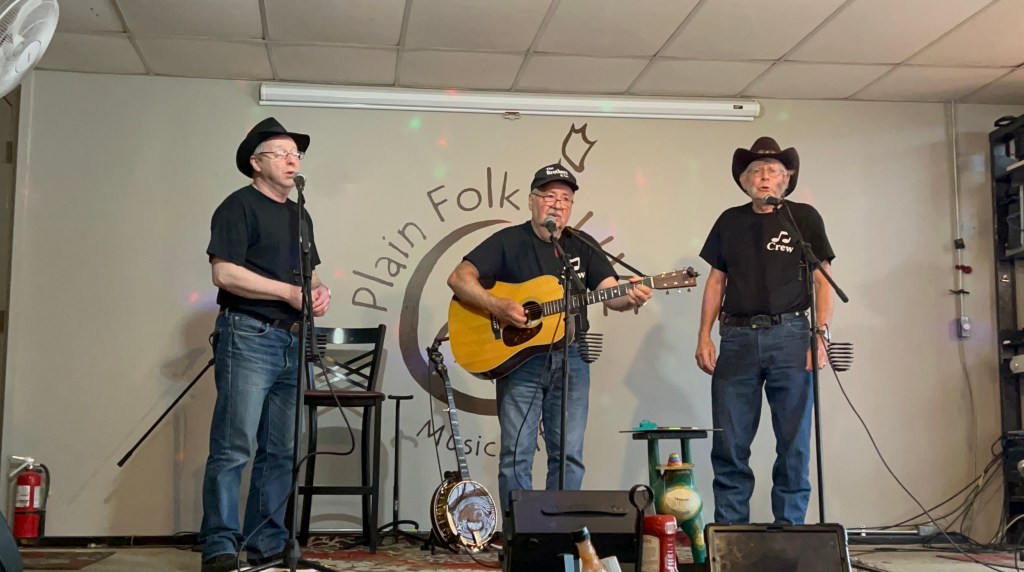
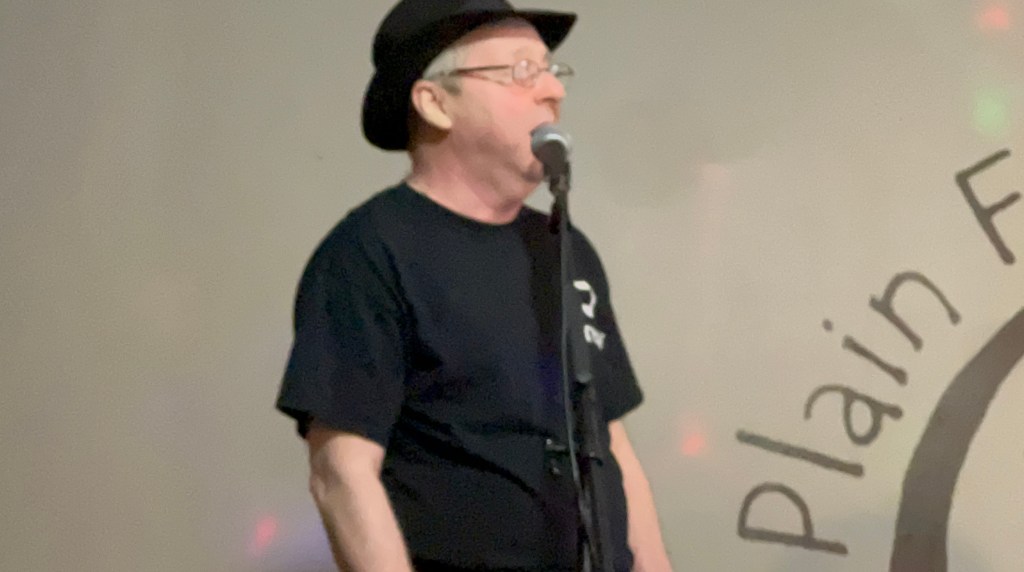
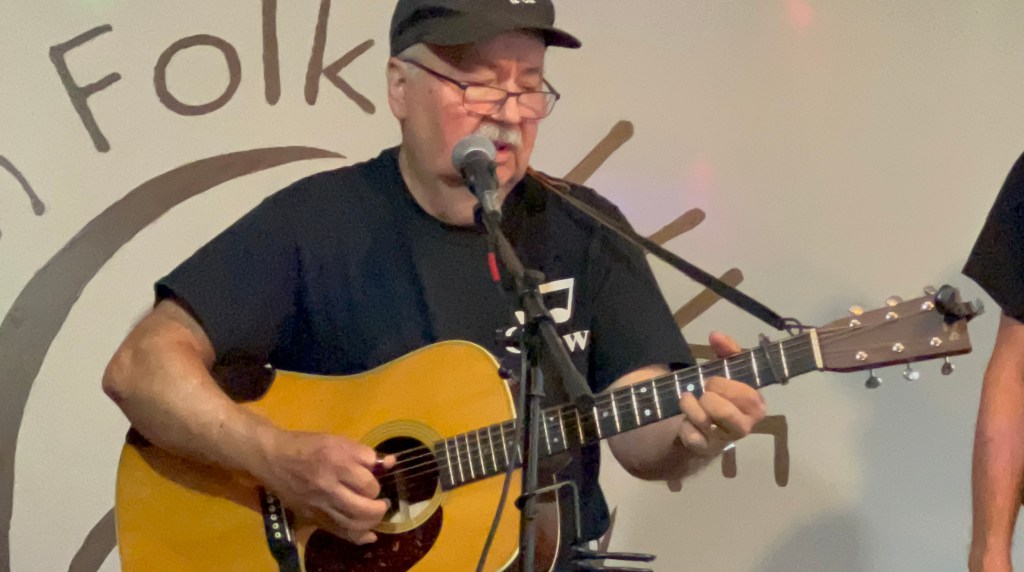
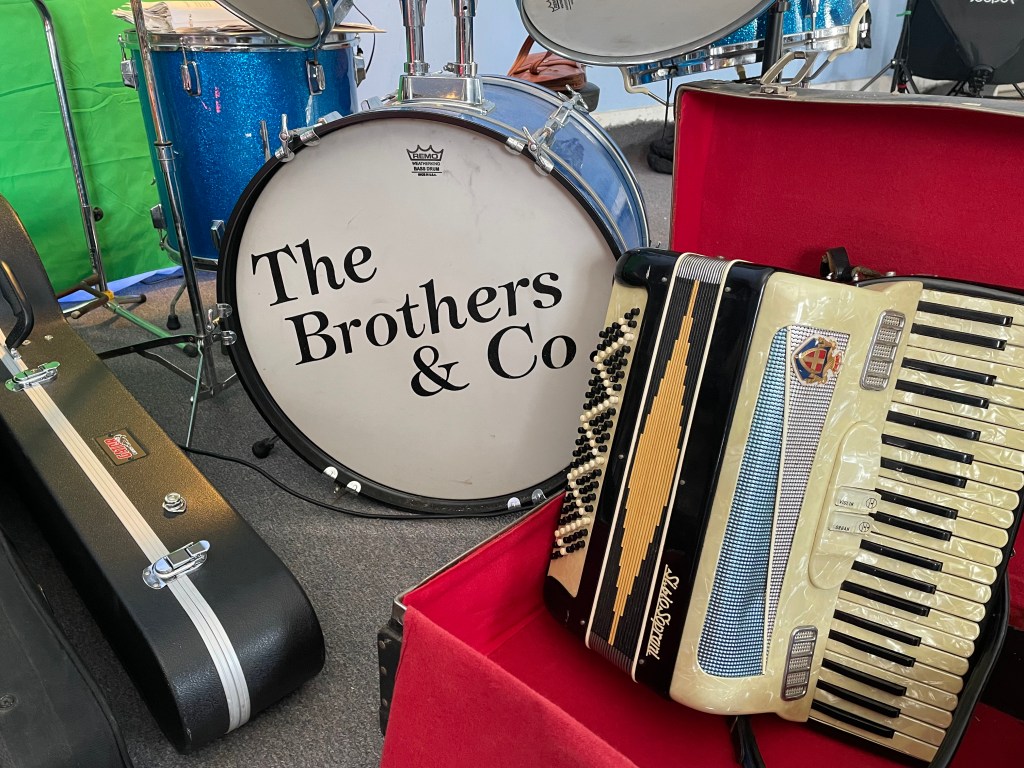
As I write this, I’m sitting with my brother and cousin after just stepping off the stage at Plain Folk Café in Pleasant Plain, Ohio. My family group, The Brothers & Co., which now consists of my older brother and our cousin, has been performing together for over 30 years. We’ve played at casinos, festivals, theaters, just about everywhere – as professional entertainment.  But I’d never experienced an open mic event until my cousin invited us to go as a group. He was a regular here, receiving a very “Cheers” like welcome from fellow performers when we arrived.

Every Thursday night since 2012, performers and patrons alike enjoy good food and entertainment, and the stage isn’t just a platform; it’s a crucible where artistry takes shape. The sign-in sheet, held aloft by a sombrero-wearing ceramic frog, sets the tone: quirky, welcoming, and uniquely communal. Each participant scribbles their name with a mix of anticipation and trepidation, knowing they’re stepping into an unfiltered arena. Some are regulars, others are first-timers, all are committed.

The pull of an open mic is multifaceted. For some, it’s a chance to test new material, an incubator for ideas that might someday grow into greatness. Writers spend hours pouring their souls into words; musicians craft melodies that echo with personal truths. They arrive not knowing whether their work will elicit applause, laughter, or silence—but they come anyway, driven by the need to express and improve.

Then there’s the process itself—learning not just to perfect the art, but to perform it before a living, breathing audience. Open mic performers are incredibly brave, hoping their work connects with even one person in the crowd. That’s where the beauty lies: that vulnerability becomes their strength. It’s almost a superpower, one which, for all my professional experience, can’t comprehend.

Gary Deer Jr and Gery Deer, two of the trio, The Brothers & Co., watch other performers on stage at Plain Folk Cafe.

The first time I was on stage, I was in first grade, doing a ventriloquist act in my elementary school talent show. I had studied the art for a year or so, and my mom thought I might like to show people. I agreed, and the next thing I knew, I was smack in the spotlight of the ultimate open mic set — me, a ventriloquist dummy, 250 schoolmates, teachers, and parents.

One joke, a laugh; another, some applause, and, at the end, I won first prize for my grade. That moment led to a lifetime of performing in front of audiences, from lecturing and emcee work to appearances at hometown festivals and on national TV. Yet, with all that, I can’t fathom getting up there alone, week after week, in front of a cafe full of patrons and performers. It requires a very different kind of courage.

Open mic nights strip away the barriers between artist and audience. Whether it’s a musician pouring their soul into an original ballad or a comic braving the silence between punchlines, the essence of their art is laid bare. Every strum of a guitar or carefully penned word reveals hours of effort, doubt, and hope. It’s humanity, distilled.

Most importantly, these evenings foster connection. In the glow of the stage lights, an unspoken camaraderie develops among performers and listeners alike. The applause isn’t just polite acknowledgment; it’s a collective celebration of effort and heart. That shared experience is what makes open mic nights so much more than casual entertainment—they’re gatherings where creativity finds its voice and its audience.

If you’ve never been to an open mic event, I urge you to go, not as a critic, but as a witness to the raw courage and artistry on display. You may not love every performance, but you will leave with a renewed appreciation for the grit it takes to share oneself so openly, and for all the creative souls who fearlessly challenge themselves week after week.

********

To learn more about The Brothers & Co. Entertainers or Plain Folk Cafe, visit them on Facebook at:

https://www.facebook.com/TheBrothersandCo

https://www.facebook.com/plainfolklive

Library Fines

In Books, Children and Family, Education, Local News, Opinion, Politics, Uncategorized on May 2, 2025 at 10:24 am

Deer In Headlines II

By Gery Deer

(Editor’s note: This edition also appears in other publications under the title “Checked Out.”)

As a kid, the local branch of the public library was in the old opera house near the center of our small farm town. It was cramped and dimly lit, and the reference desk was under the boarded-up grand staircase, giving it a sort of cubby-hole feel. I spent a good bit of time there. After school, I’d do my homework and wait for my mom to get off work. In the decades before the Internet, our library was the window to the world. But now, that window may be closing.

Ohio public libraries are funded, in part, by the Public Library Fund (PLF), which provides 1.7% of the state’s General Revenue Fund (GRF) as of this writing. However, the Republican-sponsored Ohio House Bill 96, proposed in early April of this year, would cut library funding by more than $100 million across the state. Why?

Governments have historically manipulated populations by controlling education and the media. They ban books that don’t align with their values, use defunding threats to force public and school libraries to cultivate materials for their purposes, and limit access to information. That way, voters remain ignorant, subjugated, out of touch, and pliable.

And before anyone says, “you just hate republicans,” they’re not the only ones to try this. Ohio Governor Ted Strickland, a democrat, proposed the same budget cuts a dozen years ago, and the republicans cried foul. Remember, the liberal left still regularly tries to “rewrite” some books to remove language and ideas they find offensive. So, it has gone both ways. This time, however, the danger is more palpable.

Over the last decade, public libraries have become frequent targets for budget cuts, with some policymakers arguing that digital access negates their necessity. But here’s the truth: libraries remain vital to the well-being of communities, and continued funding by federal and state governments is not just important—it’s essential. Without it, we risk depriving countless individuals of educational opportunities, civic engagement, and economic mobility.

Public libraries provide free access to knowledge for everyone (so long as their contents are not censored), regardless of socioeconomic status. Whether it’s a student researching for school, a small business owner seeking resources, or a job seeker brushing up on interview skills, libraries level the playing field in ways no digital paywall ever could. Eliminate government funding, and these services vanish, disproportionately affecting low-income communities. Instead of fostering informed citizens, we create a deeper knowledge divide, where only those who can afford education can access it.

A democratic society thrives when its citizens are informed, and libraries serve as safe spaces where people can access unbiased, factual information. They offer literacy programs, historical archives, and meeting spaces for community discussions—all of which help create engaged and empowered citizens. Where do people go for credible information when libraries close because of defunding? Unfortunately, they turn to the Internet and social media – the global misinformation machines. That’s a terrifying thought.

Libraries don’t just provide books—many offer essential services that help individuals improve their financial stability. They provide free internet access for job searches, resume-building workshops, business mentorship programs, and resources to help entrepreneurs. Government officials profess at nauseum about supporting small businesses and the workforce. Then they gut library funding and undermine those initiatives directly. If libraries disappear, so do these essential services, making it much harder for people to improve their situations.

Defunding libraries erodes the foundation of an educated, informed, and economically mobile society, which is exactly what this administration hopes to achieve. Without them, misinformation flourishes, the digital divide widens, and people lose access to critical resources for success. Libraries are not relics of the past—they are the lifeblood of communities, supporting everything from literacy to local economies.

So, before cutting another dollar from public libraries, policymakers should ask themselves: Do they really want a future where only the privileged have access to knowledge? Without funding, that’s exactly where we’re headed.

Good people on both sides of the aisle must speak out against this kind of censorship and ignorance. In Ohio, you can contact your state representative or State Representative Matt Huffman, currently Speaker of the Ohio House of Representatives: email rep78@ohiohouse.gov or call 614-466-6344.

From the New York Times : Say, Old Sport

In Entertainment, Media, Opinion on April 19, 2025 at 6:14 pm

A Fresh Look At “Gatsby.”

Author Headshot

By A.O. Scott

I’m a critic at the Book Review.

“The Great Gatsby,” F. Scott Fitzgerald’s tale of a tragic Long Island millionaire, was published 100 years ago to tepid reviews and disappointing sales. Since then, especially in the decades since World War II, it has become a staple of English classes and a fixture in popular culture. The novel has been memed, mocked, tweaked and reimagined countless times, a multifarious afterlife that I wrote about recently in The Times.

In my article, I explored some of the reasons for this longevity. But I didn’t focus on the most obvious one. In spite of what many critics of the 1920s thought, it’s a good book!

Let me be clear: I don’t mean a Great Book, though “Gatsby” may also be that. We tend to approach literary masterpieces in a spirit of deference and duty. They’re assigned in school or placed on authoritative lists of what we have to read before we die, which can be more off-putting than enticing. “The Great Gatsby” is profound and important, but it’s also all kinds of fun. Here are some of the kinds.

It’s a short, quick read.

At under 200 pages, “Gatsby” can be finished in the course of a rainy afternoon or a long plane ride. There’s a bit of wheel-spinning at the beginning, as our narrator, Nick Carraway, indulges in some philosophizing, but as soon as he mentions Jay Gatsby, whose name arrives in a cloud of mystery, glamour and foreboding, our interest is piqued. And Fitzgerald teases that interest, keeping the title character shrouded in an enigmatic aura until the very end of the book, revealing him — through Nick’s eyes — by means of a series of riddles, glimmerings and sideways glances.

It’s romantic.

Or at least Gatsby himself is. Nick describes him in the opening pages as possessing “some heightened sensitivity to the promises of life.” But modern life — crass, dishonest and materialistic — betrays those promises and destroys Gatsby’s life. Even though he’s a rich man with underworld connections, his motives remain pure. Above all, he’s driven by his love for Daisy, his former sweetheart, now married to the repellent Tom Buchanan. The tension between Gatsby’s noble spirit and the tawdry decadence of his surroundings brings the book to life. If Fitzgerald’s social criticism were less astute, the love story might seem corny; if the romance didn’t sing, the satire would collapse into cynicism.

It’s funny.

The Jazz Age reviewers who liked the book admired it as an acid-etched portrait of the times. Fitzgerald’s eye for hypocrisy and buffoonery and his ear for puffed-up speech remain sharp. Tom Buchanan, whose awfulness has a serious, violent side, is at the same time a brutally comic takedown of a certain kind of know-it-all blowhard, still familiar a century later:

“I read somewhere that the sun’s getting hotter every year,” Tom said genially. “It seems that pretty soon the earth’s going to fall into the sun — or wait a minute — it’s just the opposite — the sun’s getting cooler every year.”

F. Scott Fitzgerald could write.

Almost too well! “Gatsby” often shifts from brisk comedy to swooning lyricism to philosophical rumination within the space of a single page, somehow keeping a steady, conversational, modern tone. Fitzgerald knows when to accelerate the narrative with clipped, telegraphic sentences and when to draw it out in flights of elaborate description. The last sentence (“And so we beat on, boats against the current, borne ceaselessly back into the past”) is justly famous, but it follows a score of others that are at least as evocative, or even more so.

It has so many great characters …

Meyer Wolfsheim, the gangster who fixed the 1919 World Series. Jordan Baker, Nick’s feline sort-of girlfriend. Old Mr. Gatz, who shows up at the end to clear up the mystery of Gatsby (but really to deepen it). And of course the central triangle of Daisy, Tom and Jay.

… and so much to talk about.

There’s a reason English teachers love this book. But even if you only read it in school — or never did — there is endless fodder for discussion and debate, much of it still remarkably current. The state of the American dream, the bedazzling and corrupting power of money, the green light at the end of the dock.

Booker: Truth to Power

In history, National News, News Media, Opinion, Politics, sociology, Uncategorized, World News on April 11, 2025 at 1:57 pm

Deer In Headlines II

By Gery Deer

Last week, we saw an incredible example of unmitigated patriotism to provide a voice for those who have none in the face of a president who runs roughshod over anyone who dares oppose him. Cory Anthony Booker, the senior senator from New Jersey, took and held the Senate floor for 25 hours and 5 minutes in a marathon speech in opposition to President Trump’s haphazard and potentially illegal actions during the first three months of his term.

Until now, congressional resistance toward the president has been lackluster, to say the least. This is understandable considering the GOP’s control in both houses and the way this administration has reacted to any opposition, as a petulant child would on a playground when denied an ice cream cone. It’s embarrassing and troubling. Congressional town hall meetings across the country have been disrupted by constituents demanding that Trump be held accountable for the repercussions of his actions.

Most disruptors are ushered out or jailed for the disturbances, but their point is well taken. This president has been actively, deliberately, and defiantly testing the limits of his office and the ability of the other branches of government to keep him in check as designed.

In 1787, the men governing the 13 original American colonies had been through a great deal. They’d declared independence from the most powerful country in the world, fought them in a bloody revolution, won, and finally managed to cobble together a set of laws to live by, unlike anything seen before. The newly minted Constitution was the single most important document ever drawn up to that point – and still is today. The Preamble and Bill of Rights (the first 10 amendments for those who slept through fourth grade) are the gold standard for governing a democratic republic.

It’s doubtful the Founding Fathers ever imagined their fledgling country, still in its infancy today by European standards, would end up being tested, not by a foreign enemy, but by a power-mad oligarch occupying the president’s office. And, until today, very few have had the courage or opportunity to openly stand up to him.

Monday, March 31st, Booker took to the Senate floor and stated he’d remain there as long as he was “physically able,” and that he did – and it was no small feat, even for a former football tight-end. To hold the floor, whoever is speaking must keep talking and can’t stop, sit, lean on anything, or leave the floor for any reason. Fellow Democrats helped out, though, per Senate rules, allowing them to interrupt and ask him questions.

Over a day later, the 55-year-old senator finished speaking and limped off the floor. But, during his time, he held nothing back, walloping Trump on everything from his sweeping cuts to social services to what he called the impending “constitutional crisis” created by the president’s authoritarian actions.

To be clear, several Republicans have taken the same long-winded action on various issues over the last few years, most unsuccessfully. Such a speech isn’t a liberal or conservative move but that of a legislator committed to being heard on behalf of their constituents or the country.

Booker’s record-breaking speech was patriotic because he spoke for more than just those in his voting district. He voiced the fears not just of New Jerseyans but Americans nationwide. His words begged for compassion, kindness, and common sense – from those on both sides of the aisle. After all, when Trump’s own party doesn’t stand up to him, knowing his actions are questionable at best, someone else must.

The real question is, will Booker’s speech fuel a more dauntless anti-Trump resistance? Possibly. For more than a day, the New Jersey senator knocked the president’s agenda off the front page of every news outlet website, here and abroad. Not to mention the 350 million “likes” during the live stream on TikTok.

One thing is sure. Democrat or Republican, people must realize that Trump’s actions prove his agenda is to serve himself and his billionaire friends, not the country. So, to quote Senator Booker, “These are not normal times in America,” he said. “And they should not be treated as such in the United States Senate” or anywhere else.

Absolute Power

In history, Opinion, Politics, psychology, Uncategorized, World News on March 26, 2025 at 1:58 pm

Deer In Headlines II

By Gery Deer

Power, like money, is nothing if you have enough, but everything if you don’t. But what is it? Who has it, and what are those without it supposed to do when faced off by those who do? I’m not sure I’m smart enough to answer any of those questions. If you’ll indulge me, however, I’ll make an attempt to do so and put it into a contemporary context. First, a little history – the kind we should learn from or be doomed to repeat.

It was 1887 England. In a series of letters to Bishop Creighton concerning the issue of writing history about the Inquisition, John Dalberg-Acton, the 1st Baron Acton, or better known as Lord Acton, wrote, “Power tends to corrupt, and absolute power corrupts absolutely.” Most people are familiar with the quote, but few know the preceding passage, which gives it perspective.

“I cannot accept your canon that we are to judge Pope and King unlike other men, with a favourable presumption that they did no wrong,” Acton wrote. “If there is any presumption it is the other way against holders of power, increasing as the power increases. Historic responsibility has to make up for the want of legal responsibility.”

That’s some pretty fancy, but important language. Put more simply, Lord Acton was saying that the same moral standards should apply to everyone, including political and religious leaders. Throughout history, kings and popes were permitted, essentially, to wield their authority unchecked.

America’s Founding Fathers shared the same concern. So much so that when they created a constitution for their new country, coincidentally ratified the same year as Acton’s historic correspondence, it established three separate but equal branches of government to prevent such authoritarian power.

Power is a dangerous thing, especially in the hands of two kinds of people – those who want it, and those who want to keep it from others. The first is driven by greed, the second by fear. Lord Acton was commenting on accountability, something the Constitution ensures by setting equal the Executive, Legislative, and Judicial branches of government. Should some power-hungry tyrant manage to occupy the White House, the other branches would be able to keep him or her in check.

If that individual managed to wield enough control over two of the three branches, the third would be able to mitigate some of the potential danger. But if all three branches were heavily influenced, even manipulated by one individual, then we have a problem. That lands our country in Lord Acton’s absolute power corrupting absolutely territory, and on a much larger scale.

Let’s not forget the second kind of power broker (to borrow a term from one of my favorite authors, Robert A. Caro), the kind who want power out of fear. This individual, or group, is afraid that someone else will gain the power to control them or do things they don’t like.

These people tend to be all-or-nothing types. In other words, if they can’t have it, they don’t want anyone else to because they fear it will weaken their position. Those who are afraid of minority advancement fit this category. 

But what if you’re on the receiving end of all this – the powerless. Powerless people are led to believe, by a government or other authoritative body, that they don’t deserve power. Classism, racism, ageism, and most other “isms” are examples of one group trying to maintain power over another. To quote a great role model of the late 1980s, Ferris Bueller, “Isms, in my opinion, are not good. A person should not believe in an -ism, he should believe in himself.”

When the people lose the power over government, when their elected representatives act in blind service to one policy or individual rather than the best interest of their constituents, when power begins to corrupt absolutely, freedom no longer exists. The trouble is, corrupted power often goes unrecognized until it’s too late.

Corruption dons the cloak of misdirection, intended to fool those who are unwilling to see the danger. Try to remember that power can also be a good thing that benefits all instead of one person or ideology. Unfortunately, that doesn’t make for very good reality television, now does it?

Is this your new site? Log in to activate admin features and dismiss this message
Log In