Regardless of your politics – D or R or whatever – certainly, those with common sense can see nothing good coming from the unelected, unconfirmed power Elon Musk has been given.
This unelected interloper has infiltrated needed foreign aid funding, helped Trump to eliminate the jobs of those who challenge his totalitarian agenda, and now he has his crosshairs on the Department of the Treasury – that means he’s looking to gut social security (that’s YOUR money, BTW) – to eliminate it – as well as Medicaid. This has to stop.
But sitting by and complaining at the TV or your phone won’t do the job. For now, our congressional representatives are under the illusion that elections will still exist in two years, so we need to act. They need to be told that these actions are unacceptable. Musk is an unconfirmed thug being given cabinet-level authority to melt down the structure of public services. This isn’t about Republicans or Democrats. It’s about decency and the rule of law.
Below are links to the contact lists for the House and Senate. Simply find your state, and you’ll see the names and contact information for the offices of your representatives. My recommendation is to call – repeatedly – send email, postal mail – again, repeatedly – telling them to act now before more damage is done.
Be aware Trump’s team is ordering the purging of information like this from federal websites, so don’t wait. Access the list now and write down all of the pertinent information – including the office of the clerk of each organization.
I’ve also included an image of the contact list of the U. S. Senate – 119th Congress… this list could change. Compare it to the website before you call or write.
This is #nationalmentoringmonth and although I’ve had a few people I would agree had a mentoring roll with me, they came and went. But my father and my brother have been my lifelong mentors.
A #mentor isn’t just someone who teaches you something. They show you by example the value of those skills or lessons. They help you shape yourself into the person you want to be.
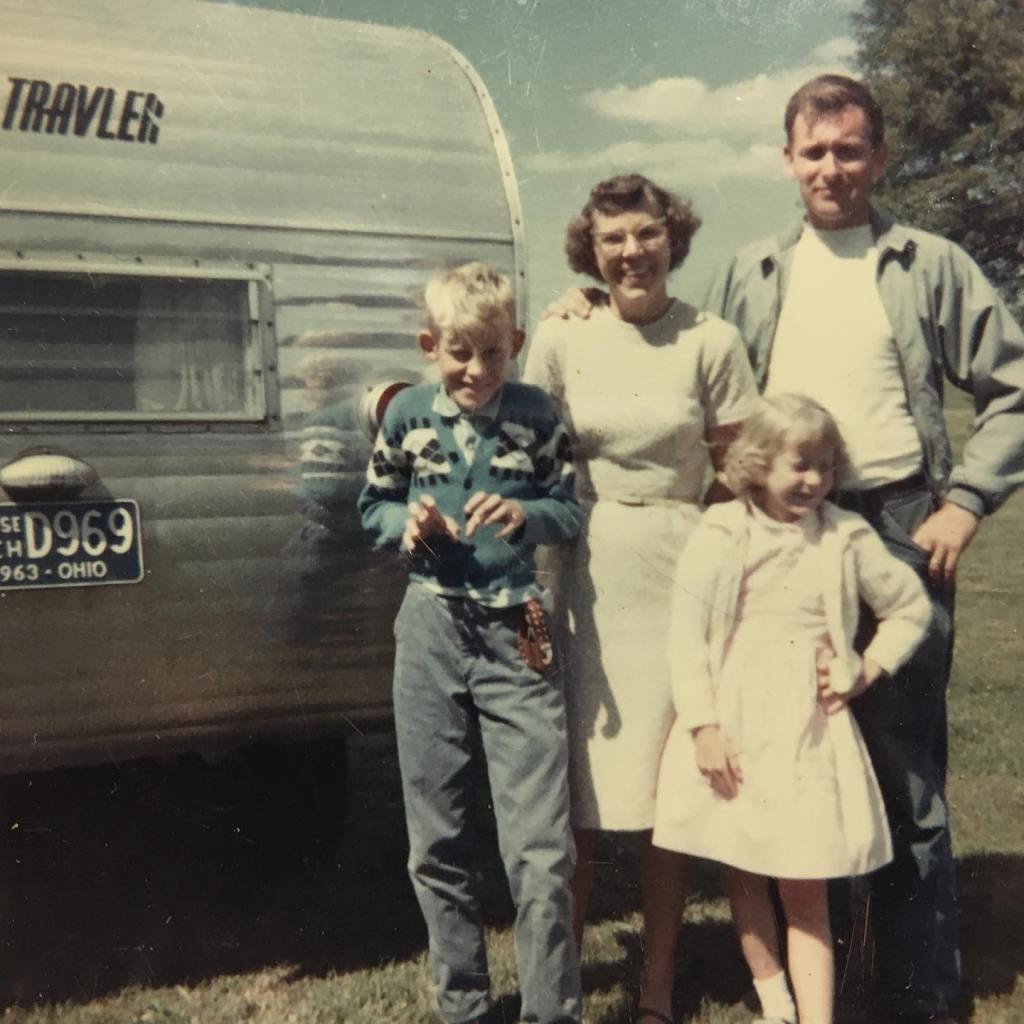
My father, Gary, Sr., was many things – a mechanic, mason, contractor, heavy equipment operator, truck driver, farmer, and agricultural mechanics teacher. He and my mother, Lois, were the right and wrong of my world. From both of them I leaned my work ethic, the value of patience, integrity and a drive to get where you want to go whatever the obstacles. Even since both have passed, I still hear them in my ear sometimes reminding me who I am and why.
My brother, Gary, Jr., is still a constant influence as well. He’s many things too – an architect, mechanic, #HVAC expert, welder, fabricator, truck driver, adult #education teacher, electrician, and a great deal more. Our age difference (16 years) put him in the position of second father. His goal was always to make sure I was as self-sufficient as possible. I’ve also had the good fortune to have him beside me at some of life’s most treasured and defeating moments.
Thanks to all of them, I am many things as well – mechanic, #electrician, truck driver, #heavy #equipment #operator, and a dozen other things. My education at #school was important but without the #mentorship of my #parents and #brother, life would have been a great deal more challenging – and not in a good way.
Who are your #mentors? If they’re still with us, thank them. Make sure they know how important they have been to the person you are today.
Xenia, Ohio – December 19, 2024 – Gail Matson, Executive Director of the Greene County FISH Pantry, is pleased to announce the appointment of Gery L. Deer to their Board of Directors. Deer brings a wealth of experience and a deep commitment to community service that aligns perfectly with the mission of the Pantry.
Gery L. Deer is the founder and creative director of GLD Communications, a marketing and public relations agency based in Jamestown. He is a contributing writer for the Xenia Daily Gazette and a recognized leader in the Greene County community, known for his extensive work in the fields of communications and community engagement. With a background in journalism and public relations, Deer has been dedicated to advocating for vital social issues and supporting local charitable organizations.
Gery Deer of Jamestown has joined the Greene County FISH Pantry Board of Directors.
“We are thrilled to welcome Gery to our Board of Directors,” said Matson. “His passion and enthusiasm for serving our community and his professional expertise in communication will help us enhance our outreach efforts and better serve our clients.”
As a board member, Deer will work closely with staff and volunteers to set policies, ensure financial health, and promote awareness of the Pantry’s services. His appointment comes at a critical time as the organization adapts to increased demand for food assistance services in the community.
“I’m honored to join the Greene County FISH Pantry Board of Directors,” said Gery L. Deer. “I look forward to collaborating with this talented group and supporting the mission of providing essential resources to those in need. Together, we can positively impact the lives of our neighbors in Greene County.” Deer also serves on the Dayton Area Chamber of Commerce Marketing Committee and is a founding member and communications chair of the Adult Patient Advocacy Council of the international Association of the Bladder Exstrophy Community.
“The Greene County FISH Pantry relies on the support of dedicated individuals and community partners to fulfill its mission,” Deer added. “With the help of our board, our dedicated volunteers, and the community’s financial support, the Pantry will continue making a significant difference in the lives of families in the region.”
To donate or for more information about the Greene County FISH Pantry, please visit our website at www.gcfp.org.
It is entirely possible that I spent too much time in this work writing about my parents. We have all had remarkable people in our lives, and my immediate family just happened to be some of the most extraordinary people in my life. With the holidays just around the corner, I wanted to relate a story that has almost become folklore.
The story begins in the late 1950s, sometime before I came along. My father was a machinist at National Cash Register, NCR, one of the largest employers in Ohio, if not the entire state. He also had what we would call side hustles. He would haul scrap metal to make ends meet, a good business when more efficient options were replacing the old cast-iron coal furnaces. Selling them for scrap was hard work but profitable. He also did concrete work and other odd jobs to help create a stable life for his family. To Dad, it was the kind of life he never had growing up in the foothills of the Appalachian and Southeastern Ohio.
While he was working, my mother raised her children, made a home for them all, and took care of the day-to-day operations of the household. She was one of the hardest working people I ever knew, even back then. But no matter how hard they worked, there were years when there just wasn’t enough money.
Around Christmas time, during a particularly lean year, the prospect of a happy Christmas looked grim. My brother was in Boy Scouts then, and my father was an assistant scoutmaster. Someone within the organization learned of my family’s financial difficulties. Shortly before Christmas, some people arrived at our house with food and gifts for all four. I remember my mother talking about it through tears as if someone had lifted them from a heavy darkness. She was eternally grateful, as was my father.
As the years went on, times got better for my family. Regardless of how little we had at any given time, I remember my parents always doing what they could to help those less fortunate. That brings me to Christmas of 1988.
That particular year, my dad learned of a nearby family that had fallen on hard times. The father had lost his industrial job, and the mother worked part-time while both did their best to raise their three small children. My mother immediately went into action.
Mobilizing the pre-Internet communications network within our family, she reorganized that year’s party into a relief event for the distressed family. With a little investigation and intuitive guesswork, my family collected information on the parents’ needs, clothing sizes, ages, and children’s interests. We even had people trying to find employment for the young father.
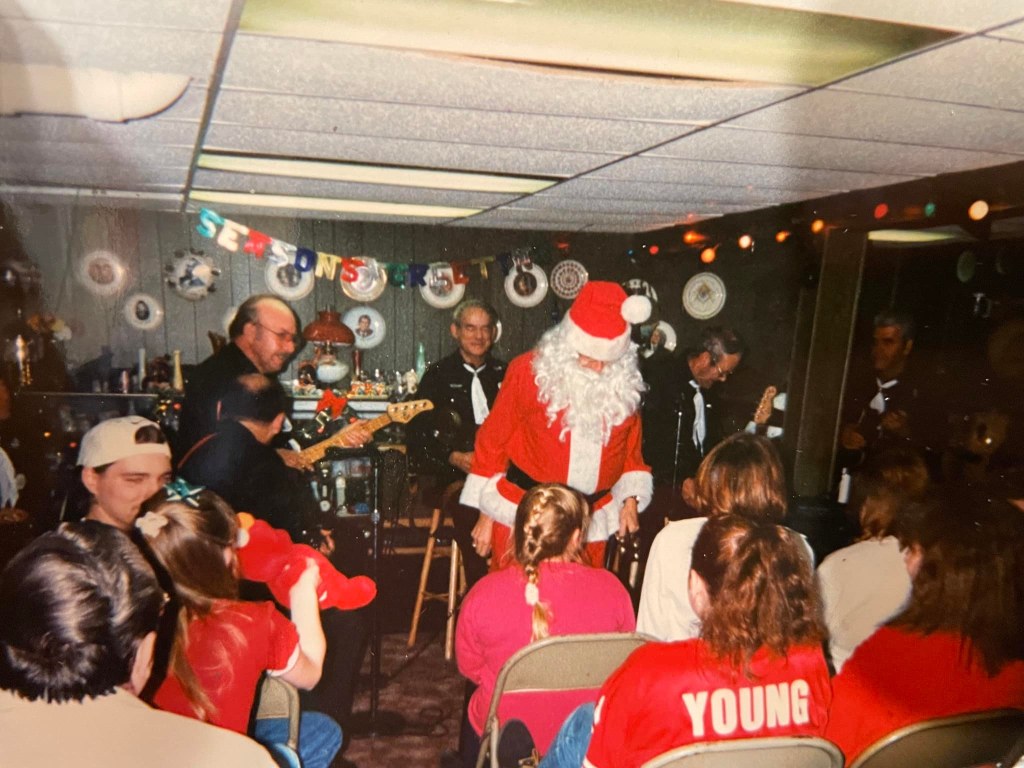
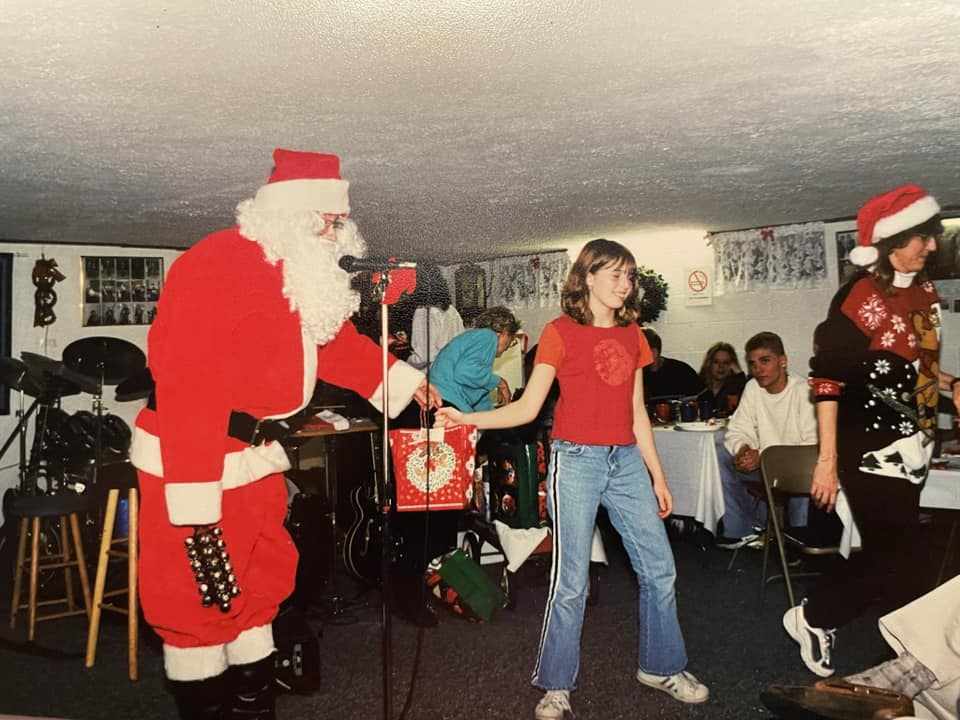
Our annual Christmas party, already a real show complete with music, songs, games, and dancing Santa, took on a whole new look. The price of admission was a donation. A list had been distributed informing everyone about what was needed and providing a way to let my mom know who was contributing what. With each person who arrived for the party came more toys, clothes, games, and food items. We even collected some cash.
On Christmas Eve, we loaded everything into a van, Santa riding shotgun, and headed for the family’s house. When we knocked on the door, we were greeted by a tiny three-year-old girl in a yellow onesie, a couple of toes poking out of the worn feet. She squealed away as she soaked in the sight of Santa Claus at her doorstep. To maintain the dignity of these hard-working people, there must be no clue where all this originated. My family were simply asked to deliver it to them.
My parents taught us by example. Kindness at the holidays should be the same throughout the year. Still, there is a gentleness during the Christmas season. We were under no illusions that a few gifts and boxes of mac and cheese would change the lives of this family. But at least, for one special holiday, they were together, safe, and they knew they mattered to someone. Sometimes, that’s enough to see you through the worst of times. Hopefully, we can all remember that year-round.
Author’s Note: A short story is based on my family’s charitable work. It’s called “A Special Place at a Special Time” and is available on Amazon. However, a revised version will be released shortly.
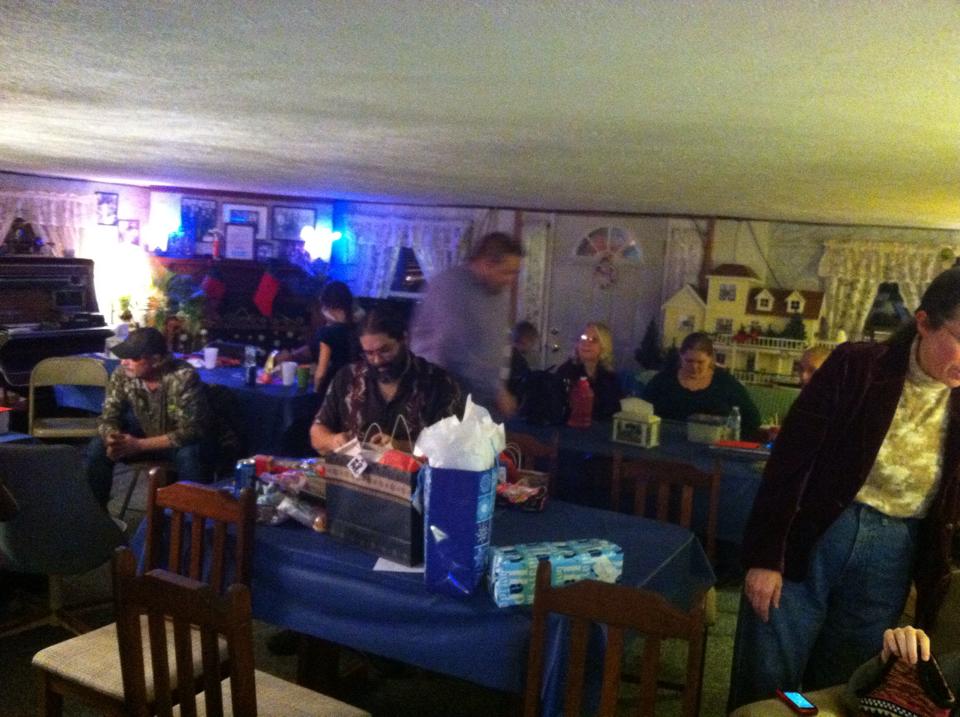
Gallery: The photos include pictures of the farm, the long lane that was decorated each year, Gary Deer Jr. as Santa and some of the later parties. Each one generated food, clothing, and other necessities for a local family. A few times, they were people in our own family – because that’s what you do.
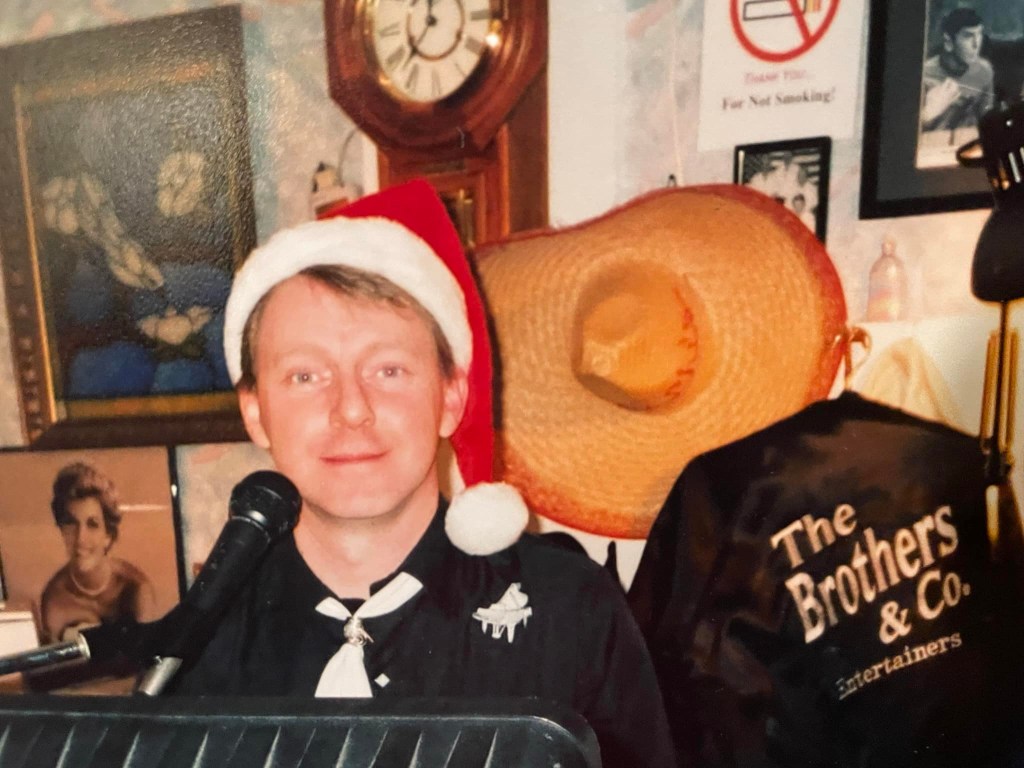
How the front of the farmhouse generally appeared at Christmas. The post that originally held the vegetable stand sign. This was taken in 2014 and is not photoshopped. It’s all real.The fireplace in “The Band Room” at the farm. The room was added because so ma ny people wanted to attend the Christmas parties.This is how the Christmas tree was arranged in our tiny farmhouse basement in the early days.The charitable parties eventually led to the creation of The Brothers & Co., our family’s band. We’ve performed all over the region at festivals, theatres, and even The Schuster Center.
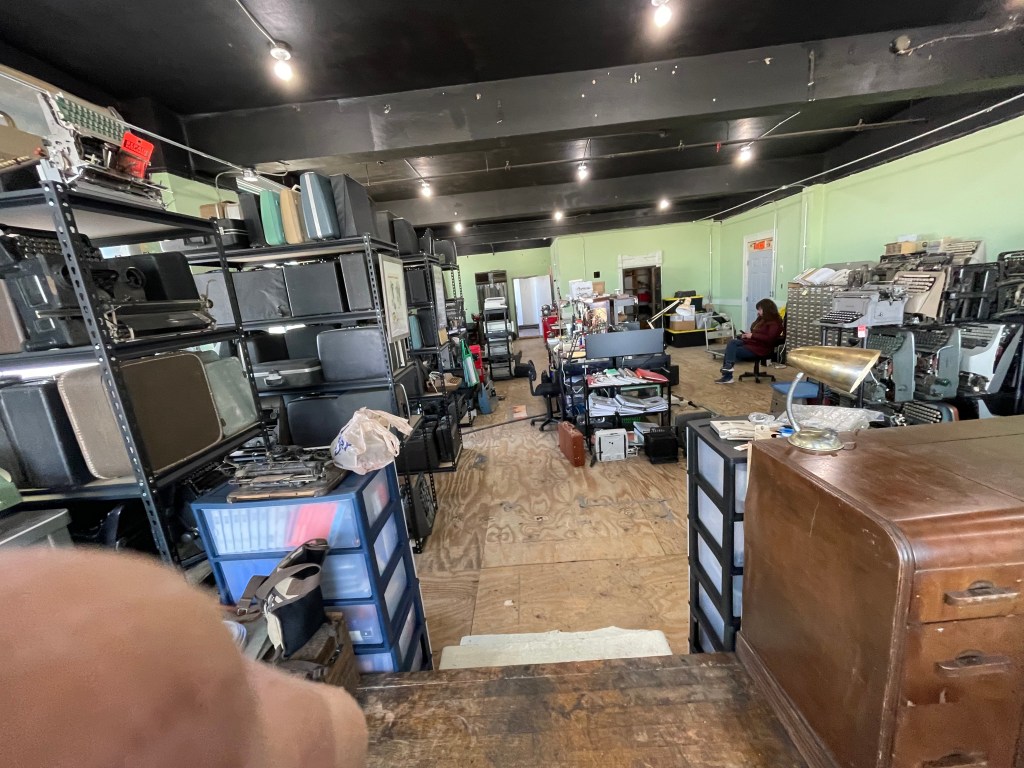
In a once abandoned sewing machine and bicycle factory on the corner of Linden and Davis Avenues, in an old, industrial section of east Dayton, Becca Brumfield carries cooler bags up two flights of stairs with two small children in her wake. At the end of a massive hallway on the top floor, they arrive at a door labeled “TB Writers Plus.” She taps a code into a keypad, an electronic lock opens, and the kids pop through the door ahead of her like prizes from a gumball machine.
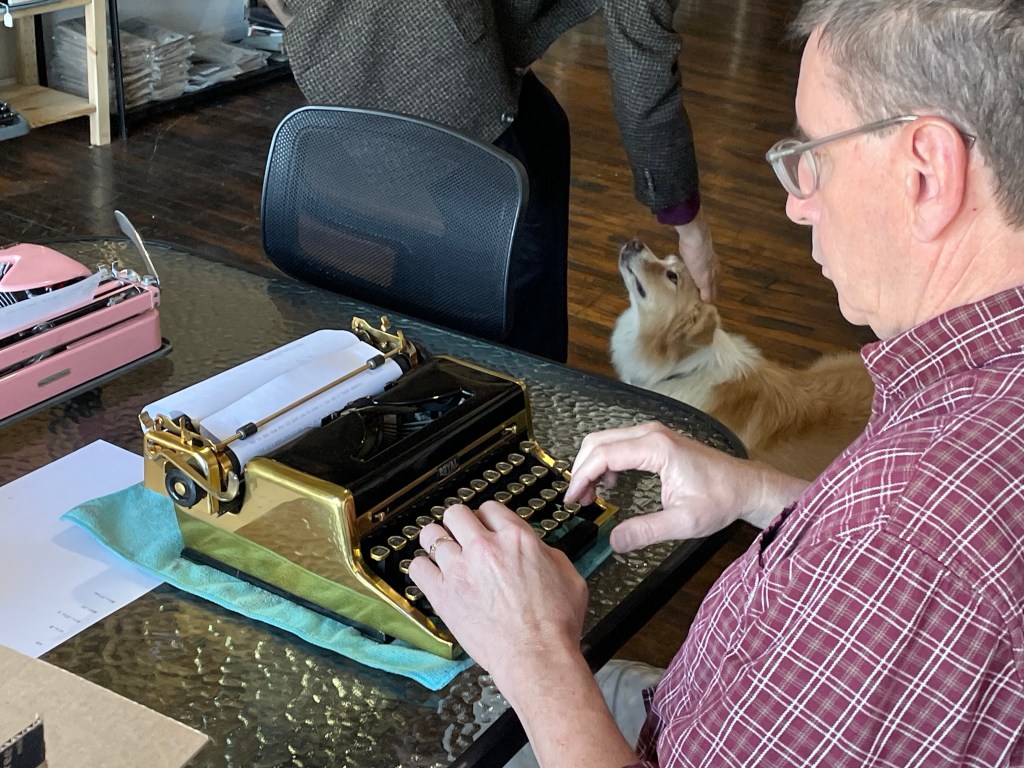
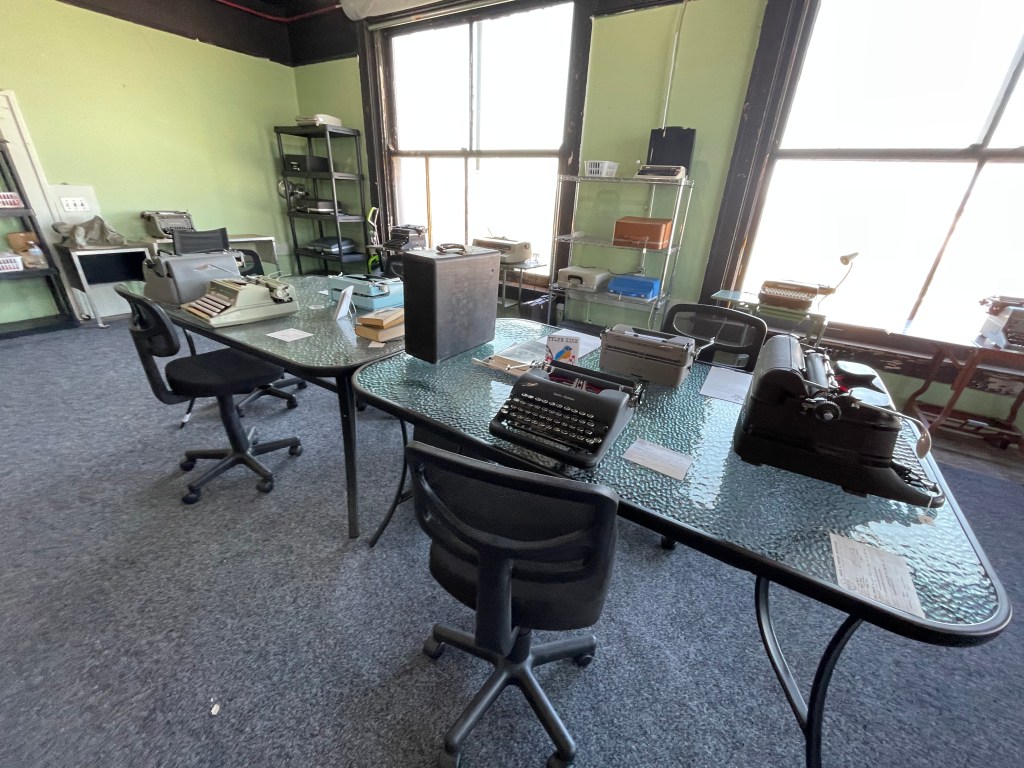
They pass workbenches and shelves loaded down with antique typewriters. On an elevated platform at one end of the room, a long glass table is flanked at one end by a floor-to-ceiling shelf of refurbished typewriters for sale.
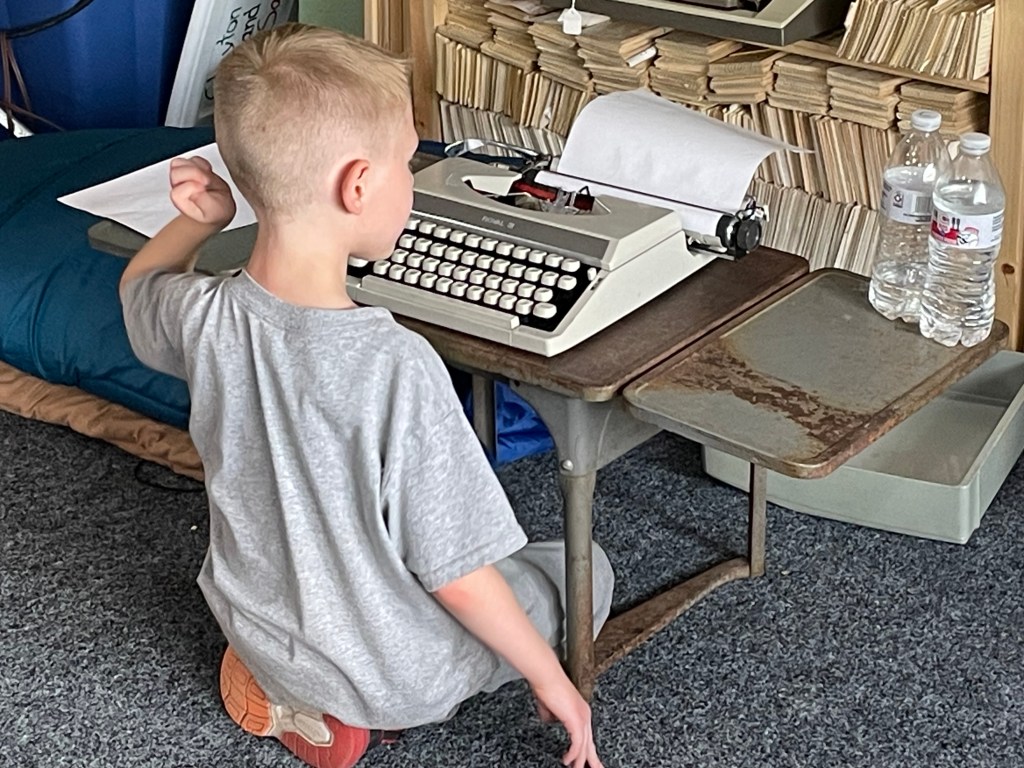
Becca lays out place settings and dishes up the food. Young Clayton, 6, and Sam, 5, who’d immediately started playing on typewriters and drawing, clamber to the table and plop down to eat. Her husband, Trevor, joins them. One of their employees sits down, too, and now it’s a typical evening at their typewriter shop.
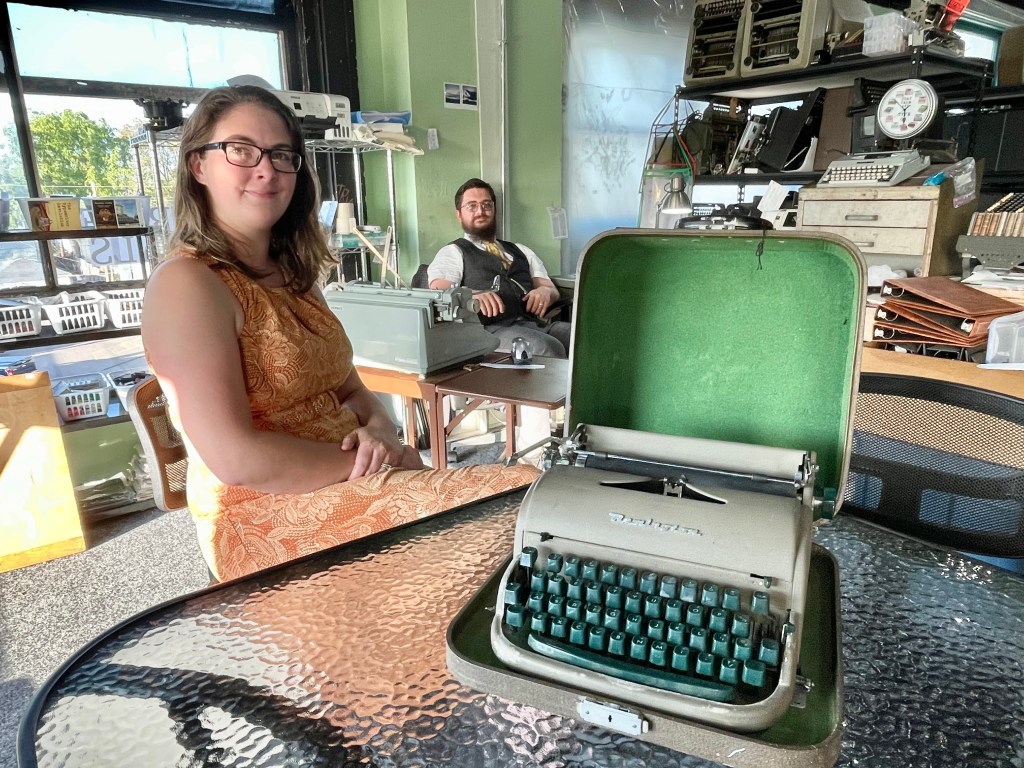
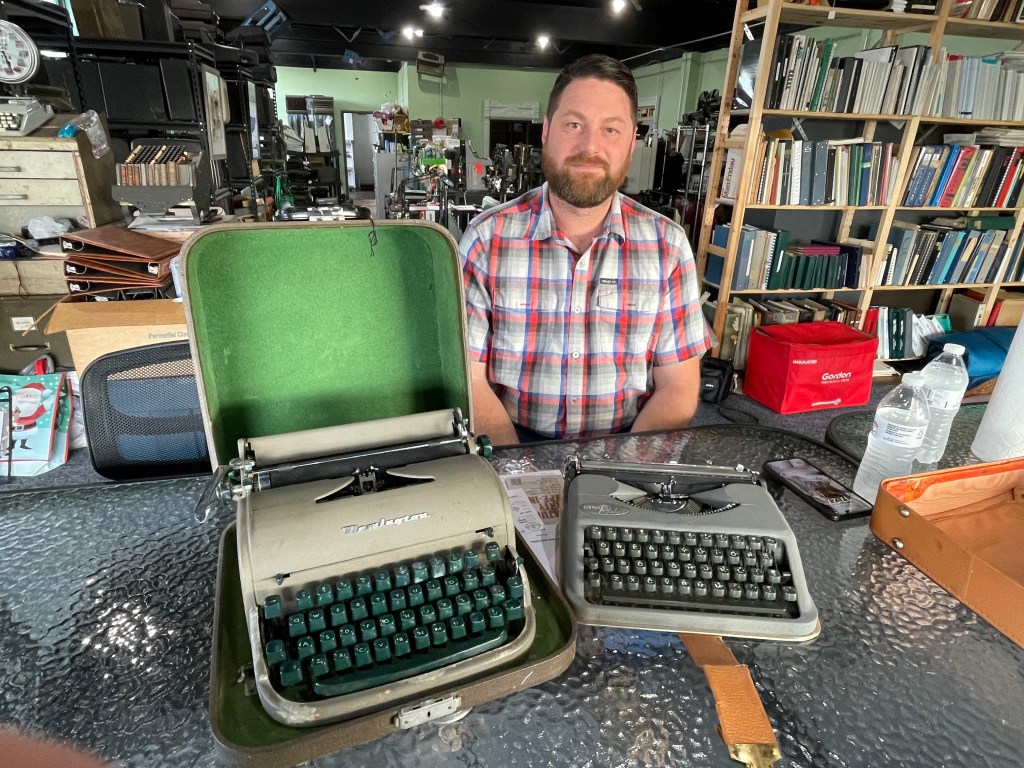
Becca and Trevor Brumfield at TB Writers Plus in Dayton, Ohio.
The Brumfield family started down this path more than a year ago when Trevor bought a typewriter online, repaired it, and started using it. Before long, he lost it to his wife and, as he puts it, “Naturally, had to buy another one.”
“That turned into several more, which became 60, which turned into 100, and that became, I gotta sell some of these,” Trevor laughed. A full-time auto mechanic, it might seem odd for someone just 26 years old to start down such an arcane career path.
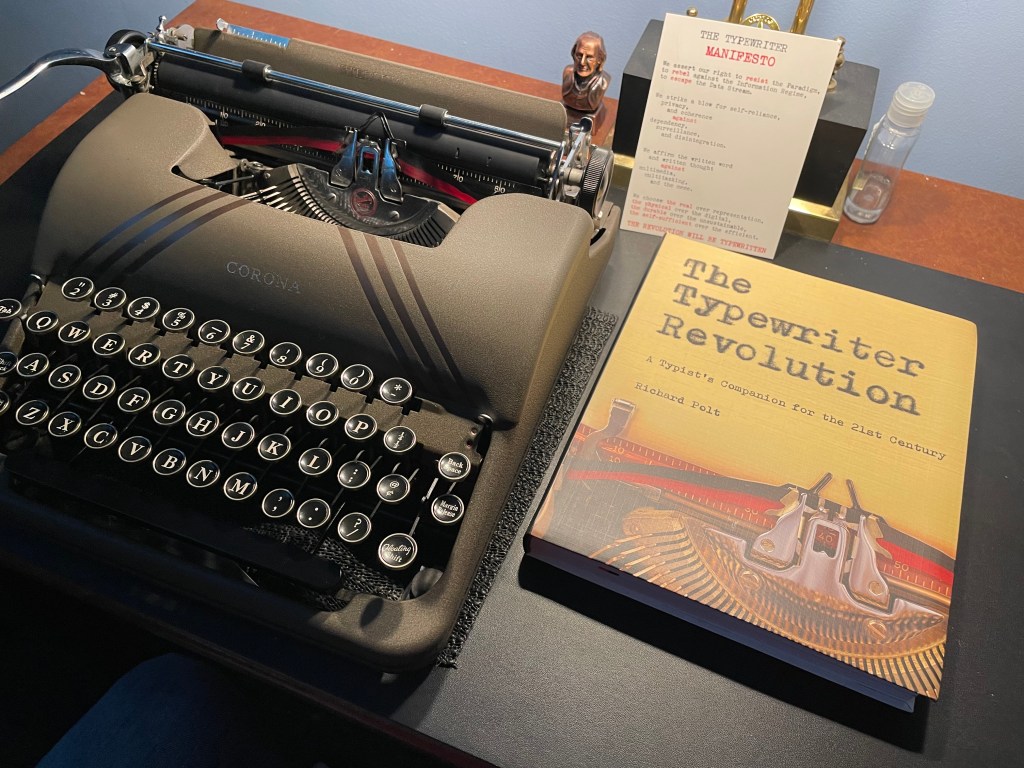
Over the last twenty years, typewriters have seen something of a renaissance. Fueled first by internet insecurities and one enthusiast’s declaration of a “Typewriter Insurgency,” writers, artists, business professionals, and college professors continue challenging the digital paradigm. “It’s not a booming industry,” Trevor admitted. “But the interest is there, and business goes in waves.” The industry got a secondary boost from the recent Taylor Swift video, “Fortnight,” which featured the megastar with an old Royal 10.
Taylor Swift’s Royal 10 in ‘Fortnight.’
Swift had them as props, but a few famous people are actual typewriter fans and users. Most notable is Tom Hanks, whose collection and passion for the machines are well known. The exposure has helped Trevor’s shop steadily grow. “I’m not sure exactly how many machines we have serviced in total,” he said, noting the expansion from his home garage last year. But we can typically get through 30-50 machines a month depending on what needs to be done to each.”
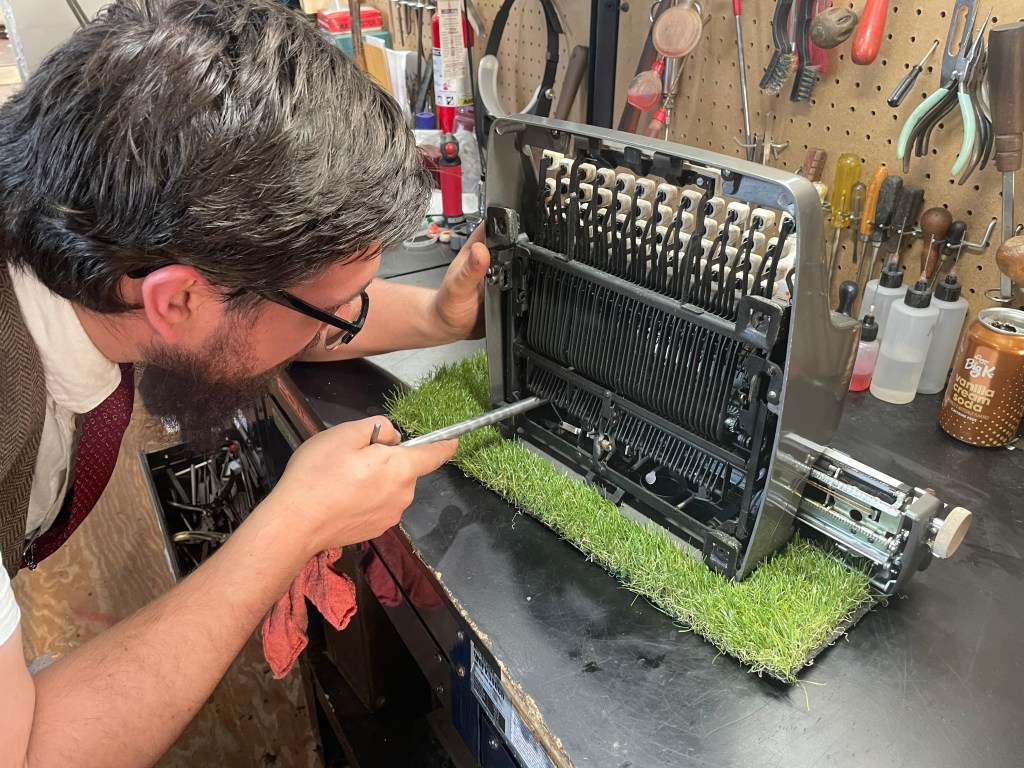
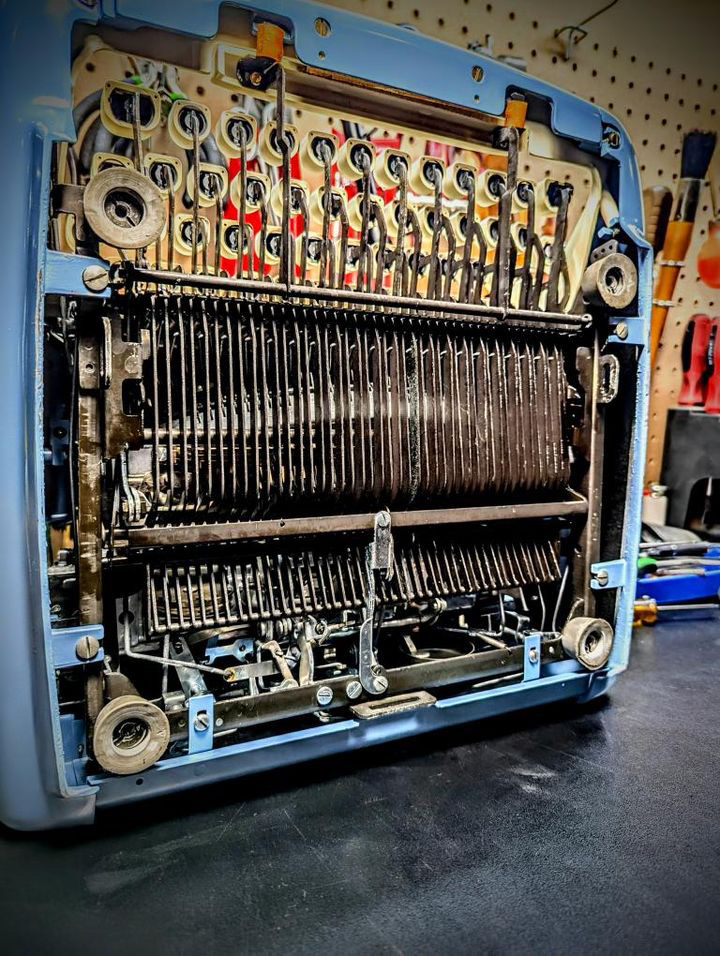
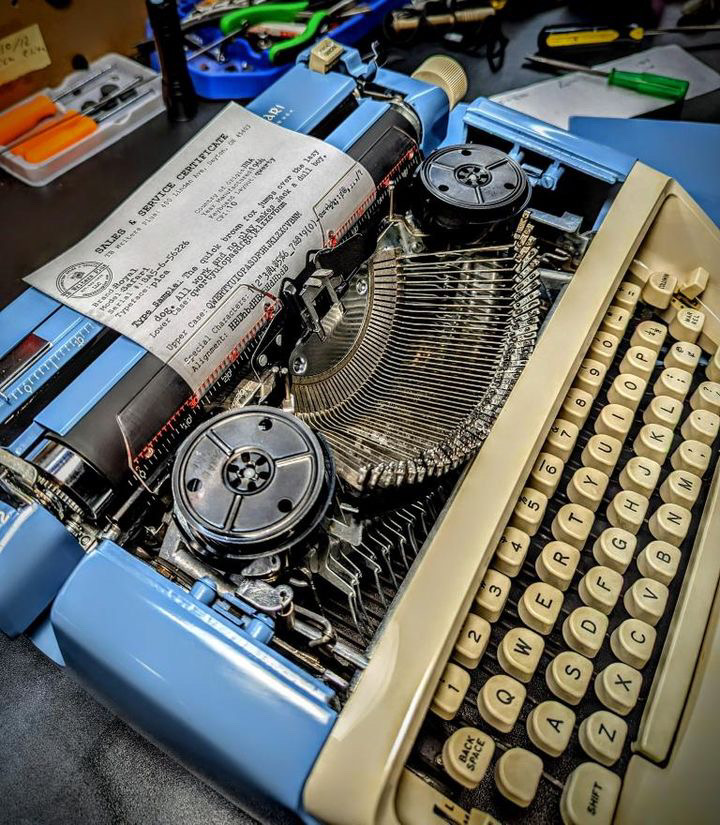
At last count, TB Writers Plus has inventoried more than 600 machines. Many are cannibalized for parts, and others are refurbished for sale. Trevor does the bulk of that work but has also trained Becca. An atmosphere of learning and openness permeates the shop. No organized training program exists, and factory training was discontinued years ago. Everyone who works here is an unofficial apprentice.
PART II – HE DOESN’T DO IT ALONE
Three part-time employees, Tyler, Keenan, and Torii, have been learning on the job, guided by Trevor’s experience. Each tackles the intricacies of these incredibly complex machines in their own way.
Tyler Lewis, of Fairborn, began as a technician in November 2023. “I mostly refurbish and repair, taking apart the machines, cleaning them, and putting them back together.” He learned about TB Writers Plus from an article in a local zine. A zine is, in his words, “An underground, independent magazine that people publish usually by using copy machines.”
Tyler should know since he’s the primary writer and publisher of his own zine, appropriately named “Tylerzine.” He was working at the Wright State University college newspaper and pitched his own article idea. “I met Trevor, immediately liked his openness, and ended up hanging out that first day for like six hours,” he said.
He sits at a typewriter loaded with purple ribbon and cranks out a short poem based on a prompt suggested by someone else in the room. Tyler’s passion and personal brand of artistic expression suit the typewriter world. “My entry point has always been the literary aspect of typewriters,” he said. “I am a devout believer in language, so what typewriters represent as a means of expression greatly appeals to me.”
Technician Keenan started as a hobby when Trevor was still working out of his garage back in 2023 but took some time off for school. The 28-year-old Kettering resident came back in May of this year. “I wanted to learn more about how typewriters work, and it was an enjoyable way to spend my time,” he said.
“I enjoy the simplicity of the process compared to modern technology that feels invasive at times,” Keenan explained. “It’s just a simple typewriter on the workbench that needs fixing. Nothing more, nothing less.”
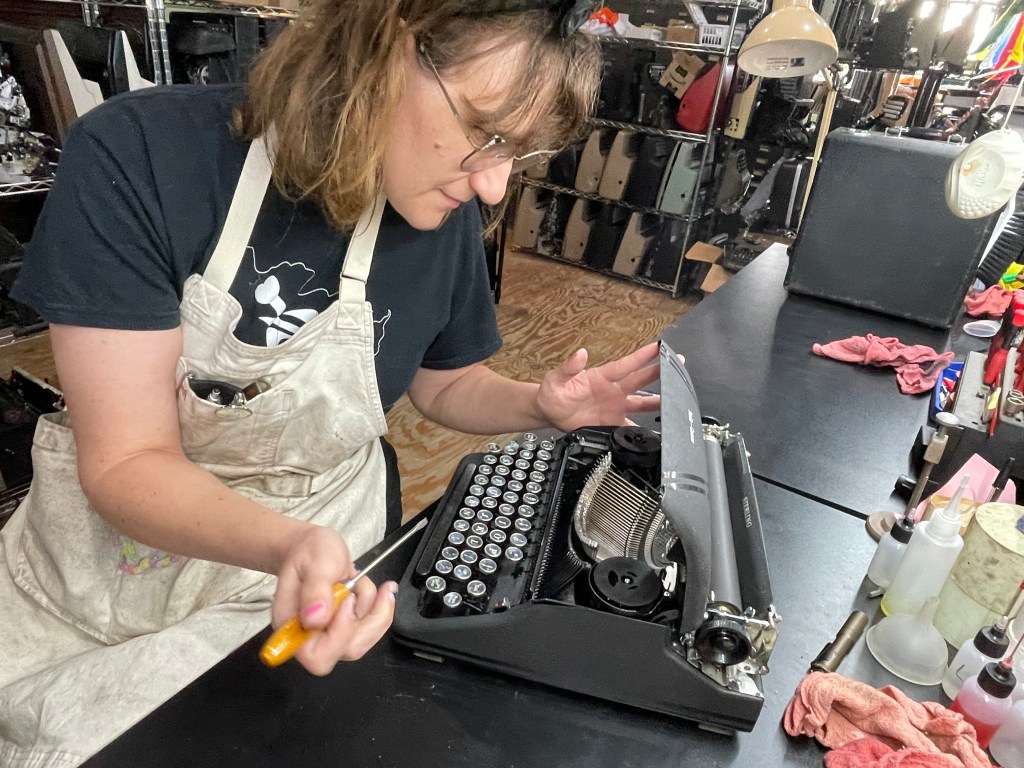
Tori’s B checks out a 1930s era Smith-Corona manual.
At the workbench, technician Torii B, from Bellbrook, hovers over an antique Smith-Corona. She scrutinizes the machine, evaluating any repairs needed before it’s put up for sale. Torii is a 36-year-old marketing and design professional and working mom. Although she has freelance design clients, she left a full-time marketing job last May. She’s applied for permanent positions in her field, but nothing’s been a good fit so far.
About a month ago, a friend told her about an anachronistic typewriter repair shop whose owner sought part-time help. As it happened, she and the friend have a role-playing game involving type-written note cards and the adventures of two fictional journalists. Her interest peaked, she reached out to TB Writers Plus, and before long, she signed on as a part-time tech and general worker.
Her diverse background fits this very mechanically oriented job. “I went to school for visual communications,” Torii said, pausing momentarily. “But, before that, I studied mechanical engineering.”
“I like the physical act of working on the machines,” she explained. “Watching the machines move keeps my mind like a well-oiled machine. Each one is like solving a puzzle.” She points to three small containers, each filled with tiny machine parts, springs, levers, and knobs. Her task is identifying and cataloging them for future repair work. It might seem tedious, but there are no more typewriter parts in production. Every part salvaged is vital to the shop’s operation.
PART III – THE TYPEWRITER COMMUNITY
A team can only function well with good leadership, and this one is no different. Trevor is doing his best to help his crew find their way. “Each works a little differently than their coworkers and has their own skill set,” he said. “Tyler is really good at detail-oriented work. Keenan’s strength is getting a lot of work done quickly. Torii is still finding her place in the shop,” Trevor continued.” She’s helped us with inventory ideas and graphic design and handles other odds and ends around the shop.”
Trevor Brumfield adjusts a 1955 Royal Quiet De Luxe.
Trevor’s interests and skills are well-suited, and he clearly enjoys this work. But what he likes most about the job is the people. “All of our customers treat my shop like a safe haven. I’m not sure why, but people drop their guard when they walk in here,” Trevor explained. “We’ve heard some crazy stories from people; war stories, childhood traumas, business plans, just about anything you can think of.”
“We have customers that will leave work in the middle of the day just to come here to vent because they are having a bad day. Next thing you know, they’ve been here for 3 hours, and their boss is calling.”
Brumfield’s modesty won’t allow for his own kindness and personability as reason enough for people to gravitate to him and his family. “I don’t know what it is about this place that makes people feel so at home, but I don’t think it is just me – or any one person here. But as soon as they walk in, they get this look like they just had a weight removed from their shoulders.”
Customer and typewriter enthusiast, Greg Parker, of Urbana, Ohio, with two of his growing collection.
TB Writers Plus customers are an eclectic mix of artists, collectors, and businesspeople from all over the country. Greg Parker, for example, is from Urbana and has purchased three typewriters from the shop. The 40-year-old, married Army veteran has been collecting typewriters for about ten years. He currently has seven, including two Royals, an Underwood, and an Olympia. He explained his interest in the machines is mainly about the experience.
“I grew up with typewriters and used them when I was young,” he said. “But I really like the aesthetics.” Parker’s not a writer or artist but a welder by trade. “I do some journaling, and I have some memoir stories I’d like to put down on paper someday,” he said. “But I feel like I was born too late, like in another time. I enjoy the mechanics of the machines. The sound and the feel are very different from a computer. When you type something on paper, it’s like you really created it yourself.”
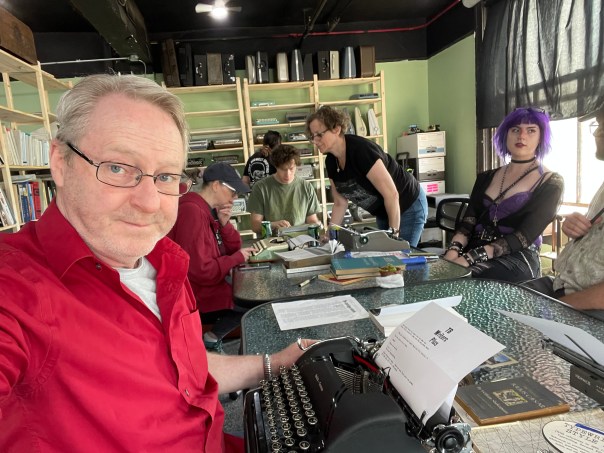
“Type-ins” attract enthusiasts from all over the country for a common purpose. TB Writers Plus has hosted several, including a costumed Halloween event and a 4th of July fireworks type-in.
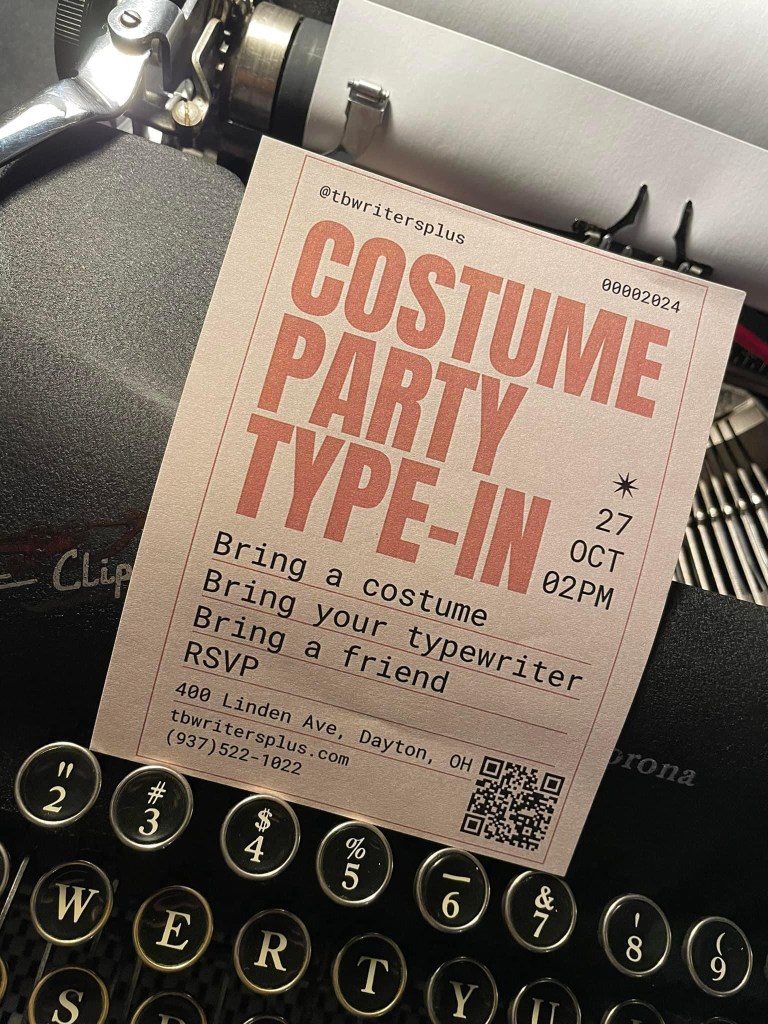
Creativity and the personal connection with a simpler time is common throughout the typewriter community. For example, on Sunday, October 27th, TB Writers Plus is hosting a costumed “type-in” event, encouraging people to come dressed in the same era as the typewriters they bring. Type-ins are most easily explained as cruise-ins for typewriter enthusiasts. Scattered around the country, these predominantly social events, provide the opportunity for aficionados to talk typewriters, socialize, and even do some typing.
Back at the dinner table, the boys are no longer interested in their meals and require some encouragement. Trevor digs into his food as he and Becca talk about their day. Eventually, they would like TB Writers Plus to be independently sustainable as afull-time career. For now, they, their crew, and, of course, Clayton and Sam, are enjoying the work and the people who share in the simplicity and resurrection of a by-gone era. To learn more, visit www.tbwritersplus.com.
Author’s Note 1:While researching this article, I had the good fortune to meet many of the shop’s customers and supporters. The loyalty they seem to share is remarkable, not just for the typewriter community in general, but for Trevor and his staff in particular. I want to note, for the record, how honored I am that they welcomed me into the circle. It’s truly an amazing community.
Author’s Note 2:While typewriter shops are still operating throughout the U.S., their numbers are dwindling. Trevor Brumfield has been buying out the inventory, tools, and parts in an effort to stay ahead of those closings and keep up with demand.
Author’s Note 3:Update August 2025 – As of this date, TB Writers Plus has expanded its footprint in the Davis-Linden Building. The shop now includes a larger typing and show room, community space, equipment washing room, additional storage and much more. They’ve also seen a change in personnel in the past year.
Without question, 2024 has been and will continue to be one of American history’s most charged and controversial election years. Among the points of contention is the continued argument regarding the necessity – and validity – of the Electoral College.
Political operatives and pundits alike have been outspoken on the subject from all political viewpoints. There seems to be no consensus because, quite frankly, even some government officials don’t understand its purpose. So, before I give you my thoughts, here’s some non-partisan history.
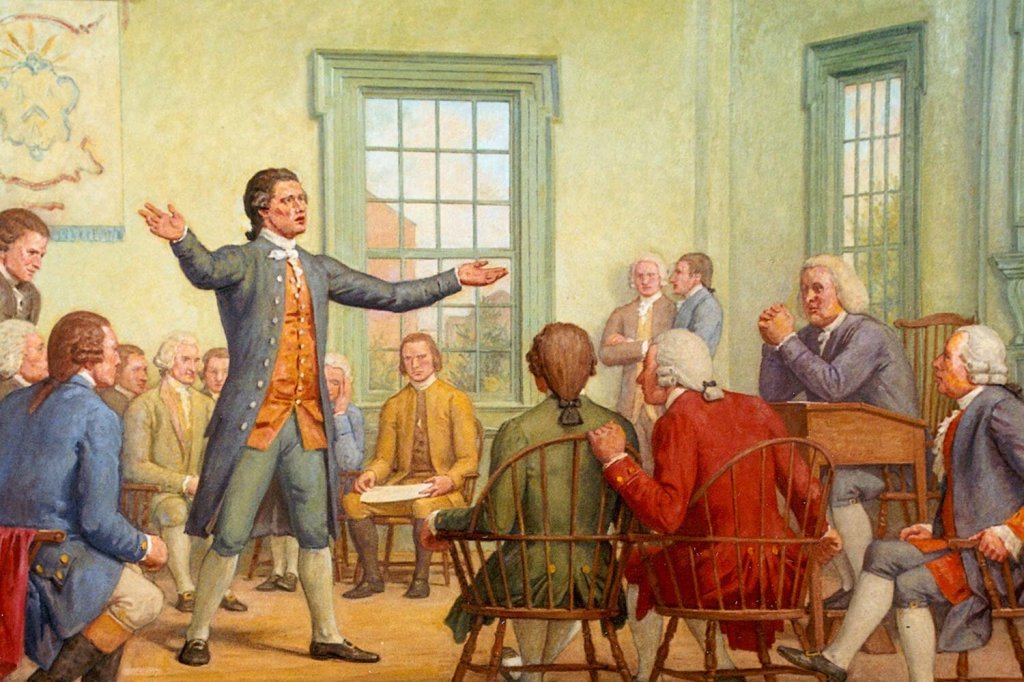
During the first Constitutional Convention of 1787, a significant debate unfolded about the method of electing a president to lead the executive branch of our newly established government. It was a pivotal moment in our history after the decision to have a single individual in the office rather than two or even a triumvirate. Just imagine the complexity of electing three people every four years.
The primary issue was whether a congressional vote should elect a president or do it by popular vote. The latter eventually won out until the smaller states began to weigh in, concerned that those with a larger population would wield more control.
Another lesser-known concern was that the political elite of the time were worried about a mass of uneducated voters swaying the results. Discussions continued for several months until, one day, in a closed-door subcommittee, James Madison laid down the concept for what became known as the Electoral College.
Enacted as a compromise and safeguard, Article II of the U.S. Constitution (later the 12th and 23rd Amendments), as well as the Electoral Count Act (ECA) of 1887) formally established the Electoral College. These laws regulated the voting process and defined the events between Election Day and the Inauguration.
Now, to clear up some misconceptions. Regardless of rhetoric to the contrary, I assure you that the Electoral College is an entirely democratic process. It is not, however, easy to explain. But I’ll try anyway (insert a deep breath here).
In a presidential election year, the political parties hold conventions where they nominate “presidential electors.” That’s simple enough to understand, but hang on. Here’s where it can get… confusing.
When a party’s presidential and vice presidential candidates win the popular vote, that party’s electoral nominees become “Electors.” Each state has the same number of Electors as members of Congress, and each Elector votes for their party’s ticket on separate ballots – one for president and one for vice president. So, your individual vote is still vitally important because the candidates cannot earn Electors without it.
For example, if Richard Nixon and Barry Goldwater (president and vice president, respectively) won the popular vote in California, the Republican nominees from that state would become Electors and cast their votes to the Electoral College. Once all the electoral votes are cast, the candidate who reaches 270 out of a possible 538 wins – and this is only triggered if the candidates win that state’s popular vote in the first place.
In the news, the results sound something like this: Nixon has won California and its 54 electoral votes. Of course, those results still have to be certified. As you might recall, there was a slight hiccup during the 2020 election certification. However, new security measures have been taken to reduce any potential repeat of those terrible events.
Remember, this is just a glance at the process, but I hope it helps. If it’s still puzzling, a good analogy is Major League Baseball’s World Series. Every year, the winner is determined not by which team got the most runs per game but by which won the most games in the series. The Electoral College works the same way.
In my opinion, the Electoral College is the only practical, efficient, and fair way to ensure everyone’s voice is heard because we’re represented just as we are in Congress. The Founders realized that the popular election alone could and would eventually bring chaos.
If we want an election process that stays in constant contention, then eliminate the EC. But if we’re going to have all our citizens represented equally, let the system do what it was designed to do. If you want to make a real difference, make sure you vote.
Deer In Headlines Special Edition – October 14, 1993
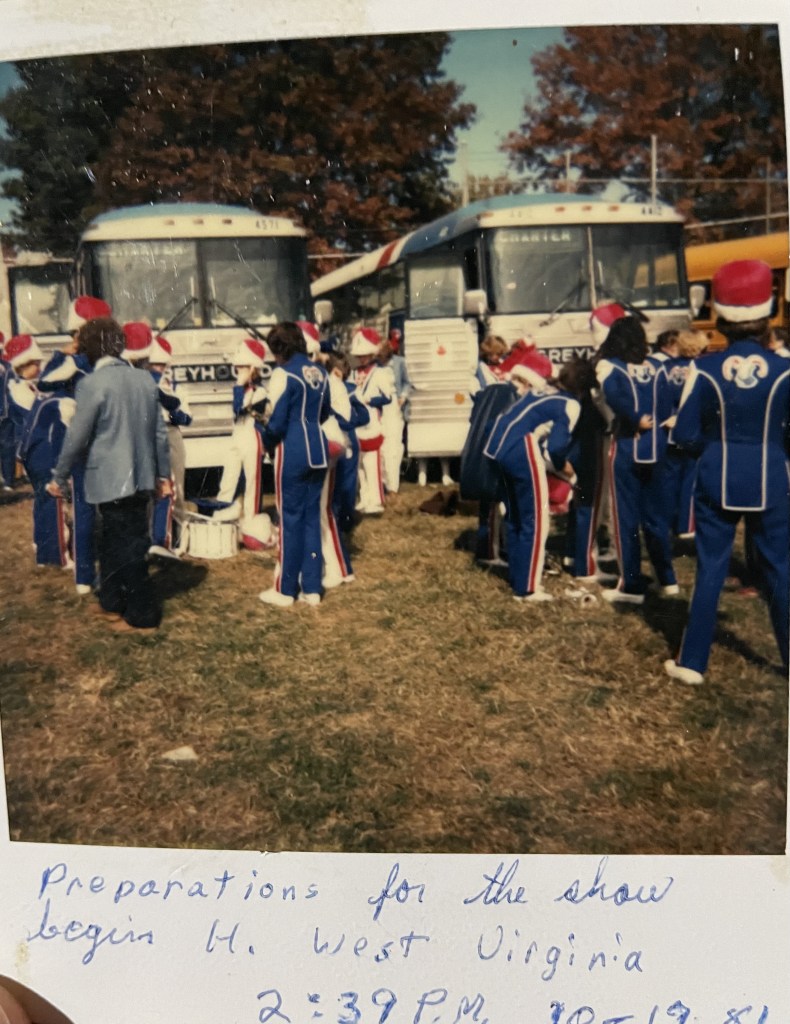
It had been a long day for the freshman saxophone player and his high school marching band friends. By now, it was 4:30 in the afternoon, and the day had begun for them nearly eleven hours ago. They’d earned the opportunity to compete in a tri-state marching band competition in Huntington, West Virginia, some 200 miles from home.
The mid-October afternoon had become hot and muggy. Even the seats in the stadium were perspiring. The adventure had begun early that morning with all the spirit of the world’s most excellent universities. The performances were over, and they sat impatiently awaiting the judging results.
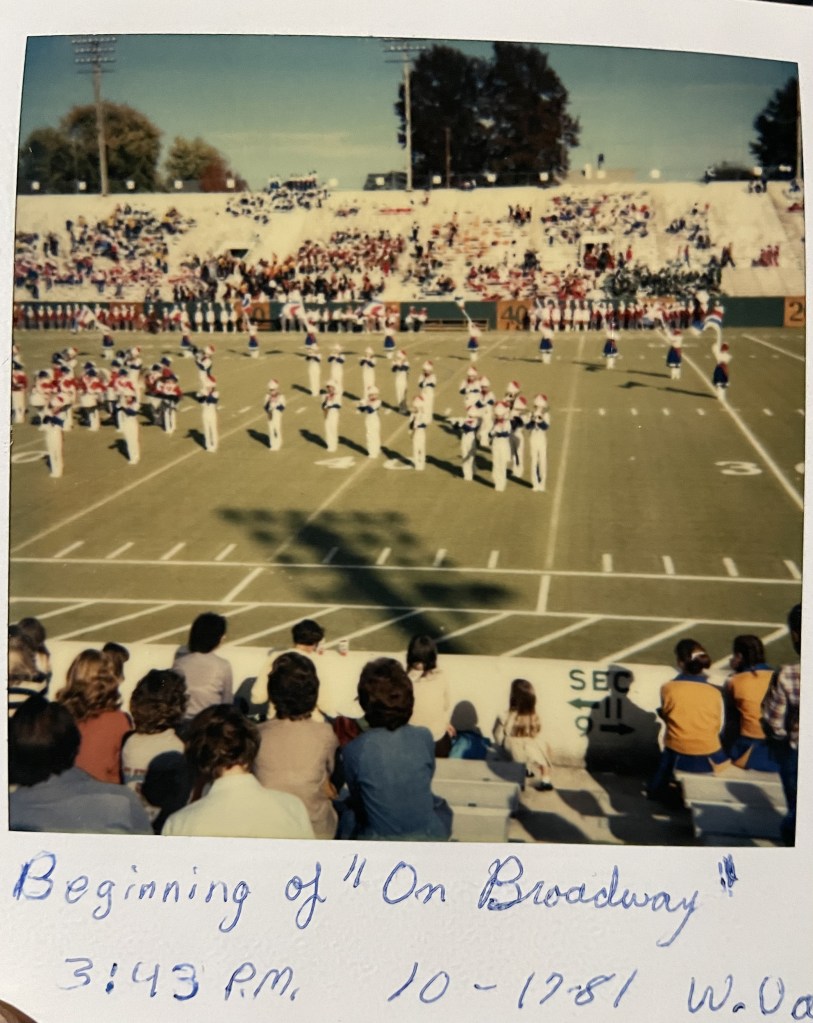
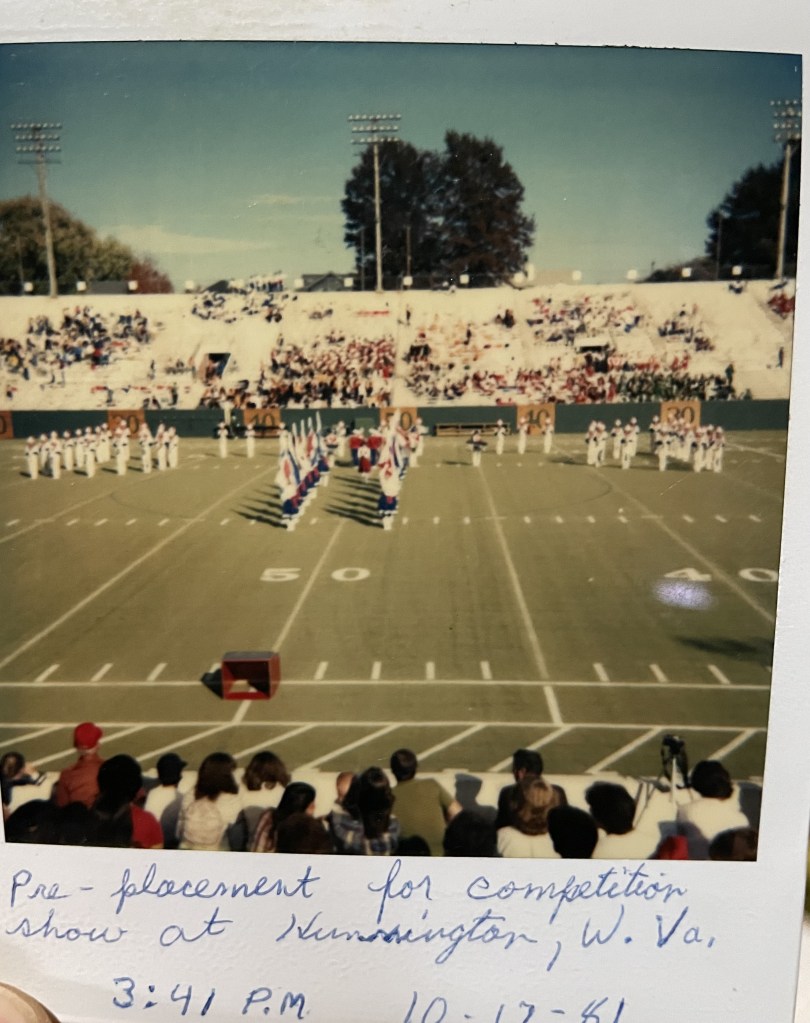
This is the view of the real Greeneview High School marching band during their first song of the contest—from the families’ perspective. (Photo by Lois Deer, 10-17-1981)
The bands were divided into three classes based on the size of their home schools. This group’s small, rural high school was in the last division, called class B, at this show. That meant it would be a long, hot wait by the time they went through each division, of each class, of each award. It was nerve-wracking, it was hot, and it was discouraging, but they waited. Patiently – well, sort of.
The university stadium buzzed with nervousness and emotion as the first awards were called. “Fifth place, class AA, goes to…,” A loud cheer bellowed from 100 yards down the bleachers, drowning out the anxious and irritated sigh from the young saxophonist and his group. The noise subsided. The announcer spoke again. “The fourth-place award goes to…” Another excited cheer came from the stands. The little band had worked hard all summer for this. It was one of the best shows they’d ever done, but this performance got off to a shaky start.
Their arrival at the host stadium was almost the exact time they were supposed to go on the field for their practice run, and things were rough. Heat exhaustion cost them one of the flag corps at the start of their competition show. The Astroturf-covered football field, new to most of the marchers, created its own set of problems. These kids were used to trotting through mud and grass. Now, wearing the slick-souled dress shoes, they had to contend with spongy ground and slippery artificial grass.
If that wasn’t enough, one of the trombone players nearly decapitated a field judge with his slide. During his morning pep talk, the director said, “Judges were fair game…” Meaning, if they got in the way, just keep doing what you’re supposed to do. Unfortunately, the aggravated trombonist took the recommendation literally. Somehow, they got through it all, and there they were. Hot. Sticky. Impatient. Every ingredient was added to create a group with a bad attitude, who, by this time, faintly resembled people sitting in a traffic jam.
A lot was riding on this, though. Everyone was here. Parents and family friends had accompanied the band on the four-hour Greyhound bus ride that morning. The busses pulled out of the school lot at 6 a.m., scored by the groans of how you’d expect average high school kids to at that time on a Saturday morning.
Most slept on the ride down. Many brought weekend homework. Others reviewed their music to ensure they remembered that one bad note at the football game the night before. Whatever the case, they made it, and everyone was pumped. And a little scared. Friday night football games were never like this. The tension grew and hovered in the air over the little group just the way that bricks don’t.
The young saxophonist eyed the band’s director. He was down on the track on the opposite side of the field, pacing back and forth in front of the reviewing stand like an expectant father. Another announcement blared from the public address speakers. The director’s curly afro hair and kinky beard glistened in the fall sun with impatient perspiration, giving him more the appearance of a heavy metal rock singer than a high school band director.
Then again, everyone was starting to look like that. The group grew increasingly discouraged with each passing award. The announcer was up to their class now, and the fourth-place award was called. Rats! The saxophonist slumped back against the bleachers with an irritated gasp. So did everyone else.
“There’s no way, ” he thought. “All these huge bands from three states? We can’t possibly have a chance at anything higher than fourth.” That seemed to be the general opinion of the others as well.
Another award. More cheering. None of it from them. Now, the announcer was up to second place, and the morale-broken musicians began standing, a few at once. Each gathered their things to return to the busses and the quiet little farm town. Some had already left the stadium.
“Well, so much for that,” someone said. “This is embarrassing, ” said another, like a line plucked from a Peanuts cartoon. Even their band director dejectedly headed towards his disappointed students. The announcer began to speak again, but no one in the group was listening. It was over. They tried, but the odds were against them, and the game was rigged.
“Second place, class B goes to…” A long pause.
This seemed to be the announcer’s annoying trademark, meant to instill drama. It didn’t work. It was just irritating. When their band took the field for the show, he sounded like he’d been mugged midway through his address. “You may take the field for comp…” Everyone held their breath. “…etition.” Whew!
Suddenly… the words no one expected to hear. No, more than that. They were impossible, improbable, incomprehensible words.
“Second place, class B goes to… Greeneview High School Marching Band from Jamestown, Ohio!”
For a solid breath, someone blinking would have rung like a gong. No one moved. No one spoke. Those shambling out stopped and turned around. There was an oxygen-steeling collective gasp.
A slow, quiet calm settled over the group as their brains processed the words they’d just heard. Suddenly, explosive screams of joy shattered the silence. They cheered, cried, and hugged. In the stadium section where their families were, everyone was on their feet, jumping, crying, and yelling. Even the other schools called cheers of congratulations, and they were equally shocked by the news.
The little band’s director stood in silent shock for a moment, and then it hit him. His eyes were as big as saucers when he turned to face the band from across the field, raising one arm in victory to them as if this little band’s second-place win were Olympic gold. It might just as well have been, but that wouldn’t have meant as much to them.
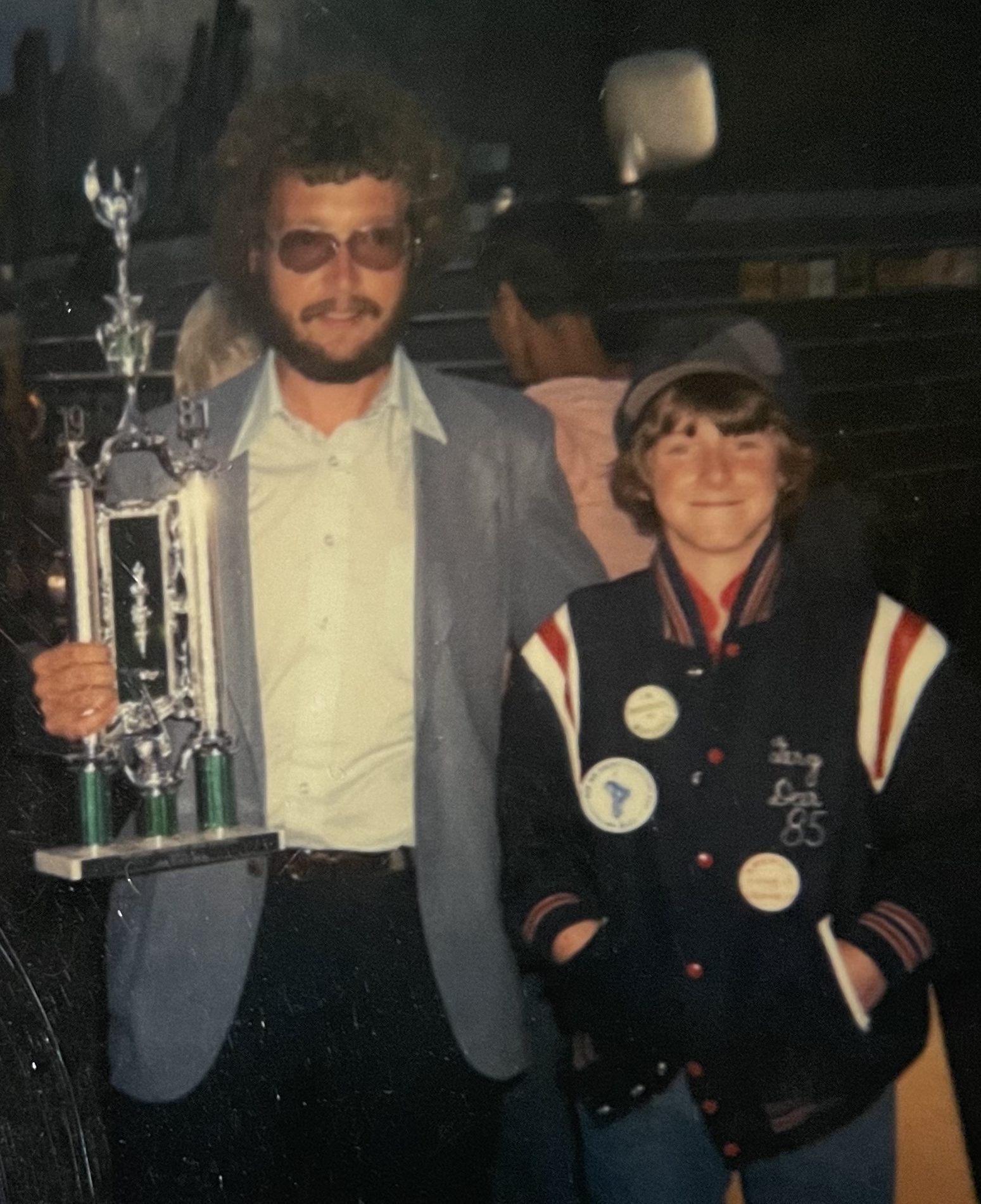
At the reviewing stand far below, their field commander and flag corps captain proudly marched to the awards table and saluted the presenters. Their vibrant red, white, and Colombian blue uniforms were almost as brilliant as the sun itself as they spun around in a military-like snap to salute the ecstatic audience. The pair accepted the two-and-a-half-foot trophy and rejoined the line of representatives standing at attention in front of them – both in tears.
Back in the stands, the young saxophonist and his friends watched and beamed. This was truly their most honored time together. The young man shaded his eyes as he took a moment to look at these people and tried desperately to soak it all in before it was over. They had no idea what they meant to him. So much of their lives lay before them. But this day… this was a day they’d never forget. “Someday, this is going to make a great story,” he thought.
The bright sunlight brought a tear to his eye. Then again, maybe it wasn’t the sunlight at all. He wiped it away. The thundering applause, congratulations, and excitement continued for what, in reality, was only about a minute or two. But it wrang out for what seemed like a lifetime to… The Little Band That Could.
———
Epilogue
My name’s Gery Deer, and that’s a true story from October 17, 1981. I was the “young saxophonist,” and I was right. I never forget that day, and it did make a great story. The band, Greeneview High School Marching Band of Jamestown, was under the direction of Richard Turner.
Band Director Richard Turner, the contest trophy, and me – Gery Deer in my newly-minted Greeneview school jacket.
I wrote this story after visiting Cooper Stadium in Columbus, Ohio, to see Greeneview perform in another competition show many years later. They competed in the Ohio Music Education Association’s state finals, and it was fascinating how little things changed from one era to the next. It was like reliving that day all over again.
Two of my four nieces were in the band in those days—now three decades ago. The oldest was the band’s field commander, a senior at the time, and a saxophone player like her uncle. The next oldest was a clarinetist and a freshman. They didn’t win their contest but took an honorable mention. Either way, I think they will still reflect on their day, as I do mine, and remember the feeling.
No one could have been prouder of my family and my school except maybe my parents, who were there again to watch their grandchildren as they did their own. And they, too, will remember. They say we can never be kids again. Well, no one could have gotten closer to it than I did that day. But to the “next generation,” I say, “When it seems like us old folks don’t understand, try to remember, we were there too.”
Fairborn, Ohio – September 17, 2024 – TCN Behavioral Health Services, Inc. will host a Chalk Walk for Recovery at their 1825 Commerce Center Blvd. office in Fairborn on Friday, September 27 from 4-7pm. The event will take place in TCN’s front parking lot.
The Chalk Walk is an opportunity for community members of all ages to come together to create chalk art and support those in recovery. TCN is providing the chalk and sidewalk space and anyone who would like to create art is invited to participate.
This year’s event will feature local artists and vendors as well as food and refreshments for sale. Water will be made available to participants free of charge, and there will be Recovery Month t-shirts for sale featuring TCN’s winning recovery month slogan: My past will remind me, but it will not define me.
“TCN takes great pride in its commitment to serving our communities. In recognition of September being Addiction and Recovery Awareness Month, TCN will be hosting a Chalk the Walk for Recovery event. We would love for you to come join us for this event!” says TCN Associate CEO Tom Otto.
Founded in 1990, TCN Behavioral Health Services, Inc. is a comprehensive behavioral health agency dedicated to improving lives by providing clinically excellent and accessible behavioral health services. TCN provides substance use, mental health and psychiatric services for adults and youth in Greene County and beyond. For more information or to donate to TCN call (937)376-8700 or visit www.tcn.org.
Some kids in school have a built-in homing device for bullies. I was one of those kids. I was ten when I started my fifth-grade year at a new school. It was great for the first couple of months. My teacher was nice. The homemade-style country food in the cafeteria was fantastic. I mean, biscuits and gravy for lunch. How amazing is that? My schoolwork was going well, and I even made a few friends. But things changed pretty quickly—for the worse.
Being new was the first thing that automatically marked me as target zero for the persecutor of the week. I was fresh meat. Unless they were influential athletes or just scary, the new kids always got subjugated first. There is nothing like a playground shakedown for milk money on the first day of school. Yikes. The worst part was that my oppressors didn’t even buy milk with it. Oh, come on.
Next, I was smart – too smart, it seemed. After all, nobody likes a kid who waltzes in from nowhere and changes the grading curve. Seriously? Couldn’t those losers have just cracked a book once in a while? Or maybe if they’d actually listened during class… bygones. Eventually, I just didn’t care anymore. From that time forward, my grades rose and fell like yo-yos.
Also, I was “sick” a lot. At least, that’s what everyone said (even the teachers). There are few things worse than a bully. However, one worse thing would be when faculty members went along with the abuse (and there were many of them). No joke. Sometimes, they made it worse by reinforcing kids’ ridiculous ideas about me.
I’ve written many times about the fact that I had a severe birth defect, which required a couple of major surgical procedures every year until I was about 13. I know, bummer, right?
However, my parents and the doctors did their best to give me as normal a life as possible, scheduling procedures around my academic calendar. Occasionally, surgeries were scheduled during the school year, which meant I’d sometimes miss a few days. Once kids got wind of this information, my tyrannization value skyrocketed.
I had no cane, prosthetic, wheelchair, or any other sort of apparatus to suggest that there was anything wrong with me. I think that confused students and faculty alike. Maybe they expected someone who’d been through so much to exhibit more visible signs of it? The truth is, I was never weak or infirmed. After surgery, they had me up and around almost immediately – not that they could keep me in bed much anyway. So, I recovered quickly.
Unfortunately, rumors and false statements made by teachers confused things further and left my classmates anxious about being around me. From there, the bully brain (that’s what I called it) distorted the facts even further. All I ever wanted was a supportive, positive school experience. But that just wasn’t in the cards for me. Even my bus rides to and from school were unbearable. Worse yet, thanks to the internet, today’s bullies can torment victims anywhere, anytime.
In theory, nobody likes a bully. The idea that it’s become politically correct, woke, or whatever the term, to be anti-bullying seems ridiculous. I guess I’ve never understood what kind of person would favor bullying in the first place, except maybe the bullies. I could write an entirely different piece on that question.
So, what’d I do about it? Almost nothing. “Did you tell the teacher?” My mother would ask. Exactly how much did my parents dislike me? Did they want me to get the crap beat out of me repeatedly? If you’re going to snitch, you might as well wear a big sign saying, “Hey, I’m over here. Come, beat me up!” But that’s what parents always want you to do.
Bullying isn’t funny. It’s neither a rite of passage nor acceptable behavior. As for me, I hold no malice toward the kids who bullied me, but I still have nothing but contempt for the school officials who allowed it. No one should have to endure that kind of trauma, and the powers that be should better protect our kids, whether in school or online.
Last night, I dreamt I was in front of a door with a sign. I pushed and pushed on that door, and I pushed, and I pushed. Then, I finally noticed that the sign, positioned over some keypad, read, “Please enter your password.”
From what I remember—it was a fuzzy dream at best—I tapped in something on the keypad. That was instantly answered by a blinding, flashing light and a horrendous honking noise. I tried another code. Same result. Then, a third, no change. The honking continued.
Suddenly, a sign lit up in front of me. “Please use two-step verification,” it glowed. I woke up. The horrible honking sound was my phone alarm. The irony is that I had to punch in a password to make it stop.
Passwords. They help keep your information secure. Still, they remain a constant source of frustration whether you’re trying to download coupons, make a simple phone call, or get access to your hard-earned money trapped behind the screen of an ATM.
Digital security measures can create an endless and unbreakable barrier to some of the simplest aspects of day-to-day living. And then what happens? Someone in Brazil hacks your bank account and charges a parasailing to your credit card. Seriously?
If all of that isn’t enough to make you throw your cell phone at the wall, now we have artificial intelligence demanding some cybernetic confab before allowing even the most innocuous transaction. It’s even more frustrating if you happen to be part of the older generation, including mine, who were suddenly and unabashedly confronted with these technologies.
I remember the days when, to withdraw some money from the bank, all you had to do was walk into your local bank, show a picture ID, give them your account number, and sign a piece of paper. That might sound complicated, but the whole process took less than a minute. If there was a problem, you were standing in front of a person who could solve it. You didn’t have to spend two hours proving who you were to some AI bot to withdraw 10 bucks. I know I sound like some grumpy old Luddite. I am, instead, quite a technically skilled person and even I concede that it’s become ridiculous.
Recent surveys indicate that the average person reuses the same password more than 14 times across all their digital accounts. So, it’s no surprise that, believe it or not, all that mucking around with passwords, usernames, and account verification can result in a potentially serious health issue known as password fatigue.
This phenomenon occurs when functionality and security conflict directly with the user’s perspective. We develop frustration, stress, and exhaustion from having to reset, remember, or otherwise manage an onslaught of passwords and other account security information.
How could we not experience stress from all of this? Sometimes, you just want to unlock your mobile phone but can’t manage to properly punch in the correct numbers. It locks. You wait the required time. Try again and again. Finally, it works. Your pulse and blood pressure have skyrocketed, your shoulders tense, and a simple phone call has become a project.
You’ll hate this advice, especially after all you’ve read here. But there are only a few ways to stay safe, or as secure as possible, in our cyber-consumed world. First, you can go entirely analog and off-grid. It’s not impossible, but it’s tough – especially when banking or handling healthcare issues. The other option is to minimize your stress by keeping a written – pen and paper – password log.
But you must be diligent. Since the best advice for cyber safety is to change your passwords often and make them increasingly complicated, you need to write them down and date-stamp them with every change. It would also benefit you to designate someone you trust to access your accounts in the unfortunate instance of your incapacity or death.
It might seem challenging, but with a little pre-planning and diligence, you can reduce your password fatigue moving forward. And with that, although I’m a bit sleep deprived, I will try to get some more work done. Fortunately, no password is required on a typewriter.


























 The Jamestown Comet