Local News & Commentary Since 1890.

Posts Tagged ‘review’

From the New York Times : Say, Old Sport

In Entertainment, Media, Opinion on April 19, 2025 at 6:14 pm

A Fresh Look At “Gatsby.”

Author Headshot

By A.O. Scott

I’m a critic at the Book Review.

“The Great Gatsby,” F. Scott Fitzgerald’s tale of a tragic Long Island millionaire, was published 100 years ago to tepid reviews and disappointing sales. Since then, especially in the decades since World War II, it has become a staple of English classes and a fixture in popular culture. The novel has been memed, mocked, tweaked and reimagined countless times, a multifarious afterlife that I wrote about recently in The Times.

In my article, I explored some of the reasons for this longevity. But I didn’t focus on the most obvious one. In spite of what many critics of the 1920s thought, it’s a good book!

Let me be clear: I don’t mean a Great Book, though “Gatsby” may also be that. We tend to approach literary masterpieces in a spirit of deference and duty. They’re assigned in school or placed on authoritative lists of what we have to read before we die, which can be more off-putting than enticing. “The Great Gatsby” is profound and important, but it’s also all kinds of fun. Here are some of the kinds.

It’s a short, quick read.

At under 200 pages, “Gatsby” can be finished in the course of a rainy afternoon or a long plane ride. There’s a bit of wheel-spinning at the beginning, as our narrator, Nick Carraway, indulges in some philosophizing, but as soon as he mentions Jay Gatsby, whose name arrives in a cloud of mystery, glamour and foreboding, our interest is piqued. And Fitzgerald teases that interest, keeping the title character shrouded in an enigmatic aura until the very end of the book, revealing him — through Nick’s eyes — by means of a series of riddles, glimmerings and sideways glances.

It’s romantic.

Or at least Gatsby himself is. Nick describes him in the opening pages as possessing “some heightened sensitivity to the promises of life.” But modern life — crass, dishonest and materialistic — betrays those promises and destroys Gatsby’s life. Even though he’s a rich man with underworld connections, his motives remain pure. Above all, he’s driven by his love for Daisy, his former sweetheart, now married to the repellent Tom Buchanan. The tension between Gatsby’s noble spirit and the tawdry decadence of his surroundings brings the book to life. If Fitzgerald’s social criticism were less astute, the love story might seem corny; if the romance didn’t sing, the satire would collapse into cynicism.

It’s funny.

The Jazz Age reviewers who liked the book admired it as an acid-etched portrait of the times. Fitzgerald’s eye for hypocrisy and buffoonery and his ear for puffed-up speech remain sharp. Tom Buchanan, whose awfulness has a serious, violent side, is at the same time a brutally comic takedown of a certain kind of know-it-all blowhard, still familiar a century later:

“I read somewhere that the sun’s getting hotter every year,” Tom said genially. “It seems that pretty soon the earth’s going to fall into the sun — or wait a minute — it’s just the opposite — the sun’s getting cooler every year.”

F. Scott Fitzgerald could write.

Almost too well! “Gatsby” often shifts from brisk comedy to swooning lyricism to philosophical rumination within the space of a single page, somehow keeping a steady, conversational, modern tone. Fitzgerald knows when to accelerate the narrative with clipped, telegraphic sentences and when to draw it out in flights of elaborate description. The last sentence (“And so we beat on, boats against the current, borne ceaselessly back into the past”) is justly famous, but it follows a score of others that are at least as evocative, or even more so.

It has so many great characters …

Meyer Wolfsheim, the gangster who fixed the 1919 World Series. Jordan Baker, Nick’s feline sort-of girlfriend. Old Mr. Gatz, who shows up at the end to clear up the mystery of Gatsby (but really to deepen it). And of course the central triangle of Daisy, Tom and Jay.

… and so much to talk about.

There’s a reason English teachers love this book. But even if you only read it in school — or never did — there is endless fodder for discussion and debate, much of it still remarkably current. The state of the American dream, the bedazzling and corrupting power of money, the green light at the end of the dock.

Ednigmatic Greatness

In Opinion, Uncategorized on January 10, 2025 at 4:37 pm

Deer In Headlines II

By Gery Deer

William Shakespeare famously said, “Be not afraid of greatness. Some are born great, some achieve greatness, and some have greatness thrust upon them.” Throughout history, the world has seen its share of remarkable individuals. From humanity’s earliest days to modern society, great people have consistently risen above the rest. But what truly constitutes greatness? What must a person be, do, or say to be considered great? How does greatness translate into goodness?

If you Google the phrase “What is greatness,” the algorithm returns an interesting perspective on the concept. One of the first lines describes it as “a state of exceptional superiority.” Really? Superiority? That’s not a term I would choose. Instead, let me share my own perspective on what constitutes greatness rather than boring you with definitions you can easily find. To me, greatness embodies a strength and consistency of character.

No one is perfect or flawless, and I am certainly no exception. But when determining greatness, surely who they are when no one’s watching – their character – should be considered. Recent political events revealed that good character need no longer be a consideration. Social media feeds bulge displays of the worst aspects of human nature, because people only seem interested in the negative, the distasteful, and the ugly. Consistency of character could hardly apply to people who relish in the misfortunes of others for entertainment’s sake.

When someone aspires to greatness, there is also often an element of narcissism involved. To achieve their goals, these individuals will do whatever is necessary to conceal any evidence of character flaws or inappropriate behavior. Their objective is to convince enough people of their good intentions so that, when anything negative about them comes to light, it won’t matter.

Their sense of greatness becomes secure, at least among those who choose to ignore the truth. Most people shy away from the spotlight of greatness, even when it is deserved, as living up to such a standard is often impossible and exhausting.

Great individuals are always learning. They cannot remain stagnant and continually seek to improve themselves. I can particularly relate to this characteristic. I find it remarkable when I meet people, especially professionals aiming for success, who do not read, engage with new ideas, or seem content with a puzzling level of stagnation. It’s important to remember that the concept of character is entirely subjective. Your definition of good character may differ greatly from mine, and for the same reasons, greatness is also in the eye of the beholder.

There are those who contribute to someone’s so-called success or greatness. True greatness involves taking credit for one’s own accomplishments while also acknowledging the support received along the way. No one achieves anything alone.

Without the contributions of others, we might not even know the names of prominent figures like Steve Jobs, Winston Churchill, or Harriet Tubman, as their journeys were shaped by many who helped them succeed—and who also played a role in their failures. For someone to become a leader, it’s important to remember the must inspire that leadership, not demand or force it.

So where am I going with all this? With all due respect to Mr. Shakespeare, greatness isn’t an innate trait, it can’t be cultivated, nor is it something to aspire to. It’s a label granted by observers. Those who proclaim their own greatness are likely undeserving of such a title.

One might assume that the qualities of greatness are universal, but this is not the case. Some may see a blustery oligarch as great, while others argue that true greatness comes from kindness, authenticity, and faith. It’s all subjective. This reminds me of a line from “Star Wars: The Empire Strikes Back.”

When Luke Skywalker first met Yoda, he said he was looking for a great warrior. The wise little green creature replied, “Wars not make one great.” While delivered by a puppeteer in a 40-year-old space opera, that statement remains profoundly true.

I can’t define greatness for you, and frankly, neither can anyone else. Ultimately, we may already have enough individuals regarded as great in history. Instead, we should each aspire to goodness because there has always been and always will be a shortage of that.

Not just a cat.

In Children and Family, Local News, Opinion, Uncategorized on April 12, 2024 at 7:22 am

Deer In Headlines II

By Gery Deer

Nearly ten years ago, my chubby tabby cat named Bray was diagnosed with untreatable liver and kidney disease. He was 15 years old and had been in good health, but the level of pain and suffering he was going through was worsening. Knowing what was ahead, I was beside myself with grief.

On the farm, I learned not to get attached to animals because they weren’t there long. While we had livestock, we also had many barn cats, several different dogs throughout the years, and even a few ducks and peacocks. Of course, I had my favorites as I grew up, and some of the dogs and cats were friendlier and more social than others.

But this was different. Bray (a name cobbled together from the words “baby” and “gray”) was my buddy who saw me through some pretty rough times. He was my first indoor pet and had my attached garage as his condo – complete with climbing shelves and a loft.

Since I’ve worked at home for much of my career, Bray would be right there. He would wander in and settle on the recliner I used to keep in the converted bedroom I used as an office. Of course, he couldn’t be bothered with things like conference calls or answering the phone. After all, like other felines, he didn’t have an owner. He had staff – me. And that was fine.

Bray was always a little overweight. Born at my family’s farm, he was kind of a runt but quickly prospered once I brought him home. He no longer had to compete with six siblings. In fact, he just kept getting bigger. At his peak, he was about 18 pounds and, despite his size, all energy.

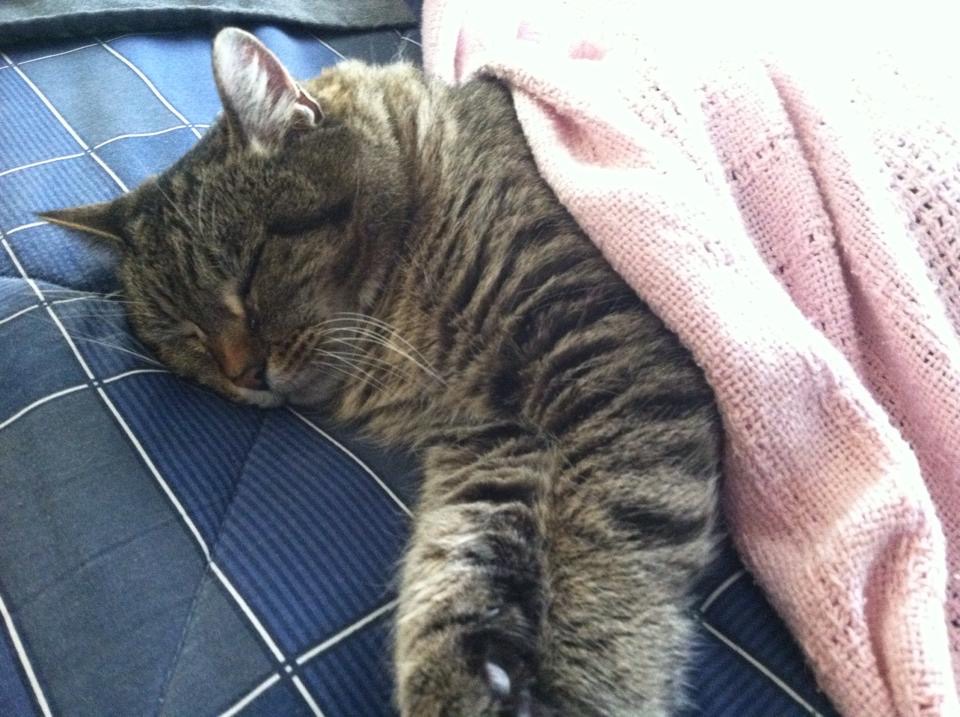
This is Bray doing one of his favorite things – 2008

He would chase me around the middle section of my house which circled through the hallways, living room, and kitchen. To this day, a strand of elastic string is tied to one of my closet doors with a plastic ball attached. It has a bell inside, and Bray spent what seemed like hours batting it around and holding onto it while gnawing on the elastic.

I used to laugh hard when he’d suddenly let go of the ball, and the elastic would snap back and knock the bell against the door. It was like someone went up behind him and said, “boo.” He’d take off running through the house, his claws struggling for traction as he ran across the slick kitchen floor.

But then Bray started losing weight. He wasn’t eating and was spending time hiding under the bed. For such a social animal, that was unusual behavior for him and sometimes a telltale sign that a cat is sick. We went to the vet, and sadly, his illness had come on pretty rapidly. Little could be done, and what was possible would be painful and expensive. Money was tight then, but regardless, at his age and stage of illness, a full recovery wasn’t likely.

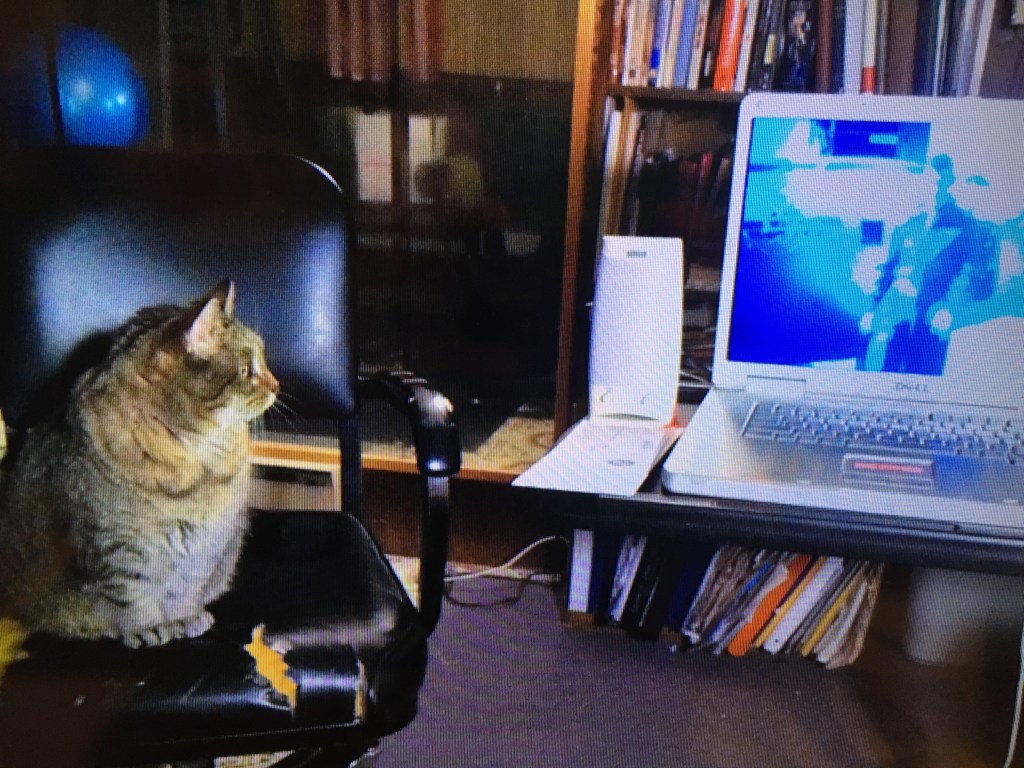
Sometimes, he liked watching movies on Gery’s computer. (2006)

As much as we anthropomorphize them, animals can’t reason as we do, so Bray would have just been in pain with no understanding of what was happening to him. That seemed cruel – to both of us. So, I had to let him go.

I was with both my parents as they left this life. I’ve had to put down cattle that were sick or injured. I even sat with my childhood pony’s head on my lap as he took his last breath after 25 years of companionship. But, with all of that, I’ve had nothing cut me so deeply as having to be the one to decide my little cat was going to die.

My reasoning tells me it was for the best. Even after a decade, I wonder if I did the right thing. Eventually, we have to accept that we chose compassion for the animals we cared for because they depended on us. They’re family and some of the choices we must make on their behalf are easy, others are devastating. As for Bray, I’ll never forget him, and I know there’s someone out there reading this and saying, “It was just a cat.” Maybe to you, but I know better.