Local News & Commentary Since 1890.

Posts Tagged ‘mindfulness’

Slow Down

In Children and Family, Opinion, Uncategorized on January 27, 2026 at 8:42 am

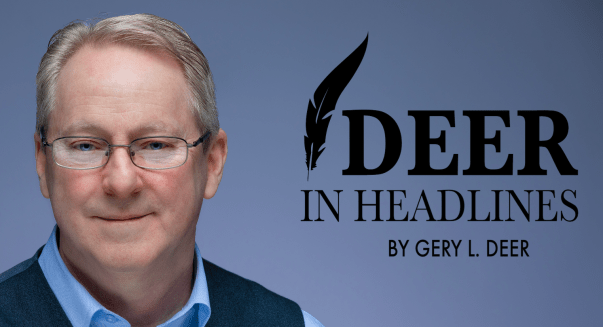
Deer In Headlines

By Gery Deer

Every day I hear people comment about the exhausting pace of modern life. Most of us have felt that strange acceleration where time seems to pick up speed as birthdays pile on. It’s the moment you’re pulling holiday decorations from the attic and swear you just put them away. Of course you didn’t. A full year passed while you were looking at your phone.

Some of that is age, sure, but some of it is engineered. Modern life has a way of nudging us forward faster than we’re built to move, and the most persistent nudge lives in our pockets. The internet, and especially social media, has turned time into a moving sidewalk that never stops. You can stand still, but you’re still being carried somewhere.

I remember my first cell phone that could send text messages and, if memory serves, receive email. At the time it felt revolutionary. I worked outside an office most days, and suddenly important updates could find me without firing up a laptop. It was convenient, efficient, and undeniably useful. This is usually the part of the story where someone asks, “What could possibly go wrong?”

Then the iPhone arrived and the rock started rolling downhill, with all of us sprinting after it. Today we’re permanently connected. Texts, emails, alerts, pings, buzzes, banners, and badges stack up like unread magazines on a coffee table. Studies now link constant device use to anxiety, high blood pressure, and other ailments. The bigger question is why we tolerate it. The answer is uncomfortable. We asked for it.

The more we demand speed and convenience, the more manufacturers and app developers provide. They’re not just selling phones. They’re selling attention, collecting data, and turning it into a high return product. That data fuels more selling, more targeting, and more noise aimed right back at us. This isn’t a conspiracy theory. It’s the business model, printed in very small type.

The byproduct is a permanent state of urgency. Time no longer feels as it once did. Information arrives in six second micro bites, and our brains are expected to digest it like a full meal. But they can’t. We skim, react, and move on. We mistake motion for understanding and speed for knowledge.

We’re all worried about so much – insane politics, societal division, jobs, kids, and the high cost of – well everything. The pressure never lets up. Instead of slowing down to understand what’s happening, we consume only fragments of information and make decisions about our lives with incomplete – or false – information. We don’t reflect. We react, often loudly, and too quickly.

As technology grows more invasive and we become more dependent on it, our reaction time decreases. Important decisions are made without context, sometimes without consideration. That should worry us. I’m convinced it’s one of many contributors to the unsettled mood of the country right now.

So, what do you do? I wish I had a good answer for you. Personally, I’ve been increasingly drawn to the analog and just setting the phone aside whenever I can. Unfortunately, the demands of my work prevent a complete disconnection from social or other digital media. But I write on a manual typewriter at some point in my workday, listen to vinyl on a turntable in my office, and just try to be aware of it all.

Occasionally, I’ll buy a print newspaper and spend several days reading every article. Cover to cover. It’s my way of appreciating the work the writers put into it while absorbing each story. It might seem a bit excentric, but I get the complete picture – without the anxiety that comes with doomscrolling. Plus, I can put it down, then go back to it whenever I want without feeling like I am missing something.

This isn’t about technology, but our resignation to life at a fever pace. Our techno-crutches are just symptoms of a more pervasive problem. We need to slow down. When everything is urgent, nothing is important. And slowing down isn’t quitting. It’s a choice about when to move, listen, or think. That small choice can quietly change the tone of a day, and sometimes an entire life if you let it.

Gery Deer is the editor and publisher of The Jamestown Comet.com and a regional columnist for several other publications.

Festina Lente

In Local News, Opinion, sociology, Uncategorized on January 4, 2026 at 12:56 pm

Deer In Headlines

By Gery Deer

Change in our lives comes in two speeds, and neither of them bothers to ask our permission. It either creeps along like a stubborn snail crossing a sidewalk, or it arrives so fast we wake up wondering who moved the furniture while we were asleep. Slow change is invisible because it’s gradual. Fast change is invisible because it’s overwhelming. It reminds me of the Latin phrase, “Festina Lente,” which means, “make haste, slowly.” Either way, we rarely recognize those significant moments of change until after they’ve happened.

I think our lives are divided into chapters or acts, like a play. Each one is marked by some moment, some Rubicon we didn’t know we were crossing at the time. That moment signals a new direction, usually unexpected and rarely announced with trumpets or a warning label. There’s no narrator to step forward and tell us this is Act Two. Life just keeps going, and we keep improvising.

Some people believe those moments don’t exist at all, that life is simply a continuous stream of overlapping events pushing us forward with little control. Others, like me, are convinced that fate is a convenient myth. Our lives are driven by choices. We make decisions based on circumstance, opportunity, fear, optimism, and experience. Those decisions quietly determine what comes next.

When real change happens, there is a moment when something nudges our lives in a new direction. The frustrating part is that we only notice it in hindsight. One of mine occurred in October of 1987, while reading the classified ads in my college newspaper. I needed a job. Buried among the listings was a small notice that the paper was hiring staff writers.

Less than an hour later, my writing career began. I was an engineering student with no sense that a decision made from necessity and desperation would shape the rest of my working life. I didn’t feel a shift. There was no lightning bolt. I just filled out an application.

Years followed in engineering and technology, but I kept writing. Newspapers. Technical publications. Industry magazines. Software manuals. The transition from a technical career to a creative one didn’t happen overnight. It was painfully slow, full of doubt, subjectivity, and rejection. Writing is a hard business in which to make a name, and I’m still working on it.

Along the way, I changed direction more than once. Demand shifted. Markets changed. The economy had opinions. Some pivots worked. Others failed spectacularly. I adjusted, recalibrated, and kept moving forward, sometimes confidently, other times reluctantly.

Nearly forty years later, that moment sitting in front of the bookstore with a newspaper folded open on my lap was clearly a dividing line. At the time, it was just another Tuesday.

As we settle into a new year, consider what might need to change in your life. Or what changed in the past year without notice. Professionally. Personally. Emotionally. We like to believe we’ll recognize those moments when they arrive, that we’ll feel enlightened or prepared. We won’t. Change doesn’t work that way, no matter how many self-help books promise otherwise.

So what do we do? We do the best we can with what we know at the time. We pay attention. We stay flexible. We understand that most change happens in tiny, almost imperceptible increments, except when it doesn’t. Perspective is everything. Our reality is defined by how we see ourselves, our surroundings, and the people around us.

If there’s comfort in that, it’s this: you don’t have to have it all figured out. Recognizing change comes later. Coping with it comes from patience, adaptability, and a willingness to pivot when necessary. Life will change, slowly or suddenly. Our job is simply to keep showing up, learning as we go, and trusting that today’s ordinary moment may someday reveal itself as the one that changed everything.

Change asks us to breathe, to pause, and to remember that discomfort often signals growth – however difficult. When things accelerate, ground yourself. When they crawl, stay patient. Talk to others. Write things down. Measure progress over months, not days. Most of all, give yourself time. You are not late. You are living inside the process, not observing it from the end.