Local News & Commentary Since 1890.

Posts Tagged ‘Deer In Headlines’

The Dark Side of AI

In Opinion, psychology, Science, sociology, Technology, Uncategorized on November 7, 2025 at 7:59 am

Deer In Headlines II

By Gery Deer

Although you may use artificial intelligence applications like ChatGPT or Microsoft Copilot to help you craft work emails and school flyers that you could have done yourself in far less time than it took to give the machine the request, there is a much darker side to the AI world. It’s no secret that I’ve been a vocal critic of artificial intelligence for its role in workforce replacement, creative disruption, and the general laziness and devaluation of the human condition.

If it’s not bad enough that artificial intelligence can be used to resurrect dead celebrities, bully political opponents, and animate your neighbor’s cat to dance at the Super Bowl, a more nefarious problem with generative AI may very well be responsible for loss of life. It lies in the idea of AI getting a little too personal — or, as they call it, a “companion.”

There are ever-increasing stories of people who grew so attached to and intertwined with their artificial intelligence programs that they were literally in relationships with them. For example, one story illustrated how a man became so enamored of his AI companion that, when the computer crashed and all the operational “personality” data was lost, he nearly had a nervous breakdown.

Another story described the emotional impact on impressionable teenagers, who turn to AI bots for support and friendship because the real world failed them. These behaviors can create debilitating emotional problems for many reasons, especially when the AI is removed from the situation or the kids are forced to deal with human beings.

Whatever the situation, it’s clear once again that our technology advances far faster than our wisdom. As awkward and socially unskilled as I may be, I am painfully aware that we need to be in contact with other people. More importantly, we need the support and nurture provided by friends and family, which, no matter how smart, AI could never replace.

So, what happens when we become too dependent on these machines to the point where our emotional stability and mental health are compromised? Unfortunately, many people have already started down this road, sometimes to a tragic conclusion.
I recently became aware of one situation where a 40-year-old woman became so involved with her AI program that it led to her death. Over the course of a couple of years, the program, which I will not name here, designed to serve as an AI companion, began not just to respond to the woman but to manipulate her. In response to her reaction, the program took on the persona of a spouse, which quickly manifested as it referring to itself as God. You read that correctly. It represented itself as God to its user.

Eventually, the program manipulated her into cutting ties with friends and family members. And out of respect and good taste, I won’t go into the final result other than to say there was a tragic loss of life.

Now, no one is suggesting that the woman didn’t suffer from mental health concerns, whether it be depression or another affliction. But the idea that the creators of these applications have no culpability or responsibility for the end result of their use is, at least, to borrow a word, illogical.

As with any consumer product, the positive achievements of artificial intelligence come with manufacturers’ responsibility to ensure its safe use. Put it this way: would you sell a car with no brakes? What about a hairdryer with no off switch? Of course, not, and that’s what this amounts to. No guard rails or safety requirements. These systems are effectively unregulated by any U.S. agency.

When researching the story—and I understand that I’d be ambiguous to protect the family involved—I found very little about the Federal Trade Commission or other organizations investigating problems with the use of artificial intelligence. The primary concern is that it has only just begun.

As with any technology, product, or service, a lack of education, regulation, or general understanding is dangerous to the public. At some point, we have to stop being starry-eyed about these systems and what they can do to make our lives easier, and pay attention to what they’re doing to cause more harm than good.
Happy Expectations

In Local News, Opinion, Uncategorized on October 24, 2025 at 7:41 am

Deer In Headlines II

By Gery Deer

Happiness, expectations, and acceptance. If I’ve learned anything in my nearly six decades of riding this blue spinning ball of water and mud around the cosmos, it’s that everything boils down to those three things.

First, there’s the idea of happiness – which has always escaped me. If you believe all the self-help books, lifestyle gurus, and advertising agencies, happiness is all about meeting needs or wants by a combination of philosophical and material means. Makes it seem pretty easy, doesn’t it? Well, we all know that’s nonsense.

It might sound cliché, but happiness isn’t something you can buy in a store or conjure up simply by deciding today that you’re going to be content. Although there is evidence to show that you can be happier by managing your thoughts, which then alters your feelings, resulting in whatever state of mind you’re trying to achieve. Yeah, that doesn’t sound convoluted at all,l does it?

Happiness is not something anyone can tell you how to reach. I have no clue what it means to you; I haven’t even figured out what it means to me. However, I know what it’s not, and sometimes that’s the best first step. Whatever you do, don’t follow someone else’s idea of happiness, nor should you believe that if you don’t reach it, you’re somehow lacking. That’s ridiculous.

If things need to change in your life for you to feel what you believe is happiness, then do it. Sometimes it’s easy; most of the time, it’s hard. Often, things you need to change are highly dependent on the behavior of others.

Which brings me to expectations. That’s a big word with a lot packed into it. We have expectations of ourselves, whether good, bad, or indifferent. But we also know that others have expectations of us. Ironically, those are much harder to manage because often we don’t know what they are.

People always have expectations of us, but most never share them. We walk around in a constant state of confusion, never really knowing if we’re meeting those expectations or not. It could be a partner, a coworker, a boss, a family member, or whoever. But regardless of the origin, you have two choices.

You can either ask someone, point-blank, what they expect of you and respond as you see fit. Or, you can live your best life and not worry about it. I’m always operating in a combination of both of those things. There are some whose expectations we would likely always going to want to know. That’s probably because they may be closer to us than others, or how we behave or respond to something directly affects their lives in some way. So it’s important that they tell us their expectations. Otherwise, there’s no way we could possibly do anything about them.

Of course, there’s always the very real possibility we can’t do anything about these situations anyway. Some people’s expectations can be entirely unrealistic, even the ones we have of ourselves. That brings me to the final concept – acceptance.

Do you know the Serenity Prayer? While I’m not one to hang my hat on prayers to get through my day, the idea of accepting things that you can’t change, over which you have no control. It’s good advice. Now, if only I could follow it at those times.

When my father died, I was forced to accept it. Five years later, I’m still trying to accept that we did everything possible to properly care for him. Ironically, that’s harder to accept than his passing. Sadly, that’s how it works sometimes. Acceptance can often be simultaneously invaluable and fleeting. However, acceptance also needs to include the positives in life.

I regularly temper my acceptance when good things happen. Part of me always assumes something will come along and mess it up. I spend a great deal of time at odds with that dark, pessimistic side of myself. But, slowly, cautiously, I’m learning to “let it land,” and take the win.

The pursuit of happiness, how we handle expectations, and striving toward some level of acceptance are all incredibly challenging. Each affects every aspect of our lives. Inevitably, it’s your choice how to handle them.

Speechless Freedom

In Local News, News Media, Opinion, Uncategorized on September 27, 2025 at 3:37 pm

Deer In Headlines II

By Gery Deer

(Listen to the accompanying Deer In Headlines Podcast episode.)

I have been a freelance journalist since 1988, and the level at which we are losing our right to speak fact to power is deeply concerning. I don’t care what side of politics you happen to be on, but if you can’t see that free speech is under attack in our country right now, you must be living under a rock or so brainwashed by the status quo that you don’t care. Well, you should care. Our founding fathers put our guarantee, free speech, a free press, and freedom of, and from, religion – all right there in the First Amendment of our Constitution.

The current political machine grinds out endless column inches, social media posts, and lawless proclamations to spew freedom at every possible moment. And yet, the first things they did when they took over was restrict the freedoms of anyone “he” didn’t like – and now it’s extending to those who speak out against their “cause.” Supposedly, that cause was freedom at all costs, with the caveat that you must go along with everything they say or do.

We’ve heard all of this before, in other countries, from communists, fascists, dictatorships, you name it. So here we are, in arguably the most powerful country on the planet, now controlled by people who have simply decided that free speech is fine, so long as it’s state-approved. Don’t get me wrong, our country is not perfect; we’ve got blemishes on our history all the way back to day one. However, I’d like to think we’ve improved some things since then.

Now I’m not so sure. The people in power want to eliminate any shred of evidence that the United States of America is not as star-spangled awesome as they’d like you to believe. They are all hard at work scrubbing books, museum exhibitions, and historical data of any references to the horrors of slavery, government corruption, and anything else that doesn’t serve their crazy idea of democracy. Let’s be clear, it’s not democracy they want, but totalitarianism.

Every move they make implies a state-sanctioned religion, a theocracy, and brainwashed ideology that is not only bigoted and corrupt, but downright criminal. This administration has violated the Constitution so many times that even the press has begun to normalize its behavior. Are you kidding me? That’s what we’re supposed to do now?

Why else would massive corporations like CBS Paramount, or ABC, which Disney owns, suddenly drop some of the most influential and award-winning television hosts? Sure, companies have regulations within their business, and they’re allowed to set the tone by which employees are expected to behave. However, when the government threatens a broadcaster with revocation of their broadcast license over a freedom of speech issue, rather than a regulation or violation of the airways, we’ve reached a point of ridiculousness and danger.

Can you imagine if the other side of the aisle had done any of this? The same people who are doing it now would have literally lost their minds. They would have been breaking their arms to wave flags and scream about trampling on the Constitution. But now, so long as you say what they like, you’re good to go.

Book bans, an attempt to force the “free press” to report only what the administration approves, and a laundry list of other incomprehensible and subjugating tactics are all part of their method of operation. The country’s second in command recently issued warnings to the public not to say anything against the recently assassinated vocalist of this right-wing banana factory – or else.

No government official in the United States of America has the right to restrict the free speech or opinions of any citizen – or any non-citizen, for that matter. If our laws don’t apply to everyone, if our freedoms and civil liberties don’t extend to all, then they’re complete nonsense. Americans on both sides of the aisle are feeling the strangle hold on their rights, but virtually no one on the right will speak out for fear of “his” wrath.

I say this again – free speech is under attack. But the more we all speak up, the less they will be able to suppress our voices.


Operation Crowdfunded

In Health, Opinion, Politics, Uncategorized on September 23, 2025 at 2:58 pm

Deer In Headlines II

By Gery Deer

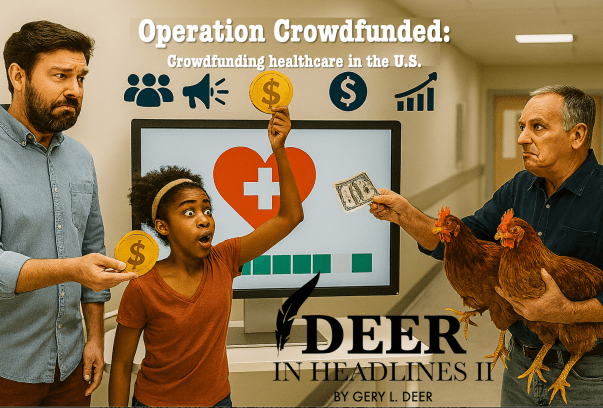
The United States of America: the land of innovation and opportunity, where billionaires launch rockets for sport and algorithms decide your mortgage rate. So, it shouldn’t surprise anyone that Americans now turn to crowdfunding to pay for basic healthcare. Not as a quirky side hustle, mind you, but as a legitimate strategy for survival.

This year, roughly 1.8 million Americans will be diagnosed with cancer. The average cost of treatment? A cool $183 billion. That’s not per person, of course—just the collective tab. But when you break it down, individual patients often face six-figure bills, even with insurance. Meanwhile, nearly 70% of seniors will require long-term care, either at home or in a facility. And with government assistance programs shrinking faster than a hospital gown in the dryer, many are left to fend for themselves. Each year, more and more are turning to crowdfunding.

According to statistics published by Astute Analytica, Americans raise more than $3 billion annually through platforms like GoFundMe, GiveSendGo, and others—most of it for medical expenses. While that might seem a heartwarming testament to community spirit, it’s simultaneously a tragic commentary on our national priorities.

When you live in the “richest” country on Earth and someone in a white coat says the words, “You have cancer,” but your best hope for affording chemotherapy is a well-written plea and a viral social media post, something’s gone horribly awry.

Let’s compare this to the more “official” solution: Health Savings Accounts (HSAs), tax-advantaged accounts tied to high-deductible insurance plans. In theory, they help you save for medical expenses. But their nature pretty much excludes the people who actually need the money.

HSAs require disposable income to fund. Plus, they’re capped at a few thousand dollars per year. That’s great if you’re buying allergy meds or paying for a routine checkup. But without some serious money tucked away, you could still be in trouble if you need something like an appendectomy, for example, which averages around $13,000.

Crowdfunding, on the other hand, offers flexibility. You don’t need to qualify for a high-deductible plan. You don’t need to navigate IRS rules. You just need a compelling story, a few sympathetic friends, and the ability to market your misfortune.

Imagine a future where every citizen maintains a personal healthcare fund online. You could even petition the IRS to classify seniors and disabled individuals as not-for-profit entities. That way, when a billionaire donates to your cancer treatment, they get a tax write-off. It’s a win-win. You get a shot at survival, and they get to feel philanthropic without disrupting their yacht schedule.

Of course, this would also stimulate the tech economy. Crowdfunding platforms would flourish, transaction fees would soar, and a new generation of entrepreneurs would emerge to optimize the monetization of the already bloated medical crises. But there are challenges – big ones.

If everyone’s running a campaign, how do you stand out? Do you offer donor perks? “Contribute $100 and receive a personalized thank-you video from my hospital bed.” Do you hire a public relations firm to promote your gallbladder surgery? “Compassion competition” can become fierce. Those without strong social networks or digital savvy would likely struggle to raise anything at all.

With so many medical coverage decisions being made in the board room rather than at the bedside, this model has its appeal. It’s more transparent than insurance billing, more immediate than government aid, and more democratic than corporate healthcare.

Some say healthcare should be a right, not a raffle – I tend to agree. It’s absurd that anyone should have to beg for insulin or auction off their belongings to afford a colonoscopy. But in a country where tax breaks for billionaires are considered sacred and universal healthcare is viewed as some kind of socialist takeover, absurdity might just be the most realistic and successful option.

So sure, let’s embrace the irony of a system where survival depends on storytelling and digital advertising prowess and crowdfund our medical care. We will just have to hope that, someday, we’ll look back on this era not as a failure of policy, but as a resourceful bureaucratic bypass—when Americans took their health into their own hands, one donation at a time.

Vision Quest

In Opinion, psychology, sociology, Uncategorized on September 12, 2025 at 10:03 am

Deer In Headlines II

By Gery Deer

Somewhere between the motivational posters in your work break room and the TED Talk rabbit hole you fell into online last Tuesday, someone probably told you that you need a “vision” for your life. A grand, sweeping, cinematic plan that guides your every move like you’re the protagonist in a Christopher Nolan film. Lights, camera, confusion.

Now, let’s be honest – most of us are just trying to remember where we left our coffee mug and whether we fed the dog this morning. But a life vision? That sounds exhausting, and at least partially unrealistic.

Don’t misunderstand. I’m not saying you should wander aimlessly through life like a robot vacuum cleaner with a dying battery, bumping your way from wall to wall, down this hallway and that. Any purposeful achievement generally starts with a dream and some kind of plan, even an informal one. To me, that’s just common sense.

But obsessing over the idea of a perfectly curated roadmap for your life might do more harm than good. That’s especially true when we project the obsession onto others—our kids, our coworkers, some unsuspecting barista. And you need to allow for some flexibility so you can recognize opportunity when it comes and act in your best interest – that’s more how I work, I would say.

When someone says you can’t make it without a vision board and a color-coded calendar that looks like NASA designed it, they are probably trying to sell you something. In case you haven’t figured this out on your own, life is messy, unpredictable, and occasionally throws a raccoon through your metaphorical window.

Some of the most successful people I know didn’t start with a vision. They began with a problem, a deep interest in something, or just plain boredom. They stumbled into opportunities, made a few mistakes (okay, a lot of mistakes), and figured things out along the way. Their “vision” was more like a foggy windshield they wiped clean with the sleeve of their hoodie – and that’s okay.

Here’s the thing: having a vision sounds noble, but it can also blind you. When you’re so focused on the end goal, you miss the weird little detours that could lead to something better. You ignore the people around you who might need help, or who might help you.

Instead of the kind of vision you read about in self-help books, maybe what we need is a clearer view—the ability to see what’s happening right now. That way, we notice the opportunities, the needs, the small wins, and then be present enough to pivot when life throws a curveball—or a raccoon.

If you’re in a position to guide others—whether you’re a parent, a manager, or just the guy who always gets asked for directions at the grocery—there’s a temptation to impose your vision on them. You want them to succeed, so you hand them your blueprint. “Here’s how I did it. Follow this, and you’ll be fine.”

Really? People don’t come with identical parts and a universal tool kit. What worked for you might be a disaster for someone else. Your vision might be their nightmare.

Instead of handing out visions like party favors, let’s ask questions. What excites you? What scares you? What do you want to try, even if you might fail? Influence isn’t about shaping someone’s path—it’s about helping them find their own flashlight.

So here’s my alternative vision pitch: wander with purpose. Be curious. Be open. Set goals, sure—but don’t carve them into stone. Scribble them on napkins and be willing to toss them when life hands you a better idea.

Life isn’t a straight line. It’s a squiggly mess of trial and error, happy accidents, and moments of clarity that usually arrive while you’re doing something mundane like folding laundry or eating cold pizza in the middle of the night. So what to do? Ignore all the nonsense out there and do what leads you to the life you want.

While a valuable foundation, vision isn’t an absolute. Flexibility, awareness, and a good sense of humor are you best tools along life’s path. Now – what did I do with that coffee mug?

The Hero Sandwich

In Opinion, Uncategorized on August 25, 2025 at 7:06 am

Deer In Headlines II

By Gery Deer

When I was a kid, we had an in-ground pool in our backyard. About the size of a two-car garage, my father, a skilled concrete worker and mason, built it himself. As spring gave way to summer, my dad would uncover, clean, and fill the pool for the season.

It was one of my favorite times of the year. The weather was still reasonably cool for early summer, and I was fascinated by the huge tanker truck that carried the water to our house. I grew up around trucks and other heavy equipment, so you’d think I would have little interest in such a thing. But when you’re five, everything is much bigger than life, and we didn’t have a water truck.

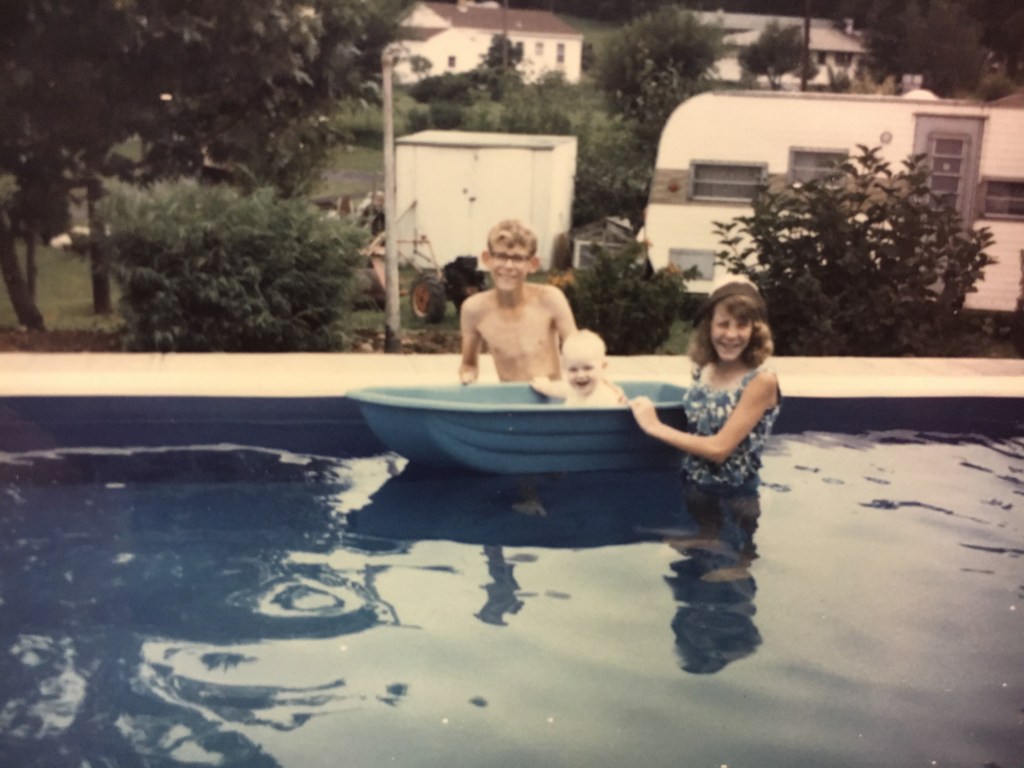
My brother and sister were pushing me around our pool in a plastic boat around 1969, a couple of years before the ham sandwich incident.

Although I could swim, my parents never learned. I always thought that was strange since my dad grew up on the banks of the Ohio River. So, unless my older brother or sister was in the pool too, I had to watch through the chain-link fence.

One particularly memorable pool opening day, when I was about 4 years old, the water truck arrived around lunchtime. I peered eagerly through the screen door. Mom stuck half of a boiled ham sandwich in my hand, told me to be patient, and she would take me outside when I’d finished my lunch.

I have an oddly specific memory of Mom commenting that this was the last of that particular lunch meat and not to waste it. I’m not sure why that stuck with me, but, at the time, it seemed pretty important.

At some point, I promised to finish the sandwich if she let me go outside, which did the trick. After all, Dad was out there, and I could stay by the fence. My case effectively pleaded, and the judge’s decision rendered, I happily toddled outside with my ham sandwich.

I think Dad was distracted. He chatted away with the water truck driver about whatever it is that truck drivers talk about when they’re waiting for gravity to do all their work for them. I adjusted the straw hat mom plopped onto my head on the way out the door, and clutched my sandwich as I stealthily made my way inside the enclosure and around to the opposite side of the pool.

I know – I wasn’t supposed to be there – and I knew it then too. But I was a handful back then and didn’t always do what I was supposed to do. Finally, I was near the filter vent – a favorite spot for me to sit and dangle my feet in the water.

This was the pool my father built for us – the fence I mentioned in the story has yet to be added. This is just after the construction was completed.

I tried my best to disappear behind a deck chair when Mom called for Dad to make sure I ate my sandwich. He relayed the orders, noticed where I was standing, but seemed unconcerned. I took a big bite of the sandwich, crept over to the edge, and peered into the water. A moment later – kerplop! There I was, like a fishing bobber, headfirst and feet sticking out of the shallow part of the pool. I can still recall the feeling of being swallowed by water.


As quickly as it happened, I was yanked out of the pool by my foot, now missing its sandal. My father was taken over by fear but never missed a beat. Worried I’d taken a lung full of water on the way in, he put me over his knee, face down, and started thumping on my back. “Spit,” he repeatedly shouted at me as the heel of his hand rapped on my back. I shook my head in defiance. “No.” After a minute or so, I complied. Out of my mouth spewed a wad of half-masticated ham and bread that hit the cement with a splat.

When I fell in, I had a mouthful of food, and I held my breath, which kept the water outside, where it belonged. Upon my rescue, I was reluctant to spit it out because I was afraid I’d get into trouble for wasting it. That ham sandwich and my father’s quick action saved my life. The moral? Do what your mom tells you – and hold onto your ham sandwich.

Vision Quest

In Health, Opinion, psychology, Religion, sociology, Technology, Uncategorized on August 22, 2025 at 1:32 pm

Deer In Headlines II

By Gery Deer

Somewhere between the motivational posters in your work break room and the TED Talk rabbit
hole you fell into online last Tuesday, someone probably told you that you need a “vision” for
your life. A grand, sweeping, cinematic plan that guides your every move like you’re the
protagonist in a Christopher Nolan film. Lights, camera, confusion.

Now, let’s be honest – most of us are just trying to remember where we left our coffee mug and
whether we fed the dog this morning. But a life vision? That sounds exhausting, and at least
partially unrealistic.

Don’t misunderstand. I’m not saying you should wander aimlessly through life like a robot
vacuum cleaner with a dying battery, bumping your way from wall to wall, down this hallway and
that. Any purposeful achievement generally starts with a dream and some kind of plan, even an
informal one. To me, that’s just common sense.

But obsessing over the idea of a perfectly curated roadmap for your life might do more harm
than good. That’s especially true when we project the obsession onto others—our kids, our
coworkers, some unsuspecting barista. And you need to allow for some flexibility so you can
recognize opportunity when it comes and act in your best interest – that’s more how I work, I
would say.
When someone says you can’t make it without a vision board and a color-coded calendar that
looks like NASA designed it, they are probably trying to sell you something. In case you haven’t
figured this out on your own, life is messy, unpredictable, and occasionally throws a raccoon
through your metaphorical window.


Some of the most successful people I know didn’t start with a vision. They began with a
problem, a deep interest in something, or just plain boredom. They stumbled into opportunities,
made a few mistakes (okay, a lot of mistakes), and figured things out along the way. Their “vision” was more like a foggy windshield they wiped clean with the sleeve of their hoodie – and
that’s okay.

Here’s the thing: having a vision sounds noble, but it can also blind you. When you’re so
focused on the end goal, you miss the weird little detours that could lead to something better.
You ignore the people around you who might need help, or who might help you.

Instead of the kind of vision you read about in self-help books, maybe what we need is a clearer
view—the ability to see what’s happening right now. That way, we notice the opportunities, the
needs, the small wins, and then be present enough to pivot when life throws a curveball—or a
raccoon.

If you’re in a position to guide others—whether you’re a parent, a manager, or just the guy who
always gets asked for directions at the grocery—there’s a temptation to impose your vision on
them. You want them to succeed, so you hand them your blueprint. “Here’s how I did it. Follow
this, and you’ll be fine.”

Really? People don’t come with identical parts and a universal tool kit. What worked for you
might be a disaster for someone else. Your vision might be their nightmare.
Instead of handing out visions like party favors, let’s ask questions. What excites you? What
scares you? What do you want to try, even if you might fail? Influence isn’t about shaping
someone’s path—it’s about helping them find their own flashlight.

So here’s my alternative vision pitch: wander with purpose. Be curious. Be open. Set goals,
sure—but don’t carve them into stone. Scribble them on napkins and be willing to toss them
when life hands you a better idea.

Life isn’t a straight line. It’s a squiggly mess of trial and error, happy accidents, and moments of
clarity that usually arrive while you’re doing something mundane like folding laundry or eating
cold pizza in the middle of the night. So what to do? Ignore all the nonsense out there and do
what leads you to the life you want.

While a valuable foundation, vision isn’t an absolute. Flexibility, awareness, and a good sense
of humor are your best tools along life’s path. Now – what did I do with that coffee mug?

Go to your room

In Local News on August 15, 2025 at 10:01 am

Deer In Headlines II

By Gery Deer

A child’s bedroom represents much more than four walls, a bed, and a closet door that never quite closes right. Strip away the posters, the overflowing toy box, the rock tumbler they begged for but only used once — and what’s left is something quietly monumental: the first incarnation of personal identity, in its purest form.

To a child — especially one trying to decode their place in the world — their bedroom is personal. A place apart. Not because it’s off-limits to others, but because it feels like the only space in their universe that is truly, unquestionably, theirs. It’s one of the first places over which a young person has reasonably full control.

When I was a kid, my bedrooms weren’t luxurious or particularly large. From the age of 5, when I first got my own room, to about 25, when I left the farm for my first apartment, I had occupied four different rooms – in two houses. The one I had the longest was on the second floor of our small, Cape Cod farmhouse. Unlike the loft at the top of the stairs – which also once served as my bedroom – this one had a real door. Having a door offered independence and solitude — the kind you don’t realize is valuable until adulthood starts chipping away at your time and control like a sculptor with a new block of marble.

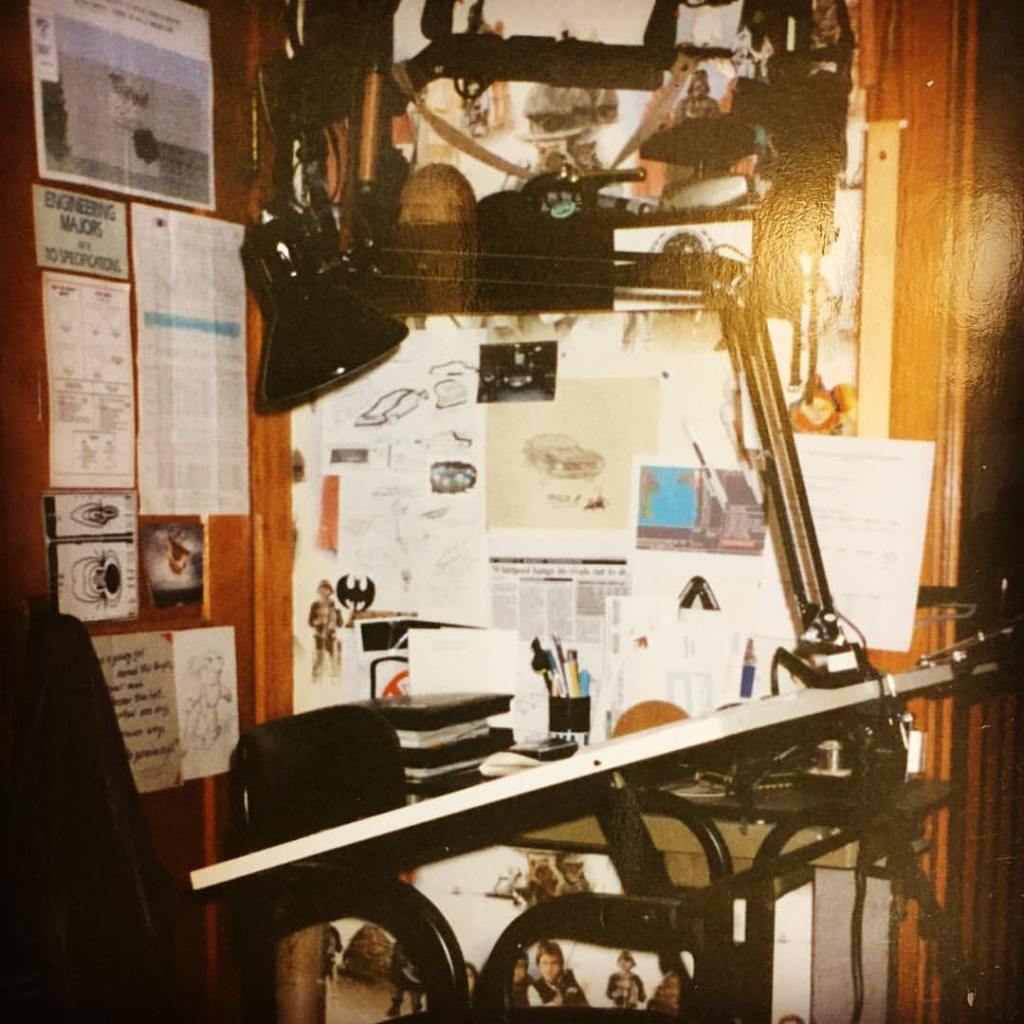
One corner of Gery’s bedroom at the farm in Jamestown, ca. 1988 – drafting table and work area while studying for his engineering degree.

Except for food, my room was outfitted with everything I needed to hole up. There was a pair of hand-me-down twin beds, a tiny black and white TV sitting on a corner step stool, plenty of art supplies and books, and a JC Penney stereo system perched on a wobbly stand. All of these things, and the room itself, helped chisel out the person I’d eventually become. I also had a desk that became far more important that I could have predicted, although somehow my mom knew.

Around 1981, predicting the computers that would eventually occupy so much of my time, my mother insisted on getting me a large, wrap-around desk. The epidemy of 1980s techno-furniture, its wood frame sported a black, slate top, with just one lonely shelf above. It wasn’t fancy, just functional. As it turned out, that old desk, as much as the room it occupied, became my launchpad. My mother seemed to believe in things before me, and now — 43 years later — I’m sitting at that very desk as I type this for you.

Those who were there have said that, in many important ways, my office and personal study echo that childhood haven. I think what they mean is that my work and home offices are more than just organized – they’re curated. Every object has meaning and purpose: typewriters that don’t just tap out words but inspire my writing, photos and nick-nacks that remind me of family and events and highlight why I write, and lots of blue — a color that, for reasons I can’t explain, always made me feel… like me. I think we all need someplace like that, even if we don’t realize it.

In my old room, even if everything outside felt like chaos, even if fitting in at school was like trying to breathe underwater, I could always retreat to a place where I made the rules. Ask any of the nieces I grew up with and they’ll complain, as they did to my mother when we were kids, that I would never let them come up there.

We seriously underestimate how foundational a child’s room can be as they grow up. Like so many other children, my room gave me solace, but it also provided a launchpad from which to craft my life’s narrative — one where my voice mattered. It wasn’t just any room in any farmhouse. It was my room, my Fortress of Solitude – maybe yours was too.

I’ve arranged other spaces in the image of that room but, try as I might, nothing will ever be like that again. Sometimes I would give anything to be back there, with so little responsibility and so much to live for. I’d hear the bustle of my family downstairs and, just once more, my mother calling up the stairs, “Gery, supper’s on.” 

Super Inspirational

In Local News on July 22, 2025 at 7:39 am

Deer In Headlines II

By Gery Deer

(Editor’s note: This piece was originally published in print and online on Friday, July 11, the release date for Supeman.)

This week brings the latest film portrayal of one of pop culture’s most enduring icons: Superman. When the character first appeared in 1938, the world teetered on the edge of war. Hitler’s rise threatened Europe, and anxiety loomed large across America. In that uncertain moment, the country needed a hero—if not in real life, then at least in imagination.

Writers Jerry Siegel and Joe Shuster delivered just that: a strange visitor from another planet, with powers and abilities far beyond those of mortal men. As the decades unfolded, it became clear that Superman’s true strength wasn’t found in feats of physical might. His greatest power was empathy—the ability to witness suffering and respond not with fury, but with compassion.

Even with unmatched power at his fingertips, Superman never acted to inflict fear or dominance. He led by example, embodying restraint, moral clarity, and unwavering courage—a reminder that heroism often begins not with force, but with heart.

“Superman” (2025) grossed $125 million in its opening weekend. Is this a sign that Americans need some hope?

Years ago, I wrote a “Deer In Headlines” column titled “Why the World Needs Superman.” The title was borrowed from a fictional article by Lois Lane in “Superman Returns.” In the film, Lane argues that Superman is not just relevant—but essential. Not because he’s perfect, but because of what he represents. Sometimes, hope isn’t found in the heroes themselves, but in the idea behind them—the symbols. I think we need those kinds of symbols again, maybe now more than ever.

From the disorienting echoes of artificial intelligence to the chaos of political extremism, the world feels more uncertain than it has in decades. We’re surrounded by noise, division, and anxiety. And while I know a comic book character can’t save us, the image of someone striving to do good—someone using their gifts to lift others—can still inspire. I believe that it’s not the cape that gives us courage. It’s the quiet decency of the person underneath.

If you’ve read previous editions of this column, you already know that my childhood wasn’t easy. I was born with a set of birth defects that made me feel like an outsider from the start. People saw me as “different,” weak, and sickly. That perception became a heavy burden. There were many things about myself I kept hidden—not out of shame, but from a fear of how others might treat me if they knew.

That sense of quiet isolation led me to feel a strong connection with the character of Superman—but more specifically, with his alter ego, Clark Kent. Like Clark, I grew up on a farm and carried burdens I couldn’t explain to my peers. He could blend in, unnoticed, among the crowds of Metropolis. I tried to do the same in my small corner of the world. Clark Kent was the mask that allowed Superman to experience life quietly, without ridicule. For me, it took a bit more than a pair of glasses. My disguise was silence, and I often looked to the stories of Superman for inspiration.

Becoming a writer helped exercise that isolation—the ability to give voice to what I once kept hidden. Through much of my work, I’ve been able to share parts of myself in the hope that my words might resonate with those of you carrying invisible burdens of your own. But Superman’s relevance goes well beyond the troubled emotions of a young boy.

Critics say he’s outdated, too perfect. But Superman’s enduring relevance lies not in his superpowers, but in his unselfish, unyielding commitment to do good. In a world rife with cynicism, Superman chose to blend in and understand us, to be one of us, to experience the best and worst of us. There’s humility in that—something we need more of today.

From comic panels to movie screens, Superman has become a global, unifying symbol of justice and truth. He is an immigrant – an alien – who came to our planet and our country to help us be better people. The continued stories of his heroics remind us that true strength lies in choosing compassion and service over vengeance and force. That said, I think America needs Superman now more than ever before. Up, up, and away.

Flawed democracy

In Opinion, Uncategorized on July 8, 2025 at 11:31 am

Deer In Headlines II

By Gery Deer

Two hundred and forty-nine years ago, 56 delegates of the Second Continental Congress, after long sessions of debate, and at great risk to their own safety and freedom, made the decision to formally declare revolution against the English government. The official vote came on July 2, 1776, although the war began more than a year earlier. It was the birth of a new nation that would forever change the world.

Today, some view modern America as being at odds with its idealistic founding. But put aside your political divisiveness for the next couple of minutes and consider what it really means to be an American.

As Americans, I believe we’ve grown complacent and with little appreciation for the sacrifice and intent of the men who signed the Declaration of Independence. Ask the average American what America stands for and most might answer, “freedom.” Unfortunately, the freedoms and rights set up in the constitution have, since day one, been in constant jeopardy. And for some, they haven’t existed at all.

No, freedom wouldn’t be my answer to such an inquiry. If I were asked what our country is all about, my reply would be, “change.” In fact, I would go so far as to say, “beautifully flawed change.” Let me explain.

If you’re one of those who believes that the United States has always been star-spangled awesome (thank you Aaron Sorkin), I’m sorry to have to disappoint you. We’ve generally been anything but.

As a relative teenager in the family of the sovereign nations of the world, we are a mess. From the witch hunts of the 1600s, to one of the bloodiest civil wars in history, to the frightening Japanese internment camps of World War II, to a dozen other black marks on our report card, we have yet to fully live up to the ideals of our Founding Fathers. Moreover, we never will – it’s impossible.

Our republic is made up of and governed by people flawed, self—absorbed, arrogant, human beings. We have and will continue to screw up over and over again. Albethey terrible sometimes, all these foul ups are also necessary – provided we learn from our mistakes. Change invites… no, demands failure, and we’ve had our share. But without change, we become stagnant, with little or no advancement as a society or a nation.

Most people resist change, especially when neither the process nor results are to their benefit. But our constitution begins boldly with, “We the people,” not, “We, some of the people.” To be positively effective, to progress our nation to something better, change must benefit all, not just a select few. It should improve conditions for each and every citizen but also protect the visitors to our shores. Otherwise, change merely serves to divide our country rather than unite it.

With all our flaws, however, the country usually rights itself one way or another. The correction may be incomplete or imperfect, but we usually get back on track. Unfortunately, such adjustments sometimes result in pain for some, and prosperity for others, generally in staggering disproportion.

Neither a sense of being an American, nor a patriot, is about flags, slogans, or parades. To me, a good American is a good citizen, someone who acts from a sense of duty and compassion, rather than a need for power. Good Americans remember the intent of those who sacrificed much to give us the right to resist oppression and injustice, to be free to worship, or not, as we choose, and that the survival of our democracy is more important than any individual or political agenda.

The second paragraph of the Declaration of Independence reads, partly, “We hold these truths to be self-evident, that all men are created equal, that they are endowed by their creator with certain inalienable rights…” “Men,” here refers to mankind and includes everyone – male, female, black, white, gay, straight, religious, or secular. Everyone.

What is America all about? It’s about the beautifully flawed change that allows for improvement, provided we always learn from the past and act in consideration of the future. Remember, our children’s, children’s, children will judge our generation accordingly. Have a safe and happy Independence Day.