Deer In Headlines – SPECIAL EDITION
By Gery Deer
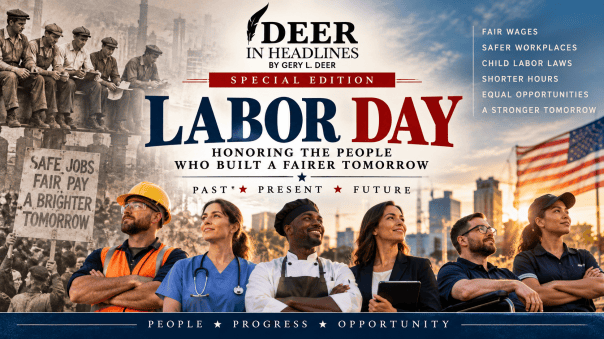
Labor Day has become one of those holidays whose meaning can easily be obscured by the celebration.
For many Americans, it means the unofficial end of summer. It means cookouts, a three-day weekend, back-to-school sales and maybe one last trip before fall settles in.
But Labor Day was never really about a day off.
And, despite its roots in the labor movement, I don’t think we should think of Labor Day as being simply “about unions,” either.
It is about people.
It is about generations of working men and women who decided that earning a living should not require sacrificing your health, your dignity, your children or virtually every waking hour of your life.
Those workers fought for things we now consider ordinary: reasonable working hours, safer workplaces, fairer wages and limits on child labor. The eight-hour workday that became part of the national labor agenda did not materialize because employers suddenly decided everyone should have more time with their families. It was the result of years of pressure, organizing and sacrifice.
Eventually, those efforts helped produce laws establishing minimum wages, maximum working hours and workplace standards. The Fair Labor Standards Act became law in 1938, and other protections followed over the decades.
Today, many of us walk into work without giving much thought to how extraordinary that history really is.
We expect fire exits. We expect machinery to have safety procedures. We expect children to be in school rather than in factories. We expect employers to pay workers in accordance with established wage laws. We expect some protection against discrimination. We expect qualified people with disabilities to have an opportunity to work and, where required, receive reasonable accommodations.
Those expectations were inherited.
Someone fought for them.
And that is precisely why Labor Day may be more relevant today than it has been in a very long time.
We are entering another period of enormous economic and technological change.
Workers are worried about higher costs. Employers are worried about higher costs, too. Businesses face pressure to increase productivity while controlling expenses. Employees wonder whether the job they have today will still exist five or ten years from now.
And sitting squarely in the middle of all of this is artificial intelligence.
AI has enormous potential. I use it. Many businesses are finding legitimate ways to use it to increase productivity, improve communication, analyze information and eliminate repetitive tasks.
But technology should improve human work, not simply make human beings disposable.
That distinction matters.
The U.S. Bureau of Labor Statistics is already incorporating potential AI exposure into its employment projections. Nobody can predict with certainty exactly what AI will do to every occupation, but we would be foolish to pretend that significant disruption isn’t coming.
The question, then, is not whether technology will change work.
It always has.
The question is what values we carry with us while it does.
If an employer can replace 100 people with software, what responsibility does that employer have to those workers? What opportunities should exist for retraining? How do we make certain productivity gains benefit more than shareholders and executives? How do small businesses compete when enormous corporations can invest billions in automation?
And perhaps most importantly, how do we prevent economic fear from becoming an excuse to weaken standards people spent generations establishing?
That includes workplace safety.
It includes fair wages and reasonable hours.
It includes protection against discrimination.
And it includes equal opportunity for people who historically had to fight simply to get through the door.
Federal law today prohibits disability discrimination in hiring, firing, pay, promotion, training and other conditions of employment, and qualified workers with disabilities may be entitled to reasonable accommodations. Those protections exist because our society eventually recognized something important: talent, ability and human value do not belong exclusively to people who look alike, come from identical backgrounds or move through the world in the same way.
The same principle applies to protections against discrimination involving race, color, religion, sex and national origin.
These standards are not inconveniences left over from another era.
They are part of what makes a modern workplace modern.
Yet laws and protections are never self-preserving. They remain meaningful only when people understand them, value them and insist that government leaders enforce them.
That means we have responsibilities beyond posting a Labor Day graphic on social media.
We can pay attention to legislation affecting workers instead of waiting until something directly affects us.
We can ask political candidates specific questions about workplace safety, discrimination, disability rights, wages, automation and worker retraining.
We can refuse to accept the idea that protecting employees automatically means being hostile to business. Good businesses need good employees, and good employees need businesses capable of succeeding. Those interests are not natural enemies.
We can also stop allowing politicians to turn every workplace issue into another ideological cage match.
Whether the person trying to weaken long-standing employee protections has an “R,” a “D” or anything else after their name should be irrelevant. If a proposal makes workplaces less safe, permits discrimination, eliminates reasonable protections or treats working people as expendable economic units, we should be willing to challenge it.
Political radicalism should not be allowed to erase workplace protections simply because the people who originally fought for them are no longer here to explain why they were necessary.
And employers have an opportunity here, too.
Businesses can choose to view employees as investments rather than expenses. They can use AI to make talented people more productive instead of reflexively asking how many salaries the technology can eliminate. They can create workplaces where people are paid fairly, treated respectfully and given opportunities to advance.
Employees can participate as well by learning their rights, understanding the responsibilities that accompany those rights, supporting coworkers who are treated unfairly and being willing to speak when established standards are threatened.
Labor Day should remind us that progress is not permanent.
Every generation inherits certain protections from the generation before it. Then it decides whether to preserve them, improve them or quietly allow them to disappear.
So today, perhaps the best way to honor the men and women who fought for safer workplaces, fairer wages, shorter hours, an end to abusive child labor and greater equality on the job isn’t merely to enjoy the day off.
Learn what they fought for.
Learn what protections exist today and why.
Pay attention when someone proposes weakening them. Ask questions. Vote. Contact elected officials. Support businesses that treat their employees well. If you employ people, make your workplace an example of what responsible employment should look like.
And as artificial intelligence and automation reshape the workplace, insist that technological progress remain connected to human progress.
The people who came before us fought to create a world in which earning a living didn’t have to mean surrendering your dignity to do it.
The least we can do on Labor Day is remember that.
The better tribute is making certain the people who come after us don’t have to fight for all of it again.
 The Jamestown Comet