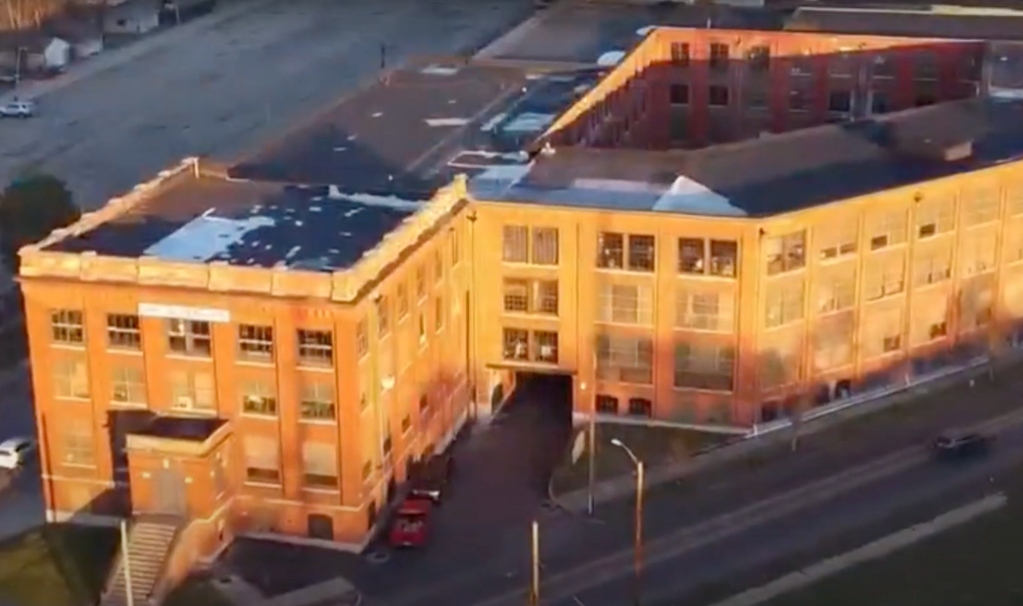
Dayton, Ohio – The Davis Linden Building, an historic landmark located at 400 Linden Avenue in Dayton, Ohio, has long been a beacon for creative professionals seeking customized commercial spaces. Owned by Matt Dieringer of Dieringer Development, the facility continues to thrive and expand, offering a nurturing environment for artists, businesses, sculptors, photographers, and other creative professionals.
Over the years, the facility has seen good times and bad. But Matt Dieringer’s vision for the Davis Linden Building has been, and will continue to be, one of growth and community. “We are committed to provide spaces that not only meet the unique needs of our tenants but also foster a sense of belonging and collaboration,” says Dieringer. This commitment is evident in the building’s diverse range of tenants, each contributing to a vibrant and supportive community.
One of the most notable tenants is Michael Bashaw, a musician and sculptor who has located his studio in the Davis Linden Building since the 1980s. Bashaw’s long-term presence is a testament to the building’s ability to provide a stable and inspiring environment for creative professionals. “My grandfather was a tenant in the building in the 1950s, so I was well aware of it,” says Bashaw. “I was originally looking for a space where I could work on my sculpture and do music rehearsals. I’m very grateful and very fortunate to be here.”
“I’m on year two and have already outgrown one space,” says tenant Tiffany Lewis, owner of Immortelle Bijouterie, an era-inspired jewelry and clothing shop. “I love the atmosphere here – the big windows, the open concept, and that there are other artists here.”
Becca Brumfield, the building’s office manager, shared her view as both a tenant and employee. She described The Davis Linden Building as a center of creativity, business, and community. Her husband, Trevor, operates one of Ohio’s last full-service typewriter repair and sales shops, TB Writers Plus, located in the building since 2023.
The dedication of the Davis Linden Building’s management to promote a sense of community among its tenants is one of its defining features. This collaborative spirit is what sets the facility apart from other commercial spaces. In that spirit, the management will soon unveil “The C2 Initiative,” based on the idea of Creativity and Commerce. The initiative is intended to expand on that sense of community with memberships, access to shared creative space, and much more.
As Dieringer Development continues to invest in the growth and development of the Davis Linden Building, the future looks bright for this creative hub. With its commitment to providing customized spaces and fostering a strong sense of community, the Davis Linden Building will undoubtedly remain a cornerstone of Dayton’s creative scene for years to come.
For more information about the Davis Linden Building and its available spaces, visit their website, www.davislindenbuilding.com/, or call 937-498-8635.
The Davis Linden Building is located in the Huffman Manufacturing District of East Dayton.
A long time ago, in a glowing box, far, far away, radio was the primary means by which most Americans received their news and entertainment. Frontline news from overseas wars, sketch comedy shows, and soap operas – all of it started on the radio. Growing up, I spent hours listening to the radio, everything from music and radio plays to late-night talk shows and Casey Kasem’s American Top 40 countdown.
Nearly all of these are gone now, but if you listen closely, you can still hear it—the crackle of an AM signal, the smooth transition of an FM dial, and the hair-raising tones of the emergency broadcast system. Well, OK, that one’s not so nostalgic. But is such a long-running, analog medium still relevant in a digital era of podcasts, streaming services, and algorithm-driven playlists?
Despite predictions of its demise, radio lives. According to Nielsen’s Q3 2023 Total Audience Report, radio remains the most popular media in America, reaching 84% of the population aged 18 and above. That’s right—more people tune in to traditional radio than watch television or scroll endlessly through social media.
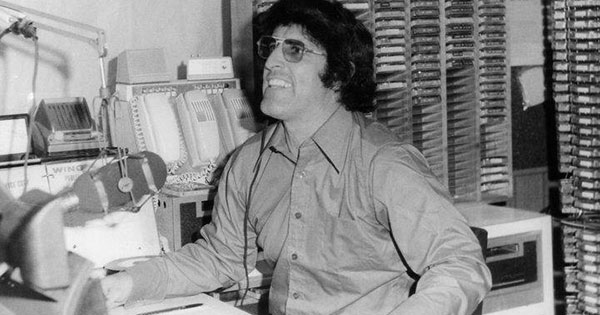
Dayton, Ohio, radio personality Steve Kirk ruled the Miami Valley airwaves for decades. Is there a need for this kind of talent in the 21st Century?
Radio is still around because, for the most part, stations and owners have adapted, shifting to digital platforms, streaming services, and podcasts. For example, this column’s podcast counterpart is featured on iHeartRadio, which operates more than 850 stations nationwide.
Additionally, over-the-air broadcasting remains a popular option, particularly in cars. Every week, approximately 92% of Americans listen to the radio—roughly 272 million people—proving that radio remains the dominant medium for commuting.
Local radio ad revenue, however, isn’t what it once was. In 2025, sales are expected to reach only around $2.4 billion—a sharp contrast to the nearly $22 billion radio generated just 20 years ago. Radio stations have had to rethink their business models due to stiff competition from digital platforms. Some have survived and prospered by embracing digital, while others struggle to keep the lights on.
Cumulus and Townsquare Media recently shut down twenty radio stations. Many of these were AM stations that had lost their audience decades ago, unable to compete with the convenience of streaming. While this thinning of the herd might seem like bad news, some argue it’s a necessary evolution—fewer stations mean less competition for ad dollars, potentially stabilizing the industry.
That said, AM remains profitable, thanks in part to FCC deregulation by Presidents Reagan and Clinton, and conservative talk programming has become its cash cow. Unlike the early 1980s, when call-in talk shows were relatively new, less restrictive laws eventually allowed companies to own and operate nearly unlimited radio stations.
Suddenly, extreme political hosts like Rush Limbaugh, who held the daytime ad money, reached millions over a network of AM stations. More entertainment-focused programs, such as Sally Jessy Raphael’s call-in show, also thrived, ruling the airwaves at night.
Then there’s traditional radio’s subscription-based cousin – satellite. Since its inception, satellite radio has been marketed as the premium alternative—no static, initially with no commercials, and a seemingly infinite selection of niche stations.
Satellite radio carved out a loyal audience, particularly among drivers who want uninterrupted entertainment on long commutes. SiriusXM, the dominant player in the satellite radio market, boasts over 34 million subscribers. While that’s a fraction of traditional radio’s reach, it’s still significant, proving that people are willing to pay for curated content.
Satellite radio offers exclusive content—think Howard Stern and live sports. However, it faces stiff competition from podcasts, which offer similar content for free. Streaming services like Spotify and Apple Music offer listeners more control over their audio experience, making it harder for satellite radio to justify its subscription fees.
Even with these checkmarks in radio’s “cons” column, in my opinion, there are still plenty of pros, so long as the medium continues to evolve. “Because that’s how we’ve always done it” isn’t a phrase anyone working in radio wants to hear from management these days.
Whether it’s delivering local news, playing your favorite tunes, or keeping you company on a long drive, radio is still a faithful companion for whatever you’re doing. If you don’t believe me, turn on your car stereo. Chances are, you’ll find something worth listening to.
An update from the Dayton Hamvention officials on May 28th reads as follows: The 2025 Hamvention set a new high attendance record with 36,814 attendees. The general chair, Brian Markland, said he felt fabulous about watching large crowds of amateur radio enthusiasts from all over the world enjoying exhibits, forums, and the flea market.
XENIA — Before cell phones or the internet, there was amateur, or “ham,” radio.
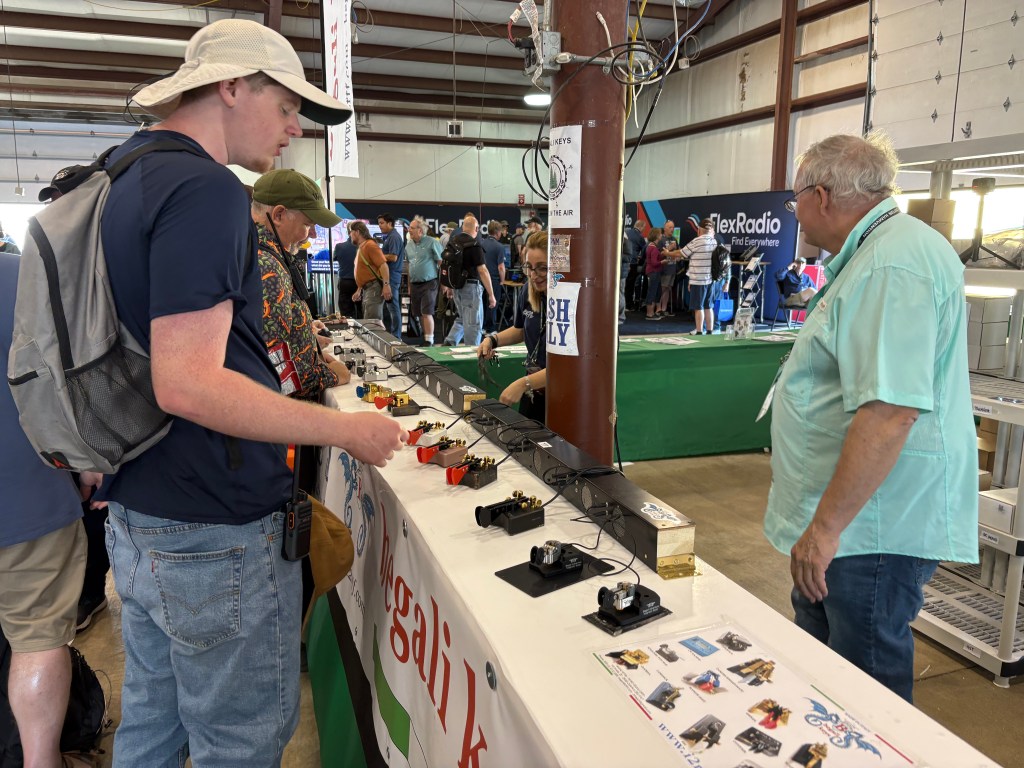
Once a year, thousands of enthusiasts descend on the Greene County Fairground and Expo Center in Xenia for the largest amateur radio convention in the world – Dayton Hamvention. Although final numbers will not be tallied for some time, organizers estimate that this year’s turnout exceeded the 35,000 attendees of 2024.
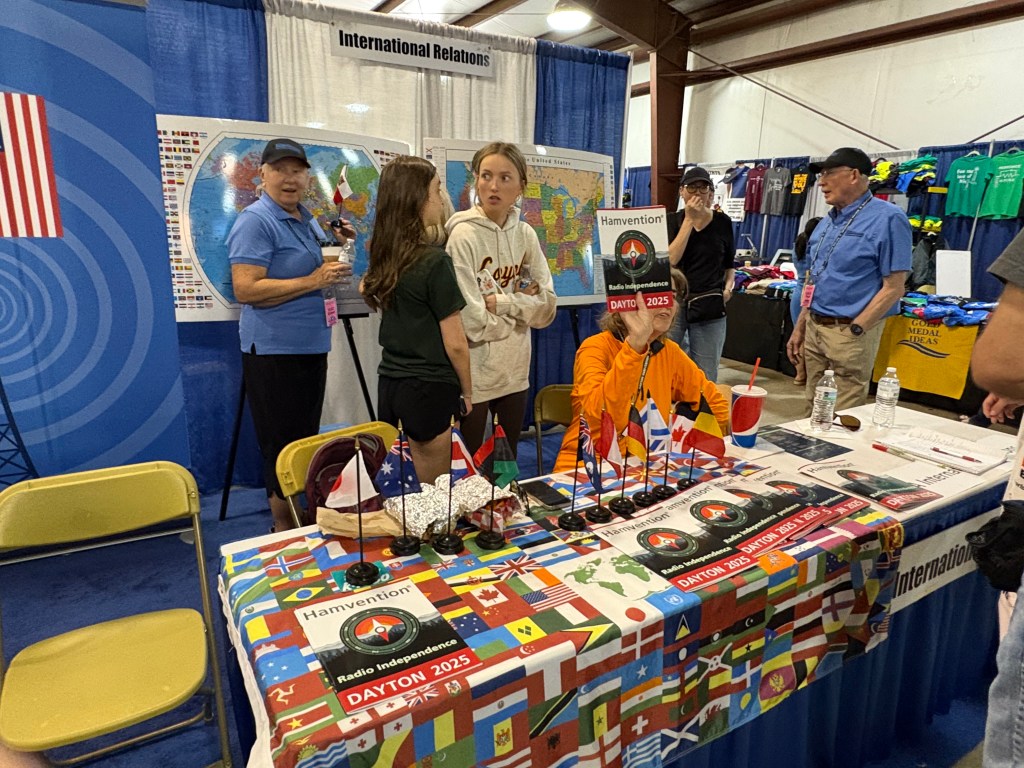
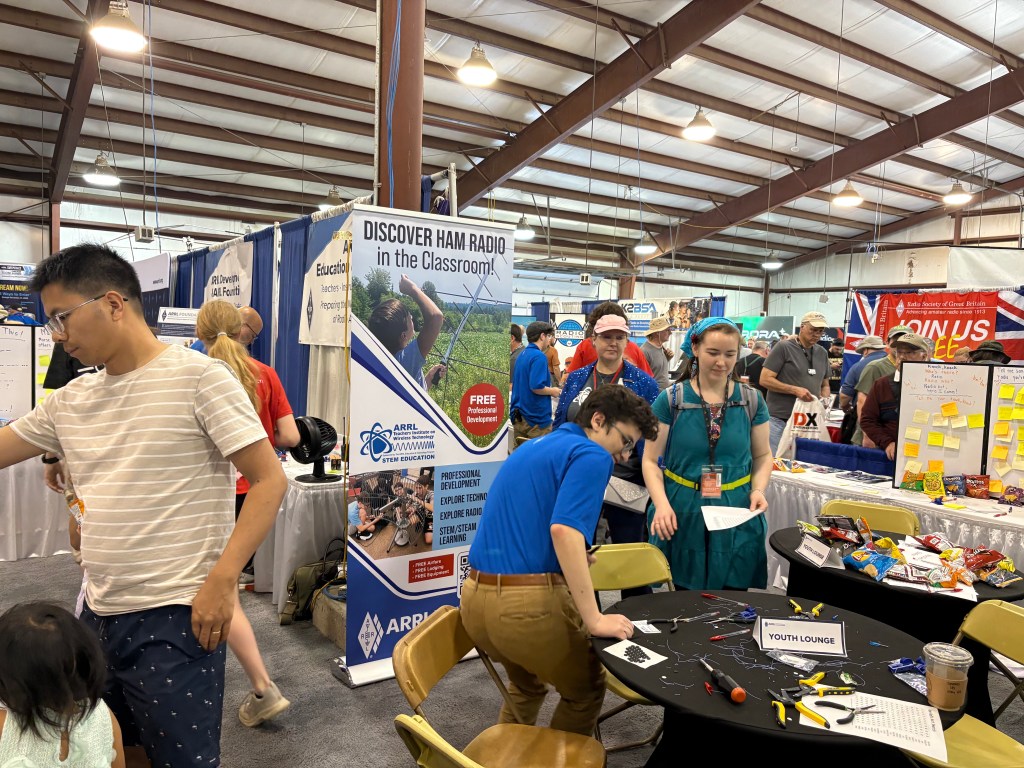
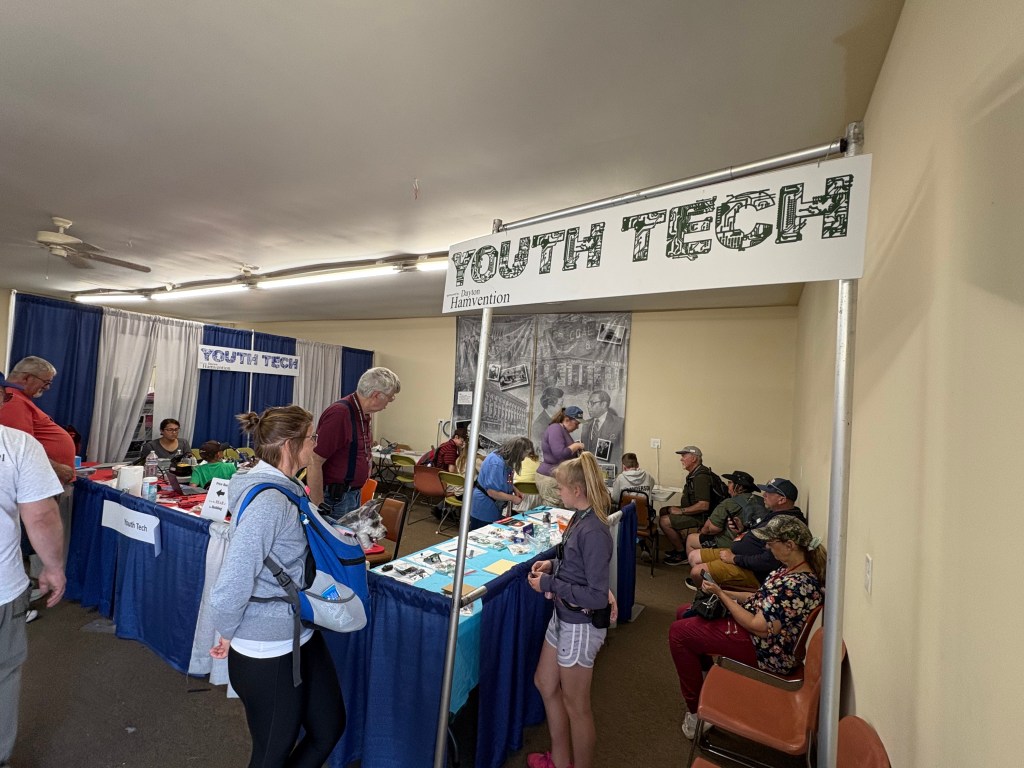
During Dayton Hamvention, participants from as many as 30 countries had the opportunity to see and buy the latest technology, attend educational and informational forums, sit for radio license exams, and take part in youth activities. This year’s event also included groups of young radio enthusiasts, organizations from all over the country made up of young people interested in both the analog and digital nature of amateur radio.
Jim Gifford, call sign N8KET, is the chairman of the media committee for Dayton Hamvention. He shared this year’s theme – Radio Independence – noting that what makes this event so important and impactful to the amateur radio community is the people. One of his favorite moments of this year’s event happened on Friday. “We had 73 students of the Community STEAM Academy (Science Technology Engineering Art and Math) in Xenia here,” he said. “They were really excited to learn how amateur radio relates to science and even space communication.”
With some 800,000 licensed ham radio operators in the United States alone, there is a remarkable sense of community among radio operators, regardless of geography. “It’s so nice for all of us in the local area to be able to come to Hamvention, but then you have to stop and think, this is a big ham fest,” said Glenn Rodgers, WI80, assistant chairman of the event’s media committee. “This is the biggest ham gathering in the world, and we’re so fortunate to be able to come to something like this in this area and it’s an honor to work here.”
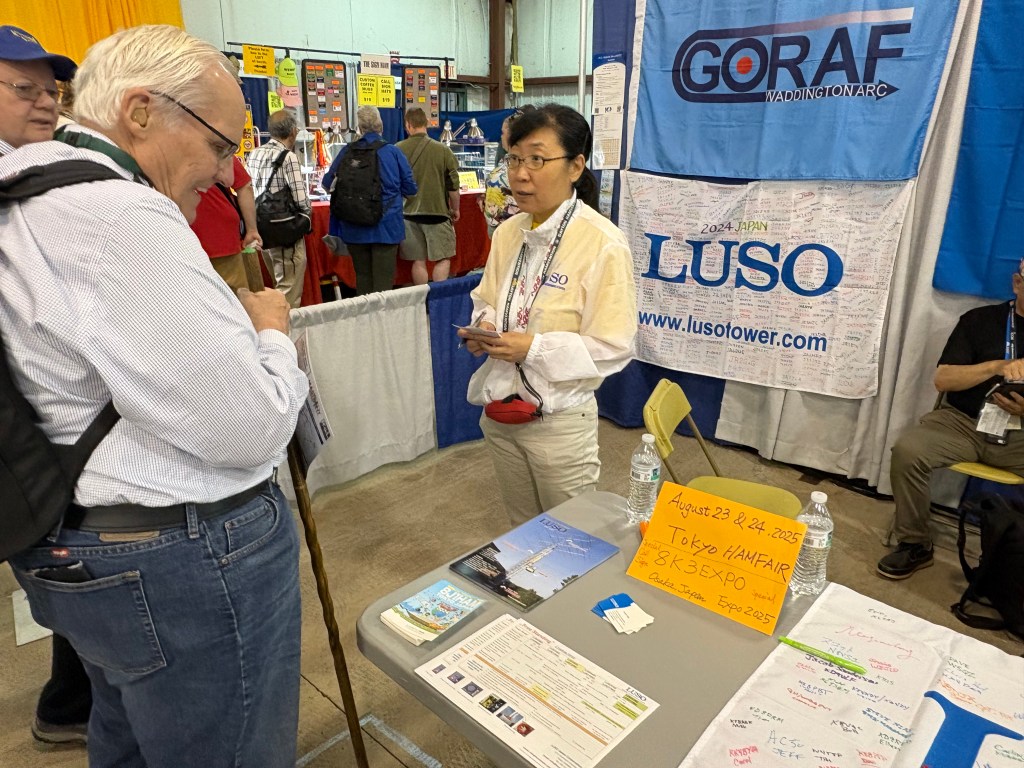
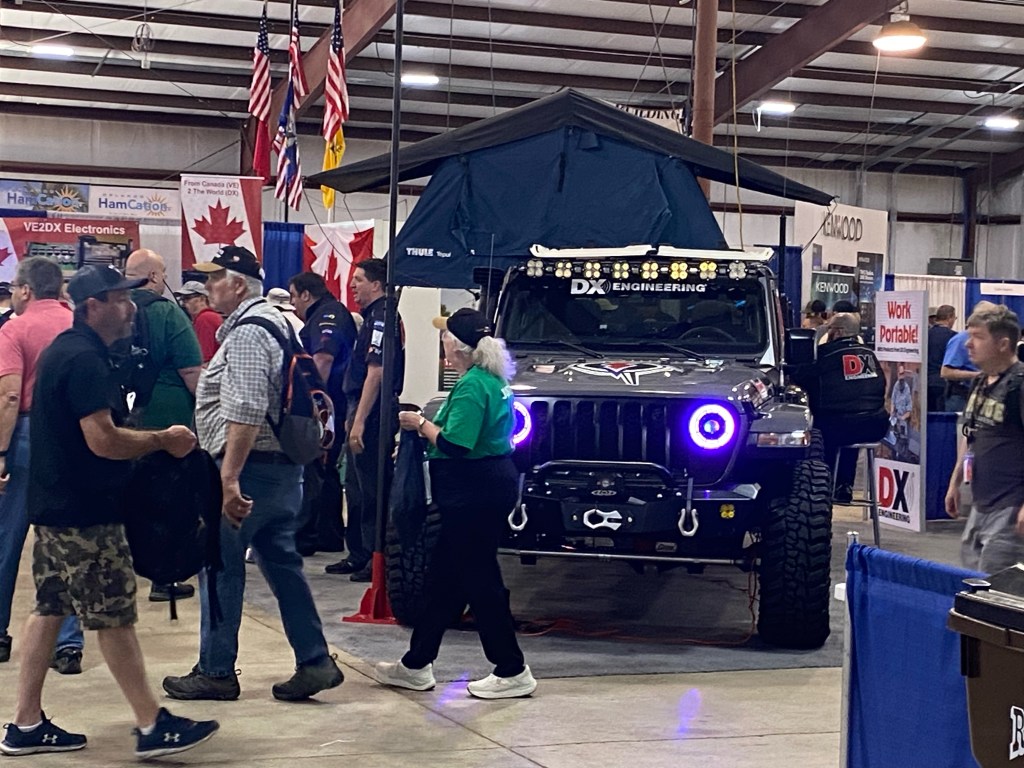
Amateur radio enthusiasts, vendors, and organizations from around the world converged at the Dayton Hamvention. Here’s a promotional booth for Tokyo Hamfair.
With such widespread interest, one might expect the world’s current geopolitical tension would hamper those relationships. According to Gifford, it does not. “We have a multitude of political views here,” he said. “But we’re ham operators, we take care of each other.”
“Because you meet people,” Gifford continued. “We talk to people all over the world. Just the other day, I spoke to somebody from Norway, and somebody from Italy, and it crosses barriers. It really does.”
Most amateur radio enthusiasts are known on the air, and to each other, only by their call sign, an alphanumeric identification given to each license holder by the Federal Communications Commission (FCC).
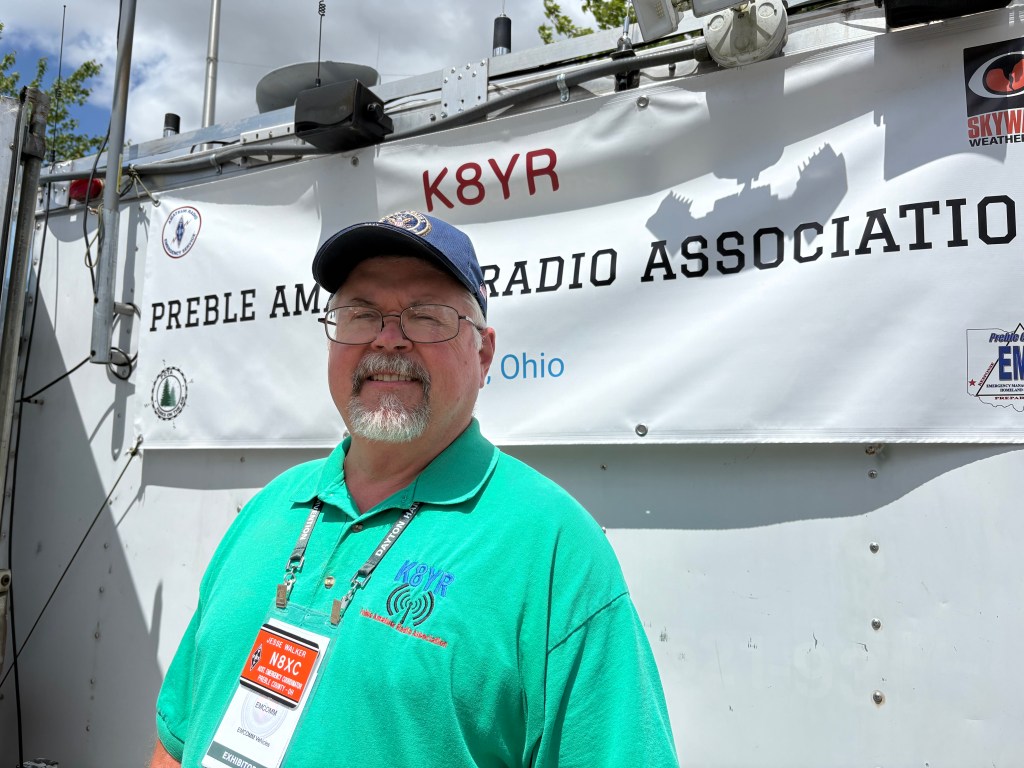
Jesse Walker, N8XC, is U.S. Navy Veteran, and business development manager with Aegis Protective Services in Eaton. He’s been involved in amateur radio since the age of 15. He explained that, although the call signs are assigned, they become part of your identity.
“Many of us only know each other by our call sign,” Walker explained, who is a member of the Preble Amateur Radio Association in Preble County. “Coming here, we get to meet face-to-face often for the first time.”
Both Rodgers and Gifford also noted that, apart from being a hobby for some, ham operators play an important role in the community during emergencies. “Amateur radio groups work as sky spotters during severe weather, they work with and support our area first responders, providing backup communications and volunteers during local emergencies,” Gifford said.
“Essentially, the Preble Amateur Radio Association is involved in public service,” said Jesse Walker. “We work with the Preble County emergency management agency. Our motto in amateur radio emergency service is, ‘when all else fails.’”
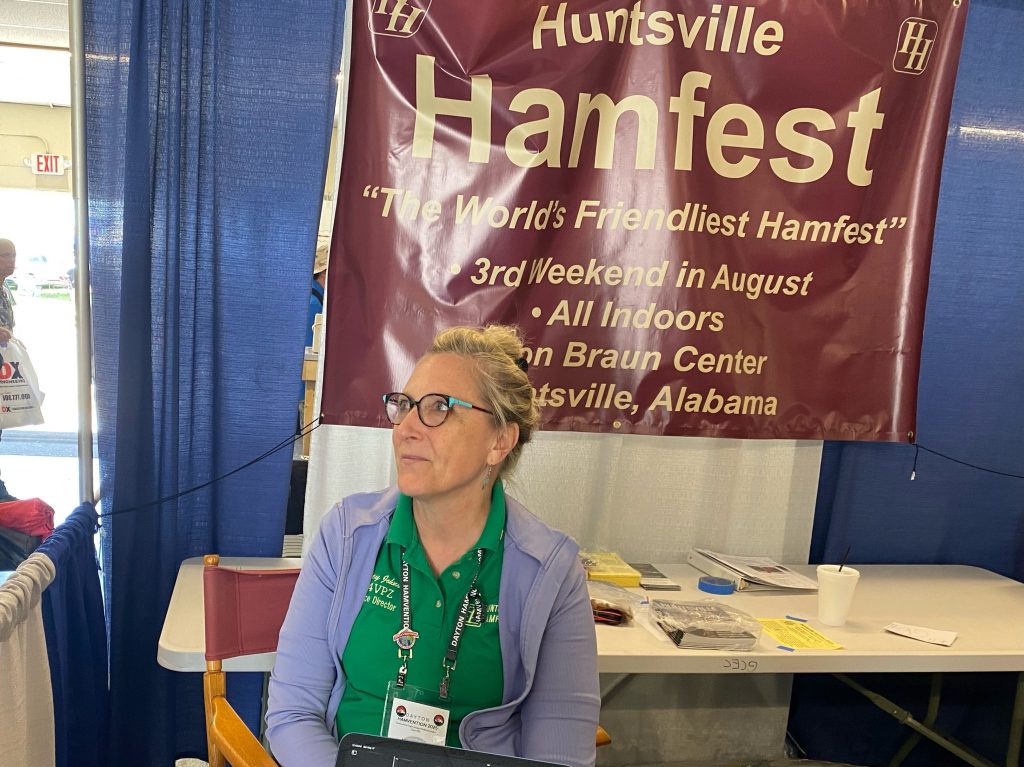
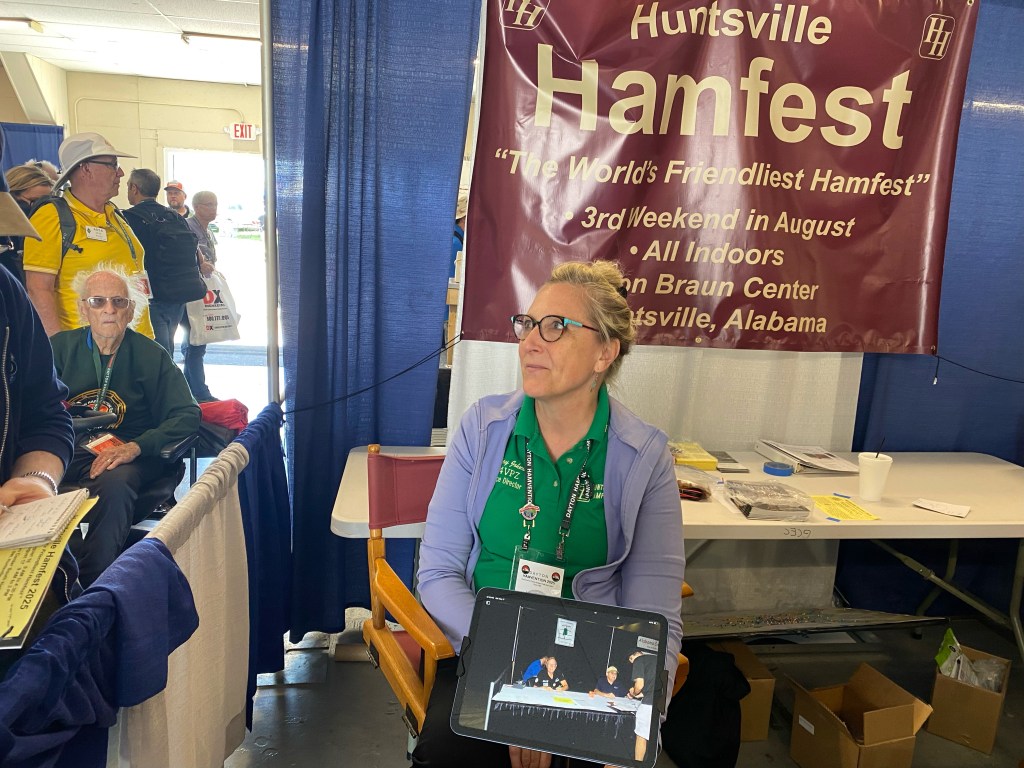
Other amateur radio convention organizers also attend to promote their own events. Huntsville Hamfest, held annually in Huntsville, Alabama, is one such organization. Mark Brown, N4BCD, is the chairperson for the Huntsville Hamfest Association. “Ours is the third largest Ham radio convention in the country, behind Dayton and Orlando, Florida,” Brown said. “We all cooperate and help support each other’s events.”
Mark Brown, N4BCD, and Kelley Johns, W4VPZ, (pictured) provided information about the Huntsville Hamfest in Alabama.
Brown suggested the consistent growth of these events and interest in amateur radio is due in part to younger people learning about its technical diversity. “I think to attract kids, we’ve got to show different aspects of the hobby, like the satellite communications, the youth on the air, and the parks on the air,” he said. “Get youth involved in it. That’s one thing these events do is bring all ages together.”
Planning for next year’s Dayton Hamvention is already underway. For more information visit hamvention.org.
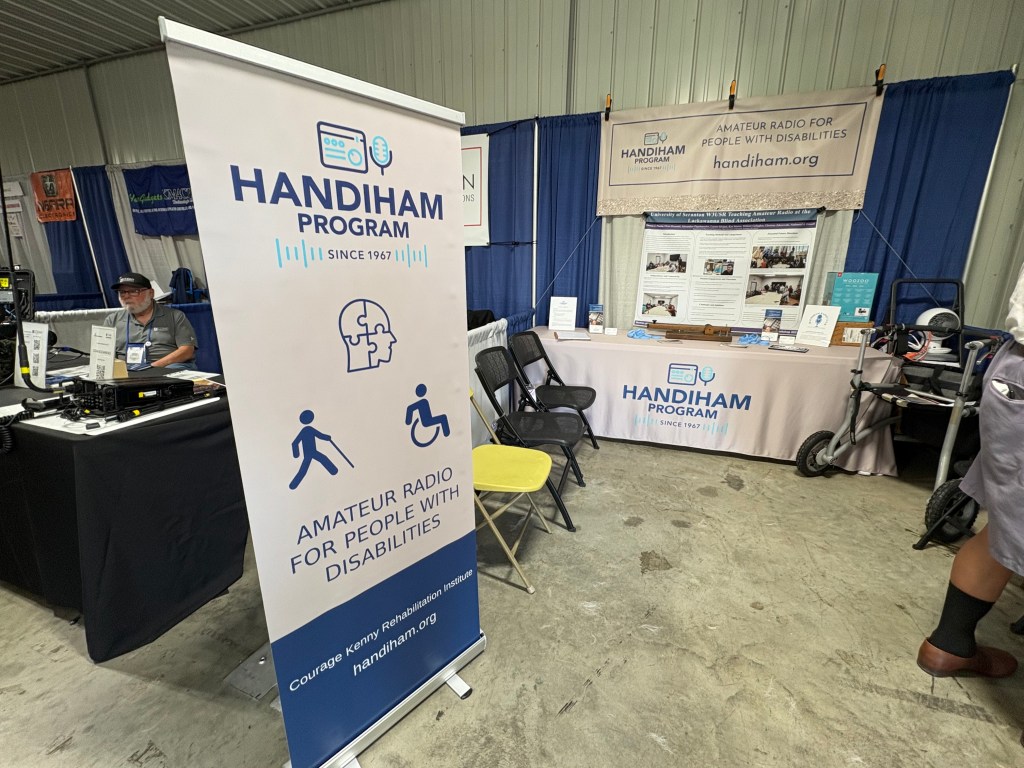
Glenn Rodgers and Jim Gifford, media committeeJesse Walker, N8XC, is U.S. Navy Veteran, and business development manager with Aegis Protective Services in Eaton.Flea market area had booth after booth of high tech and vintage technology.“Handiham” program provides connection for radio enthusiasts of limited physical ability.
I’ve been a freelance journalist for most of my adult life, going back to my days as a staff writer on a college newspaper. Since then, I’ve been published hundreds of times in everything from weekly newspapers to regional trade magazines. Much of my work consists of feature stories, opinion columns, and a few hard news pieces.
I was trained by an old-school newspaper editor who demonstrated consistent ethics and integrity. I was taught never to take a story to press without three primary sources and on-the-record statements from those directly involved to back up the information.
As the Internet became an easy way for the citizen journalist to publish news and information, credibility and fact gave way to sensationalism and uninformed opinion. Click bait replaced proper headlines. Soon, what was once referred to as “the press,” was suddenly renamed, “the media.” In this reporter’s humble opinion, they are not the same.
Webster’s Dictionary defines media (plural of the word medium) as a means of communication, such as radio, TV, newspapers, social, the internet, and so on. In other words, it refers to the delivery system rather than the content or its source.
For example, social media is a primary source of news for many Americans. Unless the information originates from a reputable news source, the content may have no oversight, no editorial integrity, no fact-checking, nothing.
You may have no idea where the information came from or how it may have changed. Think of it as a game of telephone. The more the word spreads, the less accurate it becomes. To reiterate, the social media platform (or app), such as Facebook, X, or Instagram, is just the vehicle – the medium. Reputable or not, the message originates elsewhere.
“The Press,” on the other hand, is guaranteed by the First Amendment of the U.S. Constitution. Like the three branches of government, it’s literally set up right there in black and white – which is why it’s called the Fourth Estate.
The Press should serve as a watchdog to help hold those in power accountable and provide the public with the information they need to make informed decisions. Trained Press journalists gather facts, verify information, and present it objectively across a variety of media.
A functional and qualified Press works within the realm of fact – not truth (that’s for philosophers). It should present information without bias or commentary (there’s a page for that and you’re looking at it now) and demonstrate integrity in the process.
Before I have people shouting at the screen or tearing up the paper, I agree the problem of misinformation spread by so-called news outlets is in epidemic proportions. Unfortunately, many news agencies have traded integrity for revenue, to say nothing about a complete disregard for journalistic expertise.
Cable news programs often fall into this category. They base their content on current news stories, targeting the biases and interests of a single segment of audience to grow advertising revenue. This is not news – it’s entertainment.
Even worse is when a news outlet censors content to favor the business or political interests of their owners. For example, once a paragon of investigative journalism, “The Washington Post” is rapidly losing credibility because of interference with its newsroom by its owner, Amazon founder Jeff Bezos.
Between social media, so-called citizen journalists, bloggers, and whatever else is out there, unvetted, unqualified, and often false content is cranked at an alarming rate. Their goal is to spread as much click bait as possible and deliver customers to advertisers – it’s all about money. That makes it hard to sift through the noise for qualified, factual news.
In the end, the Press should be rooted in ethics and accuracy. Sadly, many news outlets now prioritize profit, sensationalizing content to stay competitive in digital media. That’s muddied the journalistic waters, making it harder for the public to distinguish between fact and opinion.
My only advice is to check the source and remember that perspective isn’t the same as bias. News should be factual and accurate, not “fair.” There is no such thing as “fair and balanced” news. Fairness suggests compromise, whereas facts stand alone. The standard should be: is it factual, or not?
According to the National Kidney Foundation, more than 20 million Americans are affected by renal (kidney) and urological conditions. It goes on to say that millions more, currently unaccounted for, are at risk. The causes range from congenital issues to diseases that affect the urological system.
I happen to be in the category of the former. In March, I’m joining a couple of hundred other patients, caregivers, and advocates to meet with congressional representatives about more support to care for, as I will explain in my case, adult patients with congenital urological conditions.
I was born with a rare condition known as bladder exstrophy. It affects about 40,000 people worldwide, and only a few specialty hospitals in the United States specialize in the predominantly pediatric component of treatment. As a child, I was treated in Dayton, Ohio, by some of the best pediatric surgeons in the country who were, it’s safe to say, figuring it out as they went. But they did a tremendous job, and here I am.
From just a few hours old, I was looked after by a contingent of physicians and specialists in what I’ve come to refer to as the “pediatric bubble.” My healthcare providers communicated with each other and consulted on various issues as they perfected this procedure or completed that surgery. As complex as it might seem, my parents were kept well-informed and had direct lines of communication with my general practitioner and my surgeons.
Unfortunately, once you hit about 21 or 22 years old, your pediatric bubble bursts and you are unceremoniously dumped into the world without proper adult urological care. Fortunately, my pediatric surgeon handed me off to someone he trained with, an adult urologist who looked after me for 25 years until his recent retirement. For the first time in my life, I was without a specialist, and my particular problem created a barrier to finding new care.
This situation is familiar to patients with many congenital conditions that carry over into adulthood. To maintain continuity of care, most continue to see their specialists for decades, long after the primary reconstructive surgeries are complete. Thankfully, I was left with few residuals as I grew up, but maintenance needs require somewhat more specialized attention. In addition, as patients age, their physicians must know something about the situation.
Bladder exstrophy, or BE, like many other congenital problems, requires a specific set of surgical skills, reconstructive knowledge, and urological and renal expertise. There is also a critical shortage of practicing urologists. All of this, combined with the potentially long-term commitment to the patient, leaves most urologists choosing not to treat BE patients, and therein hangs the problem.
Enter the Association for the Bladder Exstrophy Community, or A-BE-C, and its newly formed Adult Patient Advisory Council (APAC), of which I am an organizing member. While A-BE-C’s global mission began as primarily pediatric, the advisory council was established to provide resources for adult patients. The goal is to ease the transition from pediatric BE care into adulthood. That’s where me and my plane ticket to Washington, D.C. come into the story.
I’ll represent our organization at the American Urological Association’s annual patient advocacy summit. It’s an opportunity to share these concerns and potential solutions with congressional representatives.
I hope they’ll listen to some of my ideas, including a subsidy or tax credit funded to help encourage young doctors to specialize in urology and, even more so, help them to dedicate some of their practice to adult BE care. With all the tragically unsympathetic, uninformed budget cuts, I wish I was more optimistic. But I will still try, and you may be able to help.
Patient advocacy isn’t about awareness and support. It’s about action. Sadly, urological problems are generally the subject of lousy humor, ignorance, and ageism. But I assure you, there’s nothing funny about it for the patients and caregivers. For them, it’s a daily struggle to maintain proper care.
You can help by following A-BE-C on social media and sharing educational content. You can also contact your congressional representatives to remind them about this. These patients don’t need more research. They need qualified specialists and the peace of mind that their cause matters.
Imagine it’s 2030, and you sit down at your digital interface to send an email. A wave of your hand over an invisible sensor brings up a holographic menu that floats before you. Just thinking about what you want to say activates an artificial intelligence (AI) chip implanted in your head, and text appears on the holographic page without a single word.
Across town, an artist stands before a digital canvas. Imagination and inspiration spiral through her mind, and she waves her hands like a sorcerer conjuring magical images out of thin air. Colors and patterns appear on the canvas, enhanced by the AI built into the electronic easel. Within moments, a brilliant painting has been created that will sell for thousands in an online gallery.
In the heart of the Midwest, a racetrack grandstand is filled with spectators. They wave banners, cheer, and call out to their favorites as the field speeds around the track. But there are no Dale Earnhardts or Danica Patricks behind the steering wheels of these unbelievably quiet vehicles.
There aren’t even steering wheels. These cars are electric and entirely autonomous. Advanced, self-driving AI technology pilots the cars in fierce, robotic competition. Skilled drivers trained the AI well before the race, but now the cars compete with each other, and millions of dollars in sponsorship and sports betting are on the line.
Sounds crazy, right? Not that long ago, all this would have been the stuff of science fiction, but we’re not as far from it as you might imagine. Although, you don’t have to because the AI is doing the imagining for you. Well, sort of.
Before I get into all that, some full disclosure. As someone with a highly technical education and professional background, I agree AI has some amazing potential. We’re seeing incredible applications in medicine, logistics, customer experience, fraud prevention, and communications. At the same time, technology has once again advanced faster than our wisdom. The fledgling technology is increasingly misused as a means of cost reduction by eliminating the need for creatives.
Human nature to date implores us to find the quickest route to success, and AI offers that very thing – especially to the do-it-yourselfers. Why train and compensate a person when the computer can handle the job without benefits or sick days?
Skill, expertise, creativity, integrity, and inspiration become valueless if the job is handed off to an AI bot. Can artificial intelligence and creativity coexist? That depends on the user. The real question we should ask is how the technology is applied in any given situation.
AI has neither inspiration nor imagination. Contrary to popular opinion, AI can’t “create” anything. It only assembles information from known sources, organizes it based on the required parameters, and then spits it back out in the requested pattern. Everything is driven and interpreted by the user, including the result.
True creativity comes from the person, the human being who holds the pen, the brush, the welding torch, or the race car steering wheel. Unlimited, on-the-fly, daredevilish creativity is inherent to the human condition. For most people, however, it goes unrealized because of circumstance. This fledgling technology may mature to help those people fulfill their creative potential.
Without emotional intelligence or ethical considerations, AI is a potential devil in the dark. The creative world scrambles to adapt to a technology poised to devalue it. But it doesn’t have to be that way. With thoughtful imagination, professional ethics, and a healthy dose of common sense, human creativity can flourish and even take ownership of the technology.
Again, my only issue with the technology is its ethical application. AI’s value is unlimited if used to benefit rather than replace the process. If they haven’t already done so, creative professionals should begin to apply AI tools, but not as a substitute for artistic imagination – it can’t do that anyway. Instead, use these tools to free time from repetitive tasks, analyze online and social media data, facilitate collaborative efforts, and streamline production.
The goal here is not to yield to the buzz but instead benefit from the potential. Deliberate motivation toward applied expertise in artificial intelligence offers another tool for creative augmentation and increased professional value.
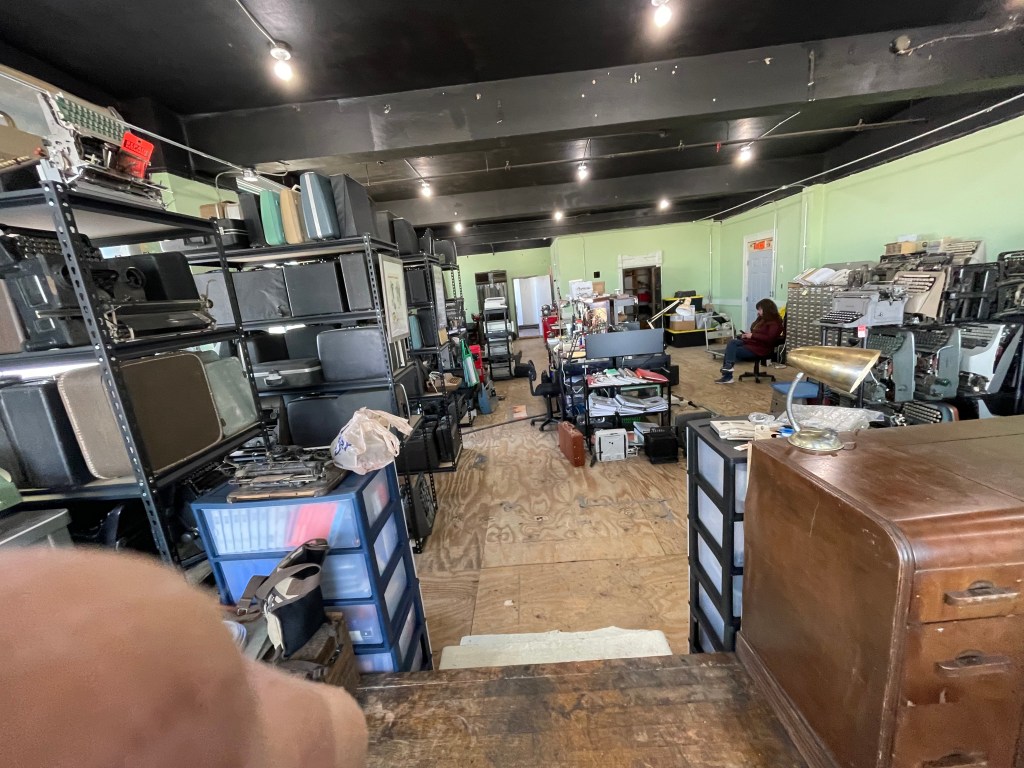
In a once abandoned sewing machine and bicycle factory on the corner of Linden and Davis Avenues, in an old, industrial section of east Dayton, Becca Brumfield carries cooler bags up two flights of stairs with two small children in her wake. At the end of a massive hallway on the top floor, they arrive at a door labeled “TB Writers Plus.” She taps a code into a keypad, an electronic lock opens, and the kids pop through the door ahead of her like prizes from a gumball machine.
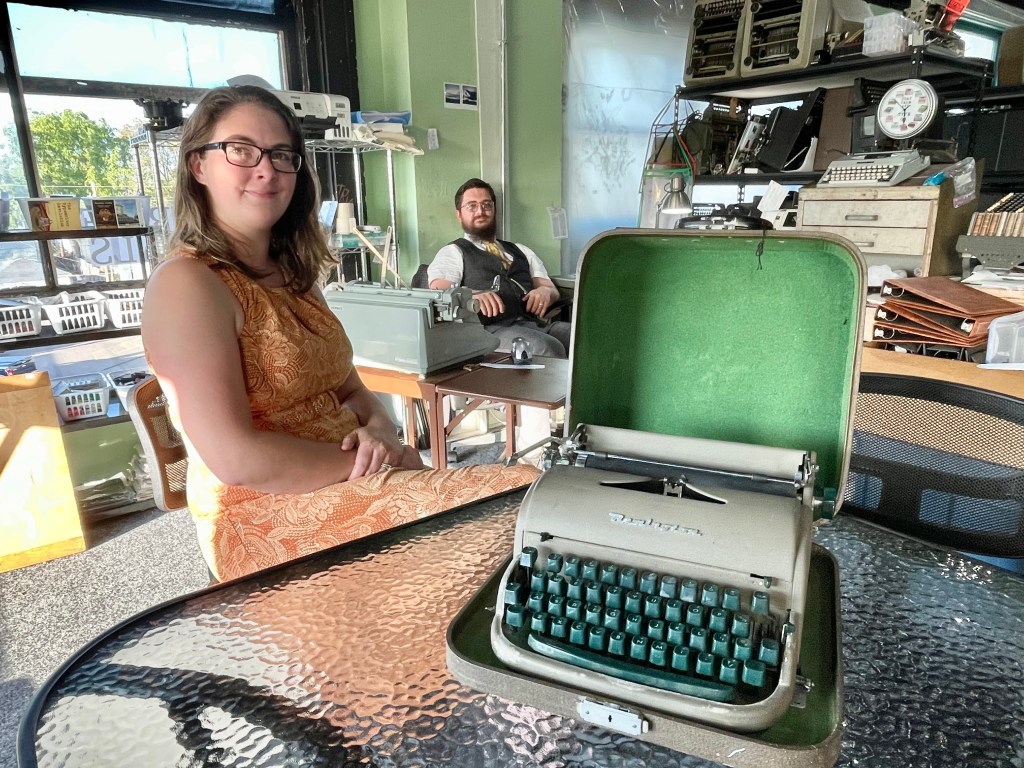
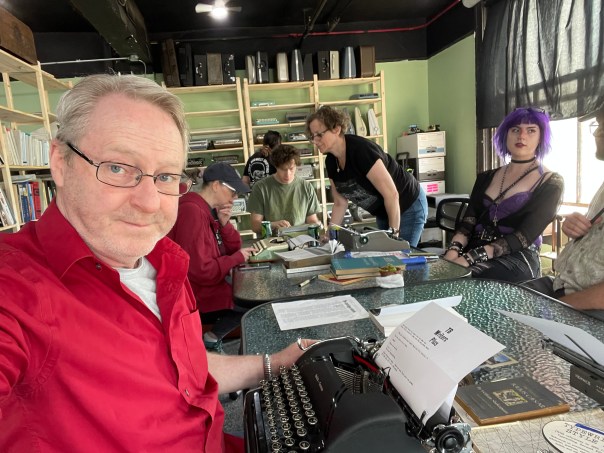
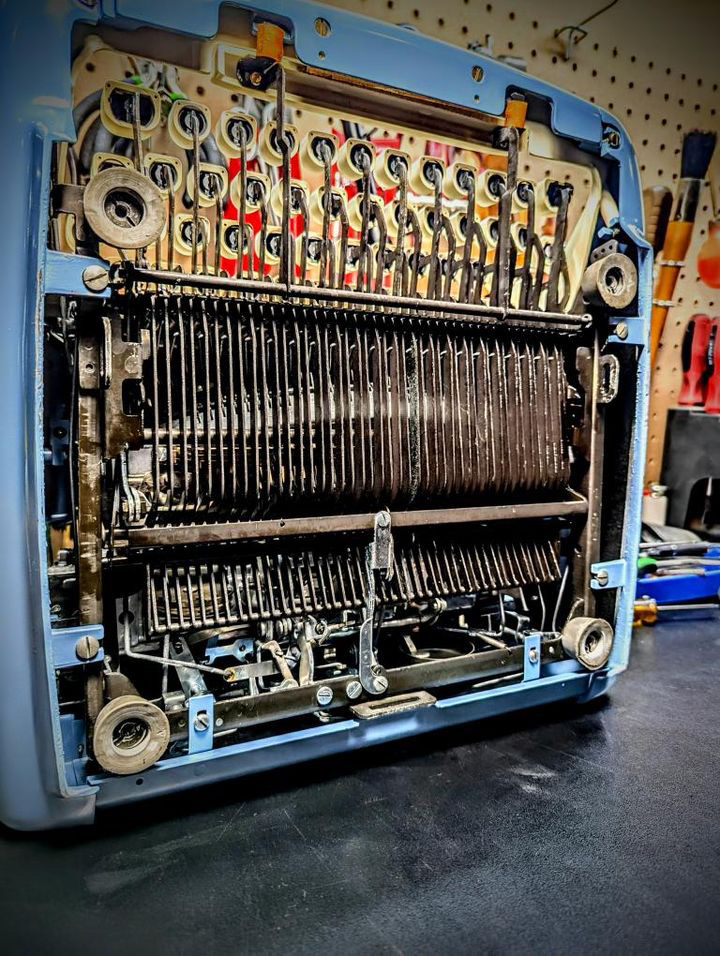
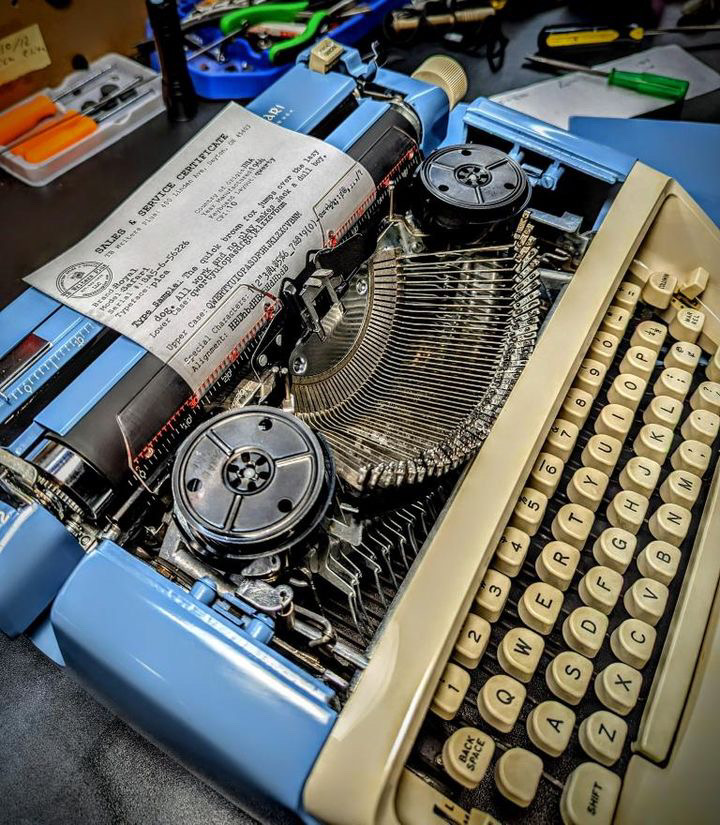
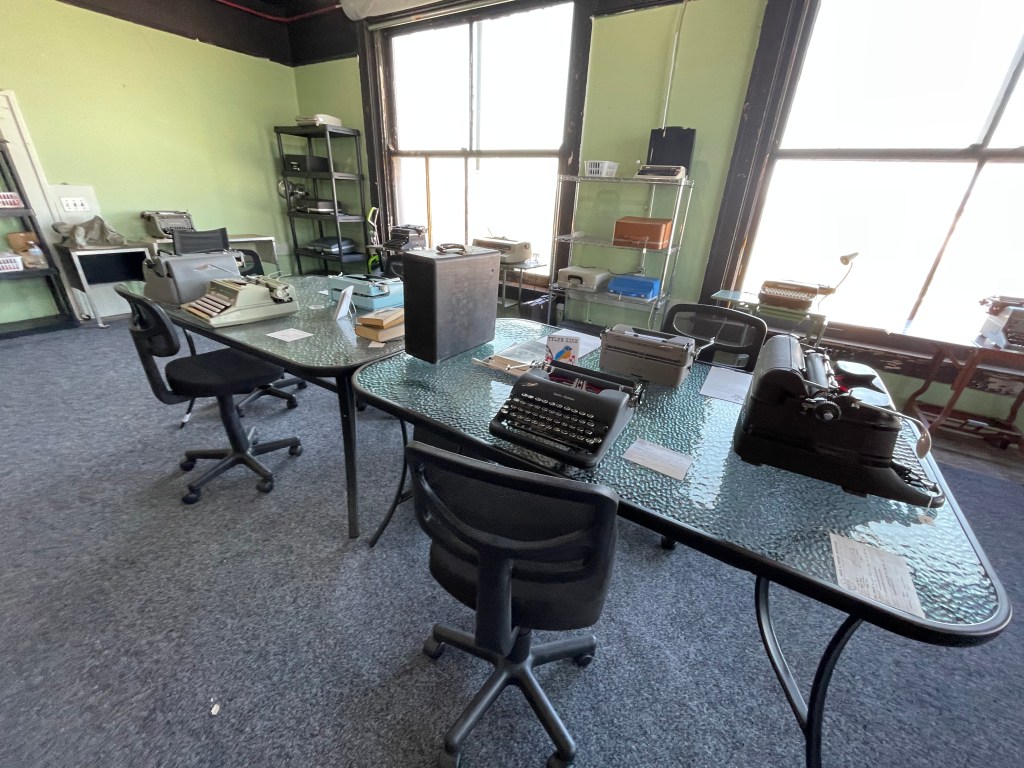
They pass workbenches and shelves loaded down with antique typewriters. On an elevated platform at one end of the room, a long glass table is flanked at one end by a floor-to-ceiling shelf of refurbished typewriters for sale.
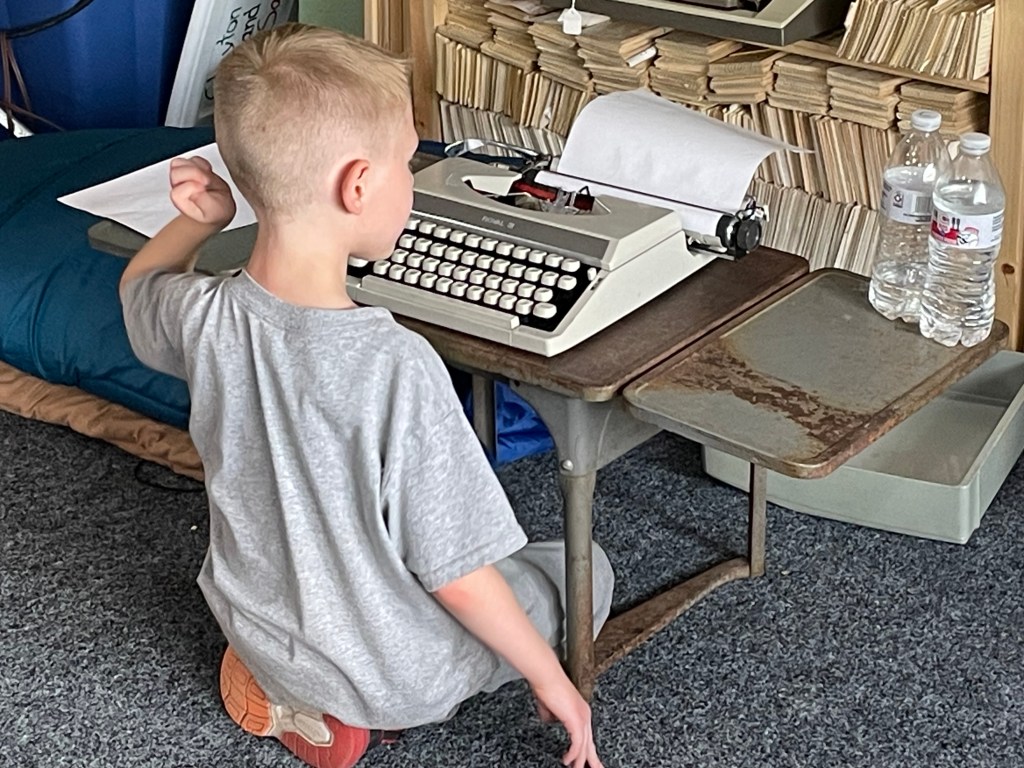
Becca lays out place settings and dishes up the food. Young Clayton, 6, and Sam, 5, who’d immediately started playing on typewriters and drawing, clamber to the table and plop down to eat. Her husband, Trevor, joins them. One of their employees sits down, too, and now it’s a typical evening at their typewriter shop.
Becca and Trevor Brumfield at TB Writers Plus in Dayton, Ohio.
The Brumfield family started down this path more than a year ago when Trevor bought a typewriter online, repaired it, and started using it. Before long, he lost it to his wife and, as he puts it, “Naturally, had to buy another one.”
“That turned into several more, which became 60, which turned into 100, and that became, I gotta sell some of these,” Trevor laughed. A full-time auto mechanic, it might seem odd for someone just 26 years old to start down such an arcane career path.
Over the last twenty years, typewriters have seen something of a renaissance. Fueled first by internet insecurities and one enthusiast’s declaration of a “Typewriter Insurgency,” writers, artists, business professionals, and college professors continue challenging the digital paradigm. “It’s not a booming industry,” Trevor admitted. “But the interest is there, and business goes in waves.” The industry got a secondary boost from the recent Taylor Swift video, “Fortnight,” which featured the megastar with an old Royal 10.
Taylor Swift’s Royal 10 in ‘Fortnight.’
Swift had them as props, but a few famous people are actual typewriter fans and users. Most notable is Tom Hanks, whose collection and passion for the machines are well known. The exposure has helped Trevor’s shop steadily grow. “I’m not sure exactly how many machines we have serviced in total,” he said, noting the expansion from his home garage last year. But we can typically get through 30-50 machines a month depending on what needs to be done to each.”
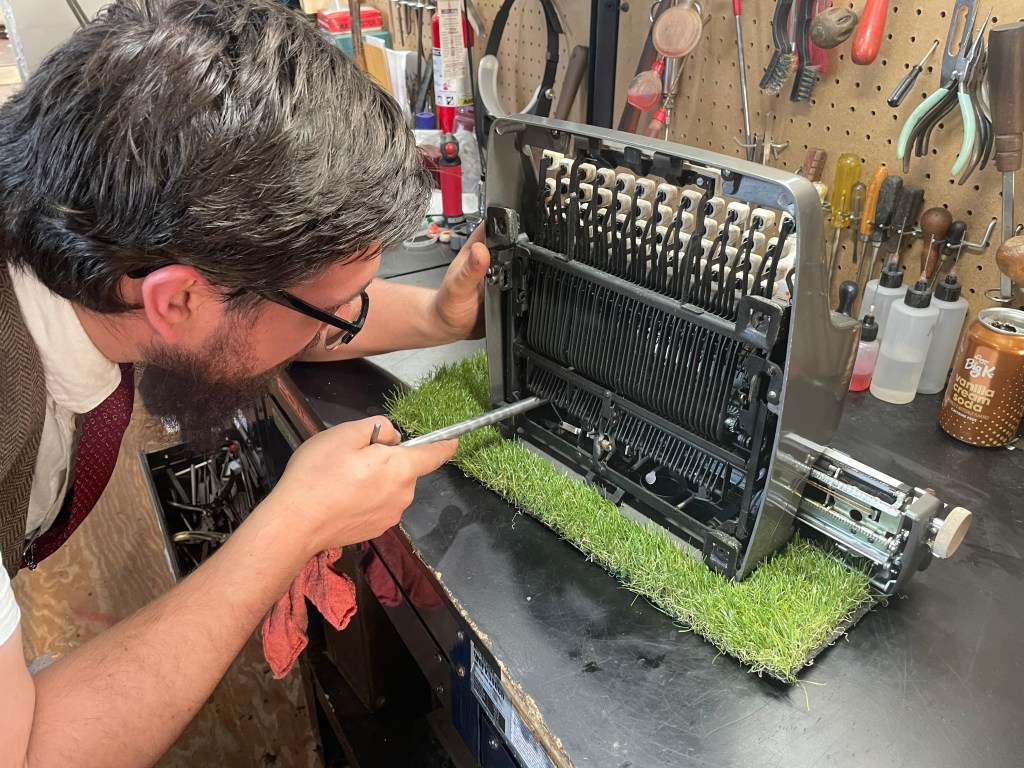
At last count, TB Writers Plus has inventoried more than 600 machines. Many are cannibalized for parts, and others are refurbished for sale. Trevor does the bulk of that work but has also trained Becca. An atmosphere of learning and openness permeates the shop. No organized training program exists, and factory training was discontinued years ago. Everyone who works here is an unofficial apprentice.
PART II – HE DOESN’T DO IT ALONE
Three part-time employees, Tyler, Keenan, and Torii, have been learning on the job, guided by Trevor’s experience. Each tackles the intricacies of these incredibly complex machines in their own way.
Tyler Lewis, of Fairborn, began as a technician in November 2023. “I mostly refurbish and repair, taking apart the machines, cleaning them, and putting them back together.” He learned about TB Writers Plus from an article in a local zine. A zine is, in his words, “An underground, independent magazine that people publish usually by using copy machines.”
Tyler should know since he’s the primary writer and publisher of his own zine, appropriately named “Tylerzine.” He was working at the Wright State University college newspaper and pitched his own article idea. “I met Trevor, immediately liked his openness, and ended up hanging out that first day for like six hours,” he said.
He sits at a typewriter loaded with purple ribbon and cranks out a short poem based on a prompt suggested by someone else in the room. Tyler’s passion and personal brand of artistic expression suit the typewriter world. “My entry point has always been the literary aspect of typewriters,” he said. “I am a devout believer in language, so what typewriters represent as a means of expression greatly appeals to me.”
Technician Keenan started as a hobby when Trevor was still working out of his garage back in 2023 but took some time off for school. The 28-year-old Kettering resident came back in May of this year. “I wanted to learn more about how typewriters work, and it was an enjoyable way to spend my time,” he said.
“I enjoy the simplicity of the process compared to modern technology that feels invasive at times,” Keenan explained. “It’s just a simple typewriter on the workbench that needs fixing. Nothing more, nothing less.”
Tori’s B checks out a 1930s era Smith-Corona manual.
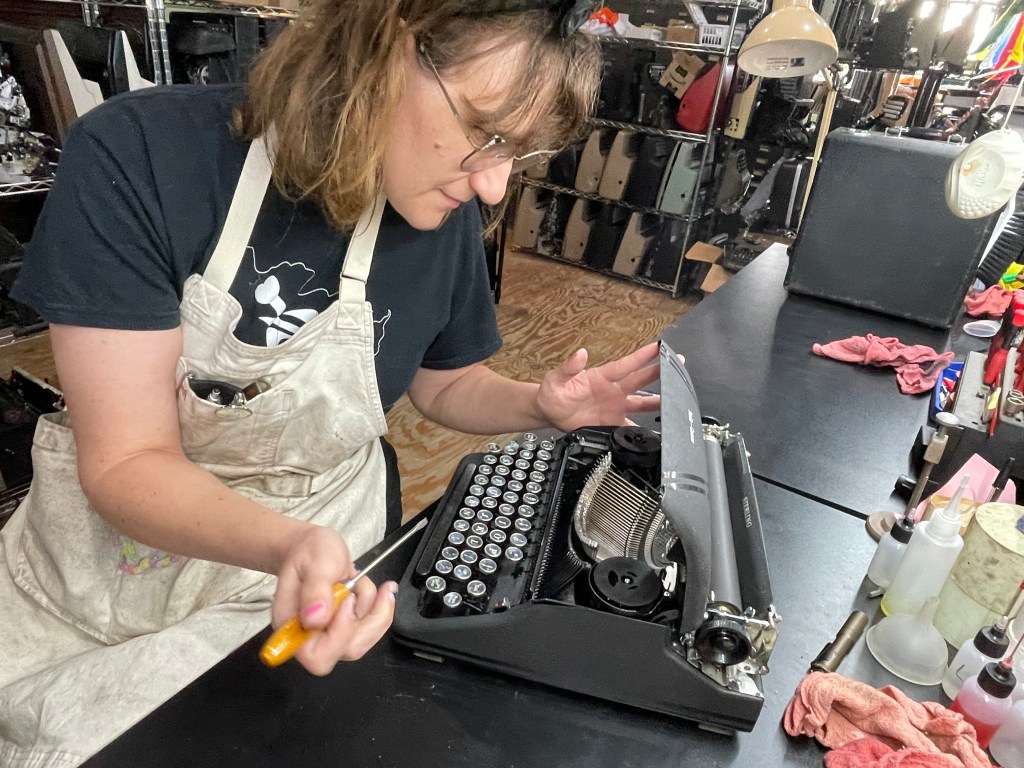
At the workbench, technician Torii B, from Bellbrook, hovers over an antique Smith-Corona. She scrutinizes the machine, evaluating any repairs needed before it’s put up for sale. Torii is a 36-year-old marketing and design professional and working mom. Although she has freelance design clients, she left a full-time marketing job last May. She’s applied for permanent positions in her field, but nothing’s been a good fit so far.
About a month ago, a friend told her about an anachronistic typewriter repair shop whose owner sought part-time help. As it happened, she and the friend have a role-playing game involving type-written note cards and the adventures of two fictional journalists. Her interest peaked, she reached out to TB Writers Plus, and before long, she signed on as a part-time tech and general worker.
Her diverse background fits this very mechanically oriented job. “I went to school for visual communications,” Torii said, pausing momentarily. “But, before that, I studied mechanical engineering.”
“I like the physical act of working on the machines,” she explained. “Watching the machines move keeps my mind like a well-oiled machine. Each one is like solving a puzzle.” She points to three small containers, each filled with tiny machine parts, springs, levers, and knobs. Her task is identifying and cataloging them for future repair work. It might seem tedious, but there are no more typewriter parts in production. Every part salvaged is vital to the shop’s operation.
PART III – THE TYPEWRITER COMMUNITY
A team can only function well with good leadership, and this one is no different. Trevor is doing his best to help his crew find their way. “Each works a little differently than their coworkers and has their own skill set,” he said. “Tyler is really good at detail-oriented work. Keenan’s strength is getting a lot of work done quickly. Torii is still finding her place in the shop,” Trevor continued.” She’s helped us with inventory ideas and graphic design and handles other odds and ends around the shop.”
Trevor Brumfield adjusts a 1955 Royal Quiet De Luxe.
Trevor’s interests and skills are well-suited, and he clearly enjoys this work. But what he likes most about the job is the people. “All of our customers treat my shop like a safe haven. I’m not sure why, but people drop their guard when they walk in here,” Trevor explained. “We’ve heard some crazy stories from people; war stories, childhood traumas, business plans, just about anything you can think of.”
“We have customers that will leave work in the middle of the day just to come here to vent because they are having a bad day. Next thing you know, they’ve been here for 3 hours, and their boss is calling.”
Brumfield’s modesty won’t allow for his own kindness and personability as reason enough for people to gravitate to him and his family. “I don’t know what it is about this place that makes people feel so at home, but I don’t think it is just me – or any one person here. But as soon as they walk in, they get this look like they just had a weight removed from their shoulders.”
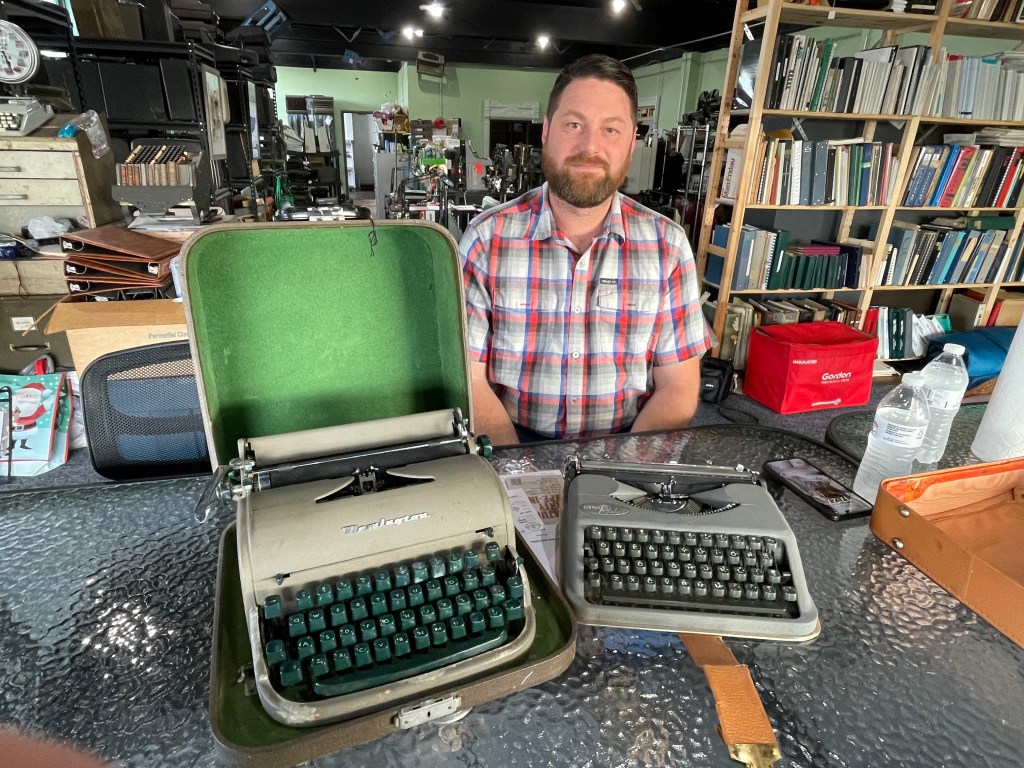
Customer and typewriter enthusiast, Greg Parker, of Urbana, Ohio, with two of his growing collection.
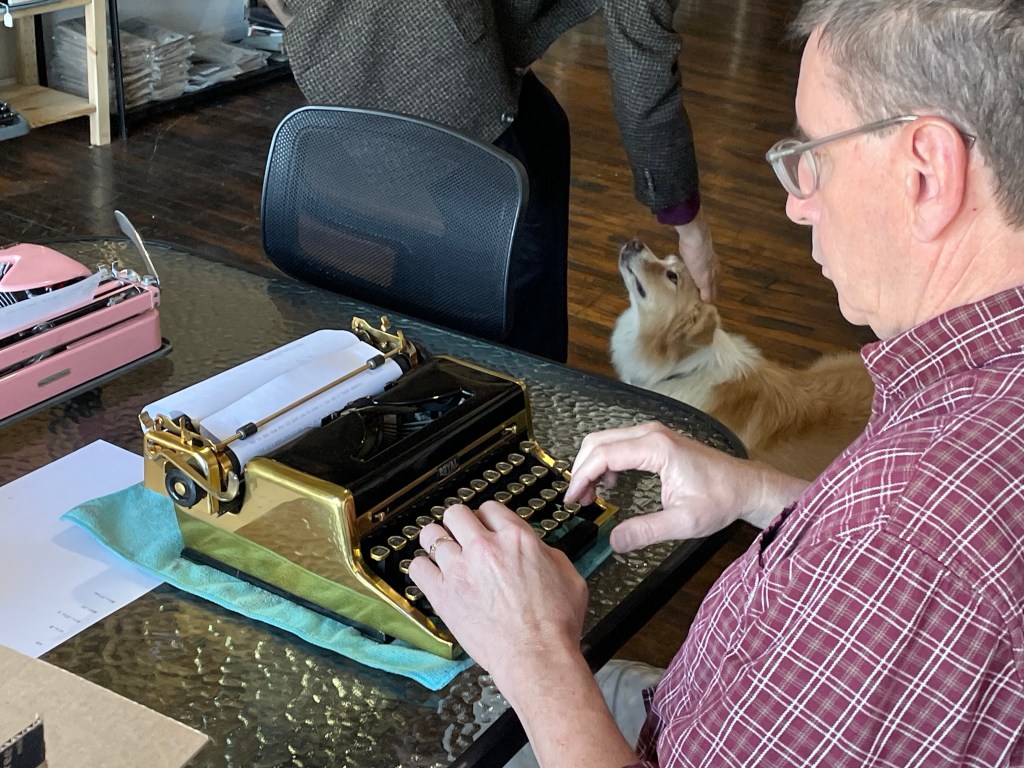
TB Writers Plus customers are an eclectic mix of artists, collectors, and businesspeople from all over the country. Greg Parker, for example, is from Urbana and has purchased three typewriters from the shop. The 40-year-old, married Army veteran has been collecting typewriters for about ten years. He currently has seven, including two Royals, an Underwood, and an Olympia. He explained his interest in the machines is mainly about the experience.
“I grew up with typewriters and used them when I was young,” he said. “But I really like the aesthetics.” Parker’s not a writer or artist but a welder by trade. “I do some journaling, and I have some memoir stories I’d like to put down on paper someday,” he said. “But I feel like I was born too late, like in another time. I enjoy the mechanics of the machines. The sound and the feel are very different from a computer. When you type something on paper, it’s like you really created it yourself.”
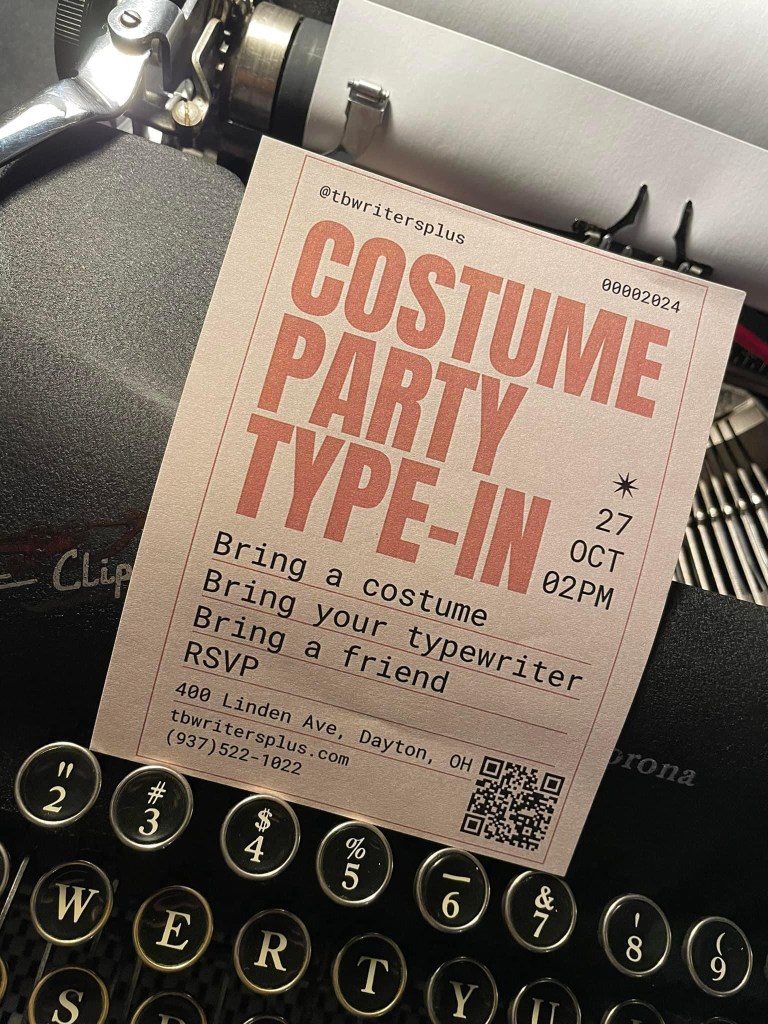
“Type-ins” attract enthusiasts from all over the country for a common purpose. TB Writers Plus has hosted several, including a costumed Halloween event and a 4th of July fireworks type-in.
Creativity and the personal connection with a simpler time is common throughout the typewriter community. For example, on Sunday, October 27th, TB Writers Plus is hosting a costumed “type-in” event, encouraging people to come dressed in the same era as the typewriters they bring. Type-ins are most easily explained as cruise-ins for typewriter enthusiasts. Scattered around the country, these predominantly social events, provide the opportunity for aficionados to talk typewriters, socialize, and even do some typing.
Back at the dinner table, the boys are no longer interested in their meals and require some encouragement. Trevor digs into his food as he and Becca talk about their day. Eventually, they would like TB Writers Plus to be independently sustainable as afull-time career. For now, they, their crew, and, of course, Clayton and Sam, are enjoying the work and the people who share in the simplicity and resurrection of a by-gone era. To learn more, visit www.tbwritersplus.com.
Author’s Note 1:While researching this article, I had the good fortune to meet many of the shop’s customers and supporters. The loyalty they seem to share is remarkable, not just for the typewriter community in general, but for Trevor and his staff in particular. I want to note, for the record, how honored I am that they welcomed me into the circle. It’s truly an amazing community.
Author’s Note 2:While typewriter shops are still operating throughout the U.S., their numbers are dwindling. Trevor Brumfield has been buying out the inventory, tools, and parts in an effort to stay ahead of those closings and keep up with demand.
Author’s Note 3:Update August 2025 – As of this date, TB Writers Plus has expanded its footprint in the Davis-Linden Building. The shop now includes a larger typing and show room, community space, equipment washing room, additional storage and much more. They’ve also seen a change in personnel in the past year.
I was a staff writer and later an editor for my college newspaper. During that time, I learned the single, most important lesson from all my years of education. Our administration-appointed supervisor once told me, “Whatever else you learn as you go through your college career,” she said, “learn to write and speak well. If you have that, you’ll be able to do anything.” She was right.
My mother also shared those views, though she had a head start by teaching me to read early. On the other hand, I would depend on my communication skills to pave my way to a multi-faceted career. She was determined to give me every possible advantage, mostly because she didn’t get them.
Literacy is one of the most critical indicators of a strong society. It reduces poverty, bigotry, ignorance, and social and professional inequality. It shouldn’t be limited to the academically gifted. Everyone should have the opportunity to learn effective communication.
Just because you don’t have an interest or aptitude for high academia, that doesn’t mean literacy is less important. I feel fortunate that I had the best of both worlds. I’ve always been an avid reader and writer and a lifelong student of all the sciences. But I also learned to rebuild a car engine, install a new water heater in my house, or change a faulty electrical outlet.
Every one of those tasks requires the ability to learn, understand, follow instructions, and cope with the unexpected. All of my “book learning” occurred while surrounded by some of the best tradespeople in the world. Even better, they were all teachers. One thing that has changed over the years is how literacy is emphasized in our public and private schools.
Do you remember when kids used to get in trouble for reading comic books at school? I will say “we” instead of “they” because I did this too. We put comic books inside large textbooks so we could read during class. From the teacher’s perspective, we seemed engrossed in our educational process. Instead, we were engaged in the exploits of Superman, Batman, or Spider-Man.
Some argued that even reading comic books was good for us because at least we were reading. But it was more than that. Comic books are a good literacy metaphor because they aren’t just about words, grammar, and sentence structure.
For our society to consider itself truly literate, we must understand language, not just the written word but communication. We also need to understand art, storytelling, and critical thinking. In an ironic twist, one way to do all that is by reading comic books. Many of the Batman stories from the 1930s and 40s are loaded with material you only find in today’s best crime novels by authors like Michael Connolly, James Patterson, and David Baldacci.
Unfortunately, some use the comic book analogy to justify spending hours on social media. That’s not the same thing. Reading is calming, focuses our minds, and relaxes our bodies. If anything, social media has dumbed us down and created an entire society nearly paralyzed by anxiety and inferiority. Scrolling doesn’t count as reading.
Still, literacy doesn’t require you to wade through “War and Peace,” “Catcher in the Rye,” or any other long-winded literary work. I supplemented my education by reading everything I could get my hands on. Whatever I had an interest in, I had books about it, encyclopedias, or topic-specific material – there was no internet back then. Now, resources are nearly endless, provided you learn the difference between credible and non-credible sources.
Advanced education isn’t required either. Truth be told, much of what I do for a living was self-taught – thanks to my early introduction to books. Self-education is mainly frowned upon in today’s society. I find it ironic that Benjamin Franklin, Thomas Jefferson, and others who wrote some of the most important documents in history would be unemployable by today’s arbitrary and unfounded standards.
My point is that American culture currently reads at a U.S. 5th-grade level. That’s unfortunate, ridiculous, and easily corrected. We must eliminate the stigmas of functional illiteracy, focus more on reading and writing in our schools, and spend more time with books than cell phones.
Last night, I dreamt I was in front of a door with a sign. I pushed and pushed on that door, and I pushed, and I pushed. Then, I finally noticed that the sign, positioned over some keypad, read, “Please enter your password.”
From what I remember—it was a fuzzy dream at best—I tapped in something on the keypad. That was instantly answered by a blinding, flashing light and a horrendous honking noise. I tried another code. Same result. Then, a third, no change. The honking continued.
Suddenly, a sign lit up in front of me. “Please use two-step verification,” it glowed. I woke up. The horrible honking sound was my phone alarm. The irony is that I had to punch in a password to make it stop.
Passwords. They help keep your information secure. Still, they remain a constant source of frustration whether you’re trying to download coupons, make a simple phone call, or get access to your hard-earned money trapped behind the screen of an ATM.
Digital security measures can create an endless and unbreakable barrier to some of the simplest aspects of day-to-day living. And then what happens? Someone in Brazil hacks your bank account and charges a parasailing to your credit card. Seriously?
If all of that isn’t enough to make you throw your cell phone at the wall, now we have artificial intelligence demanding some cybernetic confab before allowing even the most innocuous transaction. It’s even more frustrating if you happen to be part of the older generation, including mine, who were suddenly and unabashedly confronted with these technologies.
I remember the days when, to withdraw some money from the bank, all you had to do was walk into your local bank, show a picture ID, give them your account number, and sign a piece of paper. That might sound complicated, but the whole process took less than a minute. If there was a problem, you were standing in front of a person who could solve it. You didn’t have to spend two hours proving who you were to some AI bot to withdraw 10 bucks. I know I sound like some grumpy old Luddite. I am, instead, quite a technically skilled person and even I concede that it’s become ridiculous.
Recent surveys indicate that the average person reuses the same password more than 14 times across all their digital accounts. So, it’s no surprise that, believe it or not, all that mucking around with passwords, usernames, and account verification can result in a potentially serious health issue known as password fatigue.
This phenomenon occurs when functionality and security conflict directly with the user’s perspective. We develop frustration, stress, and exhaustion from having to reset, remember, or otherwise manage an onslaught of passwords and other account security information.
How could we not experience stress from all of this? Sometimes, you just want to unlock your mobile phone but can’t manage to properly punch in the correct numbers. It locks. You wait the required time. Try again and again. Finally, it works. Your pulse and blood pressure have skyrocketed, your shoulders tense, and a simple phone call has become a project.
You’ll hate this advice, especially after all you’ve read here. But there are only a few ways to stay safe, or as secure as possible, in our cyber-consumed world. First, you can go entirely analog and off-grid. It’s not impossible, but it’s tough – especially when banking or handling healthcare issues. The other option is to minimize your stress by keeping a written – pen and paper – password log.
But you must be diligent. Since the best advice for cyber safety is to change your passwords often and make them increasingly complicated, you need to write them down and date-stamp them with every change. It would also benefit you to designate someone you trust to access your accounts in the unfortunate instance of your incapacity or death.
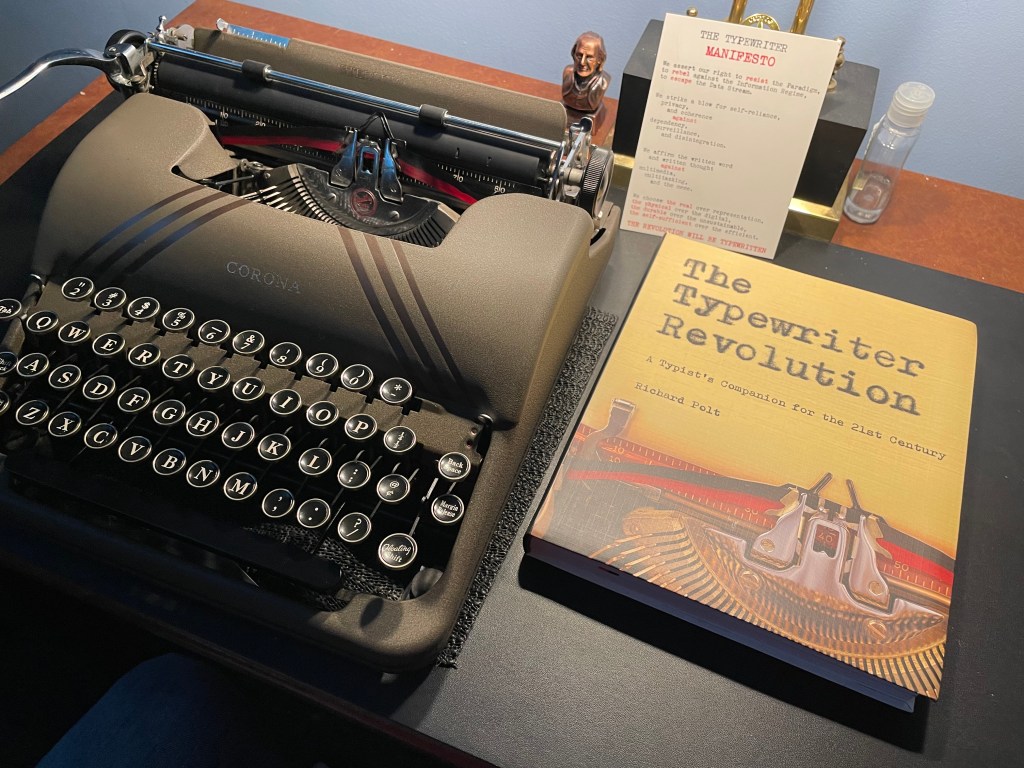
It might seem challenging, but with a little pre-planning and diligence, you can reduce your password fatigue moving forward. And with that, although I’m a bit sleep deprived, I will try to get some more work done. Fortunately, no password is required on a typewriter.
June 24, 2024, DAYTON, OHIO – The Humane Society of Greater Dayton is hosting a free microchipping event, “Chippin’ in the USA,” to help keep pets safe and reunite them with their families in case they get lost. The event will be held on Thursday, June 27th, from 1:00 PM to 5:45 PM at the Humane Society of Greater Dayton located at 1661 Nicholas Road, Dayton, OH.
Free Microchips, No Appointment Needed
This free event is open to the public, and no appointments are necessary. Walk-ins are welcome! Microchips are a permanent form of identification that can significantly increase the chances of a lost pet being returned home safely.
What to Bring:
Cats: Please bring your cat in a carrier for their safety and comfort.
Dogs: All dogs must be on a leash or in a carrier.
Prepare for Fourth of July
The Fourth of July is a notorious time for pets to escape or get loose due to loud fireworks. By microchipping your pet before the holiday, you can ensure a quicker and more successful reunion if they become separated from you.
Event Details:
Date: Thursday, June 27th, 2024
Time: 1:00 PM – 5:45 PM
Location: Humane Society of Greater Dayton (1661 Nicholas Road, Dayton, OH)
Cost: Free
For more than 120 years, the Humane Society of Greater Dayton has been a dedicated champion for both people and pets. With a steadfast commitment to all types of animals, including cats, dogs, rabbits, horses, farm animals, exotics, small animals, and more, the organization takes pride in its role as a comprehensive animal organization.
As an independent 501(c)(3) nonprofit, the Humane Society of Greater Dayton operates without government funding and maintains no affiliations with regional, state, or national animal shelters or humane societies. Every dollar raised directly supports their vital programs and services, making a tangible difference in the lives of animals and pet owners.
To learn more about their remarkable work, please visit www.hsdayton.org.






















 The Jamestown Comet