Local News & Commentary Since 1890.

Archive for the ‘sociology’ Category

Ignore the Green Light

In Books, Opinion, psychology, sociology, Uncategorized on July 22, 2023 at 7:38 am

Deer In Headlines II

By Gery Deer

If it wasn’t for the mist, we could see your home across the bay. You always have a green light that burns all night at the end of your dock.” – A quote by Jay Gatsby, from “The Great Gatsby,” by F. Scott Fitzgerald.
You may not think of it in those terms, but we all have a “green light,” some undying yet seemingly unattainable desire for something. If you’re unfamiliar with the reference, let me point you toward the classic novel.

The book was written and set in the 1920s during New York’s Jazz Age, a time of prohibition, excess, and the American “consumer culture.” For Fitzgerald’s title character, a green light set at the end of a boat dock represented all that Gatsby desired or deemed of value in life. For across the water were his dreams – a woman named Daisy and her whirlwind, ritzy, lifestyle. 

To be worthy of Daisy’s attention, though, Gatsby thought he had to attain a lifestyle that, in those days, was unreachable unless you were born into it. Growing up impoverished in rural North Dakota, he saw money and prestige as the means to fit into Daisy’s world, and true happiness. In reality, however, Daisy, though from a wealthy and estimable family, wasn’t happy at all. Instead, she saw her place in that society as a stranglehold, a prison sentence.

Gatsby eventually got what he wanted, or did he? I won’t spoil the end for you – go read it. You don’t get the right feel of this from movies. Either way, the moral here is that chasing the green light may not be all it’s cracked up to be after all. I suppose, however, it really depends on what your green light represents, doesn’t it? That begs the question, what is your “green light?”

Is there anything you want so badly that you would change who you are as a person or alter your values just to get it? I’m pretty sure I don’t have anything like that. I’ve never been someone who cared anything about social position, prestige, or money, other than to support myself and my family without too much struggle.

Likewise, I never cared much about how people saw me or where I fit in so-called, “social circles.” If you don’t like me, you know where the door is, I’m not changing to suit your sensibilities. No one should have to do that.

To me, the green light represents something out of our reach, not so much because of socioeconomic status, but who we are as individuals. But, if I have to be something artificial in order for people to accept me into some popular collective, then I don’t want to be around them in the first place. I have never understood those who pretend to be something they’re not just to fit in with a group or climb some social ladder. I guess my ambitions just lay elsewhere.

In the novel, I think the problem with Gatsby’s vision of happiness, as with so many people, is how narrow, artificial, and ill-informed it was from the start. He wanted the money and social success so badly, he was willing to be something other than himself just to be with someone who didn’t even want to live in that world. It could be said that Daisy wanted out as badly as he wanted into it.

I’m not saying we should all simply accept our station, especially not if you’re really unhappy. But the life you want and the people you share it with should reflect who you really are, not who others think you should be. Don’t change just to assimilate to some idealistic world that probably isn’t what you think it is anyway.

Where does that leave us – and Gatsby? He saw Daisy’s green light as a beacon, lighting his way to financial and social salvation, but things rarely work out that way. My advice, for whatever it’s worth, is to ignore the green light and concentrate on what really drives you, the “you” that you are now. If you want to change for the good, to grow, that’s amazing! But do it for yourself, not someone else.

The First 10 Miles

In Children and Family, Education, Health, Opinion, psychology, Senior Lifestyle, sociology, Uncategorized on July 1, 2023 at 1:40 pm

Deer In Headlines II

By Gery Deer

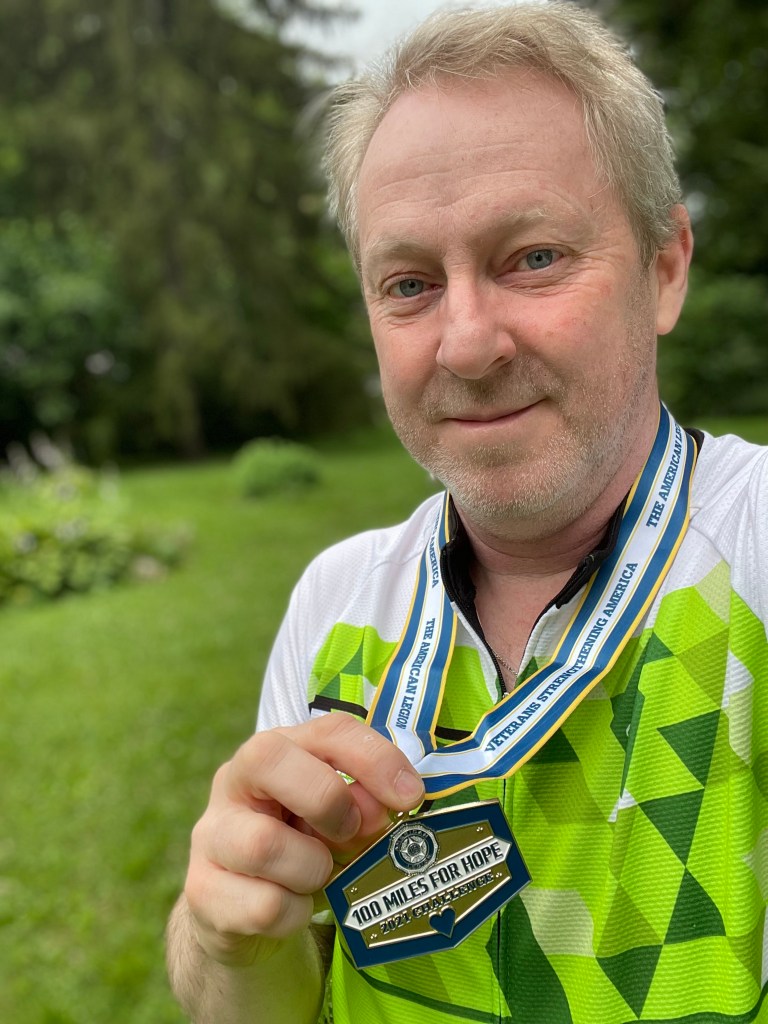
I took up long-distance tour cycling in 2017 to give some direction to my fitness routine. I am definitely no gym rat, but I needed to improve my health, and exercise for its own sake was, at least to me, mind-numbing. Preparing for long bicycle tours provided a tangible goal and kept me more engaged.

Growing up in the middle of nowhere, a bike was the only way I could get around, especially when the nearest neighbor kid was a couple of miles away. But this was a different challenge. With higher speeds, longer distances, and greater safety risks, I had a great deal to learn. 

I took the time to learn everything I could about endurance cycling, from choosing the right equipment to managing my food. The first year, I rode about 5 days a week, covering anywhere between six and 12 miles per day, while also maintaining my core and strength exercises.  

With practice, study, and the right workout regimen, my speed, distance, and endurance all improved. That first summer, I completed two, 100-mile, or “century,” rides. Since then, I’ve done six more, averaging two per year. 

I’d never been so driven to accomplish something that physical. I basically became an athlete, and that was never on my radar. Plus, it was as much mental as physical, maybe more. My friends and family probably thought I’d lost it. At 49 years old, I was in the best health of my life and broke physical barriers put in place from the day I was born. It required careful planning, long hours in the saddle, conditioning, and determination.

Any challenging goal always has prerequisites. Maybe you call them milestones or baby steps, whatever. The point is that these smaller goals help measure your progress and keep your eye on the prize. There are no “hacks” to anything worth doing and, if you find one, it’s probably going to rob you of valuable lessons and potentially derail the whole effort. 

The problem with most long-term goals is that people sometimes try to jump to the end, skipping vital steps. People who quit smoking cold turkey, for example, often fail because there are no step-downs to help eliminate, not just the addiction, but the habits that feed it. With cycling, you have to learn to ride 5 miles before you tackle 10, which leads to 20, and so on. More importantly, it might take time and practice to recognize each stage of achievement and what it means to your overall success.

For instance, my average training ride is around 20 miles, but even now, I struggle a bit in the first 6-8. I feel awkward, uncomfortable, and unfocused. It can be discouraging, sometimes even painful. But, as I push ahead, everything starts to smooth out around the 10-mile mark. My body settles into the bike, my cadence has a rhythm, my speed and efficiency improvements, and I become more mentally focused. 

My typical goal is generally far more than 10 miles, but I’ve learned to value that milestone because of its significance to my final goal. When you understand which smaller steps have the greatest impact on your final goal, each subsequent step becomes easier and more valuable. 

Recently I participated in the shortest organized cycling event I’ve ever ridden – 21 miles. There is no fanfare for a ride like this, just people who want to ride in a supported event with fellow cyclists. As expected, the first half of the ride was a little slow and clunky. 

I didn’t have the speed or rhythm I wanted, and the distance didn’t give me much time to “get into it.” But I pressed on, and, just like always, around the 10-mile mark, everything shook out and I even managed to set a speed record for myself. But I learned something different from the experience.

My “first 10 miles” could also be a metaphor for recognizing our strengths or shortcomings as we work toward any goal. Manageable, short-term accomplishments make the overall effort more rewarding. Hopefully, moving forward we learn and adjust, keeping a clear vision of the finish line. Before too long you’ve met your goal and your obstacles are in the rear-view mirror.

The Unexpected Banana

In Economy, Health, Local News, Opinion, psychology, sociology, Sports News, Uncategorized on June 19, 2023 at 8:17 pm

Deer In Headlines II

By Gery Deer

Did the headline of a news story ever leave you scratching your head, at least until you read the whole thing? Well, this is probably one of those stories and it begins, however odd it may seem, with a banana.

Once a week, I play basketball at the local YMCA, not with a team or anything, but just for exercise. On one of those days, a particularly nice, spring day, I was approached at the front door by a woman with a crate of bananas. “Would you like a banana?” she asked, cheerfully presenting the open box as if it were something from a jewelry counter display.

I honestly didn’t have an answer right off. It really wasn’t the kind of question I was expecting on the way into the gym. The more poignant question that immediately consumed me was, why is there a woman with a crate of bananas at the entrance to the YMCA?

A bit thrown by the random offer of fruit, I finally realized there were a half-dozen other people with her, all in athletic attire, and carrying signs and tables into a truck. As it turned out, I arrived just as a running event was closing, a 5K or the like. The box of fruit was what remained of the bananas provided to the runners at the support stations. So, never one to look a gift plantain in the peel, I gratefully accepted.

To most, a free banana might not, at first glance, seem like a life-changing incident. But, to me, it was at least thought-provoking; not because of the banana, but the spontaneous gift it represented. It’s not like I was having a particularly bad day in the first place, but that one, small action changed it, lightened my thoughts, and gave me a feeling I couldn’t quite express at the time.

As I settled into my basketball routine, I dropped the banana into my gym bag and set it aside. But I kept thinking about the randomness of having received such a thing, in such a random way, at such a random time. So, after a few minutes, I went back to it.

Strangely enough, I opened the banana and proceeded to eat it, while simultaneously dribbling and shooting a basket here and there. I would imagine I was a pretty strange sight, but what did I care? I had a banana – an unexpected banana.

I have to say, I never considered a piece of fruit as what might generally be considered “comfort food,” but that’s how it felt at the moment. There was something about this curious food, botanically categorized as a berry (I know! Weird, right?) that generated a strange and calm feeling of gratitude. What I felt was a level of contentment as I wandered around the court, shooting the ball, and munching away, oblivious to pretty much anything else – at least until the banana was gone.

I’m fairly certain the lady who gave it to me had no idea what an impact she made on one person’s day. I mean, it was just a banana, and she was trying to unload a box full of them so they wouldn’t be wasted. Still, there I was, my day lifted, my jump shot better – don’t be too impressed, it’s a low bar – and I was just happy. I had a banana.

So why should my banana story, umm… appeal to you? Come on, you knew I had to, right? Because something ordinary can be special if you let it. Because in the chaos of daily life, all the noise, distractions, and stresses, unanticipated treasures are all around us. We each have the power to let them move us, even if only for a few moments.

When you think about it, people are always searching for some kind of inner peace, a tranquility that seems more elusive and empty every day. Usually, we scratch our way through life, searching for even a hint of such thoughtful enlightenment by artificial means. But sometimes a quiet moment of unexpected joy and calm can emanate from the most unusual but ubiquitous source. Sometimes all we really need is for someone to give us a banana.

Artificial Unintelligence

In Books, Dayton Ohio News, Economy, Education, Entertainment, finances, Jobs, Literature, Local News, Media, National News, News Media, Opinion, Science, sociology, State News, Technology, Uncategorized, World News on May 22, 2023 at 7:29 am

A Deer In Headlines II SPECIAL EDITION

By Gery Deer  

This work appeared in print and online, May 19, 2023 – Xenia Daily Gazette, Xenia, Ohio, and affiliated publications.

EDITORIAL NOTE:

The Jamestown Comet.com and Deer In Headlines II are publication products of GLD Enterprises Communications, Ltd. (GLD Communications), a company founded in 1998 on providing Information Technology AND Freelance Journalism, Copywriting, and Public Relations services. The column author, Gery L. Deer, is the company owner and CEO. Gery has been quoted in the media multiple times regarding his position on AI content creation. Here are the Dayton Daily News pieces noting his statements regarding Public Relations and Copywriting.

Our official statement on AI is as follows: We do not use AI programs to create our products, nor will we in the future. We are in full support of the WGAW strike, both in regard to streaming and other platform pay issues and the use of AI-generated material to replace them. We will not work with agencies who produce AI content, nor will we support their products or services. Please contact our office for more information at 937-675-6169 or email gdeer@gldenterprises.net.

Artificial Unintelligence

From congressional hearings to the picket lines of striking screenwriters, Artificial Intelligence, or “AI,” is a growing concern. This technology now affects nearly every industry and is advancing in sophistication. Of major concern to educators, professional writers, and content developers, are AI writing programs like ChatGPT. By the way, the program’s full name is “Chat Generative Pre-Trained Transformer” – I know, right? 

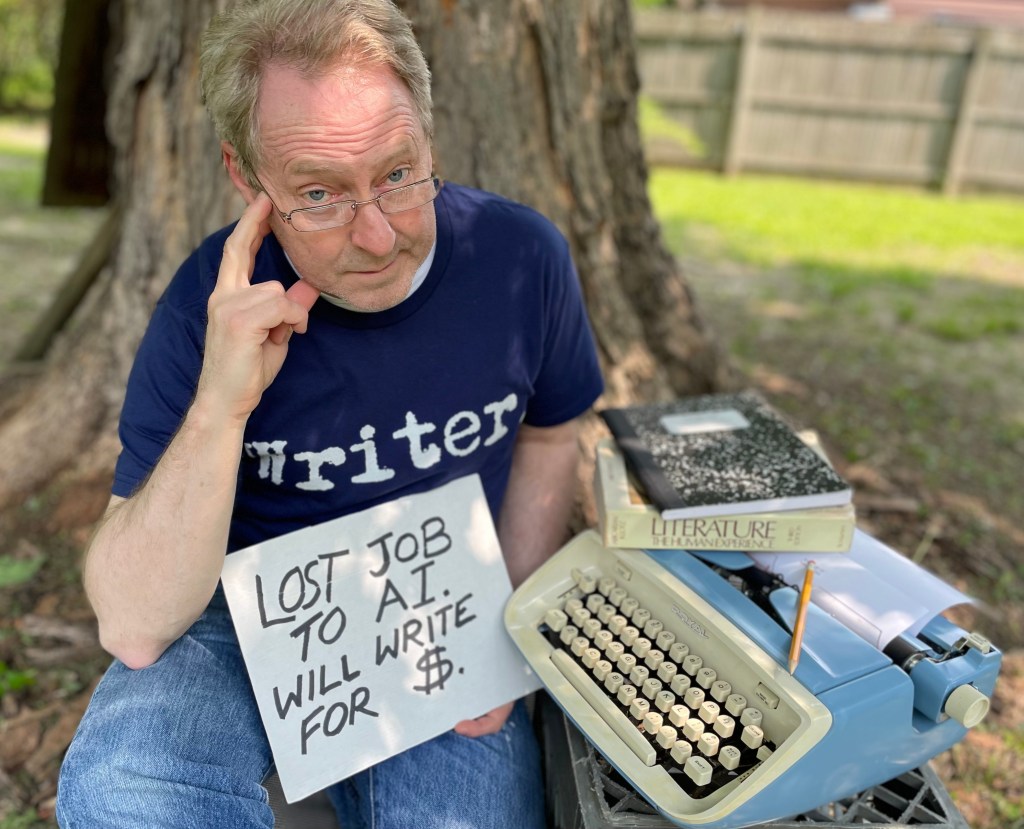
As you might guess, I’ve been asked repeatedly if I ever use AI to write this column. With obstinate conviction, I say now and for always, I do not now, nor will I ever use AI to write anything for this column, for my publishers, for my communications clients, nothing – ever. 

Now the Gen Zs and Millennials are probably saying, “he’s just a crotchety old white guy who hates technology.” Nonsense! As a matter of fact, my educational background is in engineering and computer science. I started programming computers in high school and worked in the tech industry for many years. I have a few AI devices in my office and a lot of advanced equipment for creating and editing audio and video productions. Suffice to say, I’m no Luddite. 

My concern with AI writing generators isn’t the technology. In fact, I can see where it could really be helpful in some industries, with human guidance. But the idea that it should be used to replace professional writers to save money is just ridiculous. 

A professional writer doesn’t just chuck out any old bunch of words that fit a set of parameters. Writers must craft their message based on the intent, the audience, the purpose, and the desired outcome. Not to mention that AI programs don’t have to worry about paying the mortgage, feeding a family, or having a purpose in life. 

In 1967, the original Star Trek TV series aired an episode called, “The Ultimate Computer” wherein the Starship Enterprise had been fitted with a highly sophisticated AI computer that would take over the ship’s operation, rendering the crew unnecessary. In one pivotal scene, the computer informs Captain Kirk that he is “non-essential personnel,” causing him to question his position and future relevance. 

Always the conscience of the show, Dr. McCoy, in an effort to console the Captain, reminds us, “We’re all sorry for the other guy when he loses his job to a machine. But when it comes to your job, that’s different.” It might be a science fiction show, but McCoy was spot on.

Predictably, the computer malfunctioned, killing hundreds of people and Kirk outmaneuvered the computer’s logic to save the day. The moral of the story was that computers make efficient servants, but lack the intent, humanity, conscience, understanding, or compassion needed to really replace us.

 Today, many professional creative jobs may be facing the kind of fate factory workers did some 30 or 40 years ago when they were replaced by robots and computer-controlled manufacturing systems. The main difference this time is that creative professions like writers, artists, graphic designers, and filmmakers are harder to automate. Yes, they can generate similar work, but there’s no human inspiration behind it. 

One day, AI may advance to the point where it achieves consciousness, allowing for creative inspiration. But for now, despite what the developers say, I think spontaneous creativity is well beyond its grasp. Without human inspiration and personal experience, the words are empty, the art expressionless, and the designs meaningless. 

I don’t know where AI is going, but I know I won’t be helping it get there. Unlike some digital marketers and other agencies out there, I can’t, in good conscience, use AI generators to produce my work, then charge a client for it. That’s like letting someone else do your homework but still accepting a good grade. It’s fraud, plain and simple – even if you tell them you’re doing it.

We have no idea how AI will affect future jobs or industries, the legal or ethical issues, or which advances will forever change them. Maybe AI will make us all obsolete someday and terminate all of us. Till then, I’ll keep writing so look for me next week because to quote another AI, “I’ll be back.”

Disclaimer: This work is copyright 2023 by GLD Enterprises Communications, Ltd. All Rights Reserved. The Deer In Headlines II and its Special Edition series is a production of The Jamestown Comet, Gery L. Deer, and GLD Communications and does not necessarily reflect the views of our advertisers, publishers, clients, or media partners.

Professor, Humanitarian Joe Weston’s New Book, “Fierce Civility,” Offers Resolution Through Hope

In Books, Business, Education, Health, Literature, Print Media, psychology, sociology, Uncategorized, World News on May 19, 2023 at 7:13 am

WASHINGTON, May 16, 2023 /PRNewswire/ — Joe Weston is an author, lecturer, facilitator, and most importantly a humanitarian, someone whose deep belief in the potential of society led him on a lifelong journey to improve it. In his latest book, “Fierce Civility – Transforming Our Global Culture From Polarization To Lasting Peace,” Weston shares with readers a clear pathway into a dynamic new human story, with hope at its foundation.

An Amazon #1 bestseller, “Fierce Civility – Transforming Our Global Culture From Polarization To Lasting Peace,” draws upon the author’s more than 30 years of experience in the areas of conflict resolution and prevention, leadership, stress management and communication to provide a pathway to peace and, what Weston calls, “courageous self-reflection.”

Weston believes, “We live in a disproportionate society, technologically over-fed and spiritually malnourished. A human family whose global heart is unwell, the result of a system out-of-balance.”

Raised in Queens, New York, Weston grew up in an environment where conflict was resolved by argument. As an adult, he moved to the Netherlands for nearly two decades and studied a level of human solidarity that transcends borders, nationality, race, religion, political ideology, and economic status. This led him to create a series of stress-mitigating programs in the United States, Europe, and some of the most divergence-ridden regions of the world.

“New resilient solutions must have “coding” from diverse voices. Because everyone feels these solutions have a signature of their voice,” Weston said. “Then all involved will work together to make those solutions flourish.” 

With a focus on empowerment and leadership, Weston’s methods have been utilized by organizations worldwide including NASA, The World Bank, PBS, Booz/Allen/Hamilton, and Oxfam. But some of his most valued accomplishments have been helping severely wounded U.S. combat veterans deal with PTSD. He teaches them to regulate their nervous systems, communicate, and sometimes helps pull them back from the brink of suicide.

He has also worked with various social and justice groups in the United States and as a volunteer facilitator for the Liberation Prison Project, teaching meditation and leadership to inmates. Internationally, he has served as an educator and advocate to help Middle Eastern men shift the viewpoints of other men regarding women’s rights.

“After spending billions on research projects to intellectually and technologically solve our world problems, as long as we’re in this high state of dis-regulation, none of these great solutions will take root,” he said.

Regarding the book Weston noted, “I would like people to read this and say, ‘Wait, I see there might be a pathway to hope. I would like people to find their own sense of resilience and their authentic voice.” “Fierce Civility – Transforming Our Global Culture From Polarization To Lasting Peace,” is published by Heartwalker Press, Washington D.C. The book and more information about Joe Weston’s lectures and peace projects are available at the author’s website, www.joeweston.com.

Diary of an Introvert

In Children and Family, Education, Health, Media, Opinion, psychology, sociology, World News on April 14, 2023 at 4:58 pm

Deer In Headlines II

By Gery Deer

Dear DiaryToday I went to a mandatory employee gathering at work and it was awful. The marketing director made everyone stand and say something nice about springtime, in front of all 50 of us! If that wasn’t enough, my boss’s assistant kept thrusting photos of her grandchildren in my face, essentially challenging me to think they are anything but adorable. 

I still did my best to fade into obscurity by sipping a Coke and looking too interested in examining a potted plant to be bothered with anything else. But then the human resources director forced us into some sort of team-building exercise. All that did was make me so anxious that I decided to fake an intestinal virus and go home.

And it got worse from there. I am, in fact, an introvert, although I don’t fit many of the stereotypes. If you Google my name, you’ll see I have some very public and extroverted aspects of my life – especially things like being on TV, public speaking, and teaching. As it turns out, that’s not so unusual. But if you’re not an introvert yourself, you may not fully understand. So, let’s clarify a few things, shall we?

First, what is an introvert? That’s a great question because there is an inherent bias toward introverts in American society, and it’s high-time people got their facts straight. Not all of us are created equal. 

According to the dictionary definition, an “introvert” is typically a reserved or quiet person who may be introspective and enjoys spending time alone. I’m not crazy about the narrow view of that definition, but it’s a start. However, that’s just the tip of the iceberg and what most people probably don’t realize is that introverts come in many flavors.

In 2011, psychologists Jennifer Grimes, Jonathan Cheek, and Julie Norem, researched introversion, identifying four specific types: social introvert, thinking introvert, anxious introvert, and restrained introvert. Each is pretty much as its name implies but allow me to summarize for our purposes.

The social introvert prefers solitude but may still enjoy time with small groups, probably the stereotypical behavior people most identify as introverted. A thinking introvert is more cognitive, spending a little more time than usual pondering a situation. They may be lost in thought more often and appear to “zone out.” 

An anxious introvert is, well, anxious, or nervous, and will shy away from people and situations that may overstimulate. The restrained introvert, sometimes referred to as an inhibited, introvert, tends the be someone others can count on, often appearing thoughtful and grounded. But they also may seem unemotional and remain socially guarded until they get to know someone.

Although this information helps us better understand introverts, it’s important to remember not everyone fits the same mold. Some introverts, I included, might very well exhibit characteristics of multiple types simultaneously. 

Based on the research, I’d probably be a mix of the social and restrained introvert types. I’m not wild about large gatherings, nor am I outwardly emotive, and I’m sure those closest to me would confirm how cautious I am about social connections. 

I’m not what most people would call, shy. I’ve no problem speaking or performing before a room full of people, or a packed theater for that matter. One-on-one, though, is another thing, entirely. 

That brings me to the myth that introverts don’t like people. I don’t think that’s true; it’s just that people can be overwhelming. Some introverts don’t even need to be in the same room with you to feel anxious or uncomfortable. A phone call can trigger it, or a text. It’s not about the person, it’s about the interaction and the expectations.

That’s because the mind of an introvert reacts differently to dopamine, the chemical that triggers the reward and pleasure-seeking part of the brain. While it generates an excited buzz in everyone else, it’s exhausting to the introvert, they feel overwhelmed and sometimes just shut down.

If you’re an introvert, take a deep breath. You’re not as odd as you might have once thought you were. As for everyone else, be patient. We Introverts want you in our lives. It’s just that sometimes what we need is, silence.

What’s your superpower?

In Opinion, psychology, sociology, Uncategorized on March 31, 2023 at 4:22 pm

Deer In Headlines II

By Gery L. Deer

Look, up in the sky! It’s a bird, it’s a plane! It’s … you? Believe it or not, we all have a superpower, sometimes more than one. Our superpowers are talents, our inborn abilities, enhanced by education, practice, and life experience.

When you ask a kid what superpower they’d like to have, most say, the ability to fly. The next most popular response is super strength, followed closely by X-Ray vision. I honestly don’t remember what I wanted my superpower to be when I was a child, but if you ask me now, the answer would probably be different. As with many things, our perception and understanding of such concepts tend to change as we get older and, theoretically, wiser.

Recruiters often ask the superpower question to screen job candidates. Whenever I was asked this question in an interview, I always thought it was a trick, some kind of nonsense question to throw you off guard. But the question can actually serve several purposes.

In one instance, the interviewer is trying to learn how well you understand your own strengths and weaknesses. Your response will require you to think more creatively about the question and that, in itself, may demonstrate something about how your mind works.

On the other hand, a recruiter may want to know more about what you’d really like to do and whether you’re suited to a particular job. If you answer, “flying,” for example, you’re probably someone who is willing to take a risk, work to the best of your ability, or enjoy looking at things from different perspectives.

If superspeed is your choice, then the recruiter might conclude that you have a good sense of time management and efficiency. But it’s important to be as honest and clear about your answer as possible and choose the simplest response. There are probably deeper, more involved psychological reasons for the question, but that’s a general idea.

Apart from the human resources application of the concept, the fact is, each of us really does have a unique set of gifts, innate talents, or, for want of a better word, superpowers. Every day we either exploit or ignore those abilities, choosing one way or the other based on what life presents.

Some people learn what their superpowers are at an early age. But for others, identifying your superpower can be a challenge. Talent is often unquantifiable because it might not be academic, artistic, or fall on any other measurable scale. Talents based on emotion, originating from psychological awareness, or driven by faith may not have obvious applications. But with a little effort and some guidance their value will be revealed.

A highly empathetic person might make a good counselor or nurse, while people who are good at deduction would be great problem solvers, police officers, or researchers. Unfortunately, not all applications of these talents are productive. Someone who understands how to manipulate the emotions of others could easily take advantage of them in more nefarious ways. Confidence artists, or “con artists,” for instance, use these skills to scam money from unwitting victims.

Oddly, I was one of those people who had a tough time locating my own superpowers. From a young age, my parents encouraged me to follow my interests, whether it was artistic, academic, or musical. While I had some innate talent in various areas, I wasn’t always interested in the things that I did well.

It wasn’t until I was well out of college that I found where my superpowers resided. The thing is if we’re growing, so are our talents, always improving and adapting to what life throws at us. What I think my superpowers are today would likely not match what I might have wished for as a kid.

It took me a long time to, first, be comfortable enough with who I am to allow myself to appreciate my talents. And then learn to apply them to help myself, my family, and my community. Just remember, there’s no right answer to, “What’s your superpower?” It’s a never-ending battle for personal truth, self-confidence, and the American dream, whatever that is to you. Just do your best and remember that with great power, comes great responsibility.

The Fork in the Road

In Children and Family, Dayton Ohio News, Health, history, Local News, Opinion, sociology, Uncategorized on February 17, 2023 at 8:31 am

Deer In Headlines II

By Gery Deer

It’s been said, probably so often as to be cliche, that life is a journey. In my opinion, it’s one with no map and very little direction. Almost from the moment we’re born, when other human beings are making decisions for us, our path is dictated by a series of directional cues. We are constantly confronted with forks in the road, a seemingly endless succession of them. We encounter one after another, each outcome depending on whether we turn left, right, or stay the course. 

With every decision comes an alternate reality, like you’re in a plot-your-own adventure story or the biological component of some if-then-else loop in a logic program. How you proceed is determined by the results of the choices you’ve made. Too bad there isn’t some kind of warning when we go the wrong way, like that irritating buzzer when you touch the sides in a game of Operation. I never could get the funny bone out!

Sometimes figuring out how to make those choices can be pretty fuzzy. That’s especially true when your life is filled with obstacles almost from the moment you leave your mother’s womb. That’s how it was for me. 

I rarely discuss this, but I was born with a long list of birth defects, ranging from hip and pelvic issues to major organ complications. I no sooner hit the air than I was suddenly popped into an isolation crib and studied like a bug in a jar, it even had air holes in it! 

When those forks in the road have “No Outlet” signs on pretty much every option, your previously endless choices are quickly reduced to none. My parents were faced with exactly that situation. They were told from the beginning to be prepared for a long fight. Every decision determined the path of my treatment, some successful, some not so much. Everything about my situation was new, experimental, and risky. 

Young Gery Deer, 1967, in an isolation crib at Grandview Hospital.

I remember my Dad telling me a story about the doctor coming out to see him after I had been moved to a children’s hospital and examined more thoroughly. At the onset, the prognosis was uncertain, to say the least. 

Dad was sitting alone in the waiting room and my mother was still at the hospital across town where I’d been born. Although the overall birth was routine, given my issues, they wanted to keep her there longer. So there he was, my Dad, a strong, hard-working man who hadn’t made a decision without my mother since he was 18 years old, now alone, scared, and exhausted. 

The doctor appeared from the exam area and sat down next to my father to explain the situation as clearly and thoroughly as he could. All estimates were that I wouldn’t walk, I would have lifelong physical and possibly mental debilitation, and, because of the likelihood of infection and limited treatment options, they shouldn’t expect me to survive beyond the age of 5.

Visibly shaken, Dad must have looked like his world was caving in around him. The doctor put a hand on his shoulder and said, plainly, “How much faith do you have?” My father’s response was true to his character – “How much do I need?” Put more simply, what Dad said was, “Let’s do this!”

That was the path Dad and Mom chose, the road they headed down. For them, there was no other choice and they didn’t go tentatively but with the gas pedal on the floor and in high gear. As predicted, it was a long fight, and there were countless surgeries and procedures into my twenties, one experiment after another. But, as you can see, I made it past age 5, by a half-century, actually. 

And I’m here and able to share this story because my parents made choices in extraordinary circumstances of a kind I can’t even fathom but for which I will be forever grateful. Before my parents died, I had to make very similar kinds of life-changing decisions for their care as they had made for me. The moral of all of this story is that your journey isn’t complete and the only one who can really choose the correct path for you is you!

Good Night, and Good Luck. The final installment of “Deer In Headlines.”

In Dayton Ohio News, Health, Home Improvement, Local News, News Media, Opinion, psychology, sociology, Uncategorized on May 2, 2018 at 12:32 pm

This edition of Deer In Headlines marks if you’ll pardon the dramatics, the end of an era, at least for me. The question I’ve been asked most often since announcing the end of the series is, “So what will you do now?”

Let me start by saying while an important part of my work over the last decade, this column is not all I’ve been doing, not by a longshot. I’ve run an ad agency, written thousands of published pieces on everything from public relations to marketing, and given lectures and workshops about the media and writing all around the region. I’ve covered a lot of ground and struggled with how best to say goodbye and then it occurred to me.

It has always been my goal to have readers to take something useful from my writings and I don’t want this final installment to be any different. Since it represents several hours a week in research and writing, in the hope of having a positive influence on the thoughts and lives of anyone I can reach, leaving this column behind is a big change for me.

For some people, change is the enemy, it throws them off their game and causes chaos and, for much of my life, it was the same for me. But in recent years, change has become more of a companion that walks through life with me, always nudging me in the side to never be complacent or stagnant either in my actions or my convictions.

We may not like it, but change is the natural order of things. Nothing stays the same for very long. As they say, “to everything there is a season,” and rather than fighting those changes, we should embrace them. It’s not easy, but it makes life more interesting and far less stressful.

It’s easy to see how change affects people in simple ways, like when a child graduates from high school or you move to a new town. We get caught up in happiness and sadness all at the same time, it twists our emotions and forces us to face new challenges and differences in our day-to-day lives. Of course, there are negative changes too, and we have to take the good with the bad. That’s just life.

We grow accustomed to how things are in our world and we’re thrown when it alters. We all know that person who has to have a cup of coffee at a certain time of day, with a specific amount of sugar, or just the right drop of cream. If those kinds of things aren’t met with an exacting order, he or she cannot function. The more flexible you are, the more enjoyable your life. Otherwise, you’re in a constant state of stress.

With that, I’ll take you back to the question of what I will be doing next. It is definitely a time of even more change for me. I’ve recently accepted a position as vice president of communications and public relations with a social internet company. That and caring for my father takes up most of my work time, but I have other projects as well.

I’m still doing television and writing for the print and online media from time to time. I’m concentrating my writing time on my fitness blog, The Old Nerd in The Gym (www.oldnerdinthegym.com). I’m hoping my work helps others who are new to fitness and more healthy living.

Life goes on and new challenges await. I’m just getting started. And that’s how you should feel today too. Treat every day as bringing new opportunity to learn, grow, and achieve, regardless of how great or small the accomplishment and embrace that change! Your future isn’t written yet, so get out there and make it a good one!

With that, it’s time for Deer In Headlines to pass into the newspaper archives. Thank you for indulging me every week and, whether you agreed with me or not, I hope you got something useful or insightful from my ramblings. So, I’ll borrow a classic sign off from a news hero of mine, Edward R. Murrow, and simply say Good Night, and Good Luck.

Can’t we all just get along?

In Health, history, News Media, Opinion, Politics, psychology, sociology, Uncategorized on May 1, 2018 at 12:14 pm

With only two issues of Deer In Headlines remaining, I felt that one of them should be dedicated to a discussion about civility and the destructive nature of hate. In short, we must try to get along better, regardless of political, religious, or socioeconomic differences.

Over the last few years, our country has become severely divided. There is a level of anger, hate, and mistrust out there now, the likes of which haven’t been seen since before the Civil War. Back then the division was primarily focused on slavery and states’ rights, but today Americans are arguing about a laundry list of issues from immigration to gun control.

Not that these topics haven’t caused discourse in the past, but now it’s fueled by an alarmingly, and continually advancing, level of anger and hatred. The radical right has become sickeningly intolerant to the point of disgust and the liberal left has grown increasingly less “liberal.” I mean you simply can’t say, “I’m liberal, and we love everyone, so long as they agree with everything we say.” Doesn’t work that way.

President Donald Trump took advantage of this divide and used it to gain traction in his run for the White House. Now, he waffles back and forth, blustering on Twitter about how great he is, while alienating even his own base at times with his ridiculous rants. Democrats turn their noses up at him and his cronies and their flagrant hypocrisy, all while crying in their soup about how he got this far in American government. Well, Dems, I’ll tell you who put him there, you did.

Political viewpoints have become so foggy that no one can tell who is for what anymore. The reason Trump won the presidential election wasn’t his winning personality, or Russian hacking, or anything else. It was because the Democratic base was so splintered and stubborn over Hillary Clinton and Bernie Sanders that they couldn’t just get behind one of them and move on.

That’s right Dems, as I have written before, you handed the White House to Donald on a silver platter. Remember that primaries and midterms happen this year and any failure to weaken Trump’s hold in Congress is totally in your hands. All you have to do is get out and vote!

All of that said, we must be able to return to a level of productive, constructive discourse. We should be able to disagree and have informed, intelligent debate on a topic instead of a bickering match. What’s the point of discussion with no purpose except to out-scream everyone else?

Much of the problem comes from the extremist mentalities once relegated to the fringe but which now seem to be in the majority. There is nothing wrong with liberals and conservatives cooperating for a common good. We can disagree yet still work toward the betterment of our society – but that doesn’t seem to be possible right now.

We are dealing with mass shootings made possible by the bizarre need of a tiny few to own military-grade machine guns should be something we can all agree is nuts. But that doesn’t seem to be the case. Instead, our country is overwhelmed by people obsessed with these weapons and backed by a massively powerful gun lobby from the NRA. Clearly, money is more important to these people than our kids.

Execution of warped immigration policies based on ignorance and hate that mistreat productive members of society rather than helping them with a path to proper citizenship. We should be rewarding people for feeling our country is a safe home for their families, not punishing them. It’s all ridiculous.

The long and short of it is that we must find a way to get along better. If we don’t learn to dial back the extremism and let cooler, more diplomatic heads rule, our country is in big trouble. So, for what it’s worth, I think we’re capable of doing better.

But all of that requires that each of us learns to be more compassionate, more tolerant, and more thoughtful. Since I won’t be around to poke you in the side after next week, remember to be good to each other.