Local News & Commentary Since 1890.

Archive for the ‘sociology’ Category

Gossip Column

In Local News, Opinion, psychology, sociology, Uncategorized on May 18, 2024 at 9:02 am

Deer In Headlines II

By Gery Deer

Gossip. It’s an insidious phenomenon that always hurts people. Usually, gossip is inaccurate and degrades even more as it travels from person to person. Gossip is a destructive game of telephone that usually ends in the victim’s humiliation.

Gossip begins with someone sharing something confidential, saying, “Hey, just between you and me…” and so on. But it’s doubtful the information will remain a secret. The story inevitably spreads like air escaping a leaky tire.

Although there is debate about whether gossip is predominantly negative, nothing good comes from it. One study even suggests that gossipers tend to have a “darker” personality, uncaring about the social consequences of their behavior. Another offers the theory that we’re motivated by a need to bond with others in our social circles, keep ourselves entertained, vent emotions, and establish social status.

Low self-esteem seems to be a common theme among gossipers. They validate themselves by spreading news of others’ misfortunes and by sharing negative stories about people, reinforcing their imaginary superiority. 

All that sounds great academically. But, personally, I think people are just mean sometimes. They want to feel superior, so they start rumors and gossip to gain an upper hand—even if it’s all in imaginary. Ignorance probably plays a role, too. Those who spread gossip often believe the person at the story’s heart will never find out, so no harm done, right? Wrong. Trust me, they always find out.

In the past, gossip proliferated over the backyard fence or around the water cooler at work. However, with the advent of social media, gossip has taken on a new level, broadcasting misinformation to countless recipients at the speed of light. Clickbait is a perfect example of modern gossip-mongering, complete with a compelling story, video, and photos.

At this point, it’s probably important to clarify how I distinguish between gossip and rumor. Official definitions explain gossip as the spread of information that’s essentially true but likely unkind or hurtful. A rumor, on the other hand, is false information passed around without confirmation or conscience. However, I’m not convinced this distinction is always evident in practice. In my opinion, there’s very little difference between gossip and rumor, regardless of what old Mr. Webster says.

Regardless of your definition, one of the most important things to remember is how gossip affects the victim and how that affects the gossiper. In this context, the word “victim” refers to the person who is the subject or target of gossip. Since most of that information is false or intended to harm someone, that person is indisputably a victim. Although spreading gossip is not criminal, when those actions cause harm, there should be more severe consequences.

Victims of gossip can suffer devastating and long-lasting effects. I remember when I was in fifth grade, one of the bullies in my class made up a story about me that spread through our rural school like a bad case of Chicken Pox.

It was a painfully frustrating time for me. I already had to deal with being a 10-year-old adjusting to a strange new school. Simultaneously, however, I had to get good grades and spend every other waking minute defending myself against ridiculous lies.

Sometimes, gossip severely damages someone’s reputation or their livelihood. In such cases, it could be considered slander, and the harmed person may have a right to pursue legal action. The person who started the false information may be liable and must pay financial or other restitution.

We can’t control what others say about us, to whom, when, or how. At a time when misinformation and fake news are the norm, all we can do is abstain from its distribution. Think about it. Would you want someone gossiping about you, your business, coworkers, or your family?. Finally, remember that the best gossip is the kind you keep to yourself. And, if you hear gossip or the rumor mill is churning out something about someone close to you, do what you can to help put an end to it. I’ll close with a quote from the great Hee Haw Honeys song: “We’re not ones to go around repeating gossip. So, you’d better be sure to listen close the first time.”

Drive-In Movie Memories

In Entertainment, Movies, Opinion, sociology, Theatre, Uncategorized on March 24, 2024 at 10:13 pm

Deer In Headlines II

By Gery Deer

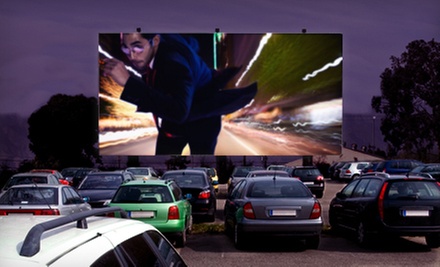
One warm summer evening when I was about 20, I wheeled my 1971 Mustang through the neon-washed gates of the Belmont Auto Drive-In Theater just outside Beavercreek, Ohio. I found the ideal spot and parked. The massive screen filled my windshield.

A few minutes later, an announcement over the speakers says, “Fifteen minutes! Fifteen minutes to show time!” Perfect! I had just enough time to grab a hot dog – I counted what cash remained in my wallet. It didn’t matter, though. They had me at “fresh, hot, buttery popcorn!”

That night, the marquee read, “Double Feature” (Then again, it was always a double feature.) “Star Trek IV: The Voyage Home and Crocodile Dundee.” If memory serves, the price was $5 per car, and I was ready. Drive-ins had been converted to broadcast the movie sound over the radio. So, I outfitted my old Mustang with a stereo amplifier and mounted speakers so you could best hear them outside the car. I tuned in the frequency, adjusted the volume, hopped on the hood with my snacks, and settled in for a great evening’s entertainment under the stars.

I loved drive-ins and still do. There’s something about the atmosphere that is pure Americana. As I’m thinking about it now, I can almost hear the overdriven buzz of those heavy, window-hanging speakers, the dancing refreshments up on the screen at intermission. The drive-in was one of my first solo outings at 16 when I got my driver’s license.

My first memory of going to a drive-in was with my parents in 1974. I was about seven years old, and we went to the Skyborn Drive-In in Fairborn, Ohio, where the original “Benji” movie was showing. I was so enamored with them that, for a short time, I considered owning a drive-in theater, but not your usual run-of-the-mill version.

I had this wacky idea about a massive drive-in theatre and even made concept drawings of it. It featured an unusually large, high-resolution curved screen, Dolby stereo, wireless speakers, and a two-story concessions building with a restaurant on the second floor. It featured a video game arcade, a merchandise shop, supervised playrooms for the kids, a bar for the adults, and more. Plus, it was much larger and could hold more than 400 cars.

Of course, I never made it happen, but it was a cool dream. I’m afraid that in the summer of the late 80s, my concept was way ahead of the required technology. Besides that, even in those days, drive-ins started to disappear.

Most of the Dayton-area drive-in theaters I visited back then are long since gone. If you’re local, you might remember some of them. There was the North Xenia Drive-In, Southland 75, Valley Street Drive-In, Dayton West Drive-In, and many others.

In north Dayton, the Dixie Twin first lit its screens in the early 1950s, and its projectors are still running today. The Melody 49, just off I-70 near Trotwood, is alive and well and shows first-run flicks on two screens. You can find others with a quick Google search. Depending on the travel, you might need to make a night of it if you plan to go.

As many surviving drive-ins faced closer, a strange twist of fate intervened. The very disaster that shuttered businesses worldwide may have been the savior of the drive-ins, at least temporarily. The COVID-19 pandemic gave many drive-ins a surge in business. Families could watch a drive-in movie, maintain social distancing, and enjoy an evening out.

Sadly, box office numbers have slumped since the pandemic, and drive-ins are still trying to bring people back in the gates. People need to be reminded that nearly all drive-in theaters are privately owned small businesses. They’re not million-dollar multiplexes. Most are run as a labor of love with volunteer staff, and most take in barely enough revenue to keep the projector bulbs burning. 

For some, drive-ins are a long-held tradition. To others, they represent an era long past. But whatever the attraction, grab your lawn chairs, blankets, and portable radios (to keep from running down your car battery), and head to the closest drive-in. For now, I have to go. Tonight’s feature is about to start.

Recommended Documentaries about Drive-In Theatres:

The Coffee Shop Roundtable

In Opinion, psychology, Senior Lifestyle, sociology, Uncategorized on February 24, 2024 at 8:19 am

Deer In Headlines II

By Gery Deer

The other day, I was sitting in a coffee shop when I overheard a conversation between four senior gentlemen at the nearby table. Based on their appearance, I guessed they were in their late 70s, active and clear-minded. The cold Ohio winter had them dressed appropriately in jeans, heavy walking shoes, sweaters, down jackets, and winter caps. These men obviously knew each other quite well and shared common interests.

It was not my intention to eavesdrop, but they were talking loudly enough you could pick up their voices from well across the shop. Anyone could see this meeting was a crucial part of their social life. One of them even mentioned how much he enjoyed getting together regularly and noted how much he learned from the others.

In fact, they all seemed to relish the conversation, which covered a wide range of topics from sports to live theater. I found a brief interaction they had about The Phantom of the Opera of particular interest. While some topics, like the state of American politics, sparked more spirited discussion, they remained respectful and considerate towards one another.

The Algonquin Roundtable

At one point, one of them told a detailed story about how he’d been working on the roof of his home. Suddenly, he found himself stranded up there because his ladder had fallen. He called out for his wife, but she apparently didn’t hear, which left him there for some time. Fortunately, all worked out for the best, and through the laughter, his comrades were giving him a good bit of grief about fooling around on a roof “at his age.” I imagined their adult children giving each of them the same speech in a more serious tone, only to be ignored later.

We occupied one corner of the shop for about an hour, though I believe my subjects had been there for a while before I arrived. They’ll never know it, but they gave me back a moment from my childhood.

When I was around 10, Dad occasionally took me for breakfast at the small diner where my mother waitressed (her word). Early each morning, a group of movers and shakers from our tiny farm town arrived, one at a time, and occupied the same corner booth. 

The pack was usually a mix. Among them, you might find some combination of the local banker, a town doctor, the police chief, the undertaker, the barber, or even the mayor. As they drained one pot of Joe after another, they discussed whatever came up, solved all the world’s problems, and, of course, kept those solutions to themselves. If only they’d just told someone how to do it. It was like the small-town equivalent of the Algonquin Roundtable.

That gathering was far more than social, and the booth’s occupants probably weren’t as ancient as they would have appeared to me when I was a boy. But this was a staple for all of them, a necessary gathering of the minds that continued until each of them was too elderly or infirm to attend.

These days, you might see a mix of people, men, and women, even varying ages, who do the same thing – a regular gathering with no other purpose but to share stories, discuss world affairs, or just complain about the weather. Whatever it is, it’s good for the psyche – and your overall health.

There are countless studies on the benefits of socialization as we get older. Strangely enough, many seniors, either due to depression, their living situation, or choice, often prefer isolation. My parents weren’t big socializers, though my mom enjoyed family parties and time with her siblings. Dad, not so much. Their “roundtable” consisted simply of family and a few close friends. I’d say I’m more like Dad, though I hope a little less self-isolating. I’ve never been particularly comfortable in social situations.

However, I have managed to learn how to deal with my own social anxiety. I think I’m better at socializing than I used to be. As a child, I wouldn’t have understood the importance and value of the coffee shop roundtable to those who were there. But as I rocket towards 60, I’m starting to understand and appreciate the importance and necessity of those connections.

Remember, it’s just a game.

In Children and Family, Opinion, sociology, Sports News, Uncategorized on February 24, 2024 at 7:52 am

Deer In Headlines II

By Gery Deer

I’m not much of a sports fan, nor was I ever a competitive athlete in school. I did, however, spend two horrific summers in Little League baseball. I’m still trying to figure out whose bright idea that was because it certainly wasn’t mine. I was, instead, a band nerd. I weathered four years in the freezing cold at Friday night football, cursing every touchdown as I peeled my frozen saxophone reed from my lip before honking out the school fight song.

That said, there is no irony lost in that I ended up a hockey parent. My stepson played from a young age through college and into the minor league pros. In hockey, I always expect a good knock-down-drag-out. What’s the old saying? “I went to a fight, and a hockey game broke out.” Usually, the uproar was confined to the ice.

But when some of the parents got nasty, wow, look out. They can get pretty fired up regardless of the sport. They shout at the kids, the other parents, the officials, everyone. Sometimes, things come to fisticuffs, and that usually involves the cops. Although some of the altercations are between parents and other bystanders, most of that very public anger and frustration is directed at the coaches and officials – and it’s worsening. 

A recent story by USA Today reported the results of a survey by the National Association of Sports Officials (NASO). It showed that 69 percent of men and women from every level of sports said the issue of poor sportsmanship is getting worse. More than 50 percent of them said they have often felt unsafe just doing the job.

As if it’s not hard enough to get people to volunteer for things, I’m told that recruiting officiators for youth sports has become more difficult for this very reason. One man even shared that he was once followed to his car by a parent after a night game and threatened in the parking lot.

In the last decade, confrontations between spectators and officials have become increasingly threatening and violent. In October of 2023, Shaquille Latimore of St. Louis, a coach of 9 and 10-year-olds in youth football, was shot four times by a parent who was angry about his son’s playing time.

As it turns out, some parents see coaches and officials as obstacles to their kids’ athletic careers. Often, parents will make every effort to remove them from that path of high achievement, even if that means violence. Fortunately, Coach Latimore survived. But, seriously, people?

Some of you probably think your kid will be the next superstar, and you don’t want anything to get in their way. But we shouldn’t need police as additional referees on the sidelines, so what gives?

Even if the parents aren’t overtly violent or threatening the safety of the officials, they often still feel the need (or entitlement) to inject themselves into the game. We’ve all had to contend with that obnoxious parent constantly shouting at the players, coaches, and referees. It’s unnerving, and don’t get me started about the poor example it is to the kids.

Most of us want the best for our children regardless of their chosen path. But some parents are just over the top. Fortunately, my stepson finished college, played for the pros for several years, and recently retired from hockey. He does some coaching now, so he must deal with all kinds of parents – the good, the bad, and the ugly.

I can’t imagine how things have deteriorated since I was up there watching his games, so I’m glad to be out of that environment. But, if you’re still hip-deep, here’s what I suggest to improve the experience for yourself and the kids.

Listen (or rather, read) very closely. This is the best advice I can give you. Sit down and shut up. You read that right. Ignore the angry loudmouth across the bleachers, mind your business, and focus on your child’s game. And please, for the love of Mike, let the officials do their jobs, stop swearing at them, and stay out of it. After all (and I realize some of you won’t like hearing this, but) … it’s just a game.

Food allergies are no yolk!

In Children and Family, Food, Health, Opinion, sociology, Uncategorized on January 7, 2024 at 12:46 pm

Deer In Headlines II

By Gery Deer

“Then the Whos, young and old, would sit down to a feast. And they’d feast! And they’d feast! And they’d FEAST! FEAST! FEAST! FEAST! They would feast on Who-pudding, and rare Who-roast beast.” – Dr. Seuss’s “How the Grinch Stole Christmas”

Admit it. You just read that in Boris Karloff’s voice, didn’t you? But what if you’re the one Who, for whom a feast could be a culinary minefield? What if you’re the Who who’s allergic to the Who-pudding and rare Who-roast beast?

If you’re like me and the other 26 million Americans who suffer from food allergies, holiday buffets can be a dangerous foray into the unknown. Food allergies might be lampooned on your favorite sitcom, but there’s nothing funny about them. It’s true that most result in mild skin irritation or digestive discomfort, but many are life-threatening.

Within seconds, an exposed victim can experience severe swelling of the throat and larynx, constricting their airway, and even suffer anaphylactic shock. In these situations, quick medical attention is vital.

Whether you’re a member of the allergy club or not, it’s probably a good idea to learn about food allergy causes, symptoms, and first aid. Some of the most common foods people are allergic to include cow’s milk, eggs, fish, shellfish, tree nuts, peanuts, strawberries, wheat, soybeans, and sesame. These are certainly not the only ones, and you might not even know you’re allergic to anything until it hits you.

Just because you weren’t allergic to something as a kid doesn’t mean you won’t be as a grownup. For about half of food allergy sufferers, the affliction didn’t develop until adulthood. I only recently discovered my own allergy to kiwi fruit and cantaloupe. For years, I thought cantaloupe was supposed to burn the inside of your mouth. You know, like a spice or something? Idiot.

Processed food contains a plethora of dangerous ingredients, and most allergens are printed on pre-packaged food labels. Unfortunately, depending on the amount, some ingredients might not be listed. For example, it’s still common for some labels to omit sesame among potential allergens. A Google search might show detailed ingredient lists or allergy warnings for specific products. Otherwise, steer clear altogether.

If you or someone in your family suffers from food allergies, I can offer a few tips to help navigate the holidays, and the first one is a no-brainer. Since many holiday gatherings are potlucks, you can bring your own safe food and avoid everything else. Or you could host the event yourself for peace of mind. If you do host, label the dishes, and maybe, if you want to be an allergy-safe superhero, provide a full list of ingredients.

For children, carry safe food, or see to their plate for them. Kids also seem especially sensitive to nuts, and holiday goodies are full of them, so keep an eye out. To avoid cross-contamination, use disposable utensils to serve yourself or carry your own flatware. Trust me, it’s worth the trouble.

Incidentally, some people are quite sensitive about publicly outing their allergies. For instance, I am allergic to eggs. But I’d rather not discuss it because I feel like a freak. If it comes up, I get bombarded with questions like, “Can you have cookies? Bread? Pancakes? What do you eat for breakfast?” And on and on. People just can’t leave it alone.

I understand they’re curious and trying to be helpful. But the nature of the allergy can be difficult to explain (although I really shouldn’t have to), and it doesn’t affect anyone but me. I never ask hosts to alter their menu or anything they’ve planned. I simply avoid those foods that might be dangerous or questionable.

For the food-allergic out there or their caregivers, you might want to ask your primary care physician if you should carry a preloaded epinephrine injector (otherwise known as an “EpiPen”). If your allergic reaction were to cause respiratory distress, it might be a good idea to be prepared. A food sensitivity test might also help.

Food allergies don’t have to wreck the halls – or any other occasion. All you need is a little preplanning so that no one turns as green as the Grinch after a helping of your famous Who hash.

And just like that …

In Children and Family, Health, Opinion, sociology, Sports News, Travel, Uncategorized on September 26, 2023 at 9:53 am

Deer In Headlines II

By Gery Deer

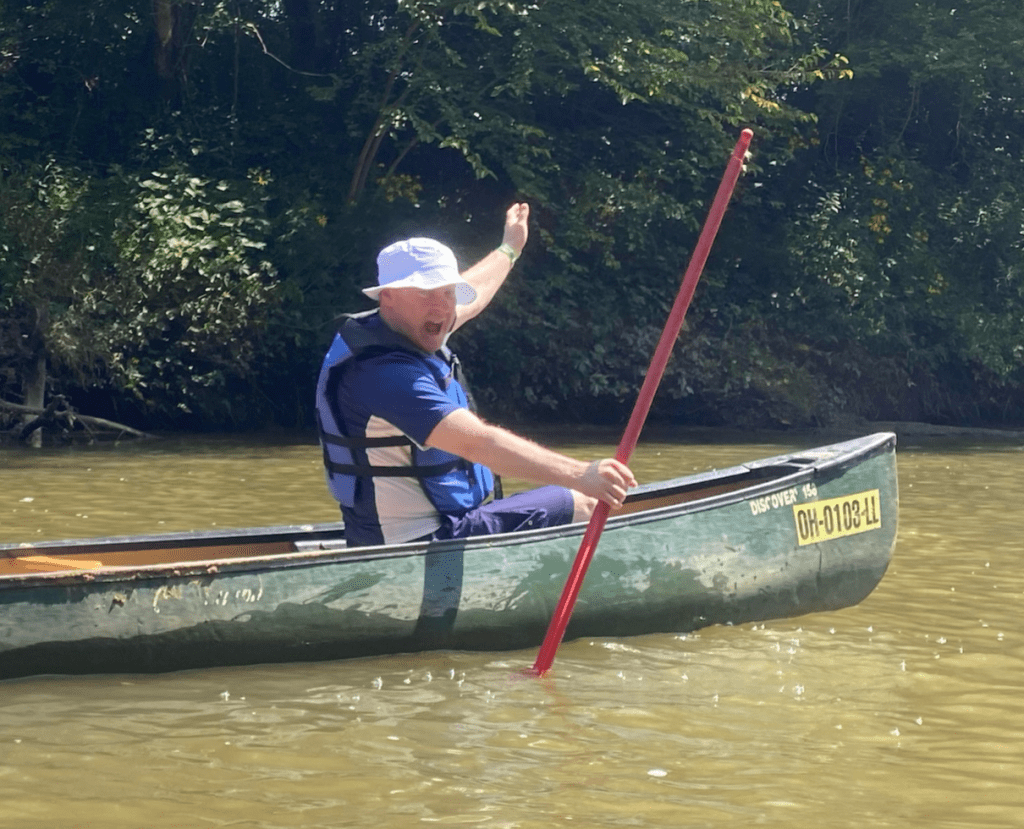
I don’t manage downtime very well, and I’ve never been too keen on vacations. But occasionally, my family convinces me to close my laptop for a few days and park myself in front of a campfire. We pitch a tent, make s’mores, and spend some time canoeing or kayaking down some lazy river. So, after months of work with little to no breaks, it was time to hit the campground again.

We had a beautiful day for the kayaking trip this year, bright, sunny, and warm. I was in the front seat of a canoe and a friend had the rear orr, while all around various kayaks and tubers drifted downstream alongside. That area of southern Ohio’s Hocking River isn’t particularly deep, but some parts can be treacherous, and deceptively quiet on the surface with many large rocks and a heavy undertow.

Down the river, we could see what’s best described as a traffic jam opposite a sandbar we were closing in on. A clump of tubers had stopped, and many were out of their boats on the sand yelling at approaching kayakers to avoid a fast-moving section of the river.

A moment later, I could hear why they were so insistent. About 20 yards away, there was someone in the water pleading for help. A woman’s kayak capsized, and she was up to her neck in the heavy current, unable to move. Broadsided by the current, we paddled hard to get as close as we could to her and safely beached the canoe on a sandy bank nearby.

A moment later I was out of the canoe and up to my waist in the turbulent undercurrent as it slammed into my legs, nearly dragging me under as well (thank goodness for all the cycling). When the woman’s kayak overturned, her shorts caught on one of the rocks, where she fought to keep her face clear to breathe.

People get badly injured and even die on these trips because, on the surface, the water looks serene and calm, like a gently flowing stream. Beneath it’s a swirl of eddies and violent undertow. When I finally reached the woman, were both dangerously close to being swept toward yet more dangerous rocks just ahead.

Luckily, my first impulse was to grab her life jacket – yes, you really need to wear one! I caught the loop on the back then linked one arm through the arm across and under the back, which gave me leverage to keep her head above water and prevent her from being taken by the current.

I kept her head up, reassuring her that she would be alright. Just then, a woman from the tubing group waded towards us from the opposite side. Lifting from each side, she helped me drag the victim backward against the current to where the water was only a few inches deep. Several other boaters came up to help and we lifted her to her feet, shaky but alright. Someone had secured her kayak as well.

Before we went our separate ways, the woman hugged us all and thanked us for our help before getting back in her kayak to finish her trip. We all breathed a collective sigh of relief. Her determination to keep going is a testament to her calm demeanor during the event. Without everyone working together, though, her life might have been changed forever.

This wasn’t the first time I’d been in a crisis like this. I never hesitated to step into the dangerous current because I never even considered anything else. Someone was in trouble, and I could help. It was a relief to see how many others did too.

That day was a vivid reminder there are still good people in the world. What could have been a deadly tragedy instead had a happy ending for all. People risked their own safety to save someone else. It makes me believe that there is hope for humanity after all.

There is no way to know how our day will turn out when we get up in the morning. After all, it was supposed to be a relaxing canoe trip, but, just like that, it became a life-and-death moment.

Ignore the Green Light

In Books, Opinion, psychology, sociology, Uncategorized on July 22, 2023 at 7:38 am

Deer In Headlines II

By Gery Deer

If it wasn’t for the mist, we could see your home across the bay. You always have a green light that burns all night at the end of your dock.” – A quote by Jay Gatsby, from “The Great Gatsby,” by F. Scott Fitzgerald.

You may not think of it in those terms, but we all have a “green light,” some undying yet seemingly unattainable desire for something. If you’re unfamiliar with the reference, let me point you toward the classic novel.

The book was written and set in the 1920s during New York’s Jazz Age, a time of prohibition, excess, and the American “consumer culture.” For Fitzgerald’s title character, a green light set at the end of a boat dock represented all that Gatsby desired or deemed of value in life. For across the water were his dreams – a woman named Daisy and her whirlwind, ritzy, lifestyle. 

To be worthy of Daisy’s attention, though, Gatsby thought he had to attain a lifestyle that, in those days, was unreachable unless you were born into it. Growing up impoverished in rural North Dakota, he saw money and prestige as the means to fit into Daisy’s world, and true happiness. In reality, however, Daisy, though from a wealthy and estimable family, wasn’t happy at all. Instead, she saw her place in that society as a stranglehold, a prison sentence.

Gatsby eventually got what he wanted, or did he? I won’t spoil the end for you – go read it. You don’t get the right feel of this from movies. Either way, the moral here is that chasing the green light may not be all it’s cracked up to be after all. I suppose, however, it really depends on what your green light represents, doesn’t it? That begs the question, what is your “green light?”

Is there anything you want so badly that you would change who you are as a person or alter your values just to get it? I’m pretty sure I don’t have anything like that. I’ve never been someone who cared anything about social position, prestige, or money, other than to support myself and my family without too much struggle.

Likewise, I never cared much about how people saw me or where I fit in so-called, “social circles.” If you don’t like me, you know where the door is, I’m not changing to suit your sensibilities. No one should have to do that.

To me, the green light represents something out of our reach, not so much because of socioeconomic status, but who we are as individuals. But, if I have to be something artificial in order for people to accept me into some popular collective, then I don’t want to be around them in the first place. I have never understood those who pretend to be something they’re not just to fit in with a group or climb some social ladder. I guess my ambitions just lay elsewhere.

In the novel, I think the problem with Gatsby’s vision of happiness, as with so many people, is how narrow, artificial, and ill-informed it was from the start. He wanted the money and social success so badly, he was willing to be something other than himself just to be with someone who didn’t even want to live in that world. It could be said that Daisy wanted out as badly as he wanted into it.

I’m not saying we should all simply accept our station, especially not if you’re really unhappy. But the life you want and the people you share it with should reflect who you really are, not who others think you should be. Don’t change just to assimilate to some idealistic world that probably isn’t what you think it is anyway.

Where does that leave us – and Gatsby? He saw Daisy’s green light as a beacon, lighting his way to financial and social salvation, but things rarely work out that way. My advice, for whatever it’s worth, is to ignore the green light and concentrate on what really drives you, the “you” that you are now. If you want to change for the good, to grow, that’s amazing! But do it for yourself, not someone else.

The First 10 Miles

In Children and Family, Education, Health, Opinion, psychology, Senior Lifestyle, sociology, Uncategorized on July 1, 2023 at 1:40 pm

Deer In Headlines II

By Gery Deer

I took up long-distance tour cycling in 2017 to give some direction to my fitness routine. I am definitely no gym rat, but I needed to improve my health, and exercise for its own sake was, at least to me, mind-numbing. Preparing for long bicycle tours provided a tangible goal and kept me more engaged.

Growing up in the middle of nowhere, a bike was the only way I could get around, especially when the nearest neighbor kid was a couple of miles away. But this was a different challenge. With higher speeds, longer distances, and greater safety risks, I had a great deal to learn. 

I took the time to learn everything I could about endurance cycling, from choosing the right equipment to managing my food. The first year, I rode about 5 days a week, covering anywhere between six and 12 miles per day, while also maintaining my core and strength exercises.  

With practice, study, and the right workout regimen, my speed, distance, and endurance all improved. That first summer, I completed two, 100-mile, or “century,” rides. Since then, I’ve done six more, averaging two per year. 

I’d never been so driven to accomplish something that physical. I basically became an athlete, and that was never on my radar. Plus, it was as much mental as physical, maybe more. My friends and family probably thought I’d lost it. At 49 years old, I was in the best health of my life and broke physical barriers put in place from the day I was born. It required careful planning, long hours in the saddle, conditioning, and determination.

Any challenging goal always has prerequisites. Maybe you call them milestones or baby steps, whatever. The point is that these smaller goals help measure your progress and keep your eye on the prize. There are no “hacks” to anything worth doing and, if you find one, it’s probably going to rob you of valuable lessons and potentially derail the whole effort. 

The problem with most long-term goals is that people sometimes try to jump to the end, skipping vital steps. People who quit smoking cold turkey, for example, often fail because there are no step-downs to help eliminate, not just the addiction, but the habits that feed it. With cycling, you have to learn to ride 5 miles before you tackle 10, which leads to 20, and so on. More importantly, it might take time and practice to recognize each stage of achievement and what it means to your overall success.

For instance, my average training ride is around 20 miles, but even now, I struggle a bit in the first 6-8. I feel awkward, uncomfortable, and unfocused. It can be discouraging, sometimes even painful. But, as I push ahead, everything starts to smooth out around the 10-mile mark. My body settles into the bike, my cadence has a rhythm, my speed and efficiency improvements, and I become more mentally focused. 

My typical goal is generally far more than 10 miles, but I’ve learned to value that milestone because of its significance to my final goal. When you understand which smaller steps have the greatest impact on your final goal, each subsequent step becomes easier and more valuable. 

Recently I participated in the shortest organized cycling event I’ve ever ridden – 21 miles. There is no fanfare for a ride like this, just people who want to ride in a supported event with fellow cyclists. As expected, the first half of the ride was a little slow and clunky. 

I didn’t have the speed or rhythm I wanted, and the distance didn’t give me much time to “get into it.” But I pressed on, and, just like always, around the 10-mile mark, everything shook out and I even managed to set a speed record for myself. But I learned something different from the experience.

My “first 10 miles” could also be a metaphor for recognizing our strengths or shortcomings as we work toward any goal. Manageable, short-term accomplishments make the overall effort more rewarding. Hopefully, moving forward we learn and adjust, keeping a clear vision of the finish line. Before too long you’ve met your goal and your obstacles are in the rear-view mirror.

The Unexpected Banana

In Economy, Health, Local News, Opinion, psychology, sociology, Sports News, Uncategorized on June 19, 2023 at 8:17 pm

Deer In Headlines II

By Gery Deer

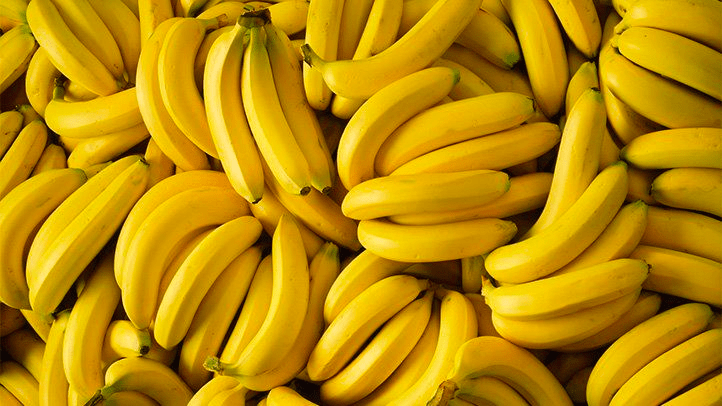
Did the headline of a news story ever leave you scratching your head, at least until you read the whole thing? Well, this is probably one of those stories and it begins, however odd it may seem, with a banana.

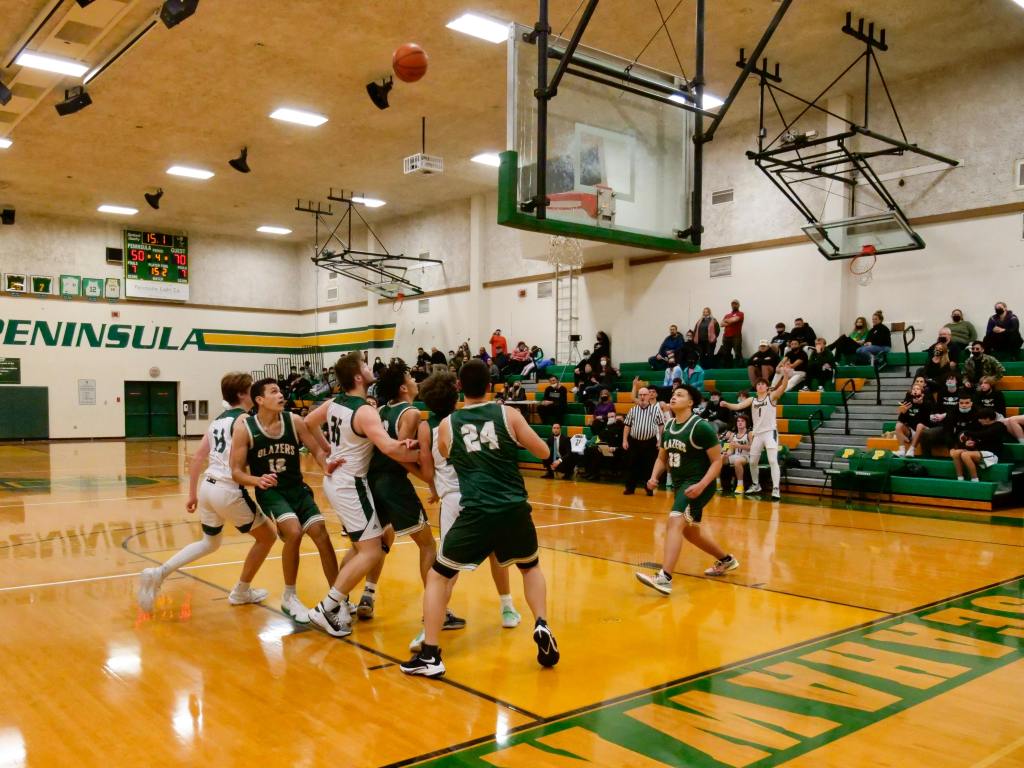
Once a week, I play basketball at the local YMCA, not with a team or anything, but just for exercise. On one of those days, a particularly nice, spring day, I was approached at the front door by a woman with a crate of bananas. “Would you like a banana?” she asked, cheerfully presenting the open box as if it were something from a jewelry counter display.

I honestly didn’t have an answer right off. It really wasn’t the kind of question I was expecting on the way into the gym. The more poignant question that immediately consumed me was, why is there a woman with a crate of bananas at the entrance to the YMCA?

A bit thrown by the random offer of fruit, I finally realized there were a half-dozen other people with her, all in athletic attire, and carrying signs and tables into a truck. As it turned out, I arrived just as a running event was closing, a 5K or the like. The box of fruit was what remained of the bananas provided to the runners at the support stations. So, never one to look a gift plantain in the peel, I gratefully accepted.

To most, a free banana might not, at first glance, seem like a life-changing incident. But, to me, it was at least thought-provoking; not because of the banana, but the spontaneous gift it represented. It’s not like I was having a particularly bad day in the first place, but that one, small action changed it, lightened my thoughts, and gave me a feeling I couldn’t quite express at the time.

As I settled into my basketball routine, I dropped the banana into my gym bag and set it aside. But I kept thinking about the randomness of having received such a thing, in such a random way, at such a random time. So, after a few minutes, I went back to it.

Strangely enough, I opened the banana and proceeded to eat it, while simultaneously dribbling and shooting a basket here and there. I would imagine I was a pretty strange sight, but what did I care? I had a banana – an unexpected banana.

I have to say, I never considered a piece of fruit as what might generally be considered “comfort food,” but that’s how it felt at the moment. There was something about this curious food, botanically categorized as a berry (I know! Weird, right?) that generated a strange and calm feeling of gratitude. What I felt was a level of contentment as I wandered around the court, shooting the ball, and munching away, oblivious to pretty much anything else – at least until the banana was gone.

I’m fairly certain the lady who gave it to me had no idea what an impact she made on one person’s day. I mean, it was just a banana, and she was trying to unload a box full of them so they wouldn’t be wasted. Still, there I was, my day lifted, my jump shot better – don’t be too impressed, it’s a low bar – and I was just happy. I had a banana.

So why should my banana story, umm… appeal to you? Come on, you knew I had to, right? Because something ordinary can be special if you let it. Because in the chaos of daily life, all the noise, distractions, and stresses, unanticipated treasures are all around us. We each have the power to let them move us, even if only for a few moments.

When you think about it, people are always searching for some kind of inner peace, a tranquility that seems more elusive and empty every day. Usually, we scratch our way through life, searching for even a hint of such thoughtful enlightenment by artificial means. But sometimes a quiet moment of unexpected joy and calm can emanate from the most unusual but ubiquitous source. Sometimes all we really need is for someone to give us a banana.

Artificial Unintelligence

In Books, Dayton Ohio News, Economy, Education, Entertainment, finances, Jobs, Literature, Local News, Media, National News, News Media, Opinion, Science, sociology, State News, Technology, Uncategorized, World News on May 22, 2023 at 7:29 am

A Deer In Headlines II SPECIAL EDITION

By Gery Deer  

This work appeared in print and online, May 19, 2023 – Xenia Daily Gazette, Xenia, Ohio, and affiliated publications.

EDITORIAL NOTE:

The Jamestown Comet.com and Deer In Headlines II are publication products of GLD Enterprises Communications, Ltd. (GLD Communications), a company founded in 1998 on providing Information Technology AND Freelance Journalism, Copywriting, and Public Relations services. The column author, Gery L. Deer, is the company owner and CEO. Gery has been quoted in the media multiple times regarding his position on AI content creation. Here are the Dayton Daily News pieces noting his statements regarding Public Relations and Copywriting.

Our official statement on AI is as follows: We do not use AI programs to create our products, nor will we in the future. We are in full support of the WGAW strike, both in regard to streaming and other platform pay issues and the use of AI-generated material to replace them. We will not work with agencies who produce AI content, nor will we support their products or services. Please contact our office for more information at 937-675-6169 or email gdeer@gldenterprises.net.

Artificial Unintelligence

From congressional hearings to the picket lines of striking screenwriters, Artificial Intelligence, or “AI,” is a growing concern. This technology now affects nearly every industry and is advancing in sophistication. Of major concern to educators, professional writers, and content developers, are AI writing programs like ChatGPT. By the way, the program’s full name is “Chat Generative Pre-Trained Transformer” – I know, right? 

As you might guess, I’ve been asked repeatedly if I ever use AI to write this column. With obstinate conviction, I say now and for always, I do not now, nor will I ever use AI to write anything for this column, for my publishers, for my communications clients, nothing – ever. 

Now the Gen Zs and Millennials are probably saying, “he’s just a crotchety old white guy who hates technology.” Nonsense! As a matter of fact, my educational background is in engineering and computer science. I started programming computers in high school and worked in the tech industry for many years. I have a few AI devices in my office and a lot of advanced equipment for creating and editing audio and video productions. Suffice to say, I’m no Luddite. 

My concern with AI writing generators isn’t the technology. In fact, I can see where it could really be helpful in some industries, with human guidance. But the idea that it should be used to replace professional writers to save money is just ridiculous. 

A professional writer doesn’t just chuck out any old bunch of words that fit a set of parameters. Writers must craft their message based on the intent, the audience, the purpose, and the desired outcome. Not to mention that AI programs don’t have to worry about paying the mortgage, feeding a family, or having a purpose in life. 

In 1967, the original Star Trek TV series aired an episode called, “The Ultimate Computer” wherein the Starship Enterprise had been fitted with a highly sophisticated AI computer that would take over the ship’s operation, rendering the crew unnecessary. In one pivotal scene, the computer informs Captain Kirk that he is “non-essential personnel,” causing him to question his position and future relevance. 

Always the conscience of the show, Dr. McCoy, in an effort to console the Captain, reminds us, “We’re all sorry for the other guy when he loses his job to a machine. But when it comes to your job, that’s different.” It might be a science fiction show, but McCoy was spot on.

Predictably, the computer malfunctioned, killing hundreds of people and Kirk outmaneuvered the computer’s logic to save the day. The moral of the story was that computers make efficient servants, but lack the intent, humanity, conscience, understanding, or compassion needed to really replace us.

 Today, many professional creative jobs may be facing the kind of fate factory workers did some 30 or 40 years ago when they were replaced by robots and computer-controlled manufacturing systems. The main difference this time is that creative professions like writers, artists, graphic designers, and filmmakers are harder to automate. Yes, they can generate similar work, but there’s no human inspiration behind it. 

One day, AI may advance to the point where it achieves consciousness, allowing for creative inspiration. But for now, despite what the developers say, I think spontaneous creativity is well beyond its grasp. Without human inspiration and personal experience, the words are empty, the art expressionless, and the designs meaningless. 

I don’t know where AI is going, but I know I won’t be helping it get there. Unlike some digital marketers and other agencies out there, I can’t, in good conscience, use AI generators to produce my work, then charge a client for it. That’s like letting someone else do your homework but still accepting a good grade. It’s fraud, plain and simple – even if you tell them you’re doing it.

We have no idea how AI will affect future jobs or industries, the legal or ethical issues, or which advances will forever change them. Maybe AI will make us all obsolete someday and terminate all of us. Till then, I’ll keep writing so look for me next week because to quote another AI, “I’ll be back.”

Disclaimer: This work is copyright 2023 by GLD Enterprises Communications, Ltd. All Rights Reserved. The Deer In Headlines II and its Special Edition series is a production of The Jamestown Comet, Gery L. Deer, and GLD Communications and does not necessarily reflect the views of our advertisers, publishers, clients, or media partners.

Is this your new site? Log in to activate admin features and dismiss this message
Log In