Local News & Commentary Since 1890.

Archive for the ‘Economy’ Category

Yellow Springs company, DMS ink, elevates inkjet capabilities

In Business, Dayton Ohio News, Economy, finances, National News, Technology, Uncategorized on June 15, 2016 at 3:56 pm


One-stop print shop opens the doors to new business opportunities

MELVILLE, N.Y., June 15, 2016 – Canon Solutions America, Inc., a wholly owned subsidiary of Canon U.S.A., Inc., today announced an advancement in its ongoing strategic relationship with DMS ink, a full-service direct mail marketing company located in Yellow Springs, Ohio. The installation of the Océ VarioPrint i300 and Océ ColorStream 3900 color digital presses in the DMS ink facility serves to expand their services to their customer base, and illustrates Canon Solutions America’s ongoing commitment to advancing customers’ print output through cutting-edge inkjet technologies.

DMS ink, formerly Dayton Mailing Services, recently moved its headquarters and most of its production to Yellow Springs, Ohio from Dayton.

DMS ink, formerly Dayton Mailing Services, recently moved its headquarters and most of its production to Yellow Springs, Ohio from Dayton.

DMS ink, originally known as Dayton Mailing Services, was founded in 1983. The company has thrived in the direct mail space for more than 30 years through its ability to adapt, staying at the forefront of the industry with cutting-edge concepts and solutions while serving a dynamic customer-base. Since its inception, DMS ink has been known throughout the region for providing best-in-class mailing services and handling its customer projects from design to distribution. With a team of dedicated professionals, the direct mail marketing leader helps a wide range of businesses including healthcare, financial, retail, insurance, and many others, to reduce their costs by offering unique capabilities that go beyond industry benchmarks.

As successful and reliable as DMS ink is within the mail marketing business landscape, to put an emphasis solely on those capabilities would be a disservice to a company that has recently expanded its operations to include leading data services and digital print offerings. Over the last five years, the Ohio-based full printing and fulfillment center has grown into a prosperous digital print provider that now boasts some of the most game-changing technologies that are redefining the industry. This transition began in early 2005 when DMS ink began its shift from a traditional letter shop to a variable data printing provider, and is most recently represented by the company’s acquisition of the Océ VarioPrint i300 sheet-fed inkjet press and the Océ ColorStream 3900 inkjet press. Since the arrival of these advanced presses, the early adopter of inkjet has opened the doors to even broader business opportunities.

“I cannot stress enough the level of activity and excitement within DMS ink as we continue our migration to a critical document company with state-of-the-art digital print capabilities,” said Christine Soward, president and owner of DMS ink, whose commitment to innovation and emerging technologies has grown the company’s revenue by double digits over the last several years. “The enthusiasm around our company is perhaps best highlighted by our purchase of what we feel is the product that will lead the charge in the industry-wide inkjet movement, the Océ VarioPrint i300.”

When DMS ink went to market for an answer to its crucial digital print needs, it specifically searched for improvements in print quality and a press that could provide commercial-type color at transactional-type costs. With a commitment to innovation, Soward and her team put an equal focus on finding a digital press that could help diversify their client roster and overall offerings while handling new and more diverse applications with an eye toward profitability. Additionally, DMS ink knew that with the emergence of new inkjet technologies, there was an answer to its ongoing quest to break down the barriers it was finding that pertained to offset printing, short-run jobs, postal optimization, one-on-one personalized communications, and the ability to maximize uptime.

“The new Océ products have allowed us to run jobs at an unbelievable rate and with incredible quality,” added Jim Hoffman, vice president of Business Development at DMS ink. “Of course you always want to get the most out of your investment, and with the Océ VarioPrint i300 and Océ ColorStream 3900 we can now fully leverage our finishing capabilities, which has resulted in heightened efficiency and automated workflows. Our core goal of becoming less of a mail house and more of a strategic partner has been greatly enhanced with the print functionality we now have with our newest acquisitions.”

Built to allow its users the ability to grow within a market that is evolving rapidly, the Océ VarioPrint i300 bridges the gap between the application flexibility and efficiency of sheet-fed presses and the economy and productivity of web-fed systems, without compromising quality. As witnessed by DMS ink, the digital press was designed to offer premium quality output with proven inkjet productivity and flexibility. Operating as the ideal complement to this leading press is the Océ ColorStream 3900 full color inkjet printer. Recognized as one of the fastest growing inkjet presses in the industry, its production and media flexibility enables a simplified transition of applications and business models to more sophisticated documents with variable personalization and smarter communication in color.

“With the confluence of new technologies and the ever-apparent shift to inkjet, we have dedicated ourselves to finding the best way for our customers to accelerate the offset-to-digital print migration with products that will set the bar for the inkjet movement,” said Francis A. McMahon, senior vice president, Marketing, Production Print Solutions, Canon Solutions America. “However, none of that is possible without feedback from our valued customers like DMS ink, which allows us to modify the technology to best fit their business goals and prepare them for expansive growth.”

The collaboration between Canon Solutions America and DMS ink did not end with the installation of the Océ VarioPrint. With the intention to migrate the rest of its inkjet products and to further enhance its workflow, DMS ink additionally implemented the Océ PRISMAproduction print workflow and output management system. This addition is set to provide DMS ink with the ability to create a unified platform for mid to high volume, high speed printing for its entire production print fleet.

“This is very much a time of change and growth here at DMS ink, and we could not be more excited to experience that growth alongside Canon Solutions America,” added Soward. “The future looks bright for DMS ink and our customers!”


About DMS ink
DMS ink (formerly Dayton Mailing Services) has thrived in the direct mail, digital print, and data management industries for more than 30 years. Their goal is to become a true partner to their customers and an extension of their business through trust and dedication. DMS ink provides innovative, cutting edge solutions using the latest technology to increase capabilities, improve efficiency and reduce costs, while maximizing consumer response and meeting the needs of the client. DMS is a minority and woman owned certified business serving clients nationally. Their unique capabilities are sought by a wide range of businesses from healthcare, financial, retail, political, energy, automotive, non-profits, and many others that require full project management of design, material acquisitions, complex data programming, variable content, printing, fulfillment and mailing services.

About Canon Solutions America, Inc.

Canon Solutions America provides industry leading enterprise, production, and large format printing solutions, supported by exceptional professional service offerings. With the technology offerings of the Canon and Océ brands, Canon Solutions America helps companies of all sizes improve sustainability, increase efficiency, and control costs through high volume, continuous feed, digital and traditional printing, and document management solutions. A wholly owned subsidiary of Canon U.S.A., Inc., Canon Solutions America is headquartered in Melville, N.Y. and has sales and service locations across the U.S. For more information on Canon Solutions America, please visit csa.canon.com.

###

Canon is a registered trademark of Canon Inc. in the United States and elsewhere. Océ is a registered trademark of Océ-Technologies B.V. in the United States and elsewhere. All other referenced product names and marks are trademarks of their respective owners and are hereby acknowledged.

© 2016 Canon Solutions America, Inc. All rights reserved.

Dayton creative agency relocated to Yellow Springs

In Business, Dayton Ohio News, Economy, Media, Uncategorized on March 22, 2016 at 3:00 pm

The Bricks Logo_V2Yellow Springs, OH – Dayton creative advertising services company, The Bricks Agency, has relocated to the village Yellow Springs as of Monday, March 21st. As the creative strategy division of DMS ink (formerly Dayton Mailing Services, Inc.), the firm has moved from the parent company’s original location on Keowee St. in Dayton to suite 102, west, of 888 Dayton Street in Yellow Springs.

Established in early 2015, The Bricks Agency provides advertising, graphic design, copywriting, print and

888 Dayton St. Yellow Springs, OH

888 Dayton St. Yellow Springs, OH

digital market strategies, as well as corporate identity and public relations services. The fledgling company’s inaugural year proved highly successful, landing its first international client and achieving two, bronze Hermes awards from the American Advertising Federation Dayton.

Gery Deer is the agency’s Managing and Communications Director. He says the move to Yellow Springs is in line with the expansion of the parent company, DMS ink, which just purchased the Dayton Street facility and will be moving its headquarters and production lines there in the coming months.

“We’re excited to be in our new, creative space and a part of such a naturally nurturing community,” Deer says. “It’s the ideal environment in which our agency can prosper and grow.”

Any questions about the agency or its relocation should be directed to Gery L. Deer, by calling 937-222-5056 Ext. 134, or email gery.deer@thebricksagency.com. Online at bestdaytonadagency.com.


If Trump gets nomination, I’m done with GOP

In Business, Economy, history, Jobs, Local News, National News, Opinion, Politics, sociology, State News, Uncategorized, World News on February 25, 2016 at 9:37 am

Deer In Headlines
By Gery L. Deer

DIH LOGOBecause I’ve always tried to get people to think about my subjects from more than one perspective, I’ve rarely shown my personal political leanings within the wording of my columns. In fact, I so often take opposing views in any given article, after any given Deer In Headlines column is published, I could be called, in the same day, a “bleeding heart liberal,” and a “right wing conservative.”

But, here it is, for the record and publicized for the first time anywhere – I am a registered Republican. (If there was a pool going somewhere, I’d like a cut please.) I am certainly not, however, what you might think of as a typical modern conservative. In truth, my considerations often demonstrate a far more liberal position but I’m also frequently sickened by the level of hypocrisy in both parties.

So, I should explain, “why Republican?” Well, I didn’t go with the GOP from any ideological position. Many years ago, during the first presidential election for which I was old enough to vote, I had to choose a party in order to participate in the primary election. At the time, I knew more about the Republican candidates, so I picked that one. Really scientific, wouldn’t you say?

No, it wasn’t the best way to choose, but I was 18 and had to make a fast decision. As the years went on, I always avoided just blindly voting the party line and chose whichever candidate I thought was best based on the facts at hand. So, my party affiliation really didn’t make much difference. But today I think that affiliation does matter, possibly more so than any other time during my life.

Trump rise indicates hateful path of GOP. Photo courtesy NYTimes.

Trump rise indicates hateful path of GOP. Photo courtesy NYTimes.

Donald Trump has managed to do exactly what he set out to since the day he announced his candidacy for president. However caustic and cartoonish his campaign, The Donald has ripped through the fabric of the Republican Party and scattered the conservative base.

My problem here is that any group that would allow and encourage a self-aggrandizing buffoon like Trump to climb to the top of the party has obviously lost its way. Poking around in the dark for the lesser of who cares, people have desperately searched for a non-politician. Sadly, they think Trump is that person. Still, Americans need a good leader and someone who understands the complexities of the world stage on which America is just one player.

To be an effective president, Trump would have to work on a team, listen to more knowledgeable advisors and make decisions based on the best interests of the people, not just to get his own way. I believe, as do others, that Trump is totally incapable of this behavior.

As Trump plowed through the rest of the party making his way to the top, he has repeatedly shown he is not ready or personally equipped to be that kind of leader. As a businessman, he comes across more like a dictator. In other words, it’s his way or nothing. Ironically, Republicans have repeatedly criticized President Obama for the very same behavior citing executive orders.

At this point, I need to be clear about something else regarding my political leanings. I don’t like Hillary Clinton either. She’s a proven liar from a deceptive family and a political insider. Bernie Sanders isn’t much better. His blathering on about so-called democratic socialism is idealistic nonsense lacking even the most basic economic foundation.

So why come out about my party affiliations now? Well, there are a couple of reasons. Over the years I’ve watched in disgust as this party that revels in moral values seems hypocritically more bigoted, angry and hateful than ever. A fact made more clear every time Trump opens his mouth to denigrate Muslims, minorities, women or whomever he’s attacking that day and is met with unbridled cheering from ignorant followers.

The party of Lincoln would certainly cringe if he were here today. In recent times, the GOP has argued harder for the right of someone to own an AR-15 assault weapon than for women and minorities to be treated equally. Honestly? It’s just embarrassing.

Trump’s shocking rise from joke to frontrunner proves that the Grand Old Party is nothing of the kind. It has become, instead, little more than another corporate sell-out run by rich, old white guys with followers who seem to thrive on hate, bigotry and fear.

A Trump nomination will be the last straw for me. When it happens, although I disagree with a great many liberal policies and ideals, I will march myself to the board of elections and change my party affiliation from Republican to Democrat.

Since, I tend to think for myself rather than be a political lemming, I’d obviously rather go “independent” but I wouldn’t, for two reasons. First, the idea of an “independent party,” is an oxymoron. You can’t be independent about something if you’re just going to follow a group. Secondly, I still want to have an effect in the primaries.

Many people are angry about the direction of the current administration and the country and I sympathize. I have many friends, family and business associates who are Trump supporters for those very reasons. And for them, I am simultaneously surprised and disappointed, but I still support them and their right to choose the candidate that best reflects their views.

So, I certainly hope these revelations have not put you off of reading my work, but I felt this was important enough to make a stand and let you, my readers, know where my head is in this election. In the coming weeks, I’ll be discussing more about what happens next in my political participation, so stay tuned to Deer In Headlines.

Gery L. Deer is an independent columnist and business writer. Deer In Headlines is distributed by GLD Enterprises Communications. More at deerinheadlines.com.

Saving the mythical middle class

In Economy, history, Local News, National News, Opinion, Politics on February 1, 2016 at 9:38 am

Deer In Headlines

By Gery L. Deer

DIH LOGODuring the post-war euphoria of the 1950s, Americans were convinced of a concept that has carried through into the next century. The “middle class” was a figment of someone’s imagination – probably a politician – and sold to the public as the ideal life. But the idea of a middle class has become as mythological as the Leave It To Beaver universe that created it.

As the presidential election year kicks into high gear, saving the dying middle class will be the subject of countless speeches. But how do you preserve something that no longer exists, if it ever did at all? The truth is, you can’t.

But who is the middle class? As it turns out, there is no consistent definition of this mythical group. Depending on the source, the middle class can be defined in a number of ways, from economical status to age and race demographics. So when you hear a politician spout off the words, “middle class,” the context is vital, otherwise it’s meaningless.

According to CNNMoney.com, one definition by the Pew Research Center is based on income. It lists the middle class as those Americans who earn between $46,900 and $140,900. Another marker has to do with aspirations.

Most people who consider themselves middle class want to own a home, send their kids to college, have proper healthcare and investment savings, a car, vacations, and so on. Obviously, that means that the money has to exist to make any of that a possibility so we’re back to financial definitions once again.

Photo courtesy NBC News

Photo courtesy NBC News

The simple fact of it is the concept of the middle class is a myth; a myth we have all been trapped into believing to the point of mass hysteria. The American dream does exist, but it’s far less detailed than we’ve been taught over the last 70 years or so, and it’s not as tied to the middle class as once thought.

Between the American dream and the middle class, I’d much rather focus on the former; at least I know it’s ambiguous and depends on my own efforts, choices and aspirations. The American dream is different for each person.

Yours might be to own a bookstore while your neighbor’s may simply be to be healthy and happy in his or her own way. But trying to be part of the middle class has done countless families harm over the years, struggling to “keep up with the Joneses,” and fighting the never ending war to amass “stuff” so as to appear successful.

As a political hot button, the idea that the middle class is suffering provides unlimited opportunity to yank at the heartstrings of conservatives. Liberals don’t seem to care as much about it. It all goes back to that subliminal mental tie-in between the middle class and the American dream.

The question remains, how do politicians evoke emotion over a group that doesn’t actually exist? Or, stated more correctly, a group that encompasses so many different kinds of people as to eliminate any particular demographic. Actually, it’s easier than you might think.

If politicians can keep that apple pie imagery flowing and preach doom and gloom over its demise, people will flock to the polls to protect it by voting for them. It’ll have the same effect as the anti-communist films of the 1950s and 60s depicting a family on a nice summer picnic when suddenly the nuclear bombs start dropping. Destroy the middle class and America dies.

But, once again, it’s impossible to destroy what doesn’t exist. The middle class is defined by whoever wants to use it to their benefit, to push their agenda. Oddly, I’d say the middle class is more about a state of mind of the individual than actual numbers.

We all just want to be normal, average Americans in similar status to our neighbors so we can relate to each other. In the end, I think we all just want to be financially stable and happy with our lives.

Community colleges are vital to economy

In Business, Economy, Education, Politics, State News, Uncategorized on October 26, 2015 at 9:42 am

Deer In Headlines

By Gery L. Deer

DIH LOGOAs college tuition continues to climb, more students are going into debt from loans or even dropping out because of the expense and the cycle is getting worse, not better. According to a 2013 estimate by Forbes magazine, students in the U.S. owed a whopping $1.2 trillion in tuition loans and that number is climbing.

Upon graduation, the average student will need to work enough to live while trying to pay off nearly $25,000 in loan debt. This is one reason community colleges are gaining ground as the first, best option for people who want a solid education that leads to gainful employment – and for less money.

Not too long ago the Obama administration announced the importance of community college and an effort to make them tuition-free for low-income families. While there is merit to the sentiment, the idea that an Ivy Leaguer, like the president, speaks as if he just discovered the value of these institutions always comes across as elitist and insulting.

When highbrow critics slam community college curriculum as easier, less valuable, or someplace only the low-performers go, it only serves to make those ivory-towered onlookers appear less intelligent. For some people, the community college serves to fill in educational gaps left by their high school experience.

College_graduate_students (1)The department of education reports that 40-percent of students who set out to earn a four-year degree still have not completed it by year six. Even so, many guidance counselors don’t suggest community college to lower-income or poorly performing students out of a sense of political correctness.

If the counselor sincerely suggests to a low-income individual, particularly a minority, that community college might be their best option, he or she could very well appear racist or the like. As a result, many students head for universities who may either not be ready for it academically or who simply cannot afford it.

Of course, not all community colleges are created equal. There are certainly those institutions that need curriculum improvement, which is why these schools must make every effort to attract talented faculty.

The Dayton, Ohio area has about a half-dozen, highly rated community colleges including Edison Community College, ITT Technical Institute, and, the fastest growing and largest, Sinclair Community College. Established in the basement of the Dayton YMCA in 1887, Sinclair is the oldest and often rated as most popular in the region and a leader in healthcare and high tech education.

Sinclair established university parallel programs more than 25 years ago, providing students the opportunity to earn an associate’s degree in engineering and other programs that transfer directly into four-year schools like University of Dayton and Ohio University, Athens. Many community colleges today offer this type of continuing program to allow students to build momentum in their college careers and nail down the academic path that most suits their goals.

Community college is an amazing opportunity for many students, allowing for more hands-on training that is generally possible at the university level and from people who have worked in the field. Most community college instructors and professors have spent years in real-life work situations, not just in academia and theory.

As it has been since their inception, community colleges also tailor programs for adult and continuing education students. From evening courses to satellite classes, adult students can earn their associate’s degree or work toward a certificate required to advance in their current job. Some larger employers even collaborate with the colleges to offer the course work on site.

Whatever the reason, lower tuition, work advancement or kick starting a longer academic career, community colleges offer a great many options for students and are not merely the “last resort.” Education and knowledge are what grow an economy, not political rhetoric and empty promises.

The university experience is simply not for everyone, regardless of academic prowess and financial means. Americans must relieve the stigma associated with community college programs and present instead a unified front for educational options in the 21st Century. Everyone benefits from education, workers, employers, the community and the country.


Gery L. Deer is an independent columnist and business writer. Deer In Headlines syndicated by GLD Enterprises Communications. More at gerydeer.com.

Dayton-based 3D manufacturing leader Bastech, Inc., combines brands

In Business, Dayton Ohio News, Economy, Media, News Media, Science, Technology, Uncategorized on September 27, 2015 at 2:53 pm

BUSINESS NEWS …

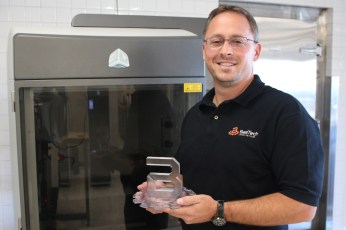
Ben Staub, Jr., owner and president of Bastech, Inc.

Dayton, OH – Dayton-based Bastech, Inc., has combined its full range of manufacturing and consumer services under one brand. Since its founding two decades ago, Bastech, Inc., has grown into three separate divisions offering a wide range of services and products from manufacturing prototypes and end-use parts to professional and consumer 3D printing equipment solutions.

Bastech, Inc., is an industry leader in field of “additive manufacturing,” or what is now more commonly known as 3D printing. The company opened in 1994 and first applied the process to automotive and product design.

Today Bastech, Inc., develops revolutionary solutions for many applications including aerospace, medical device, jewelry, packaging, metal casting, injection molding, education and more. As more commercial opportunities arose the firm established separate companies to manage industry-changing niche services.

The first, Rapid Direction, Inc., was founded in 2006 to provide 3D printing equipment and supplies, meeting the needs of those manufacturers who wanted to have in-house, 3D part production capability. Next, the retail 3D printing service, GetPrinting3D, was established in 2012 and offers consumer-based products, ranging from desktop 3D printers to full-color, 3D figurines and custom bobble heads.

Bastech’s president and owner, Ben Staub, Jr., first worked with additive manufacturing during the early 1990s. During that time, he learned the complexities of programming and prototyping with stereolithography (SLA), one of several methods used to create 3D printed objects.

That experience, combined with his background from a strong manufacturing-based, entrepreneurial family culture gave him the tools to master the process and, more importantly, match advancing capabilities with industry demand.

As the technology becomes more accessible and the industry more fluid, Staub recognized that the division of these related products and services into separate entities might make for missed opportunities.

“Many times, customers of one company have no idea what the other has to offer,” Staub says. “Explaining why we have different business units has often been confusing, even to our own people.”

For example, an electronics manufacturer outsourcing prototype parts to Bastech might not be aware that Rapid Direction could actually provide an in-house solution.

More applications for 3D printing are being developed every day and Staub’s team wants Bastech to grow with the demand while giving customers the single, best resource. Over the next few months, a concentrated brand identity will be rolled out to present a clear, single solution under the name Bastech.

“Rebranding is never an easy decision, or an uncomplicated one to execute,” he said. “Nevertheless, it is the right time for that to take place and ‘Bastech’ will become the one solution for our customers.”

Bastech, Inc., corporate facility is located at 9233 N. Dixie Dr. in Dayton. For more information, contact Bastech, Inc., by calling the corporate offices at 855-890-9292 or go online to http://www.bastech.com.

Hackers: The gangsters of the digital age.

In Business, Crime, Economy, News Media, Opinion, Uncategorized on August 24, 2015 at 10:49 am

Deer In Headlines

By Gery L. Deer

DIH LOGORecently, after watching a news story on the subject, my father, who recently turned 82 years old, asked me about what “hacking” was and why someone would do it. I struggled for a minute to explain it in terms he would understand while still giving him a rudimentary understanding of the technology.

It reminded me of a similar conversation I had with my great aunt in 1999, shortly before the Y2K turnover. At 91, she lived a fairly isolated existence in the Ohio Appalachian foothills and certainly not computer literate. But she was deeply concerned about the Y2K computer bug causing her to lose electricity, water and her savings.

I reassured her that there was nothing to be concerned about, and did my best to explain what was really going on, beyond the media hype, the volume of which was considerable when you take into account she had but one TV channel. However, satisfied with my explanation, she seemed never to give it another thought and the millennium switch came and went without incident.

The fact that she was worried at all was troubling and shows just how influential the media can be in exacerbating a problem. Today, we’re faced with a similar situation, demonstrated by my dad’s concern over hacking. So, just exactly who and what should you be worried about and why?

Hacking costs companies more than $445 billion each year.

Hacking costs companies more than $445 billion each year.

For those who don’t know, “hacking” refers to the act of using specialized programming that identifies and exploits weakness in the security of a computer system in an effort to either steal or expose confidential information, or just to prove it can be done. It is a crime and often the hackers are in another country.

These digital gangsters break in for a variety of reasons, mostly to steal and sell sensitive information, political records or financial information. Without getting into more deep technical and political motives, keep in mind that hackers aren’t interested in getting into your private computer.

Not to rain on anyone’s self-confidence, but you’re just not that important – unless you’re some celebrity or politician – for hackers to waste the effort. There has to be some gain in the end, although it might simply be the act itself, the accomplishment of breaking in.

Some hacked information is sold to other criminals who will use it for their own nefarious purposes. When performed against something like the marital cheating website, Ashley Madison, the hope is that there will be some big name to expose and embarrass. That leaves the potential for some celebrity or politician to pay handsomely to keep his or her name off of the publicized list, essentially using the information for extortion.

Most of the time, the average computer user is not directly at risk, but that said, you could still be vulnerable if a store or bank you frequent happens to be a target. The best advice is to read all correspondence from retailers and financial institutions.

If their systems are compromised, they will contact customers first – very quietly – before going public with the information, so as to limit panic among their patrons. You will be instructed what to do in the event of a hack and how to best communicate with the vendor for further information.

Another way to protect your own information with online accounts, and I can’t stress this enough, is to use strong, complex passwords. Often the data stored for online accounts does not include a visible password, even the website owners can’t help you if you lose it. So the more complex it is, and the more often you change it, the less likely a hacker will be able to gain access to your information even if they get in.

Hacking, as a criminal activity, has created a billion-dollar industry around the world, on both sides of cyber security. More than ever, specialists are being trained to combat cyber attacks and electronic infiltration on every level.

As cyber security becomes more sophisticated, so will the criminals who seek to break it. They are the nameless, faceless equivalents of the modern day Jesse James and John Dillinger. Each generation has its nemeses and cyber criminals are the current lot, intent on wreaking havoc with our digital world.

Gery L. Deer is an independent columnist and business writer. Deer In Headlines is distributed by GLD Enterprises Communications. More at gerydeer.com.

Preventing student debt will take work

In Economy, finances, history, National News, Opinion, Uncategorized on August 5, 2015 at 11:10 am

Deer In Headlines
By Gery L. Deer

DIH LOGOIn recent months, democrats seem more upset than ever about the level of student debt, with President Obama leading the charge to loan forgiveness. But as tuition continues to rise for state students in a still struggling economy, why has nothing been done to limit massive salaries paid to state college administrators, many near the million-dollar mark, while students struggle to pay skyrocketing fees?

Constantly up in arms over the greed of wealthy conservatives, liberals seem to maintain a blissful ignorance toward millionaires who help to push their own political agenda, such as college administrators. But limiting the salaries of these academic fat cats could help to ease the financial burden on the schools and the students.

According to the salary database of the Ohio State University, for example, former President E. Gordon Gee “earned” a whopping, $859,566 in 2013. And that’s only the cash salary; this figure doesn’t include any sort of benefits or bonuses. You could easily surmise that his nearest underlings earn somewhere close to that, at least in the middle six figures.

What could a state employed “figurehead” possibly do to be worth that kind of money? After all, it’s OSU, not Harvard. That’s simply ridiculous, no matter how many letters are stacked up after his name.

IMG_3970Universities aren’t alone in this outrageous salary model, however. According to a December 2015 report by the Dayton Business Journal, Sinclair Community College President Steven Johnson now earns a base salary – without benefits – of $371,454.

Why are the taxpayers shelling out nearly a half-million dollars for a community college president? Keep in mind that these people are not teachers and most high-level administrators continue to receive raises and bonuses even when the schools are making budget cuts everywhere else.

Still, while it could help lower tuition slightly, even if the salaries are cut back in top-heavy administrations, it wouldn’t do much to help people actually pay for school. College students need to take on some of the responsibility to limit their own debt, in ways that no one wants to talk about because they’re politically incorrect.

First, here’s a thought just way out of left field – get a job. Most of the people I went to college with were not from wealthy families and many of the loans we’re talking about today didn’t exist three decades ago. So, they did what I did, applied for every grant and scholarship available and worked as many as three, part-time jobs to help cover the costs. Some did take out small loans, a semester or two at a time, and paid them back as they went.

It’s hard to pinpoint exactly when “work” became such a bad word? A student who works while in school gains a better sense of responsibility, learns how to handle money more efficiently and is more self-sufficient. That also makes them less likely to return home after they graduate because they aren’t afraid to take jobs to make ends meet while looking for their career spot.

Another major sticking point of the American university mentality is that you have to finish your degree in no more than four years. Those who don’t hit the mark may end up at the bottom of the placement pile, labeled as disengaged or unmotivated, and that’s just ridiculous.

Common sense suggests that if it takes longer and the student works during their higher education years, future employers will benefit from applicants with more real-world experience and the worker is more likely to excel faster and make more money.

The simple fact remains that the American economy is still wounded, and all of the handouts in the world won’t change that. Students today would be far better off to work while going to school. If that means they don’t get done in four years, so be it. In adult life, you don’t always have it easy and you need to take responsibility for yourself.

Loan forgiveness is treating the symptom, not the disease. With the foregone conclusion that they’ll never have to pay back a student loan, there is simply no incentive for people to try to stay out of that debt in the first place.


Gery L. Deer is an independent columnist and business writer. Deer In Headlines is distributed by GLD Enterprises Communications. More at gerydeer.com

Public perception and the dusty GOP

In Economy, history, Opinion, Politics, Uncategorized on July 7, 2015 at 3:02 pm

Deer In Headlines

By Gery L. Deer


DIH LOGOIt seems the republican field of presidential candidacy is bursting at the seams, not to mention getting a little ridiculous. At the time of this writing, there are a dozen GOP candidates hoping to sway voters, and the RNC, before next year’s primary season, while only four democrats have officially tossed their hats into the ring.

At this point in the game, it’s anyone’s race. Until the democratic field shakes out, it’s unlikely there will be many republican endorsements. Before that can happen, supporters need to see is how their favorite conservative candidate stands up against the opposition.

Most early candidacies are a function of money – how much they have, how much is coming in and where to spend it for the best return on the investment. Media is critical to political perception, and expensive, but, at this point many of the candidates will have to spend time doing the old grip and grin just to introduce themselves to key voters in New Hampshire, South Carolina and Iowa. It seems old school in a world of nonstop social media, but it’s necessary.

1280px-Republican_National_ConventionThere are too many GOP candidates with little to no name recognition and that will be an obstacle. Keep in mind, most of the country had no idea who Barack Obama was until the eleventh hour and, two terms later, he has repeatedly made history. But, can the Republican National Committee change the perception of the GOP as the tired, dusty party to something more progressive?

Dem forerunner Hillary Clinton has experience, but not in the same “boots on the ground” role as Jeb Bush or one of the other candidates who have been state governors. Still, just having been a governor isn’t enough to guarantee any sort of mileage in a presidential campaign, especially when accomplishments in office have been lackluster, to say the least.

Ohio Governor John Kasich, for example, has announced that he will officially launch his 2016 White House bid in late July. To hear Kasich describe it, he’s earned his seat at the table having been single handedly responsible for Ohio’s economic recovery following the recession. But, economists have been clear that Ohio’s recuperation is consistent with the rest of the country, resulting instead from federal stimulus packages, short term interest rate reductions and bail outs.

Assuming respectable advancement in the primaries, the candidates could experience secondary problems based on their choice of running mate. While the announcement comes much later in the game, everyone is thinking about it now and those interested in the job are quietly knocking on the door behind the scenes.

Hitching a ride on Kasich’s coat tails as a running mate would most likely be Ohio’s attorney general, Mike DeWine, an obvious choice for the short list. Although he served in congress for a time, DeWine’s name recognition is relatively useless beyond the borders of the Buckeye State.

If Kasich chooses DeWine, he would probably also have to deal with conservative backlash for the AG’s many liberal-leaning policies, the least of which is gun control, including his sponsorship of legislation against assault weapons and personal firearm ownership. Though carefully kept out of any published information, DeWine is also rumored to have been a democrat before changing sides in order to make a political name for himself in Ohio’s largely conservative Greene County. If true, that could further impede any national conservative support of a Kasich-DeWine ticket.

But even if the GOP candidacy field narrows, republicans are still stuck with the public perception as a “rich white guys club,” despite the fact there are two minorities on the list; an African American, retired neurosurgeon Ben Carson, and a woman, former business exec Carly Fiorina. Historically, the GOP has great difficulty connecting with younger voters and minorities and, so far, nothing has happened to mitigate that problem.

Republicans are largely seen by young voters as bigoted, gun-happy, greedy and stuck in the1950s. Until one of the many conservative candidates manages to offer an alternative to that perception for a mass audience, Americans might be looking at another term under a democratic administration.


Gery L. Deer is an independent columnist and business writer. Deer In Headlines is distributed by GLD Enterprises Communications. More at gerydeer.com.

More money needed to combat child poverty

In Children and Family, Economy, National News, Opinion, Politics, sociology on May 19, 2015 at 11:51 am

Deer In Headlines
By Gery L. Deer

DIH LOGOFor many Americans, a day of suffering might include a flat tire on the way to work, the cable going out right before a favorite program, or a long line at the coffee shop. But for millions of children, suffering means doing without basic necessities like proper nutrition and even the most basic health care.

According to the National Center for Children in Poverty (NCCP), more than 16 million children in the United States live in families with income below the poverty level of $23,550. That’s a staggering 22-percent of all the kids in the country.

Some people today believe that childhood poverty in America is something from the past. In fact, one in six children in the United States lives below the poverty line.

Some people today believe that childhood poverty in America is something from the past. In fact, one in six children in the United States lives below the poverty line.

Despite the political rhetoric, generally coming from conservatives who feel poverty is a problem of the lazy, the NCCP reports that most of the parents of these children do indeed work. But low wages and in unstable employment situations continue to restrict any sort of progress for them. Experts agree that poverty is the single greatest threat to the welfare of American children in modern society.

In addition, for those who believe that poverty is a problem mainly suffered by minorities, here are some statistics. The NCCP reports that among America’s poorest children, 4.2 million are white, 4 million are Latino, 3.6 million are African American, 400,000 are Asian, and 200,000 are American Indian. That’s right; the majority of American kids living in poverty are white. But, clearly, the numbers are fairly close, so it’s certainly clear that poverty doesn’t seem to discriminate.

Red Nose DayMost of what’s needed to help this problem involves, as always, more money. There just isn’t enough funding through government social service programs to provide the needed services to support poverty-stricken children and younger adults. The National Broadcasting Company (NBC), along with charity partners such as Boys and Girls Clubs of America and Feeding America, is sponsoring a national day of awareness and fund-raising called, “Red Nose Day,” on Thursday, May 21st.

The United Way of Orange County, California explained the event on their website, “The campaign encourages everyone from children to corporations to do something fun in the name of raising awareness around a serious global issue, while also raising funds to help identify and deliver solutions. Red Nose Day USA activities culminate in a 3-hour telethon airing on NBC Saturday May 21 at 8pm.”

In addition to events like Red Nose Day, people are encouraged to help out in whatever capacity available to them, and it’s not just about writing a check. Those interested in volunteering can check with their local chapter of The United Way or other social service organizations to find out more.

Living in the richest, most powerful country in the world should inherently provide some kind of security for a child, at the very least with regard to food and shelter. Without proper living conditions, a child will simply not be able to learn well and that makes school less of a priority than eventually helping the family to support itself.

Children who can’t learn or leave school will only continue the cycle of poverty in many instances, forever locking themselves into the lowest paying work, when employment is even available.

So the question begs to be asked, “Can’t the government do more?” Yes, it can. But it hasn’t, and it probably won’t. Annually, only a pittance of tax dollars is allocated towards this problem and local social service programs are continually scaled back because of lack of funding.

Even the great Affordable Healthcare Act (a.k.a. Obamacare), which was supposed to provide health insurance for America’s poorest citizens, has made no significant difference. Because of its incredibly complicated application procedures, among other reasons, the program has thoroughly failed to meet healthcare needs of these children and their families.

Even if someone only has a little more, there is always a way to help those with far less. Red Nose Day is a fun start, but there needs to be more done to help those living in poverty. Congress (liberal and conservative alike) and the president share the blame for this tragic disfigurement of American culture. It’d be interesting to see how they would handle living without the six-figure salaries and free insurance.


Gery L. Deer is an independent columnist and business writer. Deer In Headlines is distributed by GLD Enterprises Communications. More at gerydeer.com