Local News & Commentary Since 1890.

Archive for the ‘Economy’ Category

Tim Tzimas Named President and CEO of Innovative Sterilization Technologies/ONE TRAY® and Company’s Flagship Product Gets A Second FDA Clearance

In Business, Dayton Ohio News, Economy, Health, Local News, Technology, Uncategorized on February 19, 2026 at 10:05 am

Innovative Sterilization Technologies (IST), headquartered at 7625 Paragon Rd., Suite A in Dayton, has announced the appointment of Tim Tzimas as its new President and Chief Executive Officer, effective January 1, 2026, marking a new chapter for the company as it continues to reshape sterilization efficiency and medical device organization.

Tim Tzimas, new President and Chief Executive Officer of Innovative Sterilization Technologies (IST)

Tzimas brings more than 25 years of leadership experience in the orthopedic, neurosurgical, and medical technology sectors, with a career focused on sales management, operations, and organizational development in regulated healthcare markets.

Most recently, Tzimas served as joint reconstruction sales manager for the New York Metro Branch at Stryker, where he led one of the company’s largest U.S. territories. There, he managed strategic sales, robotic system utilization, and oversaw a team of more than 25 sales, clinical, and operational professionals.

Tzimas steps into IST’s top seat at a time where cases are rapidly transitioning from inpatient to outpatient facilities, causing pressure to do more with less—higher case volumes, tighter margins, and growing regulatory demands. IST’s leadership believes Tzimas’s experience and perspective in the power of consolidating trays, enhancing workflows, and maximizing efficiencies, position the company to meet those challenges head-on while continuing to expand adoption of its flagship ONE TRAY® system.

“Sterilization has long been treated as a necessary behind the scenes function, and in many ways the industry is still operating on outdated assumptions,” Tzimas said. “I want to help IST dispel existing dogma and change the perception in the market about how to best manage surgical instrument sterilization and containment.”

Under Tzimas’ leadership, IST plans to sharpen its focus on helping inpatient and outpatient facilities scale efficiently while maintaining the highest standards of safety and compliance. Wider adoption of ONE TRAY® and EZ-TRAX™ will elevate surgical workflow at facilities challenged by limited space, excessive cost, disconnect in instrument delivery and processing of instrumentation.

“My goal is to help surgical facilities sustain increased volumes and long-term success,” Tzimas said. “When teams are less burdened by unnecessary steps and inefficiencies, they can focus on what matters most—patient care and operational excellence.”

Tzimas sees the opportunity to shift industry language and thinking altogether, with The Total Solution, ONE TRAY®, E-Z TRAX™, and ONE CART ™, not just as another option, but as the standard.

“I want professionals in that space to simply say, ‘Just ONE TRAY® it,’” he added. “That’s when you know you’ve changed the conversation.”

IST officials said Tzimas’ appointment reflects the company’s commitment to innovation, education, and leadership in sterile processing at a time of rapid change. With demand for outpatient procedures continuing to rise, the company expects his vision to guide IST’s next phase of growth while reinforcing its mission to simplify sterilization without compromising quality.

Innovative Sterilization Technologies (IST) announced has also announced that ONE TRAY® sterilization container has received a second clearance from the U.S. Food and Drug Administration (FDA), significantly expanding its use across hospital and surgical facility workflows.

ONE TRAY®’s original clearance in 2006 (IFU K052567*) included sterilization at 270°F (132°C), Exposure Time 4 minutes, Cycle Dry Time Not Required and validated to maintain the sterility of the contents for up to a 48-hour storage period.

ONE TRAY®s NEW additional clearance in 2025 (IFU K250029**) maintains the same validated sterilization parameters – 270°F (132°C), Exposure Time 4 minutes, but with a 365 day event related shelf life/storage period with a 15-minute minimum dry time.

When introduced in 2006, ONE TRAY® represented a new approach to sealed sterilization container technology. Now, according to Barbara Ann Harmer MHA, BSN, RN, Vice President of Clinical Services at IST, the expanded storage window provides facilities with even more operational flexibility.

“The additional storage time gives the surgical department an alternative when unforeseen problems arise in the operating room,” Harmer said. “Those surgical delays often ripple far beyond the OR.”

“When patients arrive for surgery, they’ve already prepared, food and medications withheld, family schedules arranged, anxiety managed,” she said. “If the schedule is seriously disrupted, so are their lives. ONE TRAY® provides two solutions to keep everything on track. If the instrumentation is available, we are the fastest option to maintaining the schedule.”

“With the rising cost of healthcare, everyone is being asked to do more with less,” President and CEO of IST Tim Tzimas said. “The dual FDA clearances improve efficiency across the entire chain of custody in the sterilization process – an increasingly important factor as healthcare systems face mounting costs and staffing pressures. It truly offers a total solution and total flexibility to respond to clinical urgency, optimize inventory, and standardize sterilization processes using a single, reusable sealed container platform.”

IST encourages hospitals and surgical facilities to reach out to Barbara Ann at bharmer@onetray.com or 407-709-7209 for any questions related to the application of the new FDA clearance in their facilities. You can also visit onetray.com/ifucomparison to learn more about each IFU.

* Reference 510k summary- https://www.accessdata.fda.gov/scripts/cdrh/cfdocs/cfpmn/pmn.cfm?ID=K052567

** Reference 510k summary- https://www.accessdata.fda.gov/scripts/cdrh/cfdocs/cfpmn/pmn.cfm?ID=K250029

Upstates, Downstates

In Children and Family, Economy, Education, Opinion, Uncategorized on December 22, 2025 at 3:30 pm

Deer In Headlines II

By Gery Deer

PART I

Modern Americans are fascinated with the complexities of British social classes. Television programs like “Upstairs, Downstairs” and, more recently, “Downton Abbey” give us colonials a glimpse into the inner workings of a world in which you are trapped in the station to which you were born, good or bad. We gaze through the looking glass at the uptight snobbery of the self-anointed lords and ladies who flutter around their castles, moaning about what they’ll wear to dinner after changing clothes for the tenth time that day.

All the while, we commoners across the pond suffer alongside the struggles of those who do the actual work – the maids, footmen, farmers, and shopkeepers. They’re all just trying to make ends meet, but are never permitted to step out of their place to be more than that. All this because their father’s, father’s father was a farmer or cook or butler – and so shall they be, as ordained by a class system that’s as ridiculous as it is antiquated.

We watch, we grimace, we sit in our superiority about having extricated ourselves from such nonsense 250 years ago – or did we? Americans love the idea that this country is a classless society. We’re taught that if we work hard enough and do our best, we can rise to whatever level we choose. It’s a comforting (and arrogant) notion that makes for great campaign speeches. Unfortunately, it’s completely false. Classism has been with us since the beginning, even though we try very hard not to admit it.

Never has America’s class system been more visible than since the 2024 presidential election. The “haves” took over in January, largely thanks to the ignorance of the “have-nots.” Sadly, those who got this administration elected – mainly the working poor – don’t seem to care that the people they sent to Washington want to keep them right where they are – broke and blaming everyone on the other side for their circumstances.

Why else would they gut our social services, eliminate job training and healthcare support, and destroy historic buildings in favor of grand, palatial eyesores to show off the wealth – and their class status – that you and I will never, ever experience. Remember, none of this is new. It’s always been this way, but most Americans pretend it’s not. I promise you, though, if you set one foot into that world and you don’t belong, you’ll know it – they’ll make sure of that.

In Europe, classism originates from a combination of wealth and notions of nobility passed down through generations. But here, it’s all about the cash. Or, more correctly, wealth in general. From the moment the first colonists set foot on this continent, social layers began to form. European class systems based on land and labor arrived right along with them. Those who owned property or controlled trade (the wealthy) quickly established themselves at the top. Those who labored — whether as indentured servants, tenant farmers, or enslaved people — occupied the lower rungs. Wealth dictated opportunity, status, and political power.

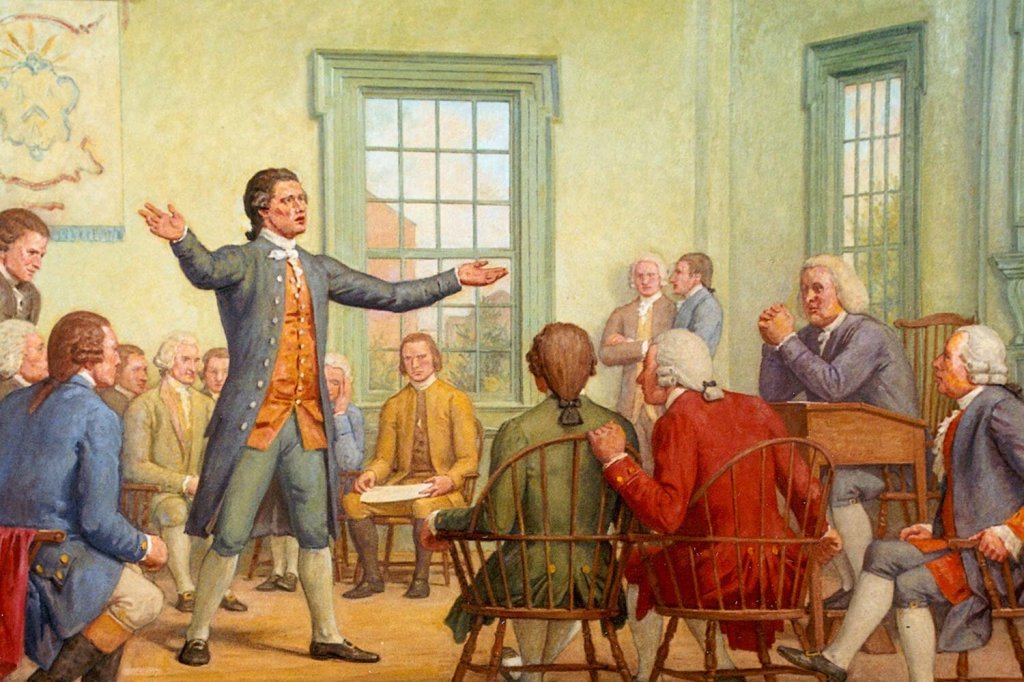
When the founders sat down to sketch out a nation based on Enlightenment ideals, they tried to break from those traditionally rigid hierarchies. The promise was that this new republic would be different: more equal, more flexible, more open to talent than lineage. But before the ink was even dry on the Constitution, participation in democracy was tied to property ownership. In other words, class.

The industrial periods of the late 19th and early 20th centuries produced titans of industry and staggering corporate wealth, alongside factory workers who lived ten to a room and rarely made ends meet. The labor unrest of that era was more than economic conflict. It was an open confrontation between classes that the country pretended didn’t exist. And yet, generation after generation, we’ve continued telling ourselves that class isn’t part of the American story.

But it is – and that distinction is growing daily, minute by minute, mainly due to our current political structure and power, as billionaires are given increasing influence over our government.

In part two, we will talk about who perpetuates the very real American class system and what, if anything, can be done to lessen its influence on the majority.

PART II

I’m painfully aware of class distinctions. I grew up in a farm family that also included teachers, mechanics, cattle workers, and waitresses. I’ve had every job you can imagine – and some you can’t – and in every situation there was always someone around to remind me of my “place.” I never became a “have,” but, like you, I work for my living – and I always have – something most blue bloods can rarely claim.

Excluding tech boom millionaires from the 1990s, there is significant generational wealth at the top of the American food chain. However, most wealthy individuals insist that their success stems solely from a work ethic. Those struggling, on the other hand, are told to pull harder on their bootstraps. It’s a neat trick: if class doesn’t exist, then anyone stuck at the bottom must simply not be trying hard enough. That’s why republicans in power (who tend to be the wealthier group) blame the poor for being poor – spouting off on how they must be lazy, working the system, etc. And democratic leaders (who are often less wealthy, but not without means), champion the working poor while still condescending to them, maintaining the class barriers. Has Chuck Schumer, a multi-millionaire, invited you to any parties lately? Yeah, me either. Both sides are to blame for all this.

The truth is that modern America has a very real class structure, even if we don’t officially name it. At the top is the wealth class — that small percentage of Americans whose fortunes come from investments, corporate ownership, or inherited wealth. Below them is the upper middle class, made up of highly educated professionals who enjoy stability, networks, and cultural influence. The middle class — if we can still call it that with a straight face — includes those with some savings, homeownership, and a degree or a skilled trade.

Further down are the working class and the working poor, whose lives are shaped by hourly wages, inconsistent schedules, limited benefits, and housing insecurity. The lower classes – where most of us fit – are increasingly squeezed by rising costs and stagnant wages. What separates these groups isn’t just income. It’s wealth, education, geography, access to healthcare, and those unwritten rules known as “cultural capital” — things like networking, confidence in professional settings, or simply knowing which doors to knock on.

So where did our grand experiment at classlessness go wrong? It failed in all the predictable places. Public education and other social services were intended to level the field, but are still funded by local taxes that mirror neighborhood wealth. Even the American Dream itself was built on the idea that anyone can rise — as long as they start from somewhere near the top in the first place.

Those who rise to power tend to be members of the upper class, with little or no desire to lose their position by pandering to social groups with no influence, financial or otherwise. Sure, we see extensive TV news footage of politicians and wealthy people who volunteer with social services, donate to charities, and give speeches on behalf of the poor and less fortunate. But at no time do you ever see one of those people – from any political side – do something that might benefit you and me while jeopardizing their own place.

We could effect change, however, if we improve access to education, support trade schooling, strengthen worker protections, and provide financial literacy programs. We could even create a healthcare system that doesn’t punish people for simply being alive. Unfortunately, none of this seems likely in the current social and political climates.

America must accept that class exists, but only those at the top are sure of it. For some reason, the poorest people support the politicians and policies that tend to harm them the most. It’s time to wake up and realize that, to maintain their positions and wealth, the upper class will always try to subjugate the middle and lower classes.

So, what can you do? Listen to what the politicians are saying and doing. How does it help you? How does it harm you? Dump the idiotic crowd mentality of party and vote for your own best interests, not theirs.

Decades of Imagination: The Creative Legacy of Dayton’s Historic Davis Linden Building

In Dayton Ohio News, Economy, Entertainment, Local News, Technology, Uncategorized on June 19, 2025 at 9:29 am
Dayton, Ohio – The Davis Linden Building, an historic landmark located at 400 Linden Avenue in Dayton, Ohio, has long been a beacon for creative professionals seeking customized commercial spaces. Owned by Matt Dieringer of Dieringer Development, the facility continues to thrive and expand, offering a nurturing environment for artists, businesses, sculptors, photographers, and other creative professionals.

Over the years, the facility has seen good times and bad. But Matt Dieringer’s vision for the Davis Linden Building has been, and will continue to be, one of growth and community. “We are committed to provide spaces that not only meet the unique needs of our tenants but also foster a sense of belonging and collaboration,” says Dieringer. This commitment is evident in the building’s diverse range of tenants, each contributing to a vibrant and supportive community.

One of the most notable tenants is Michael Bashaw, a musician and sculptor who has located his studio in the Davis Linden Building since the 1980s. Bashaw’s long-term presence is a testament to the building’s ability to provide a stable and inspiring environment for creative professionals. “My grandfather was a tenant in the building in the 1950s, so I was well aware of it,” says Bashaw. “I was originally looking for a space where I could work on my sculpture and do music rehearsals. I’m very grateful and very fortunate to be here.”

Click here for a video interview with Bashaw.

“I’m on year two and have already outgrown one space,” says tenant Tiffany Lewis, owner of Immortelle Bijouterie, an era-inspired jewelry and clothing shop. “I love the atmosphere here – the big windows, the open concept, and that there are other artists here.”

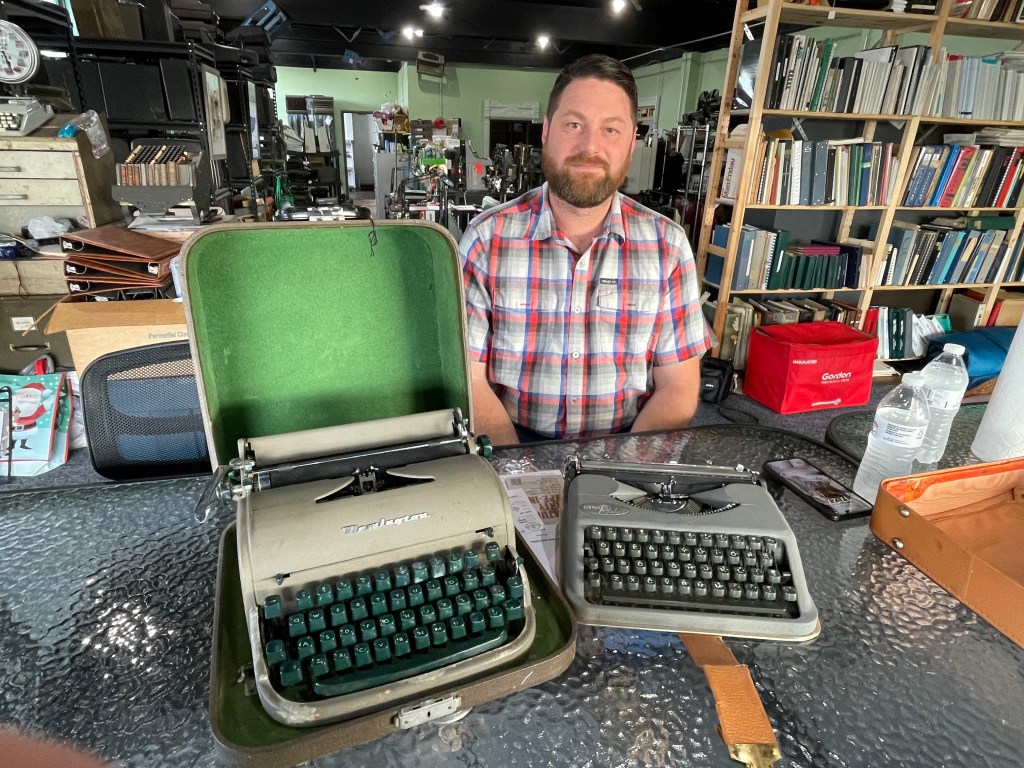
Becca Brumfield, the building’s office manager, shared her view as both a tenant and employee. She described The Davis Linden Building as a center of creativity, business, and community. Her husband, Trevor, operates one of Ohio’s last full-service typewriter repair and sales shops, TB Writers Plus, located in the building since 2023.

The dedication of the Davis Linden Building’s management to promote a sense of community among its tenants is one of its defining features. This collaborative spirit is what sets the facility apart from other commercial spaces. In that spirit, the management will soon unveil “The C2 Initiative,” based on the idea of Creativity and Commerce. The initiative is intended to expand on that sense of community with memberships, access to shared creative space, and much more.

As Dieringer Development continues to invest in the growth and development of the Davis Linden Building, the future looks bright for this creative hub. With its commitment to providing customized spaces and fostering a strong sense of community, the Davis Linden Building will undoubtedly remain a cornerstone of Dayton’s creative scene for years to come.

For more information about the Davis Linden Building and its available spaces, visit their website, www.davislindenbuilding.com/, or call 937-498-8635.

News Incredulity

In Economy, Local News, News Media, Opinion, Politics, Print Media, Technology, Uncategorized on March 15, 2025 at 3:38 pm

Deer In Headlines II

By Gery Deer

I’ve been a freelance journalist for most of my adult life, going back to my days as a staff writer on a college newspaper. Since then, I’ve been published hundreds of times in everything from weekly newspapers to regional trade magazines. Much of my work consists of feature stories, opinion columns, and a few hard news pieces.

I was trained by an old-school newspaper editor who demonstrated consistent ethics and integrity. I was taught never to take a story to press without three primary sources and on-the-record statements from those directly involved to back up the information.

As the Internet became an easy way for the citizen journalist to publish news and information, credibility and fact gave way to sensationalism and uninformed opinion. Click bait replaced proper headlines. Soon, what was once referred to as “the press,” was suddenly renamed, “the media.” In this reporter’s humble opinion, they are not the same.

Webster’s Dictionary defines media (plural of the word medium) as a means of communication, such as radio, TV, newspapers, social, the internet, and so on. In other words, it refers to the delivery system rather than the content or its source.

For example, social media is a primary source of news for many Americans. Unless the information originates from a reputable news source, the content may have no oversight, no editorial integrity, no fact-checking, nothing.

You may have no idea where the information came from or how it may have changed. Think of it as a game of telephone. The more the word spreads, the less accurate it becomes. To reiterate, the social media platform (or app), such as Facebook, X, or Instagram, is just the vehicle – the medium. Reputable or not, the message originates elsewhere.

“The Press,” on the other hand, is guaranteed by the First Amendment of the U.S. Constitution. Like the three branches of government, it’s literally set up right there in black and white – which is why it’s called the Fourth Estate.

The Press should serve as a watchdog to help hold those in power accountable and provide the public with the information they need to make informed decisions. Trained Press journalists gather facts, verify information, and present it objectively across a variety of media.

A functional and qualified Press works within the realm of fact – not truth (that’s for philosophers). It should present information without bias or commentary (there’s a page for that and you’re looking at it now) and demonstrate integrity in the process.

Before I have people shouting at the screen or tearing up the paper, I agree the problem of misinformation spread by so-called news outlets is in epidemic proportions. Unfortunately, many news agencies have traded integrity for revenue, to say nothing about a complete disregard for journalistic expertise.

Cable news programs often fall into this category. They base their content on current news stories, targeting the biases and interests of a single segment of audience to grow advertising revenue. This is not news – it’s entertainment.

Even worse is when a news outlet censors content to favor the business or political interests of their owners. For example, once a paragon of investigative journalism, “The Washington Post is rapidly losing credibility because of interference with its newsroom by its owner, Amazon founder Jeff Bezos.

Between social media, so-called citizen journalists, bloggers, and whatever else is out there, unvetted, unqualified, and often false content is cranked at an alarming rate. Their goal is to spread as much click bait as possible and deliver customers to advertisers – it’s all about money. That makes it hard to sift through the noise for qualified, factual news.

In the end, the Press should be rooted in ethics and accuracy. Sadly, many news outlets now prioritize profit, sensationalizing content to stay competitive in digital media. That’s muddied the journalistic waters, making it harder for the public to distinguish between fact and opinion.

My only advice is to check the source and remember that perspective isn’t the same as bias. News should be factual and accurate, not “fair.” There is no such thing as “fair and balanced” news. Fairness suggests compromise, whereas facts stand alone. The standard should be: is it factual, or not?

Just My Type

In Business, Economy, Entertainment, Literature, Local News, Technology, Uncategorized on November 2, 2024 at 9:30 am

Dayton Typewriter Shop Promotes Community

By Gery Deer

PART I  A CAREER FROM ANOTHER ERA

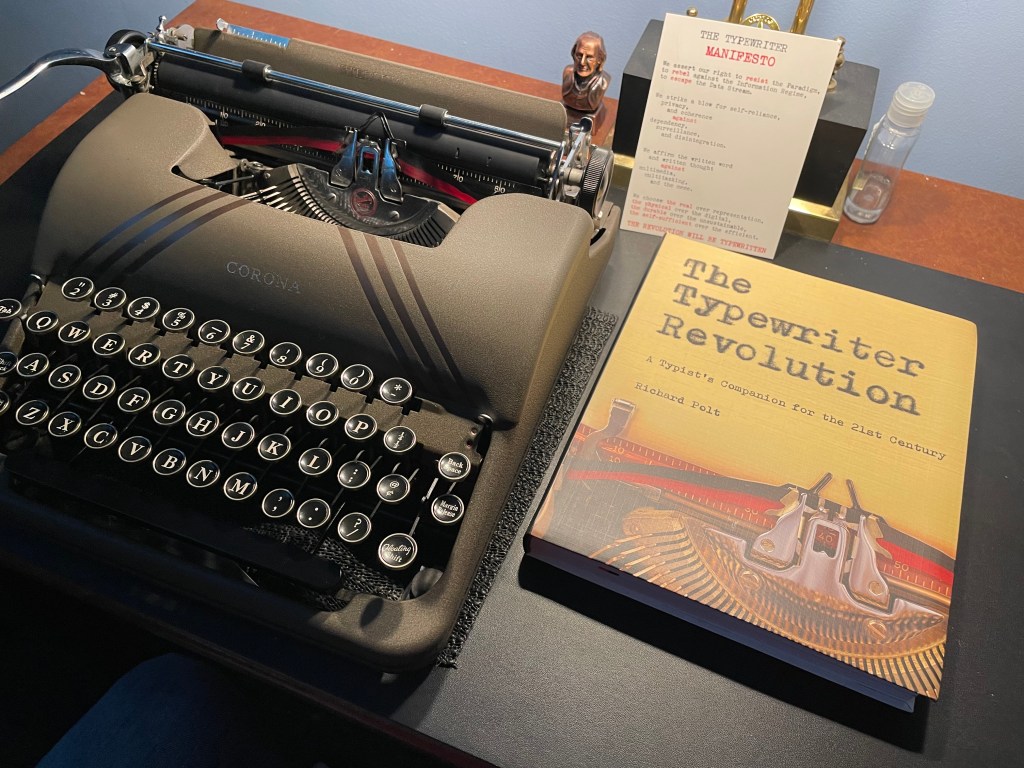
In a once abandoned sewing machine and bicycle factory on the corner of Linden and Davis Avenues, in an old, industrial section of east Dayton, Becca Brumfield carries cooler bags up two flights of stairs with two small children in her wake. At the end of a massive hallway on the top floor, they arrive at a door labeled “TB Writers Plus.” She taps a code into a keypad, an electronic lock opens, and the kids pop through the door ahead of her like prizes from a gumball machine. 

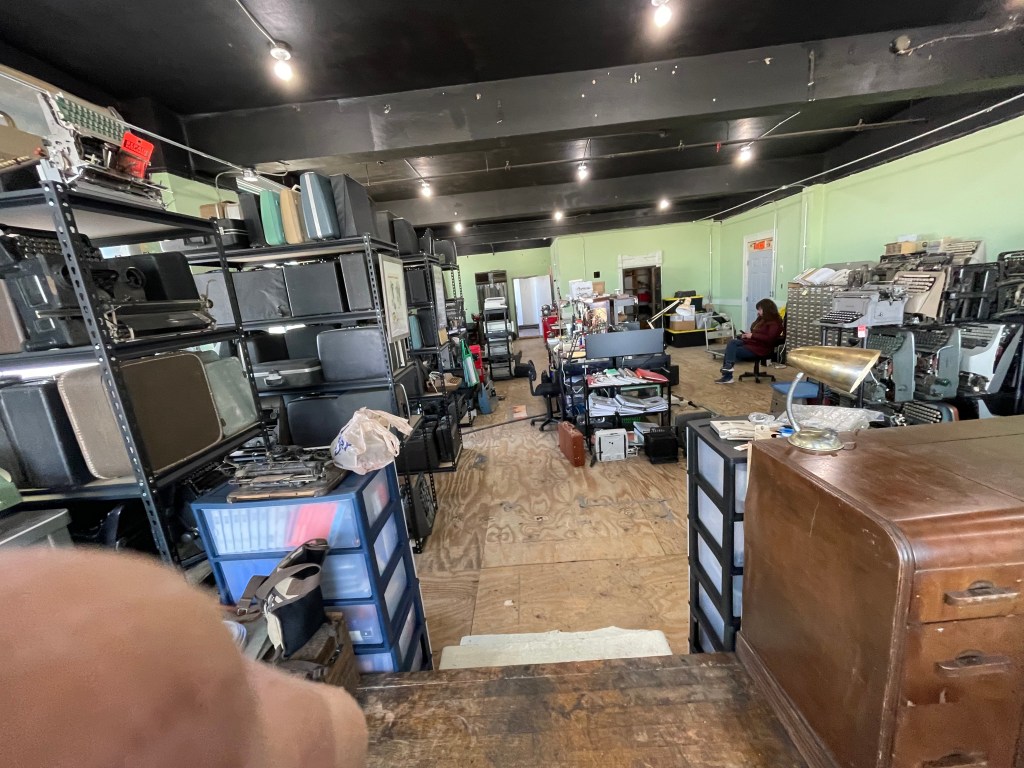
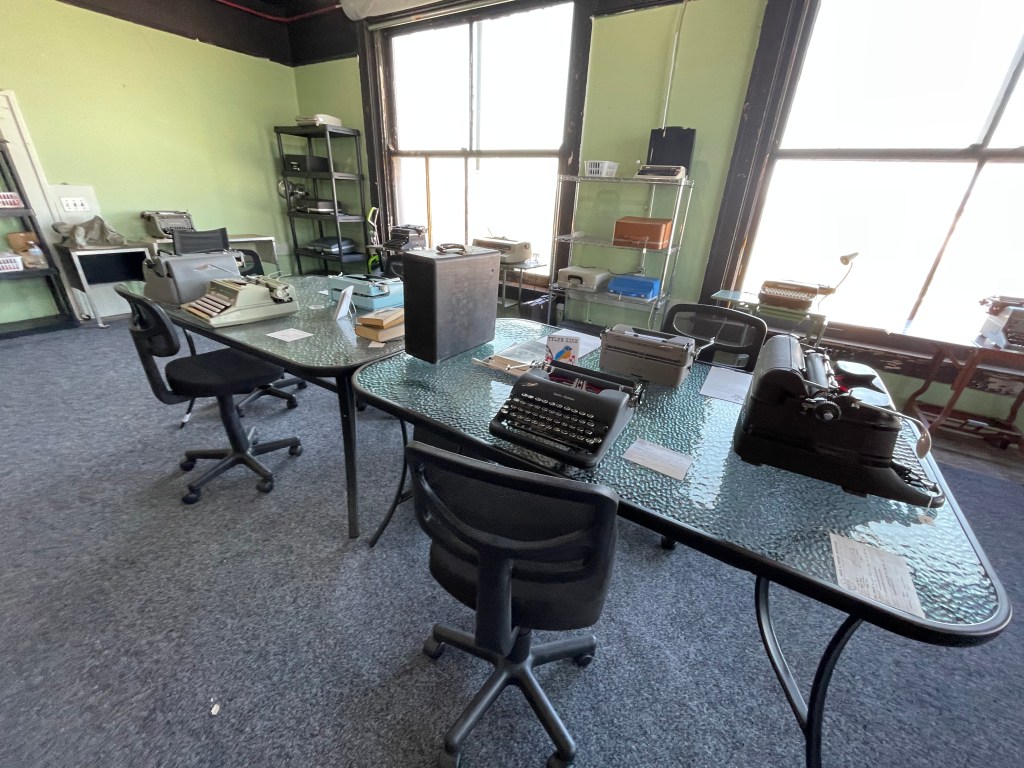
They pass workbenches and shelves loaded down with antique typewriters. On an elevated platform at one end of the room, a long glass table is flanked at one end by a floor-to-ceiling shelf of refurbished typewriters for sale. 

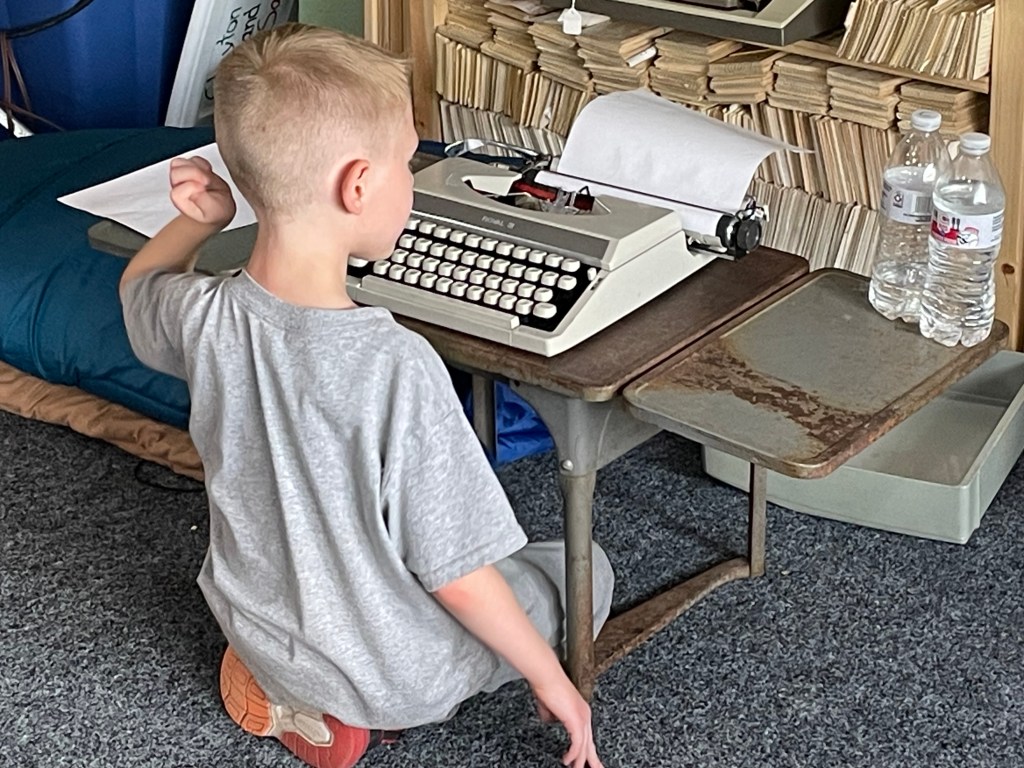
Becca lays out place settings and dishes up the food. Young Clayton, 6, and Sam, 5, who’d immediately started playing on typewriters and drawing, clamber to the table and plop down to eat. Her husband, Trevor, joins them. One of their employees sits down, too, and now it’s a typical evening at their typewriter shop.

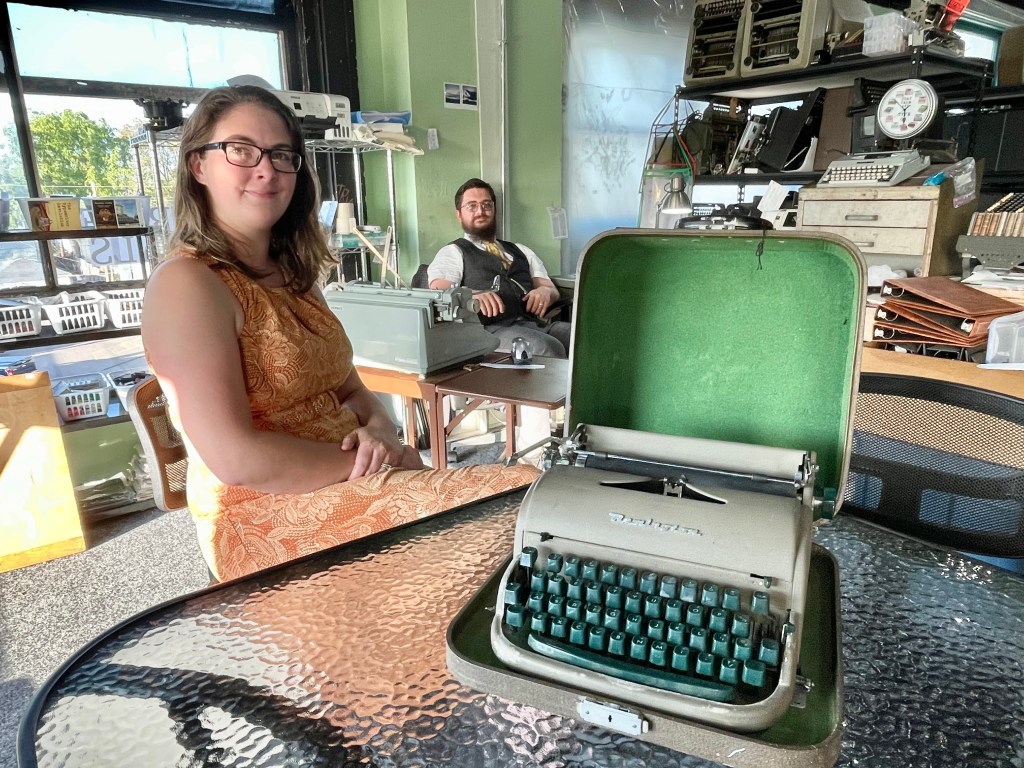
Becca and Trevor Brumfield at TB Writers Plus in Dayton, Ohio.

The Brumfield family started down this path more than a year ago when Trevor bought a typewriter online, repaired it, and started using it. Before long, he lost it to his wife and, as he puts it, “Naturally, had to buy another one.” 

“That turned into several more, which became 60, which turned into 100, and that became, I gotta sell some of these,” Trevor laughed. A full-time auto mechanic, it might seem odd for someone just 26 years old to start down such an arcane career path. 

Over the last twenty years, typewriters have seen something of a renaissance. Fueled first by internet insecurities and one enthusiast’s declaration of a “Typewriter Insurgency,” writers, artists, business professionals, and college professors continue challenging the digital paradigm. “It’s not a booming industry,” Trevor admitted. “But the interest is there, and business goes in waves.” The industry got a secondary boost from the recent Taylor Swift video, “Fortnight,” which featured the megastar with an old Royal 10. 

Taylor Swift’s Royal 10 in ‘Fortnight.’

Swift had them as props, but a few famous people are actual typewriter fans and users. Most notable is Tom Hanks, whose collection and passion for the machines are well known. The exposure has helped Trevor’s shop steadily grow. “I’m not sure exactly how many machines we have serviced in total,” he said, noting the expansion from his home garage last year. But we can typically get through 30-50 machines a month depending on what needs to be done to each.” 

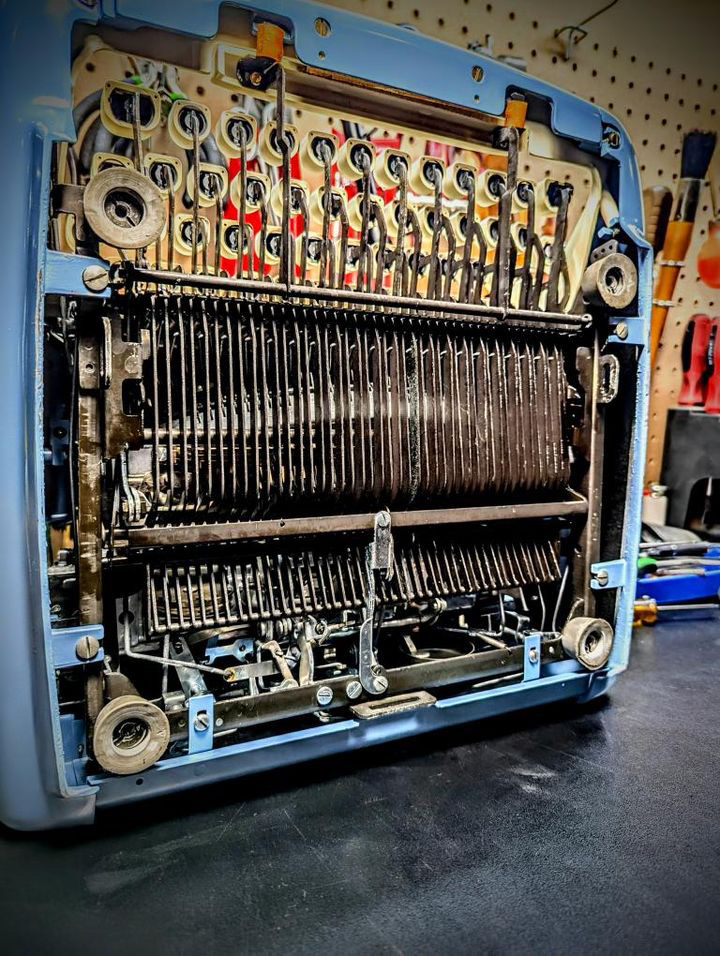
At last count, TB Writers Plus has inventoried more than 600 machines. Many are cannibalized for parts, and others are refurbished for sale. Trevor does the bulk of that work but has also trained Becca. An atmosphere of learning and openness permeates the shop. No organized training program exists, and factory training was discontinued years ago. Everyone who works here is an unofficial apprentice. 

PART II –  HE DOESN’T DO IT ALONE

Three part-time employees, Tyler, Keenan, and Torii, have been learning on the job, guided by Trevor’s experience. Each tackles the intricacies of these incredibly complex machines in their own way.

Tyler Lewis, of Fairborn, began as a technician in November 2023. “I mostly refurbish and repair, taking apart the machines, cleaning them, and putting them back together.” He learned about TB Writers Plus from an article in a local zine. A zine is, in his words, “An underground, independent magazine that people publish usually by using copy machines.” 

Tyler should know since he’s the primary writer and publisher of his own zine, appropriately named “Tylerzine.” He was working at the Wright State University college newspaper and pitched his own article idea. “I met Trevor, immediately liked his openness, and ended up hanging out that first day for like six hours,” he said. 

He sits at a typewriter loaded with purple ribbon and cranks out a short poem based on a prompt suggested by someone else in the room. Tyler’s passion and personal brand of artistic expression suit the typewriter world. “My entry point has always been the literary aspect of typewriters,” he said. “I am a devout believer in language, so what typewriters represent as a means of expression greatly appeals to me.” 

Technician Keenan started as a hobby when Trevor was still working out of his garage back in 2023 but took some time off for school. The 28-year-old Kettering resident came back in May of this year. “I wanted to learn more about how typewriters work, and it was an enjoyable way to spend my time,” he said.

“I enjoy the simplicity of the process compared to modern technology that feels invasive at times,” Keenan explained. “It’s just a simple typewriter on the workbench that needs fixing. Nothing more, nothing less.”

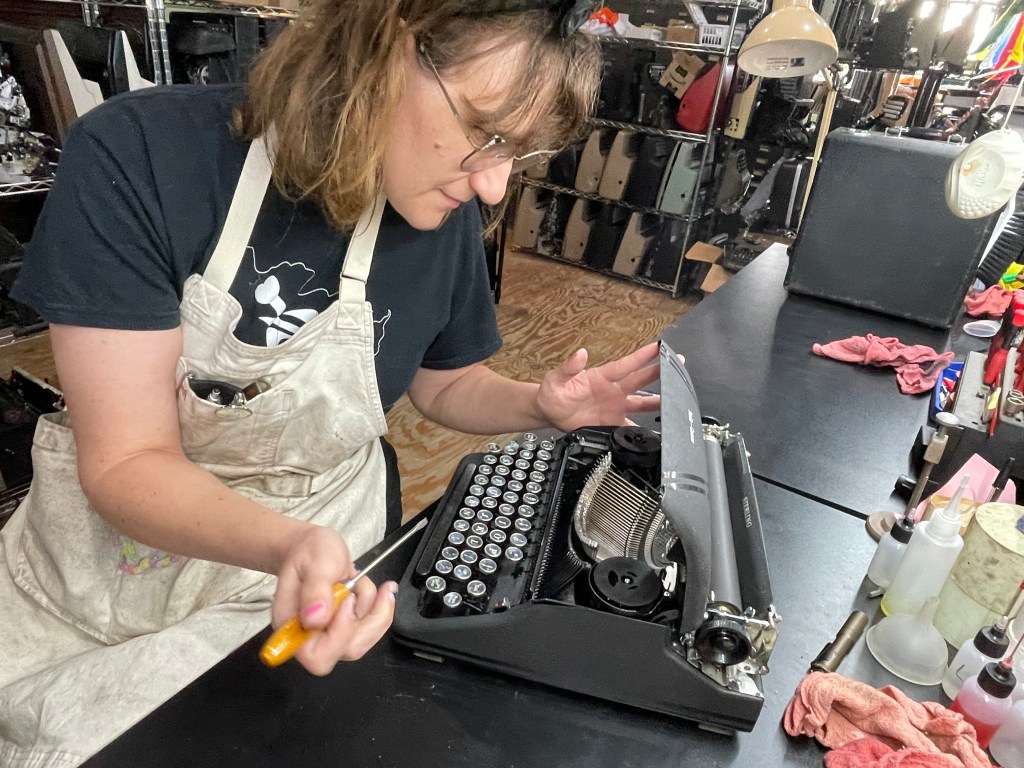
Tori’s B checks out a 1930s era Smith-Corona manual.

At the workbench, technician Torii B, from Bellbrook, hovers over an antique Smith-Corona. She scrutinizes the machine, evaluating any repairs needed before it’s put up for sale. Torii is a 36-year-old marketing and design professional and working mom. Although she has freelance design clients, she left a full-time marketing job last May. She’s applied for permanent positions in her field, but nothing’s been a good fit so far.

About a month ago, a friend told her about an anachronistic typewriter repair shop whose owner sought part-time help. As it happened, she and the friend have a role-playing game involving type-written note cards and the adventures of two fictional journalists. Her interest peaked, she reached out to TB Writers Plus, and before long, she signed on as a part-time tech and general worker.

Her diverse background fits this very mechanically oriented job. “I went to school for visual communications,” Torii said, pausing momentarily. “But, before that, I studied mechanical engineering.”

“I like the physical act of working on the machines,” she explained. “Watching the machines move keeps my mind like a well-oiled machine. Each one is like solving a puzzle.” She points to three small containers, each filled with tiny machine parts, springs, levers, and knobs. Her task is identifying and cataloging them for future repair work. It might seem tedious, but there are no more typewriter parts in production. Every part salvaged is vital to the shop’s operation.

PART III – THE TYPEWRITER COMMUNITY

A team can only function well with good leadership, and this one is no different. Trevor is doing his best to help his crew find their way. “Each works a little differently than their coworkers and has their own skill set,” he said. “Tyler is really good at detail-oriented work. Keenan’s strength is getting a lot of work done quickly. Torii is still finding her place in the shop,” Trevor continued.” She’s helped us with inventory ideas and graphic design and handles other odds and ends around the shop.” 

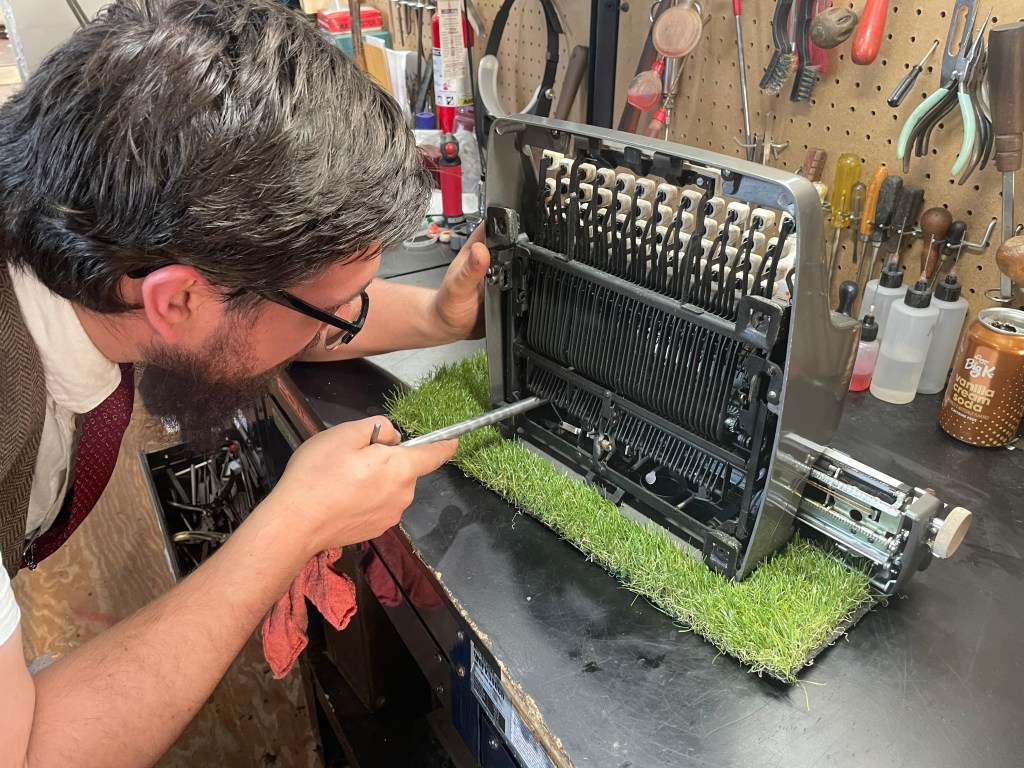
Trevor Brumfield adjusts a 1955 Royal Quiet De Luxe.

Trevor’s interests and skills are well-suited, and he clearly enjoys this work. But what he likes most about the job is the people. “All of our customers treat my shop like a safe haven. I’m not sure why, but people drop their guard when they walk in here,” Trevor explained. “We’ve heard some crazy stories from people; war stories, childhood traumas, business plans, just about anything you can think of.”

“We have customers that will leave work in the middle of the day just to come here to vent because they are having a bad day. Next thing you know, they’ve been here for 3 hours, and their boss is calling.” 

Brumfield’s modesty won’t allow for his own kindness and personability as reason enough for people to gravitate to him and his family. “I don’t know what it is about this place that makes people feel so at home, but I don’t think it is just me – or any one person here. But as soon as they walk in, they get this look like they just had a weight removed from their shoulders.” 

Customer and typewriter enthusiast, Greg Parker, of Urbana, Ohio, with two of his growing collection.

TB Writers Plus customers are an eclectic mix of artists, collectors, and businesspeople from all over the country. Greg Parker, for example, is from Urbana and has purchased three typewriters from the shop. The 40-year-old, married Army veteran has been collecting typewriters for about ten years. He currently has seven, including two Royals, an Underwood, and an Olympia. He explained his interest in the machines is mainly about the experience. 

“I grew up with typewriters and used them when I was young,” he said. “But I really like the aesthetics.” Parker’s not a writer or artist but a welder by trade. “I do some journaling, and I have some memoir stories I’d like to put down on paper someday,” he said. “But I feel like I was born too late, like in another time. I enjoy the mechanics of the machines. The sound and the feel are very different from a computer. When you type something on paper, it’s like you really created it yourself.”

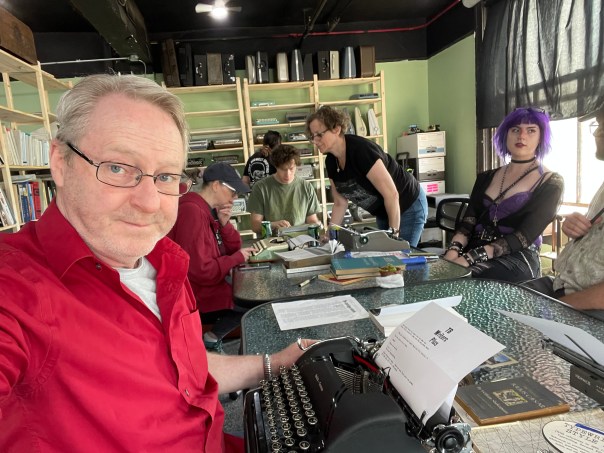
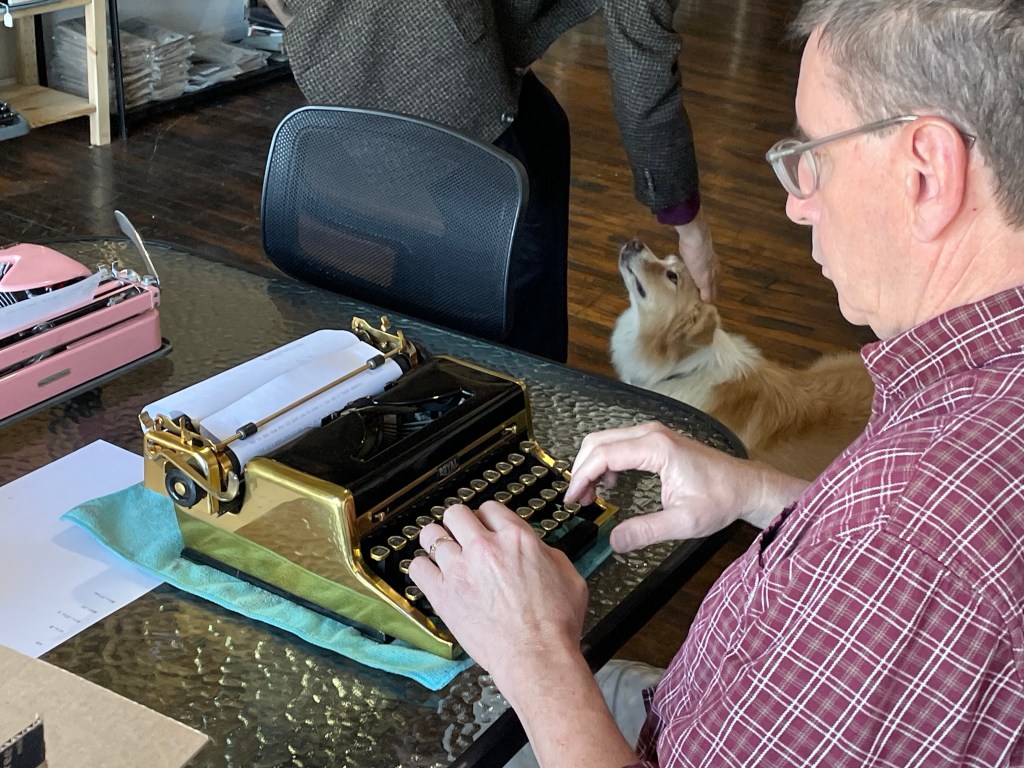
“Type-ins” attract enthusiasts from all over the country for a common purpose. TB Writers Plus has hosted several, including a costumed Halloween event and a 4th of July fireworks type-in.

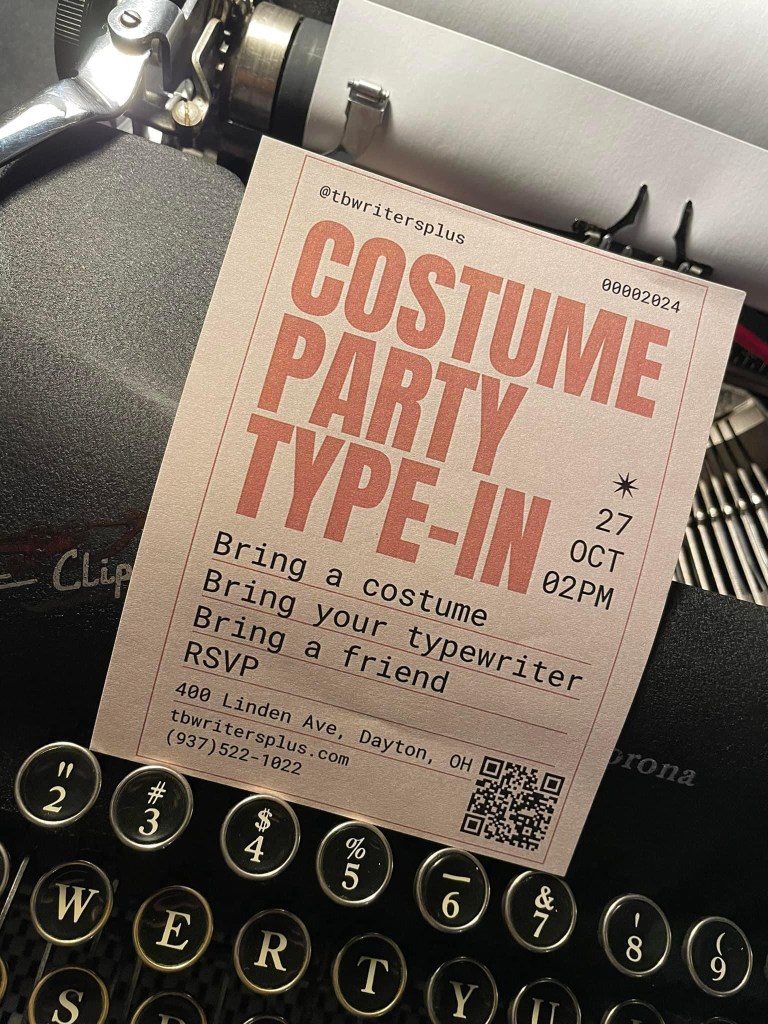
Creativity and the personal connection with a simpler time is common throughout the typewriter community. For example, on Sunday, October 27th, TB Writers Plus is hosting a costumed “type-in” event, encouraging people to come dressed in the same era as the typewriters they bring. Type-ins are most easily explained as cruise-ins for typewriter enthusiasts. Scattered around the country, these predominantly social events, provide the opportunity for aficionados to talk typewriters, socialize, and even do some typing. 

Back at the dinner table, the boys are no longer interested in their meals and require some encouragement. Trevor digs into his food as he and Becca talk about their day. Eventually, they would like TB Writers Plus to be independently sustainable as afull-time career. For now, they, their crew, and, of course, Clayton and Sam, are enjoying the work and the people who share in the simplicity and resurrection of a by-gone era. To learn more, visit www.tbwritersplus.com.

Author’s Note 1: While researching this article, I had the good fortune to meet many of the shop’s customers and supporters. The loyalty they seem to share is remarkable, not just for the typewriter community in general, but for Trevor and his staff in particular. I want to note, for the record, how honored I am that they welcomed me into the circle. It’s truly an amazing community.

Author’s Note 2: While typewriter shops are still operating throughout the U.S., their numbers are dwindling. Trevor Brumfield has been buying out the inventory, tools, and parts in an effort to stay ahead of those closings and keep up with demand.

Author’s Note 3: Update August 2025 – As of this date, TB Writers Plus has expanded its footprint in the Davis-Linden Building. The shop now includes a larger typing and show room, community space, equipment washing room, additional storage and much more. They’ve also seen a change in personnel in the past year.

Literacy’s Silver Bullet

In Books, Children and Family, Economy, Education, National News, Opinion, Print Media, Technology, Uncategorized on October 19, 2024 at 10:35 am

Deer In Headlines II

By Gery Deer

I was a staff writer and later an editor for my college newspaper. During that time, I learned the single, most important lesson from all my years of education. Our administration-appointed supervisor once told me, “Whatever else you learn as you go through your college career,” she said, “learn to write and speak well. If you have that, you’ll be able to do anything.” She was right.

My mother also shared those views, though she had a head start by teaching me to read early. On the other hand, I would depend on my communication skills to pave my way to a multi-faceted career. She was determined to give me every possible advantage, mostly because she didn’t get them.

Literacy is one of the most critical indicators of a strong society. It reduces poverty, bigotry, ignorance, and social and professional inequality. It shouldn’t be limited to the academically gifted. Everyone should have the opportunity to learn effective communication.

Just because you don’t have an interest or aptitude for high academia, that doesn’t mean literacy is less important. I feel fortunate that I had the best of both worlds. I’ve always been an avid reader and writer and a lifelong student of all the sciences. But I also learned to rebuild a car engine, install a new water heater in my house, or change a faulty electrical outlet.

Every one of those tasks requires the ability to learn, understand, follow instructions, and cope with the unexpected. All of my “book learning” occurred while surrounded by some of the best tradespeople in the world. Even better, they were all teachers. One thing that has changed over the years is how literacy is emphasized in our public and private schools.

Do you remember when kids used to get in trouble for reading comic books at school? I will say “we” instead of “they” because I did this too. We put comic books inside large textbooks so we could read during class. From the teacher’s perspective, we seemed engrossed in our educational process. Instead, we were engaged in the exploits of Superman, Batman, or Spider-Man.

Some argued that even reading comic books was good for us because at least we were reading. But it was more than that. Comic books are a good literacy metaphor because they aren’t just about words, grammar, and sentence structure.

For our society to consider itself truly literate, we must understand language, not just the written word but communication. We also need to understand art, storytelling, and critical thinking. In an ironic twist, one way to do all that is by reading comic books. Many of the Batman stories from the 1930s and 40s are loaded with material you only find in today’s best crime novels by authors like Michael Connolly, James Patterson, and David Baldacci.

Unfortunately, some use the comic book analogy to justify spending hours on social media. That’s not the same thing. Reading is calming, focuses our minds, and relaxes our bodies. If anything, social media has dumbed us down and created an entire society nearly paralyzed by anxiety and inferiority. Scrolling doesn’t count as reading.

Still, literacy doesn’t require you to wade through “War and Peace,” “Catcher in the Rye,” or any other long-winded literary work. I supplemented my education by reading everything I could get my hands on. Whatever I had an interest in, I had books about it, encyclopedias, or topic-specific material – there was no internet back then. Now, resources are nearly endless, provided you learn the difference between credible and non-credible sources. 

Advanced education isn’t required either. Truth be told, much of what I do for a living was self-taught – thanks to my early introduction to books. Self-education is mainly frowned upon in today’s society. I find it ironic that Benjamin Franklin, Thomas Jefferson, and others who wrote some of the most important documents in history would be unemployable by today’s arbitrary and unfounded standards.

My point is that American culture currently reads at a U.S. 5th-grade level. That’s unfortunate, ridiculous, and easily corrected. We must eliminate the stigmas of functional illiteracy, focus more on reading and writing in our schools, and spend more time with books than cell phones.

Efficacious Electoral College

In Books, Children and Family, Economy, Education, history, Local News, Politics, sociology, Uncategorized on October 19, 2024 at 10:20 am

Deer In Headlines II

By Gery Deer

Without question, 2024 has been and will continue to be one of American history’s most charged and controversial election years. Among the points of contention is the continued argument regarding the necessity – and validity – of the Electoral College.

Political operatives and pundits alike have been outspoken on the subject from all political viewpoints. There seems to be no consensus because, quite frankly, even some government officials don’t understand its purpose. So, before I give you my thoughts, here’s some non-partisan history.

During the first Constitutional Convention of 1787, a significant debate unfolded about the method of electing a president to lead the executive branch of our newly established government. It was a pivotal moment in our history after the decision to have a single individual in the office rather than two or even a triumvirate. Just imagine the complexity of electing three people every four years.

The primary issue was whether a congressional vote should elect a president or do it by popular vote.  The latter eventually won out until the smaller states began to weigh in, concerned that those with a larger population would wield more control.

Another lesser-known concern was that the political elite of the time were worried about a mass of uneducated voters swaying the results. Discussions continued for several months until, one day, in a closed-door subcommittee, James Madison laid down the concept for what became known as the Electoral College.

Enacted as a compromise and safeguard, Article II of the U.S. Constitution (later the 12th and 23rd Amendments), as well as the Electoral Count Act (ECA) of 1887) formally established the Electoral College. These laws regulated the voting process and defined the events between Election Day and the Inauguration.

Now, to clear up some misconceptions. Regardless of rhetoric to the contrary, I assure you that the Electoral College is an entirely democratic process. It is not, however, easy to explain. But I’ll try anyway (insert a deep breath here).

In a presidential election year, the political parties hold conventions where they nominate “presidential electors.” That’s simple enough to understand, but hang on. Here’s where it can get… confusing.

When a party’s presidential and vice presidential candidates win the popular vote, that party’s electoral nominees become “Electors.” Each state has the same number of Electors as members of Congress, and each Elector votes for their party’s ticket on separate ballots – one for president and one for vice president. So, your individual vote is still vitally important because the candidates cannot earn Electors without it.

For example, if Richard Nixon and Barry Goldwater (president and vice president, respectively) won the popular vote in California, the Republican nominees from that state would become Electors and cast their votes to the Electoral College. Once all the electoral votes are cast, the candidate who reaches 270 out of a possible 538 wins – and this is only triggered if the candidates win that state’s popular vote in the first place.

In the news, the results sound something like this: Nixon has won California and its 54 electoral votes. Of course, those results still have to be certified. As you might recall, there was a slight hiccup during the 2020 election certification. However, new security measures have been taken to reduce any potential repeat of those terrible events.

Remember, this is just a glance at the process, but I hope it helps. If it’s still puzzling, a good analogy is Major League Baseball’s World Series. Every year, the winner is determined not by which team got the most runs per game but by which won the most games in the series. The Electoral College works the same way.

In my opinion, the Electoral College is the only practical, efficient, and fair way to ensure everyone’s voice is heard because we’re represented just as we are in Congress. The Founders realized that the popular election alone could and would eventually bring chaos.

If we want an election process that stays in constant contention, then eliminate the EC. But if we’re going to have all our citizens represented equally, let the system do what it was designed to do. If you want to make a real difference, make sure you vote.

No job is bulletproof, not even mine.

In Economy, finances, Media, National News, Opinion, Technology, Uncategorized on April 20, 2024 at 12:02 pm


Deer In Headlines II

By Gery Deer

Have you ever been afraid for your job? I laugh when people think I can’t lose my job since I work for myself. As a writer, even working under my public relations agency, I’m often called “self-employed.” The immediate assumption is that no one can fire you.

There’s a lot of nonsense to unpack there. First, and possibly most important, there’s no such thing as self-employed. Unless you have a magical chest of gold or cash that continuously refills itself, you’re working for somebody who’s paying you. Being independently employed (my preferred terminology) means you’ve traded one boss for many (customers).

Second, working on your own means constantly beating the bushes, knocking on doors, and continuously selling yourself to generate a pipeline of work. My father and brother created multiple, simultaneous jobs for themselves because they never wanted to be out of work—and they never were.

My family seemed to always have multiple income streams—cattle, trucking, engine work, welding, anything that brought a buck. However small the amount of revenue, it added up. Mom and Dad ran the farm and our trucking business, and I always knew my family worked hard for what we had. No two days were alike. Dad might be out on one of our trucks or auctioning cattle one day. The next, he and my brother might be rebuilding a tractor engine and welding a broken hay rake—all before dinner.

Over the years, I adopted the same philosophy, but I wasn’t always independently employed. Once upon a time, I worked for “the man,” and the woman, and the corporate overlords, and whatever else they’re called. From engineering technician and mechanical designer to database developer and coder, I did the 8-to-5 grind for many years before going out on my own.

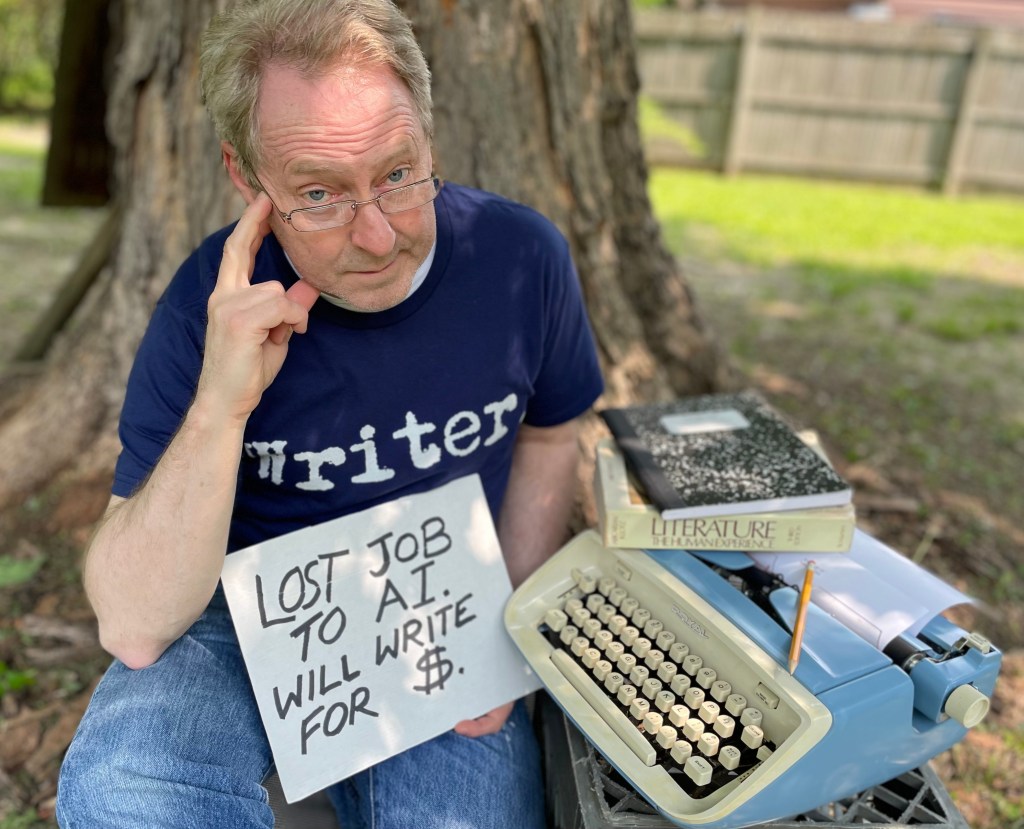
Writers in every industry are rapidly becoming an endangered species due to Artificial Intelligence.

Since much of what I did in the corporate arena was high-tech, the advanced skills required evolved rapidly. I constantly studied the latest technologies to avoid obsolescence. I’ve always been fascinated by computers, but keeping up with advances in computer technology during the 1990s was exhausting.

If that wasn’t enough to worry about, no matter my job, I always felt like something would ruin it. Someone would take it away from me or decide I wasn’t qualified, and that’d be that. I really did know what I was doing. But I suffered from terrible imposter syndrome. Then, one day, that was enough. I walked away.

Life as an independent professional can be tough, especially if you’re used to a steady paycheck and punching out at 5. At least no one ever gets fired, right? Wrong.

There’s a quote from the TV show “Mad Men” that goes, “The day you sign a client is the day you start losing them.” It means that every customer will eventually leave you—your fault, their fault, nobody’s fault. It’s just part of the process. So, when that happens, you are effectively fired. Depending on how many customers you have, that’s how many times you will be fired.

Despite the romanticization, self-employment is hard work and a bit like riding a bike. If you stop pedaling, you fall. You must exceed customer expectations the first time, or those firings I mentioned start sooner. Is that more secure than a corporate job? In many ways, yes. Let me explain.

If I am a “free agent,” I can play in whatever league I want. However, I only get to set some of the rules. I usually have to work within the guidelines of my profession or the client’s needs. One thing is sure, however. If I do my best, treat people with respect, and give them good value for their money, the work will continue.

That doesn’t mean I don’t worry about my job. I do, but for very different reasons. One is automation. Artificial intelligence, or AI, threatens the livelihood of writers in every industry, and what it generates is, at best, inadequate.

Another concern is that my skills will be devalued by a market flooded with amateurs and dabblers. These people produce inferior work, disparaging the profession and limiting potential business for the pros.

Ultimately, no one’s job is bulletproof—not even mine. Always demonstrate your best work. That will show your value, and you’ll stay employed – somewhere. In the meantime, try to remember that there’s always another job.

Gery Deer presents Referral Marketing Master Class at The Hub on February 7th

In Business, Dayton Ohio News, Economy, Education, finances, Local News, Media, News Media, Uncategorized on January 16, 2024 at 3:32 pm

In conjunction with International Networking Week, GLD Communications has scheduled a Referral Marketing Master Class at The Hub in the Dayton Arcade, 31 South Main Street, Dayton, OH 45402, on Wednesday, February 7th,11:30 AM until 1:00 PM. The class typically costs more than $250, but this session has been specially priced at just $40 per person.

Presented by GLD Communications’s founder and creative director, Gery Deer, the 90-minute lunch-and-learn session includes techniques for identifying and developing referral partnerships. Pre-registration is required. Seats sell out quickly. Register at gldcommunications.com. 

GLD Communications Creative Director, Gery Deer, will present the class.

Deer started GLD Communications in 1997 as a part-time job. Today, it is an old-school public relations firm with media production and content distribution all under one roof. The company provides newswire stories, documentary-styled film productions, podcasting, reputation and crisis management, and copywriting services. This master class is part of the agency’s business success coaching services.

Deer said people rarely learn to turn passive networking into proactive referral partnerships. It requires strategy, time, and commitment. He also noted that most people confuse networking with referral marketing when they are symbiotic.

“People mistakenly interchange the words networking’ and referral marketing, but the two have a causal relationship,” said Deer. “This master class explains how strategic networking is just the beginning and provides the opportunity for Referral Marketing partnerships that can generate revenue for years.”

An award-winning writer and creative director, Deer has navigated many changes in his business over the years. “We have withstood recession, lagging sales, and staffing issues,” he said. “I built and maintained our public relations media agency on referrals, but it was a massive learning curve. I wish someone had a class like this back when I started.”

Deer said the course also offers insight into leveraging your current networking opportunities to identify potential referral partners. He will also cover the various networking organizations ranging from service clubs like Rotary to professional referral organizations, specifically Business Networking International (BNI). Nikki Gates, Managing Director of the Miami Valley Ohio Region of BNI, will also be in attendance to offer information on her organization’s growth in the Dayton market. 

Event parking is not included but is available at Reibold Parking, 25W W. 5th St., Dayton, 45422. For more information and a direct link to register, visit www.gldcommunications.com

Beavercreek Chamber of Commerce Annual Meeting and Awards Event Recognized Outstanding Members and Grant Recipients.

In Business, Dayton Ohio News, Economy, finances on November 17, 2023 at 8:31 am

By GLD Communications

Beavercreek, Ohio – On Thursday, November 16th, the Beavercreek Chamber of Commerce presented its annual awards in recognition of outstanding community service by chamber members. The recipients were honored at the chamber’s Annual Meeting & Awards Presentation at the Holiday Inn Dayton/Fairborn, sponsored by Rodriguez Financial Strategies.

“Our annual meeting allows us to come together, celebrate, and reflect on the successes of the past year,” said Wendy Rogers, President and CEO of the Beavercreek Chamber of Commerce. “We also share our vision for the chamber and our members as we become better, together, moving into 2024.” The winners were as follows:

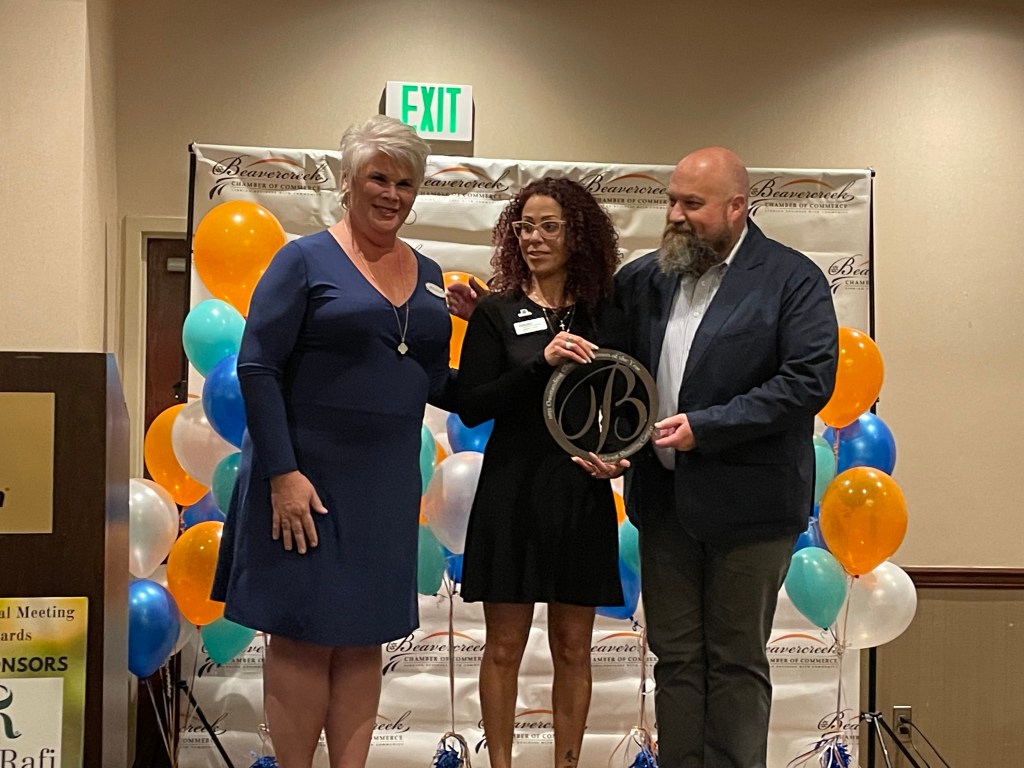
Beavercreek Chamber President, Wendy Rogers, presents the Oustanding Business of the Year Award to Midwest Shooting Center.

Midwest Shooting Center – Outstanding Chamber Business of the Year. Awarded to an active and engaged member of the Beavercreek Chamber of Commerce, located in Beavercreek as well as positively impacted the Beavercreek business community.

Don Adams, City of Beavercreek Mayor-Elect  – Chamber Volunteer of the Year. Awarded to an individual who is active and engaged with the Beavercreek Chamber of Commerce. A member who has performed exemplary acts to promote the mission of the chamber throughout the year.

Collin Lyon, First Command Financial Services – Chamber Young Professional of the Year. Awarded to a member in good standing, between the ages of 21 and 40. One who is active and engaged with the Beavercreek Chamber, looking to strengthen and enhance their leadership abilities.

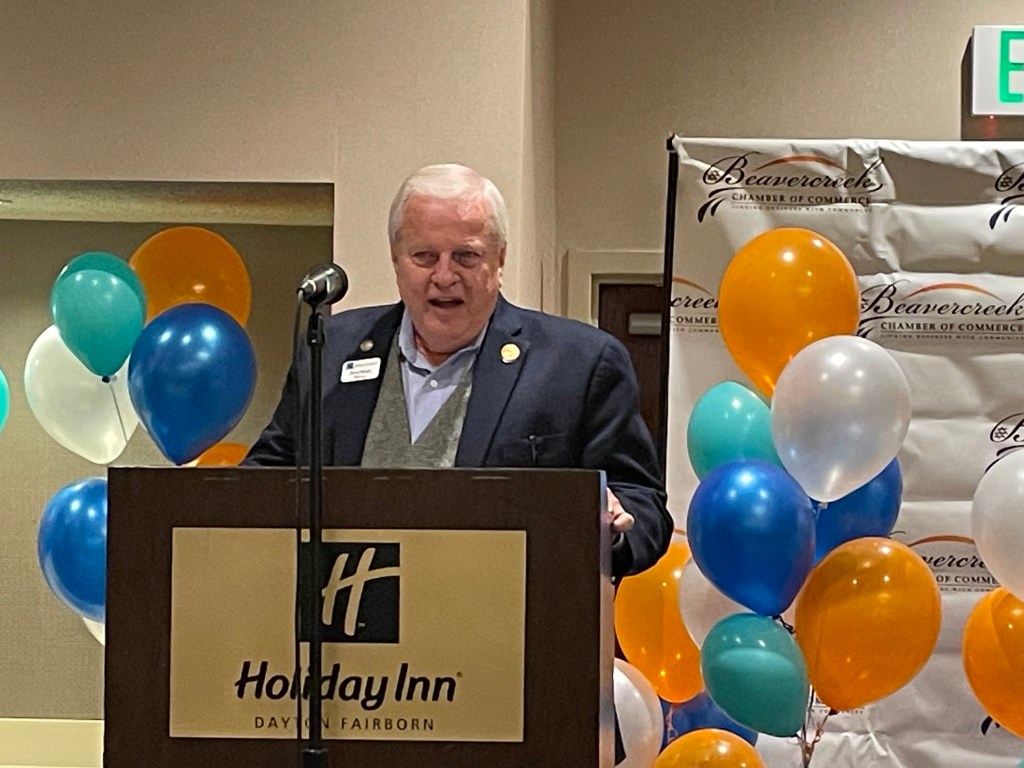
Bob Stone, Mayor of Beavercreek – E.G. Shaw Lifetime Achievement Award. Awarded to an individual who exemplifies the character and memory of E.G. Shaw: service to others, characteristics including honesty, sincerity, integrity, and benevolence. One who has performed outstanding service for the betterment of the Beavercreek community.

Beavercreek Mayor Bob Stone received the Chamber’s 2023 Lifetime Achievement Award.

Beavercreek Pizza Dive – Gussie Jones Civic Award. Awarded to an individual or organization having performed outstanding service for the betterment of the Beavercreek Community.  Must possess characteristics including honesty, sincerity, integrity, and benevolence.

Col. Christopher Meeker, Commander of the 88th Air Base Wing at WPAFB – Military Award (In Memory of Ret. Col. Len Holihan). Awarded to an individual or organizational chamber member, who has enhanced the relationship between the Beavercreek Community and the military.

During the event, the Chamber also recognized the winners of the chamber’s 2nd Annual Business Development Grant.

“The purpose of the Business Development Grant program is to provide capital and promote growth that will help the business benefit the community,” said Wendy Rogers, President and CEO of the Beavercreek Chamber of Commerce. “Grant recipients will use the money to increase capacity, adding a new venture, or other expansion.”

The grants are funded through donations and sponsorships. This year’s Platinum Annual Sponsor is Back to Business I.T. will be presenting the awards, and $2,000.00 of their sponsorship dollars went directly to fund the grants. will be presented with the award.

The 2023 Business Development Grant Winners were as follows: 

Mills Park Hotel – $3,000.00. Mills Park Hotel requested funding for video and content creation for their event, catering, and dining services. The video and content pieces would launch their independent property in entering video and social media streaming, as well as secure a spot at a major regional travel exposition where this content would be displayed to prospective clients and showcase this property, its amenities, and the greater Greene County area in an impactful and meaningful campaign.

McAlister’s Deli – $3,000.00. McAlister’s Deli in Beavercreek requested funding to upgrade their patio increasing its capacity from 20 to 40 guests, as well as create a more visual appeal and provide a more enjoyable environment for their customers.  This upgrade along with others will also create more job opportunities, beautify the front of the location, and contribute to the overall economic growth of Beavercreek.

Electric Dance Center – $1,000.00. Electric Dane Center requested funding to open a new dance center.  The grant funds will be used to outfit the studio with the equipment necessary to grow dancers’ technique and love of dance. They have been a part of Beavercreek for 30 years and the opening of this new center will allow them to continue to contribute to the further growth of Beavercreek.

Beaver Creek Wetlands – $1,000.00. Beaver Creek Wetlands Association requested funding to create transformative educational opportunities centered around the wetlands, empowering individuals to become environmental stewards and champions of wetland conservation. By investing in education, the Beaver Creek Wetlands Association can create a sustainable future where wetlands thrive, benefiting both the environment and the communities that depend on them. Any member of the Beavercreek Chamber of Commerce in good standing is eligible to apply for the grant.

For more information about the Beavercreek Chamber of Commerce award winners, or to learn how to become a member, visit www.beavercreekchamber.org.