Local News & Commentary Since 1890.

Posts Tagged ‘Ohio’

TCN Behavioral Health Announces Annual School Supply Distribution Events

In Dayton Ohio News, Health, Local News, News Media, psychology, Uncategorized on July 8, 2024 at 10:36 am

TCN Behavioral Health Services, Inc. announces their annual School Supply Drive Distribution Events. TCN annually collects school supplies and donations for the children in their service areas. In 2023 they provided supplies to over 300 children and hope to expand that reach in 2024. The five distribution events listed above will include free pizza and beverages as well as school supplies while supplies last.

“Every year, TCN provides supplies to more than 300 students within our local communities. This helps ensure a successful beginning to the school year for these students, alleviates some of the financial strain on parents and caregivers, and supports educators who frequently contribute their own resources to support classrooms,” says Tasha Jones, TCN’s Executive Administrative Assistant. “This wouldn’t be possible without the dedication of our donors and volunteers.” The five events will be held from 4-6 PM at the following TCN office locations:

Wednesday July 24 – 1825 Commerce Center Blvd, FAIRBORN

Friday July 26th – 1522 E. US Hwy 36, URBANA

Thursday July 25th – 1021 N. Market Street, TROY

Tuesday July 30 – 118 Maple Avenue, BELLEFONTAINE

Wednesday July 31 – 452 W. Market Street, XENIA

TCN accepts donations of school supplies at all locations, or donors can shop the School Supply Drive Amazon Wishlist at https://a.co/i3dO9iF to have supplies shipped directly to TCN for preparation and distribution. The organization also accepts monetary donations at tcn.org or https://tcn.jotform.com/202296368911965 by selecting “school supply drive” in the dropdown menu. Volunteers can sign up to help at their local events here: https://tcn.jotform.com/223056028945962.

Founded in 1990, TCN Behavioral Health Services, Inc. is a comprehensive behavioral health agency dedicated to improving lives by providing clinically excellent and accessible behavioral health services. TCN provides mental health, substance use and psychiatric services for adults and youth in Champaign, Greene, Logan, Miami, and Montgomery counties. For more information or to donate to TCN call (937)376-8700 or visit www.tcn.org.

Heirloom Emotions

In history, Media, Opinion, Senior Lifestyle, Uncategorized on June 15, 2024 at 8:55 am

Deer In Headlines II

By Gery Deer

It’s truly remarkable how we can develop such deep emotional bonds with family heirlooms. Whether it’s an antique jewelry box, a wax candle mold, or even a small piece of roof tile from a 19th-century courthouse, these objects hold a special place in our hearts as cherished remnants of days gone by.

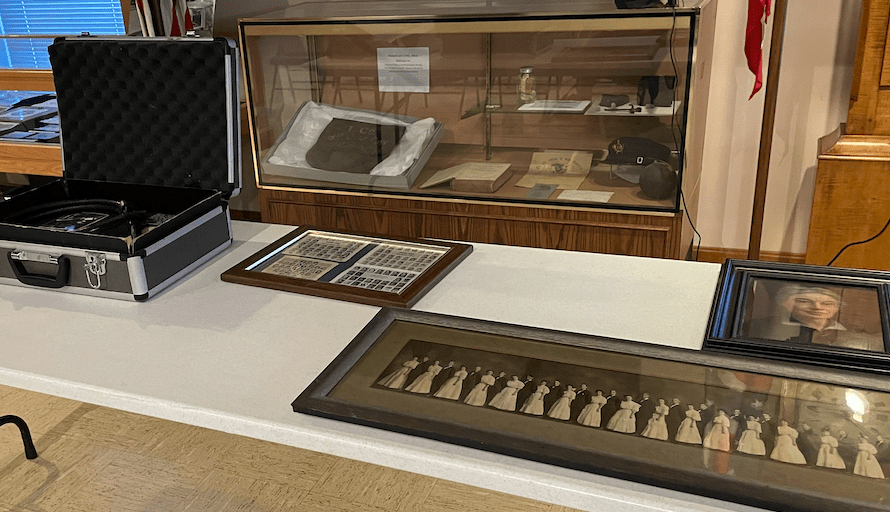
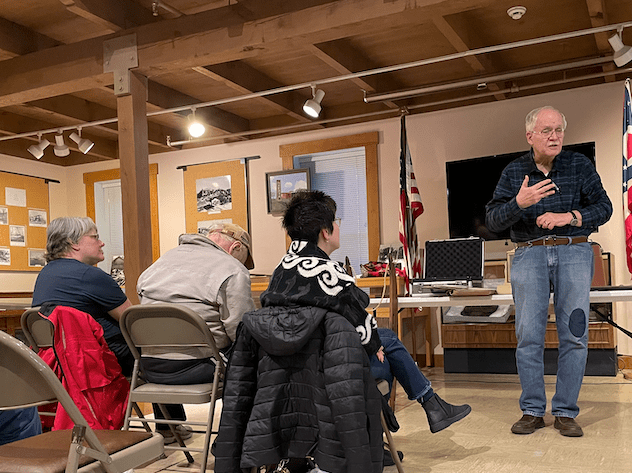
I recently attended an event promoted as a kind of show-and-tell at the local historical society. Visitors were encouraged to bring an item that had some significance to them, the history of the community, or their family, and share the story behind each piece.

Upon my arrival, I was greeted by a sight that stirred a sense of nostalgia. The organizers had proudly arranged the evening’s offerings on tables at the front of the room. Soon, a representative of the organization initiated the event, and one by one, each presenter stepped forward, their faces beaming with pride as they shared the personal significance of their cherished items.

It was like watching a live edition of The Antiques Roadshow minus the frequent condescension of the hosts. You know, “I’m sorry, but this frog statue lamp with a clock in its belly isn’t worth squat.” I always hated that. Anyway, I doubt any of the artifacts would have been for sale. You’d likely have to pry each one out of its owner’s cold, dead hands.

Even more impressive than the reverence with which each person spoke about their property was the variety of items they brought. One man brought a wooden dynamite crate, which was once used to carry explosives for stump removal at his grandparents’ farm. Another showed off his own grade school pictures, some 65 years old.

Others exhibited familial artifacts ranging from a military bayonet to a small jewelry box, which we learned was the owner’s only connection with her great-grandmother. Though very plain to the eye, it was priceless and beautiful to her, and perspective is everything.

When it originated with the speaker, like the school photos, the speaker relayed a personal account of the object’s significance. If, on the other hand, the possession once belonged to a loved one or close friend, the connection is very different. Things left behind by those before us can be deeply meaningful. Heirlooms strengthen our memory of someone and remind us of the relationship.

You’re unlikely to forget a departed parent, spouse, or sibling. But seeing and touching something that belonged to them reaffirms that connection tactilely and creates an emotional response, good and bad.

As I absorbed each story, a profound realization dawned on me. The pride, honor, or reverence—whatever you may call it—was not about the possessions. It was about the people in the stories, whether they were related or not to the speaker. After all, what is human society without stories? Stories shared between family and tribal members are how we preserve our history. And physical remnants of that history, like these family heirlooms, make the stories more tangible, more real.

And it doesn’t have to be about people who have passed on. For those in the room who had attended the same school, the antique class photos had a more profound, more personal association. Someone who’d been a student at the same school as several of the audience, but a half-century earlier, bound two generations, brought together because someone shared a story about a picture.

Finally, there’s something to be said for legacy. I think we all want to be remembered. I sincerely hope to leave behind more than a half-used pencil and a broken typewriter. But if so, I also hope someone will come up with a compelling and meaningful story about them. I think the ancestors of those who shared family items would be very proud of their legacy.

My parents left behind a treasure trove of memories, from books and dolls to trucks and tractors. Among these, I hold dear my father’s wristwatch. He personally handed it to me, sharing the story of its origin. When I gaze upon it, I am transported back to that moment. It’s not about the watch itself, but the emotional bond it represents, the moments he spent with me that hold the true value.

My “Piano Man” Days

In Dayton Ohio News, Entertainment, Music, Opinion, Uncategorized on June 7, 2024 at 8:10 am

Deer In Headlines II
By Gery Deer

“It’s nine o’clock on a Saturday. The regular crowd shuffles in.” Those are the first lines of Billy Joel’s “Piano Man,” a song that always transports me back to my college days. To help pay for school, I was the pianist at a small Italian restaurant. Even in the 80s, it was old-fashioned, with one large room outlined by raised booths along the walls and a few floor tables in the middle. The decor was, what’s the word, beige. Yep, a lot of beige. Or was it brown? It’s tough to be sure because the lighting was pretty low.

Every Friday and Saturday evening, for about three hours, I performed all instrumentals on a small studio upright. I was like a live Muzak machine without the lyrics. I. Did. Not. Sing. Period. No one would have wanted to hear that. You might as well go outside and toss an alley cat into an upright trash can for that cacophony.

I had a repertoire of about 250 pieces, mostly pop and oldies, but I tossed in the occasional classical number just to show off. A quiet tinkling of “Fur Elise” goes particularly well with linguini, and the leg of lamb begged delivery of Bach’s “Sheep May Safely Graze.” I can’t read music, so everything was by ear. I memorized each song pretty much the first time it fell from my ear to my hands. Regulars would often bring a tape of some song they wanted me to play, and I’d learn it before their next visit.

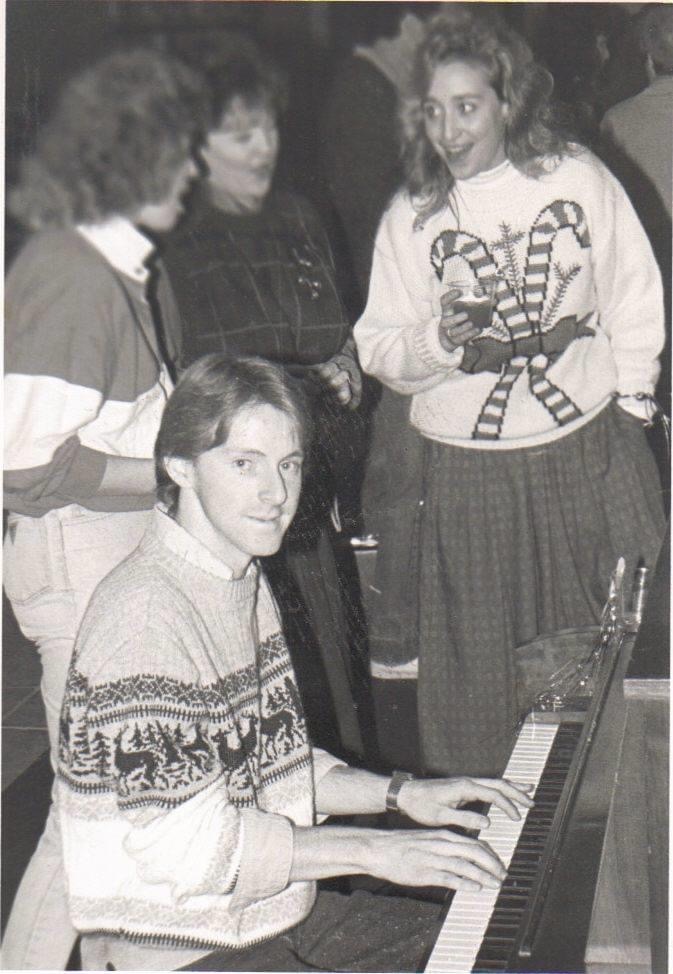
“Piano Man” Gery Deer, performing for a holiday event at Sinclair Community College in 1988.

Once in a while, I’d break out the occasional show tune. On slower nights, I’d rearrange some old TV show theme song into a long, drawn-out ballad. You should hear my dramatic rendition of “Gilligan’s Island” at half speed with Liberace-esque flourishes. People would ask if it was some rare piece by Rubinstein or Mozart. I’d reply, “Oh, no. It’s an original by Schwartz (Sherwood, that is – go look it up).

Playing in a restaurant isn’t all tickling the ivories and clever combinations of sets. It’s more about the people. Unlike a “piano bar” or dueling pianos show, restaurant performances are more atmosphere than anything else. Still, although I got paid for my hours on the bench, my livelihood really depended on tips.

Depending on the traffic, my available talent that evening, and the generosity of the customers, I could have a forty-dollar or four-hundred-dollar night. The latter required some people skills. I was unable to respond with more than a smile or nod when someone tipped me while I was playing. So, I’d take a break at my first opportunity and walk over to their table to thank them.

Here’s a secret about restaurant or bar piano players. We are always watching you. No, I didn’t care what you ordered. I never gave a thought to how stingy you were about tipping the waitstaff after spending a ridiculous amount on too many bottles of cheap wine. Nor did it matter to me that your date’s dress was so short your wife would certainly have disapproved.

No, I was studying my audience’s reaction. It was gratifying when people clearly enjoyed my work and that it added to their evening experience. If a table was paying particular attention to one kind of music, I’d adjust my set list accordingly. More often than not, a request or early tip came from one of those parties, generally the lady of the table. I think the guys were embarrassed to come up to me. I have no idea why.

During my three years there, I also learned a great deal about human behavior. Restaurants only provide a two-dimensional view of human interaction, but it’s alive with celebrations, sadness, gluttony, and togetherness.

I was very young then, so I also learned a lot about myself, particularly that I was more introverted than I’d ever realized. I’d like to think my music always improved someone’s day and that it still does. At least, I hope so.

If a street or restaurant musician ever makes your day just a little brighter, please take time to tell them so and drop a few bucks in their jar. You’ll make their day and yours, too.

CHECK OUT THE PODCAST FOR THIS EDITION.

Gossip Column

In Local News, Opinion, psychology, sociology, Uncategorized on May 18, 2024 at 9:02 am

Deer In Headlines II

By Gery Deer

Gossip. It’s an insidious phenomenon that always hurts people. Usually, gossip is inaccurate and degrades even more as it travels from person to person. Gossip is a destructive game of telephone that usually ends in the victim’s humiliation.

Gossip begins with someone sharing something confidential, saying, “Hey, just between you and me…” and so on. But it’s doubtful the information will remain a secret. The story inevitably spreads like air escaping a leaky tire.

Although there is debate about whether gossip is predominantly negative, nothing good comes from it. One study even suggests that gossipers tend to have a “darker” personality, uncaring about the social consequences of their behavior. Another offers the theory that we’re motivated by a need to bond with others in our social circles, keep ourselves entertained, vent emotions, and establish social status.

Low self-esteem seems to be a common theme among gossipers. They validate themselves by spreading news of others’ misfortunes and by sharing negative stories about people, reinforcing their imaginary superiority. 

All that sounds great academically. But, personally, I think people are just mean sometimes. They want to feel superior, so they start rumors and gossip to gain an upper hand—even if it’s all in imaginary. Ignorance probably plays a role, too. Those who spread gossip often believe the person at the story’s heart will never find out, so no harm done, right? Wrong. Trust me, they always find out.

In the past, gossip proliferated over the backyard fence or around the water cooler at work. However, with the advent of social media, gossip has taken on a new level, broadcasting misinformation to countless recipients at the speed of light. Clickbait is a perfect example of modern gossip-mongering, complete with a compelling story, video, and photos.

At this point, it’s probably important to clarify how I distinguish between gossip and rumor. Official definitions explain gossip as the spread of information that’s essentially true but likely unkind or hurtful. A rumor, on the other hand, is false information passed around without confirmation or conscience. However, I’m not convinced this distinction is always evident in practice. In my opinion, there’s very little difference between gossip and rumor, regardless of what old Mr. Webster says.

Regardless of your definition, one of the most important things to remember is how gossip affects the victim and how that affects the gossiper. In this context, the word “victim” refers to the person who is the subject or target of gossip. Since most of that information is false or intended to harm someone, that person is indisputably a victim. Although spreading gossip is not criminal, when those actions cause harm, there should be more severe consequences.

Victims of gossip can suffer devastating and long-lasting effects. I remember when I was in fifth grade, one of the bullies in my class made up a story about me that spread through our rural school like a bad case of Chicken Pox.

It was a painfully frustrating time for me. I already had to deal with being a 10-year-old adjusting to a strange new school. Simultaneously, however, I had to get good grades and spend every other waking minute defending myself against ridiculous lies.

Sometimes, gossip severely damages someone’s reputation or their livelihood. In such cases, it could be considered slander, and the harmed person may have a right to pursue legal action. The person who started the false information may be liable and must pay financial or other restitution.

We can’t control what others say about us, to whom, when, or how. At a time when misinformation and fake news are the norm, all we can do is abstain from its distribution. Think about it. Would you want someone gossiping about you, your business, coworkers, or your family?. Finally, remember that the best gossip is the kind you keep to yourself. And, if you hear gossip or the rumor mill is churning out something about someone close to you, do what you can to help put an end to it. I’ll close with a quote from the great Hee Haw Honeys song: “We’re not ones to go around repeating gossip. So, you’d better be sure to listen close the first time.”

The Carriage Returns

In Business, Local News, News Media, Opinion, Technology on April 20, 2024 at 1:22 pm

Deer In Headlines II
By Gery Deer

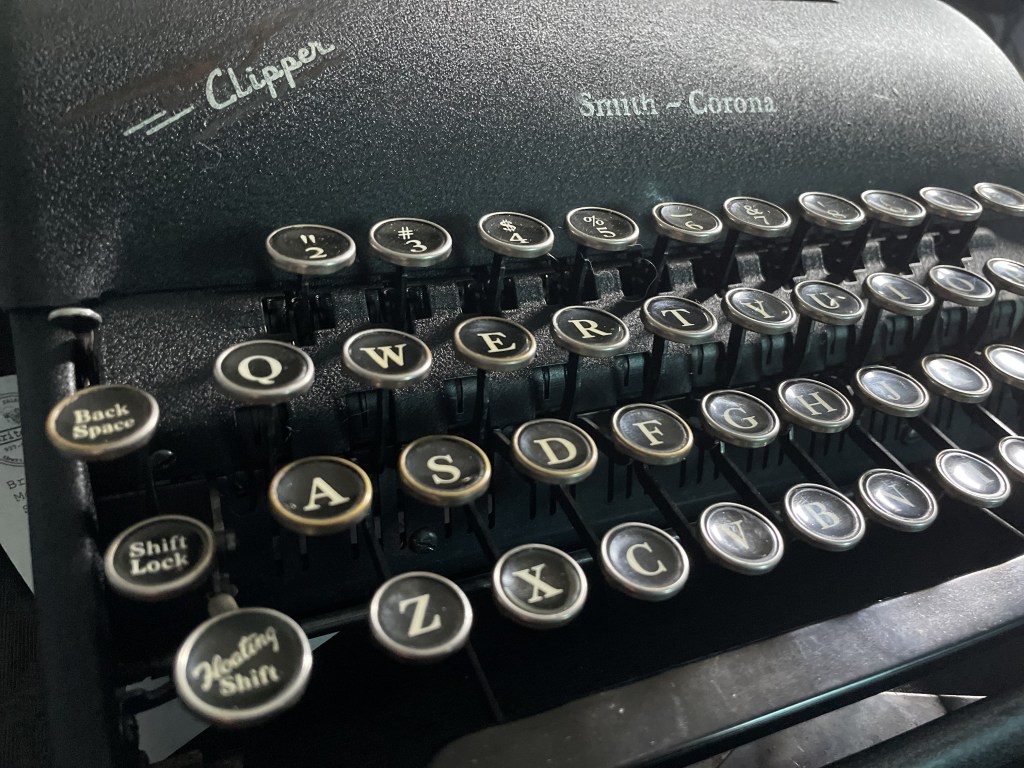
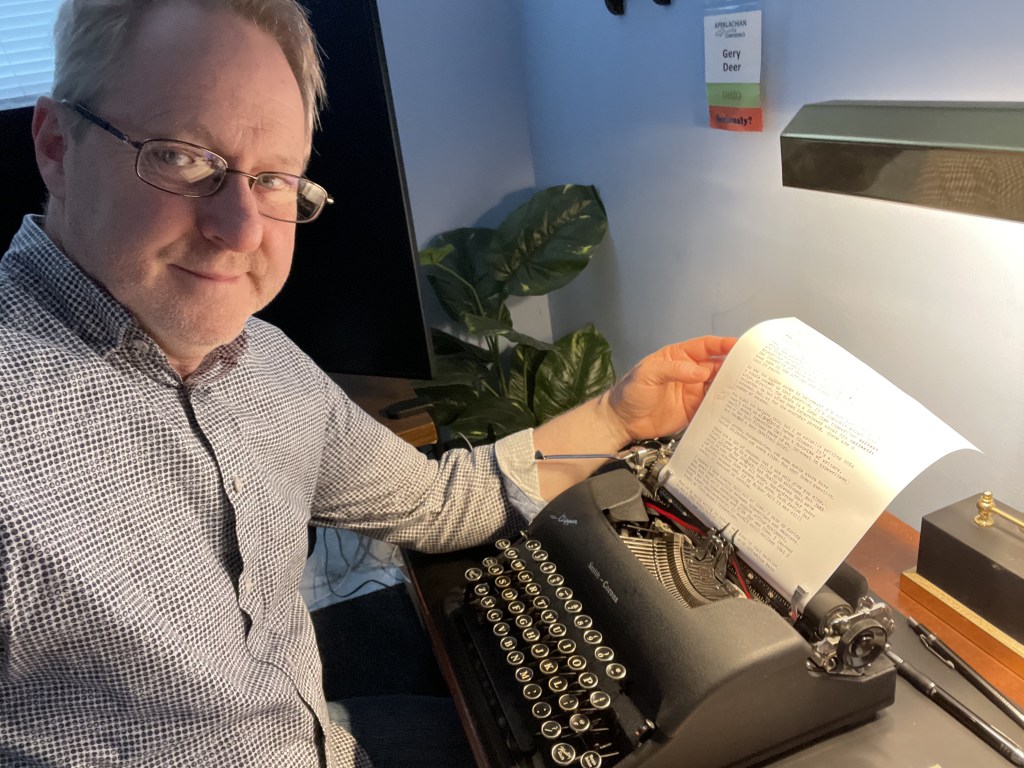
You may not believe it, but I’m writing this week’s edition of “Deer In Headlines” on an antique manual typewriter. Remember the typewriter? The truth is, I just bought this machine a few days ago at TB Writers Plus, a startup typewriter shop in Dayton, Ohio.

(Check out the Bonus Video and the Deer In Headlines Podcast episode that accompanies this piece!)

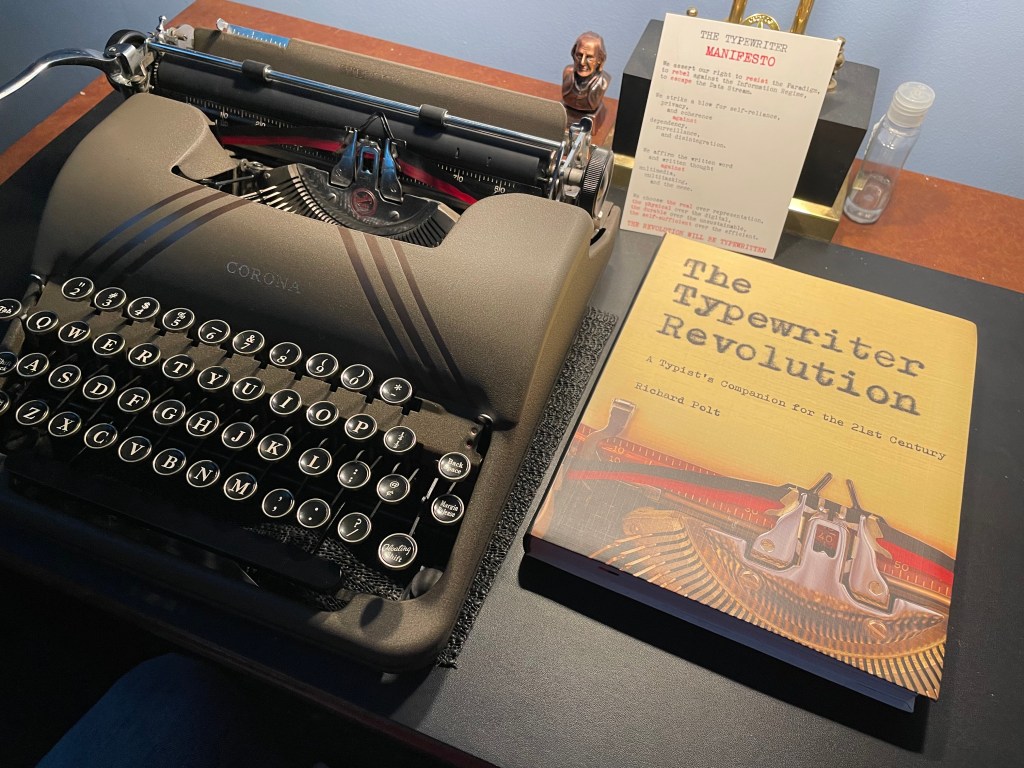
I have three manuals, but this is a sleek 1945 Smith-Corona Clipper, matte black, with a textured chassis and gold-lettered, enameled keys. It sounds like I’m describing a classic car, doesn’t it? That’s exactly how some people see it.

Your next question is obvious, and I’ve heard it a dozen times already – why? I’m a technically savvy person with a significant digital presence. So why would I sit down to write on an old typewriter? That’s a great question. I’ll try to answer as we go. Let me first say I’m not alone.

Over the last twenty years or so, interest in typewriters has been on the rise. That sharp, rhythmic clickety-clack has charmed a whole new generation of writers, collectors, and nostalgics. It’s commonly known that actor, author, and director Tom Hanks is a long-time typewriter collector. Whole communities of typewriter enthusiasts share photos and samples from their beloved machines online and in person.

Many attend type-ins, where people gather at typewriter shops, homes, libraries, or anywhere else to, well, type. I often refer to them as cruise-ins for typewriter enthusiasts. There’s even an activity called type-casting, where you create something on a typewriter, scan it as an image, and post it online. (Learn more about the so-called “Typewriter Insurgency” here.)

As a Gen Xer who hit high school during the 1980s, modern office tech was still coming of age. We barely had reliable copy machines. Most schools and businesses had a mix of PCs and typewriters (mostly electric), so I learned both almost simultaneously. I’m comfortable with either.

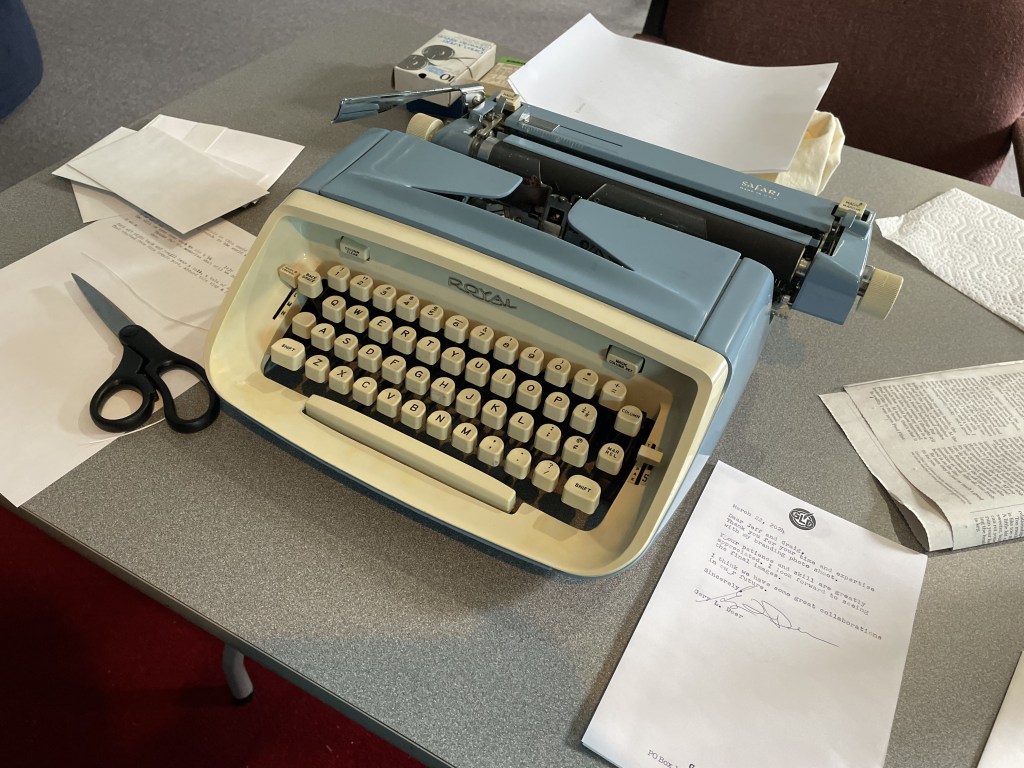
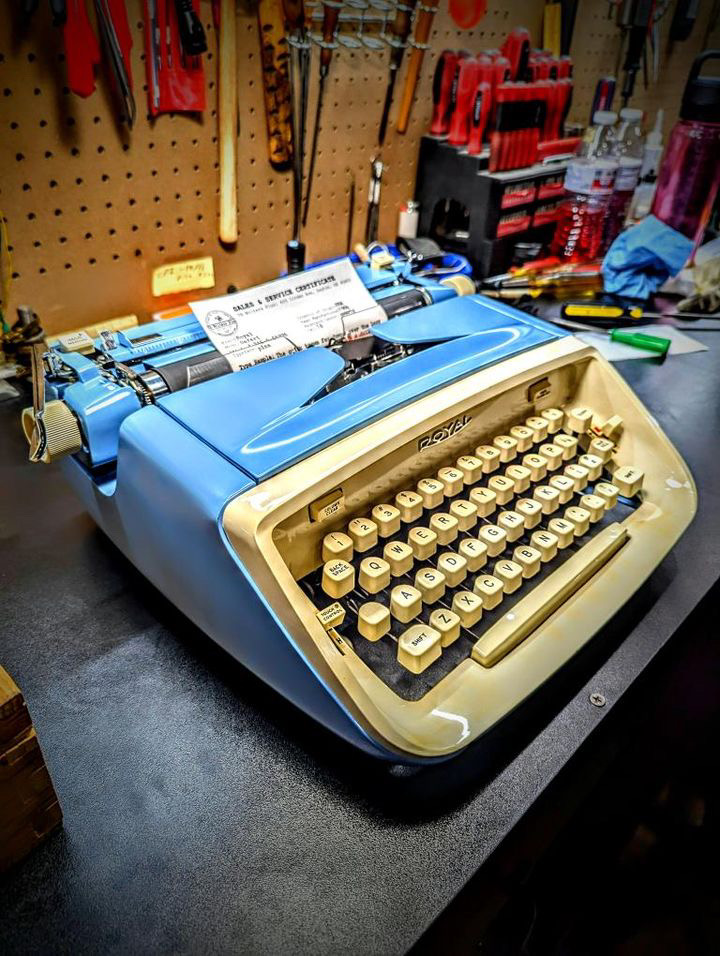
In the background, Gery’s 1964 Royal Safari. (Photo by Hue12 Studios, Dayton, OH)

I bought my first manual typewriter while I was in college, mostly for its portability. A good bit of my earliest writing was done on that machine. It was—or rather is—a 1964 Royal Safari, light blue with off-white keys and accents. It still sounds like I’m describing a ‘57 Chevy. And yes, I still have it.

Aside from nostalgia and mechanical admiration, I think digital overstimulation may have contributed to some people’s leaving the computer behind. I can relate. I’m so immersed in the continuous urgency of the digital environment that I just want—no, need—the quiet of the old ways.

I know the typewriter can be noisy, but I wasn’t referring to “quiet” in that sense. When those keys snap against the paper, I am fully engaged and undistracted from my writing. The slower pace allows me to choose my words more carefully, and there are no pop-ups, email messages, or social media nonsense. It’s kind of freeing.

I’ve also heard some people turn to the typewriter out of paranoia. Privacy has become a real concern in the digital world, and viruses can’t infiltrate typewriters, nor can your printed pages be hacked. You’re most definitely off-grid. But there’s a price to pay for that: time.

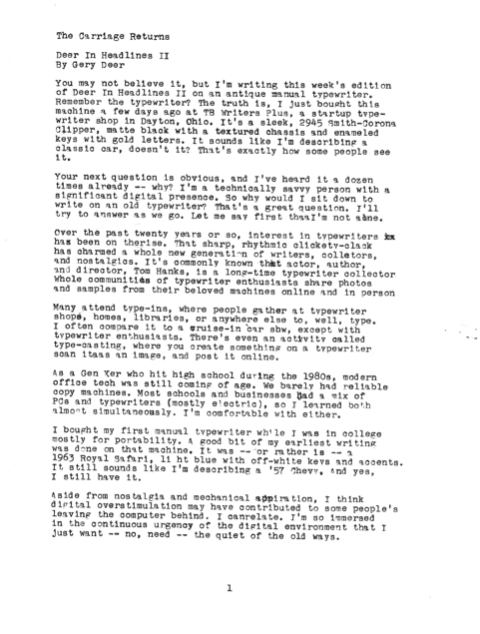
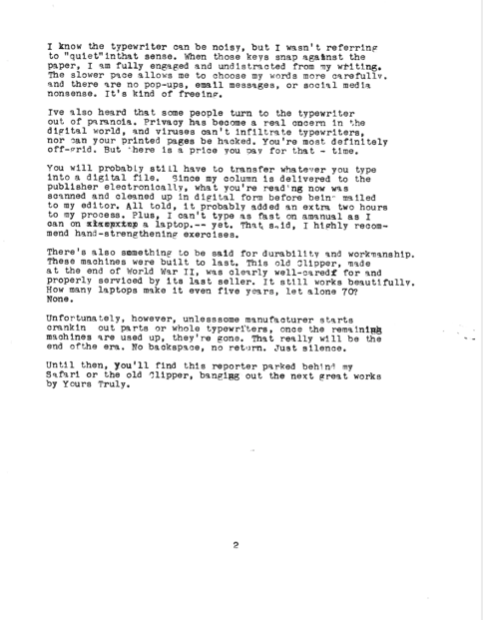
You will probably still have to transfer whatever you type into a digital file. Since my column is delivered to the publisher electronically, what you’re reading now was scanned and cleaned up in digital form before being emailed to my editor. All told, it probably added an extra two hours to my process. Plus, I can’t type as fast on a manual as I can on a laptop – yet. That said, I highly recommend hand-strengthening exercises.

There is also something to be said for durability and workmanship. These machines were built to last. This old Clipper, made at the end of World War II, was clearly well-cared for and properly serviced by its last seller. It still works beautifully. How many laptops make it even five years, let alone 80? None.

Unfortunately, however, unless some manufacturer starts cranking out new parts or whole typewriters, once the remaining machines are used up, they’re gone. That really will be the end of an era. No backspace, no return. Just silence.

Until then, you’ll find this reporter parked behind my Safari or the old Clipper, banging out the next great works by Yours Truly.

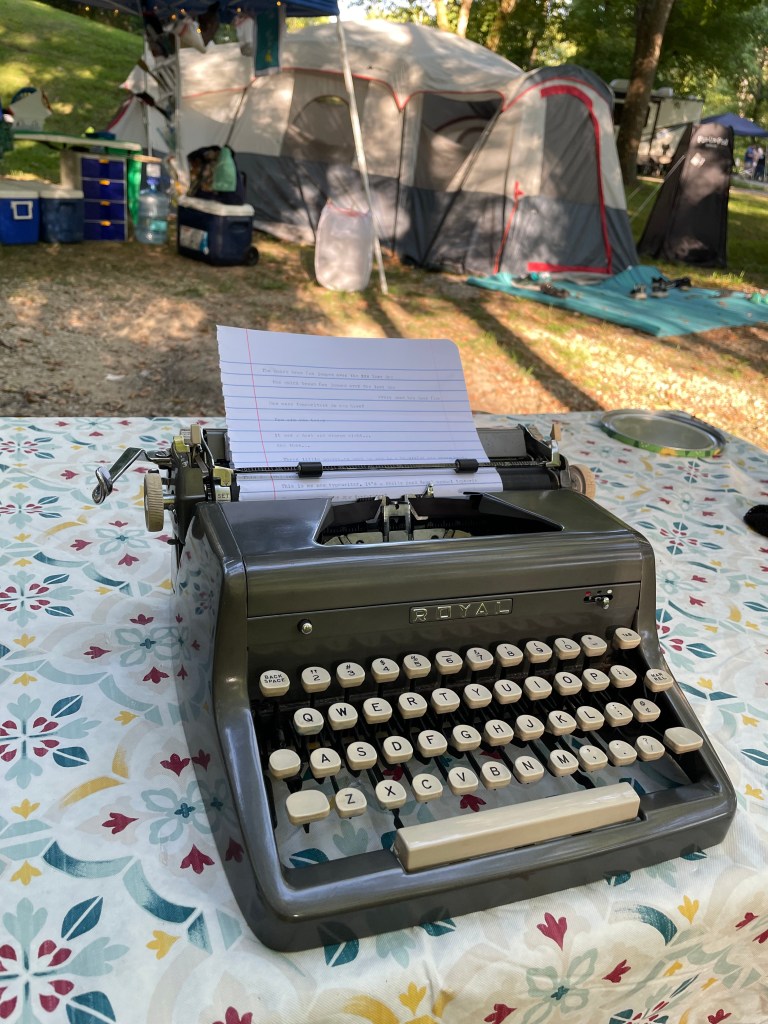
(See the gallery for photos of the typewriters mentioned in this piece and more.)

Not just a cat.

In Children and Family, Local News, Opinion, Uncategorized on April 12, 2024 at 7:22 am

Deer In Headlines II

By Gery Deer

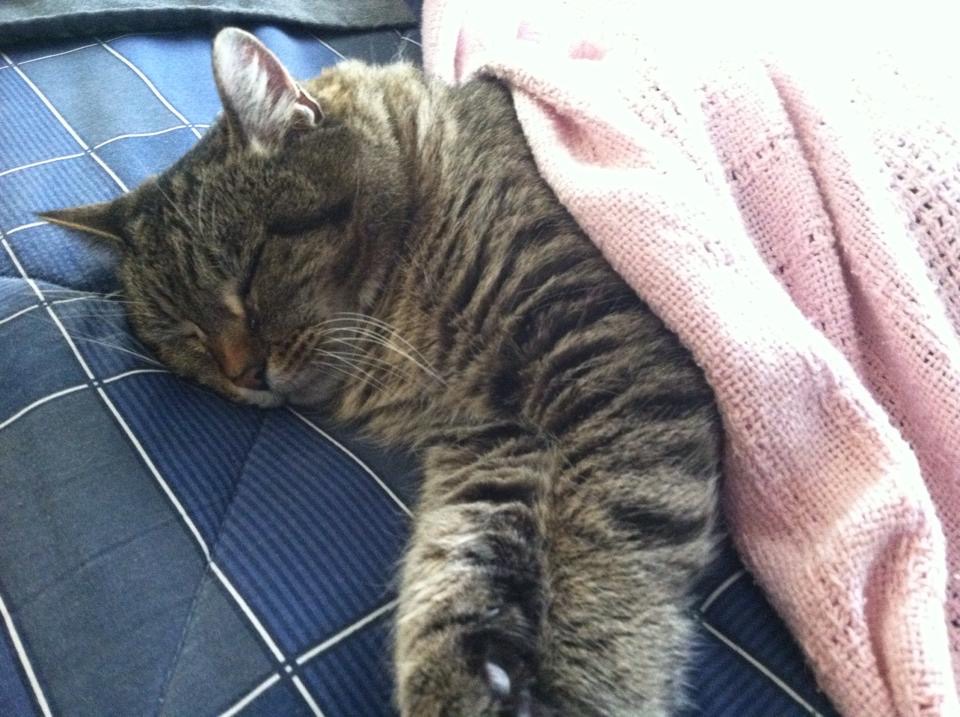
Nearly ten years ago, my chubby tabby cat named Bray was diagnosed with untreatable liver and kidney disease. He was 15 years old and had been in good health, but the level of pain and suffering he was going through was worsening. Knowing what was ahead, I was beside myself with grief.

On the farm, I learned not to get attached to animals because they weren’t there long. While we had livestock, we also had many barn cats, several different dogs throughout the years, and even a few ducks and peacocks. Of course, I had my favorites as I grew up, and some of the dogs and cats were friendlier and more social than others.

But this was different. Bray (a name cobbled together from the words “baby” and “gray”) was my buddy who saw me through some pretty rough times. He was my first indoor pet and had my attached garage as his condo – complete with climbing shelves and a loft.

Since I’ve worked at home for much of my career, Bray would be right there. He would wander in and settle on the recliner I used to keep in the converted bedroom I used as an office. Of course, he couldn’t be bothered with things like conference calls or answering the phone. After all, like other felines, he didn’t have an owner. He had staff – me. And that was fine.

Bray was always a little overweight. Born at my family’s farm, he was kind of a runt but quickly prospered once I brought him home. He no longer had to compete with six siblings. In fact, he just kept getting bigger. At his peak, he was about 18 pounds and, despite his size, all energy.

This is Bray doing one of his favorite things – 2008

He would chase me around the middle section of my house which circled through the hallways, living room, and kitchen. To this day, a strand of elastic string is tied to one of my closet doors with a plastic ball attached. It has a bell inside, and Bray spent what seemed like hours batting it around and holding onto it while gnawing on the elastic.

I used to laugh hard when he’d suddenly let go of the ball, and the elastic would snap back and knock the bell against the door. It was like someone went up behind him and said, “boo.” He’d take off running through the house, his claws struggling for traction as he ran across the slick kitchen floor.

But then Bray started losing weight. He wasn’t eating and was spending time hiding under the bed. For such a social animal, that was unusual behavior for him and sometimes a telltale sign that a cat is sick. We went to the vet, and sadly, his illness had come on pretty rapidly. Little could be done, and what was possible would be painful and expensive. Money was tight then, but regardless, at his age and stage of illness, a full recovery wasn’t likely.

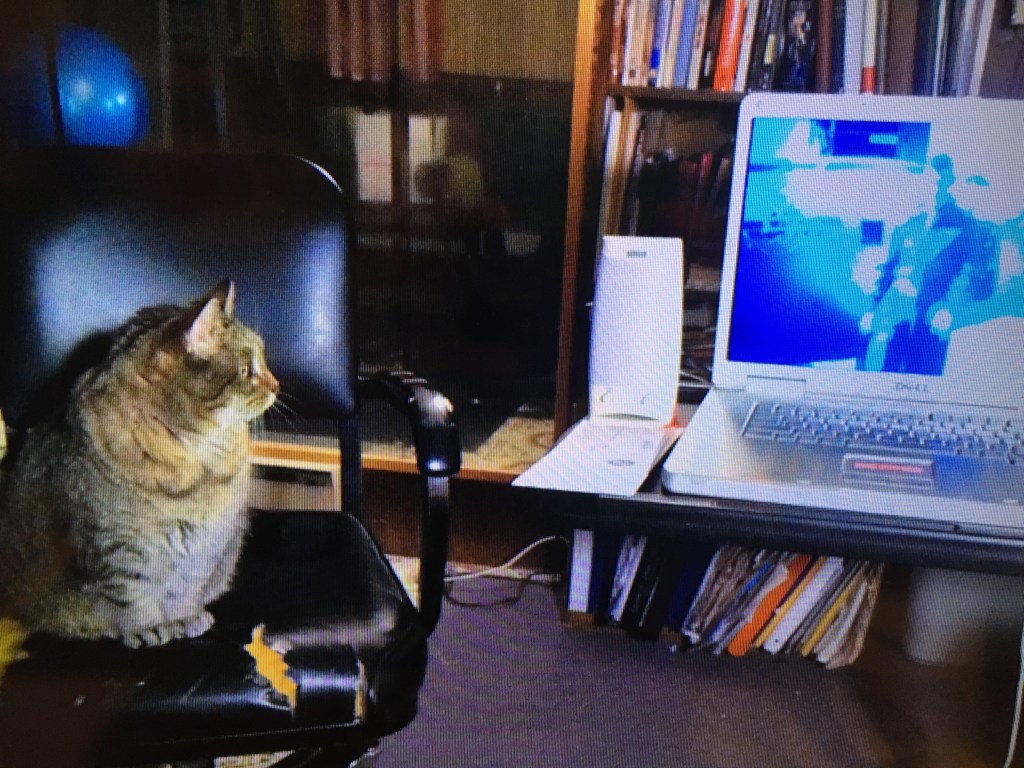
Sometimes, he liked watching movies on Gery’s computer. (2006)

As much as we anthropomorphize them, animals can’t reason as we do, so Bray would have just been in pain with no understanding of what was happening to him. That seemed cruel – to both of us. So, I had to let him go.

I was with both my parents as they left this life. I’ve had to put down cattle that were sick or injured. I even sat with my childhood pony’s head on my lap as he took his last breath after 25 years of companionship. But, with all of that, I’ve had nothing cut me so deeply as having to be the one to decide my little cat was going to die.

My reasoning tells me it was for the best. Even after a decade, I wonder if I did the right thing. Eventually, we have to accept that we chose compassion for the animals we cared for because they depended on us. They’re family and some of the choices we must make on their behalf are easy, others are devastating. As for Bray, I’ll never forget him, and I know there’s someone out there reading this and saying, “It was just a cat.” Maybe to you, but I know better.

Uniquely Portable Magic

In Books, Education, Entertainment, Opinion, Print Media, Technology, Uncategorized on April 7, 2024 at 9:47 am

Deer In Headlines II

By Gery Deer

“Books are uniquely portable magic.”—Stephen King, On Writing: A Memoir of the Craft.

I’ve often quoted classic books in this column for several reasons. For one thing, those brilliant writers of old had wisdom that still eludes me, and I need to borrow it occasionally. 

I also enjoy the opportunity to share my love of books with those of you who are kind enough to give me your attention for a few minutes each week. My hope is that, in addition to my humble observations, I can share some words from those scribes who were (or are) far wiser and more eloquent than me. 

Of course, I don’t just cite the classics. I toss in something fun and modern here and there as well. You may not realize it, but I’ve shared some words from the likes of Douglas Adams, George R.R. Martin, J.K. Rowling, and more. 

I wasn’t a voracious reader when I was young, but that changed as I grew up. In high school, I became interested in Charles Dickens. Later, it was the stories of Mark Twain. From “The Little Red Lighthouse and the Great Gray Bridge” to “Lord of the Flies,” one book led to another. It’s interesting how that happens. Once you’re hooked…

That said, here are my questions of the day: Have books become obsolete in the shadow of the internet and social media? As some try to ban classics like Huckleberry Finn and To Kill A Mockingbird, what has become of literature’s social significance? What does the future hold for the classics and all the unwritten works yet to come? I don’t have the column inches to answer these questions, so here are my brief thoughts. 

In my humble opinion, Stephen King had it right. Books are magical. They transport us to faraway lands, introduce us to people around the globe, and inspire imagination and dreams. But books are far more than mere escapism from our daily grind into the worlds of Harry Potter and Captain Nemo. 

Books are the arks of our history. They help us learn from the past, hold a mirror to the present, and prepare for the future. Every published page offers a tiny glimpse into who we are as a species—warts and all. When you read a book, you have no choice but to learn something. Ignorance is replaced with knowledge and understanding, and then a funny thing happens—people get along better. Books provide the knowledge that breaks down all the barriers that separate us.

Booksellers are struggling, however. In many American communities, there might be a Starbucks or a parking lot where the neighborhood bookstore once stood. Instead of the pages of some great new novel, many people seem far more interested in scrolling through social media.

Although I prefer the printed page for most of my reading, my appreciation for books is more about content than construction. I typically read two or three books simultaneously, each in a different medium—audio, digital, or print. 

A book is a book. Unless you can convince me that words read aloud are less meaningful than those read by eye, listening to an audiobook still counts as reading. You should read however you feel comfortable.

Concerning book bans, I won’t get into the obviously paranoid politics involved. If you don’t like a book, don’t read it. But the concept of book banning should horrify us because it casts a long shadow backlit by terrors of the past. 

Some writers spend decades crafting the perfect book, hoping it will positively impact the reader. No matter your age, the genre, or the medium, reading a book will improve critical thinking and creativity and release dopamine, the brain’s “happy” chemical. 

If you haven’t done so for a while, it’s time to get some of that happiness for yourself or give it to someone else. A book is one of the most meaningful gifts you can give. Libraries and bookstores offer a fun, affordable family experience you will remember forever.

Thankfully, books, even printed ones, aren’t going away anytime soon. But if they were ever to disappear, so would our society, our humanity, and, eventually, the record of our very existence. 

*************

More Information:

Your local library is a great, free resource for the whole family to explore the unlimited world of books!

If you want to learn more about the book industry, the future of printed books and bookstores, check out these documentary films: The Booksellers. And Hello, Bookstore.

Drive-In Movie Memories

In Entertainment, Movies, Opinion, sociology, Theatre, Uncategorized on March 24, 2024 at 10:13 pm

Deer In Headlines II

By Gery Deer

One warm summer evening when I was about 20, I wheeled my 1971 Mustang through the neon-washed gates of the Belmont Auto Drive-In Theater just outside Beavercreek, Ohio. I found the ideal spot and parked. The massive screen filled my windshield.

A few minutes later, an announcement over the speakers says, “Fifteen minutes! Fifteen minutes to show time!” Perfect! I had just enough time to grab a hot dog – I counted what cash remained in my wallet. It didn’t matter, though. They had me at “fresh, hot, buttery popcorn!”

That night, the marquee read, “Double Feature” (Then again, it was always a double feature.) “Star Trek IV: The Voyage Home and Crocodile Dundee.” If memory serves, the price was $5 per car, and I was ready. Drive-ins had been converted to broadcast the movie sound over the radio. So, I outfitted my old Mustang with a stereo amplifier and mounted speakers so you could best hear them outside the car. I tuned in the frequency, adjusted the volume, hopped on the hood with my snacks, and settled in for a great evening’s entertainment under the stars.

I loved drive-ins and still do. There’s something about the atmosphere that is pure Americana. As I’m thinking about it now, I can almost hear the overdriven buzz of those heavy, window-hanging speakers, the dancing refreshments up on the screen at intermission. The drive-in was one of my first solo outings at 16 when I got my driver’s license.

My first memory of going to a drive-in was with my parents in 1974. I was about seven years old, and we went to the Skyborn Drive-In in Fairborn, Ohio, where the original “Benji” movie was showing. I was so enamored with them that, for a short time, I considered owning a drive-in theater, but not your usual run-of-the-mill version.

I had this wacky idea about a massive drive-in theatre and even made concept drawings of it. It featured an unusually large, high-resolution curved screen, Dolby stereo, wireless speakers, and a two-story concessions building with a restaurant on the second floor. It featured a video game arcade, a merchandise shop, supervised playrooms for the kids, a bar for the adults, and more. Plus, it was much larger and could hold more than 400 cars.

Of course, I never made it happen, but it was a cool dream. I’m afraid that in the summer of the late 80s, my concept was way ahead of the required technology. Besides that, even in those days, drive-ins started to disappear.

Most of the Dayton-area drive-in theaters I visited back then are long since gone. If you’re local, you might remember some of them. There was the North Xenia Drive-In, Southland 75, Valley Street Drive-In, Dayton West Drive-In, and many others.

In north Dayton, the Dixie Twin first lit its screens in the early 1950s, and its projectors are still running today. The Melody 49, just off I-70 near Trotwood, is alive and well and shows first-run flicks on two screens. You can find others with a quick Google search. Depending on the travel, you might need to make a night of it if you plan to go.

As many surviving drive-ins faced closer, a strange twist of fate intervened. The very disaster that shuttered businesses worldwide may have been the savior of the drive-ins, at least temporarily. The COVID-19 pandemic gave many drive-ins a surge in business. Families could watch a drive-in movie, maintain social distancing, and enjoy an evening out.

Sadly, box office numbers have slumped since the pandemic, and drive-ins are still trying to bring people back in the gates. People need to be reminded that nearly all drive-in theaters are privately owned small businesses. They’re not million-dollar multiplexes. Most are run as a labor of love with volunteer staff, and most take in barely enough revenue to keep the projector bulbs burning. 

For some, drive-ins are a long-held tradition. To others, they represent an era long past. But whatever the attraction, grab your lawn chairs, blankets, and portable radios (to keep from running down your car battery), and head to the closest drive-in. For now, I have to go. Tonight’s feature is about to start.

Recommended Documentaries about Drive-In Theatres:

Socially Unacceptable News

In Local News, National News, News Media, Opinion, Uncategorized on March 17, 2024 at 9:33 pm

Deer In Headlines II

By Gery Deer

According to recent surveys, nearly 80 percent of Americans have at least one social media account, and the total number of global users is nearly 5 billion worldwide. I happen to be one of the masses. I use it to promote my work and stay in touch with family, friends, and clients. But social media as a news source? I’m afraid not. Unfortunately, Pew Research reports that 6 of every 10 Americans rely on social media as their main resource for news. As a veteran freelance journalist, that’s an unsettling statistic.

I guess it wouldn’t be so bad if people followed qualified news sources, but that’s the exception rather than the rule. Most simply accept everything posted on social media as fact or truth (not the same things and more on that later). What’s worse, a great deal of that junk is created by “bots,” automated programs designed to post incendiary content and drive online traffic. 

Facebook, Instagram, TikTok, and Twitter, or “X,” or whatever it’s called now, are not, I repeat, not news outlets. The most accurate way to describe social media is to compare it to the bulletin board at your local grocery. Anyone can post anything, unmoderated and unvetted. You, the consumer, can choose whether to look and believe what you see.

I understand that nowadays there is a growing tendency for Americans to mistrust news media. It’s even more prevalent among those belonging to extremist groups. Unfortunately, both the far right and the far left are not interested in objective facts. Their sole purpose is to twist and manipulate information to achieve one goal – chaos. They have no interest in journalistic integrity anyway.

I intentionally use the word “facts” instead of “truth” since the concept of truth is entirely subjective, and you shouldn’t find it in the evening news. To paraphrase Indiana Jones, if you’re interested in truth, take a philosophy class. Our news media should present accurate and objective reports, with no subjective notions of truth. 

Speaking of facts, how about those headlines? Headlines shouldentice you with a piece of the story. After all, the whole idea is to get you to read. But extreme and fake news producers create misleading, AI-driven headlines. Algorithms determine what words are more likely to lead readers down an endless and manipulative rabbit hole of advertisements and more deceptive content.

Here’s a great example. Everyone loves Betty White. As so many of her contemporaries passed on, fans hoped she’d live to 100. Sadly, that wasn’t her fate. But a couple of years before she died, there was a headlined story going around social media that read, “Betty White dyes at home.” Do you see anything wrong with that headline? If you don’t, you need a vocabulary lesson, not a philosophy class.

The headline was written to trick gullible fans into clicking on the tragic tale of their beloved Betty’s passing. Eventually, they would realize it was a fake story about White “dying” her hair, at home. By then it was too late. Duped readers were bombarded with unstoppable pop-up ads and the website made a fortune from the pay-per-click fees they were charging advertisers. 

Once again, the story wasn’t posted by any legitimate news agency, but it was well camouflaged. Yes, people should know the difference between the words, “dyes” and “dies,” but even the best proofreader may have missed that if they happened to be Betty White’s biggest fan. Fake and misleading news only gets traction because people share it, and the next story might not be a harmless joke.

You don’t need to fear social media but remember the bulletin board analogy. These platforms can be effective marketing tools. They can help friends and families stay in touch or offer an outlet for creative expression. But every day, social media is also being used to manipulate more people, disseminate misinformation, and spread hate, aggression, ignorance, and fear.

My advice is simple. Get your news from legitimate outlets – like this publication. Ultimately, you have the choice of whetherto believe what you see. Although social media may offer you a road sign on the information superhighway, you are still the onestill steering the car.

The Coffee Shop Roundtable

In Opinion, psychology, Senior Lifestyle, sociology, Uncategorized on February 24, 2024 at 8:19 am

Deer In Headlines II

By Gery Deer

The other day, I was sitting in a coffee shop when I overheard a conversation between four senior gentlemen at the nearby table. Based on their appearance, I guessed they were in their late 70s, active and clear-minded. The cold Ohio winter had them dressed appropriately in jeans, heavy walking shoes, sweaters, down jackets, and winter caps. These men obviously knew each other quite well and shared common interests.

It was not my intention to eavesdrop, but they were talking loudly enough you could pick up their voices from well across the shop. Anyone could see this meeting was a crucial part of their social life. One of them even mentioned how much he enjoyed getting together regularly and noted how much he learned from the others.

In fact, they all seemed to relish the conversation, which covered a wide range of topics from sports to live theater. I found a brief interaction they had about The Phantom of the Opera of particular interest. While some topics, like the state of American politics, sparked more spirited discussion, they remained respectful and considerate towards one another.

The Algonquin Roundtable

At one point, one of them told a detailed story about how he’d been working on the roof of his home. Suddenly, he found himself stranded up there because his ladder had fallen. He called out for his wife, but she apparently didn’t hear, which left him there for some time. Fortunately, all worked out for the best, and through the laughter, his comrades were giving him a good bit of grief about fooling around on a roof “at his age.” I imagined their adult children giving each of them the same speech in a more serious tone, only to be ignored later.

We occupied one corner of the shop for about an hour, though I believe my subjects had been there for a while before I arrived. They’ll never know it, but they gave me back a moment from my childhood.

When I was around 10, Dad occasionally took me for breakfast at the small diner where my mother waitressed (her word). Early each morning, a group of movers and shakers from our tiny farm town arrived, one at a time, and occupied the same corner booth. 

The pack was usually a mix. Among them, you might find some combination of the local banker, a town doctor, the police chief, the undertaker, the barber, or even the mayor. As they drained one pot of Joe after another, they discussed whatever came up, solved all the world’s problems, and, of course, kept those solutions to themselves. If only they’d just told someone how to do it. It was like the small-town equivalent of the Algonquin Roundtable.

That gathering was far more than social, and the booth’s occupants probably weren’t as ancient as they would have appeared to me when I was a boy. But this was a staple for all of them, a necessary gathering of the minds that continued until each of them was too elderly or infirm to attend.

These days, you might see a mix of people, men, and women, even varying ages, who do the same thing – a regular gathering with no other purpose but to share stories, discuss world affairs, or just complain about the weather. Whatever it is, it’s good for the psyche – and your overall health.

There are countless studies on the benefits of socialization as we get older. Strangely enough, many seniors, either due to depression, their living situation, or choice, often prefer isolation. My parents weren’t big socializers, though my mom enjoyed family parties and time with her siblings. Dad, not so much. Their “roundtable” consisted simply of family and a few close friends. I’d say I’m more like Dad, though I hope a little less self-isolating. I’ve never been particularly comfortable in social situations.

However, I have managed to learn how to deal with my own social anxiety. I think I’m better at socializing than I used to be. As a child, I wouldn’t have understood the importance and value of the coffee shop roundtable to those who were there. But as I rocket towards 60, I’m starting to understand and appreciate the importance and necessity of those connections.