Fairborn, Ohio – September 17, 2024 – TCN Behavioral Health Services, Inc. will host a Chalk Walk for Recovery at their 1825 Commerce Center Blvd. office in Fairborn on Friday, September 27 from 4-7pm. The event will take place in TCN’s front parking lot.
The Chalk Walk is an opportunity for community members of all ages to come together to create chalk art and support those in recovery. TCN is providing the chalk and sidewalk space and anyone who would like to create art is invited to participate.
This year’s event will feature local artists and vendors as well as food and refreshments for sale. Water will be made available to participants free of charge, and there will be Recovery Month t-shirts for sale featuring TCN’s winning recovery month slogan: My past will remind me, but it will not define me.
“TCN takes great pride in its commitment to serving our communities. In recognition of September being Addiction and Recovery Awareness Month, TCN will be hosting a Chalk the Walk for Recovery event. We would love for you to come join us for this event!” says TCN Associate CEO Tom Otto.
Founded in 1990, TCN Behavioral Health Services, Inc. is a comprehensive behavioral health agency dedicated to improving lives by providing clinically excellent and accessible behavioral health services. TCN provides substance use, mental health and psychiatric services for adults and youth in Greene County and beyond. For more information or to donate to TCN call (937)376-8700 or visit www.tcn.org.
TCN Behavioral Health Services, Inc. announces their annual School Supply Drive Distribution Events. TCN annually collects school supplies and donations for the children in their service areas. In 2023 they provided supplies to over 300 children and hope to expand that reach in 2024. The five distribution events listed above will include free pizza and beverages as well as school supplies while supplies last.
“Every year, TCN provides supplies to more than 300 students within our local communities. This helps ensure a successful beginning to the school year for these students, alleviates some of the financial strain on parents and caregivers, and supports educators who frequently contribute their own resources to support classrooms,” says Tasha Jones, TCN’s Executive Administrative Assistant. “This wouldn’t be possible without the dedication of our donors and volunteers.” The five events will be held from 4-6 PM at the following TCN office locations:
Wednesday July 24 – 1825 Commerce Center Blvd, FAIRBORN
Friday July 26th – 1522 E. US Hwy 36, URBANA
Thursday July 25th – 1021 N. Market Street, TROY
Tuesday July 30 – 118 Maple Avenue, BELLEFONTAINE
Wednesday July 31 – 452 W. Market Street, XENIA
TCN accepts donations of school supplies at all locations, or donors can shop the School Supply Drive Amazon Wishlist at https://a.co/i3dO9iF to have supplies shipped directly to TCN for preparation and distribution. The organization also accepts monetary donations at tcn.org or https://tcn.jotform.com/202296368911965 by selecting “school supply drive” in the dropdown menu. Volunteers can sign up to help at their local events here: https://tcn.jotform.com/223056028945962.
Founded in 1990, TCN Behavioral Health Services, Inc. is a comprehensive behavioral health agency dedicated to improving lives by providing clinically excellent and accessible behavioral health services. TCN provides mental health, substance use and psychiatric services for adults and youth in Champaign, Greene, Logan, Miami, and Montgomery counties. For more information or to donate to TCN call (937)376-8700 or visit www.tcn.org.
June 24, 2024, DAYTON, OHIO – The Humane Society of Greater Dayton is hosting a free microchipping event, “Chippin’ in the USA,” to help keep pets safe and reunite them with their families in case they get lost. The event will be held on Thursday, June 27th, from 1:00 PM to 5:45 PM at the Humane Society of Greater Dayton located at 1661 Nicholas Road, Dayton, OH.
Free Microchips, No Appointment Needed
This free event is open to the public, and no appointments are necessary. Walk-ins are welcome! Microchips are a permanent form of identification that can significantly increase the chances of a lost pet being returned home safely.
What to Bring:
Cats: Please bring your cat in a carrier for their safety and comfort.
Dogs: All dogs must be on a leash or in a carrier.
Prepare for Fourth of July
The Fourth of July is a notorious time for pets to escape or get loose due to loud fireworks. By microchipping your pet before the holiday, you can ensure a quicker and more successful reunion if they become separated from you.
Event Details:
Date: Thursday, June 27th, 2024
Time: 1:00 PM – 5:45 PM
Location: Humane Society of Greater Dayton (1661 Nicholas Road, Dayton, OH)
Cost: Free
For more than 120 years, the Humane Society of Greater Dayton has been a dedicated champion for both people and pets. With a steadfast commitment to all types of animals, including cats, dogs, rabbits, horses, farm animals, exotics, small animals, and more, the organization takes pride in its role as a comprehensive animal organization.
As an independent 501(c)(3) nonprofit, the Humane Society of Greater Dayton operates without government funding and maintains no affiliations with regional, state, or national animal shelters or humane societies. Every dollar raised directly supports their vital programs and services, making a tangible difference in the lives of animals and pet owners.
To learn more about their remarkable work, please visit www.hsdayton.org.
Have you ever considered a microcosm? Chances are you haven’t, but we are exposed to them almost every day. Essentially, a microcosm is anything in miniature that represents something bigger. For our purposes, a microcosm is a small group or community whose characteristics represent a larger one.
We see microcosms everywhere, and we’re usually unaware of them. Some are fictional, existing only in books, movies, television, and theatre. Others are happening around us, whether we’re integrated participants or outside observers. Let’s look at a couple of examples.
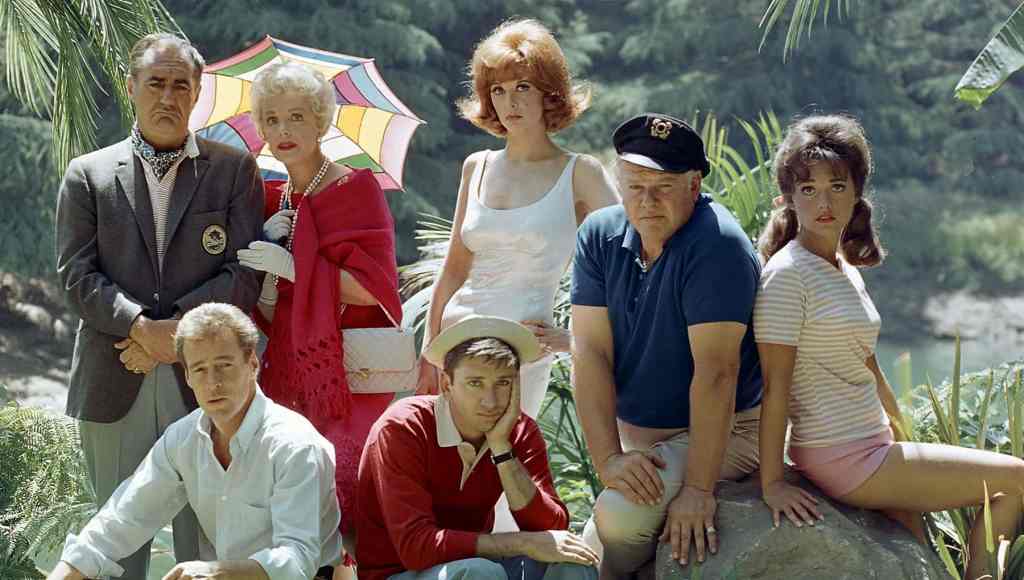
Consider the classic TV show “Gilligan’s Island,” which its creator, Sherwood Schwartz, referred to as a social microcosm. It featured seven characters, each representing a different socioeconomic position. Gilligan and the Skipper embodied the working class, while the Professor symbolized academia.
Mr. and Mrs. Howell (the millionaire and his wife) represented the elite, privileged upper crust. Mary Ann, a girl from the heartland, brought an earthy, grounded perspective, and Ginger, the movie star, added a touch of glamour.
Gilligan’s Island creator Sherwood Schwartz called the slapstick-laden sitcom of the 60s a “social microcosm” because of the socio-economic makeup of the characters.
Shipwrecked on an island in the middle of the Pacific, the writers put these people in absurdly improbable situations where each demonstrated their own inherent characteristics, however unrealistically. That’s where the comedy came from, and it worked.
Of course, to suspend the disbelief and immerse the viewer into the cartoon-like world, the show generally left out more realistic issues in such a situation. Problems like food, water, clothing, and shelter only arose when a comedic lack of some basic survival needs drove the story. But that’s TV. What about in real life? Where do microcosms exist day-to-day?
Recently, I found myself at a family birthday party in a local bowling alley. The guest of honor was turning 18, and a lively group of teenagers had gathered around the scoring console, ready for a game. As the afternoon progressed, the pitcher of soda ran dry, and the pizza had disappeared. Hunger pangs set in. (Kids eat a lot, wow!) With nothing else to do, I volunteered to make a snack bar run, setting the stage for an interesting observation of a real-life microcosm.
It was a Saturday afternoon, and the place was packed. Nearly every lane was occupied. As I walked along the service area at the back wall, past the shoe rental and pro shop, I suddenly noticed how much real life was happening all around me, and it all registered in my mind with sounds.
When I first realized what I was listening to, I literally froze for a moment. A woman nearly collided with me as she hurried along, balancing a pizza, drinks, and bowling shoes. I was so surprised by how I felt at the moment that I was compelled to step out of the foot traffic, close my eyes, and just listen.
Amidst the chaos, I focused on individual sounds. I heard the familiar thud as bowling balls dropped onto the hardwood floors and the dull rumble as each raced down the lane. Finally, the unmistakable crash of the pins as the ball hit them or the disheartening clunk if it dropped into the gutter.
Above pin resets, hand dryers, and clanking ball returns were the sounds of people living life. This was the microcosm of the moment—celebrations, first dates, families, young, old, and everyone in between.
I opened my eyes, looked around, and tried to put sight with sound. More birthday parties, a small child, with a ramp and dad’s help, making her first attempt to roll the ball. Neither she nor her parents will ever forget that day. A couple of lanes down, several older women chatted and crocheted between frames. One of the women working on a large afghan appeared to be winning.
I was standing among people from many different walks and stages of life. They all had one purpose, albeit the motivations were different. Everyone was there to enjoy the game, be with family and friends, and create lasting memories.
Eventually, I had to complete my mission and get the food back to our group before the teenagers ate their own shoes. But I can still hear those sounds and remember all the life that was being lived on that one normal day at the bowling alley.
I hate thunderstorms. Some people find them relaxing, even romantic. Not me. Storms like that wind me into a sort of controlled anxiety. Growing up in the shadow of the 1974 Xenia Tornado, a thunderstorm always set me on alert, scanning the skies like Chicken Little, certain something terrible would swoop down and obliterate my world.
When I was a little kid, I put together an emergency kit and hid it under the basement stairway. It had a thermos of water, dehydrated ice cream (that gross, Neapolitan NASA museum stuff), a flashlight, matches, candles, and cans of soup. I know it seems silly now, but give me a break. I was like ten, and I thought I was being prepared.
I was always taught that knowledge was my best defense against fear. Over time, I educated myself about the meteorology surrounding tornados and the storms that spawned them. As I got older, the fear dissipated, eventually replaced by scientific understanding and respect. I wasn’t scared anymore. I even went on a couple of storm chases. But one rainy spring day, that newly minted resolve would be tested up close.
It was the spring of 1988, and I was a commuting college student. One afternoon, I’d just arrived home after class, and my parents were making a bedding delivery in the truck. I popped in a video and settled in with some takeout before starting my homework.
The weather had been threatening since mid-morning, and the afternoon brought even darker skies. Our house sat in the center of 25 acres, back a long lane, so it was very quiet there. I was sitting next to the open window in my bedroom, engaged in my movie when a massive clap of thunder and lightning nearly knocked me out of my chair. The power went out.
I went downstairs and out the back door to look at the sky. An ominous wall of clouds was closing in from the southwest. I hurried around the house and behind our barn, where I could see the livestock. Usually, when a storm approached, the cattle meandered down the hillside into the valley behind our house. That’s just where they were. Smart creatures.
Back at the house, I paused on the front porch step as the wind kicked up. Another bone-rattling clap of thunder boomed, and brilliant lightning illuminated the dark sky. That’s when I saw it. Rainwater ran into my eyes as I stood there motionless in the downpour. A small tornado spun down out of the sky like a crooked finger reaching for the ground.
It touched down, moved along the edge of our hayfield, and whipped up dirt, grass, and other debris as it intensified. Moving parallel to my position, the funnel picked up speed, crashed into one of my dad’s grain trucks, and shattered its old wooden sideboards into kindling.
I probably should have run to the basement, but I couldn’t move. Unconsciously, I fought my basic instinct and didn’t move. I wanted to see it. I needed to see it. I never imagined I would be so close and never felt threatened. It was oddly quiet. There was no freight train sound, as most people usually report; it was probably too small.
My ears popped as it passed, however. The funnel continued another quarter-mile, still moving along the field. It was as if a hidden puppeteer controlled it. The thing slipped across the road, narrowly missed a house, and blew apart a small horse barn. As quickly as it had appeared, it was gone, dissolved into the air. All was quiet.
I’m not sure how smart it was to stand there. I knew the tornado, however small, was dangerously unpredictable and could have changed course and come right at me. But sometimes, we just must face our fears and meet them head-on. I was never again afraid.
Since that day back on the farm, I’ve been close to at least three other tornadoes. I still do my best to be prepared. When shopping for my first house, I had only one deal-breaking requirement—a basement. I also have a little more in my emergency kit these days than a can of Campbell’s.
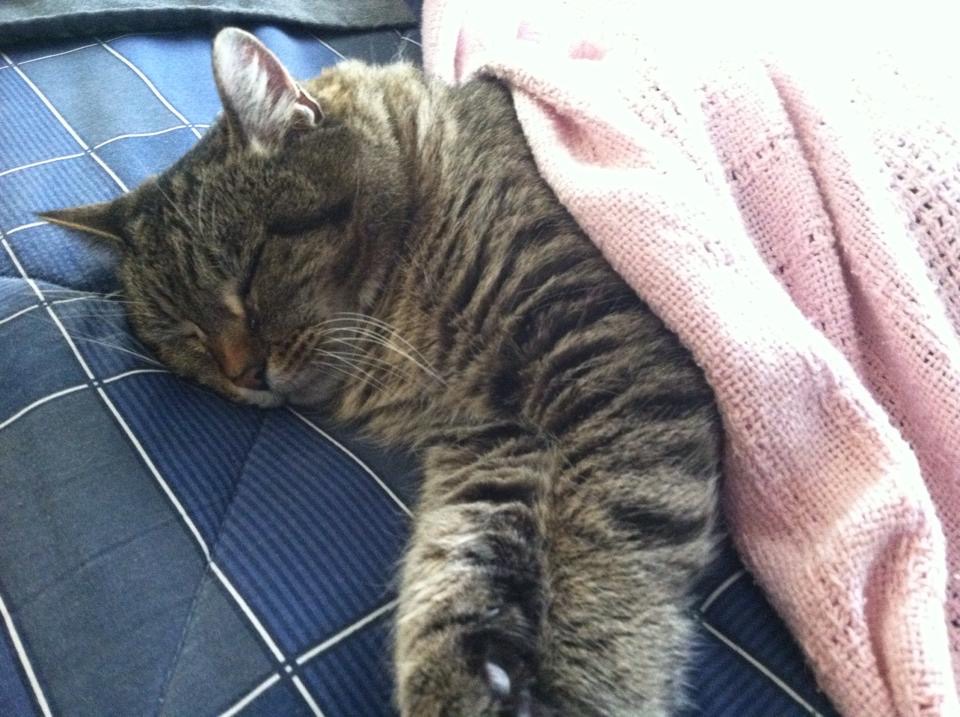
Nearly ten years ago, my chubby tabby cat named Bray was diagnosed with untreatable liver and kidney disease. He was 15 years old and had been in good health, but the level of pain and suffering he was going through was worsening. Knowing what was ahead, I was beside myself with grief.
On the farm, I learned not to get attached to animals because they weren’t there long. While we had livestock, we also had many barn cats, several different dogs throughout the years, and even a few ducks and peacocks. Of course, I had my favorites as I grew up, and some of the dogs and cats were friendlier and more social than others.
But this was different. Bray (a name cobbled together from the words “baby” and “gray”) was my buddy who saw me through some pretty rough times. He was my first indoor pet and had my attached garage as his condo – complete with climbing shelves and a loft.
Since I’ve worked at home for much of my career, Bray would be right there. He would wander in and settle on the recliner I used to keep in the converted bedroom I used as an office. Of course, he couldn’t be bothered with things like conference calls or answering the phone. After all, like other felines, he didn’t have an owner. He had staff – me. And that was fine.
Bray was always a little overweight. Born at my family’s farm, he was kind of a runt but quickly prospered once I brought him home. He no longer had to compete with six siblings. In fact, he just kept getting bigger. At his peak, he was about 18 pounds and, despite his size, all energy.
This is Bray doing one of his favorite things – 2008
He would chase me around the middle section of my house which circled through the hallways, living room, and kitchen. To this day, a strand of elastic string is tied to one of my closet doors with a plastic ball attached. It has a bell inside, and Bray spent what seemed like hours batting it around and holding onto it while gnawing on the elastic.
I used to laugh hard when he’d suddenly let go of the ball, and the elastic would snap back and knock the bell against the door. It was like someone went up behind him and said, “boo.” He’d take off running through the house, his claws struggling for traction as he ran across the slick kitchen floor.
But then Bray started losing weight. He wasn’t eating and was spending time hiding under the bed. For such a social animal, that was unusual behavior for him and sometimes a telltale sign that a cat is sick. We went to the vet, and sadly, his illness had come on pretty rapidly. Little could be done, and what was possible would be painful and expensive. Money was tight then, but regardless, at his age and stage of illness, a full recovery wasn’t likely.
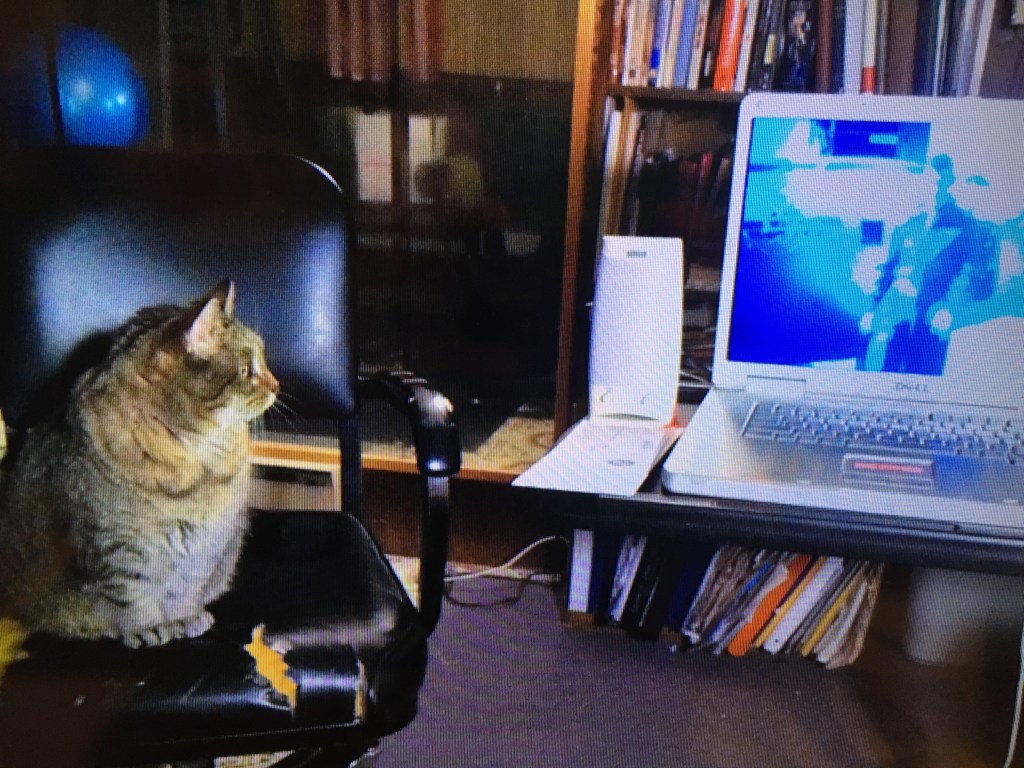
Sometimes, he liked watching movies on Gery’s computer. (2006)
As much as we anthropomorphize them, animals can’t reason as we do, so Bray would have just been in pain with no understanding of what was happening to him. That seemed cruel – to both of us. So, I had to let him go.
I was with both my parents as they left this life. I’ve had to put down cattle that were sick or injured. I even sat with my childhood pony’s head on my lap as he took his last breath after 25 years of companionship. But, with all of that, I’ve had nothing cut me so deeply as having to be the one to decide my little cat was going to die.
My reasoning tells me it was for the best. Even after a decade, I wonder if I did the right thing. Eventually, we have to accept that we chose compassion for the animals we cared for because they depended on us. They’re family and some of the choices we must make on their behalf are easy, others are devastating. As for Bray, I’ll never forget him, and I know there’s someone out there reading this and saying, “It was just a cat.” Maybe to you, but I know better.
According to recent surveys, nearly 80 percent of Americans have at least one social media account, and the total number of global users is nearly 5 billion worldwide. I happen to be one of the masses. I use it to promote my work and stay in touch with family, friends, and clients. But social media as a news source? I’m afraid not. Unfortunately, Pew Research reports that 6 of every 10 Americans rely on social media as their main resource for news. As a veteran freelance journalist, that’s an unsettling statistic.
I guess it wouldn’t be so bad if people followed qualified news sources, but that’s the exception rather than the rule. Most simply accept everything posted on social media as fact or truth (not the same things and more on that later). What’s worse, a great deal of that junk is created by “bots,” automated programs designed to post incendiary content and drive online traffic.
Facebook, Instagram, TikTok, and Twitter, or “X,” or whatever it’s called now, are not, I repeat, not news outlets. The most accurate way to describe social media is to compare it to the bulletin board at your local grocery. Anyone can post anything, unmoderated and unvetted. You, the consumer, can choose whether to look and believe what you see.
I understand that nowadays there is a growing tendency for Americans to mistrust news media. It’s even more prevalent among those belonging to extremist groups. Unfortunately, both the far right and the far left are not interested in objective facts. Their sole purpose is to twist and manipulate information to achieve one goal – chaos. They have no interest in journalistic integrity anyway.
I intentionally use the word “facts” instead of “truth” since the concept of truth is entirely subjective, and you shouldn’t find it in the evening news. To paraphrase Indiana Jones, if you’re interested in truth, take a philosophy class. Our news media should present accurate and objective reports, with no subjective notions of truth.
Speaking of facts, how about those headlines? Headlines shouldentice you with a piece of the story. After all, the whole idea is to get you to read. But extreme and fake news producers create misleading, AI-driven headlines. Algorithms determine what words are more likely to lead readers down an endless and manipulative rabbit hole of advertisements and more deceptive content.
Here’s a great example. Everyone loves Betty White. As so many of her contemporaries passed on, fans hoped she’d live to 100. Sadly, that wasn’t her fate. But a couple of years before she died, there was a headlined story going around social media that read, “Betty White dyes at home.” Do you see anything wrong with that headline? If you don’t, you need a vocabulary lesson, not a philosophy class.
The headline was written to trick gullible fans into clicking on the tragic tale of their beloved Betty’s passing. Eventually, they would realize it was a fake story about White “dying” her hair, at home. By then it was too late. Duped readers were bombarded with unstoppable pop-up ads and the website made a fortune from the pay-per-click fees they were charging advertisers.
Once again, the story wasn’t posted by any legitimate news agency, but it was well camouflaged. Yes, people should know the difference between the words, “dyes” and “dies,” but even the best proofreader may have missed that if they happened to be Betty White’s biggest fan. Fake and misleading news only gets traction because people share it, and the next story might not be a harmless joke.
You don’t need to fear social media but remember the bulletin board analogy. These platforms can be effective marketing tools. They can help friends and families stay in touch or offer an outlet for creative expression. But every day, social media is also being used to manipulate more people, disseminate misinformation, and spread hate, aggression, ignorance, and fear.
My advice is simple. Get your news from legitimate outlets – like this publication. Ultimately, you have the choice of whetherto believe what you see. Although social media may offer you a road sign on the information superhighway, you are still the onestill steering the car.
BEAVERCREEK, Ohio – March 12, 2024 – The seventh annual Rafi’s Amigos Golf Outing is scheduled for Friday, May 31st, 2024, beginning at 8:00 AM EDT, at Beavercreek Golf Club, 2800 New Germany Trebein Rd., Beavercreek, Ohio. For the second year, proceeds will fund a one-day, immersive experience at Air Camp for Junior Reserve Officer Training Corps (JROTC) students from three Greene County Schools. Full details are available at https://www.askrafi.com/events/7th-annual-rafis-amigos-golf-outing
José “Rafi” Rodriguez, Colonel (Retired) USAF, president of Rodriguez Financial Strategies, LLC, organizes and hosts the event. “I started Rafi’s Amigos Golf Outing to raise funds for causes dear to my heart, and I am grateful for the incredible community support,” Rodriguez said.
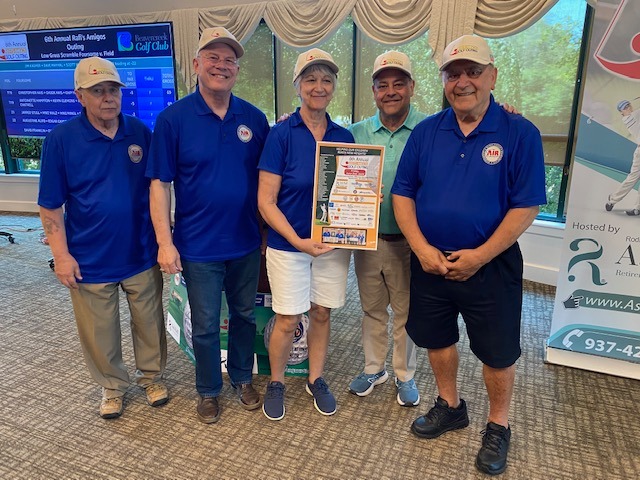
Jose “Rafi” Rodriguez (second from right) with representatives of Air Camp, who will host JROTC students benefiting from the golf outing.
Originally from Puerto Rico, Rodriguez joined the Air Force ROTC at the University of Puerto Rico in Mayaguez, where he was a distinguished graduate. After a 26-year career in the Air Force, Rodriguez retired as a senior officer while serving at Wright Patterson Air Force Base in Dayton.
Over the last six years, Rafi’s Amigos Golf Outing, which Rodriguez describes as a “scramble,” raised money for several regional organizations, such as United Way of Greater Dayton Area, and continues to grow. Last year’s event exceeded expectations by several thousand dollars, allowing 40 students and their instructors to attend Air Camp.
Air Camp again was a natural partnership given Rodriguez’s background, the region, and the goal—to support the youth of his community. Based in Dayton, Ohio, Air Camp, Inc. was founded in 2006 by Dr. Vince Russo and Dick Reynolds, Lieutenant General (Retired) USAF.
Russo currently serves as the organization’s President and Chairman. “Early on, we decided to use aviation as the learning medium because the real language of aviation is math,” he said. Our goal is to use aviation to help the students understand the importance of Science, Technology, Engineering, and Math (STEM) and inspire them to pursue careers related to those fields.” More information about Air Camp is available at aircampusa.org.
This year’s presenting sponsor is the White-Allen Auto Group / White-Allen Family of Companies in Dayton. Tim White is the president and grandson of the company’s founder. White explained why his company has supported the golf outing for the last several years. “When you’re dealing with the future of STEM education for the young members of society, that’s a wonderful mission to get behind.”
Rodriguez proudly chose “Rafi’s Amigos” because he wanted it to be where people could enjoy a community event for a great cause. “Amigos” is the Spanish word for ‘friends,’ I consider this an event where friends come together, old or new, to support a common cause in our community,” Rodriguez explained. “I hope people will come to support these future leaders of our country.”
The other day, I was sitting in a coffee shop when I overheard a conversation between four senior gentlemen at the nearby table. Based on their appearance, I guessed they were in their late 70s, active and clear-minded. The cold Ohio winter had them dressed appropriately in jeans, heavy walking shoes, sweaters, down jackets, and winter caps. These men obviously knew each other quite well and shared common interests.
It was not my intention to eavesdrop, but they were talking loudly enough you could pick up their voices from well across the shop. Anyone could see this meeting was a crucial part of their social life. One of them even mentioned how much he enjoyed getting together regularly and noted how much he learned from the others.
In fact, they all seemed to relish the conversation, which covered a wide range of topics from sports to live theater. I found a brief interaction they had about The Phantom of the Opera of particular interest. While some topics, like the state of American politics, sparked more spirited discussion, they remained respectful and considerate towards one another.
The Algonquin Roundtable
At one point, one of them told a detailed story about how he’d been working on the roof of his home. Suddenly, he found himself stranded up there because his ladder had fallen. He called out for his wife, but she apparently didn’t hear, which left him there for some time. Fortunately, all worked out for the best, and through the laughter, his comrades were giving him a good bit of grief about fooling around on a roof “at his age.” I imagined their adult children giving each of them the same speech in a more serious tone, only to be ignored later.
We occupied one corner of the shop for about an hour, though I believe my subjects had been there for a while before I arrived. They’ll never know it, but they gave me back a moment from my childhood.
When I was around 10, Dad occasionally took me for breakfast at the small diner where my mother waitressed (her word). Early each morning, a group of movers and shakers from our tiny farm town arrived, one at a time, and occupied the same corner booth.
The pack was usually a mix. Among them, you might find some combination of the local banker, a town doctor, the police chief, the undertaker, the barber, or even the mayor. As they drained one pot of Joe after another, they discussed whatever came up, solved all the world’s problems, and, of course, kept those solutions to themselves. If only they’d just told someone how to do it. It was like the small-town equivalent of the Algonquin Roundtable.
That gathering was far more than social, and the booth’s occupants probably weren’t as ancient as they would have appeared to me when I was a boy. But this was a staple for all of them, a necessary gathering of the minds that continued until each of them was too elderly or infirm to attend.
These days, you might see a mix of people, men, and women, even varying ages, who do the same thing – a regular gathering with no other purpose but to share stories, discuss world affairs, or just complain about the weather. Whatever it is, it’s good for the psyche – and your overall health.
There are countless studies on the benefits of socialization as we get older. Strangely enough, many seniors, either due to depression, their living situation, or choice, often prefer isolation. My parents weren’t big socializers, though my mom enjoyed family parties and time with her siblings. Dad, not so much. Their “roundtable” consisted simply of family and a few close friends. I’d say I’m more like Dad, though I hope a little less self-isolating. I’ve never been particularly comfortable in social situations.
However, I have managed to learn how to deal with my own social anxiety. I think I’m better at socializing than I used to be. As a child, I wouldn’t have understood the importance and value of the coffee shop roundtable to those who were there. But as I rocket towards 60, I’m starting to understand and appreciate the importance and necessity of those connections.
TCN clients can now access SUN Clinics on Tuesdays from 1pm to 4pm and Fridays from 10am to 1pm.
Bellefontaine, Ohio – January 9, 2024 – TCN Behavioral Health Services, Inc. announces the opening of its second See U Now (or “SUN”) Clinic on Tuesday, January 9, 2024. The clinic, located physically in the Bellefontaine office at 118 Maple Avenue, will be open weekly on Tuesdays from 1pm to 4pm and can see clients both in person and via telehealth.
TCN’s first SUN Clinic opened on January 6, 2023 in TCN’s Xenia office, and in 2023 provided 434 services to 262 clients both in person and via telehealth. The SUN Clinic is intended to serve clients without a prior appointment as their need arises. A Clinic Coordinator works with the client to choose the services they wish to receive from a multi-disciplinary team of providers including nursing, psych, MAT, primary care, substance use and mental health counseling, case management and peer support. The Clinic accepts all payment options including Medicaid, Medicare, private insurance, and self-pay. As with all TCN services, local board funding is available for clients who qualify.
“TCN is always proud of our innovative practice to meet clients where they are, and the SUN Clinic is another example of this,” says TCN CEO Lori Strobl. “SUN’s motto is “nothing about you, without you” and its mission is to empower the client to be in control of their healthcare and truly partner with their clinical team.”
“We are very excited to welcome this new model of behavioral health care to our communities,” says Dr. Adam Sorensen, Executive Director of the Mental Health Drug & Alcohol Services Board of Logan & Champaign Counties. “TCN’s SUN Clinic approach has a proven track record, and it is a perfect example of TCN’s commitment to offering high-quality, person-centered care. We appreciate TCN’s ongoing partnership and willingness to be innovative with our shared goals of improving access and quality of care in our neighborhoods.”
Founded in 1990, TCN Behavioral Health Services, Inc. is a comprehensive behavioral health agency dedicated to improving lives by providing clinically excellent and accessible behavioral health services. TCN provides mental health, substance use and psychiatric services for adults and youth in Logan and Champaign counties. For more information or to donate to TCN call (937)376-8700 or visit http://www.tcn.org.







 The Jamestown Comet