Local News & Commentary Since 1890.

Posts Tagged ‘healthcare’

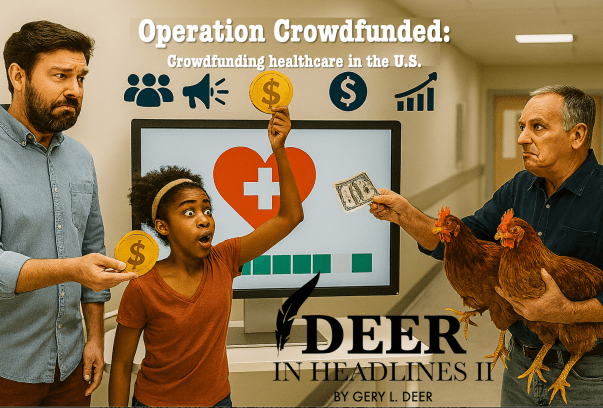
Operation Crowdfunded

In Health, Opinion, Politics, Uncategorized on September 23, 2025 at 2:58 pm

Deer In Headlines II

By Gery Deer

The United States of America: the land of innovation and opportunity, where billionaires launch rockets for sport and algorithms decide your mortgage rate. So, it shouldn’t surprise anyone that Americans now turn to crowdfunding to pay for basic healthcare. Not as a quirky side hustle, mind you, but as a legitimate strategy for survival.

This year, roughly 1.8 million Americans will be diagnosed with cancer. The average cost of treatment? A cool $183 billion. That’s not per person, of course—just the collective tab. But when you break it down, individual patients often face six-figure bills, even with insurance. Meanwhile, nearly 70% of seniors will require long-term care, either at home or in a facility. And with government assistance programs shrinking faster than a hospital gown in the dryer, many are left to fend for themselves. Each year, more and more are turning to crowdfunding.

According to statistics published by Astute Analytica, Americans raise more than $3 billion annually through platforms like GoFundMe, GiveSendGo, and others—most of it for medical expenses. While that might seem a heartwarming testament to community spirit, it’s simultaneously a tragic commentary on our national priorities.

When you live in the “richest” country on Earth and someone in a white coat says the words, “You have cancer,” but your best hope for affording chemotherapy is a well-written plea and a viral social media post, something’s gone horribly awry.

Let’s compare this to the more “official” solution: Health Savings Accounts (HSAs), tax-advantaged accounts tied to high-deductible insurance plans. In theory, they help you save for medical expenses. But their nature pretty much excludes the people who actually need the money.
HSAs require disposable income to fund. Plus, they’re capped at a few thousand dollars per year. That’s great if you’re buying allergy meds or paying for a routine checkup. But without some serious money tucked away, you could still be in trouble if you need something like an appendectomy, for example, which averages around $13,000.

Crowdfunding, on the other hand, offers flexibility. You don’t need to qualify for a high-deductible plan. You don’t need to navigate IRS rules. You just need a compelling story, a few sympathetic friends, and the ability to market your misfortune.

Imagine a future where every citizen maintains a personal healthcare fund online. You could even petition the IRS to classify seniors and disabled individuals as not-for-profit entities. That way, when a billionaire donates to your cancer treatment, they get a tax write-off. It’s a win-win. You get a shot at survival, and they get to feel philanthropic without disrupting their yacht schedule.

Of course, this would also stimulate the tech economy. Crowdfunding platforms would flourish, transaction fees would soar, and a new generation of entrepreneurs would emerge to optimize the monetization of the already bloated medical crises. But there are challenges – big ones.

If everyone’s running a campaign, how do you stand out? Do you offer donor perks? “Contribute $100 and receive a personalized thank-you video from my hospital bed.” Do you hire a public relations firm to promote your gallbladder surgery? “Compassion competition” can become fierce. Those without strong social networks or digital savvy would likely struggle to raise anything at all.

With so many medical coverage decisions being made in the board room rather than at the bedside, this model has its appeal. It’s more transparent than insurance billing, more immediate than government aid, and more democratic than corporate healthcare.

Some say healthcare should be a right, not a raffle – I tend to agree. It’s absurd that anyone should have to beg for insulin or auction off their belongings to afford a colonoscopy. But in a country where tax breaks for billionaires are considered sacred and universal healthcare is viewed as some kind of socialist takeover, absurdity might just be the most realistic and successful option.

So sure, let’s embrace the irony of a system where survival depends on storytelling and digital advertising prowess and crowdfund our medical care. We will just have to hope that, someday, we’ll look back on this era not as a failure of policy, but as a resourceful bureaucratic bypass—when Americans took their health into their own hands, one donation at a time.

Mr. Deer Goes To Washington

In Health, Local News, National News, Opinion, Science, Technology, Uncategorized, World News on February 28, 2025 at 4:55 pm

Deer In Headlines II

By Gery Deer

According to the National Kidney Foundation, more than 20 million Americans are affected by renal (kidney) and urological conditions. It goes on to say that millions more, currently unaccounted for, are at risk. The causes range from congenital issues to diseases that affect the urological system.

I happen to be in the category of the former. In March, I’m joining a couple of hundred other patients, caregivers, and advocates to meet with congressional representatives about more support to care for, as I will explain in my case, adult patients with congenital urological conditions.

I was born with a rare condition known as bladder exstrophy. It affects about 40,000 people worldwide, and only a few specialty hospitals in the United States specialize in the predominantly pediatric component of treatment. As a child, I was treated in Dayton, Ohio, by some of the best pediatric surgeons in the country who were, it’s safe to say, figuring it out as they went. But they did a tremendous job, and here I am.

From just a few hours old, I was looked after by a contingent of physicians and specialists in what I’ve come to refer to as the “pediatric bubble.” My healthcare providers communicated with each other and consulted on various issues as they perfected this procedure or completed that surgery. As complex as it might seem, my parents were kept well-informed and had direct lines of communication with my general practitioner and my surgeons.

Unfortunately, once you hit about 21 or 22 years old, your pediatric bubble bursts and you are unceremoniously dumped into the world without proper adult urological care. Fortunately, my pediatric surgeon handed me off to someone he trained with, an adult urologist who looked after me for 25 years until his recent retirement. For the first time in my life, I was without a specialist, and my particular problem created a barrier to finding new care.

This situation is familiar to patients with many congenital conditions that carry over into adulthood. To maintain continuity of care, most continue to see their specialists for decades, long after the primary reconstructive surgeries are complete. Thankfully, I was left with few residuals as I grew up, but maintenance needs require somewhat more specialized attention. In addition, as patients age, their physicians must know something about the situation.

Bladder exstrophy, or BE, like many other congenital problems, requires a specific set of surgical skills, reconstructive knowledge, and urological and renal expertise. There is also a critical shortage of practicing urologists. All of this, combined with the potentially long-term commitment to the patient, leaves most urologists choosing not to treat BE patients, and therein hangs the problem.

Enter the Association for the Bladder Exstrophy Community, or A-BE-C, and its newly formed Adult Patient Advisory Council (APAC), of which I am an organizing member. While A-BE-C’s global mission began as primarily pediatric, the advisory council was established to provide resources for adult patients. The goal is to ease the transition from pediatric BE care into adulthood. That’s where me and my plane ticket to Washington, D.C. come into the story.

I’ll represent our organization at the American Urological Association’s annual patient advocacy summit. It’s an opportunity to share these concerns and potential solutions with congressional representatives.

I hope they’ll listen to some of my ideas, including a subsidy or tax credit funded to help encourage young doctors to specialize in urology and, even more so, help them to dedicate some of their practice to adult BE care. With all the tragically unsympathetic, uninformed budget cuts, I wish I was more optimistic. But I will still try, and you may be able to help.

Patient advocacy isn’t about awareness and support. It’s about action. Sadly, urological problems are generally the subject of lousy humor, ignorance, and ageism. But I assure you, there’s nothing funny about it for the patients and caregivers. For them, it’s a daily struggle to maintain proper care.

You can help by following A-BE-C on social media and sharing educational content. You can also contact your congressional representatives to remind them about this. These patients don’t need more research. They need qualified specialists and the peace of mind that their cause matters.

Health Insurance Hostility

In Crime, National News, Opinion on December 13, 2024 at 2:31 pm

Deer In Headlines II

By Gery Deer

The shocking murder of the UnitedHealthcare CEO, 50-year-old Brian Thompson, has had a ripple effect on public opinion towards health insurance companies. As information continues to unfold about the alleged killer, Luigi Mangione, it’s becoming clear that the man’s motivation was likely related to coverage disputes.

But what does this mean going forward? Has this man’s terrible action awakened scrutiny toward all health insurance companies, or was it the act of one disturbed individual who felt his only recourse was to take matters into his own murderous hands? We may never know the answer to the latter, which begs even more questions.

Is it likely there will be copycat crimes? Is the public’s temperature so high towards these companies that the shooter was merely the first to act on what countless others may have imagined? Many insurers seem to think so and have begun removing senior staff members’ names, bios, and photos from company websites to prevent another such incident.

Since the moment the tragic event was reported, social media buzzed with emotional speculation. Anger, frustration, and, strangely enough, sympathy towards the alleged killer have emerged from many who have felt the sting of corporate healthcare.

Some of the reactions to this man’s horrific death were downright grim. One example of such dark commentary went something like this, “Did he die quickly, or was he waiting to see if his insurance would cover treatment?” Most were worse. Many were unrepeatable.

I would caution anyone who sees this terrible act as some sort of statement against the status quo of health insurance in our country. Nor should you fit the assailant with a white hat or call him Robin Hood. Nothing could be further from the truth. Social banditry aimed at an unimaginable public slaying isn’t going to resolve the health insurance crisis any more than political pundits can.

It’s unlikely that this event will alter the operational procedures of health insurance companies in any way. There’s little argument against the idea that the American healthcare system is beyond disastrous. Sadly, there is simply too much money on the line at the top of these corporations for any real action that might benefit the consumer. If anything, premiums continue to rise while more and more claims are rejected.

Since 2019, average family healthcare policy premiums have increased as much as 24%, with individual coverage not far behind. Even if you can afford coverage, there’s a good chance your claim – regardless of the necessity of treatment – will be denied. A Keiser Family Foundation study reported that health insurance companies denied an average of 17% of claims, with some reaching as high as 49%, even for in-network care. In short, it’s not getting any better, and there are no signs that this incident will move that needle in a positive direction.

There’s also the problem of sympathetic influencers and media whipping up a potentially dangerous movement akin to what we saw at the U.S. Capitol on January 6. This time, instead of political ideology to light the fire of unrest, it’s something more people can relate to. We’ve all had claims denied or medical bills shockingly higher than expected due to “out of network” notices or other corporate nonsense. Human suffering can be a highly motivating reason to take to arms, and now we’ve seen the alleged result of one disturbed individual’s response to it.

Our system is in bad shape, no question, yet this isn’t how to resolve it. In my opinion, we’re aiming at the wrong target (no pun intended). The biggest problem isn’t the insurance companies but the colossal and unregulated healthcare costs they’re meant to mitigate.

Billions of dollars pass through hospital doors daily, and the government allows it. They’ll break up Google or Microsoft over trivial anti-trust issues. But even suggesting that some behemoth healthcare system should have its revenue capped sends Congress into a frenzy.

Why? Money. Millions in donations, lobbying cash, and back-door deals on both sides of the aisle will forever prevent any reduction of the staggeringly high costs we pay for healthcare. Unless that changes, we’re perpetually at the mercy and living the network of the stockholders of these massive insurance conglomerates.

TCN Behavioral Health Announces Opening of Second See U Now (“SUN”) Clinic

In Charities, Dayton Ohio News, Health, Local News, psychology, Uncategorized on January 11, 2024 at 9:07 am

TCN clients can now access SUN Clinics on Tuesdays from 1pm to 4pm and Fridays from 10am to 1pm.

Bellefontaine, Ohio – January 9, 2024TCN Behavioral Health Services, Inc. announces the opening of its second See U Now (or “SUN”) Clinic on Tuesday, January 9, 2024. The clinic, located physically in the Bellefontaine office at 118 Maple Avenue, will be open weekly on Tuesdays from 1pm to 4pm and can see clients both in person and via telehealth.

TCN’s first SUN Clinic opened on January 6, 2023 in TCN’s Xenia office, and in 2023 provided 434 services to 262 clients both in person and via telehealth. The SUN Clinic is intended to serve clients without a prior appointment as their need arises. A Clinic Coordinator works with the client to choose the services they wish to receive from a multi-disciplinary team of providers including nursing, psych, MAT, primary care, substance use and mental health counseling, case management and peer support. The Clinic accepts all payment options including Medicaid, Medicare, private insurance, and self-pay. As with all TCN services, local board funding is available for clients who qualify.

“TCN is always proud of our innovative practice to meet clients where they are, and the SUN Clinic is another example of this,” says TCN CEO Lori Strobl. “SUN’s motto is “nothing about you, without you” and its mission is to empower the client to be in control of their healthcare and truly partner with their clinical team.”

“We are very excited to welcome this new model of behavioral health care to our communities,” says Dr. Adam Sorensen, Executive Director of the Mental Health Drug & Alcohol Services Board of Logan & Champaign Counties. “TCN’s SUN Clinic approach has a proven track record, and it is a perfect example of TCN’s commitment to offering high-quality, person-centered care. We appreciate TCN’s ongoing partnership and willingness to be innovative with our shared goals of improving access and quality of care in our neighborhoods.” 

Founded in 1990, TCN Behavioral Health Services, Inc. is a comprehensive behavioral health agency dedicated to improving lives by providing clinically excellent and accessible behavioral health services.  TCN provides mental health, substance use and psychiatric services for adults and youth in Logan and Champaign counties.  For more information or to donate to TCN call (937)376-8700 or visit http://www.tcn.org.

Ignorance: A leading cause of illness in America

In Children and Family, Education, Health, Opinion, Science, Uncategorized on July 14, 2014 at 6:00 pm

DIH LOGOAhead of heart disease and cancer, could ignorance be one of the leading causes of serious illness in the United States? It seems as though, regardless of the facts related to disease prevention, there are literally millions of people who simply choose to take no notice.

First, a definition of the word, “ignorance” as it is used here, so as not to intentionally offend anyone. Ignorance refers mainly to a lack of understanding, education or information. Most of the time, the deficiency of knowledge is unintentional, resulting from inexperience or an educational history lacking in a specific area. However, ignorance can also result from a choice, a conscious decision to disregard certain information, in this case regarding health.

Excessive alcohol consumption, for example, is the fourth leading preventable cause of death in the United States, according to the Centers for Disease Control and Prevention (CDC).  From 2006-2010, the agency reports, excessive alcohol use resulted in, “approximately 88,000 deaths and 2.5 million years of potential life lost annually during that period, costing an estimated $223.5 billion.”

The CDC also reports that nearly 20 percent of Americans smoke, that’s around 43 million people. With nearly one in five deaths now caused by smoking-related illness, why would anyone consciously choose to continue such a disgusting and polluting habit? Denial of the necessity of childhood vaccines may also contribute to preventable disease contraction.

Parents who refuse to vaccinate their children expose them, and those around them, to potentially life-altering illness ranging from measles to polio (poliomyelitis). Because of polio’s recurrence in several African countries, in May of 2014 the World Health Organization declared the resurging polio threat an international emergency stating that it is, “one of the world’s most serious vaccine preventable diseases.” Many experts fear that, if unchecked, it could be brought to the United States and make a devastating comeback due to a fall in newborn vaccinations.

Food is another contributing problem to preventable illness in the United States. Well-educated, intelligent people commonly turn a blind eye to the facts related to diabetes, obesity and cholesterol-related heart disease. More often, Americans tend to choose potato chips and soda pop over a fresh apple or glass of unsweetened fruit juice.

poor choicesIt is one thing when people don’t know about these issues, but it’s quite another if they simply refuse to pay attention or take action. Billions of dollars is spent every year caring for those who may never have become so ill had they taken some basic, precautionary steps.

Of course, regular contradictions between those giving advice on better health and their own behavior also inhibit the effectiveness of patient education. Many healthcare workers are just as guilty as the general public; perhaps even more so because they should, by profession, know better. Why should a patient listen to the recommendations of their healthcare provider if he or she ignores the same information?

How many nurses, doctors and staff are readily seen smoking outside a hospital or other healthcare facility? Logically, it’s hard to grasp how people can work daily around people suffering from diseases that might have either been prevented or mitigated and not take that knowledge to heart for their own health.

In some cases, moderation can help reduce a person’s risks; eating less fat, cutting back on sugar, and limited indulgence in junk food will certainly make a difference. But there is no safe amount of smoking or recreational drug use. It’s all deadly, one cigarette or 50, the body just wasn’t meant to have to process that kind of toxic material day in and day out.

The bottom line is that any reduction in positive health will compromise the body’s ability to fight off disease. When people become ill, they can no longer work, contribute to society or provide for their families. Quality of life suffers for the individual and all of those around them. Ignorance of facts and undisputed medical advice can take a terrible toll on a person – and everyone around them.


Gery L. Deer is an independent columnist and business writer based in Jamestown, Ohio. More at http://www.gerydeer.com.

Is this your new site? Log in to activate admin features and dismiss this message
Log In