Local News & Commentary Since 1890.

Posts Tagged ‘Fairborn Daily Herald’

700 Words

In Entertainment, Literature, Local News, Media, News Media, Opinion, Uncategorized on April 7, 2023 at 5:05 pm

Deer In Headlines II

By Gery L. Deer

A few weeks ago, I appeared on a local television program to promote this column. During the 3-minute interview, the host was surprised to learn that Deer In Headlines II is – and has always been – exactly 700 words in length.

Unfortunately, limited time prevented a deeper dive into such a precise word count. But the conversation made me realize, though you may be a regular reader, you may not know much about how all this works. So, here’s a look at how it all comes together.

First, riddle me this. What’s the difference between a writer and a pizza delivery person? The answer – a pizza delivery person can feed a family of four. Yes, I know, terrible joke, but not entirely inaccurate.

I’ve heard it said that writing for a living is like having homework every day for the rest of your life. That wasn’t far off either. Writers are romanticized in movies and TV. We’ve all seen images of the Hemmingway wannabes, huddled over an old IBM Selectric (go look it up), pecking out the next great American novel. It’s all so dramatic – and all such nonsense. I’m sure some see themselves that way, we scribes can be a self-absorbed lot for sure. But that is certainly not me.

I’m not a novelist, though I have a couple of manuscripts in a drawer somewhere. My work is focused on non-fiction, freelance journalism, copywriting, and public relations. Sometimes I do get to work in my fuzzy slippers, but most days I go to an office and sit at a desk. I also traded in my manual typewriter for a MacBook Pro – much easier to fit in a messenger bag.

I am the founder and creative director of a public relations and media production firm and, although I might own the place, I’m not my own boss. That’s a load of nonsense. I have a dozen bosses, and they all pay my salary – they’re called clients. When I’m asked, “Are you a professional writer,” the answer is a resounding yes, though it didn’t start that way.

In college, I was an engineering and computer science student but worked for my college newspaper as a staff writer, eventually earning the senior editor position. I even stayed on after graduation to handle the summer editions. My coursework always included English composition, communication, and classical author studies like Charles Dickens and D.H. Lawrence.

When I started the original Deer In Headlines, some 15 years ago, my inspiration came from the news. Today, that inspiration comes from people, their struggles, achievements, interests, convictions, and feelings. Most of the time it all starts with a tiny glimmer of an idea; that word, or phrase that just won’t leave me alone. As it becomes something more substantial, I write down what your grade-school English teacher might have called, “the main idea.” Oddly enough, that often becomes the headline.

Then I sit down with my laptop, or sometimes just paper and pencil (not a pen), and see where the idea takes us. I say “us” because you, my audience, are there with me – following the words as they paint a picture of my thoughts and feelings about a subject that I hope will give you food for thought, inspiration, hope, or whatever might help you at that moment.

I will never use an AI (artificial intelligence) writing program. Because, if my work is to have meaning, there must be a human mind and heart behind the keyboard. When you read this, what you get is all me, like it or not.

Before I close, I don’t want to leave you without answering the original question. Why 700 words? I wish I could give you some deep, philosophical, or even technical answer. Within the first year, the original DIH series just worked out and it became a clear goal each week. It also fits nicely in the print layout, and you can easily read it in just over 2 minutes, then get on with your life. But I hope you take away something useful out of these 700 words every week and please know that I thoroughly appreciate your time and attention.

What’s your superpower?

In Opinion, psychology, sociology, Uncategorized on March 31, 2023 at 4:22 pm

Deer In Headlines II

By Gery L. Deer

Look, up in the sky! It’s a bird, it’s a plane! It’s … you? Believe it or not, we all have a superpower, sometimes more than one. Our superpowers are talents, our inborn abilities, enhanced by education, practice, and life experience.

When you ask a kid what superpower they’d like to have, most say, the ability to fly. The next most popular response is super strength, followed closely by X-Ray vision. I honestly don’t remember what I wanted my superpower to be when I was a child, but if you ask me now, the answer would probably be different. As with many things, our perception and understanding of such concepts tend to change as we get older and, theoretically, wiser.

Recruiters often ask the superpower question to screen job candidates. Whenever I was asked this question in an interview, I always thought it was a trick, some kind of nonsense question to throw you off guard. But the question can actually serve several purposes.

In one instance, the interviewer is trying to learn how well you understand your own strengths and weaknesses. Your response will require you to think more creatively about the question and that, in itself, may demonstrate something about how your mind works.

On the other hand, a recruiter may want to know more about what you’d really like to do and whether you’re suited to a particular job. If you answer, “flying,” for example, you’re probably someone who is willing to take a risk, work to the best of your ability, or enjoy looking at things from different perspectives.

If superspeed is your choice, then the recruiter might conclude that you have a good sense of time management and efficiency. But it’s important to be as honest and clear about your answer as possible and choose the simplest response. There are probably deeper, more involved psychological reasons for the question, but that’s a general idea.

Apart from the human resources application of the concept, the fact is, each of us really does have a unique set of gifts, innate talents, or, for want of a better word, superpowers. Every day we either exploit or ignore those abilities, choosing one way or the other based on what life presents.

Some people learn what their superpowers are at an early age. But for others, identifying your superpower can be a challenge. Talent is often unquantifiable because it might not be academic, artistic, or fall on any other measurable scale. Talents based on emotion, originating from psychological awareness, or driven by faith may not have obvious applications. But with a little effort and some guidance their value will be revealed.

A highly empathetic person might make a good counselor or nurse, while people who are good at deduction would be great problem solvers, police officers, or researchers. Unfortunately, not all applications of these talents are productive. Someone who understands how to manipulate the emotions of others could easily take advantage of them in more nefarious ways. Confidence artists, or “con artists,” for instance, use these skills to scam money from unwitting victims.

Oddly, I was one of those people who had a tough time locating my own superpowers. From a young age, my parents encouraged me to follow my interests, whether it was artistic, academic, or musical. While I had some innate talent in various areas, I wasn’t always interested in the things that I did well.

It wasn’t until I was well out of college that I found where my superpowers resided. The thing is if we’re growing, so are our talents, always improving and adapting to what life throws at us. What I think my superpowers are today would likely not match what I might have wished for as a kid.

It took me a long time to, first, be comfortable enough with who I am to allow myself to appreciate my talents. And then learn to apply them to help myself, my family, and my community. Just remember, there’s no right answer to, “What’s your superpower?” It’s a never-ending battle for personal truth, self-confidence, and the American dream, whatever that is to you. Just do your best and remember that with great power, comes great responsibility.

Life and Grief

In Health, Local News, psychology, Senior Lifestyle, Uncategorized on March 24, 2023 at 9:10 pm

Deer In Headlines II

By Gery Deer

Most people don’t have to grieve the loss of a loved one until after that person has passed away. But family caregivers who look after someone with a degenerative disease like Alzheimer’s, ALS, or Parkinson’s, may face grief in a very different, and sometimes far more painful way.

A psychologist will tell you under normal conditions, people dealing with grief will progress through a number of stages: Denial, Anger, Bargaining, Depression, and finally Acceptance. We generally get hung up on one or more along the way until we can emotionally work through them, either on our own or with professional help.

I first learned the science behind grief in high school and college psychology classes, but not like I would understand it later in life. Up to that point, I had experienced grief like most people – by dealing with the death of a family member, the loss of a job, or whatever life tossed my way. But later, while caring for my mother as she declined from the ravages of Alzheimer’s disease, I was struck with how differently grief manifests itself for someone whose loved one is slowly being ripped away.

In my experience what makes grief different for a caregiver is how the grieving process seems to reset as a disease like Parkinson’s progresses through various stages. As your loved one suffers physical and cognitive decline, your understanding of their status has to be adjusted accordingly.

For example, early on, my father could no longer bathe himself and, not long after, even taking a drink from a cup was a major challenge. You say to yourself, “OK, this is how it’s going to be now,” once you’ve accepted some level of decline. You grieve the loss of the previous status, knowing things are getting worse.

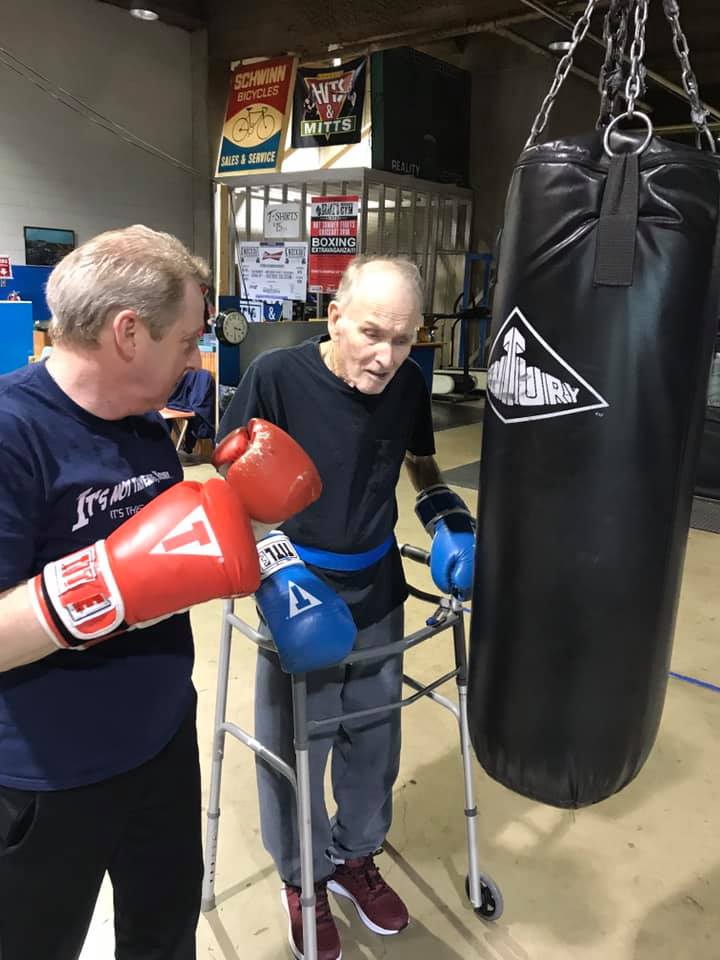
Gary Deer Sr. attends a Parkinson’s boxing class with Gery at Drake’s Gym in Dayton, OH in 2019.

Five minutes later, you notice something else that’s gone downhill or altered in some way. There is no set rate for when to expect these changes in your loved one’s health and they can come on rapidly. That means you barely get the chance to wrap your head and emotions around each state of change before you’re dealing with three more simultaneously.

Knowing there is no happy ending at the end of this story, you face constant adjustment and acceptance which are exhausting both mentally and emotionally. All this turmoil adds up to something called, “anticipatory grief,” which is exactly what it sounds like; you’re mourning the person as the disease progresses, anticipating their eventual death.

None of this is generally a conscious thought process. After my mother’s passing, I understood it better, and that, at least, helped me cope with my father’s decline several years later. But until I realized all of this, I was just angry all the time. I was frustrated at why dad couldn’t remember how to sit down in the a properly, or just use a spoon, but 10 minutes earlier it hadn’t been a problem. Things literally changed on the fly.

In my case, the difference between caring for Mom vs. Dad is that my mother’s Alzheimer’s disease removed any expectation in my mind of her being cognitively aware enough to help herself. She had no clue what was going on around her, so it was slightly easier to adjust because she didn’t push back. Dad’s mental state was usually pretty good, so he pushed back – a lot. And I kind of got it; it’s tough to spend your life being the one taking care of everyone else and suddenly you feel like a helpless burden.

It really bothered my dad to need help with anything, like standing up from a chair, or that we had to restrict things like coffee because the caffeine aggravated his symptoms. As his condition changed, we tried to counter each new phase with alternative ways to keep him comfortable and safe while dealing with altered symptoms.

I don’t know how to tell you to deal with anticipatory grief. Everyone copes differently. Being aware of it can help a bit. If you’re caring for someone who is slipping away, spend what time you can with them. Be there with them, be present, and be kind to them and especially to yourself.

PUBLISHER NOTE: If you or someone you know is a caregiver, visit http://www.theoldnerdinthegym.com for resources, a podcast, and other information that might help.

Great Expectations

In Local News on March 17, 2023 at 8:54 am

Deer In Headlines II

By Gery Deer

Everyone has expectations and they can have a profound effect on how we perceive reality. Unmet expectations can lead to disappointment, hurt feelings, and even anger. Conversely, those we achieve can leave us feeling fulfilled and successful.

Before I go on, it’s important to clarify that expectations are very different from “hopes.” Expectations depend on the actions or responses of others. Hope does not, it’s entirely internal. While they do often occur simultaneously, they are generated by very different aspects of our emotional state. And, since we are dealing with emotions here, there is no standard – expectations affect everyone differently.

Some lead us to create standards by which we expect ourselves and others to live, with the bar raised so high as to be completely unreachable. Sometimes our expectations are entangled with our personal aspirations, either of which can set us up for success, or crush us in the event of failure.

Expectations affect nearly every aspect of our lives, from our professional careers to personal relationships. What we want out of those experiences is often laid out in our minds well in advance. One of the big problems with expectations in any sort of relationship is that everyone has them, and most of the time they reside only in the mind, unshared.

When someone has unspoken expectations of you they set themselves up for disappointment. Not only is it unfair, but also unrealistic. That person is creating the potential for hurt feelings and will likely blame you, even if you did nothing to warrant the ill will. This can be observed when people have unrealistic expectations of how their life should be because they constantly compare it to something else, real or fictional. 

Take, for instance, someone who thinks the experience of dating or marriage should be like something they saw in a romantic comedy or novel. No question they’re in for one heck of a disappointment. But it happens, to men and women alike. Why? In this case, it’s unlikely any of those expectations are ever voiced because let’s face it, they would sound ridiculous.

Creating an environment for unrealized expectations is common in romantic relationships, but also among coworkers, and even between parents and children. Parents may very well inadvertently pass their own life expectations along to their kids. Those who have unfulfilled dreams could, and often do, however unknowingly, lay those expectations on their children.

Imagine a mother who had been a star athlete in high school and college but, for whatever reason, never made it to professional sports. She might, without meaning to, end up pushing her son or daughter into that same field, feeling as though she is simply sharing a positive experience, but instead harboring expectations of the child obtaining that which she failed to achieve. Living vicariously through them, she rediscovers her youth, hoping this time, for better success, even if it’s not hers. 

I was introduced to Charles Dickens’s classic novel, “Great Expectations,” in my sophomore year of high school (thank you Miss Fasbinder).  It is a compelling tale molded around the ambitions of a young orphan named, Philip Pirrip, otherwise known as, “Pip,” whose expectations robbed him of his ability to value much of the good in his life. 

The story follows the young man’s desire to use a chance inheritance to rise above his station and marry the girl of his dreams. No spoilers here, but I will tell you this. The assumptions Pip made early on turned out to be incorrect, not an uncommon mistake for anyone. As it turns out, expectations can be an incredibly powerful source of stress. Constantly trying to hit some arbitrary goal line can drive you crazy. So, how do we avoid all this disappointment? 

First, consider what really makes you happy and practice some gratitude for what you have. Don’t make comparisons and avoid the social media trap of trying to keep up with the perfect life of strangers. When your expectations far outrun your reality, you set yourself up for failure and unhappiness. Next, build up some emotional acceptance. If you’re regularly disappointed by others, it might very well be that your own undeclared expectations are what have let you down.

Let Your Light Shine Again

In Books, Dayton Ohio News, Education, Health, history, Literature, Opinion, Print Media, psychology, Uncategorized on March 9, 2023 at 4:46 pm

Deer In Headlines II

By Gery Deer

Insecurity affects people in different ways, from a simple annoyance to debilitating anxiety. It can be especially jarring when you were just there, doing your thing, and then, out of the blue, something rocks your confidence. Insecurity generally occurs when we compare ourselves to others, giving in to the ridiculous and constantly varying standards set by society.

The 1942 children’s book, “The Little Red Lighthouse and the Great Gray Bridge,” by Hildegarde H. Swift and Lynd Ward, has been an inspiration to children around the world. Myself included. I learned to read very early because of this book but, for me, its influence was far more literacy. The story itself, one of self-worth and perseverance, was also something to which I gravitated.

“The Little Red Lighthouse and the Great Gray Bridge,” is a simple story about a real lighthouse that sits on the banks of the Hudson River in New York City. As described in the book, “It was round and fat and red. It was fat and red and jolly. And it was very, very proud.”

Anthropomorphized in the story, the Lighthouse’s self-confidence stemmed from its own sense of importance in keeping boats safe along the river. Every night it flashed – one second on, two seconds off, with a big fog bell outside that clanged, “warning,” during bad weather.

The Lighthouse was originally built in 1889 as the North Hook Beacon, in Sandy Hook, New Jersey. In 1917, the lighthouse was shut down, but it wasn’t quite finished working yet. Four years later, it was moved to its current location in Manhattan’s North Washington Park in an effort to improve navigational support along the river.

Early in 1927, however, work began on the great span of the George Washington Bridge, directly behind the Lighthouse. By 1948 it was felt the bridge lighting overcast any need for the smaller light on the river and The Little Red Lighthouse was extinguished – seemingly forever.

Paralleled in the story, when the Lighthouse saw the large beam of light from atop the tower of the Great Gray Bridge, it was left feeling small, insignificant, and unimportant. At the same time, something had delayed the man who came every night to turn on the light. The Lighthouse felt abandoned and no longer needed.

Later, as a terrible storm came in, the Bridge called down, “Little Brother, where is your light?” The Bridge explained its duty to the ships of the air, but the Lighthouse was still important to safeguard the boats. Eventually, the caretaker arrived and turned on the gas, allowing the Lighthouse’s beam to shine brightly once more.

In reality, the Lighthouse was slated for demolition. But, in 1951, thanks to the popularity of the children’s book, an unprecedented public outcry to preserve The Little Red Lighthouse led the U.S. Coast Guard to deed it to the New York Department of Parks and Recreation. Nearly three decades later, it was added to the National Register of Historic Places and eventually designated a protected landmark of New York City.

Now safe in the shadow of the Bridge, the Lighthouse story’s simple message of self-worth was one that has resonated with people for more than 70 years. We all need it to feel relevant and valued but anyone can suffer from insecurity at some point. 

Like the Lighthouse, any of us can be unsure of our place in the world, comparing ourselves to those around us who seem bigger and better. Feeling irrelevant can be devastating.

That feeling, caused or fueled by deeply-rooted insecurity can sabotage the confidence of even the most self-assured person. And, sometimes we need a “Big Brother,” like the Bridge, or someone else we admire or respect to hold a mirror up for us so we can see our real value. That’s something my own Big Brother has done since I was very small, and, even as an adult, I still turn to him sometimes for that reassurance.

No matter how insignificant we may feel sometimes we all have something to offer. Just remember the courage of “The Little Red Lighthouse,” look for that one spark of inspiration, and, as the Bridge said to the Lighthouse, “let your light shine again.”

Fear not the techno-babble

In Books, Dayton Ohio News, Entertainment, Literature, Local News, Media, Opinion, Print Media, Science, Technology, Uncategorized, World News on March 3, 2023 at 8:48 am

Deer In Headlines II

By Gery Deer

“Far out in the uncharted backwaters of the unfashionable end of the western spiral arm of the galaxy lies a small unregarded yellow sun. Orbiting this at a distance of roughly ninety-two million miles is an utterly insignificant little blue-green planet whose ape-descended life forms are so amazingly primitive that they still think digital watches are a pretty neat idea.”

That’s how British writer, Douglas Adams, described us in 1979 at the opening of his book, “The Hitchhikers Guide to the Galaxy.” Adams, who was an avid fan of technology, observed quite correctly that Humans, as a species, are pretty proud of their technological advancement, and can’t wait to define themselves by it.

Learning to get the most out of it, however, was another issue entirely. Even more challenging, if you happen to be one of those who choose the simple life of the Luddite, you could be left in the flotsam and jetsam of a digital tsunami.

Regardless of your generation, X, Y, Z, or PDQ, sometimes all this techno-babble can just make you feel … stupid. To start with, there’s the word – technology. It conjures visions of computer screens, smartwatches, and self-driving cars. But when “Hitchhikers” was published, most of that stuff was science fiction. Back then, a typewriter was still the prominent piece of office tech and the hottest new home entertainment was the video cassette recorder (VCR) – and none of us could set the clock.

I remember it well. There it was, that flashing, digital “12:00” that teased and mocked us from our easy chairs, daring only the bravest of the tech-savvy to make it do anything else. Little did we know that those four blinking LCD characters were the innocuous vanguard of a technological invasion soon to consume every first-world ape-descendent in the whole of this little blue-green planet. It would happen fast and in ways that no one could have ever anticipated. Resistance would be futile, even though some still try.

I don’t get why people struggle with technology – not so much its use, but the very idea of it. I used to think it was generational. But some people just refuse, age, education, and intelligence notwithstanding. Admittedly, I come at this from a unique perspective.

Even though I grew up a farm boy, I was always fascinated by advancing technology. I had one of the aforementioned digital watches and even taught myself programming on a Commodore VIC 20 home computer when I was 12. I went to college in engineering and computer science and worked in those fields in my early professional career.

For me, just like a hammer is for a carpenter, a smartphone or tablet computer is just another tool. They provide me with information and help me manage my personal and professional life.

As I get older, I understand how people can be resistant to change. But I’m not wired that way, at least where technology is concerned, I am constantly learning. I have an interest in science, technology, engineering, astronomy, all of it, so adjusting comes pretty easily to me.

Technology also improves medical care, public safety, and education for our kids. We have a responsibility to make it work for us, to apply those technologies that improve our lives, not take them over.

Like the first caveman who used a stick as a tool, eventually, most of us adapt to the tech that we’re forced to use. If you had a VCR and bore any hope of actually using the machine’s most sellable feature, recording TV shows we weren’t home to see, you learned to set the clock.

But it all might just be too much for some people, and, oddly, I kind of get it. Technophobia and digital fatigue are genuine problems, albethey somewhat self-induced. Keep in mind you don’t need every new high-tech gadget just because it’s popular.

To the tech-obsessed, I have one thing to tell you. Your Apple Watch might be cool, but it doesn’t have the answer to life the universe, and everything, so calm down. And, my old analog Timex may not have Bluetooth, but it actually shows the time, unlike the clock on my VCR – which is still flashing twelve.

One Moment, Please.

In Dayton Ohio News, Entertainment, Environment, Health, history, Local News, National News, Opinion, Uncategorized on February 24, 2023 at 7:02 am

Deer In Headlines

By Gery L. Deer

It’s been said that times change, but moments don’t. The Cambridge Dictionary defines a moment as an indefinitely short period of time or particular occasion. In life, a moment generally represents an instant we can’t get back, one that we either cherish or regret, depending on its personal significance. Together, the moments we experience weave an intricate tapestry of our past, a delicate collage unique to each of us.

A single moment in life can challenge us forever, define us in completely new terms, open doors, or close the path to opportunities. It can be simultaneously life-changing and heartbreaking, glorious yet gut-wrenching.

We usually take those moments for granted, even when we should be paying more attention. Sadly, we are rarely given advance notice of the importance of any given moment. When a moment in life truly changes us and alters our perception, it’s usually either joyful or tragic, forever burned into our memory and our psyche.

Young children may be the luckiest of us because they live in the moment, constantly meeting the world with new wonder. Even if they don’t appreciate its significance, they experience every minute, the “now,” with unaware abandon. Unfortunately, maturity sometimes robs us of that wonder, replacing it instead with the day-to-day problems of life.

Wouldn’t it be great, though, if we could manage to slow time a bit, live more in the moment like kids, and better recognize the meaning and noteworthiness of one instant? As adults, the trick is first to recover the childlike vision that may have faded. Then we have to learn how to recognize the significance of a mere instant in the whole of our lives.

As they whiz past, like blurry telephone poles along the highway, recognition becomes increasingly difficult. But, while trying to capture the most important moments, we may completely miss them because we’re too busy trying to get a video of it on our mobile devices.

This big, bright, world is presented live, in 3-D, and high definition. Still, we stare through artificial eyes at a 3-inch screen in awe of the events unfolding before us. Unfortunately, while we’re trying to capture a digital memory, we’re missing the nuance of the moment. Genuinely seminal moments deserve our full attention.

It reminds me of people who are constantly snapping pictures during a fireworks display or their child’s school play. I get wanting a quick photo or video clip. But holding the phone up the entire time to watch through a screen minimizes the importance of the moment. Personally, if I’m there, I want to experience and appreciate what’s going on right in front of me.

With all their attention focused on some gadget, they miss the “IRL” visuals, the sounds, the reactions of those around them, and, most importantly, the company. These are meaningful, shared moments that will never come again. By the way, if you’re not up on your text-speak, IRL means “In Real Life.”

Staying in the present can be hard, no matter what we’re doing. A moment cannot be measured on a stopwatch or added as a calendar event. It’s here, you’re in it, then it’s gone, all at once. It’s up to each one of us to determine what it means, hopefully during but, at least after we have experienced it. We all have our own values system for guidance.

So the question remains, how do we create more mindful awareness in our daily lives? How do we appreciate those life-altering moments as they happen? I suppose I could just spout the same stuff you’d find if you Google all the self-help gurus. They’re going to say to do things like slow down, meditate, eat healthier, exercise, take in nature, put away your technology, and so on. There is certainly a place for all that. We should probably be doing all those things anyway.

Instead, I will only say this, paraphrasing one of the prolific producer Norman Lear’s television theme songs. “This is it, this is life, the one you get, so go and have a ball.” And it’s fine to snap a photo, but remember to be in the moment. Be present, put away all the tech, and experience life – IRL.

The Fork in the Road

In Children and Family, Dayton Ohio News, Health, history, Local News, Opinion, sociology, Uncategorized on February 17, 2023 at 8:31 am

Deer In Headlines II

By Gery Deer

It’s been said, probably so often as to be cliche, that life is a journey. In my opinion, it’s one with no map and very little direction. Almost from the moment we’re born, when other human beings are making decisions for us, our path is dictated by a series of directional cues. We are constantly confronted with forks in the road, a seemingly endless succession of them. We encounter one after another, each outcome depending on whether we turn left, right, or stay the course. 

With every decision comes an alternate reality, like you’re in a plot-your-own adventure story or the biological component of some if-then-else loop in a logic program. How you proceed is determined by the results of the choices you’ve made. Too bad there isn’t some kind of warning when we go the wrong way, like that irritating buzzer when you touch the sides in a game of Operation. I never could get the funny bone out!

Sometimes figuring out how to make those choices can be pretty fuzzy. That’s especially true when your life is filled with obstacles almost from the moment you leave your mother’s womb. That’s how it was for me. 

I rarely discuss this, but I was born with a long list of birth defects, ranging from hip and pelvic issues to major organ complications. I no sooner hit the air than I was suddenly popped into an isolation crib and studied like a bug in a jar, it even had air holes in it! 

When those forks in the road have “No Outlet” signs on pretty much every option, your previously endless choices are quickly reduced to none. My parents were faced with exactly that situation. They were told from the beginning to be prepared for a long fight. Every decision determined the path of my treatment, some successful, some not so much. Everything about my situation was new, experimental, and risky. 

Young Gery Deer, 1967, in an isolation crib at Grandview Hospital.

I remember my Dad telling me a story about the doctor coming out to see him after I had been moved to a children’s hospital and examined more thoroughly. At the onset, the prognosis was uncertain, to say the least. 

Dad was sitting alone in the waiting room and my mother was still at the hospital across town where I’d been born. Although the overall birth was routine, given my issues, they wanted to keep her there longer. So there he was, my Dad, a strong, hard-working man who hadn’t made a decision without my mother since he was 18 years old, now alone, scared, and exhausted. 

The doctor appeared from the exam area and sat down next to my father to explain the situation as clearly and thoroughly as he could. All estimates were that I wouldn’t walk, I would have lifelong physical and possibly mental debilitation, and, because of the likelihood of infection and limited treatment options, they shouldn’t expect me to survive beyond the age of 5.

Visibly shaken, Dad must have looked like his world was caving in around him. The doctor put a hand on his shoulder and said, plainly, “How much faith do you have?” My father’s response was true to his character – “How much do I need?” Put more simply, what Dad said was, “Let’s do this!”

That was the path Dad and Mom chose, the road they headed down. For them, there was no other choice and they didn’t go tentatively but with the gas pedal on the floor and in high gear. As predicted, it was a long fight, and there were countless surgeries and procedures into my twenties, one experiment after another. But, as you can see, I made it past age 5, by a half-century, actually. 

And I’m here and able to share this story because my parents made choices in extraordinary circumstances of a kind I can’t even fathom but for which I will be forever grateful. Before my parents died, I had to make very similar kinds of life-changing decisions for their care as they had made for me. The moral of all of this story is that your journey isn’t complete and the only one who can really choose the correct path for you is you!

Old Endings and New Beginnings

In Local News, Media, Opinion, Uncategorized on February 10, 2023 at 10:25 am

Deer In Headlines 2

By Gery Deer

Can you believe it’s already February of 2023? I know it’s been some time, but I’m back at the op-ed desk – although I have no idea for how long. This time around, my column has a different title and a more personal focus. I’m not sure what direction it will take, but my hope is that you find it of some use, even if all it does is give you something to think about. So, since I’m starting over here, I decided to start this new version with a very simple topic: new beginnings. At least I thought it would be simple.

What can be said about new beginnings? First, wouldn’t you have to think about the “old ending?” What came to an end and why? Is it worth leaving where it is, or does it need to be dredged up and dealt with in some new way. Who knows? All we can do is pick up where we are, decide where we want to go, and take that first step, one foot in front of the other. 

Author Mary Shelley (yes, of Frankenstein fame) once said, “The beginning is always today.” I would expand that to say, the only moment we have is this one, right here, the one you’re in now. No past, no future, just the “now.” So, “new” beginnings may not be possible since, really, it’s just the beginning of whatever comes next. 

After my father died, I felt pretty lost. We were in the middle of the pandemic, July of 2020, and I had been so immersed in his care for the months and years prior to his passing, that the direction I was taking on the other side of it wasn’t really pointing anywhere. I was getting back to work, my friends and family were trying to support me, and I was looking for anything to help me recover who I was without Dad to look after. 

When people try to reinvent themselves, often looking for that new beginning, it’s sometimes because they don’t like who they are, or were. But that wasn’t where I stood at the time. I’ve always been pretty comfortable with who I am, but, as they say, life happens and that can throw you. And thrown I was, tossed by circumstances like a cornhole bag, missing the target by a mile. 

For several months I suffered from, what I eventually learned was, depression brought on by anticipatory grief and the constant second-guessing of myself with regard to Dad’s care. Oddly, I had never experienced depression before and had a really tough time wrapping my head around the idea. Me? Depressed? Nonsense. I just couldn’t accept it. Forget a new start, I didn’t want anything to do with anyone.

That feeling was completely foreign to me. I had always powered through challenges in my life, and there have been a ton of them. At that point, however, I was hiding on a couch in my basement – so not like me. 

What did I do about it? Great question. I wish I had the ideal step-by-step guide to offer you for starting over after major changes that shake you like an 8-point quake on the Richter scale. Unfortunately, I don’t.

What I can tell you is that first, you need to figure out where you stand at the moment. Don’t think about the future, it isn’t written yet, and try very hard to let go of past baggage. You can’t fix what was and what’s to come is entirely of your own making. Your first steps will determine your path and turning left or right at the fork in the road creates your own unique reality. Whatever that reality, though, it’s yours, no one else’s. 

New beginnings happen every morning when we roll out of bed, or fall out as is my case most days. I stomp to the bathroom, look in the mirror, and wonder how that old man got my pajamas. Still, it’s a new day, a fresh start, another chance to get it right, or completely blow it. How ever it comes out, at least it’s my choice. And the choice of a new beginning can be yours too.

Mills Park Hotel in Yellow Springs, Ohio, sold to employee and spouse for $4.5 million

In Local News on April 27, 2022 at 10:48 pm

Yellow Springs, OH – April 27, 2022 – The stylish Mills Park Hotel, located at 321 Xenia Avenue, in downtown Yellow Springs, Ohio, has been sold to an employee and his spouse. Ryan Aubin, the marketing manager for the hotel since 2019, and his husband, Alex Price, have purchased the property and business for approximately $4.5 million. The Dayton couple was one of several parties who made offers when the owners first announced their intent to sell nearly a year ago.


Mills Park Hotel was the project of developer Jim Hammond and his family, who have owned and operated the property from the start. Construction was completed in 2016 and forever changed the look of the small, eclectic, Greene County village. The 28-room, 31,000 square-foot southern-style hotel, with its sprawling front porch and grand foyer, rises three stories and houses a restaurant, gift shop, banquet hall, fitness room, and conference space.

The hotel’s design was modeled after the 19th Century home of William Mills (1814-1879), an early settler who first came to Yellow Springs in 1827. While the original home no longer exists, every attempt was made to incorporate its charm and style into the hotel. Some of the furnishings were even built from trees that grew on the property.

According to Aubin, the community and hotel staff have been very encouraging. “Obviously, there are questions, but everyone has been assured all along that Alex and I do not intend to change anything,” he said. “We just want to build on the great product that the Hammond family started.”

Mills Park Hotel Marketing Director, Ryan Aubin (seated), and his husband Alex Price, are the new owners of the property located in Yellow Springs, Ohio. The couple plans to continue the great service that made the hotel a success since it opened in 2016.

Mills Park Hotel is ranked in the top 2-percent of properties on Hotels.com and Expedia. It is a favorite of destination travelers who want to experience the relaxed, diverse charisma of the village, yet be only footsteps from great outdoor adventures, museums, performing arts, and the Dayton area’s many historic attractions.

Aubin and Price intend to continue to offer a unique experience for guests and keep the hotel a shining star in the community. “We’ve got an amazing staff that cares about how wonderfully our guests are treated,” Aubin said. “We do everything we can to make them feel like they are staying in a presidential suite but with the personal touches of a bed-and-breakfast.”

For reservations or booking information, visit millsparkhotel.com. Media inquiries should be directed to their publicist, Gery Deer at GLD Enterprises Communications, Ltd., (937) 902-4857 or gdeer@gldenterprises.net. Video story available at https://youtu.be/8JI27CBo2Fw.