Local News & Commentary Since 1890.

Archive for the ‘psychology’ Category

Life, interrupted.

In Children and Family, Education, Health, Opinion, psychology, Uncategorized on May 19, 2023 at 6:54 am

Deer In Headlines II

By Gery Deer
Author C.S. Lewis said, “The great thing if one can, is to stop regarding all the unpleasant things as interruptions of one’s ‘own,’ or ‘real’ life. The truth is, of course, what one refers to as the interruptions are precisely one’s real life.” There’s more to Lewis’s intent here, but he is essentially referring to the ways we sometimes watch life fly by while worrying about all the things that supposedly interrupt it. 

Not everything that interrupts life is unpleasant, however. Many of what we would call interruptions tend to be what we use as excuses for things we put off or never do at all, whatever the reason.

Everyone has things we say we are going to do, someday. That trip you still haven’t taken, the home project you never quite got back to, or a visit with old friends or family you haven’t seen for a while. Everything’s always later, tomorrow, or next year. But, for some reason, you just never seem to get there and the next thing you know, it’s too late. 

The excuses for why we never accomplish that list of “laters” may vary but include phrases like, “life happens,” or “life gets in the way.” But does it? The fact is life doesn’t just happen in time to interrupt your unrealized dreams. Believe it or not, it’s going on all around you, every day, every minute, continually advancing and devouring your time like PacMan scooting through the maze of life munching on ghosts. Sadly, most of the time, you’re the one who gets in the way.

It might be hard to accept, but we, each one of us, are responsible for most of the obstacles to our own happiness. We make excuses, take detours, and get in our own way, doing, even subconsciously or unknowingly, whatever we can to keep us from our goal. It’s not clear why we practice this unconscious self-sabotage, but it’s pretty common, and it takes a lot of self-awareness to overcome it.

Remember that blaming life or anything else just allows more excuses. Life doesn’t really get in the way at all but, instead, it is the way. Unfortunately, most people are so worried about what they’re not doing they forget to notice. We forget to live and never toward everything that we later say got interrupted by life. I’ve written many times about appreciating life’s moments, but what I’m talking about here is life as a whole.

See, once it’s done, it’s done. If there’s something you want to do, you have just to do it. Drop the excuses, build a plan, and make it happen, interruptions be damned. Sounds easy, doesn’t it? It’s not. It takes work, commitment, and determination. 

It’s true some things may be out of reach financially, or something like taking time off from work to hike through Italy for a month could be a little unrealistic. But this isn’t just about a visit to the Grand Canyon or buying that big new thing that’ll be replaced by another big new thing 20 minutes after you swipe your credit card. Our goal here is to identify what really matters to you and live those things now, so you don’t regret it later.

As old age creeps up on us just the way a racecar on the track doesn’t, our perspectives shift quite a lot. I doubt anyone waits for the final curtain of life’s performance wishing they’d bought that new car or played the most popular video game of the time. No, what makes life worth the effort are people and time with friends and family – chosen or by blood. 

One of the most overused excuses isn’t some interruption in our daily routine, but time itself. The irony is that time is finite, we only have so much, and we often exhaust a great deal of it claiming we didn’t have enough in the first place. 

Time is the one thing in life that is completely under our control since we can choose how we use it. So, if we want to really live, we need to ignore the interruptions and stop making excuses so we can better use what little we have.


Diary of an Introvert

In Children and Family, Education, Health, Media, Opinion, psychology, sociology, World News on April 14, 2023 at 4:58 pm

Deer In Headlines II

By Gery Deer

Dear DiaryToday I went to a mandatory employee gathering at work and it was awful. The marketing director made everyone stand and say something nice about springtime, in front of all 50 of us! If that wasn’t enough, my boss’s assistant kept thrusting photos of her grandchildren in my face, essentially challenging me to think they are anything but adorable. 

I still did my best to fade into obscurity by sipping a Coke and looking too interested in examining a potted plant to be bothered with anything else. But then the human resources director forced us into some sort of team-building exercise. All that did was make me so anxious that I decided to fake an intestinal virus and go home.

And it got worse from there. I am, in fact, an introvert, although I don’t fit many of the stereotypes. If you Google my name, you’ll see I have some very public and extroverted aspects of my life – especially things like being on TV, public speaking, and teaching. As it turns out, that’s not so unusual. But if you’re not an introvert yourself, you may not fully understand. So, let’s clarify a few things, shall we?

First, what is an introvert? That’s a great question because there is an inherent bias toward introverts in American society, and it’s high-time people got their facts straight. Not all of us are created equal. 

According to the dictionary definition, an “introvert” is typically a reserved or quiet person who may be introspective and enjoys spending time alone. I’m not crazy about the narrow view of that definition, but it’s a start. However, that’s just the tip of the iceberg and what most people probably don’t realize is that introverts come in many flavors.

In 2011, psychologists Jennifer Grimes, Jonathan Cheek, and Julie Norem, researched introversion, identifying four specific types: social introvert, thinking introvert, anxious introvert, and restrained introvert. Each is pretty much as its name implies but allow me to summarize for our purposes.

The social introvert prefers solitude but may still enjoy time with small groups, probably the stereotypical behavior people most identify as introverted. A thinking introvert is more cognitive, spending a little more time than usual pondering a situation. They may be lost in thought more often and appear to “zone out.” 

An anxious introvert is, well, anxious, or nervous, and will shy away from people and situations that may overstimulate. The restrained introvert, sometimes referred to as an inhibited, introvert, tends the be someone others can count on, often appearing thoughtful and grounded. But they also may seem unemotional and remain socially guarded until they get to know someone.

Although this information helps us better understand introverts, it’s important to remember not everyone fits the same mold. Some introverts, I included, might very well exhibit characteristics of multiple types simultaneously. 

Based on the research, I’d probably be a mix of the social and restrained introvert types. I’m not wild about large gatherings, nor am I outwardly emotive, and I’m sure those closest to me would confirm how cautious I am about social connections. 

I’m not what most people would call, shy. I’ve no problem speaking or performing before a room full of people, or a packed theater for that matter. One-on-one, though, is another thing, entirely. 

That brings me to the myth that introverts don’t like people. I don’t think that’s true; it’s just that people can be overwhelming. Some introverts don’t even need to be in the same room with you to feel anxious or uncomfortable. A phone call can trigger it, or a text. It’s not about the person, it’s about the interaction and the expectations.

That’s because the mind of an introvert reacts differently to dopamine, the chemical that triggers the reward and pleasure-seeking part of the brain. While it generates an excited buzz in everyone else, it’s exhausting to the introvert, they feel overwhelmed and sometimes just shut down.

If you’re an introvert, take a deep breath. You’re not as odd as you might have once thought you were. As for everyone else, be patient. We Introverts want you in our lives. It’s just that sometimes what we need is, silence.

What’s your superpower?

In Opinion, psychology, sociology, Uncategorized on March 31, 2023 at 4:22 pm

Deer In Headlines II

By Gery L. Deer

Look, up in the sky! It’s a bird, it’s a plane! It’s … you? Believe it or not, we all have a superpower, sometimes more than one. Our superpowers are talents, our inborn abilities, enhanced by education, practice, and life experience.

When you ask a kid what superpower they’d like to have, most say, the ability to fly. The next most popular response is super strength, followed closely by X-Ray vision. I honestly don’t remember what I wanted my superpower to be when I was a child, but if you ask me now, the answer would probably be different. As with many things, our perception and understanding of such concepts tend to change as we get older and, theoretically, wiser.

Recruiters often ask the superpower question to screen job candidates. Whenever I was asked this question in an interview, I always thought it was a trick, some kind of nonsense question to throw you off guard. But the question can actually serve several purposes.

In one instance, the interviewer is trying to learn how well you understand your own strengths and weaknesses. Your response will require you to think more creatively about the question and that, in itself, may demonstrate something about how your mind works.

On the other hand, a recruiter may want to know more about what you’d really like to do and whether you’re suited to a particular job. If you answer, “flying,” for example, you’re probably someone who is willing to take a risk, work to the best of your ability, or enjoy looking at things from different perspectives.

If superspeed is your choice, then the recruiter might conclude that you have a good sense of time management and efficiency. But it’s important to be as honest and clear about your answer as possible and choose the simplest response. There are probably deeper, more involved psychological reasons for the question, but that’s a general idea.

Apart from the human resources application of the concept, the fact is, each of us really does have a unique set of gifts, innate talents, or, for want of a better word, superpowers. Every day we either exploit or ignore those abilities, choosing one way or the other based on what life presents.

Some people learn what their superpowers are at an early age. But for others, identifying your superpower can be a challenge. Talent is often unquantifiable because it might not be academic, artistic, or fall on any other measurable scale. Talents based on emotion, originating from psychological awareness, or driven by faith may not have obvious applications. But with a little effort and some guidance their value will be revealed.

A highly empathetic person might make a good counselor or nurse, while people who are good at deduction would be great problem solvers, police officers, or researchers. Unfortunately, not all applications of these talents are productive. Someone who understands how to manipulate the emotions of others could easily take advantage of them in more nefarious ways. Confidence artists, or “con artists,” for instance, use these skills to scam money from unwitting victims.

Oddly, I was one of those people who had a tough time locating my own superpowers. From a young age, my parents encouraged me to follow my interests, whether it was artistic, academic, or musical. While I had some innate talent in various areas, I wasn’t always interested in the things that I did well.

It wasn’t until I was well out of college that I found where my superpowers resided. The thing is if we’re growing, so are our talents, always improving and adapting to what life throws at us. What I think my superpowers are today would likely not match what I might have wished for as a kid.

It took me a long time to, first, be comfortable enough with who I am to allow myself to appreciate my talents. And then learn to apply them to help myself, my family, and my community. Just remember, there’s no right answer to, “What’s your superpower?” It’s a never-ending battle for personal truth, self-confidence, and the American dream, whatever that is to you. Just do your best and remember that with great power, comes great responsibility.

Life and Grief

In Health, Local News, psychology, Senior Lifestyle, Uncategorized on March 24, 2023 at 9:10 pm

Deer In Headlines II

By Gery Deer

Most people don’t have to grieve the loss of a loved one until after that person has passed away. But family caregivers who look after someone with a degenerative disease like Alzheimer’s, ALS, or Parkinson’s, may face grief in a very different, and sometimes far more painful way.

A psychologist will tell you under normal conditions, people dealing with grief will progress through a number of stages: Denial, Anger, Bargaining, Depression, and finally Acceptance. We generally get hung up on one or more along the way until we can emotionally work through them, either on our own or with professional help.

I first learned the science behind grief in high school and college psychology classes, but not like I would understand it later in life. Up to that point, I had experienced grief like most people – by dealing with the death of a family member, the loss of a job, or whatever life tossed my way. But later, while caring for my mother as she declined from the ravages of Alzheimer’s disease, I was struck with how differently grief manifests itself for someone whose loved one is slowly being ripped away.

In my experience what makes grief different for a caregiver is how the grieving process seems to reset as a disease like Parkinson’s progresses through various stages. As your loved one suffers physical and cognitive decline, your understanding of their status has to be adjusted accordingly.

For example, early on, my father could no longer bathe himself and, not long after, even taking a drink from a cup was a major challenge. You say to yourself, “OK, this is how it’s going to be now,” once you’ve accepted some level of decline. You grieve the loss of the previous status, knowing things are getting worse.

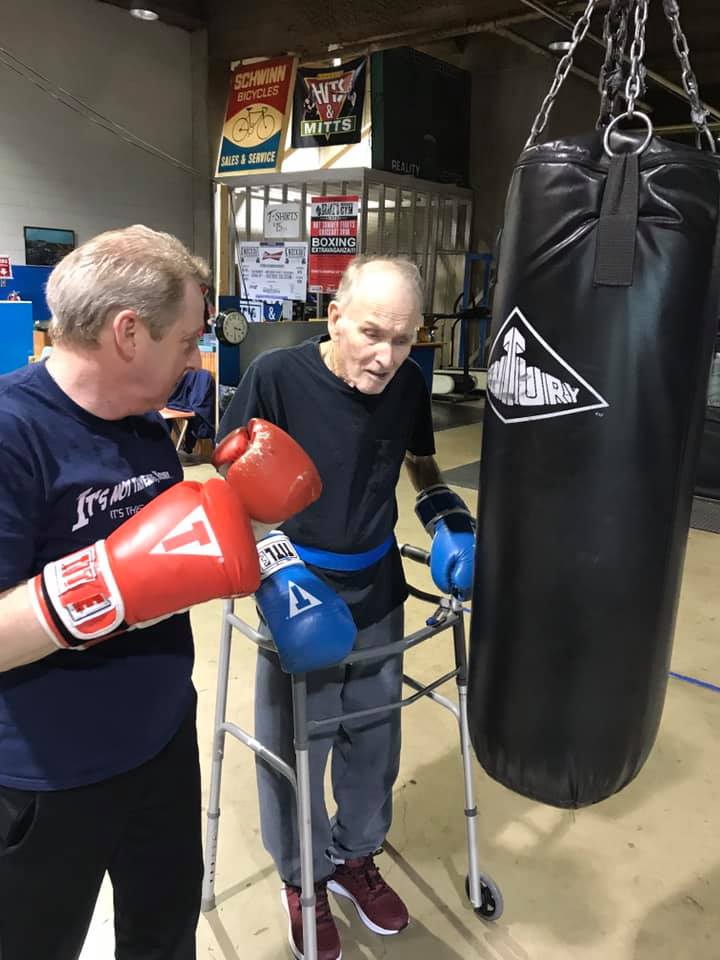
Gary Deer Sr. attends a Parkinson’s boxing class with Gery at Drake’s Gym in Dayton, OH in 2019.

Five minutes later, you notice something else that’s gone downhill or altered in some way. There is no set rate for when to expect these changes in your loved one’s health and they can come on rapidly. That means you barely get the chance to wrap your head and emotions around each state of change before you’re dealing with three more simultaneously.

Knowing there is no happy ending at the end of this story, you face constant adjustment and acceptance which are exhausting both mentally and emotionally. All this turmoil adds up to something called, “anticipatory grief,” which is exactly what it sounds like; you’re mourning the person as the disease progresses, anticipating their eventual death.

None of this is generally a conscious thought process. After my mother’s passing, I understood it better, and that, at least, helped me cope with my father’s decline several years later. But until I realized all of this, I was just angry all the time. I was frustrated at why dad couldn’t remember how to sit down in the a properly, or just use a spoon, but 10 minutes earlier it hadn’t been a problem. Things literally changed on the fly.

In my case, the difference between caring for Mom vs. Dad is that my mother’s Alzheimer’s disease removed any expectation in my mind of her being cognitively aware enough to help herself. She had no clue what was going on around her, so it was slightly easier to adjust because she didn’t push back. Dad’s mental state was usually pretty good, so he pushed back – a lot. And I kind of got it; it’s tough to spend your life being the one taking care of everyone else and suddenly you feel like a helpless burden.

It really bothered my dad to need help with anything, like standing up from a chair, or that we had to restrict things like coffee because the caffeine aggravated his symptoms. As his condition changed, we tried to counter each new phase with alternative ways to keep him comfortable and safe while dealing with altered symptoms.

I don’t know how to tell you to deal with anticipatory grief. Everyone copes differently. Being aware of it can help a bit. If you’re caring for someone who is slipping away, spend what time you can with them. Be there with them, be present, and be kind to them and especially to yourself.

PUBLISHER NOTE: If you or someone you know is a caregiver, visit http://www.theoldnerdinthegym.com for resources, a podcast, and other information that might help.

Let Your Light Shine Again

In Books, Dayton Ohio News, Education, Health, history, Literature, Opinion, Print Media, psychology, Uncategorized on March 9, 2023 at 4:46 pm

Deer In Headlines II

By Gery Deer

Insecurity affects people in different ways, from a simple annoyance to debilitating anxiety. It can be especially jarring when you were just there, doing your thing, and then, out of the blue, something rocks your confidence. Insecurity generally occurs when we compare ourselves to others, giving in to the ridiculous and constantly varying standards set by society.

The 1942 children’s book, “The Little Red Lighthouse and the Great Gray Bridge,” by Hildegarde H. Swift and Lynd Ward, has been an inspiration to children around the world. Myself included. I learned to read very early because of this book but, for me, its influence was far more literacy. The story itself, one of self-worth and perseverance, was also something to which I gravitated.

“The Little Red Lighthouse and the Great Gray Bridge,” is a simple story about a real lighthouse that sits on the banks of the Hudson River in New York City. As described in the book, “It was round and fat and red. It was fat and red and jolly. And it was very, very proud.”

Anthropomorphized in the story, the Lighthouse’s self-confidence stemmed from its own sense of importance in keeping boats safe along the river. Every night it flashed – one second on, two seconds off, with a big fog bell outside that clanged, “warning,” during bad weather.

The Lighthouse was originally built in 1889 as the North Hook Beacon, in Sandy Hook, New Jersey. In 1917, the lighthouse was shut down, but it wasn’t quite finished working yet. Four years later, it was moved to its current location in Manhattan’s North Washington Park in an effort to improve navigational support along the river.

Early in 1927, however, work began on the great span of the George Washington Bridge, directly behind the Lighthouse. By 1948 it was felt the bridge lighting overcast any need for the smaller light on the river and The Little Red Lighthouse was extinguished – seemingly forever.

Paralleled in the story, when the Lighthouse saw the large beam of light from atop the tower of the Great Gray Bridge, it was left feeling small, insignificant, and unimportant. At the same time, something had delayed the man who came every night to turn on the light. The Lighthouse felt abandoned and no longer needed.

Later, as a terrible storm came in, the Bridge called down, “Little Brother, where is your light?” The Bridge explained its duty to the ships of the air, but the Lighthouse was still important to safeguard the boats. Eventually, the caretaker arrived and turned on the gas, allowing the Lighthouse’s beam to shine brightly once more.

In reality, the Lighthouse was slated for demolition. But, in 1951, thanks to the popularity of the children’s book, an unprecedented public outcry to preserve The Little Red Lighthouse led the U.S. Coast Guard to deed it to the New York Department of Parks and Recreation. Nearly three decades later, it was added to the National Register of Historic Places and eventually designated a protected landmark of New York City.

Now safe in the shadow of the Bridge, the Lighthouse story’s simple message of self-worth was one that has resonated with people for more than 70 years. We all need it to feel relevant and valued but anyone can suffer from insecurity at some point. 

Like the Lighthouse, any of us can be unsure of our place in the world, comparing ourselves to those around us who seem bigger and better. Feeling irrelevant can be devastating.

That feeling, caused or fueled by deeply-rooted insecurity can sabotage the confidence of even the most self-assured person. And, sometimes we need a “Big Brother,” like the Bridge, or someone else we admire or respect to hold a mirror up for us so we can see our real value. That’s something my own Big Brother has done since I was very small, and, even as an adult, I still turn to him sometimes for that reassurance.

No matter how insignificant we may feel sometimes we all have something to offer. Just remember the courage of “The Little Red Lighthouse,” look for that one spark of inspiration, and, as the Bridge said to the Lighthouse, “let your light shine again.”

GLD Enterprises Communications, LLC celebrates 21 years with new services and additional staff

In Business, Dayton Ohio News, Economy, finances, Local News, News Media, psychology, Uncategorized on April 4, 2019 at 10:09 am

April 3, 2019, Jamestown, Ohio – GLD Enterprises Communications, Ltd. of Jamestown, Ohio, has announced the expansion of their company with the addition of a new principal staffer and additional services. The firm’s announcements come as it celebrates 21 years in business.

Julie Barth, Director of Digital Media Communication

Founded in March of 1998, GLD Enterprises Communications, Ltd., is a marketing communications agency specializing in strategic marketing, copywriting, public relations, and creative development. The company’s CEO and founder is a lifelong entrepreneur, advertising award-winner and Pulitzer-nominated freelance journalist, Gery L. Deer.

To deepen the professional bench, Julie Barth has joined the agency as a partner in the role of Director of Digital Media Communication (Media Director). Her primary duties focus on audio and video development and production, media relations, digital content, and social media.

Originally from New Jersey, Barth earned a Bachelor’s degree in Psychology from Heidelberg University and recently graduated from the International College of Broadcasting in Dayton with a degree in Audio and Video production. She also supports some of the firm’s business development activities and represents them as a member of the leadership team of the Huber Heights chapter of the H7 Network business referral organization.

Because of the founder’s background, GLD Enterprises Communications, Ltd. strengths have always been in the creation of marcom content for clients. Therefore, in addition to traditional communications and PR services, the agency’s expansion includes audio-visual production, such as promotional videos and podcasting services, and a unique, highly successful audience-centric content marketing approach called, “HEO ™,” which stands for Human Engagement Optimization™.

“We are excited about this next chapter in the firm’s evolution,” said Deer. “Most advertisers are trying to reach people, not search engines. After all, who is it that buys their products or services? Google? No, it’s people. We develop content for our clients to engage with the human being on the other side of the screen.”

According to Deer, over the years, GLD Enterprises Communications, Ltd. has gone through many changes including name and focus. “We’re always learning, always adjusting to the needs of our clients and the market,” Deer said. “To stay stagnant is to go out of business, and how will that help the dozens of clients who depend on us? We will continue to evolve.”

For more information, visit the company’s website at www.gldenterprises.net, or connect on LinkedIn and Facebook.


Good Night, and Good Luck. The final installment of “Deer In Headlines.”

In Dayton Ohio News, Health, Home Improvement, Local News, News Media, Opinion, psychology, sociology, Uncategorized on May 2, 2018 at 12:32 pm

This edition of Deer In Headlines marks if you’ll pardon the dramatics, the end of an era, at least for me. The question I’ve been asked most often since announcing the end of the series is, “So what will you do now?”

Let me start by saying while an important part of my work over the last decade, this column is not all I’ve been doing, not by a longshot. I’ve run an ad agency, written thousands of published pieces on everything from public relations to marketing, and given lectures and workshops about the media and writing all around the region. I’ve covered a lot of ground and struggled with how best to say goodbye and then it occurred to me.

It has always been my goal to have readers to take something useful from my writings and I don’t want this final installment to be any different. Since it represents several hours a week in research and writing, in the hope of having a positive influence on the thoughts and lives of anyone I can reach, leaving this column behind is a big change for me.

For some people, change is the enemy, it throws them off their game and causes chaos and, for much of my life, it was the same for me. But in recent years, change has become more of a companion that walks through life with me, always nudging me in the side to never be complacent or stagnant either in my actions or my convictions.

We may not like it, but change is the natural order of things. Nothing stays the same for very long. As they say, “to everything there is a season,” and rather than fighting those changes, we should embrace them. It’s not easy, but it makes life more interesting and far less stressful.

It’s easy to see how change affects people in simple ways, like when a child graduates from high school or you move to a new town. We get caught up in happiness and sadness all at the same time, it twists our emotions and forces us to face new challenges and differences in our day-to-day lives. Of course, there are negative changes too, and we have to take the good with the bad. That’s just life.

We grow accustomed to how things are in our world and we’re thrown when it alters. We all know that person who has to have a cup of coffee at a certain time of day, with a specific amount of sugar, or just the right drop of cream. If those kinds of things aren’t met with an exacting order, he or she cannot function. The more flexible you are, the more enjoyable your life. Otherwise, you’re in a constant state of stress.

With that, I’ll take you back to the question of what I will be doing next. It is definitely a time of even more change for me. I’ve recently accepted a position as vice president of communications and public relations with a social internet company. That and caring for my father takes up most of my work time, but I have other projects as well.

I’m still doing television and writing for the print and online media from time to time. I’m concentrating my writing time on my fitness blog, The Old Nerd in The Gym (www.oldnerdinthegym.com). I’m hoping my work helps others who are new to fitness and more healthy living.

Life goes on and new challenges await. I’m just getting started. And that’s how you should feel today too. Treat every day as bringing new opportunity to learn, grow, and achieve, regardless of how great or small the accomplishment and embrace that change! Your future isn’t written yet, so get out there and make it a good one!

With that, it’s time for Deer In Headlines to pass into the newspaper archives. Thank you for indulging me every week and, whether you agreed with me or not, I hope you got something useful or insightful from my ramblings. So, I’ll borrow a classic sign off from a news hero of mine, Edward R. Murrow, and simply say Good Night, and Good Luck.

Can’t we all just get along?

In Health, history, News Media, Opinion, Politics, psychology, sociology, Uncategorized on May 1, 2018 at 12:14 pm

With only two issues of Deer In Headlines remaining, I felt that one of them should be dedicated to a discussion about civility and the destructive nature of hate. In short, we must try to get along better, regardless of political, religious, or socioeconomic differences.

Over the last few years, our country has become severely divided. There is a level of anger, hate, and mistrust out there now, the likes of which haven’t been seen since before the Civil War. Back then the division was primarily focused on slavery and states’ rights, but today Americans are arguing about a laundry list of issues from immigration to gun control.

Not that these topics haven’t caused discourse in the past, but now it’s fueled by an alarmingly, and continually advancing, level of anger and hatred. The radical right has become sickeningly intolerant to the point of disgust and the liberal left has grown increasingly less “liberal.” I mean you simply can’t say, “I’m liberal, and we love everyone, so long as they agree with everything we say.” Doesn’t work that way.

President Donald Trump took advantage of this divide and used it to gain traction in his run for the White House. Now, he waffles back and forth, blustering on Twitter about how great he is, while alienating even his own base at times with his ridiculous rants. Democrats turn their noses up at him and his cronies and their flagrant hypocrisy, all while crying in their soup about how he got this far in American government. Well, Dems, I’ll tell you who put him there, you did.

Political viewpoints have become so foggy that no one can tell who is for what anymore. The reason Trump won the presidential election wasn’t his winning personality, or Russian hacking, or anything else. It was because the Democratic base was so splintered and stubborn over Hillary Clinton and Bernie Sanders that they couldn’t just get behind one of them and move on.

That’s right Dems, as I have written before, you handed the White House to Donald on a silver platter. Remember that primaries and midterms happen this year and any failure to weaken Trump’s hold in Congress is totally in your hands. All you have to do is get out and vote!

All of that said, we must be able to return to a level of productive, constructive discourse. We should be able to disagree and have informed, intelligent debate on a topic instead of a bickering match. What’s the point of discussion with no purpose except to out-scream everyone else?

Much of the problem comes from the extremist mentalities once relegated to the fringe but which now seem to be in the majority. There is nothing wrong with liberals and conservatives cooperating for a common good. We can disagree yet still work toward the betterment of our society – but that doesn’t seem to be possible right now.

We are dealing with mass shootings made possible by the bizarre need of a tiny few to own military-grade machine guns should be something we can all agree is nuts. But that doesn’t seem to be the case. Instead, our country is overwhelmed by people obsessed with these weapons and backed by a massively powerful gun lobby from the NRA. Clearly, money is more important to these people than our kids.

Execution of warped immigration policies based on ignorance and hate that mistreat productive members of society rather than helping them with a path to proper citizenship. We should be rewarding people for feeling our country is a safe home for their families, not punishing them. It’s all ridiculous.

The long and short of it is that we must find a way to get along better. If we don’t learn to dial back the extremism and let cooler, more diplomatic heads rule, our country is in big trouble. So, for what it’s worth, I think we’re capable of doing better.

But all of that requires that each of us learns to be more compassionate, more tolerant, and more thoughtful. Since I won’t be around to poke you in the side after next week, remember to be good to each other.

Living Longer vs. Living Better

In Children and Family, Health, Local News, Opinion, psychology, Science, Senior Lifestyle, State News, Technology, Uncategorized on December 26, 2017 at 8:07 am

Deer In Headlines
By Gery L. Deer

Modern medicine is an incredible thing, with breakthroughs almost daily that range from simple treatments for common ailments to advanced organ transplants. Through those great medical innovations, the lifespan of the average person is now well into the 80s, with better living through chemistry, or so they want us to believe.

But while we treat one area of illness another continues to progress making it seem like we’re falling apart in little pieces. Where we once just dropped dead from something simple like a heart attack, now it seems we deteriorate bit by bit, with each component of our bodies being held together by a separate roll of medical duct tape.

Think of it this way. We take a pill for blood thinning so we don’t have a clot and get a stroke or heart attack. We take a pill for diabetes to keep our glucose levels down. But at the same time, our mind is intact, with virtually no deterioration. Or maybe it’s the opposite, Alzheimer’s shreds the mind while the body is still healthy. Eventually, the body follows in decay since the Alzheimer’s begins to affect how the nervous system functions.

Thanks to modern science, we’re living longer than ever, but I wouldn’t call it healthier or with much of a quality of life. There’s something to be said for just having the lights go out all at once. One of the most horrific things I have had to endure is watching my mother’s mind go as her body still functioned reasonably well. Or what might be worse, having an active, clear mind trapped in a degenerating body that refuses to follow the brain’s instructions any longer.

At what point are we living too long for our own good and quality of life? Can medical science develop a plan to help the entire body and mind maintain the same or reasonably similar level of health for as long as possible? I don’t think that’s really possible.

So, here we are, a pill for this and a potion for that, all in the name of better living through chemistry. Granted, much of what’s wrong with us is their our doing – smoking, drinking, sugar, fat, it goes on and on. Personal responsibility as one ages should at least be taken into account here. We are what we eat, and boy, it’s a mess.

Formaldehyde and chemicals in our water, the carcinogenic material in our meat, pesticides in our vegetables, super-sized everything at the fast food counter, vaping (yeah, like that’s not smoking, whatever). It’s all killing us. But don’t worry, there’s a pill to counteract the effects of all that, so don’t worry about it.

Isn’t it idiotic, though, how much of what happens to us as we age is our own fault? We’re getting older, but we’re sicker when we live longer. When we won’t take care of ourselves even in the short term, someone else has to pay for that later on.

Last year, for example, obesity-related illness cost Americans nearly $200 billion and treating sickness related to smoking cost more than $300 billion. But wait, there’s more! Excessive use of alcohol costs Americans $249 billion.

Fighting obesity is sadly not as simple as trading a cheeseburger for a celery stick. It takes a full and complete lifestyle overhaul that may require generations to affect a family line. But you can totally prevent alcohol and tobacco illness by never lighting up or popping open that cold one.

Addiction may be a disease, but even that is 100-percent preventable because that first drink or smoke is a choice. A penny toward prevention is worth billions toward a cure.

Well, some of this we have control over, some we don’t. It’s so hard to imagine how people can just not care about their own well-being and how that affects those around them. As we age, we need more help from others. Wouldn’t it be great if that burden were just a little easier on our loved ones?

Yes, we’re living longer. But, despite what the big pharmaceutical company advertisements tell you, the quality of that long life is not measured in milligram doses.


Gery L. Deer is an independent columnist and business writer. Deer In Headlines is distributed by GLD Enterprises Communications, Ltd. More at gerydeer.com

The needs of the many

In Charities, Education, history, Local News, Media, National News, Opinion, Politics, psychology, Uncategorized on December 25, 2017 at 2:50 pm

Deer In Headlines
By Gery L. Deer

There is a quote from the Star Trek science fiction franchise that has been repeated often throughout the various television series and movies, “the needs of the many outweigh the needs of the few.” The phrase was first spoken by Leonard Nimoy’s character of Spock in Star Trek II: The Wrath of Khan as he tries to reassure his Admiral Kirk about a command decision.

It might be a fictional source, but the sentiment carries a great deal of merit, especially in today’s self-gratification-focused society. The concept is based on a logical determination wherein decisions are made to favor the needs over those of a large population of just a few individuals or even a single person.

Much of the time decisions are made from a very personal, emotional point of view. And there are people out there who simply live in their own little reality, completely oblivious to how their own behavior affects others, so logical thinking just isn’t within their comprehension. But there are three areas where people can make a difference in affecting the lives of far more than themselves and the few who might immediately benefit from a single decision.

First, the needs of the many should be the primary concern of government officials – always. At the state and federal levels, members of legislature seem far less concerned with helping their whole citizen constituency but rather filling their own coffers and lining the pockets of their big donors.

The local level seems to be more about ego, people who want to have their name on everything and be the big fish in the small pond. If those who are sent to represent “the people” would actually do that for a change, the country would be in a far better state.

In business, the idea is to make a buck and show a profit, and those aren’t bad things because they mean jobs and a growing economy. But when business benefits from bad practice, like unregulated pollution or any other activity that could cause harm either physically or economically to an outside population.

Commerce can be community-minded and still make money, the two needn’t be mutually exclusive. Everyone will benefit when a business focuses on the needs of the many, instead of the needs of the stockholder or management chasing the next bonus, whatever the cost.

Individually, each person can make a difference by just taking a moment to consider the consequences of every decision. When people consider the larger picture and understand how their choices affect those around them, the outcome can be far more appealing to everyone affected.

The first thing that comes to mind is intoxicated or distracted driving. Waiting to send that next text or check Twitter, calling a cab or Uber after a particularly “loaded” holiday bash could literally save lives.

What hasn’t been revealed here is that, at some point, the needs of the few, or the one, outweigh the needs of the many. Not because of logic, but because we are human, and we make illogical, emotional decisions and sometimes that’s a good thing.

As a family caregiver for a special needs child or an elderly parent, for example, you might need to adjust your day-to-day activity to accommodate your charge. One person, who requires that the world adjusts to them sometimes. And no one is perfect. But, most people will put the needs of that individual first, weighing how everyday decisions affect everyone involved.

Sadly, it is impossible to change some people and altering the “me” mindset of a culture could very well take generations. Plus, there will always be power-hungry politicians, self-absorbed celebrities, and that one neighbor who continually throws her dog droppings over the fence into the next yard.

In the end, the problem is all about people; illogical, unpredictable, impulsive, self-driven people. It would be great, though, if we, as a society, could start thinking in a more logical manner, something incredibly unlikely given the current state of entitlement and gluttony that has overrun America. Maybe with a little effort on the part of each individual, everyone might eventually, Live Long, and Prosper. See what I did there?

Gery L. Deer is an independent columnist and business writer. Deer In Headlines is distributed by GLD Enterprises Communications, Ltd. More at gldenterprises.net.

Is this your new site? Log in to activate admin features and dismiss this message
Log In