Local News & Commentary Since 1890.

Archive for the ‘Print Media’ Category

Barnes & Noble Turns the Page: 60-Store Expansion Signals Printed Book Renaissance

In Business, Entertainment, Local News, Print Media, State News, Uncategorized on December 22, 2025 at 6:51 pm

By Gery Deer

After years of contraction and store closures, Barnes & Noble in is writing a new chapter in its history. The nation’s largest bookseller has announced plans to open more than 60 new stores in 2026, a striking vote of confidence in brick-and-mortar retail and a clear sign that printed materials are enjoying a cultural comeback.

Barnes & Noble has announced it will open more than 60 new stores around the country. One of the most recent open in November in Hamilton, Ohio.

Once viewed as a casualty of e-commerce and e-readers, Barnes & Noble has steadily regained its footing under CEO James Daunt, who has emphasized locally curated stores, knowledgeable booksellers and community engagement. The company now operates roughly 600 locations nationwide and reports strong performance at recently opened stores.

“We’ve seen a real resurgence in interest in physical bookstores,” Daunt has said in recent interviews. “Readers want places that feel human again — where they can browse, discover and spend time. A bookstore should be a cultural space, not just a transaction.”

Industry analysts say the expansion reflects a broader shift in consumer behavior. After years of constant connectivity, many Americans are experiencing digital fatigue — exhaustion from endless screen time, notifications and scrolling. Printed books offer an antidote: no alerts, no blue light and a more immersive reading experience.

“People are deliberately stepping away from screens,” said Dr. Laura Mitchell, a media and consumer-behavior analyst. “Books provide focus and calm in a way digital content doesn’t. There’s something grounding about holding a physical object and engaging with it on your own terms.”

Younger readers are also fueling the trend. Social media platforms, particularly TikTok’s influential #BookTok community, have driven bestseller lists and encouraged a new generation to buy — and collect — physical books. Rather than replacing print, digital platforms are now helping revive it.

The expansion is expected to have a noticeable impact in Ohio, where Barnes & Noble has already opened new locations in recent years and is widely expected to continue growing its footprint. Ohio’s mix of suburban growth, college towns and strong library and reading culture makes it fertile ground for bookstores that double as community gathering places.

While independent bookstores remain cautious about competition, many observers note that Barnes & Noble’s new model relies less on uniformity and more on regional identity, allowing stores to tailor selections and events to local tastes.

For an industry once declared obsolete, the message is clear: the printed page still matters. As Barnes & Noble prepares to open dozens of new stores, it is betting that readers are ready to turn down the screen — and turn the page instead.

Xenia Daily Gazette Launches Inaugural Holiday Short Story Contest

In Children and Family, Local News, News Media, Print Media, Uncategorized on November 25, 2025 at 10:00 am

COURTESY OF OUR PARTNERS AT THE XENIA DAILY GAZETTE

The Xenia Daily Gazette is inviting local writers and storytellers to take part in its first annual Holiday Short Story Contest, which is going on now. Sponsored by McIlvaine Realtors, the contest encourages community members to put their holiday reflections into words under this year’s theme: “What the holidays mean to me.”

The inaugural contest is open to anyone age 12 and older, and entries may be up to 800 words in length. Stories should be sent as attachments or pasted into the email body to editor@xeniagazette.com by December 15, 2025. All entries must include the writer’s name, address, phone number, and email address.

The winner will receive a $50 VISA gift card, courtesy of McIlvaine Realtors, and their work will be published in both the Xenia Daily Gazette and the Fairborn Daily Herald during Christmas week, giving the author a special spotlight during the holiday season.

To help select the winning story, the Gazette has brought in a familiar local voice: Gery Deer, longtime contributing journalist, columnist, and author of the Gazette’s “Deer In Headlines” series, who will serve as one of the judges. Deer is participating courtesy of GLD Communications in Jamestown, which has supported Reading Is Fundamental (RIF) for the last three years through its national literacy initiative.

Deer said the contest offers the community an exceptional opportunity to reflect on what makes the season meaningful. “This is the time of year when family means the most, memories become stories told to new generations, and sharing seems to be at the heart of the season,” he said. “We hope people will share their stories with us and maybe even inspire others to write something as well.”

The Gazette hopes the new contest will become a cherished annual tradition, welcoming writers of all skill levels—from students and first-time storytellers to seasoned creatives looking for a festive way to express themselves.

Entries will be judged on originality, clarity, and how well they capture the holiday theme. While participation is open beyond Greene County, organizers are especially hopeful for strong involvement from area schools, families, and aspiring writers eager to share what the holidays mean to them.

McIlvaine Realtors, known for their long-standing support of community programs, expressed enthusiasm about sponsoring the first-ever contest and encouraging a new generation of local storytellers.

Dayton area PR firm named agency of record for controversial biotech author

In Books, Dayton Ohio News, Education, Health, Literature, National News, Print Media, Technology, Uncategorized on October 30, 2025 at 1:45 pm

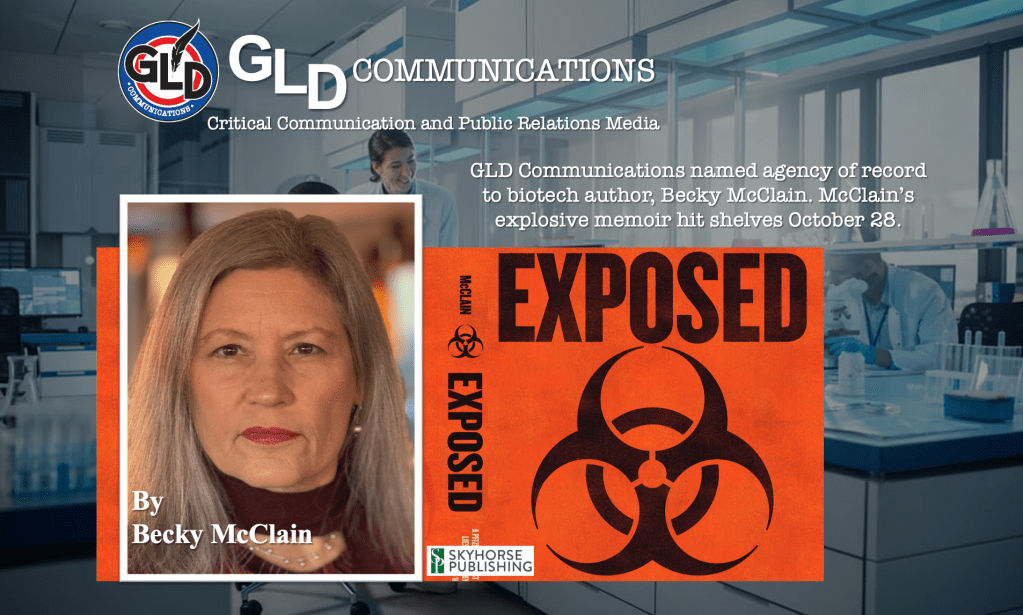
GLD Enterprises Communications, Ltd. Named Agency of Record for Biotech Whistleblower Becky McClain’s New Memoir, “Exposed”

Jamestown, OH — October 30, 2025 — GLD Enterprises Communications, Ltd. (GLD Communications), a strategic media marketing and public relations firm based in Jamestown, Ohio, has been named the agency of record for biotech whistleblower Becky McClain, author of the explosive new book, “Exposed,” which hits shelves October 28 from Skyhorse Publishing.

Led by founder and creative director Gery L. Deer, GLD Communications will oversee all media access management for McClain, whose story has already sparked widespread interest. The agency will also manage social media engagement and coordinate interviews and appearances related to the book’s release.

“This is a story that demands attention,” said Gery L. Deer. “Becky McClain’s courage in speaking out—despite enormous personal and professional risk—embodies the kind of integrity we strive to amplify. GLD Communications is honored to support her mission and ensure her voice reaches the audiences who need to hear it.”

“Exposed” chronicles McClain’s harrowing journey from molecular biologist to whistleblower, detailing her legal battle against a major biotech corporation over alleged safety violations and retaliation. The book dives deep into the ethical and regulatory failures she witnessed, offering a sobering look at the intersection of science, corporate power, and public health. The topic has proven highly controversial, drawing attention from journalists, activists, and policymakers alike.

Consumer advocate Ralph Nader, who was involved in the original case, penned the book’s powerful foreword, lending further weight to McClain’s revelations. Early media coverage has included interviews with national outlets and investigative podcasts, with more expected following the book’s release.

McClain’s voice resonates throughout the pages of her book. “I’ve written this book as a witness to a system gone bad — a system that breaks people bad — a system that threatens the public’s health, workers’ rights, and America’s right to freedom of speech,” she states, underscoring the urgency and personal cost of her journey.

“Exposed” is more than a memoir—it’s a call to action. Through meticulous documentation and emotional candor, McClain invites readers to examine the intersection of science, ethics, and power. The book also explores the broader implications for workers in high-risk industries and the mechanisms that protect—or fail to protect—them.

The book is poised to become a touchstone in discussions about whistleblower protections and corporate transparency. As the biotech industry continues to evolve, McClain’s story serves as a stark reminder of the human cost of scientific advancement––and the ongoing risks to worker safety as well as public health in a world still marked by the pain and uncertainty caused by the COVID-19 pandemic.

Effective immediately, all media inquiries, interview requests, and public engagement related to “Exposed” will be handled through GLD Communications. For more information or to request media access, contact the agency directly via email gdeer@gldenterprises.net. “Exposed” is available now on Amazon.com and in bookstores. Questions about the publisher or distribution should be directed to the offices of Skyhorse Publishing, New York, New York.

News Incredulity

In Economy, Local News, News Media, Opinion, Politics, Print Media, Technology, Uncategorized on March 15, 2025 at 3:38 pm

Deer In Headlines II

By Gery Deer

I’ve been a freelance journalist for most of my adult life, going back to my days as a staff writer on a college newspaper. Since then, I’ve been published hundreds of times in everything from weekly newspapers to regional trade magazines. Much of my work consists of feature stories, opinion columns, and a few hard news pieces.

I was trained by an old-school newspaper editor who demonstrated consistent ethics and integrity. I was taught never to take a story to press without three primary sources and on-the-record statements from those directly involved to back up the information.

As the Internet became an easy way for the citizen journalist to publish news and information, credibility and fact gave way to sensationalism and uninformed opinion. Click bait replaced proper headlines. Soon, what was once referred to as “the press,” was suddenly renamed, “the media.” In this reporter’s humble opinion, they are not the same.

Webster’s Dictionary defines media (plural of the word medium) as a means of communication, such as radio, TV, newspapers, social, the internet, and so on. In other words, it refers to the delivery system rather than the content or its source.

For example, social media is a primary source of news for many Americans. Unless the information originates from a reputable news source, the content may have no oversight, no editorial integrity, no fact-checking, nothing.

You may have no idea where the information came from or how it may have changed. Think of it as a game of telephone. The more the word spreads, the less accurate it becomes. To reiterate, the social media platform (or app), such as Facebook, X, or Instagram, is just the vehicle – the medium. Reputable or not, the message originates elsewhere.

“The Press,” on the other hand, is guaranteed by the First Amendment of the U.S. Constitution. Like the three branches of government, it’s literally set up right there in black and white – which is why it’s called the Fourth Estate.

The Press should serve as a watchdog to help hold those in power accountable and provide the public with the information they need to make informed decisions. Trained Press journalists gather facts, verify information, and present it objectively across a variety of media.

A functional and qualified Press works within the realm of fact – not truth (that’s for philosophers). It should present information without bias or commentary (there’s a page for that and you’re looking at it now) and demonstrate integrity in the process.

Before I have people shouting at the screen or tearing up the paper, I agree the problem of misinformation spread by so-called news outlets is in epidemic proportions. Unfortunately, many news agencies have traded integrity for revenue, to say nothing about a complete disregard for journalistic expertise.

Cable news programs often fall into this category. They base their content on current news stories, targeting the biases and interests of a single segment of audience to grow advertising revenue. This is not news – it’s entertainment.

Even worse is when a news outlet censors content to favor the business or political interests of their owners. For example, once a paragon of investigative journalism, “The Washington Post is rapidly losing credibility because of interference with its newsroom by its owner, Amazon founder Jeff Bezos.

Between social media, so-called citizen journalists, bloggers, and whatever else is out there, unvetted, unqualified, and often false content is cranked at an alarming rate. Their goal is to spread as much click bait as possible and deliver customers to advertisers – it’s all about money. That makes it hard to sift through the noise for qualified, factual news.

In the end, the Press should be rooted in ethics and accuracy. Sadly, many news outlets now prioritize profit, sensationalizing content to stay competitive in digital media. That’s muddied the journalistic waters, making it harder for the public to distinguish between fact and opinion.

My only advice is to check the source and remember that perspective isn’t the same as bias. News should be factual and accurate, not “fair.” There is no such thing as “fair and balanced” news. Fairness suggests compromise, whereas facts stand alone. The standard should be: is it factual, or not?

Literacy’s Silver Bullet

In Books, Children and Family, Economy, Education, National News, Opinion, Print Media, Technology, Uncategorized on October 19, 2024 at 10:35 am

Deer In Headlines II

By Gery Deer

I was a staff writer and later an editor for my college newspaper. During that time, I learned the single, most important lesson from all my years of education. Our administration-appointed supervisor once told me, “Whatever else you learn as you go through your college career,” she said, “learn to write and speak well. If you have that, you’ll be able to do anything.” She was right.

My mother also shared those views, though she had a head start by teaching me to read early. On the other hand, I would depend on my communication skills to pave my way to a multi-faceted career. She was determined to give me every possible advantage, mostly because she didn’t get them.

Literacy is one of the most critical indicators of a strong society. It reduces poverty, bigotry, ignorance, and social and professional inequality. It shouldn’t be limited to the academically gifted. Everyone should have the opportunity to learn effective communication.

Just because you don’t have an interest or aptitude for high academia, that doesn’t mean literacy is less important. I feel fortunate that I had the best of both worlds. I’ve always been an avid reader and writer and a lifelong student of all the sciences. But I also learned to rebuild a car engine, install a new water heater in my house, or change a faulty electrical outlet.

Every one of those tasks requires the ability to learn, understand, follow instructions, and cope with the unexpected. All of my “book learning” occurred while surrounded by some of the best tradespeople in the world. Even better, they were all teachers. One thing that has changed over the years is how literacy is emphasized in our public and private schools.

Do you remember when kids used to get in trouble for reading comic books at school? I will say “we” instead of “they” because I did this too. We put comic books inside large textbooks so we could read during class. From the teacher’s perspective, we seemed engrossed in our educational process. Instead, we were engaged in the exploits of Superman, Batman, or Spider-Man.

Some argued that even reading comic books was good for us because at least we were reading. But it was more than that. Comic books are a good literacy metaphor because they aren’t just about words, grammar, and sentence structure.

For our society to consider itself truly literate, we must understand language, not just the written word but communication. We also need to understand art, storytelling, and critical thinking. In an ironic twist, one way to do all that is by reading comic books. Many of the Batman stories from the 1930s and 40s are loaded with material you only find in today’s best crime novels by authors like Michael Connolly, James Patterson, and David Baldacci.

Unfortunately, some use the comic book analogy to justify spending hours on social media. That’s not the same thing. Reading is calming, focuses our minds, and relaxes our bodies. If anything, social media has dumbed us down and created an entire society nearly paralyzed by anxiety and inferiority. Scrolling doesn’t count as reading.

Still, literacy doesn’t require you to wade through “War and Peace,” “Catcher in the Rye,” or any other long-winded literary work. I supplemented my education by reading everything I could get my hands on. Whatever I had an interest in, I had books about it, encyclopedias, or topic-specific material – there was no internet back then. Now, resources are nearly endless, provided you learn the difference between credible and non-credible sources. 

Advanced education isn’t required either. Truth be told, much of what I do for a living was self-taught – thanks to my early introduction to books. Self-education is mainly frowned upon in today’s society. I find it ironic that Benjamin Franklin, Thomas Jefferson, and others who wrote some of the most important documents in history would be unemployable by today’s arbitrary and unfounded standards.

My point is that American culture currently reads at a U.S. 5th-grade level. That’s unfortunate, ridiculous, and easily corrected. We must eliminate the stigmas of functional illiteracy, focus more on reading and writing in our schools, and spend more time with books than cell phones.

Uniquely Portable Magic

In Books, Education, Entertainment, Opinion, Print Media, Technology, Uncategorized on April 7, 2024 at 9:47 am

Deer In Headlines II

By Gery Deer

“Books are uniquely portable magic.”—Stephen King, On Writing: A Memoir of the Craft.

I’ve often quoted classic books in this column for several reasons. For one thing, those brilliant writers of old had wisdom that still eludes me, and I need to borrow it occasionally. 

I also enjoy the opportunity to share my love of books with those of you who are kind enough to give me your attention for a few minutes each week. My hope is that, in addition to my humble observations, I can share some words from those scribes who were (or are) far wiser and more eloquent than me. 

Of course, I don’t just cite the classics. I toss in something fun and modern here and there as well. You may not realize it, but I’ve shared some words from the likes of Douglas Adams, George R.R. Martin, J.K. Rowling, and more. 

I wasn’t a voracious reader when I was young, but that changed as I grew up. In high school, I became interested in Charles Dickens. Later, it was the stories of Mark Twain. From “The Little Red Lighthouse and the Great Gray Bridge” to “Lord of the Flies,” one book led to another. It’s interesting how that happens. Once you’re hooked…

That said, here are my questions of the day: Have books become obsolete in the shadow of the internet and social media? As some try to ban classics like Huckleberry Finn and To Kill A Mockingbird, what has become of literature’s social significance? What does the future hold for the classics and all the unwritten works yet to come? I don’t have the column inches to answer these questions, so here are my brief thoughts. 

In my humble opinion, Stephen King had it right. Books are magical. They transport us to faraway lands, introduce us to people around the globe, and inspire imagination and dreams. But books are far more than mere escapism from our daily grind into the worlds of Harry Potter and Captain Nemo. 

Books are the arks of our history. They help us learn from the past, hold a mirror to the present, and prepare for the future. Every published page offers a tiny glimpse into who we are as a species—warts and all. When you read a book, you have no choice but to learn something. Ignorance is replaced with knowledge and understanding, and then a funny thing happens—people get along better. Books provide the knowledge that breaks down all the barriers that separate us.

Booksellers are struggling, however. In many American communities, there might be a Starbucks or a parking lot where the neighborhood bookstore once stood. Instead of the pages of some great new novel, many people seem far more interested in scrolling through social media.

Although I prefer the printed page for most of my reading, my appreciation for books is more about content than construction. I typically read two or three books simultaneously, each in a different medium—audio, digital, or print. 

A book is a book. Unless you can convince me that words read aloud are less meaningful than those read by eye, listening to an audiobook still counts as reading. You should read however you feel comfortable.

Concerning book bans, I won’t get into the obviously paranoid politics involved. If you don’t like a book, don’t read it. But the concept of book banning should horrify us because it casts a long shadow backlit by terrors of the past. 

Some writers spend decades crafting the perfect book, hoping it will positively impact the reader. No matter your age, the genre, or the medium, reading a book will improve critical thinking and creativity and release dopamine, the brain’s “happy” chemical. 

If you haven’t done so for a while, it’s time to get some of that happiness for yourself or give it to someone else. A book is one of the most meaningful gifts you can give. Libraries and bookstores offer a fun, affordable family experience you will remember forever.

Thankfully, books, even printed ones, aren’t going away anytime soon. But if they were ever to disappear, so would our society, our humanity, and, eventually, the record of our very existence. 

*************

More Information:

Your local library is a great, free resource for the whole family to explore the unlimited world of books!

If you want to learn more about the book industry, the future of printed books and bookstores, check out these documentary films: The Booksellers. And Hello, Bookstore.

Professor, Humanitarian Joe Weston’s New Book, “Fierce Civility,” Offers Resolution Through Hope

In Books, Business, Education, Health, Literature, Print Media, psychology, sociology, Uncategorized, World News on May 19, 2023 at 7:13 am

WASHINGTON, May 16, 2023 /PRNewswire/ — Joe Weston is an author, lecturer, facilitator, and most importantly a humanitarian, someone whose deep belief in the potential of society led him on a lifelong journey to improve it. In his latest book, “Fierce Civility – Transforming Our Global Culture From Polarization To Lasting Peace,” Weston shares with readers a clear pathway into a dynamic new human story, with hope at its foundation.

An Amazon #1 bestseller, “Fierce Civility – Transforming Our Global Culture From Polarization To Lasting Peace,” draws upon the author’s more than 30 years of experience in the areas of conflict resolution and prevention, leadership, stress management and communication to provide a pathway to peace and, what Weston calls, “courageous self-reflection.”

Weston believes, “We live in a disproportionate society, technologically over-fed and spiritually malnourished. A human family whose global heart is unwell, the result of a system out-of-balance.”

Raised in Queens, New York, Weston grew up in an environment where conflict was resolved by argument. As an adult, he moved to the Netherlands for nearly two decades and studied a level of human solidarity that transcends borders, nationality, race, religion, political ideology, and economic status. This led him to create a series of stress-mitigating programs in the United States, Europe, and some of the most divergence-ridden regions of the world.

“New resilient solutions must have “coding” from diverse voices. Because everyone feels these solutions have a signature of their voice,” Weston said. “Then all involved will work together to make those solutions flourish.” 

With a focus on empowerment and leadership, Weston’s methods have been utilized by organizations worldwide including NASA, The World Bank, PBS, Booz/Allen/Hamilton, and Oxfam. But some of his most valued accomplishments have been helping severely wounded U.S. combat veterans deal with PTSD. He teaches them to regulate their nervous systems, communicate, and sometimes helps pull them back from the brink of suicide.

He has also worked with various social and justice groups in the United States and as a volunteer facilitator for the Liberation Prison Project, teaching meditation and leadership to inmates. Internationally, he has served as an educator and advocate to help Middle Eastern men shift the viewpoints of other men regarding women’s rights.

“After spending billions on research projects to intellectually and technologically solve our world problems, as long as we’re in this high state of dis-regulation, none of these great solutions will take root,” he said.

Regarding the book Weston noted, “I would like people to read this and say, ‘Wait, I see there might be a pathway to hope. I would like people to find their own sense of resilience and their authentic voice.” “Fierce Civility – Transforming Our Global Culture From Polarization To Lasting Peace,” is published by Heartwalker Press, Washington D.C. The book and more information about Joe Weston’s lectures and peace projects are available at the author’s website, www.joeweston.com.

Let Your Light Shine Again

In Books, Dayton Ohio News, Education, Health, history, Literature, Opinion, Print Media, psychology, Uncategorized on March 9, 2023 at 4:46 pm

Deer In Headlines II

By Gery Deer

Insecurity affects people in different ways, from a simple annoyance to debilitating anxiety. It can be especially jarring when you were just there, doing your thing, and then, out of the blue, something rocks your confidence. Insecurity generally occurs when we compare ourselves to others, giving in to the ridiculous and constantly varying standards set by society.

The 1942 children’s book, “The Little Red Lighthouse and the Great Gray Bridge,” by Hildegarde H. Swift and Lynd Ward, has been an inspiration to children around the world. Myself included. I learned to read very early because of this book but, for me, its influence was far more literacy. The story itself, one of self-worth and perseverance, was also something to which I gravitated.

“The Little Red Lighthouse and the Great Gray Bridge,” is a simple story about a real lighthouse that sits on the banks of the Hudson River in New York City. As described in the book, “It was round and fat and red. It was fat and red and jolly. And it was very, very proud.”

Anthropomorphized in the story, the Lighthouse’s self-confidence stemmed from its own sense of importance in keeping boats safe along the river. Every night it flashed – one second on, two seconds off, with a big fog bell outside that clanged, “warning,” during bad weather.

The Lighthouse was originally built in 1889 as the North Hook Beacon, in Sandy Hook, New Jersey. In 1917, the lighthouse was shut down, but it wasn’t quite finished working yet. Four years later, it was moved to its current location in Manhattan’s North Washington Park in an effort to improve navigational support along the river.

Early in 1927, however, work began on the great span of the George Washington Bridge, directly behind the Lighthouse. By 1948 it was felt the bridge lighting overcast any need for the smaller light on the river and The Little Red Lighthouse was extinguished – seemingly forever.

Paralleled in the story, when the Lighthouse saw the large beam of light from atop the tower of the Great Gray Bridge, it was left feeling small, insignificant, and unimportant. At the same time, something had delayed the man who came every night to turn on the light. The Lighthouse felt abandoned and no longer needed.

Later, as a terrible storm came in, the Bridge called down, “Little Brother, where is your light?” The Bridge explained its duty to the ships of the air, but the Lighthouse was still important to safeguard the boats. Eventually, the caretaker arrived and turned on the gas, allowing the Lighthouse’s beam to shine brightly once more.

In reality, the Lighthouse was slated for demolition. But, in 1951, thanks to the popularity of the children’s book, an unprecedented public outcry to preserve The Little Red Lighthouse led the U.S. Coast Guard to deed it to the New York Department of Parks and Recreation. Nearly three decades later, it was added to the National Register of Historic Places and eventually designated a protected landmark of New York City.

Now safe in the shadow of the Bridge, the Lighthouse story’s simple message of self-worth was one that has resonated with people for more than 70 years. We all need it to feel relevant and valued but anyone can suffer from insecurity at some point. 

Like the Lighthouse, any of us can be unsure of our place in the world, comparing ourselves to those around us who seem bigger and better. Feeling irrelevant can be devastating.

That feeling, caused or fueled by deeply-rooted insecurity can sabotage the confidence of even the most self-assured person. And, sometimes we need a “Big Brother,” like the Bridge, or someone else we admire or respect to hold a mirror up for us so we can see our real value. That’s something my own Big Brother has done since I was very small, and, even as an adult, I still turn to him sometimes for that reassurance.

No matter how insignificant we may feel sometimes we all have something to offer. Just remember the courage of “The Little Red Lighthouse,” look for that one spark of inspiration, and, as the Bridge said to the Lighthouse, “let your light shine again.”

Fear not the techno-babble

In Books, Dayton Ohio News, Entertainment, Literature, Local News, Media, Opinion, Print Media, Science, Technology, Uncategorized, World News on March 3, 2023 at 8:48 am

Deer In Headlines II

By Gery Deer

“Far out in the uncharted backwaters of the unfashionable end of the western spiral arm of the galaxy lies a small unregarded yellow sun. Orbiting this at a distance of roughly ninety-two million miles is an utterly insignificant little blue-green planet whose ape-descended life forms are so amazingly primitive that they still think digital watches are a pretty neat idea.”

That’s how British writer, Douglas Adams, described us in 1979 at the opening of his book, “The Hitchhikers Guide to the Galaxy.” Adams, who was an avid fan of technology, observed quite correctly that Humans, as a species, are pretty proud of their technological advancement, and can’t wait to define themselves by it.

Learning to get the most out of it, however, was another issue entirely. Even more challenging, if you happen to be one of those who choose the simple life of the Luddite, you could be left in the flotsam and jetsam of a digital tsunami.

Regardless of your generation, X, Y, Z, or PDQ, sometimes all this techno-babble can just make you feel … stupid. To start with, there’s the word – technology. It conjures visions of computer screens, smartwatches, and self-driving cars. But when “Hitchhikers” was published, most of that stuff was science fiction. Back then, a typewriter was still the prominent piece of office tech and the hottest new home entertainment was the video cassette recorder (VCR) – and none of us could set the clock.

I remember it well. There it was, that flashing, digital “12:00” that teased and mocked us from our easy chairs, daring only the bravest of the tech-savvy to make it do anything else. Little did we know that those four blinking LCD characters were the innocuous vanguard of a technological invasion soon to consume every first-world ape-descendent in the whole of this little blue-green planet. It would happen fast and in ways that no one could have ever anticipated. Resistance would be futile, even though some still try.

I don’t get why people struggle with technology – not so much its use, but the very idea of it. I used to think it was generational. But some people just refuse, age, education, and intelligence notwithstanding. Admittedly, I come at this from a unique perspective.

Even though I grew up a farm boy, I was always fascinated by advancing technology. I had one of the aforementioned digital watches and even taught myself programming on a Commodore VIC 20 home computer when I was 12. I went to college in engineering and computer science and worked in those fields in my early professional career.

For me, just like a hammer is for a carpenter, a smartphone or tablet computer is just another tool. They provide me with information and help me manage my personal and professional life.

As I get older, I understand how people can be resistant to change. But I’m not wired that way, at least where technology is concerned, I am constantly learning. I have an interest in science, technology, engineering, astronomy, all of it, so adjusting comes pretty easily to me.

Technology also improves medical care, public safety, and education for our kids. We have a responsibility to make it work for us, to apply those technologies that improve our lives, not take them over.

Like the first caveman who used a stick as a tool, eventually, most of us adapt to the tech that we’re forced to use. If you had a VCR and bore any hope of actually using the machine’s most sellable feature, recording TV shows we weren’t home to see, you learned to set the clock.

But it all might just be too much for some people, and, oddly, I kind of get it. Technophobia and digital fatigue are genuine problems, albethey somewhat self-induced. Keep in mind you don’t need every new high-tech gadget just because it’s popular.

To the tech-obsessed, I have one thing to tell you. Your Apple Watch might be cool, but it doesn’t have the answer to life the universe, and everything, so calm down. And, my old analog Timex may not have Bluetooth, but it actually shows the time, unlike the clock on my VCR – which is still flashing twelve.

Extends Deadline, 2018 WOWA anthology now open for submissions

In Books, Dayton Ohio News, Entertainment, Literature, Print Media, Uncategorized on July 7, 2018 at 10:59 am

Dayton, Ohio, June 1, 2018 –The Western Ohio Writers Association (WOWA) is now accepting short story fiction submissions for their 2018 anthology themed, “Redemption, Reinvention, Revenge” (final title TBA), targeted for publication in Q4 2018.

The Western Ohio Writers Association was founded in 2008 as a resource for writers of all genre in the southwestern Ohio, southeastern Indiana, and northwestern Kentucky region. The organization provides monthly critique sessions, networking opportunities, workshops and education, and creative support.

This will be WOWA’s second anthology, having published its first, “Flights of Fiction,” in 2013. This time, however, rather than only member authors, submissions are open to writers outside the group.

“We are looking for innovative short fiction between 2,500 and 7,500 words. Stories should have diverse appeal and must incorporate one or more of the anthology theme’s concepts,” explained WOWA Executive Director, Gery L. Deer.  “All submissions must be original works that have not been previously published. We will choose approximately 15 stories for this anthology.”

Submissions are open to fiction writers 18 and up who are permanent residents of the following Ohio counties: Brown, Butler, Champaign, Clarke, Clermont, Clinton, Darke, Fayette, Franklin, Greene, Hamilton, Highland, Madison, Miami, Montgomery, Preble, Warren. Authors do not need to be members of WOWA in order to submit.

Submissions will be accepted between May 1, 2018 and now extended to August 31, 2018. Please either upload your manuscript document through our Submission Form page or send it as an email attachment to submissions@westernohiowriters.com. No more than two submissions per author, please. We will reject stories that include explicit sex, brutality, or pervasive profanity. We do not accept simultaneous submissions.

Full details and submission guidelines are available online at www.westernohiowriters.com, click on “WOWA Publications.”

Is this your new site? Log in to activate admin features and dismiss this message
Log In