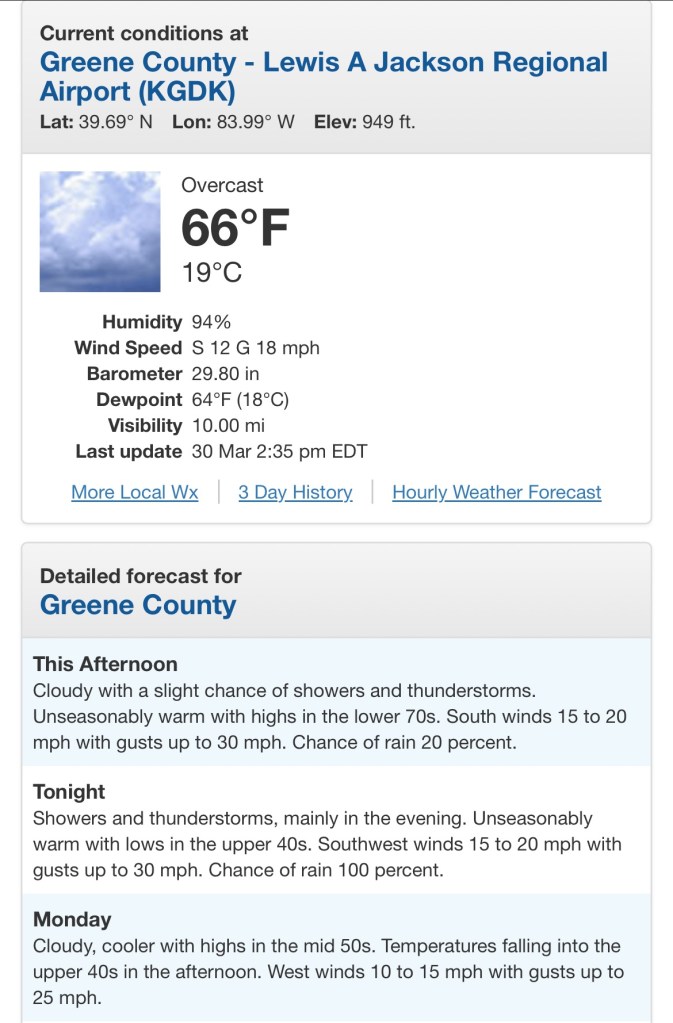
A Tornado Watch has gone up for areas to our west, mainly portions of Illinois and Indiana. The Jamestown Comet Weather Center is watching the situation closely and will post any alerts for this area as they are received. A very good day to remain weather aware!
Current Greene County conditions at the time of this posting…
Follow our Facebook page for the latest news and urgent weather information from our Comet weather specialist.
Power, like money, is nothing if you have enough, but everything if you don’t. But what is it? Who has it, and what are those without it supposed to do when faced off by those who do? I’m not sure I’m smart enough to answer any of those questions. If you’ll indulge me, however, I’ll make an attempt to do so and put it into a contemporary context. First, a little history – the kind we should learn from or be doomed to repeat.
It was 1887 England. In a series of letters to Bishop Creighton concerning the issue of writing history about the Inquisition, John Dalberg-Acton, the 1st Baron Acton, or better known as Lord Acton, wrote, “Power tends to corrupt, and absolute power corrupts absolutely.” Most people are familiar with the quote, but few know the preceding passage, which gives it perspective.
“I cannot accept your canon that we are to judge Pope and King unlike other men, with a favourable presumption that they did no wrong,” Acton wrote. “If there is any presumption it is the other way against holders of power, increasing as the power increases. Historic responsibility has to make up for the want of legal responsibility.”
That’s some pretty fancy, but important language. Put more simply, Lord Acton was saying that the same moral standards should apply to everyone, including political and religious leaders. Throughout history, kings and popes were permitted, essentially, to wield their authority unchecked.
America’s Founding Fathers shared the same concern. So much so that when they created a constitution for their new country, coincidentally ratified the same year as Acton’s historic correspondence, it established three separate but equal branches of government to prevent such authoritarian power.
Power is a dangerous thing, especially in the hands of two kinds of people – those who want it, and those who want to keep it from others. The first is driven by greed, the second by fear. Lord Acton was commenting on accountability, something the Constitution ensures by setting equal the Executive, Legislative, and Judicial branches of government. Should some power-hungry tyrant manage to occupy the White House, the other branches would be able to keep him or her in check.
If that individual managed to wield enough control over two of the three branches, the third would be able to mitigate some of the potential danger. But if all three branches were heavily influenced, even manipulated by one individual, then we have a problem. That lands our country in Lord Acton’s absolute power corrupting absolutely territory, and on a much larger scale.
Let’s not forget the second kind of power broker (to borrow a term from one of my favorite authors, Robert A. Caro), the kind who want power out of fear. This individual, or group, is afraid that someone else will gain the power to control them or do things they don’t like.
These people tend to be all-or-nothing types. In other words, if they can’t have it, they don’t want anyone else to because they fear it will weaken their position. Those who are afraid of minority advancement fit this category.
But what if you’re on the receiving end of all this – the powerless. Powerless people are led to believe, by a government or other authoritative body, that they don’t deserve power. Classism, racism, ageism, and most other “isms” are examples of one group trying to maintain power over another. To quote a great role model of the late 1980s, Ferris Bueller, “Isms, in my opinion, are not good. A person should not believe in an -ism, he should believe in himself.”
When the people lose the power over government, when their elected representatives act in blind service to one policy or individual rather than the best interest of their constituents, when power begins to corrupt absolutely, freedom no longer exists. The trouble is, corrupted power often goes unrecognized until it’s too late.
Corruption dons the cloak of misdirection, intended to fool those who are unwilling to see the danger. Try to remember that power can also be a good thing that benefits all instead of one person or ideology. Unfortunately, that doesn’t make for very good reality television, now does it?
I’ve been a freelance journalist for most of my adult life, going back to my days as a staff writer on a college newspaper. Since then, I’ve been published hundreds of times in everything from weekly newspapers to regional trade magazines. Much of my work consists of feature stories, opinion columns, and a few hard news pieces.
I was trained by an old-school newspaper editor who demonstrated consistent ethics and integrity. I was taught never to take a story to press without three primary sources and on-the-record statements from those directly involved to back up the information.
As the Internet became an easy way for the citizen journalist to publish news and information, credibility and fact gave way to sensationalism and uninformed opinion. Click bait replaced proper headlines. Soon, what was once referred to as “the press,” was suddenly renamed, “the media.” In this reporter’s humble opinion, they are not the same.
Webster’s Dictionary defines media (plural of the word medium) as a means of communication, such as radio, TV, newspapers, social, the internet, and so on. In other words, it refers to the delivery system rather than the content or its source.
For example, social media is a primary source of news for many Americans. Unless the information originates from a reputable news source, the content may have no oversight, no editorial integrity, no fact-checking, nothing.
You may have no idea where the information came from or how it may have changed. Think of it as a game of telephone. The more the word spreads, the less accurate it becomes. To reiterate, the social media platform (or app), such as Facebook, X, or Instagram, is just the vehicle – the medium. Reputable or not, the message originates elsewhere.
“The Press,” on the other hand, is guaranteed by the First Amendment of the U.S. Constitution. Like the three branches of government, it’s literally set up right there in black and white – which is why it’s called the Fourth Estate.
The Press should serve as a watchdog to help hold those in power accountable and provide the public with the information they need to make informed decisions. Trained Press journalists gather facts, verify information, and present it objectively across a variety of media.
A functional and qualified Press works within the realm of fact – not truth (that’s for philosophers). It should present information without bias or commentary (there’s a page for that and you’re looking at it now) and demonstrate integrity in the process.
Before I have people shouting at the screen or tearing up the paper, I agree the problem of misinformation spread by so-called news outlets is in epidemic proportions. Unfortunately, many news agencies have traded integrity for revenue, to say nothing about a complete disregard for journalistic expertise.
Cable news programs often fall into this category. They base their content on current news stories, targeting the biases and interests of a single segment of audience to grow advertising revenue. This is not news – it’s entertainment.
Even worse is when a news outlet censors content to favor the business or political interests of their owners. For example, once a paragon of investigative journalism, “The Washington Post” is rapidly losing credibility because of interference with its newsroom by its owner, Amazon founder Jeff Bezos.
Between social media, so-called citizen journalists, bloggers, and whatever else is out there, unvetted, unqualified, and often false content is cranked at an alarming rate. Their goal is to spread as much click bait as possible and deliver customers to advertisers – it’s all about money. That makes it hard to sift through the noise for qualified, factual news.
In the end, the Press should be rooted in ethics and accuracy. Sadly, many news outlets now prioritize profit, sensationalizing content to stay competitive in digital media. That’s muddied the journalistic waters, making it harder for the public to distinguish between fact and opinion.
My only advice is to check the source and remember that perspective isn’t the same as bias. News should be factual and accurate, not “fair.” There is no such thing as “fair and balanced” news. Fairness suggests compromise, whereas facts stand alone. The standard should be: is it factual, or not?
WASHINGTON (AP) — References to a World War II Medal of Honor recipient, the Enola Gay aircraft that dropped an atomic bomb on Japan and the first women to pass Marine infantry training are among the tens of thousands of photos and online posts marked for deletion as the Defense Department works to purge diversity, equity and inclusion content, according to a database obtained by The Associated Press.
The database, which was confirmed by U.S. officials and published by AP, includes more than 26,000 images that have been flagged for removal across every military branch. But the eventual total could be much higher.
1 of 5 |
In this image provided by the U.S. Marine Corps, Pfc. Christina Fuentes Montenegro prepares to hike to her platoon’s defensive position during patrol week of Infantry Training Battalion near Camp Geiger, N.C. Oct. 31, 2013. (Sgt. Tyler Main/U.S. Marine Corps via AP)
2 of 5 |
In this image provided by the U.S. Air Force, the Boeing B-29 named the “Enola Gay” is seen on Tinian in the Marianas Islands. (U.S. Air Force via AP)
3 of 5 |
In this image provided by the U.S. Air Force, armorers and other ground personnel undergo training at Chanute Field, Ill., during World War II (U.S. Air Force via AP)
4 of 5 |
In this image provided by the U.S. Air Force, Staff Sgt. Krysteena Scales, a 816th Expeditionary Airlift Squadron Flying Crew Chief, performs pre-flight checks before departing on a mission in a C-17 Globemaster III, March 19, 2009, at an undisclosed location in Southwest Asia. (Senior Airman Andrew Satran/U.S. Air Force via AP)Read More
5 of 5 |
This image provided by the U.S. Marine Corps shows World War II Medal of Honor recipient Pfc. Harold Gonsalves during World War II. (U.S. Marine Corps via AP)
In this image provided by the U.S. Air Force, the Boeing B-29 named the “Enola Gay” is seen on Tinian in the Marianas Islands. (U.S. Air Force via AP)
One official, who spoke on condition of anonymity to provide details that have not been made public, said the purge could delete as many as 100,000 images or posts in total, when considering social media pages and other websites that are also being culled for DEI content. The official said it’s not clear if the database has been finalized.
Defense Secretary Pete Hegseth had given the military until Wednesday to remove content that highlights diversity efforts in its ranks following President Donald Trump’s executive order ending those programs across the federal government.
The vast majority of the Pentagon purge targets women and minorities, including notable milestones made in the military. And it also removes a large number of posts that mention various commemorative months — such as those for Black and Hispanic people and women.
In this image provided by the U.S. Air Force, armorers and other ground personnel undergo training at Chanute Field, Ill., during World War II (U.S. Air Force via AP)
In some cases, photos seemed to be flagged for removal simply because their file included the word ”gay,” including service members with that last name and an image of the B-29 aircraft Enola Gay, which dropped the first atomic bomb on Hiroshima, Japan, during World War II.
In this image provided by the U.S. Air Force, Staff Sgt. Krysteena Scales, a 816th Expeditionary Airlift Squadron Flying Crew Chief, performs pre-flight checks before departing on a mission in a C-17 Globemaster III, March 19, 2009, at an undisclosed location in Southwest Asia. (Senior Airman Andrew Satran/U.S. Air Force via AP)
Several photos of an Army Corps of Engineers dredging project in California were marked for deletion, apparently because a local engineer in the photo had the last name Gay. And a photo of Army Corps biologists was on the list, seemingly because it mentioned they were recording data about fish — including their weight, size, hatchery and gender.
In addition, some photos of the Tuskegee Airmen, the nation’s first Black military pilots who served in a segregated WWII unit, were listed on the database, but those may likely be protected due to historical content.
The Air Force briefly removed new recruit training courses that included videos of the Tuskegee Airmen soon after Trump’s order. That drew the White House’s ire over “malicious compliance,” and the Air Force quickly reversed the removal.
Many of the images listed in the database already have been removed. Others were still visible Thursday, and it’s not clear if they will be taken down at some point or be allowed to stay, including images with historical significance such as those of the Tuskegee Airmen.
This image provided by the U.S. Marine Corps shows World War II Medal of Honor recipient Pfc. Harold Gonsalves during World War II. (U.S. Marine Corps via AP)
Asked about the database, Pentagon spokesman John Ullyot said in a statement, “We are pleased by the rapid compliance across the Department with the directive removing DEI content from all platforms. In the rare cases that content is removed that is out of the clearly outlined scope of the directive, we instruct components accordingly.”
He noted that Hegseth has declared that “DEI is dead” and that efforts to put one group ahead of another through DEI programs erodes camaraderie and threatens mission execution.
Some images aren’t gone
In some cases, the removal was partial. The main page in a post titled “Women’s History Month: All-female crew supports warfighters” was removed. But at least one of the photos in that collection about an all-female C-17 crew could still be accessed. A shot from the Army Corps of Engineers titled “Engineering pioneer remembered during Black History Month” was deleted.
Other photos flagged in the database but still visible Thursday included images of the World War II Women Air Service Pilots and one of U.S. Air Force Col. Jeannie Leavitt, the country’s first female fighter pilot.
Also still visible was an image of then-Pfc. Christina Fuentes Montenegro becoming one of the first three women to graduate from the Marine Corps’ Infantry Training Battalion and an image of Marine Corps World War II Medal of Honor recipient Pfc. Harold Gonsalves.
It was unclear why some other images were removed, such as a Marine Corps photo titled “Deadlift contenders raise the bar pound by pound” or a National Guard website image called “Minnesota brothers reunite in Kuwait.”
Why the database?
The database of the 26,000 images was created to conform with federal archival laws, so if the services are queried in the future, they can show how they are complying with the law, the U.S. official said. But it may be difficult to ensure the content was archived because the responsibility to ensure each image was preserved was the responsibility of each individual unit.
In many cases, workers are taking screenshots of the pages marked for removal, but it would be difficult to restore them if that decision was made, according to another official, who like the others spoke on the condition of anonymity to provide additional details that were not public.
A Marine Corps official said every one of its images in the database “either has been taken down or will be taken down.” The Marines are moving on the directive as fast as possible, but as with the rest of the military, very few civilian or contractor employees at the Pentagon can perform content removal, the official said.
In the Marine Corps, just one defense civilian is available to do the work. The Marine Corps estimates that person has identified at least 10,000 images for removal — and that does not count more than 1,600 social media sites that have not yet been addressed.
Many of those social media sites were military base or unit support groups created years ago and left idle. No one still has the administrative privileges to go in and change the content.
The Marine official said the service is going through each site and getting new administrative privileges so it can make the changes.
On Feb. 26, the Pentagon ordered all the military services to spend countless hours poring over years of website postings, photos, news articles and videos to remove any mentions that “promote diversity, equity and inclusion.”
If they couldn’t do that by Wednesday, they were told to “temporarily remove from public display” all content published during the Biden administration’s four years in office.
___
AP reporters Nicholas Riccardi in Denver, Christina Cassidy in Atlanta, Will Weissert and Ayanna Alexander in Washington and Christine Fernando in Chicago contributed to this report
(The Jamestown Comet.com claims no origin or ownership for this content and is providing it as a service to our readers. All sources and content verified. Please see the Associated Press main website for detailed stories.)
When I was 11, my uncle came to visit me during one of my many prolonged stays in the hospital. I had a reasonably significant surgical procedure and was confined to a wheelchair, so he sat in my room and regaled me with tales of life on the outside. He was my mother’s younger brother. His nickname was “Tuff,” though his real name was Gary – one of four in my immediate family. Since our families were close, nicknames were helpful, as you might imagine.
At one point during his visit, Uncle Tuff decided I’d been cooped up for too long and needed to escape for a bit. I wasn’t tethered to any wires or hoses at that point, so we made good our getaway. I’m not sure, but I don’t think I was supposed to leave the floor, and we were trying to be stealthy. I think he had given the nurses the heads-up and cleared it first, but I played along.
After a quick elevator ride, we arrived at a vending area, complete with snack tables and a microwave. He parked me at a table and dug into his pocket for change. A moment later, a Mr. Goodbar candy bar and a bottle of Royal Crown cola appeared in front of me.
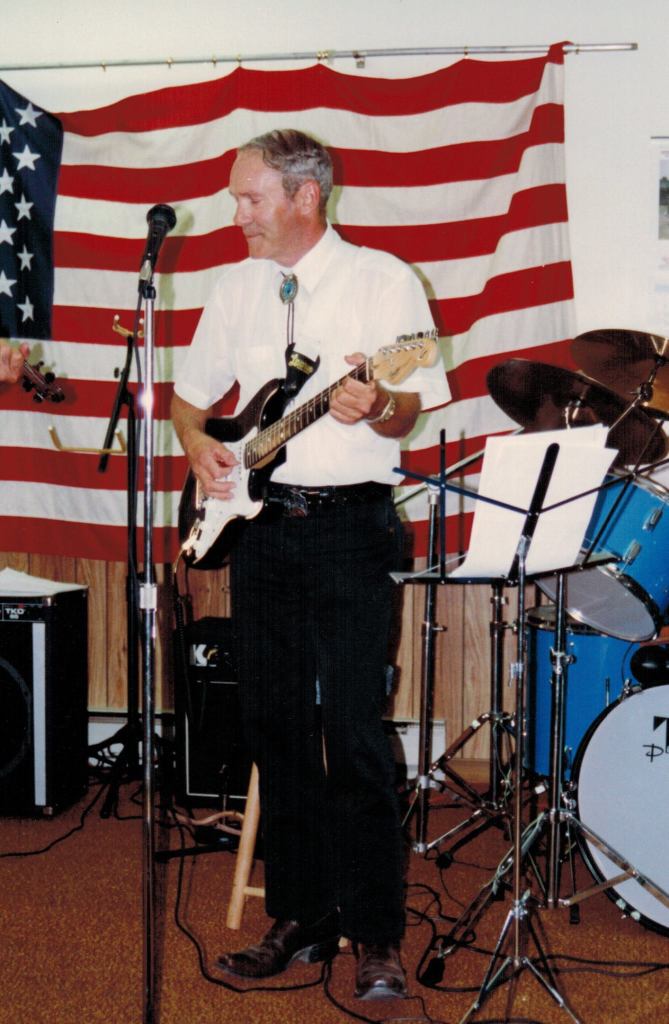
Gary “Tuff” Sutton, Sr., his wife, my Aunt Phyllis, and their two kids, Pam and Gary, Jr. “Butch,” were fixtures in my home. My mother’s youngest sibling, he was the uncle I knew best. He taught me to play the piano, which, like the soda and chocolate, gave me a reprieve from the rigors of the hospital. I’ll forever be grateful.
In case you’re unfamiliar, the Mr. Goodbar is made by Hershey and is little more than your basic chocolate bar, but with peanuts. It’s not fancy, but after a week of hospital food, it was like someone had bestowed on me a feast fit for kings. For the next half hour, we knocked back our RCs and chocolate, and he did his best to take my mind off where I was – he was good at that.
Back in my room, he’d left me with an extra chocolate bar – plain Hershey’s this time – and gave the nurse another bottle of RC to keep cold for me. It was a good day, all things considered.
We lost my Uncle Tuff to lung cancer in 2005. Ironically, another memory associated with that day at the hospital was that he wasn’t allowed to smoke. It was one of the few times I remember seeing him without a smoldering Salem. He was around my life a great deal, and I miss him every day, especially when I sit at a piano – he taught me to play.
But of all the times we had later, playing music with our family band or just sitting around the kitchen table at the farm where I grew up listening to him and my dad tell stories, that one moment at the hospital will always stand out. That was when a little boy, uncertain of his future, forgot for a moment how badly he was feeling, all thanks to his uncle and a candy bar.
I guess the point of all this is that, as children, it’s incredible how things intertwine to create influential memories into adulthood. Then, when we’re grown, we often reflect on those moments, maybe to draw inspiration or clarity. Many events in our formative years leave an indelible imprint on our psyche to help shape our beliefs, behaviors, and aspirations.
Understanding the profound influence of these early experiences offers invaluable insights into how we relate to people and the world as adults. But I wouldn’t dig too deeply. As Sigmund Freud is fabled to have said, “Sometimes a cigar is just a cigar.” In this case, a chocolate bar and a bottle of soda are just a chocolate bar and a bottle of soda.
These moments, whether joyous or traumatic, become the defining chapters of our personal narratives. I don’t really know what long-term effect that single event had on my overall growth as an adult. I know it wasn’t the chocolate that made it special, but rather my uncle’s relationship with me. But, on the rare occasions that I might indulge in a Mr. Goodbar, I still smile and remember.
So, when life’s daily challenges become too much, maybe it would help to think back to one of those moments when a simple kindness, and perhaps a chocolate bar, could bring a smile to your face.
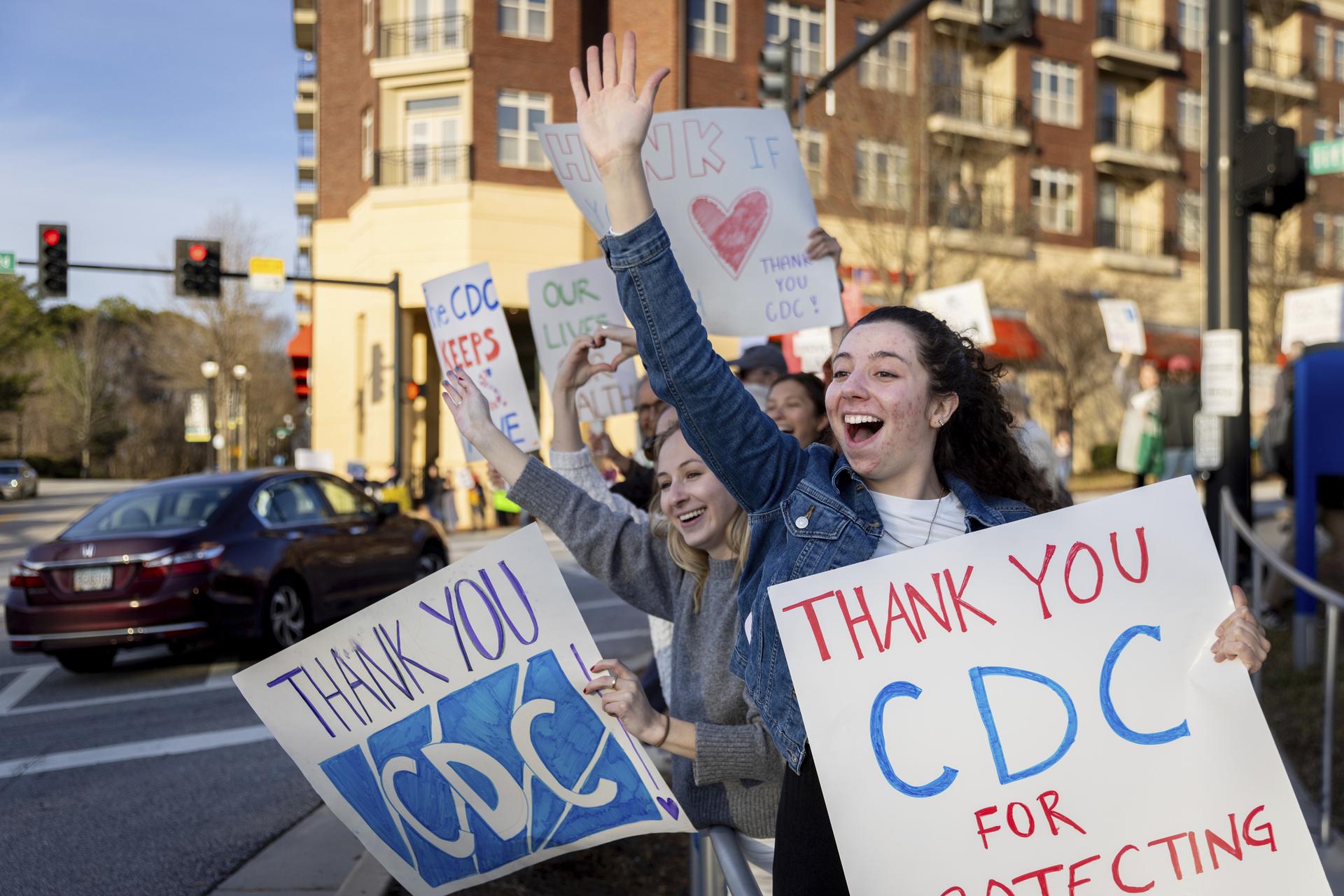
In the news today: The top public health agency in the United States says some employees who were laid off can come back to work; the Trump administration drops a high-profile abortion case in Idaho; and France’s Macron and allies will discuss protecting Europe with French nuclear deterrence. Also, how healthy eating could be tied to good sleep. Supporters of Centers for Disease Control and Prevention employees protest CDC layoffs, in Atlanta, Feb. 18. (Arvin Temkar/Atlanta Journal-Constitution via AP)
POLITICS CDC rescinds termination notice, calls about 180 fired employees back The nation’s top public health agency says about 180 employees who were laid off two weeks ago can come back to work. Emails went out Tuesday to some Centers for Disease Control and Prevention probationary employees who got termination notices last month, according to current and former CDC employees. Read more.
What to know:A message seen by the AP was sent with the subject line, “Read this e-mail immediately.” It said that “after further review and consideration,” a Feb. 15 termination notice has been rescinded and the employee was cleared to return to work on Wednesday. “You should return to duty under your previous work schedule,” it said.
Health and Human Services Secretary Robert F. Kennedy Jr. last month pledged “radical transparency” at the department, but HHS officials have not provided details about CDC staff changes and did not respond to emailed requests on Tuesday and Wednesday.
How many of the reinstated employees returned to work Wednesday is unclear. It’s also unclear whether the employees will be spared from widespread job cuts that are expected soon across government agencies.




 The Jamestown Comet