“How did you go bankrupt?” Bill asked. “Two ways,” Mike said. “Gradually and then suddenly.” Ernest Hemingway’s characters in his 1926 novel, “The Sun Also Rises,” were speaking about money. But I think we go morally bankrupt pretty much the same way. I mean, when did people in our country become so mean to each other, so divisive? Has it always been that way, and I’ve just been too head-down in my own world to notice? Maybe it’s that the only people with a megaphone or resonant rhetoric tend to be the extremists. But the real question is, what is “morality?” That is a complicated question with no definitive answer.
I have always believed that, like so many of life’s perceptions, the idea of morality is in the eye of the beholder. I mean that the concept of decency or morality (and those aren’t the same things) is based on your perspective or what you absorb from those around you. For instance, if you were close to your parents, and they were friendly people who shared what they had, helped their neighbors, and worked hard every day to provide a good life for you, then, odds are, you’ll behave similarly. But it isn’t always so.
If you were not close to your parents or lived in animosity with them for some reason, you might end up the lay-about who steals from the cash register or kicks puppies. But I’m afraid this is slipping into a philosophical discussion of nature vs. nurture, which gets messy. So, let’s move on.
Isn’t it entirely possible that the idealistic concept of morality is simply imaginary, realistically unachievable, and that sometimes people are just bad? My unqualified opinion says yes. But wait, is my position unqualified? I know people, and I can tell when they intentionally cause harm to me or others. I’d say that pretty well qualifies me, or anyone else, to judge bad vs. good. Of course, that opinion remains relative to my point of view. And God knows we all have nasty relatives.
Speaking of God, which I don’t do very much because it’s one of those topics to be avoided at all the dinner parties I don’t go to, like sex and politics. But – when someone says, “God gives us a moral compass.” To that, I will only say this. To which “god” are you referring?
An estimated 700 different creator deities (gods) are worshipped worldwide. If you ask one follower of each, I would imagine they’d all say theirs is the only one. So be it. But, if the wrath of any one of those vengeful, judgmental deities was supposed to persuade people to behave themselves, I think it didn’t work. Think about it, more and bloodier wars have been – and still are – fought over tribal god images than any other reason in the history of mankind. Therefore, any idea of a religiously motivated morality strains credibility.
You alone must decide what morality is for yourself. Look, we all have good and bad in us; one person’s mistake is another person’s malice. A good deed to you might be torture for someone else. Some people think having a woman who displays her bare ankles is immoral, while there are likely people out there for whom any clothing at all would be considered offensive.
The real question is, are there unilateral rights and wrongs (morals)? It’s likely that most people would answer in the affirmative. For example, a vast majority would probably agree that killing is wrong. If you’re steering your morality ship by the Bible’s Ten Commandments, it’s right there in the text: “Thou shalt not kill.” However, it’s often argued by theologians that this is an incorrect translation. Some say the line should be, “Thou shalt not murder,” giving the commandment a very different meaning. Once again, it’s all about interpretation.
As to the original question of whether our society is going morally bankrupt, the interpretative relativity of the facts makes analysis impossible. But, given the constant reports of murder, war, greed, and fanatical extremism in the world gnawing at the very foundation of basic morality, I’d say our account is already in the red.
We are in a new Cold War with Russia. Simply put, Russian President Vladimir Putin is a totalitarian dictator pretending to run a democracy. He believes he is “the chosen one” who can rebuild the Soviet Union to its former glory, and the invasion of Ukraine is the vanguard. But why? What is fueling this resurgence of communist values and acceptance of totalitarian rule by the Russian people? More importantly, what’s that to do with us?
Keep in mind there was never anything glorious about the Soviet Union. It was a political mess. Contrary to pop mythology, it didn’t collapse because of President Ronald Reagan’s “Tear Down This Wall” speech in Berlin. The U.S.S.R. fell apart because it was top-heavy. Political infighting, corruption, defections, and KGB activity, constantly threatened to tear it apart. The country was finally brought to its knees by the weight of a stagnant economy maintaining an unnecessary Cold War superiority, an overextended military, and a laundry list of failed Soviet policies.
The disintegrating infrastructure threw the government into turmoil. President Mikhail Gorbachev worked to rebuild his country with a free market economy, reduced military spending, and open democracy. It was a good idea on paper, but generations of Russian people had known only “the party” and had little understanding of individual prosperity or free enterprise.
The Unholy Alliance – Russian President Vladimir Putin, right, and North Korea’s leader Kim Jong Un shake hands during their meeting in Vladivostok, Russia, Thursday, April 25, 2019. (AP Photo/Alexander Zemlianichenko, Pool, File)
Instead of comfort and security, social upheaval, increased crime, and economic crises threw the country into disarray. History has taught us that when people suffer, all it takes to move the needle toward dictatorship is one man saying the right things at the right time. In 1930s Germany, Adolph Hitler promised a new world for his country under a common rule that would ensure jobs and prosperity. You know what happened next. Although his motivation may not be as sinister as Hitler’s, in Russia, Putin’s just getting started.
Over the last several years, Putin has been spreading familiar, Soviet-era rhetoric—I can save you, Russia will be prosperous again, America is evil, and so on. The people listened and re-elected him for two consecutive, six-year terms. He even signed a law allowing him to run twice more in his lifetime. Since his KGB-era government squashes any potential challenger, he could remain dictator, oops, sorry, “president,” until 2036. But he’ll likely update that law again and stay until his death.
As the war between Ukraine and Russia continues and Putin attempts to rally communist allies in Southeast Asia, it’s clear he has no intention of slowing down. One example is his recent meeting with North Korean “President” Kim Jong Un. In this reporter’s opinion, Vladimir Putin intends to fully reconstruct the U.S.S.R. to how it was in his youth—a world power. But this time, he wants it to be “the” world power. His actions indicate that he sees the current U.S. political system as tumultuous and plans to take advantage of that distraction while he hopes for a Trump revival.
From my observations, Putin sees Donald Trump as a kindred spirit with the same self-aggrandizing, power-hungry appetite. But he also views him as weak, self-serving, inexperienced, and unfocused, with no genuine personal convictions. He says whatever pleases his followers. That’s not Putin’s method of operation.
Make no mistake, Putin’s a narcissist of majestic proportions. But somewhere in there, he genuinely believes he’s saving his beloved motherland from ruin. If he can rebuild the U.S.S.R. while the American people and their allies are distracted by a haywire presidential election and the war in Gaza, America will be too weak to stop him.
My point is that we should be worried—very worried. Putin will continue his advancements. If we don’t end political divisiveness, begin to work together for the common good, and develop a solid geopolitical policy on Russia before Putin’s plans move forward, this revived Cold War could get hot rapidly.
I don’t like to write about politics, and I promised I wouldn’t do it much in this column. But this is important. We must stop the Jerry Springer-like sideshow that’s playing out in Washington and take this year’s election more seriously. The security of our world, the future of our democracy, and the safety of our country depend on it.
TCN Behavioral Health Services, Inc. announces their annual School Supply Drive Distribution Events. TCN annually collects school supplies and donations for the children in their service areas. In 2023 they provided supplies to over 300 children and hope to expand that reach in 2024. The five distribution events listed above will include free pizza and beverages as well as school supplies while supplies last.
“Every year, TCN provides supplies to more than 300 students within our local communities. This helps ensure a successful beginning to the school year for these students, alleviates some of the financial strain on parents and caregivers, and supports educators who frequently contribute their own resources to support classrooms,” says Tasha Jones, TCN’s Executive Administrative Assistant. “This wouldn’t be possible without the dedication of our donors and volunteers.” The five events will be held from 4-6 PM at the following TCN office locations:
Wednesday July 24 – 1825 Commerce Center Blvd, FAIRBORN
Friday July 26th – 1522 E. US Hwy 36, URBANA
Thursday July 25th – 1021 N. Market Street, TROY
Tuesday July 30 – 118 Maple Avenue, BELLEFONTAINE
Wednesday July 31 – 452 W. Market Street, XENIA
TCN accepts donations of school supplies at all locations, or donors can shop the School Supply Drive Amazon Wishlist at https://a.co/i3dO9iF to have supplies shipped directly to TCN for preparation and distribution. The organization also accepts monetary donations at tcn.org or https://tcn.jotform.com/202296368911965 by selecting “school supply drive” in the dropdown menu. Volunteers can sign up to help at their local events here: https://tcn.jotform.com/223056028945962.
Founded in 1990, TCN Behavioral Health Services, Inc. is a comprehensive behavioral health agency dedicated to improving lives by providing clinically excellent and accessible behavioral health services. TCN provides mental health, substance use and psychiatric services for adults and youth in Champaign, Greene, Logan, Miami, and Montgomery counties. For more information or to donate to TCN call (937)376-8700 or visit www.tcn.org.
(Editor’s Note: This is an extended edition of the June 19, 2024 print edition of Deer In Headlines II. Throughout the piece you’ll find links to IMDB pages and YouTube videos which give you more information and even let you watch episodes of the shows mentioned. One link is a full documentary of the events surrounding a 1984 episode of the show, “Press Your Luck.” I hope you enjoy it.)
See if any of these titles spin your wheel: “To Tell the Truth,” “Truth or Consequences,” “Press Your Luck,” “Password,” “Card Sharks,” “The $64,000 Question,” “Who Wants to Be a Millionaire,” “$100,000 Pyramid,” “What’s My Line.” – the list goes on. Welcome to the world of television gameshows, a uniquely American invention that has endured long past the time any survey might have said it would.
Television game shows hit the air almost the moment picture tubes began to glow in households nationwide. The genre may change over the years, and some are downright ridiculous. But whatever you think of them, these programs continue to be a popular influencer of American culture.
According to broadcast historians, the first game show was a radio quiz show called “Brooklyn Eagle Quiz on Current Events.” It debuted in 1923 on WNYC, New York, but eventually achieved national broadcast status, setting the stage for all that would follow.
Game shows are categorized by how the contestants play. Quiz shows, like “Who Wants to Be A Millionaire,” rely on a question-and-answer trivia format. Panel shows, like “Match Game,” use groups of celebrities to move the game along. Activity-oriented programs, such as the more recent “Total Wipeout,” require contestants to do something physical. Reality game shows and talent contests, like “Survivor” and “American Idol,” are relatively new formats. However, it could be argued that shows like “The Gong Show” and possibly Ed McMahon’s “Star Search” were Simon Cowell’s inspiration for programs like “Britain’s Got Talent” and “Idol.”
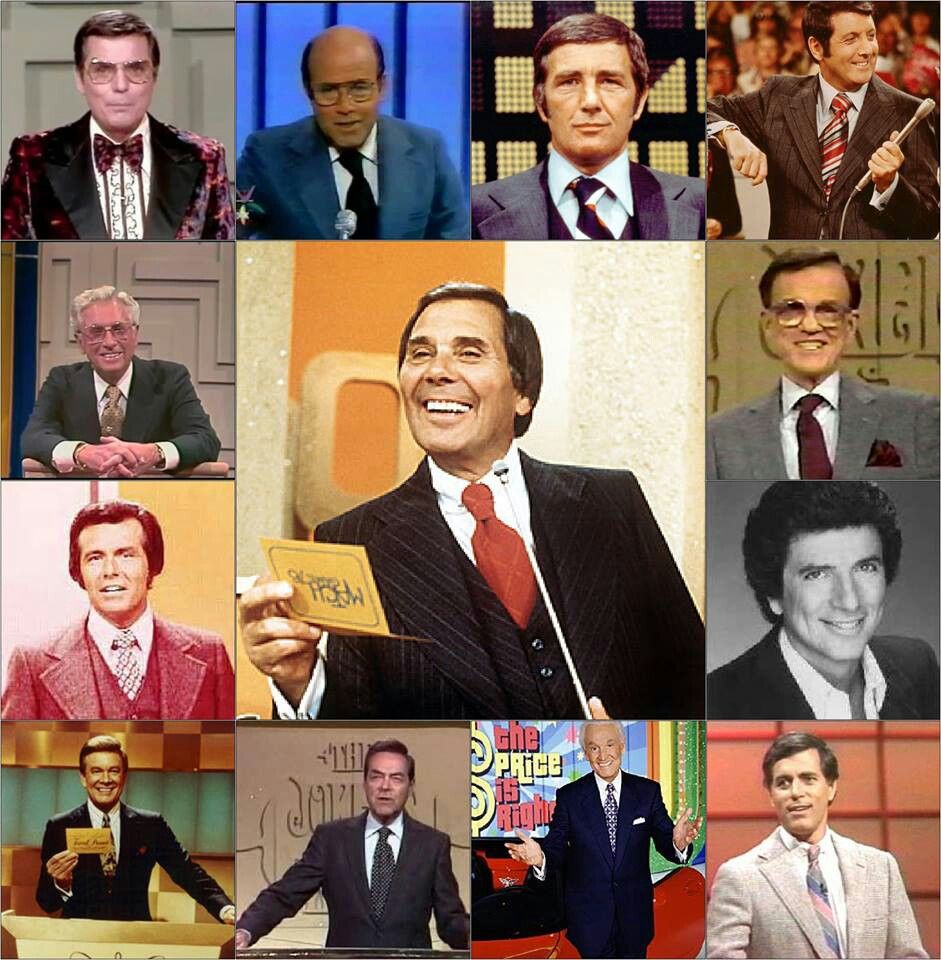
From the 1960s through the 80s, producers of these programs were prolific and turned their hosts into stars. The list includes such performers as Gene Rayburn (Match Game), Monty Hall (Let’s Make A Deal), Allen Ludden (Password), Gary Moore (To Tell the Truth), Chuck Woolery (Wheel of Fortune/Love Connection),Tom Kennedy (Name That Tune), the late Alex Trebek of “Jeopardy!” fame, and many others. As “Wheel of Fortune” host Pat Sajak takes his final spin in June 2024, Ryan Seacrest joins the ranks with other more recent additions like Steve Harvey (Family Feud), Howie Mandell (Deal or No Deal), Keke Palmer (Password, 2022), and Jane Lynch (The Weakest Link, US).
A “host” of hosts … Peter Marshall, Joe Garigiola, Richard Dawson, Monte Hall, Allen Ludden, Gene Rayburn, Bill Cullen, Bob Eubanks, Burt Convey, Wink Martindale, Jack Barry, Bob Barker, and Peter Tomarken.
Many shows started at local TV stations and grew in popularity until they became network products. Although most began at the network level, produced either in New York or Los Angeles, there were a few locals. Around 1975, the Dayton, Ohio edition of “Bowling for Dollars,” a sort of franchised show package that any station could license, was hosted weeknights by long-time radio personality, David G. McFarland. Most local stations chose the cheaper option, however, which was simply to air pre-produced programs like “Wheel of Fortune,” saving thousands on production costs.
At the network level, a staggering amount of money was generated by advertising, and show producers wielded a great deal of power over daytime television. Mark Goodson and Bill Todman produced such long-running shows as “The Price is Right” and “Match Game.” Their programs still generate ratings and money, even the reruns. Chuck Barris helmed “The Newlywed Game” and several others. Talk show host and producer Merv Griffin is responsible for two of the most popular shows still in production: “Jeopardy!” and “Wheel of Fortune.”
“Beat the Clock” started on the radio in 1948 and continued on television in various formats through 1980. Mark Goodson and Bill Todman produced the network TV versions.
Virtually every network scrambled to fill morning daytime slots with gameshows, from card games to shopping sprees. Every type of game or activity was being turned into a gameshow. Even PBS had a game show at one point called “Think Twice,” starring Monteria Ivey. Needless to say, it didn’t last very long.
Like other media, game shows have had their share of scandals over the years. The one with the farthest-reaching repercussions was the 1950s quiz show, “Twenty-One.” Advertisers and producers colluded to provide breakout contestants with quiz answers to keep them in the game longer and drive drama and viewership. Once discovered, convened hearings to determine how the scandal would affect future programs. Eventually, legislation was passed to limit advertisers’ influence over the outcome of these contests.
When he finally became a contestant on the show, Larsen focused on one particular pattern with every spin and timed his hit of the buzzer to stop the board at just the right moment. Through 40 spins, he avoided the prize-stealing “Whammy,” racked up his cash, and went home. The incident was not exactly scandalous, but it was certainly embarrassing for the network.
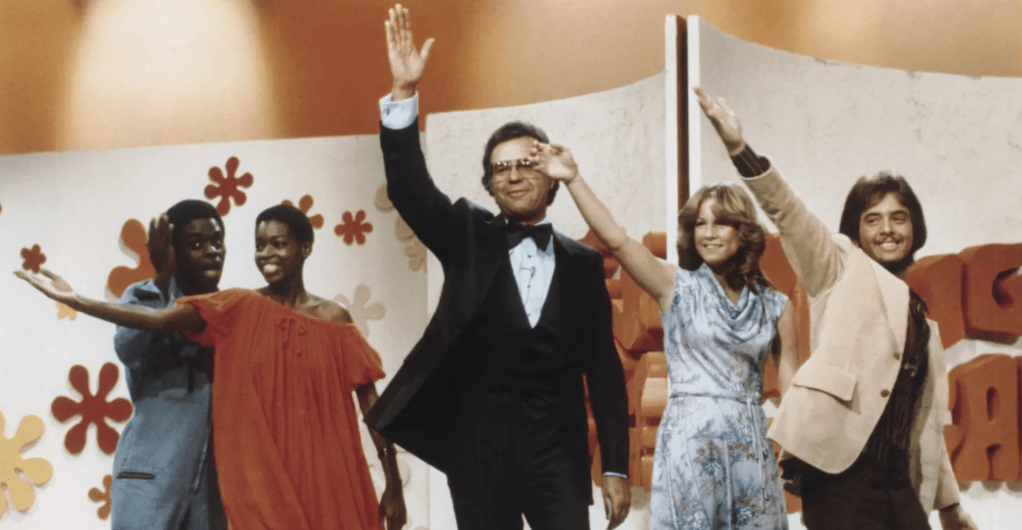
Photo: Jim Lange (center) on ‘The Dating Game’. EVERETT COLLECTION. The Dating Game (1965–1973, 1978–1980, 1986–1989, 1996–1999, 2021)
“Press Your Luck” has seen at least one reboot over the years, but after that incident, the gameboard’s electronics were greatly modified. As for Larsen, he lost a good bit of his money to a home robbery and bad financial decisions. Sadly, he died of cancer just 15 years later at the young age of 49.
Today, three long-running game shows still rule the airwaves: “Jeopardy!,” “The Price is Right,” and “Wheel of Fortune.” “Wheel” and “Jeopardy!” are syndicated programs airing at different times in local markets. However, “The Price is Right” remains a network behemoth that still anchors the CBS daytime lineup.
With its famous phrase, “Come on down,” inviting audience members to Contestants’ Row, “The Price is Right” is the longest-running game show on television. It debuted in 1956 but was revamped some years later. Prior to that, the program was hosted by the venerable “dean of game show hosts,” Bill Cullen. Don Pardo, later of “Jeopardy” and “Saturday Night Live” fame, was one of his announcers.
In 1972, CBS debuted a new, more modern version of the program. The network eventually broke convention by expanding from the typical 30-minute format to a full hour, capitalizing on the show’s wild popularity. They also tapped popular “Truth or Consequences” host Bob Barker to become master of ceremonies. The success of the new format led to a syndicated evening version hosted by Dennis James, also one of the earliest game show hosts.
Today, “Price” is the longest-running television game show at more than 9,000 episodes and Barker spent the last 35 years of his career holding the mic. Upon Barker’s retirement, comedian Drew Carey stepped in during the 2007 season, again giving it a fresh look and attracting a younger demographic.
As Ryan Seacrest assumes the role of spin-maestro on “Wheel of Fortune,” the rest of the show will stay pretty much the same. Vanna White will stay on, although her purpose seems superfluous at this point given the electronic nature of the puzzle board’s letters. She is apparently still needed to tap on a digital screen while someone in the control room pushes a button to reveal the letter.
Game shows generally offer a glimpse of ordinary people in an extraordinary, albeit artificial, situation. Behind door number three, each contestant can hope for a new car, and Monty Hall (and now Wayne Brady) always has a smile and a cash prize for finding that one random object in their pocket.
Those not lucky enough to appear on stage or failed to beat the clock, the buzzer, or whatever received the “home version” of the game they were on.
Some game shows, like Hall’s “Let’s Make A Deal,” are pure silliness, while others offer contestants the unrealistic promise of fulfilling their dreams (at least financially). But modern talent and reality gameshows, like “American Idol,” “Survivor,” and CBS’s “Big Brother,” dangle fame and fortune before their contestants, luring viewers in with contrived drama and fake infighting.
I know what I’m talking about, here. I was a compensated performer on NBC’s “America’s Got Talent” (AGT) in 2006. I met many of the contestants and witnessed their hope and agony as they struggled to meet sometimes impossible demands of producers. The show is crushing to those who compete, some of whom are seasoned, talented performers hoping for a break.
These programs never reveal to the audience the manipulation that goes on behind the scenes as producers subject the performers to the scrutiny of unqualified, B-list celebrity judges. Easy money? Hardly. Quiz shows can be fun and quick entertainment for contestant and viewer. But contests like AGT are arduous, dejecting, sometimes even humiliating for the contestants.
Sadly, it’s unlikely this particular form of gameshow is going away anytime soon. Talent and reality gameshows rake in millions of dollars in ad revenue for every episode, each artificially sweetened and chock full of “unscripted” flavor.
Fear not—the old-school gameshow format is making a resurgence. Thanks to connected TV, you can stream hundreds of these daytime diversions from nearly every decade since their inception. Amazon Prime even includes a channel called Buzzr, a gameshow buff’s paradise that runs them all day, all the time. (Buzzr is owned by Fremantle, the successor owner of the Mark Goodson-Bill Todman game show library.)
Like any other television programming, gameshows must be taken for what they are – mindless diversion. They were never meant to be Shakespeare or Ibsen. As children they often helped pass sick days home from school or gave our mothers something to do while ironing. However you experience them, they’re here to stay. So, until next time, this is Gery Deer saying, “Help control the pet population. Have your pet spayed or neutered. Goodbye, everybody.” (Special thanks to Bob Barker.)





 The Jamestown Comet