Local News & Commentary Since 1890.

Posts Tagged ‘xenia’

Food allergies are no yolk!

In Children and Family, Food, Health, Opinion, sociology, Uncategorized on January 7, 2024 at 12:46 pm

Deer In Headlines II

By Gery Deer

“Then the Whos, young and old, would sit down to a feast. And they’d feast! And they’d feast! And they’d FEAST! FEAST! FEAST! FEAST! They would feast on Who-pudding, and rare Who-roast beast.” – Dr. Seuss’s “How the Grinch Stole Christmas”

Admit it. You just read that in Boris Karloff’s voice, didn’t you? But what if you’re the one Who, for whom a feast could be a culinary minefield? What if you’re the Who who’s allergic to the Who-pudding and rare Who-roast beast?

If you’re like me and the other 26 million Americans who suffer from food allergies, holiday buffets can be a dangerous foray into the unknown. Food allergies might be lampooned on your favorite sitcom, but there’s nothing funny about them. It’s true that most result in mild skin irritation or digestive discomfort, but many are life-threatening.

Within seconds, an exposed victim can experience severe swelling of the throat and larynx, constricting their airway, and even suffer anaphylactic shock. In these situations, quick medical attention is vital.

Whether you’re a member of the allergy club or not, it’s probably a good idea to learn about food allergy causes, symptoms, and first aid. Some of the most common foods people are allergic to include cow’s milk, eggs, fish, shellfish, tree nuts, peanuts, strawberries, wheat, soybeans, and sesame. These are certainly not the only ones, and you might not even know you’re allergic to anything until it hits you.

Just because you weren’t allergic to something as a kid doesn’t mean you won’t be as a grownup. For about half of food allergy sufferers, the affliction didn’t develop until adulthood. I only recently discovered my own allergy to kiwi fruit and cantaloupe. For years, I thought cantaloupe was supposed to burn the inside of your mouth. You know, like a spice or something? Idiot.

Processed food contains a plethora of dangerous ingredients, and most allergens are printed on pre-packaged food labels. Unfortunately, depending on the amount, some ingredients might not be listed. For example, it’s still common for some labels to omit sesame among potential allergens. A Google search might show detailed ingredient lists or allergy warnings for specific products. Otherwise, steer clear altogether.

If you or someone in your family suffers from food allergies, I can offer a few tips to help navigate the holidays, and the first one is a no-brainer. Since many holiday gatherings are potlucks, you can bring your own safe food and avoid everything else. Or you could host the event yourself for peace of mind. If you do host, label the dishes, and maybe, if you want to be an allergy-safe superhero, provide a full list of ingredients.

For children, carry safe food, or see to their plate for them. Kids also seem especially sensitive to nuts, and holiday goodies are full of them, so keep an eye out. To avoid cross-contamination, use disposable utensils to serve yourself or carry your own flatware. Trust me, it’s worth the trouble.

Incidentally, some people are quite sensitive about publicly outing their allergies. For instance, I am allergic to eggs. But I’d rather not discuss it because I feel like a freak. If it comes up, I get bombarded with questions like, “Can you have cookies? Bread? Pancakes? What do you eat for breakfast?” And on and on. People just can’t leave it alone.

I understand they’re curious and trying to be helpful. But the nature of the allergy can be difficult to explain (although I really shouldn’t have to), and it doesn’t affect anyone but me. I never ask hosts to alter their menu or anything they’ve planned. I simply avoid those foods that might be dangerous or questionable.

For the food-allergic out there or their caregivers, you might want to ask your primary care physician if you should carry a preloaded epinephrine injector (otherwise known as an “EpiPen”). If your allergic reaction were to cause respiratory distress, it might be a good idea to be prepared. A food sensitivity test might also help.

Food allergies don’t have to wreck the halls – or any other occasion. All you need is a little preplanning so that no one turns as green as the Grinch after a helping of your famous Who hash.

GCCOA Hosts Memory Loss Presentation

In Children and Family, Dayton Ohio News, Health, Local News, psychology, Science, Senior Lifestyle, Uncategorized on January 4, 2024 at 1:47 pm

The Greene Count Council on Aging is hosting a free memory loss information session titled, “Is It Dementia?” The event will be held at 2:30 PM, on Wednesday, January 10th, at the Xenia Community Center, 1265 W. Second St., in Xenia. Seating is limited, so please call 937-376-5486 or email YourFriends@gccoa.org to reserve yours.

From the GCCOA information:

We all experience memory loss at one time or another and many of us are fearful of what it might mean. Is it ‘normal’ memory loss or is it caused by dementia, such as Alzheimer’s disease?

Experts will answer your questions, address your concerns, discuss the types of dementia and explore things to consider as a caregiver or someone wanting to learn more about memory loss and dementia.

From the editor: For more on dementia, here is a study from Columbia University’s Irving Medical Center – https://www.cuimc.columbia.edu/news/one-10-older-americans-has-dementia

Deer in … headlights.

In Business, Health, Local News, Opinion, State News, Uncategorized on December 29, 2023 at 9:10 am

Deer In Headlines II

By Gery Deer

A few weeks ago, I was driving along minding my own business when a deer decided it would be a great time to remodel the front end of my pickup truck. It was dark but I was neither sleepy nor distracted yet saw nothing in advance of the collision. The animal seemed to come from out of nowhere. There was a loud, metallic bang, a hard shudder, and the hood of my truck popped straight up in front of the windshield.

Fortunately, I could see well enough around the hood to get the vehicle to the side of the road. Once I stopped and the dust had settled, the first words that entered my mind were, “So that happened.”

I called 911 to report the accident, and no irony was lost on either me or the dispatcher about a guy named Deer hitting a deer. Not to worry, she was great and sent an officer right away. If you have followed my column, you know this was certainly not my first traffic accident, nor was it the most serious. It was, however, my second deer strike in about four years. Enough, already. I’ve met my quota now, right?

Here’s a photo of Gery’s Ford F-150 truck from this article. It was totaled.

I think I was most upset because I had recently paid off the loan on the truck and, just that morning, even ordered new tires. Ever the optimist, I remember I laughed out loud and said to nobody, “Well, at least I don’t have to buy the tires now.” Like they say, onward and upward, right?

Hitting a deer on an Ohio roadway is almost a rite of passage. I’m surprised our driver’s education classes don’t include a section detailing what to do after a deer strike. I can hear it now, in the best 1970s filmstrip narrator’s voice. “After you have hit the animal, get out to see if it’s still alive. Oh, it’s a six-pointer! Be careful. Those antlers are sharp!” Then, it would go on to tell you to call the police and decide what to do with the carcass.

Here in the Buckeye state, if you hit a deer with your car, you’re entitled to keep it. What you do with it after that is entirely up to you. The first time it happened to me, the responding police officer asked if I wanted the carcass, and I said no. Then she said, “Well, you’ll need to decide which of the guys arguing over it gets to take it home.” Seriously? I told her to flip a coin. In hindsight, I should have sold it to one of them. After all, I was out a truck, and they got free venison.

Between hunters flushing them out of the woods into the road and people feeding them on the back porch, deer strikes are becoming more problematic every year. I read an Ohio highway statistic that vehicles had hit more than 13,000 deer in 2022. I can believe that. The day the body shop picked up my truck, the flatbed driver told me he’d hauled four other deer-damaged vehicles just that afternoon. With an overall deer population in the state just under 800,000, I’m surprised the accident tally is so low.

What can you do to avoid hitting a deer? Unfortunately, there’s no easy answer. The problem with deer is that they’re jittery, indecisive, and never travel alone. Trying to outguess them will get you hurt or worse.

The best things you can do are buckle up, drive with your bright beams on in rural or wooded areas, and always remember when you see one, there are always others. By the way, those deer whistles that you stick to the grill don’t work — a siren, maybe, but not those.

Above all, avoid distractions while driving, especially at night. No text, call, or cigarette is that important. Put that stuff down and pay attention to the road. Trust me, it takes only an instant for everything to change.

Although my truck was totaled, it was at least large enough to protect me. I have seen deer go up the hood and crash through the windshield, seriously injuring the driver and passengers. So, please watch out for those… deer in headlights.

Publication Notices: Deer In Headlines and Deer In Headlines II are media properties of Gery L. Deer and GLD Enterprises Communications, Ltd., who is also the copyright holder. The product is distributed via The Jamestown Comet.com (A property of GLD Communications), and by Green County Newspapers / The Xenia Daily Gazette by special permission.

Don’t Panic!

In Books, Education, Entertainment, Health, Opinion, psychology, Uncategorized on October 17, 2023 at 7:50 am

Deer In Headlines II

By Gery Deer

Don’t panic! That’s rarely what you want to hear at those crazy moments when, odds are panicking is exactly the thing you should be doing. The dictionary defines “panic” as a sudden, uncontrollable fear or anxiety, often causing wildly unthinking behavior. Reactions vary widely, from a little nervousness to a full-on panic attack, complete with hyperventilation, rapid pulse, excessive perspiration, and much more.

Fortunately, I’ve never really been someone who panics. I’m generally calm in high-stress situations. Adrenaline probably creates a false sense of clarity and focus. I would say I’ve experienced anxiety, tension, and worry, but nothing I would call panic. It made me wonder, what makes you panic? It’s likely that you’re not alone in your apprehension. So, here are some things that commonly make people panic.

Number one on the list, meeting the potential in-laws for the first time. This is a great one. Symptoms include sweaty palms, a terrible sense of inadequacy, and the feeling that you just swallowed a lizard – and it desperately wants to come back up.

Next up is the dreaded job interview. You spend the days and hours ahead of the big moment researching, reading self-help blogs about how to prepare for interviews, and generally freak out. And talk about sweaty palms, you nearly break into a human sprinkler system just sitting in the lobby waiting for your turn. That bouncing knee, what even causes that?

What about being stuck in an elevator? Do you panic then? It might be comforting to know that fewer than 50 people die in elevator-related accidents every year in the United States. Fatalities range from falling cars to being caught in the doors between floors. Gruesome! But, what are the odds of you being one of those people? You have a better chance of being hit by lightning or winning the lottery, now that should bring on some panic.

You’re lazily riding your bicycle down the street and suddenly realize the neighbor’s Jack Russel is out and has slipped his tether. There is nothing more panic-inducing than a small dog chasing you on a bike. I never worry about the big dogs; they give up at the end of the driveway. But the little ones, oh dear! Just pedal faster and don’t turn around!

A first date. More sweaty palms, overthinking your clothes, and whether your car is cool enough to impress your date. Will you say the wrong thing, talk too much, or manage to seem interesting enough to get a second date? So much at stake and yet nothing at all.

Something I never thought of before – automatic flushers in public bathrooms. My niece shared with me that some people are afraid that the toilet will flush while they’re sitting on it. It’s the anticipation of when the flush happens that apparently induces the anxiety.

Oh, and remember the panic you felt back in grade school that accompanied report card day? (Yes, I’m old. Grade reports were once on paper.) Brow-soaking worry would set in about the grades the comments be, and, above all, will Mom or Dad sign it.

Vacation is supposed to be a relaxing, fun time with family and friends, a break from stress and worry. So, imagine you’re out on the open road and you just passed the first exit you’ve seen for hours and, suddenly, your car’s “low fuel” light comes on. The gas gage is bouncing on “E” and now you start to worry. Will you make it to the next exit? Your car isn’t fancy enough to have the estimated fuel and mileage indicator so you’re in the dark. How much gas do you have left? Can you make it to the next exit?

What else can induce panic? How do you combat those feelings? Sometimes you can avoid things, but often, you just have to face whatever it is, head on, and move forward. Panic is caused by feelings spun up by thoughts. When I feel anxious or worried, I do my best to try to alter my thoughts, which, hopefully, will change my feelings and I can remain calm. Maybe you can find some practice that will help you do the same.

A House Divided

In Dayton Ohio News, Education, finances, Food, Health, history, Local News, News Media, Opinion, Politics, psychology, Senior Lifestyle, Uncategorized on September 2, 2023 at 2:47 pm

Deer In Headlines II

By Gery Deer

When I restarted this series after a 5-year hiatus, I decided to steer away from politics, religion, and other hot-button topics in favor of more personal subjects. That said, I’ll dip a toe into that pool only enough to express my concern at the level of divisiveness now facing our country and who actually pays the price for it.

The political climate in America today is toxic, with no end in sight. Everything is viewed only from one side by an ill-informed, angry citizenry and uncompromising elected, uncivilized government officials. Over the long haul, we simply can’t function that way. Our legislators must work together in order to govern, even to manage the most basic issues. Unfortunately, that seems unlikely to change when the only people getting attention are the radical extremists.

Regardless of your ethnic background, or whether you’re conservative, liberal, or whatever, surely there are things we can all agree on, right? For instance, instead of spending hours on cable TV news bickering about who caused inflation, wouldn’t our collective energy be better spent on ways to help people get through it? Meanwhile, our dedicated elected officials spend taxpayer money riding around in limousines, secure in their healthcare, paychecks, and benefits, all guaranteed long after they’ve left office.

More absurd is that, in the most powerful and wealthiest country on Earth, there are still people who can’t get enough food, shelter, or other necessities – particularly the elderly, veterans, and children. No, it’s beyond absurd, it’s criminal. This problem affects everyone. The number of working poor continues to grow, most of my family included. Most people are only a paycheck or two from ruin. All it takes is one major catastrophe and boom, we’re on the street. Regardless, people from every side are too busy waving flags and hating each other’s politics to care or do anything about it.

Recently, I did some work at a food pantry and had the opportunity to learn more about the mission of these organizations. I am shocked about how necessary they are in so many communities. In just one year, the number of families served might double, so they must continually find new ways to meet the constantly growing demand.

You might be surprised to know that the people who most need services like this are not homeless or indigent. They are instead the working poor, single-parent families, and, sadly, veterans. No one should feel ashamed of taking help from those who offer it. But I can’t imagine how hard must be for someone who proudly served our country and then is forced to go to a food pantry just to have enough to eat.

The number of military families and veterans who need various types of assistance is also surprising. They include elderly or disabled veterans, military wives and husbands with young children trying to make ends meet while their spouses are deployed, families of all ages and backgrounds, and the kids, wow. Watching a child’s eyes light up over a book or something as simple as a Twinkie or a fresh piece of fruit can be simultaneously enlightening and heartbreaking.

Again, while the politicians ride around in limousines and kowtow to mindless followers during ridiculous cult-like rallies, the people they claim to be fighting for wait in lines at food pantries. They have no money, little healthcare, and a veteran affairs system that’s so broken it needs to be razed and rebuilt from the ground up.

These issues aren’t conservative or liberal, Muslim, Jewish, or Christian. We are so blinded by ridiculous ideologies and political divisiveness that we can’t see the real responsibilities facing our country – poverty, homelessness, substance abuse, an ever-changing job market, and so much more. Certainly, we could all get together on some of these things. Nope, it’s just not going to happen.

The people I meet in these situations don’t want handouts. They want to be understood and for their elected legislature to work for not against them. But until we put down the flags, turn off the news, and choose to be better human beings, nothing will change. So, all I have left to say is to quote my favorite president. “A house divided cannot stand.”

You’ve got this.

In Children and Family, Opinion, psychology, Uncategorized on August 28, 2023 at 10:25 pm

Deer In Headlines II

By Gery Deer

If you have followed my series for a while, you know that I dealt with a lot of health problems growing up. From birth, until I was about 21, I had around 200 different procedures and surgeries. Some were experiments, with unknown outcomes, and others were common procedures as some type of intermittent step from point A to point B. Some went perfectly, others did not. Something that I learned through all of that was a fierce sense of what I’m going to call determination.

That determination came from a confidence, not in myself, but in the physicians, my parents, and my family. Not for one second did I ever doubt I would make it through something, even with talk like, “This procedure may limit his ability to walk,“ or, “Recovery could take up to a year,” or my favorite, “This one’s pretty involved“ – like the others weren’t? Yeah, sometimes it didn’t sound too good, but everyone kept reassuring me and, to my kid brain and blind faith in those looking after me, I knew everything would be alright.

As a child, the only dependable sources for accurate information and support are the adults around you. It’s not like your playground friends could be much help. Most of mine didn’t even understand what was going on with me – and didn’t care. Such ignorance generated the incredible amount of bullying that I endured (kids are awful). The irony was, none of the hurtful things they said about me had any basis in fact. Actually, most were downright science fiction. But, through all that, I still believed all would eventually be OK. No, it was more than that. The truth is no other outcome ever crossed my mind. This was my world and I would get through it.

Today, I carry that same fortitude, grit, or determination; call it what you will. I’ve experienced my share of depression as an adult, mostly related to the deaths of my parents. But, for the most part, I am just not wired to perseverate on negatives. I realize the good in a problem may be pretty hard to find, but it’s there. It’s not about being a “glass half-full” kind of person, but rather I prefer to be a realist. I look at all the negatives and I’m firmly aware of everything that can go wrong (or already has). Dwelling on all of that will not change the outcome one bit, but it will keep me from having the energy to fight through it.

I’m afraid I don’t have your answers and positive thinking is simply not enough. We all have to try to find proof within ourselves that life is worth living. Even the bright spots are buried deep down you have to try to recognize them. I always say that some part of me fought to survive to this point, so I would just be letting myself down if I give up now.

The bad news is, I don’t know how to tell you to do any of that. And I have more bad news for you – neither do any of the self-help gurus. They’re all throwing out a bunch of dimestore psychobabble. They wrap it in rainbows and sunshine, drop it between the covers of a badly-written book, and advertise it to you on Amazon for $23.95. But, for all of that, they really have no answers. Here’s a secret, though – you may already have the answers you need. Yes, you will have to make the effort and take the time to find them.

That may be really, really hard, and anyone who says otherwise is full of crap. We all face things that we think we can’t get through, and some of them we don’t – the residuals of those events stay with us. Life is hard but it is not impossible. If you leave the gate thinking the race is lost, then what hope is there? So, for what it’s worth from me, whatever’s going on, I know you can handle it – and so do you. Hang in there. Find your bright spot, hold onto it, and don’t let anybody deter you. You’ve got this.

We weren’t always old.

In Local News, Opinion, psychology, Senior Lifestyle, Uncategorized on July 14, 2023 at 6:08 pm

Deer In Headlines II

By Gery Deer

An elderly gentleman sat quietly in a wheelchair, hunched and feeble, and his tired eyes peered through thick, smudged glasses. What remained of probably a head full of dark, wavy locks now lay in thin, white whisps. A young woman in a healthcare uniform sat next to him, smiling as she helped him eat some pudding from a small plastic cup. He looked longingly at the family sitting across the room entertaining what he assumed was a grandparent. His thoughts wandered back, 30, 40, and 50 years, to the days of his youth, as a young husband and father.

He remembered the excitement of family vacations, the birth of his first child, his first job and promotion, and buying their first home. So many things had happened, so much time, so much life, so many had gone on before him, so many yet to come. To him, just a moment ago, he was a young man, but now… He glanced again at the family, and around the room at the other residents of the nursing home.

“We weren’t always old,” he whispered under his breath, a single tear sliding from beneath his heavy glasses. The woman continued to give him the snack until the cup was empty. A moment later, he’d dozed off and she was pushing his chair back to his room.

I saw countless scenes like this while I cared for my parents. Life has a way of teaching us things, whether we are willing students or not. As we age, begin to understand pearls of wisdom shared by our parents, grandparents, and teachers. Somehow, the man’s lament of “we weren’t always old,” stuck a chord with me. I wasn’t either.

For some reason, the young seem to ignore the person behind the white hair, walkers, and wrinkles. Somewhere in there is the person they once were, young, vibrant, active, and productive. They were actors, writers, salespeople, teachers, police officers, musicians, mothers, lawyers, doctors, and so much more. They were somebody, and we should never forget it!

Everyone’s got that grandparent, aunt, or uncle, who sits in the corner at holiday dinners telling stories of the old days, but almost no one listens. They’ve heard the stories over and over as if the person’s mind is locked into that point in their life history. I learned a lot about my dad while I was caring for him. He would sit and tell me stories as we worked a puzzle or watched an old western on TV. I tried hard to understand who he was beyond the man I knew as my father. I’m not sure many people ever do that with their senior family.

As we age, we are still people, still individuals. We can still dream, imagine, love, care, create, understand, learn, and grow, but the system doesn’t always let us. Eventually, we will outlive our societal usefulness. We’re parked in Hell’s waiting room as our relatives wait to argue about who gets the junk we leave behind. It’s no wonder our minds retreat to better days. It’s ridiculous, and it’s pretty sad. There is so much to learn from our seniors, so much history, life lessons, and experience, all of which would benefit us to learn and absorb.

It’s strange how we treat the elderly in this country. In government, we routinely elect and re-elect people who stay in power for decades, until they finally age out to illness or die in office. Most are still holding political office many years after corporate America would have shown them the door. But most of the rest of us are “put out to pasture” at what is arguably a very young age. Illness notwithstanding, senior citizens still have a great deal to offer. They should be the schoolteachers, counselors, and mentors.

 Our society might be in better shape if our youth paid more attention to the mistakes and successes of past generations instead of constantly trying to reinvent the wheel. So, my advice to the younger folks out there is simple – spend more time with the older folks in your lives. Pay attention to their stories – listen and learn. You never know, you both may learn something!

My Closest Calls

In Health, Local News, Opinion, psychology, Technology, Uncategorized on July 9, 2023 at 10:27 pm

Deer In Headlines II

By Gery Deer

One bright, sunny summer day almost 30 years ago, I was driving my brother’s grain truck along a quiet country road near Spring Valley, Ohio. About a quarter mile ahead, my Dad drove his own truck, leading the way to where we would be collecting a load of hay. Our trucks were big, 6-wheeled, lift-bed grain boxes, about 10 tons each, and Dad was always leery about moving too fast on those old back roads, so we were just taking our time.

Just a few miles from our destination, a cement truck whizzed past him in the oncoming lane. It was the big kind with a small, metal cage for a cab, a long barrel with the engine trailing behind, and large balloon-like tires. I heard his voice over the CB radio warning me to beware as it approached. Barely a moment later, I was eye to eye with the driver as suddenly an explosion of glass, tearing metal, and a cloud of dust engulfed me. Our two massive steel machines had collided, left front fender to left front fender, and the sound was like nothing I can adequately describe.

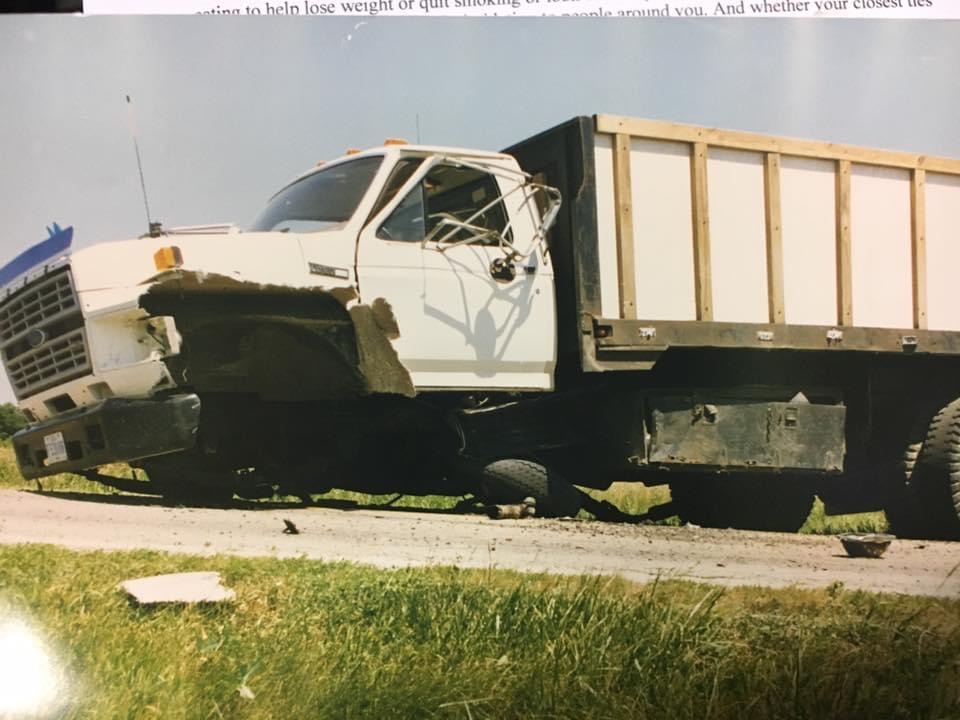
It was over as instantly as it had happened. What only seconds before had been a clean, powerful machine, and the center of my brother’s livelihood, was now little more than a pile of scrap. I had done what I could at the instant of impact to stop the vehicle. But, it was no use, the pedals were no longer connected to anything – neither was the steering wheel. As it came to rest, the truck’s lower frame plowed into the asphalt, like the Titanic’s bow crashing into the ocean floor. The cab and running board were severely damaged, the mirror shattered, and the door was caved in. The front axle and wheels were gone and the steering shaft snapped off. Moreover, there was no sign of my assailant. The cement truck was gone!

Behind the motionless, dead hulk of my truck, in a hay field, nearly a quarter of a mile away lay the twisted wreckage of the cement truck. It had telegraphed off of my truck, slamming into my frame multiple times, rolled behind me at full speed, and snapped off a power pole at its base – leaving a transformer suspended in mid-air by its cable. Then it spun out of control, careened down a long hill, and came to rest, upside down and backward. By some bizarre miracle, the driver, wearing no seatbelt and, according to the police investigation, moving twice my speed, had managed to survive relatively unhurt, as did I.

This is the truck … after.

Oddly, the casualties were limited to the two trucks and my Dad’s wits – as in frightened out of. He had to watch it all happen to me in his rearview mirror. By the time my truck had come to a stop, he’d bailed out of his and was running toward me yelling my name to see if I was OK. I was far more worried about him, though. 

I’d never seen him that shaken, out of breath, pale. When he saw I was unhurt he seemed to calm down. I was busy tossing my belongings out of the open, or rather, shattered, window, and trying to figure out how to get the door open. Once I was sure both Dad and I were OK, I told him to go check on the other driver while I used my cell to call for help. A few minutes later, I heard sirens coming up the road, and within moments the county sheriff’s deputies arrived. All would be OK – at least until my brother got there. Yikes! But that’s a story for another time. 

I will forever appreciate how fortunate I was that day. I can’t imagine what would have happened had either truck been a few inches one way or another. Life’s a gamble, every day. I think we always need to recognize how quickly things can change direction – through no fault or action of our own. Appreciate the positives, stay strong through the negatives. And remember, to live your best life. You never know what turns it might take one day.

The First 10 Miles

In Children and Family, Education, Health, Opinion, psychology, Senior Lifestyle, sociology, Uncategorized on July 1, 2023 at 1:40 pm

Deer In Headlines II

By Gery Deer

I took up long-distance tour cycling in 2017 to give some direction to my fitness routine. I am definitely no gym rat, but I needed to improve my health, and exercise for its own sake was, at least to me, mind-numbing. Preparing for long bicycle tours provided a tangible goal and kept me more engaged.

Growing up in the middle of nowhere, a bike was the only way I could get around, especially when the nearest neighbor kid was a couple of miles away. But this was a different challenge. With higher speeds, longer distances, and greater safety risks, I had a great deal to learn. 

I took the time to learn everything I could about endurance cycling, from choosing the right equipment to managing my food. The first year, I rode about 5 days a week, covering anywhere between six and 12 miles per day, while also maintaining my core and strength exercises.  

With practice, study, and the right workout regimen, my speed, distance, and endurance all improved. That first summer, I completed two, 100-mile, or “century,” rides. Since then, I’ve done six more, averaging two per year. 

I’d never been so driven to accomplish something that physical. I basically became an athlete, and that was never on my radar. Plus, it was as much mental as physical, maybe more. My friends and family probably thought I’d lost it. At 49 years old, I was in the best health of my life and broke physical barriers put in place from the day I was born. It required careful planning, long hours in the saddle, conditioning, and determination.

Any challenging goal always has prerequisites. Maybe you call them milestones or baby steps, whatever. The point is that these smaller goals help measure your progress and keep your eye on the prize. There are no “hacks” to anything worth doing and, if you find one, it’s probably going to rob you of valuable lessons and potentially derail the whole effort. 

The problem with most long-term goals is that people sometimes try to jump to the end, skipping vital steps. People who quit smoking cold turkey, for example, often fail because there are no step-downs to help eliminate, not just the addiction, but the habits that feed it. With cycling, you have to learn to ride 5 miles before you tackle 10, which leads to 20, and so on. More importantly, it might take time and practice to recognize each stage of achievement and what it means to your overall success.

For instance, my average training ride is around 20 miles, but even now, I struggle a bit in the first 6-8. I feel awkward, uncomfortable, and unfocused. It can be discouraging, sometimes even painful. But, as I push ahead, everything starts to smooth out around the 10-mile mark. My body settles into the bike, my cadence has a rhythm, my speed and efficiency improvements, and I become more mentally focused. 

My typical goal is generally far more than 10 miles, but I’ve learned to value that milestone because of its significance to my final goal. When you understand which smaller steps have the greatest impact on your final goal, each subsequent step becomes easier and more valuable. 

Recently I participated in the shortest organized cycling event I’ve ever ridden – 21 miles. There is no fanfare for a ride like this, just people who want to ride in a supported event with fellow cyclists. As expected, the first half of the ride was a little slow and clunky. 

I didn’t have the speed or rhythm I wanted, and the distance didn’t give me much time to “get into it.” But I pressed on, and, just like always, around the 10-mile mark, everything shook out and I even managed to set a speed record for myself. But I learned something different from the experience.

My “first 10 miles” could also be a metaphor for recognizing our strengths or shortcomings as we work toward any goal. Manageable, short-term accomplishments make the overall effort more rewarding. Hopefully, moving forward we learn and adjust, keeping a clear vision of the finish line. Before too long you’ve met your goal and your obstacles are in the rear-view mirror.

A sharper image

In Children and Family, Education, Health, Opinion, Uncategorized on June 23, 2023 at 4:36 pm

Deer In Headlines II

By Gery Deer

When we meet someone, we form mental and emotional impressions of them based on personal behavior, past experiences, and other characteristics. That collection of impressions, what I call their “image,” becomes who we know them to be and there’s a lot riding on it. It defines how we relate to them for the duration. But when there is a serious conflict, that perception can be radically altered, forever.

Unfortunately, the perceptions we have of people are incredibly fragile. It takes very little to destroy how others see you, transforming you instantly from a cherished friend or family member to persona non grata.

A mean-spirited word, a slammed door, or even a disconnected telephone can escalate things, and then we start to fight back. Whether or not we are in the right, it’s pretty natural to become defensive when words are weaponized, our character is put into question, or our feelings get hurt. Of course, that just makes it worse.

Amidst such a vehement exchange, personalities may seem to alter as you each posture for a fight. All at once, a person with whom you have had a long, trusting connection no longer recognizes you, nor you them. Their understanding of who you are is suddenly and forever changed and any safety within the relationship is seemingly lost forever in the heat of the moment.

So how would they see you then? What happens to the relationship? Can it be salvaged, or, some psychologists might ask, should it be salvaged? That depends on how often such things occur, the depth of the emotional injury, and the circumstances.

When these conflicts occur between the same people, it becomes harder for them to see each other in the same light as before. The previous state of the relationship may never be recovered. The only hope may be that both people are willing to work together to prevent it from happening again.

It should go without saying that everybody needs to be on the same page, they must know what they want out of the resolution. Are they trying to rebuild the relationship and see each other the way they did before? Or are they merely patching it, hoping the problem doesn’t resurface, but without any real strategy to prevent it?

When perceptions change significantly, it may not be possible to see each other as before, reducing any desire to resolve the problem in the first place. It might not seem worth it at that point. The question is, can you accept the other person for how you see them now and start over?

More importantly, were you seeing them accurately in the first place? How much of who they are in your eyes is based on who you wanted them to be? An argument might simply have revealed a side of them previously unseen. Then again, that could be your incomplete perception.

Reading back through these paragraphs, I realize I’ve given you a lot of questions and very few answers. That’s because each situation is different and the outcome depends on personal dynamics, emotions, and circumstances, there is no cookie-cutter solution. That said, as with so many things in life, communication is key.

Effective communication must be a two-way street with dialogue, understanding, and, most importantly, patients. Each person must be willing to do their best to understand the other’s point of view and work toward a positive resolution. A word of warning also, avoid dredging up old arguments because it will kill any hope of saving your relationship – let it go! And never underestimate the power of a sincere apology.

If you do manage to work things out, understand first that any relationship is an ongoing process requiring practice and patience, and it will be different than before, changed for the better. You’ll be moving forward from a more solid foundation.

I’m the first one to say this sounds like a bunch of self-help chicken soup. It certainly does, but sometimes that’s necessary. Still, I know that I’ve ruined my share of relationships because I was so worried about defending myself or being right that I forgot how much the other person meant to me. You can avoid that same stupid mistake.

Is this your new site? Log in to activate admin features and dismiss this message
Log In