Local News & Commentary Since 1890.

Posts Tagged ‘politics’

Voters can’t handle the truth

In Business, Economy, Education, Local News, Media, National News, Opinion, Politics, State News, Uncategorized on October 9, 2012 at 9:03 am

Deer In Headlines

By Gery L. Deer

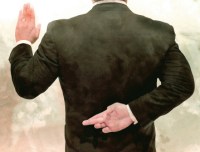
Politicians distort the truth and exaggerate facts to elicit effect from an audience. All of them do it. The idea of any candidate being open and honest is not only unbelievable, but would likely bring the American political system to a dead stop.

No one is going to be completely honest and the determination of whether a politician is lying is in the eye of the beholder. Unfortunately die-hard fans of a particular candidate will insist that it’s only the opponent who lies. The hard, cold truth is, they all “lie.”

In the Star Wars film series, mentor Obi Wan Kenobi warns Luke Skywalker that many of the truths we cling to in life depend greatly on our point of view. Nowhere is that a more appropriate statement than in the political ring.

Often, distortion of the facts is an effort to cover uncertainty or a lack of knowledge. No one could possibly provide an answer to every problem and, rather than appear weak or uninformed, a candidate has prepared a neutral response to counter his or her lack of a solution. Voters should learn to read between the lines and determine whether this behavior is a character flaw or the nature of the job.

Sometimes a candidate, in a moment of either clarity or misstep, will betray his or her thoughts. Mitt Romney’s off-the-cuff remarks about the 47-percent of people who will vote for Obama because of the president’s predilection for endorsing entitlement programs is a perfect example of what can happen when a candidate’s true thoughts come to light.

Political candidates are under intense, constant scrutiny. Every word, every step, every mispronounced name can affect their overall image and subsequent performance in polling. Even misspeaking can be inferred as a lie and bring a campaign crashing down at any moment.

No matter how carefully words and phrases are chosen, however, they can still be used out of context to paint a candidate with a single brush stroke. Generally referred to as “sound bites,” the act of hacking up entire speeches into 30-second snippets has become far too common and can lead the listening public to the wrong conclusions.

Along the same concept, political advertising should be focused on informing the public about the intentions of the candidate. Instead, the point of these messages is to tear down the other guy, discrediting the opposition to the point of exclusion. Millions of dollars are poured into these ads just so each campaign can go back and forth on television, radio and on the Internet, just trying to counter the latest round of jabs from the other side.

Print or broadcast, generally the ads follow a simple pattern. One candidate takes a stab at the opponent’s position on something which is then answered from the other side with an accusation of lying about it, followed by some kind of weak rebuttal. But who is actually lying? Once again, that may depend on a point of view.

Developing and keeping on track a strong platform is tough for a political operative in today’s 2-minute news cycle. Since the American voter tends to go on hearsay and emotional preference rather than fact, it’s nearly impossible to maintain a consistent message. Much of the time is spent on damage control, like the president is doing now after his lackluster performance in the first debate.

Still, whether or not a politician lies is almost irrelevant to the modern voter. Americans seem to be more interested in trivial issues than the larger picture, proven by how easily they are distracted from more important problems by garbage issues. One man’s garbage, however, is another man’s treasure; so once again, it’s back to the pesky point of view.

One thing is for certain – all politicians lie. Voters just need to come to terms with how much of that really matters and learn how to separate the facts from the rhetoric.

 

People Treat You Like The Clothes You Wear

In Business, Economy, Entertainment, Media, National News, Opinion, Politics, psychology, sociology, television, Uncategorized on September 11, 2012 at 9:59 am

DEER IN HEADLINES

By Gery L. Deer

How do you think people see You?

From the earliest of ages most people are taught not to judge the proverbial book by its cover. But, contrary to that advice, we all tend to treat people like the clothes they wear, even though we only see what they show us.

Each of us is judged every day by our friends, employers, customers, even those on the street who we don’t know. We are judged because of height, weight, hair color, skin color, clothes, shoes, the car we drive, what kind of dog we have and, especially during this election season, our political views.

Sometimes these assessments are socially motivated. If you are active in a particular political, social or economic circle, your sociopolitical survival may dependent solely on the perceptions of others. Your clothing, how you walk, how you speak and even the color of your eyes can affect whether people accept you into their clique.

Still, while most of us avoid calling such critical attention to ourselves, some people crave it or are naturally argumentative, choosing instead to invite a challenge to their choices. When you put a bumper sticker on your car or dye your hair blue, for example, the purpose for doing so couldn’t be clearer – you are trying to get a reaction from people.

Naturally, someone is reading this saying, “No, that’s wrong! I’m exercising my freedom of expression.” A valid point; but we express things so that people will hear us, otherwise why bother? So again, whatever the motivation, you’re seeking the attention and someone will be judging you for it.

Now, in an era of high-tech surveillance, even more people are watching and judging us. For those who actually thrive on such attention, reality television has set an unprecedented tone of exposing the worst in people.

Exposure seems to be the operative word here, with TV shows that exploit virtually anyone all in the name of ratings. Cable television, once dedicated to entertainment and news, now specializes in parading before us a sideshow that would have embarrassed even the likes of P.T. Barnum.

From little people and hyper-religious families with dozens of children to hog-hunting hill folk and spray-tanned uber-rich housewives, producers jockey for best train wreck for prime time. Why? Networks are raking in the advertising cash by feeding on the voyeuristic, excessively judgmental nature of the American public.

People think it’s fun to watch and criticize those who have willingly thrown themselves out there to be fed upon by the vultures in the viewing audience. All of this comes from our inherent tendency towards prejudice and the underlying critical nature of humanity.

Something worth mentioning is that as I was writing this, I realized I had used the word “judgment” or “judge” more than I normally would in one essay. Reviewing several online thesauruses, I discovered there were no direct synonyms for the word “judgment” when it applies to forming an opinion or condemning someone based on personal opinion. It was the only word that fit. How’s that for a narrow-minded reality?

In the end we’re all judged and we all do the same to others. We might not act on those opinions, but we certainly have them. It’s a fact of society, and always has been. A person in a business suit will likely be treated differently than someone in dirty, torn jeans and a t-shirt. As inaccurate as it might be sometimes, people treat you like the clothes you wear.

Remember also, that all of this depends on your point of view, like the car missing two hubcaps on one side. If the observer is looking at the side of the car where the wheels are still covered, what difference does it make?